Chapter 3: The Octalysis Framework
A Gamification Design Framework for Everyone
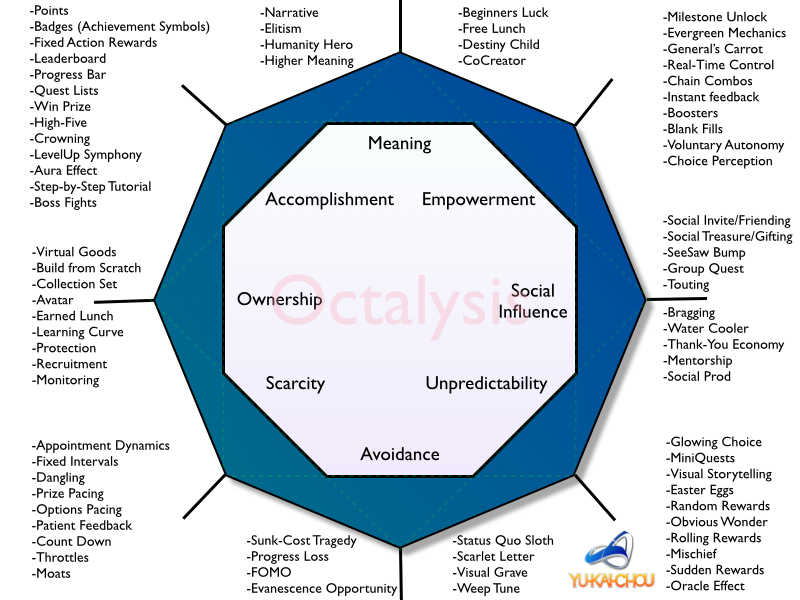
Because of the issues discussed in the last chapter, I spent the past decade working to create a complete framework to analyze and build strategies around the various systems that make games engaging. I saw that almost every successful game appeals to certain Core Drives within us and motivates us towards a variety of decisions and activities. I also noticed that different types of game techniques push us forward differently; some through inspiration and empowerment, some through manipulation and obsession. I drilled down to find what differentiates one type of motivation from another. The end result is a gamification design framework called Octalysis, which derives its name from an octagonal shape with 8 Core Drives representing each side.
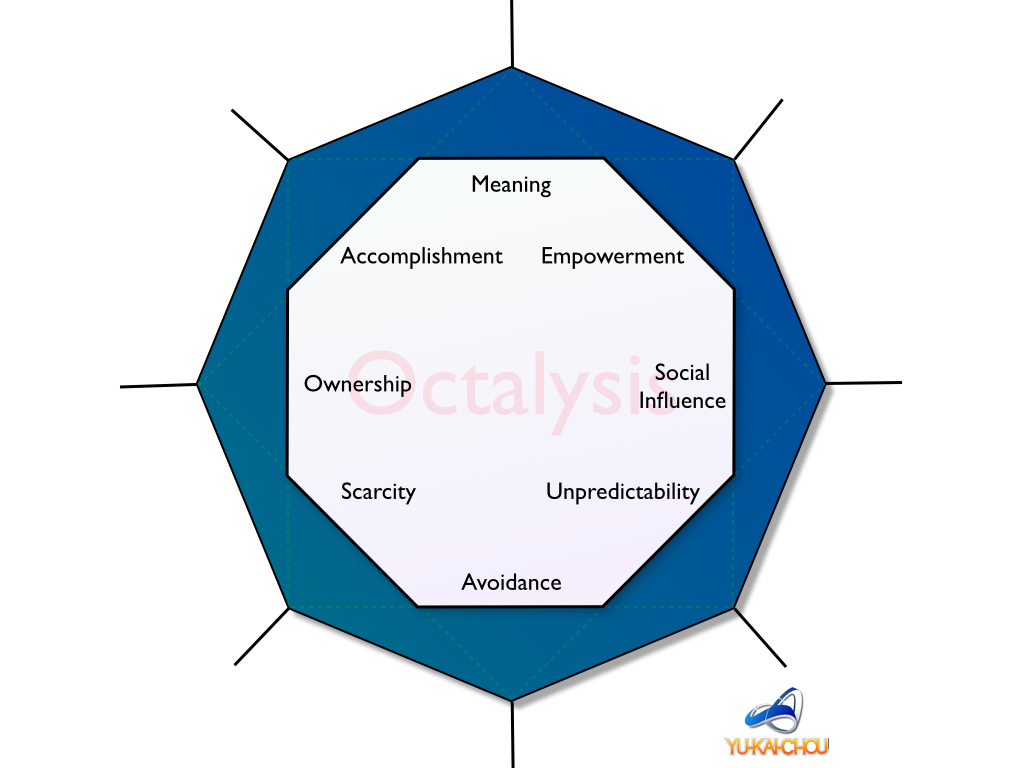
In the past decade, I have been blessed in many more ways than I could anticipate. My lonely passion in gamification became something that various industries paid attention to. I could have easily stumbled upon a passion that remained a desert land throughout my life. Similarly, when I published the Octalysis Framework on my blog YukaiChou.com, it was also extremely well-received by the industry. Many brilliant pieces of work remain unnoticed or unappreciated for most of the creator’s life, let alone a design framework I simply put up on my personal blog. To my delight, within a year the Octalysis Framework was organically translated into over fourteen different languages - I had to stumble upon most of them one at a time. I quickly received many opportunities to speak, teach, and consult globally.
Through many years of experiments and adjustments, I realized that everything we do is based on one or more of the 8 Core Drives within Octalysis. This is important to keep in mind because it also suggests that if there are none of these Core Drives behind a Desired Action, there is no motivation, and no behavior happens.
Let us quickly examine what these 8 Core Drives are.
The 8 Core Drives of Gamification
Core Drive 1: Epic Meaning & Calling
Epic Meaning & Calling is the Core Drive that is in play when a person believes they are doing something greater than themselves and/or were “chosen” to take that action. An example of this is when a player devotes a lot of their time to contribute to projects such as Wikipedia. We are familiar with the fact that people don’t contribute to Wikipedia to make money, but they don’t even do it to pad their resumes. People contribute to Wikipedia because they believe they are protecting humanity’s knowledge – something much bigger than themselves. This also comes into play when someone has “Beginner’s Luck” – an effect where people believe they have some type of gift that others don’t or believe they are “lucky” getting that amazing sword at the very beginning of the game.
Core Drive 2: Development & Accomplishment
Development & Accomplishment is our internal drive for making progress, developing skills, achieving mastery, and eventually overcoming challenges. The word “challenge” here is very important, as a badge or trophy without a challenge is not meaningful at all. This is also the core drive that is the easiest to design for and, coincidentally, is where the majority of the PBLs: points, badges, leaderboards mostly focus on.
Core Drive 3: Empowerment of Creativity & Feedback
Empowerment of Creativity & Feedback is expressed when users are engaged in a creative process where they repeatedly figure new things out and try different combinations. People not only need ways to express their creativity, but they need to see the results of their creativity, receive feedback, and adjust in turn. This is why playing with Legos and making art is intrinsically fun. If these techniques are properly designed and integrated to empower users to be creative, they often become Evergreen Mechanics: where a game designer no longer needs to continuously add additional content to keep the activity fresh and engaging. The brain simply entertains itself.
Core Drive 4: Ownership & Possession
Ownership & Possession is where users are motivated because they feel like they own or control something. When a person feels ownership over something, they innately want to increase and improve what they own. Besides being the major core drive for the desire to accumulate wealth, it deals with many virtual goods or virtual currencies within systems. Also, if a person spends a lot of time customizing their profile or avatar, they automatically feel more ownership towards it also. Finally, this drive is also expressed when the user feels ownership over a process, project, and/or the organization.
Core Drive 5: Social Influence & Relatedness
Social Influence & Relatedness incorporates all the social elements that motivate people, including: mentorship, social acceptance, social feedback, companionship, and even competition and envy. When you see a friend that is amazing at some skill or owns something extraordinary, you become driven to attain the same. This is further expressed in how we naturally draw closer to people, places, or events that we can relate to. If you see a product that reminds you of your childhood, the sense of nostalgia would likely increase the odds of you buying the product.
Core Drive 6: Scarcity & Impatience
Scarcity & Impatience is the Core Drive of wanting something simply because it is extremely rare, exclusive, or immediately unattainable. Many games have Appointment Dynamics or Torture Breaks within them (come back 2 hours later to get your reward) – the fact that people can’t get something right now motivates them to think about it all day long. As a result, they return to the product every chance they get. This drive was well utilized by Facebook when it launched: at first it was just for Harvard students, then it opened up to a few other prestigious schools, and eventually all colleges. When it finally opened up to everyone, many people wanted to join simply because they previously couldn’t get in.
Core Drive 7: Unpredictability & Curiosity
Unpredictability is the Core Drive of constantly being engaged because you don’t know what is going to happen next. When something does not fall into your regular pattern recognition cycles, your brain kicks into high gear and pays attention to the unexpected. This is obviously the primary Core Drive behind gambling addictions, but it is also present in every sweepstake or lottery program that companies run. On a lighter level, many people watch movies or read novels because of this Core Drive. The very controversial Skinner Box experiments, where an animal irrationally presses a lever frequently because of unpredictable results, are exclusively referring to the core drive of Unpredictability & Curiosity - although many have misunderstood it as the driver behind points, badges, and leaderboard mechanics in general.1
Core Drive 8: Loss & Avoidance
This Core Drive should come as no surprise – it’s the motivation to avoid something negative from happening. On a small scale, it could be to avoid losing previous work or changing one’s behavior. On a larger scale, it could be to avoid admitting that everything you did up to this point was useless because you are now quitting. Also, opportunities that are fading away have a strong utilization of this Core Drive, because people feel if they didn’t act immediately, they would lose the opportunity to act forever (e.g. “Special offer for a limited time only!”)
Left Brain (Extrinsic Tendency) vs. Right Brain (Intrinsic Tendency) Drives
I will repeat multiple times in this book that, because everything you do is based on one or more of these 8 Core Drives, when there are none of these 8 Core Drives behind a Desired Action, there is zero motivation and no action takes place. In addition, each of these 8 Core Drives has different natures within them. Some make the user feel powerful, but do not create urgency, while others create urgency, obsession, and even addiction, but make the user feel bad. Some are more short-term extrinsically focused, while some are more long-term intrinsically focused. As a result, these 8 Core Drives are charted on an Octagon not simply for aesthetic purposes, but because the placement determines the nature of the motivation.
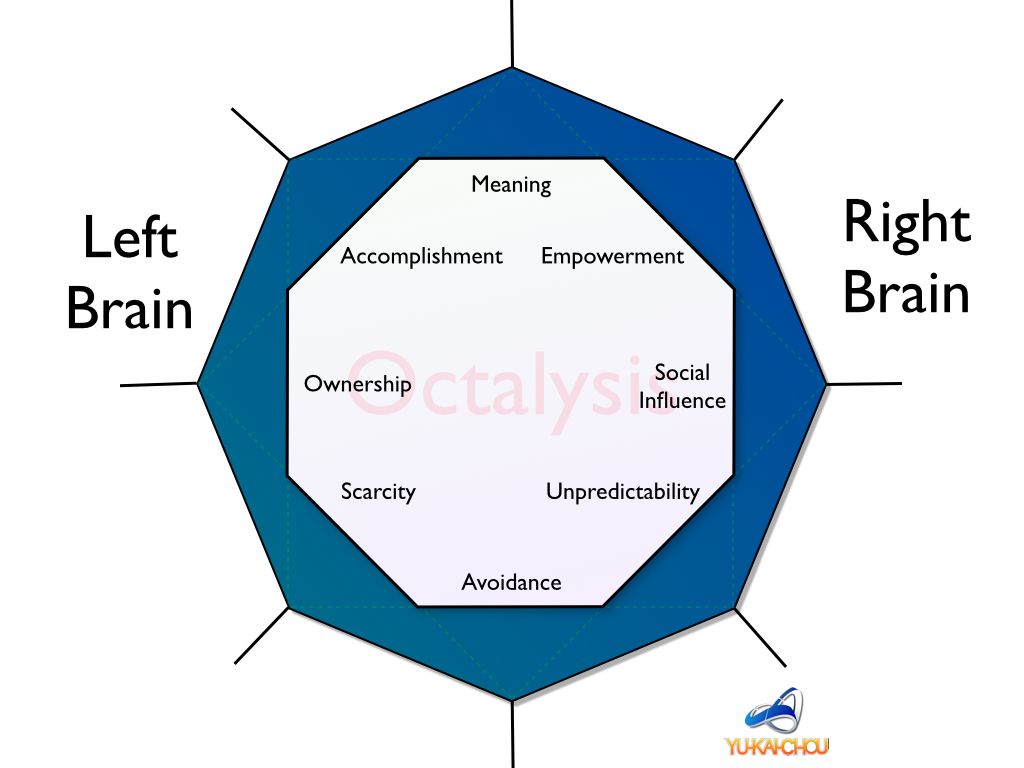
The Octalysis Framework is arranged so that the Core Drives that focus on creativity, self-expression, and social dynamics are organized on the right side of the octagon. In my framework, I call them Right Brain Core Drives. The Core Drives that are most commonly associated with logic, analytical thought, and ownership are graphed on the left side of the Octagon and are termed Left Brain Core Drives.
It is worth noting (especially for the “sciencey” readers who are now shaking their heads) that the Left Brain and Right Brain references are not literal in terms of actual brain geography but merely a symbolic differentiation between two distinct functions of the brain.
Interestingly, Left Brain Core Drives tend to rely on Extrinsic Motivation – you are motivated because you want to obtain something, whether it be a goal, a good, or anything you cannot obtain. On the other hand, Right Brain Core Drives are mostly associated with Intrinsic Motivations – you don’t need a goal or reward to use your creativity, hang out with friends, or feel the suspense of unpredictability – the activity itself is rewarding on its own.
This is important, because many companies emphasize designing for Extrinsic Motivators, such as providing users a reward when they complete a task. However, many studies have shown that extrinsic motivation impairs intrinsic motivation. Why? Because once the companies stop offering the extrinsic motivator, user motivation will often plummet to a level much lower than when the extrinsic motivator was first introduced. We will examine this tendency, termed the overjustification effect, in Chapter 13.
It is much better for companies to design experiences that motivate the Right Brain Core Drives, making something in and of itself fun and rewarding so users can continuously enjoy and engage in the activity. Motivation is often better when it sticks.
White Hat vs Black Hat Gamification
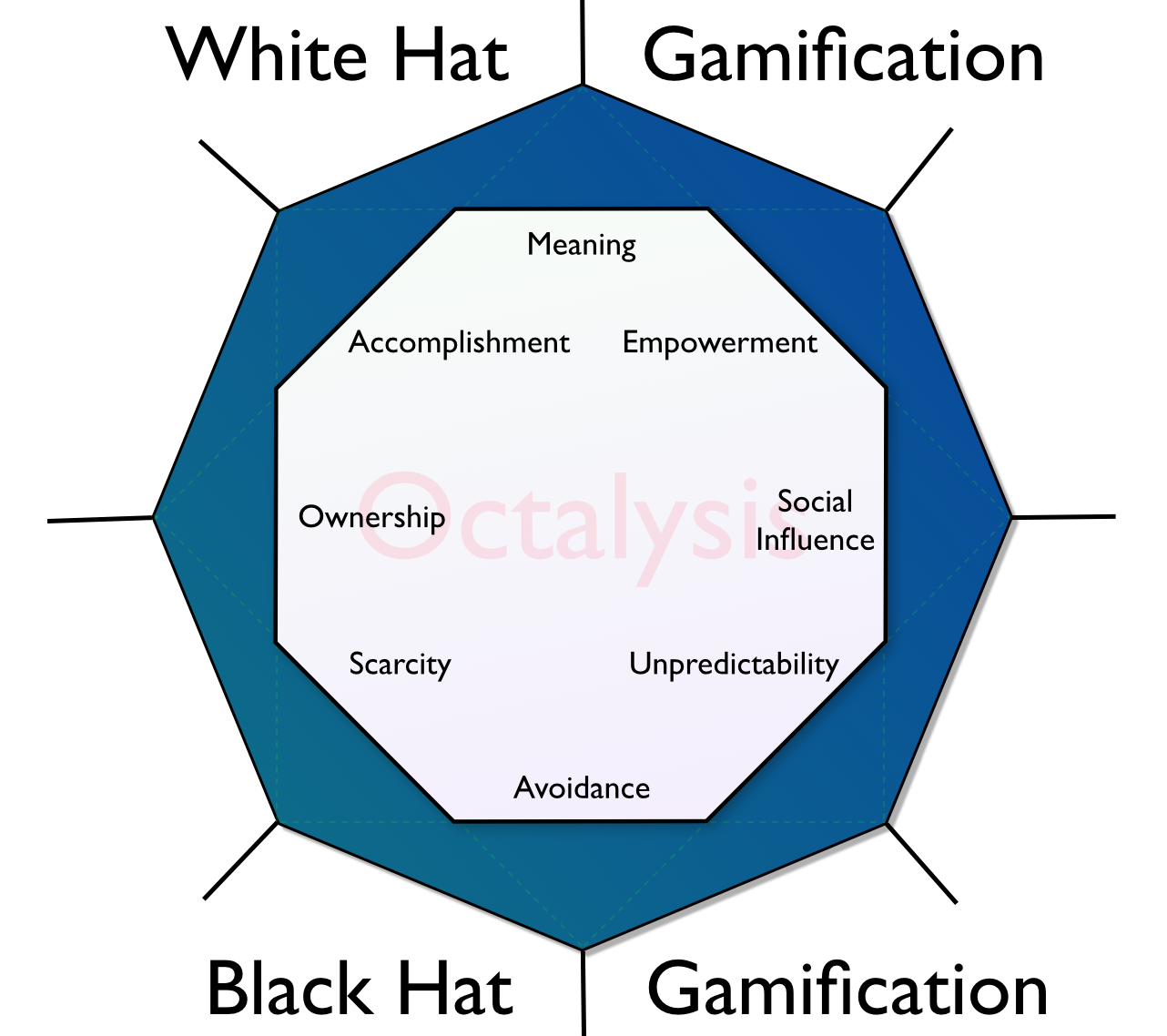
Another factor to note within the Octalysis Framework is that the top Core Drives in the octagon are considered very positive motivations, while the bottom Core Drives are considered to be more negative. I call techniques that heavily use the top Core Drives “White Hat Gamification,” while techniques that utilize the bottom Core Drives are called “Black Hat Gamification.”
If something is engaging because it lets you express your creativity, makes you feel successful through skill mastery, and gives you a higher sense of meaning, it makes you feel very good and powerful. On the other hand, if you are always doing something because you don’t know what will happen next, you are constantly in fear of losing something, or because you’re struggling to attain things you can’t have, the experience will often leave a bad taste in your mouth - even if you are consistently motivated to take these actions.
From an Octalysis perspective, the problem with Zynga games (historically) is that they have been very successful with implementing many Black Hat Game Techniques. Of course, they don’t have the framework to understand it as “black hat,” but they refer to it as “Data Driven Design.”2 Because of the Black Hat Motivation, for a long period of time their games drove great numbers off each user in terms of retention, addiction, and monetization. However, because most Zynga games do not make users feel good when playing, when the user is finally able to wean themselves from the system, they will.
This is similar to the situation with gambling addictions - they don’t feel like they are in control of themselves, and when they quit they actually feel empowered. In recent years, Zynga further validated my theories based on Octalysis by “double-downing” on a suite of gambling games such as the Slot Machine Game Riches of Olympus, which further draws their design methodology away from White Hat Core Drives. 3
It’s important to note that just because something is called Black Hat doesn’t necessarily mean it is bad. These are just motivators and they can also be used for productive and healthy results. Many people voluntarily submit themselves to Black Hat Gamification in order to go to the gym more often, eat healthier, or avoid hitting the snooze button on their alarm clock every morning. We will talk about the ethics and positive Black Hat Gamification Design in Chapter 14.
Based on the Octalysis Framework, a good Gamification practitioner should consider all 8 Core Drives in promoting positive and productive activities so that everyone ends up happier and healthier afterwards.
The Hidden Ninth Core Drive: Sensation
Beyond the 8 Core Drives that will be explored in depth within this book, there is in fact a hidden ninth Core Drive called “Sensation,” which is the physical pleasure one obtains from taking an action. People do drugs, get massages, or have sex (hopefully along with many other Core Drives) because of the sensation Core Drive. If you choose one food over another, it is often merely because one tastes better than the other, which is primarily sensation. The key differentiation here compared to other Core Drives is that sensation deals with physical feelings that bring pleasure to our touch, hearing, sight, smell, and even taste. The other Core Drives bring pleasure to us through psychological means - the meaning and context behind what we see, hear, or taste.
The reason why I don’t have it included in the main set of the framework is that the Octalysis Framework primarily focuses on psychological motivators instead of physical ones. For instance, in most cases I cannot design an interactive experience where the user gets the feeling of physical acceleration while being on a roller coaster. Massages can be designed as rewards or feedback mechanics within the Octalysis Strategy Dashboard (covered in Chapter 16), but the behaviors will usually be motivated through Core Drives such as Scarcity, Accomplishment, and Ownership.
Even though we don’t include sensation as part of the 8 Core Drives of Octalysis, we recognize its presence and understand how certain behaviors are driven by it. However, sensation by itself also has limitations without the 8 Core Drives accompanying it. Even pleasurable activities such as sex, when lacking curiosity, relatedness, creativity, and scarcity, can potentially become rather unappealing.
How to Apply Level 1 Octalysis to Actual Systems
Now that we have the Octalysis Framework laid out, the next step is to determine how to utilize it. Since everything a person does is based on one or more of the Core Drives, generally any engaging product or system will have at least one of the Core Drives listed above. If none of the Core Drives are present within a system, there is no motivation, and users will drop out.
The first application of Octalysis is to use it in analyzing the strengths and weaknesses of various products and experiences with respect to motivation. The key here is to start thinking about how that product or experience utilizes each of the 8 Core Drives, and identify all the game mechanics and techniques that are used to activate them.
A few Gamification examples with Octalysis
Here’s an Octalysis done for a few games and online products:
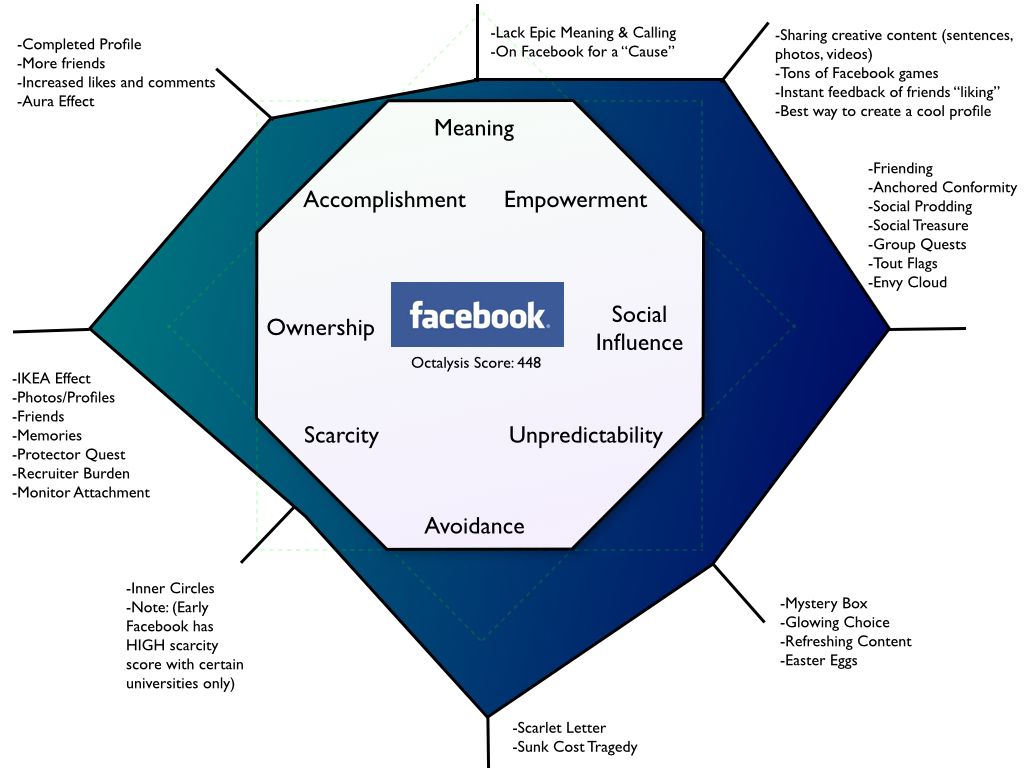
As you can see from the chart, Facebook is very strong in many of the 8 Core Drives, but rather weak on Core Drive 1: Epic Meaning & Calling - there is generally no higher purpose in using Facebook unless you are one of the few who are actively contributing to a cause on Facebook.
It is also weak on Core Drive 6: Scarcity & Impatience, as these days there are very few things that users want to do on Facebook but are barred from doing.
The illustration tells us that Facebook mostly focuses on Right Brain Core Drives, which focus on Intrinsic Motivation. It also trends more into the Black Hat zone, which means that it is more prone to drive obsessive behavior that encourages users to return on a daily basis.
Among the Left Brain Core Drives, we see that people are extrinsically motivated on Facebook, not so much to feel accomplished or gain exclusivity, but because of Core Drive 4: Ownership & Possession - to collect, customize, and improve what is theirs.
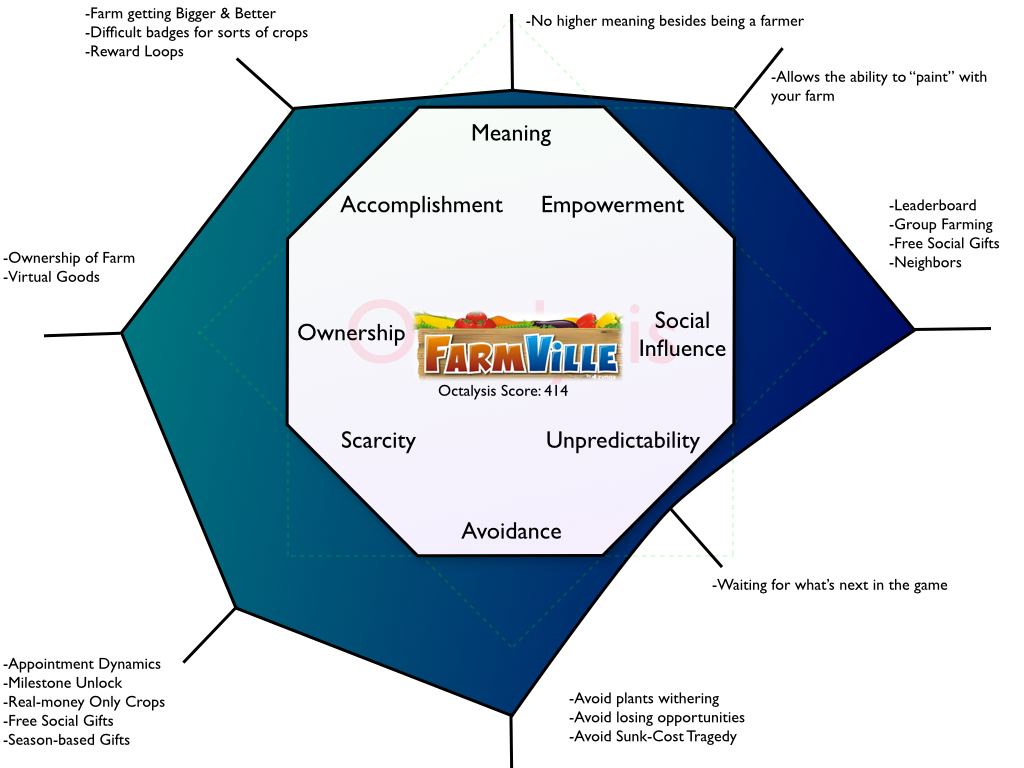
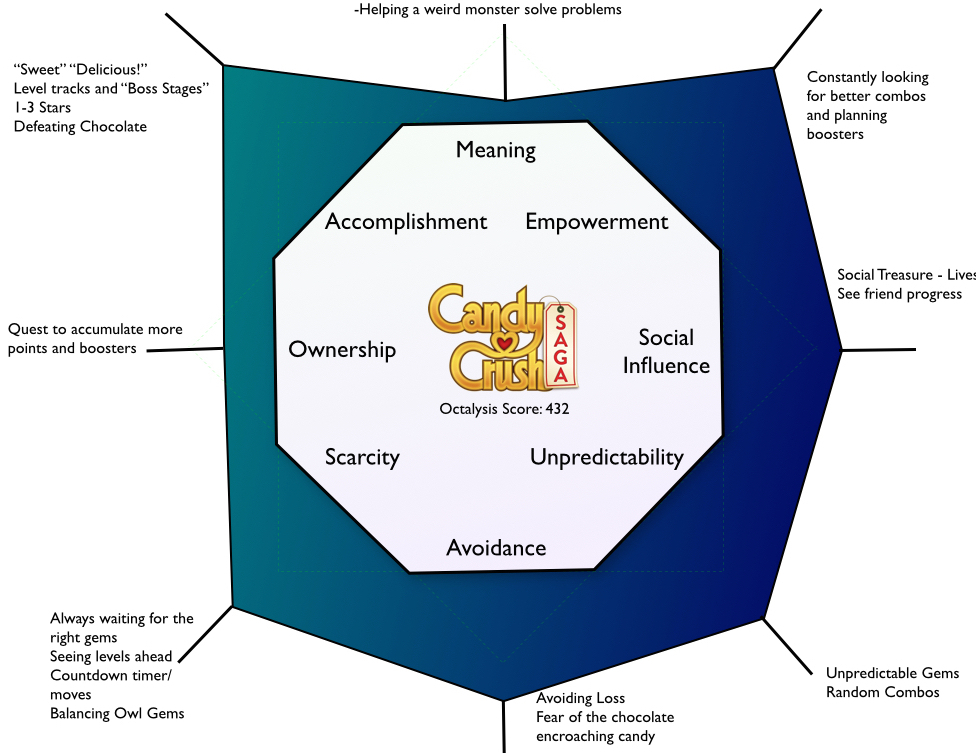
Here we see a couple game examples that contrast against each other.
Like Facebook, Farmville and Candy Crush also lack Core Drive 1: Epic Meaning & Calling within, but Farmville also lacks Core Drive 7: Unpredictability & Curiosity - there are not that many surprises in the game. You go back on Farmville simply to harvest the crops that you planted a few hours earlier. Candy Crush is a little more balanced, but a little skewed towards the Right Brain Core Drives.
Previously, I crafted each Octalysis shape by hand on Keynote. Fortunately, a fan of Octalysis, Ron Bentata from Israel, graciously offered to build an easier Octalysis Tool for everyone.
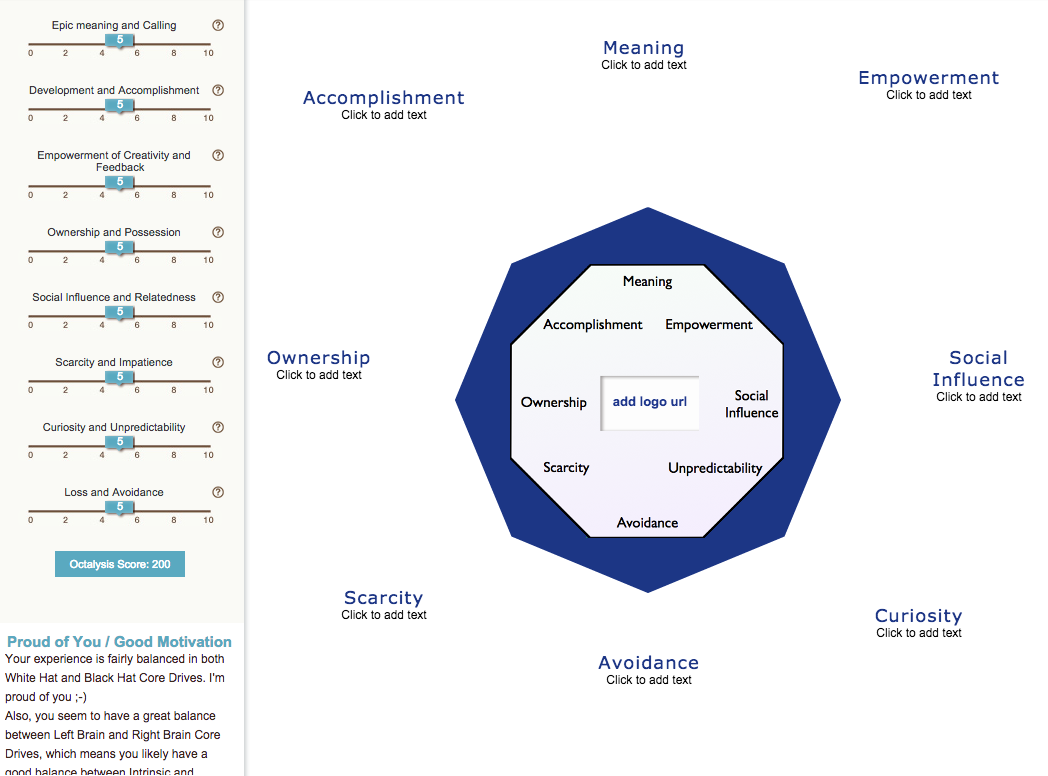
(Accessed from www.yukaichou.com/octalysis-tool)
With the Octalysis Tool, let’s see a few more examples with Octalysis.
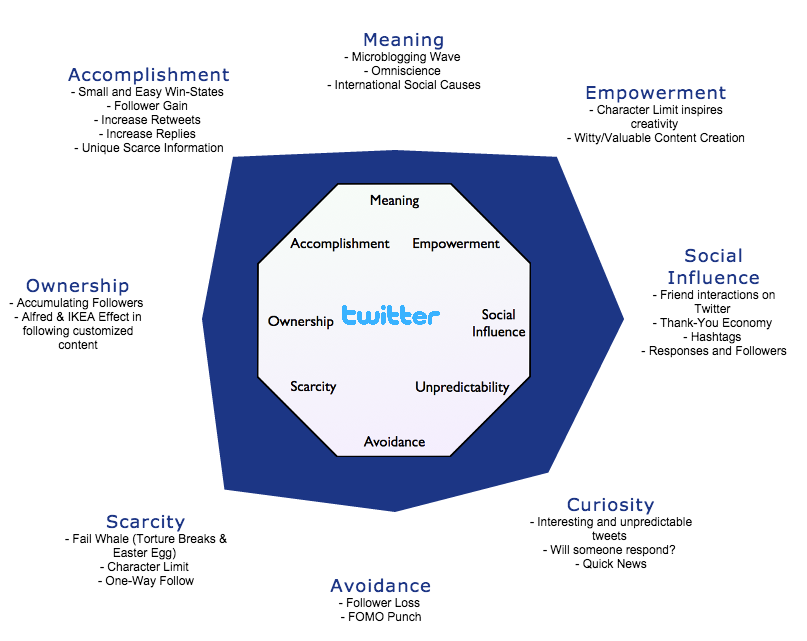
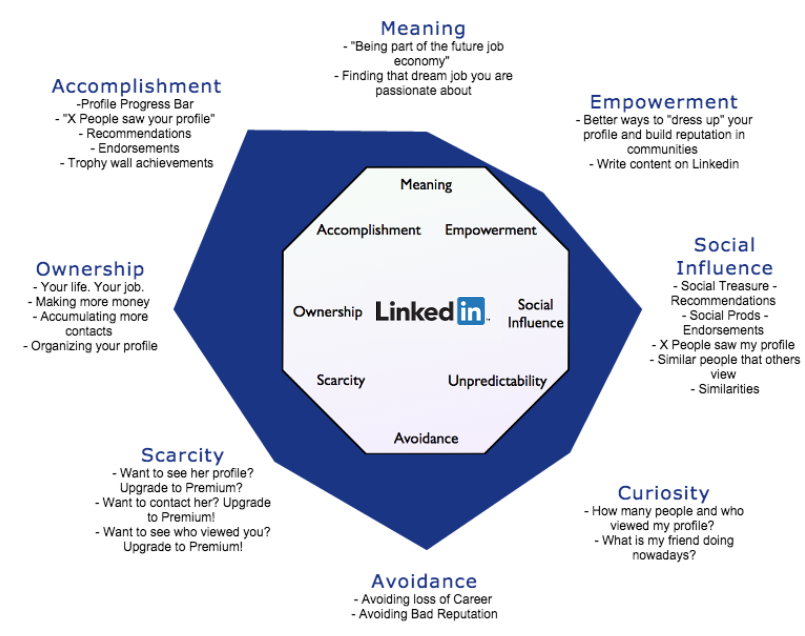
Here we can see that Twitter is also fairly well balanced but skews more towards Right Brain Core Drives. In contrast, LinkedIn is heavily focused on the Left Brain Core Drives, with a White Hat emphasis. This makes sense, because LinkedIn is all about your career, your life, your accomplishment. Those are very extrinsic goals, and as a result, everyone feels like they need to have a LinkedIn Account. However, because it lacks Right Brain (intrinsic tendency) Core Drives, there’s not a lot of enjoyable activities on LinkedIn. And this has been the challenge that they have been faced with for many years. Users create their profiles, and then there is nothing left to do on LinkedIn. The account just sits there.
In the past couple of years, LinkedIn has been working very hard to increase engagement on the site, especially on Core Drive 5: Social Influence & Relatedness through Game Techniques such as Social Prods and Social Treasures - we will talk about how LinkedIn uses these Game Techniques in Chapter 9. However, through the Octalysis Framework we can see that LinkedIn could benefit massively if they put more effort into Core Drive 3: Empowerment of Creativity & Feedback, as well as Core Drive 7: Unpredictability & Curiosity.
Quick Intro to Level II Octalysis and Beyond
Ten years of Gamification study and implementations result in a fairly robust framework that can become actionable towards driving better motivation and metrics. As you can see, creating a rich gamified experience is much more than simply slapping on various game-mechanics to existing products. It is a craft that requires a nontrivial amount of analysis, thinking, testing, and adjusting.
As you become more and more advanced in Octalysis beyond the contents of this book, you will start to learn the higher levels of Octalysis design. (Up to five levels. There are only a handful of people in the world who know what is Level IV and above). These advanced levels incorporate much more sophisticated design principles and in-depth analysis.
Once one has achieved mastery in Level I Octalysis, they can then apply it to Level II Octalysis, where we try to optimize experiences throughout all four phases of the player/user journey. These phases are: Discovery (why people would even want to try out the experience), Onboarding (where users learn the rules and tools to play the game), Scaffolding (the regular journey of repeated actions towards a goal) and Endgame (how do you retain your veterans).
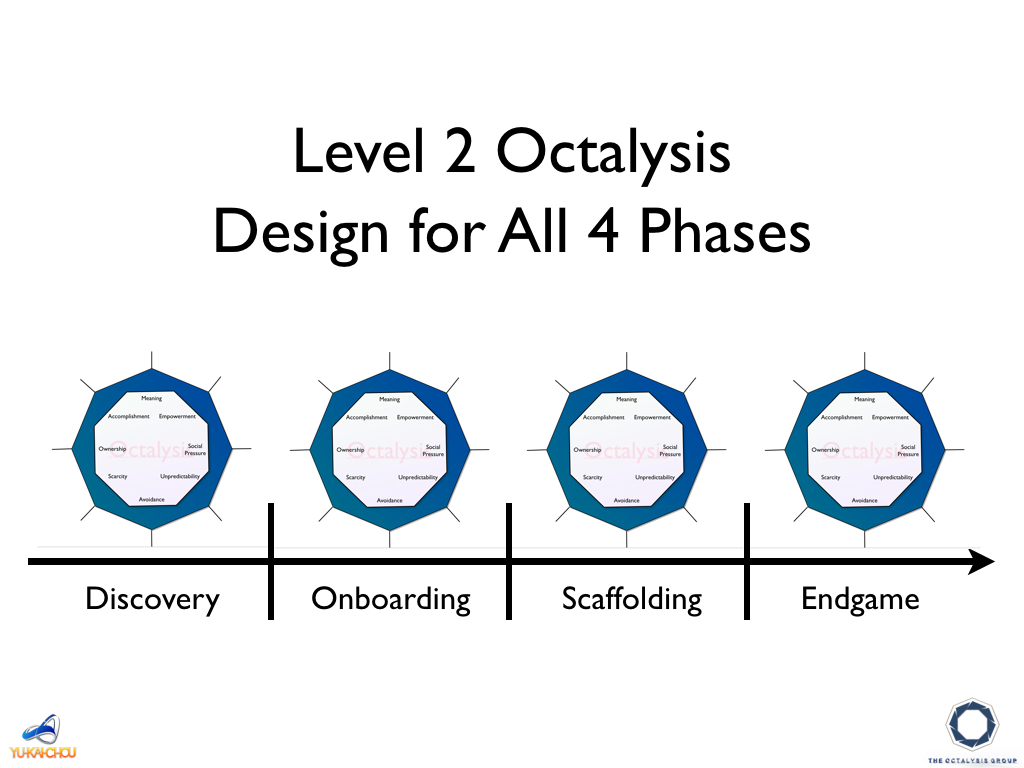
Most people treat their product as one experience, which seems reasonable. But in terms of motivation, I believe this is a mistake because the reason you are using a product on Day 1 is often very different from that of Day 100. Since everything you do is because of one of these 8 Core Drives (besides the 9th hidden Core Drive - Sensation), if at any phase none of the 8 Core Drives are present, there is no reason for the user to move on to the next phase, and the user simply drops out.
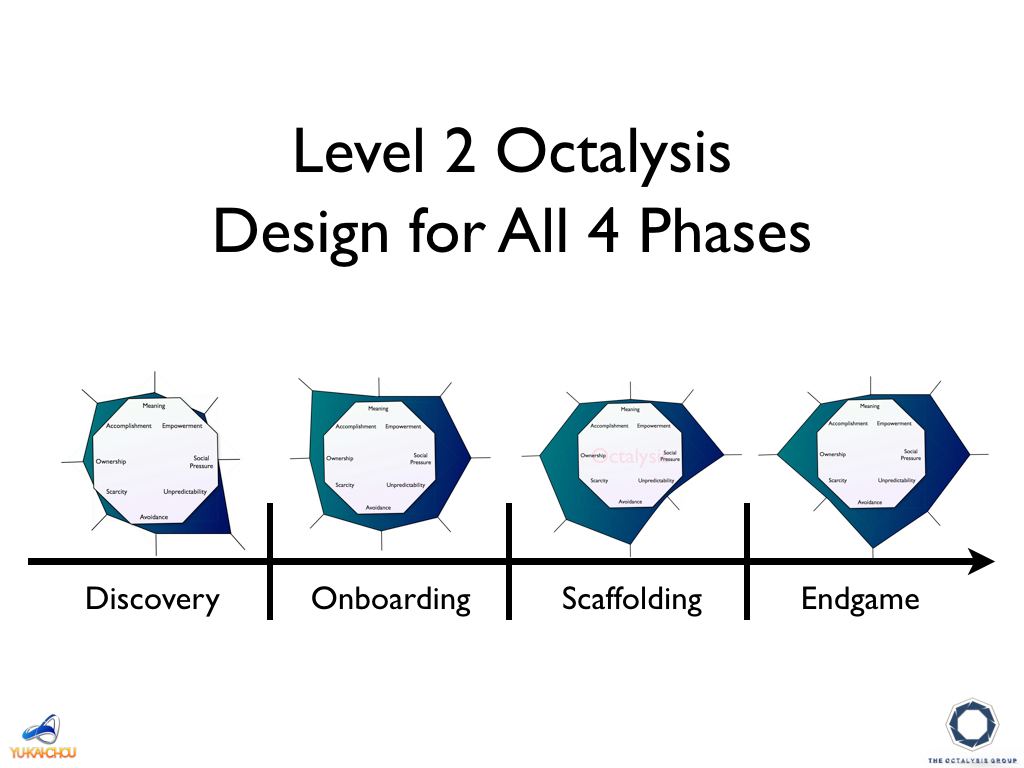
In the above illustration, you can evaluate how different Core Drives are more prominent during each Experience Phase of the player’s journey - whether it would be unpredictability, accomplishment, or social influence. For instance, most people Discover a product because of Core Drive 7: Unpredictability & Curiosity – they read about it on the news or hear others talking about it.
During Onboarding, they might be motivated by Core Drive 2: Development & Accomplishment – feeling smart and competent during the early stages. During the Scaffolding Phase, they might be motivated because of the social dynamic (Core Drive 5) as well as trying to go after the goal they could not reach yet (Core Drive 6: Scarcity & Impatience). In the Endgame, they might continue to be engaged because they don’t want to lose their status and achievements (Core Drive 8: Loss & Avoidance).
How you design for all four Experience Phases through the 8 Core Drives will strongly demonstrate your ability as an Octalysis Gamification Designer. Of course, never forget to design for the proper nature of the Core Drives, understanding when you want to have more Black Hat, when to have more White Hat, and when to use Extrinsic/Intrinsic motivators.
Once you have mastered Level II Octalysis, you can then push on to Level III and factor in the different player types. This will allow you to see how different types of people are motivated at different stages of the experience.
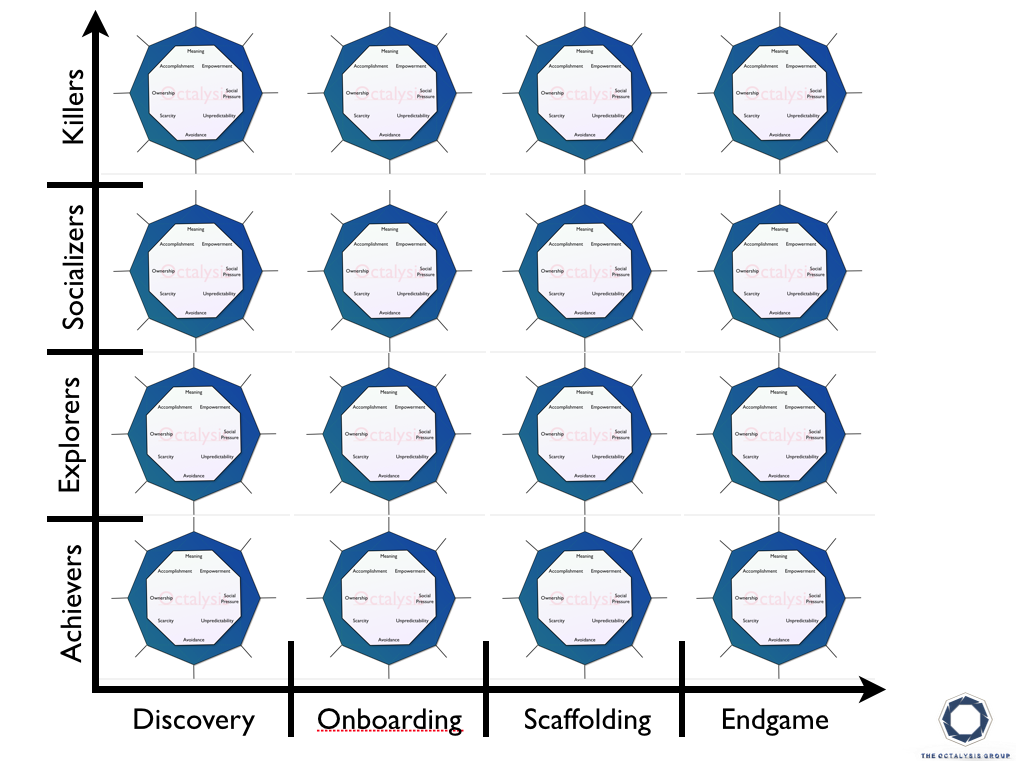
In the above diagram, I applied Richard Bartle’s Four Player Types (Achievers, Socializers, Explorers, and Killers) to Level III Octalysis primarily because it is the most recognized model in game design. However, Level III Octalysis does not need to use Bartle’s Player Types4. In fact, Richard Bartle himself claims that his Four Player Types may not be suitable for gamification environments5. It could be Sales vs. Marketing Staff, Male vs. Female, Loyal Customers vs. Nonchalant Customers vs. New Customers etc. The point here is that different types of people are motivated differently, so Level III Octalysis allows the designer to understand and design for how everyone is feeling at different stages. We will also examine Richard Bartle’s Four Player Types with Octalysis in Chapter 15.
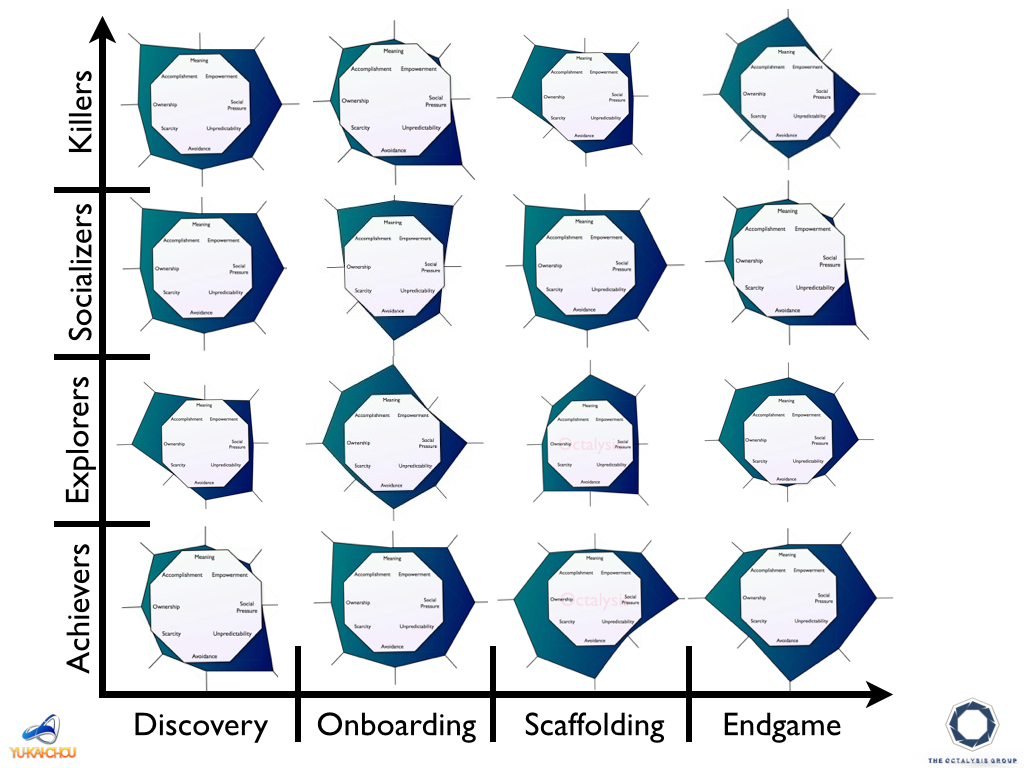
It is incredibly difficult to design something that pleases everyone. But with this framework, you can start to identify where the weaknesses are within your system and work on improving for motivation at various points. Once you become familiar with Level III Octalysis, you can almost feel how motivation moves within your system and recognize where motivation is lacking or whether there is too much Black Hat or Extrinsic Motivation in the system.
For instance, through Level III Octalysis, one can reach conclusions such as, “Looks like the Achievers start the experience in Discovery well, Onboarding is fine, but in Scaffolding they lose motivation and drop out. The Explorers will try out the product because of Core Drive 7: Unpredictability & Curiosity, but during Onboarding they feel confused and would leave. Socializers wouldn’t even try out the experience because there is no Core Drive 5: Social Influence & Relatedness advertised in the product. Finally, the Killers seem to be the ones in this case to stay through Discovery, Onboarding, Scaffolding, and Endgame - possibly showing off to the new players.”
While there are five levels of Octalysis in total, Level I is often sufficient for the majority of companies seeking to understand why their products are not engaging their users. Higher-level Octalysis processes are useful for organizations that are truly committed to making sure that they push their metrics in the right direction and improve the longevity of a gamified system. Many games are only popular for three to eight months, but ones that have impeccable Endgame design can last over decades — or even centuries.
This book will be about examining the 8 Core Drives, how to design for them, and how they all come together to create a phenomenal experience for any user. If the above does not interest you so far, it is safe for you to put the book down and do better things with your time. But if the above excites you and you choose to go on, I promise you there will be an exhilarating journey of discovery, empowerment and awakening ahead. I’m even feeling excited just thinking about it.
To get the most out of the book, Choose only ONE of the below options to do right now:
Easy: Think of a game that you have enjoyed playing for a very long time. Can you identify which of the 8 Core Drives are present in the game?
Medium: Think about why you are reading this book. What Core Drives have motivated you to read this book over other activities?
Share what you come up with on Twitter or your preferred social network with the hashtag #OctalysisBook and see what ideas other people have.