Fifth Generation Time Management
There are many names we’ve tried to come up with for what’s in this book and the field or industry we practice in the real world. Time Management, Self Management, Stress Management, Productivity, Life Management, Project Management, Risk Management, Communication Management, Agile Software Development, Change Management, and so on. Each one has its nuance, positive and negative connotations, and proposed boundaries set by those who practice them.
For example, some say Agile Software Development should only apply to software, while others say the opposite. Most fields and industries have jokes about themselves. Some jokes were written by those practicing in the field.
One of the more popular jokes from the self-improvement field comes from poking fun at Time Management. They all start something like this: “Calling it Time Management is ridiculous. You can’t manage time, you can only manage…” actions, yourself, life, and so on. Calling the skill, practice, or profession “time management” is like saying you’re going to learn how to manage the universe; entirely beyond your influence and too big for your (or my) brain.
All fields have their heroes and heroines. Their contributions are downplayed and overplayed depending on who you talk with. The same is true for Time-self-stress-life-whatever Management.
As we seek differentiation, we tend to rename things. Either to differentiate “our thing” from “their thing” or to get away from a label that has gone sour, “Oh, it’s not Project Management, it’s Agile Software Development” or vice versa.
Stephen Covey is one such “hero” and the author of The 7 Habits of Highly Effective People. When people in the Time Management field reference Covey, the Time Management Matrix is often brought up as his seminal contribution to the field of self-management. I disagree. In fact, I barely recall or credit Covey with the Time Management Matrix at all, if for no other reason than it is one idea in one chapter of a much larger work and body of work. The Time Management Matrix is laid out when Covey describes the four generations of time management.
In short, the first generation is getting what’s in your head into the world in the form of notes and checklists (to-do lists). Second generation becomes future-oriented with calendars and appointment books. Third generation introduces the concept of values (personal or collective) and prioritizing based on those values along with short-, medium-, and long-term goals and daily planning to the achievement of those goals. Fourth generation focuses on maintaining production and production capability by way of interpersonal relationships and results-orientation with a further emphasis on being principle-based and character-centered. Each generation adds to the previous more than it abandons or replaces things.
In the case of time management, Covey’s work is focused on the fourth generation using what he called the Time Management Matrix to describe the point behind a planning method. You want to spend most of your time in Quadrant II in order to become what he called a Quadrant II Self-Manager.
What does that mean?
Imagine a chart where the X-axis represents urgency and the Y-axis represents importance. If divided in fourths you end up with four quadrants, important and urgent, important and not-urgent, not-important and urgent, and not-important and not-urgent. Quadrant II is the top right corner, and contains things that are important and will rarely, if ever, become urgent; namely reflecting on and building character does not help you while your house is on fire with you in it.
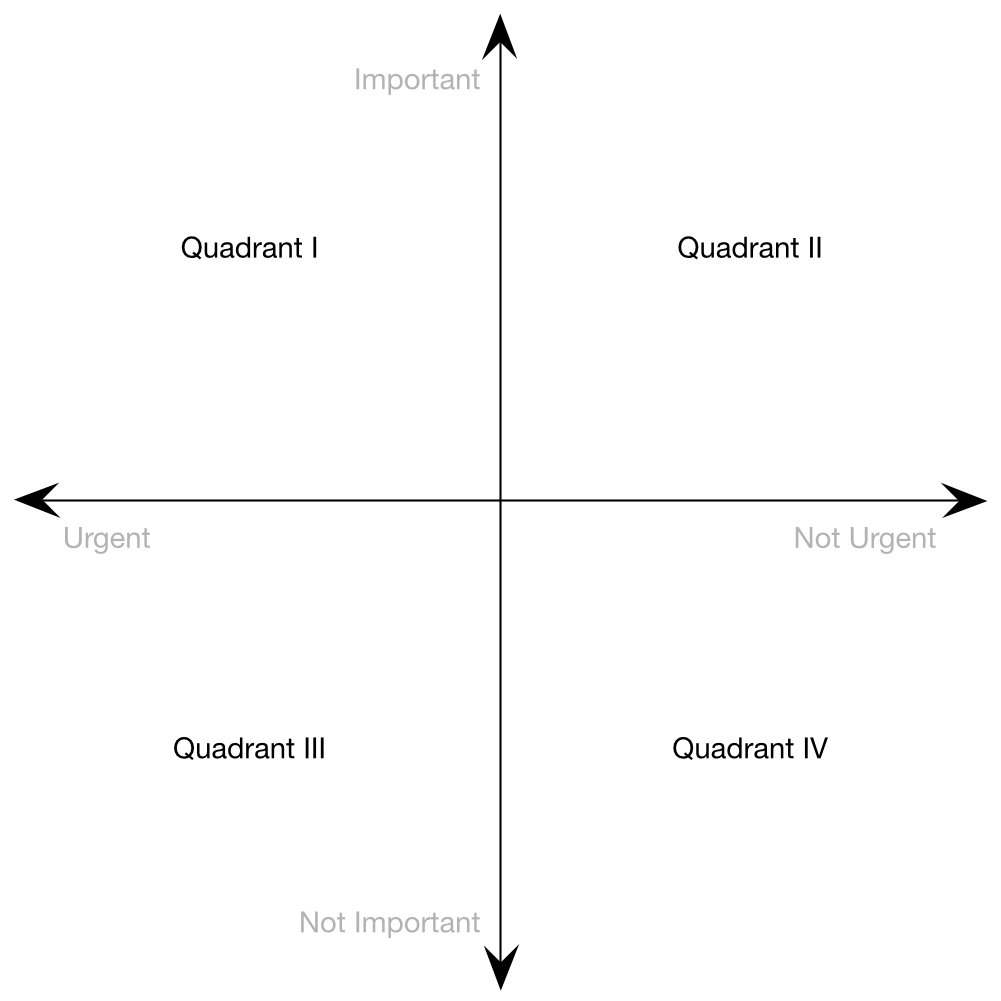
Spending most of your time in important and urgent or Quadrant I, can burn you out. Spending most of your time in not-important and urgent or not-important and not-urgent, Quadrants III and IV, may end up with you becoming irresponsible. Spending most of your time in important and not-urgent, Quadrant II, is where discipline and balance are achieved, according to Covey.
Some have interpreted this matrix as a way to manage your to-do list; if the item is important and due soon, put it in Quadrant I and do it. Once Quadrant I is clear, start working on Quadrant II things so they never become urgent. This is not a bad idea; however, it is not related to Covey’s work directly, in my opinion.
When The Time Management Matrix is attributed to Covey, it is often related to this to-do list management method. However, Covey recommends leveraging calendars based on vision, roles, and goals to “put first things first” not the time management matrix.
Using the matrix as a to-do list management tool is more like what’s been called the Eisenhower Box.
The Eisenhower Box was definitely named after President Eisenhower and possibly used by him to make some decisions, though the jury’s still out. Quadrant I is fire fighting; do the thing. Quadrant II is for things like long-term strategic planning or getting down to the gym; schedule the thing, which does tie to Covey, indirectly. Quadrant III is mostly meetings; delegate the thing. Quadrant IV are time wasters and most leisure activities; delete the thing.
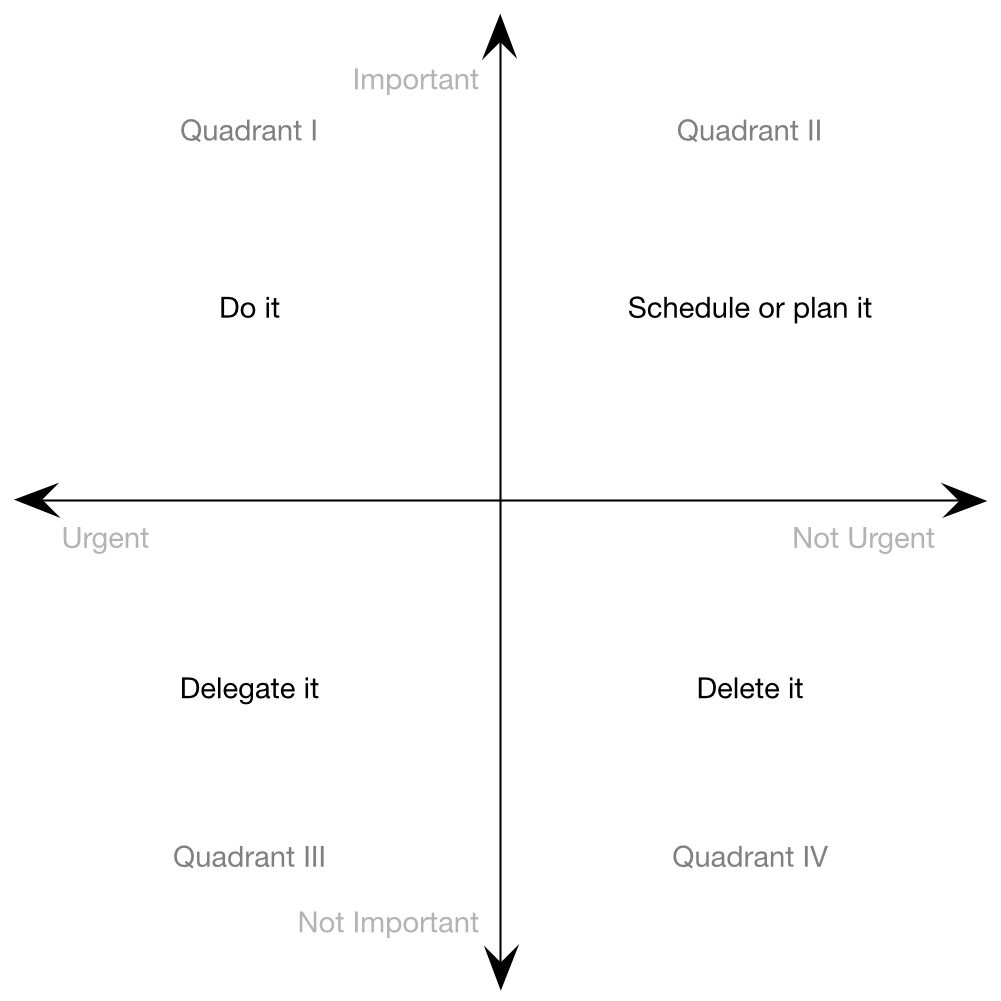
There’s debate on the origins of the Eisenhower Box. Did Eisenhower invent it? Was it derived from a quote of his? Did he use it? That sort of thing.
Regardless, I don’t see The Time Management Matrix and The Eisenhower Box described to the same purpose in the same sources. Further, given the prescriptive nature of The Eisenhower Box and Covey’s own words, I see them as using the same model in two different ways.
If you’ve heard the allegory of the jar with the rocks, pebbles, and sand, fourth generation thinking is where that comes from. It’s easy to tell we’re still coming to grips with the fourth generation, given the explanation I felt was necessary, which is fine.
I also think we’re coming to recognize a fifth generation, which is focused on agility, flow, purpose, and, by extension, mindfulness.
Triumph over Time hopes to help usher in the fifth generation without emphasizing a specific approach or vantage, which is in keeping with the fifth generation itself. I will use comparison to describe what I mean by not emphasizing an approach or vantage.
In personal productivity, I have found three popular resources, relatively speaking, that can get you very close to a fifth generation system. The 7 Habits of Highly Effective People by Stephen Covey, Getting Things Done by David Allen, and The Pomodoro Technique® by Francesco Cirillo. Each one takes a specific approach and vantage.
Imagine a mapping application. When zoomed out completely, you are at the highest level. You have a vantage with great breadth but little depth and detail. Now imagine looking at an image of the street view little breadth but great depth and detail. Transferring to the forest metaphor, the highest level is the territory or region, and the street view is the undergrowth on the forest floor.
The 7 Habits of Highly Effective People takes a region-first approach and can get you to the forest and some of the trees. Getting Things Done takes a trees-first approach and can get you to the undergrowth with little knowledge of the forest whatsoever. The Pomodoro Technique® takes an undergrowth-first approach (or walking down a street by way of the street view images).
The first focuses on values, principles, and people. The second focuses on processes, tools, and “being like water” (agility and flow). The third focuses on becoming focused (flow and mindfulness).
They all have parts of the others. In some cases, it may only be one sentence. Further, each is geared toward, though not necessarily made specifically for, different types of thinkers. If you tend to be what we call a strategic thinker, the top-down approach of Covey might be your preference. If you’re what we call a tactical thinker, the bottom-up approach of Allen might be more your thing. If you’re extremely detail-oriented, find your focus failing, or have issues with interruptions or distractions, The Pomodoro Technique® might be the best place to start. If you are, or want to be, someone who can transfer up, down, and side-to-side with ease, at-will, and with purpose, you might prefer Triumph over Time’s similar depth across the entire breadth approach.