Strategy
Influencers of Strategy
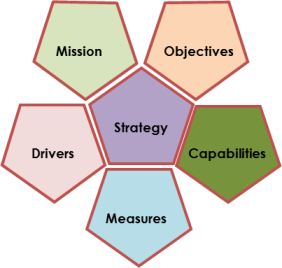
Business Strategy and its consequent business objectives are shaped by a series of influencers, none of which should be ignored.
At the very highest level the Mission Statement of the business should at the very least set its direction. The Drivers, whether originating from perhaps competitive pressures of from legislative requirements, provides a means by which some prioritisation can be derived.
The Measures establish a quantitative basis from which relative success or failure of any strategic outcomes can be assessed whilst Capabilities describe what the business is either able or needs to be able to deliver.
The combination of understanding where the business is ultimately headed, what is important and on what time horizons, what the business is actually able to do coupled with a quantitative measure of what defines success enables a foundation from which a business strategy and specific objectives can be built.
Business Capability – a key to success.
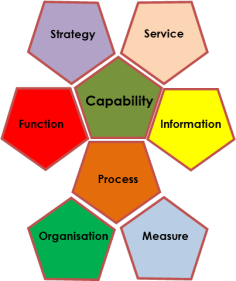
Central to the success of a business are the capabilities that it has available through which it can deliver on its defined strategy.
Individual capabilities can exist at various levels of maturity and whilst they may be being used the question always needs to be asked : Are they as effective as they should be?
An athlete for example may be quite capable of running and completing a marathon but are they capable of winning a race?
The ability to be able to successfully deliver products and services to the customer base of a business is tied up with the maturity of its capabilities.
Establishing and understanding the relationship between each business capability and
- the strategy it supports;
- dependent products and Services;
- its information requirements;
- delivered business functions and
- supporting business processes
as well as a setting a benchmark against which it should be measured provides a structure through which the maturity and hence the success of the business can be improved.
Capability Maturity Cycle
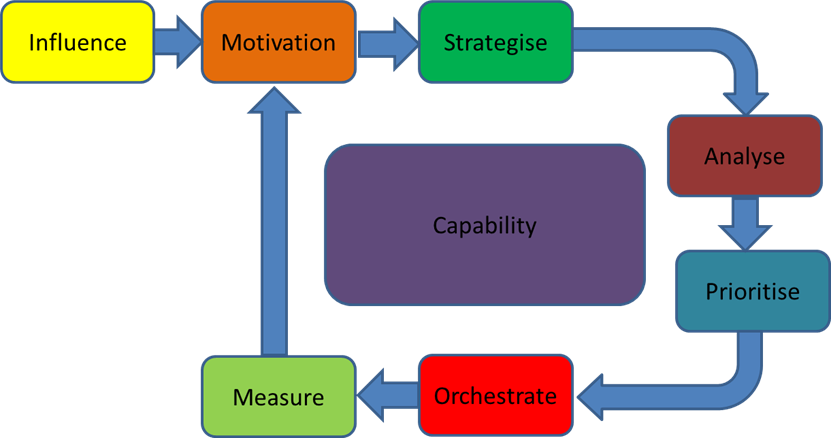
The ability to deliver effective capabilities is at the heart of any successful business.
Capabilities do not come into being perfectly formed but tend to mature as the perceived need for them becomes more apparent.
Driven by both external and internal influences the motivation to establish and mature a capability arises from the relative benefits it brings to the business. Usually competing with other capabilities for the development dollar understanding how and when it can provide value assists in the prioritisation process for having the capability either realised or improved.
Once built or modified then subsequently utilised measuring the effectiveness of the capability to deliver provides the required feedback to the maturation cycle.
Achieving Business Balance
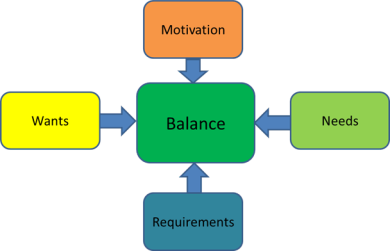
Operating a business successfully entails the constant maintenance of a balancing act between competing influences.
Establishing and subsequently maintaining the alignment with a defined business strategy requires a real understanding of the difference between what is wanted and what is actually needed.
Understanding the motivations driving wants as compared to the requirements driving needs provides a means to moderate the aspirations defined within a business vision with that of the reality as affected by either the capability to deliver or financial considerations.
Before making any decision affecting the business ask the questions:
- Why should this be done?
- What is the expected outcome?
- In making the decision will the business be positioned to be in a better place?
Questioning decisions before being made is one way of maintaining balance.
Business Stressors
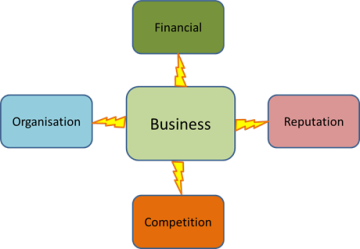
All businesses regardless of whether they are large or small are subject to a variety of business stressors. How the business ultimately responds to these will have significant impact on how the they will perform.
Financial stressors will affect how and what they business is able to invest in its future. The ability to either access funds to grow the business or the need to conserve what funds are available affect the ability to both innovate and execute.
The good reputation of a business is something that is essential to be preserved. How the business is perceived in the market will affect the types of activities that should be undertaken. For instance, if the business is seen as an innovator then it is expected that innovation will continue to flow. Alternatively if the business is seen as providing exemplary service then standards must be maintained. The good reputation of a business is something that may take ages to establish. It certainly does not take long to lose.
Competition is a stressor that can be quite healthy. That other businesses may be offering products and services in competition to your own can provide the impetus to either differentiate with the view of winning additional market share or to consolidate and accept the status quo. This second option is the riskier as of course the competitor may elect themselves to differentiate and steal your market.
Organisational stressors, depending how they are expressed can be either extremely positive or quite destructive. Internal power politics, where the achieving of personal agendas becomes more important than those of the business, can lead to business failure. Healthy discussion arising from differences of opinion can however lead to significant business improvement.
That stressors exist within a business must be recognised. Every identified stressor must have some corresponding ongoing activity as without responding to them through either mitigation or management the business could ultimately fail. Managed appropriately a business can prosper.
Differentiating wants and needs.
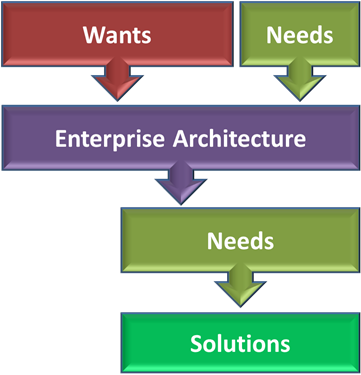
A Business will often decide that they ‘need’ to undertake certain activities so as to solve particular problems that they perceive themselves as having. Once these activities have been completed and the ‘problems’ solved the business expects to reap the benefits of a job well done. This is all well and good in theory but does tend to fall down in practice. The issue tends to be in differentiating between wants and needs. What may seem like a ‘good idea at the time’ and may have been very well executed might not, in fact, deliver the business the benefits it expects. Perceiving a problem existing does not necessarily imply that it does.
Deciding that a particular solution is appropriate does not mean that it is. Without sufficient and accurate information available to them, a decision maker does as good a job as they are able. Without better information they may ‘want’ to believe that a problem exists and also ‘want’ the identified solution to be the correct one. How often has a business been influenced, for example, by a software vendor in making their pitch that the only realistic solution to a problem (which the vendor has defined) is their solution. The vendor is out to convince the business that they also have the problem and the vendor’s solution will be their ‘saviour’. Perhaps the business does have the problem suggested.
An Enterprise Architecture provides a tool against which the business can assess the reality of the problem existing and the impact it is having if it does exist. The nature of the impact can define whether the ‘problem’ needs to be resolved. If a problem does in fact exist and is deemed necessary to resolve a business can explore the available options. A particular vendor solution might be appropriate, then again it might not.
An Enterprise Architecture can provide insight into what is ‘needed’ to solve a problem and optionally allow what is ‘wanted’ but not ‘needed’ to be discarded, consequently better defining the scope of what needs to be undertaken. Focussing on the needs rather than the ‘wants’ provides for a more concise solution, delivering the benefits that are required and potentially eliminating extraneous cost and effort from the equation.
Transitioning from Goals to Outcomes and Capabilities to Services
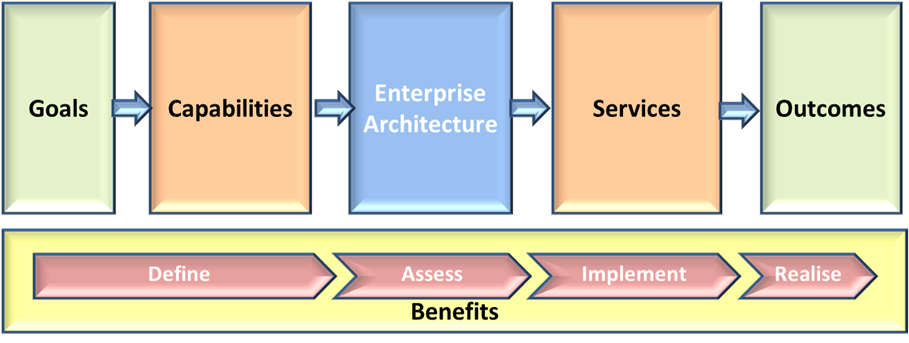
To succeed, a business needs to transition its goals into beneficial outcomes. Goals, in being realised, need to be supported by business capability which describes what a business is able to do and services which leverage combined capabilities to define something tangible that can be consumed by either internal or external customers.
Whilst capabilities define the ‘what’ and have an internal focus, services define the ‘what and how’ and are more externalised. Customers of a businesses are directly interested in what services the business offers not necessarily what it is capable of doing. Customers may be intimately interested in how well the services are executed as they are personally affected. Services should be defined that progress the goals of the business but should also play to the business capabilities.
A service that does not progress business goals should be questioned as to its existence. A service poorly executed, through not having the business not having the capability to deliver, will not be received well by its consumers. An Enterprise Architecture can be pivotal to establishing services that progress the goals of the business. With the ability to determine the capabilities required to support the deliver business goals the Enterprise Architecture can assist in highlighting what areas of the business need maturing.
An Enterprise Architecture can also provide information to support the assessment of services that should be either developed or changed. Keeping business value clearly in sight services can be constructed from existing, new or improved capability that provide the greatest benefit. An Enterprise Architecture provides a business with a tool that assists in defining:
- What capabilities are required?
- What Services provide the best value?
- What benefit each service is expected to render to the business and
- What benefits are ultimately realised?
Successfully transitioning from business goals through capability development to service delivery provides business outcomes that provides the expected realisation of business benefits.
It is not an overhead
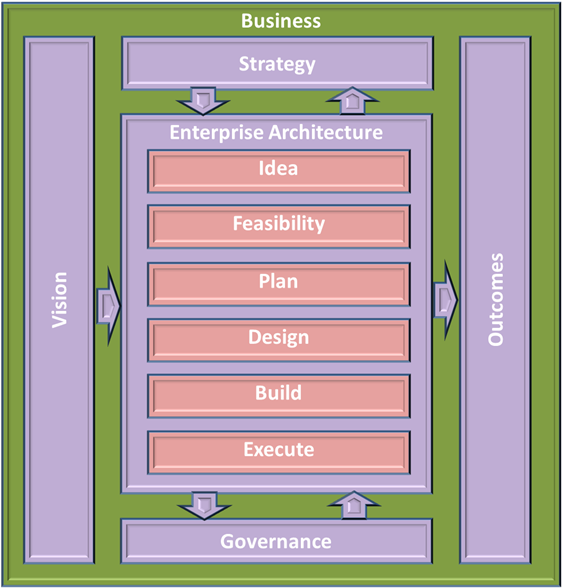
Many members of a business community with access to an Enterprise Architecture see it as an overhead that ‘gets in the way’ of them ‘doing their job. As an overhead it is seen as something apart from their ‘Business As Usual’ activities offering a distraction rather value and thus is a liability. The purpose of an Enterprise Architecture within a business is to provide a governed mechanism through which business vision and strategy is able to be translated into effective enterprise change. This is accomplished by creating, communicating and improving the key requirements, principles and models that describe the desired future state of the business and supporting the transition to that goal. Enterprise Architecture is consequently not an overhead but integral to business success. Taking an idea from initiation through to execution for example it can be seen that an Enterprise Architecture is integral to each stage in its development.
- Idea: Does it progress the business vision and strategy?
- Feasibility: Is it doable, what are the benefits and should it be done?
- Plan: When should it be done and how?
- Design: What standards and principles are applicable?
- Build: Does what is being built match what is required?
- Execute: Does the outcome deliver the identified benefits?
An Enterprise Architecture is consequently not a thing apart but is embedded into the very fabric of the business. By providing appropriate information when required it ensures that:
- No unnecessary activity takes place.
- Duplication and waste is minimised.
- Resources are conserved.
- Decisions on prioritisation are more efficient.
- Scope and planning of projects emerging from idea generation is managed.
- Change is effective.
An Enterprise Architecture should not be seen as an overhead but an asset with which the business will derive significant benefit.