Business Change
Drivers of Change
Just what is the driver for change within a business?
So often we see change for change’s sake. Perhaps a business decision maker says “ We must have one of those because our competitor has one”. Whether it is a good idea or not is not necessarily considered. The perception that it is a good idea holds sway.
Similarly change is often driven by an unreasoned need that the business should have the biggest and the best and of course with all bells and whistles. The perception here is the users of the new system will appreciate what is provided. This perception needs to be tested.
Whilst the desire to change, driven by the perception of need, may be valid the actual decision to invoke change should be qualified by the identification and quantification of business benefit.
The old adage ‘ If it’s not broken don’t fix it’ should be at least considered when exploring change options.
Is change always the best remedy?
Resistance to Change
Resistance or opposition to change can be as much a barrier to sustainable business growth as is the implementing change for change’s sake.
There are far too many decision makers that lack sufficient insight on what is possible through an unreasoned desire to hold onto the past. How many times have you heard someone say ‘But that is the way we have always done it’ or ‘It has always worked in the past’?
Whether it is the reluctance to take a risk that is the cause of not being prepared to move out of their comfort zone or just a predisposition to not acknowledge that there is any other way the consequence can be a stagnant or decaying business that allows both opportunities to be missed and their more flexible competitors to perhaps take their market.
The Execution of Change
The execution of change, whether in business or in everyday life, once accepted as inevitable, should be managed properly.
Frequently, activities required to implement a change are delayed or postponed whilst other perhaps less arduous or simpler activities are undertaken. “Why do today when you can do it tomorrow?” is a question not so much asked but implied by action. Procrastination of the harder work in favour of the simpler does not really help in the long run.
Twisting an oft use phrase to now say ‘there is madness in the method” seems to reflect the apparent randomness and inefficiencies that often accompanies the deferral of the necessary to accomplish the unnecessary or less urgent.
When the need for change has been accepted it should be embraced with all activities undertaken when required.
Risk management and asking “What if?
It is not reasonable to expect that we can absolutely know everything about those things that can affect anything we undertake to do, there are always elements of risk that we need to consider.
A farmer plants a crop at a particular time of year in anticipation that the weather conditions will be conducive to a successful harvest. A miner will dig a mine expecting it to yield a quantity of ore and sell it at a certain price. A traveller plans an itinerary that supports the trip they wish to make. In each case the expected outcome can be significantly affected through unexpected events. There may be an extreme weather event affecting crop growth, demand for the mined ore may collapse along with its price or a volcano may erupt affecting flight schedules.
When planning to undertake any endeavour and with the realisation that there must be inherent risks we should always be prepared to ask ‘What if …?’
Only when we ask this question can we explore the ramifications of what we plan on doing. It is only then that we can explore options that may mitigate the risks and to decide if the benefits are worth the possibility of failure.
With an understanding of the risks, a level of confidence in how likely they are to be realised and plans on how to mitigate or avoid the risk we can then make a reasoned decision on how to progress.
When undertaking any activity it is always worthwhile to have a Plan B.
A Simple Change Cycle
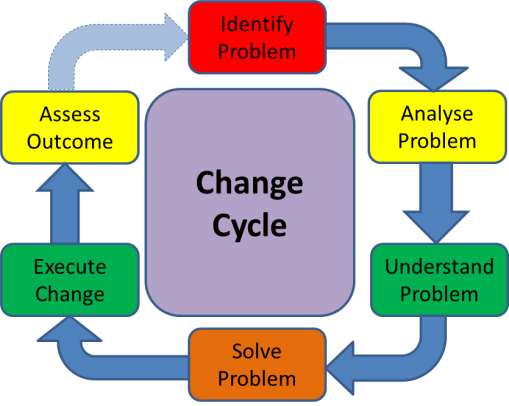
Change, within a business context, is inherently cyclic in nature. Undertaking change for change’s sake is not something that would normally be expected to occur.
The trigger for a change event is the identification within the business that there is a problem that needs to be addressed. The size of the problem need not be large but does need to invoke the desire for change to occur. Appropriate analysis of the problem should eventually lead to its full definition and an understanding of its root cause.
With understanding and, assuming there is the motivation within the business to continue to address the problem, a solution can be defined and ultimately executed. This will result in changes to the business itself.
The change cycle concludes with an assessment of the outcome of the change. Depending how the original problem has been impacted by the change may itself invoke a further change cycle to be implemented.
Enterprise Architecture – Supporting Business Change
All businesses are dynamic in so far as they need to respond to change drivers. How they respond is very much dependent on how well they know their business and its inter-dependencies.
It is very well accepted that the change outcome will be modified by alterations to key variables.
For instance, assume the Business decided on implementing a change, as a direct response to competitive pressure, that required the creation of a new product.
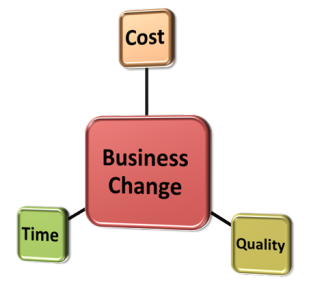
In its development there is always a balancing act between
- Cost: What will be the financial impact on the bottom line of developing the product?
- Time: How soon can the product be brought to market?
- Quality: How well will the product be developed?
It is well accepted that change in any one variable must have an adverse impact on another.
- If Quality is to be increased there must be an increase in cost and possibly time
- If Time is to be reduced there must be an increase on cost and/or a decrease in quality
- If Cost is to be decreased there must be a decrease in quality and time
For simplicity, with each of these questions, it is assumed that the change scope remains unaltered. A reduction in scope can result in decreased cost and/or time whilst leaving quality unchanged. A reduction in scope however does impact the ability to deliver on the original business requirement.
Where a business has an Enterprise Architecture available to it the ability to determine the impact of change is greatly enhanced. With appropriate measures in place, associated with capability, function and process, the ability undertake analysis in a ‘what if’ scenario provides key input into the decision making process.
With pragmatism at times demanding that cost or time pressures take precedence over quality an Enterprise Architecture can assist in providing an optimal response.
- How much can cost or time can be realistically reduced?
- What is the operational impact in a change in quality?
Drivers of change are largely outside of a business’s ability to influence.
How a business responds is entirely up to them.
The ability to make wise decisions is predicated on being as informed as possible.
An Enterprise Architecture can provide information necessary to support the decision making process.
Triggers of Business Change
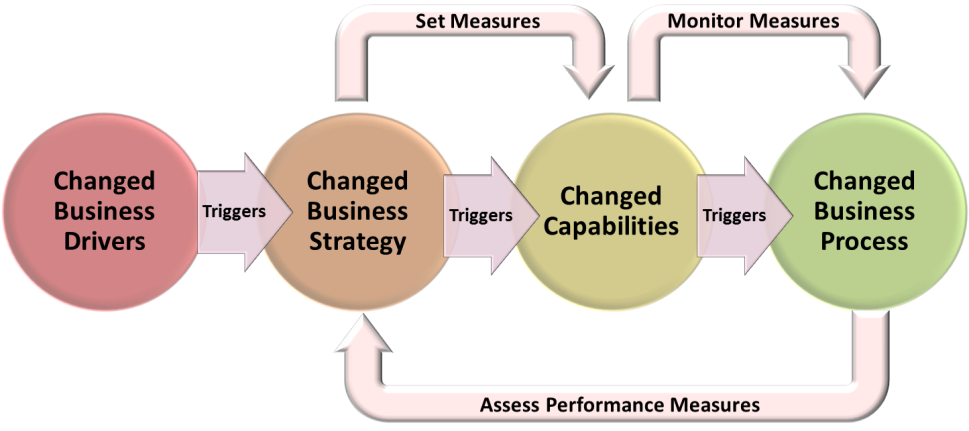
All businesses are continually subject to change. With the recognition that change is inevitable having processes in place to deal with them ensures that a considered and informed response can be made.
The drivers of change can originate from multiple sources, few of which are under direct business control. Some of these are:
- Introduction or changes of Legislation;
- Introduction or changes in industry codes of conduct;
- Competitive pressures;
- Financial Pressures;
- Customer needs and
- Technology changes
Changed or new business driver will trigger a series of cascading events that need to be efficiently and effectively managed.
In response to a change in business driver there will need to be a corresponding change in business strategy. Depending on the change this can then trigger either changes in existing business capability or potentially require the development of new ones.
In realising a capability change there will consequential changes to business process, with a ripple effect on all parts of the business (people and technical) that the changed processes have contact.
With the application of change within a business an assessment of its efficacy should be fed back into the strategy change process.
This assessment can only be reliably made if in executing change key performance measures are set early in the change process and monitored as the change progresses through to completion. By assessing the impact of change and matching it to a known baseline taken prior to the change taking effect, the efficiency of the change process can be measured as well as the effectiveness of the decision making process.
How a business responds to change drivers and the lessons learned through implementation of change can define how well a business operates.
Enterprise Architecture – Managing Risk
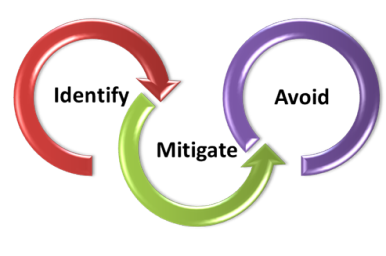
Engaging in business activity always has associated with it some element of risk. Embedded in each risk is a probability that some threat, damage, injury, liability, loss or other negative business effect, caused by external or internal factors, may occur.
Unfortunately not all risks are identified.
Each risk, if realised, will affect the business with its impact ranging from minor to catastrophic.
Being in a position to identify that a risk exists, its nature, its potential impact and the likelihood of its occurring provides a business with the opportunity to take risk mitigation or avoidance action.
Knowledge of the business and the external factors affecting it is paramount to being able to effectively manage risk.
An established Enterprise Architecture is a tool that, wielded well, can assist the risk management process.
A well maintained Enterprise Architecture, containing mature and accurate information about the business and its external influencers, is a significant enabler of the business..
- With good information the opportunity to identify risk is increased.
- With good information to analyse the ability to determine accurately the impact of risk is enhanced.
- With the ability to answer ‘what if’ questions the capability to identify activities that either mitigate or avoid the risk is greatly improved.
An Enterprise Architecture can remove much of the ‘guesswork’ out of a business.Decisions can be made with a fuller understanding of the risks, their impact and what can be done about them.