Organisation
Behavioural Maturity
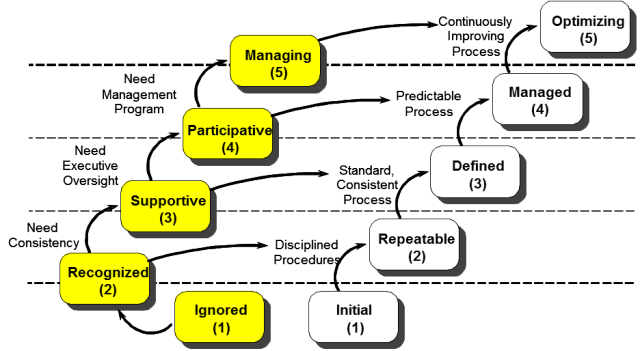
Establishing an effective Enterprise or Business Architecture within an organisation is in much need having achieved behavioural maturity as it is in achieving process maturity.
As, when progressing through the various CMMI maturity levels to achieve optimised business processes, there are parallel behavioural characteristics that must also be realised.
It is often said that a successful business is as much about the people as it is about the process. In essence without good disciplined people there is no business.
Corporate Maturity
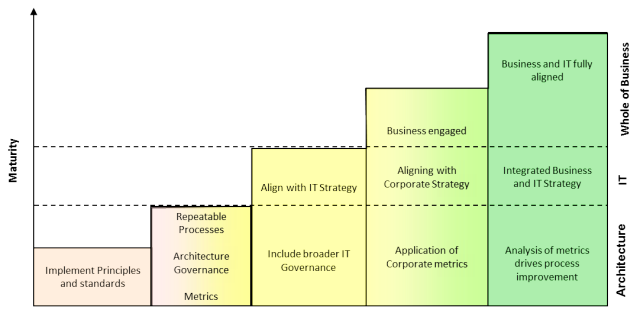
For a business to fully realise its potential to deliver whatever may be its primary mission it must reach an overall level of maturity such that it operates as a single ‘organism’.
So often a business will recognise that work needs to be undertaken yet only matures some aspects of their operation, failing to complete and failing to reap the full benefits. Having an architecture function with its house in order is a good start. Architecture and IT are only part of the answer however, as the whole of business need also to be fully engaged and integrated.
Recognising the potential rewards to a business in driving actively towards maturity should be the incentive to either commence or continue the journey.
Accountability and responsibility
Responsibility to undertake decisions within any business usually devolves to multiple individuals. The scope and the magnitude of the decisions that they are empowered to make is largely dependent on the role they occupy.
Whilst responsibilities are generally easy to manage the same cannot be said with accountabilities. Generally for every decision that is made, ignoring at present those made by committees, a single individual must be accountable. Where the accountable individual is the same as the responsible individual it is quite obvious where credit or blame, if needed, should be directed as a consequence of a decision made and its resultant outcomes. Where accountability and responsibility are divided there is generally no such clarity.
Well defined processes supporting the potential decision outcomes must be in place within a business where accountability and responsibility can be separated. Without such, accountable individuals may not be prepared to delegate responsibility possibly crippling the business by taking on too much themselves. On the other hand the individual who does have delegated responsibility may fail to make decisions without having a clear understanding of the ramifications.
Communication, Comprehension, Co-operation, Collaboration
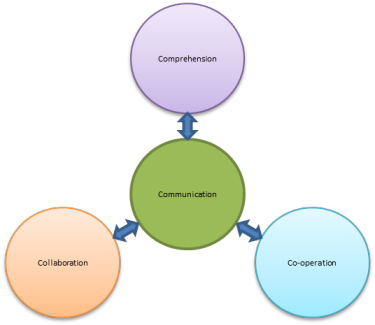
Good communication is at the heart of a successful business. Not so often, fortunately, communication takes the form of a monologue with one party telling what it is they think they want to have done. The resultant business outcome may not be what was either intended or expected and may often be detrimental to the business.
With true dialogue all parties are able to contribute and in gaining clarity can rapidly reach a state of comprehension and increased understanding of what is really required.
Communication with full comprehension is the means by which co-operation can be engendered within a business. Collaboration is that desired extension of co-operation where all parties mutually work together to achieve a common goal. With true enduring collaboration a business will reap significant benefits.
Left or Right Brained Architects
A person who is left-brained is often referred to as being more logical, analytical and objective than their right-brained counterpart who is regarded as being more intuitive, thoughtful and subjective.
A question could be asked regarding the attributes that are necessary to be a good Business or Enterprise Architect. Certainly being able to analyse the requirements of a business and applying logical processes in order to establish the need and priority of developing supporting initiatives is highly desirable.
But how then are these initiatives to be defined?
Being able to think outside of the box and with the ability to take that ‘leap of faith’ that an idea could work is often the prerequisite for the business initiative that is truly innovative.
Decisions to proceed may result more from the application of ‘gut feeling’ rather than logic. Risks may be greater but so may the rewards.
In reality the Business and Enterprise Architect will display aspects of both right and left brained behaviour. It is the balance and the amount of interaction between the two, managing the risks though logic that were raised through intuition, which will determine their success.
Sometimes the answer should be no.
Not all activity undertaken under the guise of developing architecture models provides value to the business. I would hate to count up the number of times I have been asked to undertake some task which would identify the interdependencies between components within the enterprise only to find that there was either no real relationship established or in having identified one to find that knowledge of the relationship provided no tangible benefit.
As you are with two people, with some effort, able to establish a linkage between them so you can with components within a business. The question is, having established that linkage, what was the point?
The desire to link everything to everything is predicated on wanting to know it all. The problem of course is that knowing it can obscure what is important. It sometimes seems that the more you know about everything the less you know about the specific: a real demonstration of ‘not being able to see the forest for the trees’.
Architectural work undertaken must be guided by the questions that are important for the business to ask when making decisions. Activities that do not support these questions may be counter-productive, diverting resources and effort from more valuable endeavours.
When requested to undertake some activities sometimes the answer should be no.
Picking low hanging fruit: not necessarily the best option.
Regardless of intent it is so easy when undertaking a multi-faceted activity to focus on completing the simpler tasks first. Using the rationale of picking the low hanging fruit much effort can be expended in actually avoiding the more difficult tasks. This is not necessarily laziness but possibly an actual disinclination to risk failure. Whilst the simpler tasks are being ‘ticked off’ progress appears to be being made and success appears to be assured. I am reminded of the project adage which says ‘ The first 90% of a project is completed in 90% of the time, the remainder of the project takes another 90%’.
However avoiding making a commitment to starting the harder tasks or perhaps actively procrastinating by undertaking additional, related but unnecessary simple tasks can , as a consequence and possibly disastrously, result in not achieving the outcome of that the original activity was expected to deliver.
Any activity should be analysed for how to best proceed. Picking and choosing individual tasks and leaving the harder ‘stuff’ until last is not likely to be the optimal way to proceed. Balance need to be injected into the process and the best way to proceed should be followed irrespective of personal bias or preference.
Behavioural Motivators: The need to succeed.
There are obviously many different behavioural motivators that drive or inhibit the work ethic of an individual. Many of these can be leveraged or exploited to drive real benefit in the business world.
The Need to achieve: achievement behaviour is an interaction between situational variables and the individual subject’s motivation to achieve. An individual’s motivation can be either implicit where they are driven by spontaneous impulses to act through incentives inherent in the tasks they are undertaking or explicit where their actions are driven by outside influences.
Maintaining a working environment where the tasks undertaken by the individual are in themselves interesting and intrinsically challenging encourages implicit behaviour. Additionally, a business, with a culture of rewards and recognition, provides an environment that strongly encourages the explicit individual to strive for succeed in each of their endeavours.
This desire to achieve can however be perverted when the rewards rather than the achievement become the central focus.
Greed, with all of it negative and destructive connotations unfortunately can become the prime motivator. Balancing the rewards offered against the personal satisfaction provided by the achievement itself becomes crucial.
Behavioural Motivators: Politics and Power
Competing agendas from multiple individuals within an organisation can be counter-productive. These often exist as a consequence of the ‘political’ machinations that are progress. Some individuals within a business, whether consciously or unconsciously strive to gain personal power and influence. The activities in which they engage and how they proceed, are frequently designed to enhance their own standing. Consequently, when the personal goals of the individual do not align with that of the business, there may be a conflict of interest which can adversely affect the performance of other individuals and the business itself. Perceived success in this situation is measured from the personal perspective rather than from the business as a whole.
Almost everyone has come across ‘the Empire Builder’ within an organisation. Whilst the way they operate may not be ultimately malignant, the fact that they exist may cause others within the organisation to attempt to counter their plans with their own. Focus is subsequently redirected from that of the business to that of the individual.
It is probably inevitable that any given business will have some level of political power play in progress at any given time. In recognising this, a wise business manager will attempt to temper the politics by ensuring that all individuals retain a focus on business goals.
Who is in the driver’s seat?
A significant danger in establishing an Enterprise Architecture Practice within a business arises through potential confusion of who is in the driver’s seat.
An IT lead Enterprise Architecture initiative needs to assure the business that they, IT, are not leading the business but offering guidance and advice. Where there is a perception that this is not the case the ‘business’ can feel disenfranchised and can either push back at IT or worse still totally disengage.
I like to use the analogy of a GPS in a car. The driver is able set their final destination of a journey into a GPS. The GPS will then look at where the journey is commencing and establish a route by which the driver, if they follow it can get to their destination. The driver is aware that there may be more than one route available to them (‘Toll’ or ‘no Toll’ as an example)
The driver is not bound to follow the directions provided by the GPS and is able to make decisions of their own that may vary the route. The variation that the driver invokes may or may not provide for a better trip but then again perhaps their local knowledge, not included in the GPS’s database, does give a better result.
If we equate the GPS with an Enterprise Architecture we see that the better informed it is the better the outcome. The GPS can never know all there is to know about conditions on the ground so can be over-ridden by the driver. The driver, similarly recognises that they do not know everything about their journey which is why they are using the GPS.
Once over-ridden a GPS will go through the process of recalibrating a new route to the target destination.
An Enterprise Architecture provides information and guidance to the business. The guidance offered can either be followed or not depending on what additional information the business may elect to consider or in fact how well they trust the GPS itself. I am reminded of the recent debacle relating to the Maps app on the iPhone and the problems it caused some users who followed directions blindly.
The Enterprise Architecture will only be regarded as an asset to be used where the guidance it offers is perceived to be of value. Where it is not, it is either dispensed with or kept ‘in the glove box’ for a time of need.
Failing to Plan is Planning to Fail
How often do we see a perfectly good idea fall flat through the responsible person (if one indeed exists) not having taken care in the planning process? Whilst it is not feasible to foresee all possible obstacles to success the most potentially damaging can be avoided or mitigated by careful planning.
Any initiative that is perceived as providing value to the business and therefore worth doing is also worth the effort to plan carefully. Doing so allows for a better quantitative understanding of the benefits it may bring, the impact it may have on other related initiatives and the resources it may consume in its development and execution.
Not planning can result in unexpected costs, resources conflicts and business impacts that are undesirable. Scenarios arising from not planning range from little impact (because of good luck), failure of the initiative and with the the worst case, failure of the business itself.
Having established planning processes and following them is absolutely essential if outcomes are to be optimised. Anything less is just a gamble.
Size does not matter.
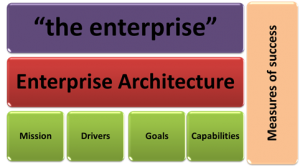
An Enterprise Architecture is able to contribute significant value no matter the size or the nature of the business. A business can be anything from a single person operation through to a multinational conglomerate or a government. All have missions that define their goals and objectives. All have internal and external driver that affects what they do..All wish to succeed in their endeavours. The one person business, in establishing their initial business plan must, if they wish to succeed, define what it is they wish to achieve and decide if it is actually ‘doable’.
- Understanding what capabilities they have and what additional ones are required to deliver on its mission helps in shaping the business plan.
- Defining the measures of success and having a view as to when success should be achieved allows them to monitor progress.
- Describing the processes they will use, the costs of implementing each and how they inter-relate enables the possibility of business process improvement.
How does this differ from what is required of the multi-national or government. The ‘larger’ the business the greater its inherent complexity yet the impact, on getting it wrong, can be seemingly just as great for the small business as for the large.
Not succeeding for the small business can mean it closes. Not succeeding for the large may not be as terminal.
Good, well informed decisions, made in the very small through to the ultra large enterprises are crucial for realising their individual success. This can only occur if they have access to a repository of knowledge and information from which to draw.
An Enterprise Architecture or something which is equivalent (the name is irrelevant) can provide the information that is required to support decisions that will provide an optimal path to success. Where it does not exist the enterprise should look at establishing one or risk failing to achieve what it wants.
Moderating tribal behaviour
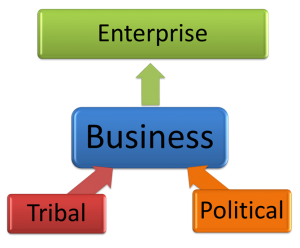
Any business with more than more than one person within it will, at times, be faced with having to handle competing views. ‘Political’ agendas within a business can, if not moderated can be so destructive that the business can be torn asunder.
Politics can be born out of the passion arising from individuals having a different vision for the business than others in positions of power and influence. A different vision will translate to different goals and objectives** which in turn will require different processes and solutions.
The astute political player will manipulate others to their way of thinking hence creating a new ‘tribe’ within the business. Business politics and the consequential tribal behaviour can devolve a business from being united to being one which is at war with itself. The business will not benefit where this behaviour persists.
The existence of an operational Enterprise Architecture can assist a tool for the purposes of moderation between competing tribes.
An Enterprise Architecture will be compromised whilst there are alternative visions in place as the likelihood is that the measures of business success will differ for the goals and objectives of each. The application of different measures and the importance in which they are held will result in different decisions being made.
What the Enterprise Architecture can offer is the ability to support the development of the quantitative impact of the decisions that would be made for each vision and potentially provide the proponents of each vision with a better understanding of what they and others are proposing.
With better information the chances of reaching a common understanding of how the business should proceed is enhanced.
Where there are such ideological differences within a business that no common understanding and hence agreement can be reached an Enterprise Architecture can offer some insight as to what the impact of the competing tribes might be with the aim of being able to provide mitigation strategies that would at the very least reduce the substantial negative benefit that would occur otherwise.