Tools for looking up tagcoding hashtags
In the early days of #tagcoding I used Twitter on a tablet and would look up an #isic code using a printed list, as that would be faster than scrolling through an electronic document. This I did until I created on a wiki page a tabbed table for the ISIC classes. Since then the tagcoding cycle usually has these steps:
- In Twitter, I read and assess the post, is it worth to be retrieved later on?
- If yes (and I don’t know the code by heart), I switch screens to my browser to go to the #tagcoding pivot page.
- On the basis of the topic dimension, I look up the corresponding ISIC class - often this is straightforward, but in some cases one has to look up the class definition, for instance for bee-keeping, or for copper mining.
- I remember the code and return to Twitter, where I quote, or add a comment including the coding hashtag
- I finish the comment and tweet the #tagcoded post.
There are a few tricks in this cycle: when holding a link on a web page, Chrome in Android supports actions such as: Open in new tab, Open in incognito tab, Copy link address, Copy link text, Download link, Share link.
I would often copy the link text or the link address, in one or two successive visits to the web browser, and then paste them in the comment on Twitter. When the link text includes both the code hashtag and its meaning this allows me to “advocate” for #tagcoding. The wiki provision is that a page must have a title that includes the coding hashtag. This is usually the case as you may have noticed in many screenshots.
If a broader search is needed, I would search on the wiki, or use the tagcloud that the wiki produces on the basis of the page tags.
While practicing the #tagcoding, over the past years, I have looked into ways to provide online tools to quickly look up a specific coding hashtag in a topic dimension.
Unlike common search tools, when the user searches a topic dimension, several tools explicitly show the range of topics covered in the dimension. This encourages heterophilous awareness and search behaviours.
Consult #tagcoding guidelines for these tools and some further #tagcoding conventions.
Tabbed table
A tabbed table with “top” tabs is convenient to order topics in a two level hierarchy with between ten to twenty topics at the highest level in the hierarchy, and between two and hunderd topics per top-level topic.
In the figure below four tabbed tables are briefly described:
- a table with country codes, alphabetically per continent;
- the function of government table with about 120 classes in 10 divisions;
- a table with the sustainable development goals (17) and targets (169);
- a table with the economic activities with about 420 classes in 21 sections.
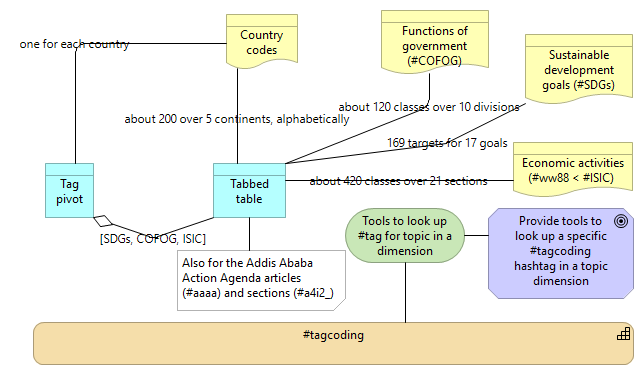
There is an example of each of these tables in the chapter dealing with the topic dimension.
The benefit of showing these tables is that they give the user an humbling awareness of the total topic space that is covered by the topic dimension. They also encourage an heterophilous awareness.
The two screenshots below show the front or guide page of the tabbed table for ISIC and the E tab, for Section E - Water supply, sewerage, waste management and remediation activities. The sections allow to limit the search space for the classes. Manufacturing is the section with most classes.
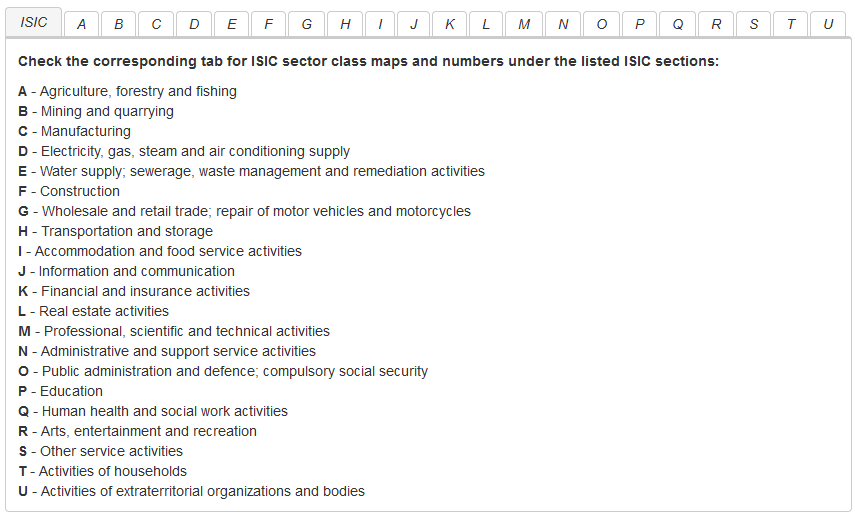
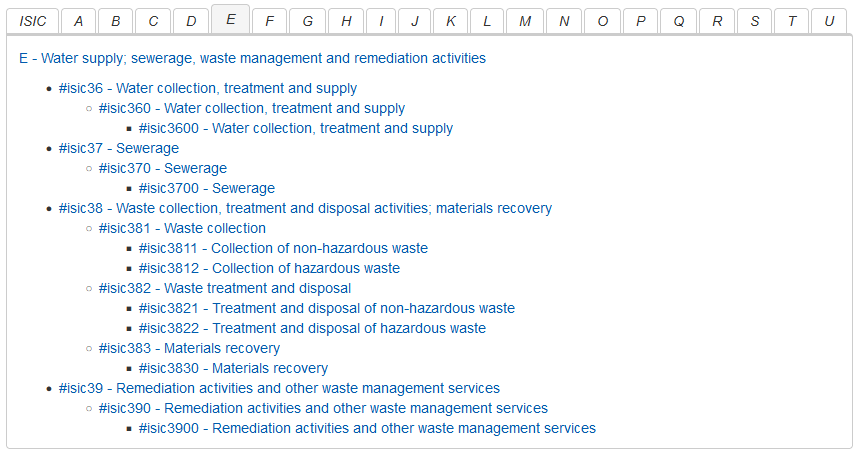
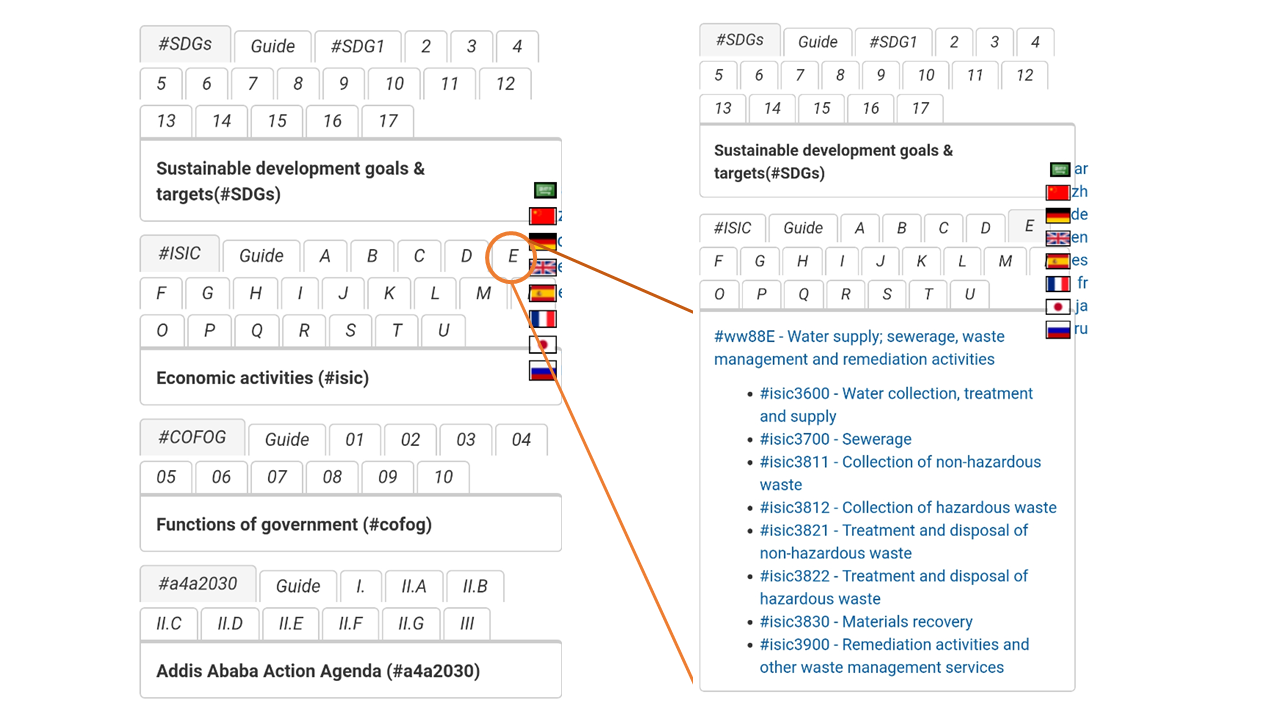
A #tagcoding pivot will include several tabbed tables. In order to fit several tables on a single screen of a smart phone, the landing view of a #tagcoding pivot will only show the tabs of a tabbed table and its title. This view of a tabbed table is called its landing view.

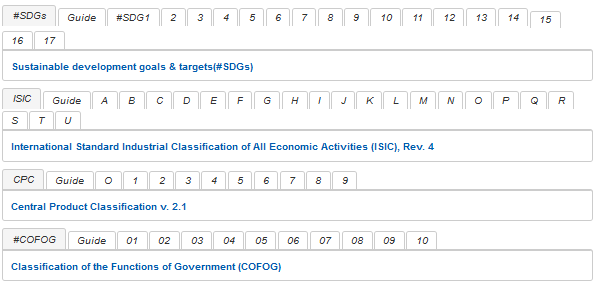
The next image shows on the left hand side part of the landing view of the #tagcoding pivot which includes four tabbed tables: the first one for the sustainable development goals, the second for economic activities, the third for the functions of government, and the fourth for the Addis Ababa Action Agenda. On the left hand side the ISIC classes in Section E are shown with their #tagcoding hashtag.
Topic-#tag cloud
A topic-#tag cloud is convenient in situations where the hierachy of the topics cannot be derived from the topic name and where there is a unique #tag for the topic. This is for instance the case for local government units, the name of which gives no indication of their country or state. In a topic-#tag cloud each term consists of a topic name, followed by a hashtag. In the cloud the terms are ordered alphabetically. It takes only a few seconds to look up the coding hashtag for the topic, even in clouds with thousands of terms.
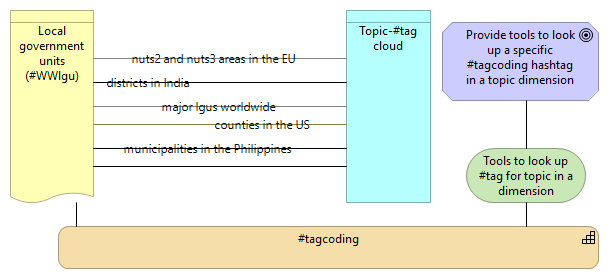
For links to these clouds we refer to the chapter on the local government unit coding hashtags. The tag clouds are produced from the tags of the wiki pages in a certain category.
Also in this case showing the total cloud gives a humbling awareness to the user.
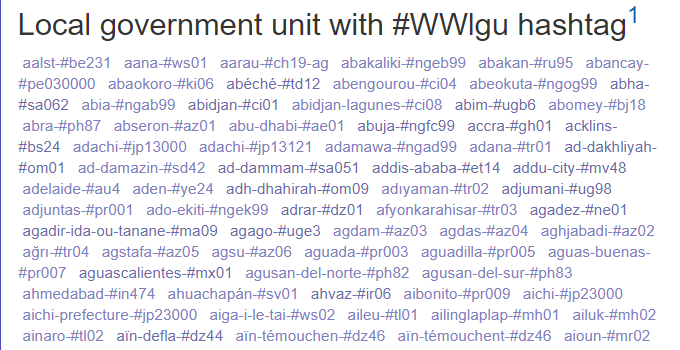
The picture below shows the screenshot of part of the topic-#tag cloud for the major lgus worldwide.
Term cloud
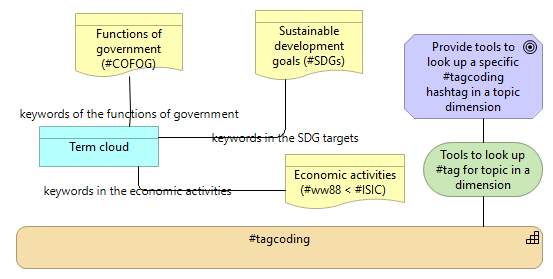
A term cloud is convenient in situations where a topic includes several sub-topics that matter individually. For instance keywords of functions of government or economic activities, and keywords in the sustainable development targets. As the terms are ordered alphabetically it takes only a few seconds to look up a specific term. By looking up a term, the list of pages is produced that are tagged with the term. When the coding hashtag is included in the title of the page it is immediately clear which topics in the topic dimension include the term.
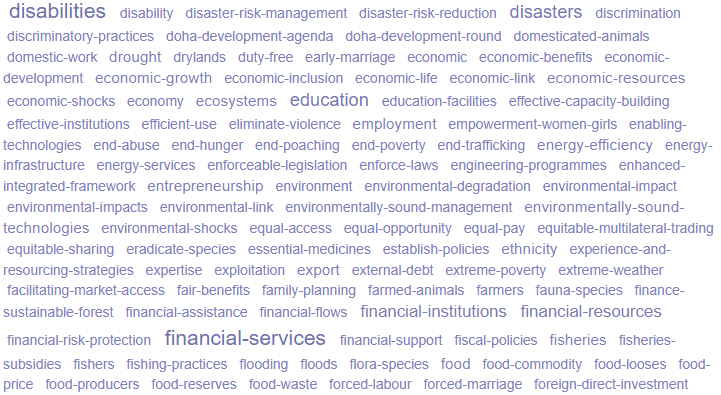
The picture below shows the screenshot of part of the term cloud for the sustainable development targets.
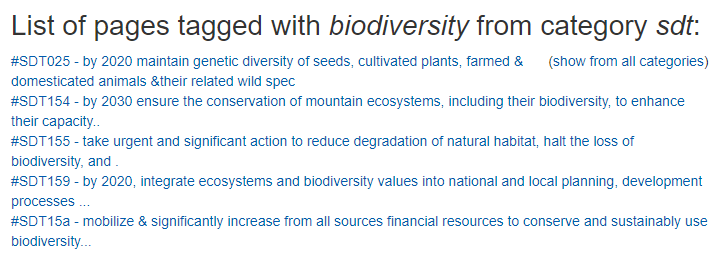
The picture below shows the list of targets with the term “Biodiversity”. In the category of “sdt:” wiki pages we have taken care to always include the coding hashtag in front of the targets title.
Mixed cloud
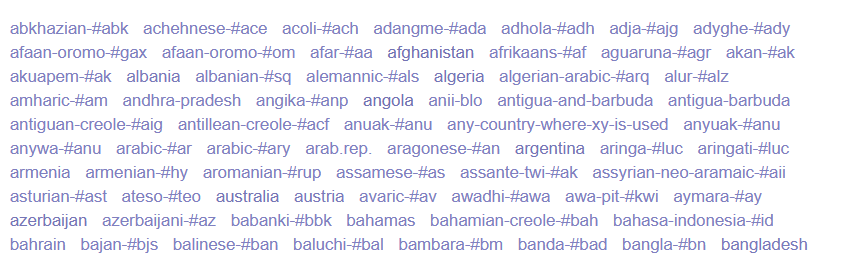
A mixed cloud is convenient in situations where both terms and topic-tag combinations are relevant, for instance: - topic-tag: a language with its ISO 639 code, and - term: a country where a language is spoken or used.
The picture below shows the screenshot of part of the topic-hashtag and term cloud for languages and the countries where they are used.
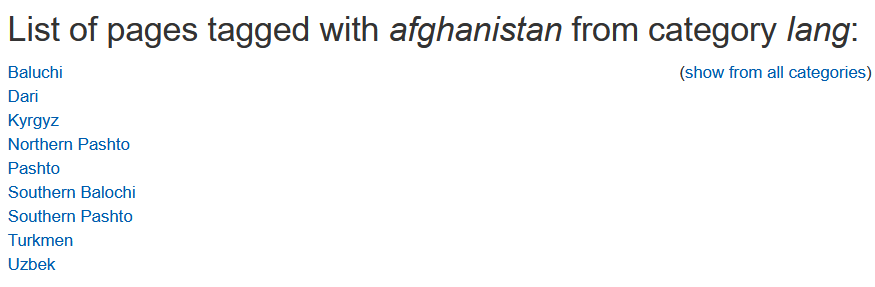
As the topic-tags and country names are “tags” of language pages, selection of a country shows the languages that are used there, for instance for Afghanistan:
Another example is the term cloud of the “item:” pages in the Ens Wiki. This wiki has three page types, cpc: for the Central Product Classification, item: for SDGs, ISIC, COFOG and other topics, and lang: for languages.
The item: pages for SDGs (and targets), ISIC and COFOG are tagged with the CPC topics for which they matter, or with topics for which the corresponding CPC code hasn’t been determined yet.
The picture below shows the screenshot of part of the Tags for goods, services and bads.
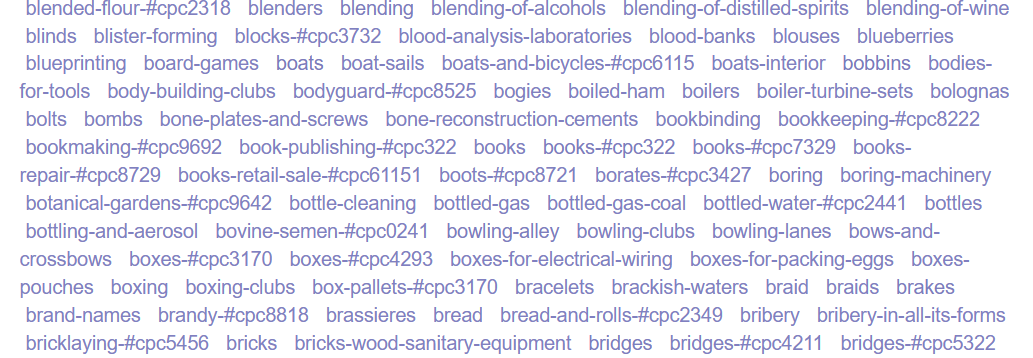
This cloud has thousands of terms. For many of these terms a CPC code must still be determined, or may not be available.
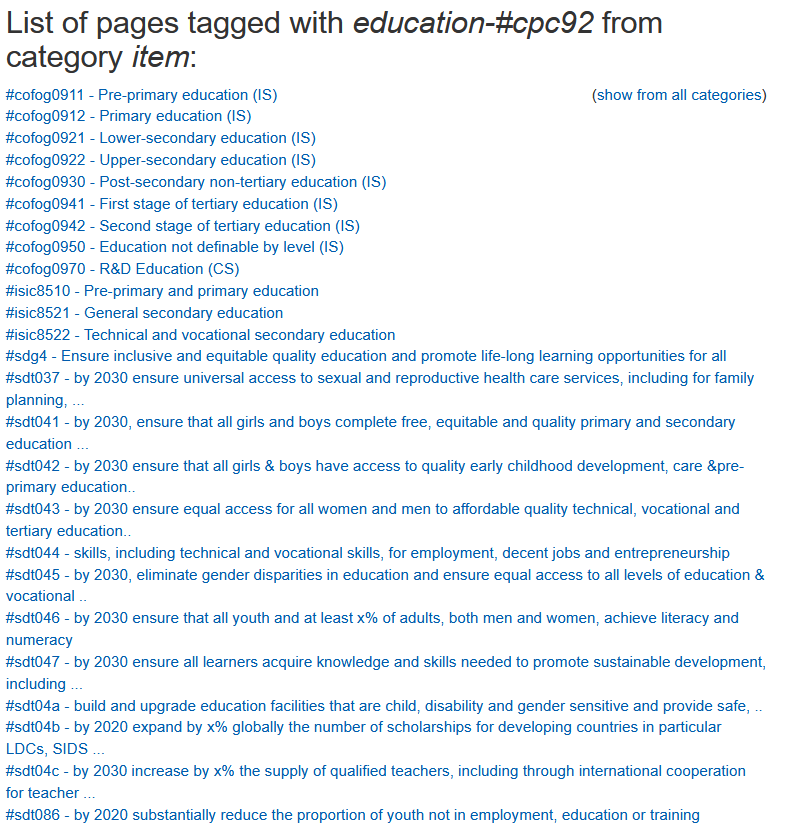
The screenshot below shows the List of pages tagged with education-#cpc92.
#Tagcoding pivot pages
Wiki pages with multiple tabbed tables can be set to simultaneously show the coding hashtags for a broad topic such as education or health in multiple topic dimensions. Such a wiki page is called a pivot page.
When putting tabbed tables with respectively 17, 21 and 10 top level topics on a single wiki page, that page can have 3570 different views showing topic descriptions and their coding hashtags.
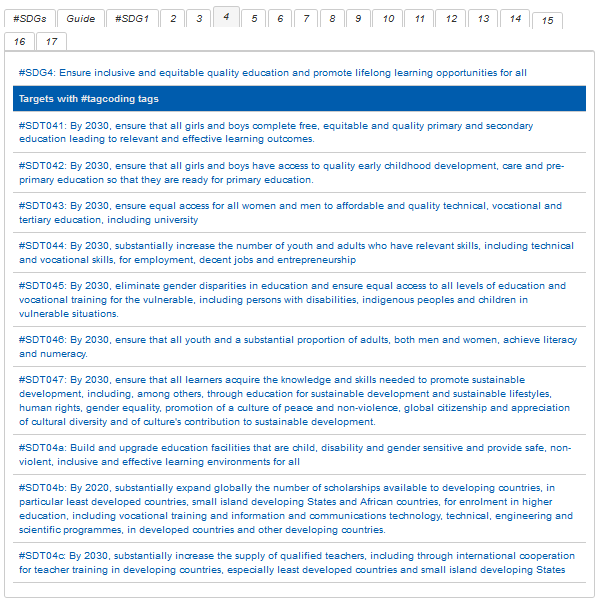
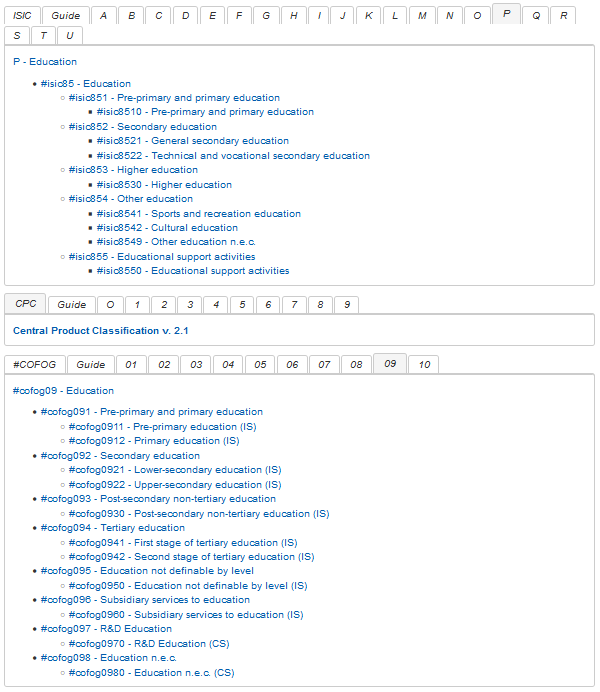
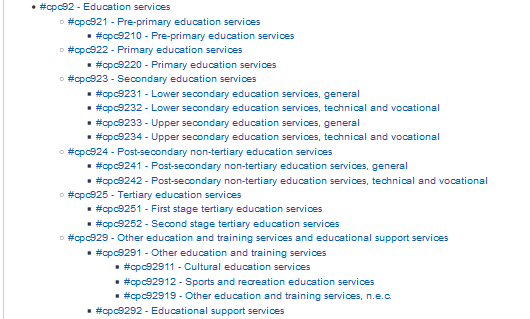
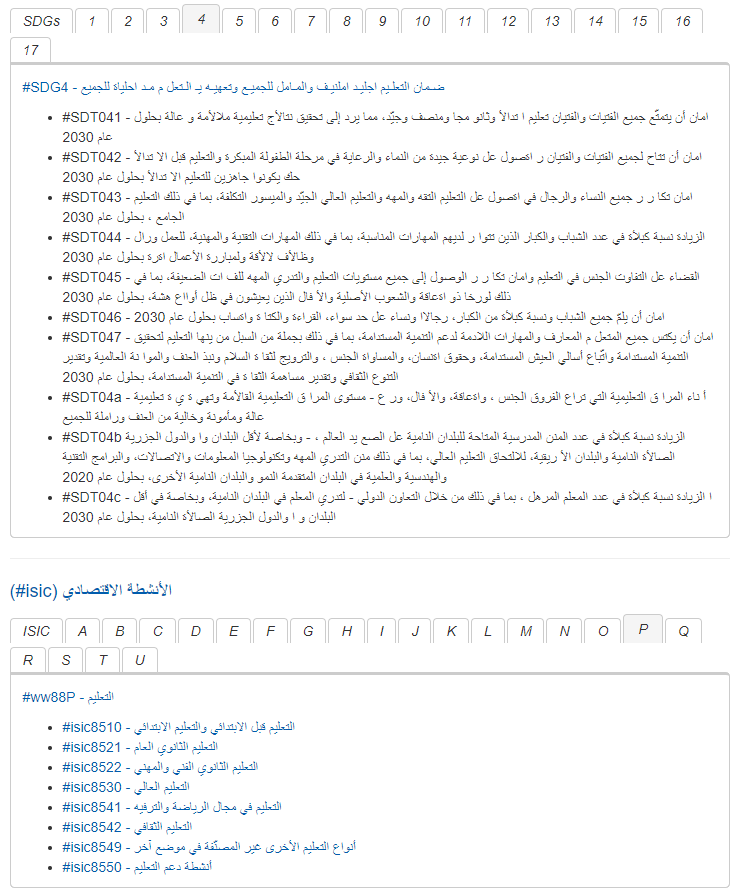
The screenshot on the next page shows the education #tags in the dimensions of goals, economic activities and functions of government.
Pivot pages in other languages support an immediate production of similar views:
- English #tags for the #2030Agenda;
- French Pivot de #tagcodage;
- Arabic;
- Chinese;
- Spanish #Tag pivote;
- Japanese;
- Dutch Spil in het nederlands;
- Russian: Целей устойчивого развития;
- Tagalog: #tagcoding pivot sa Tagalog and
- Ilonggo: hil.wiki - ang larangan ng publiko sa Ilonggo.
The following four views are of the pivot page in English.
The education view of the pivot page in Arabic concludes this chapter:
#Tagcoding pivot pages per country
The #tagcoding pivot pages per country have been designed in accordance with the topic dimensions and layers of government services as explained in the figure below.
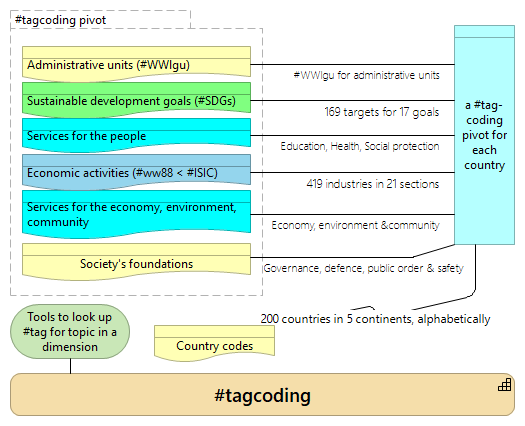
In this view the functions of government have been divided in three layers, with “actors” on lower layers responsible and accountable for protecting and supporting the well-being of actors on higher layers (carrying capacity):
- (Government) services for the people which include the divisions: 09 - Education; 07 - Health; 08 - Recreation, culture & religion; and 10 - Social protection.
- Services for the economy, environment and community which include the divisions: 04 - Economic Affairs; 05 - Environmental Protection; and 06 - Housing and Community Amenities.
- Governance, justice and society’s foundations which include the divisions: 01 - General Public Services; 02 - Defence; and 03 - Public Order and Safety.
The screenshot below shows the landing view of the #tagcoding pivot for the United States of America.
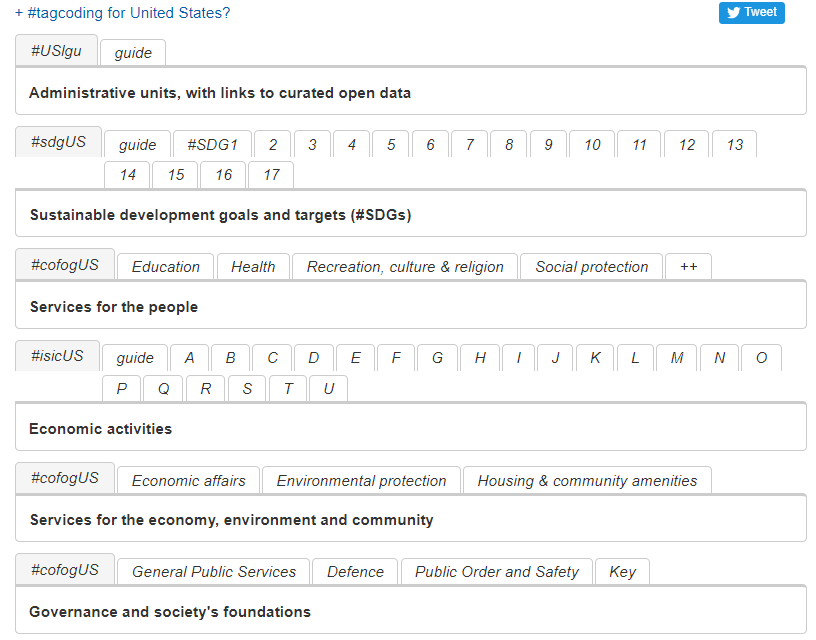
The first annex includes a link to a similar english page for each of over 190 countries. For all these countries, a similar #tagcoding pivot page is available in the other official languages of the United Nations. Each such page supports 14256 views on interrelated topics.