Pivotal points in the history of knowledge conversion
In the history of recording knowledge and making it accessible there are a number of pivotal points (Perkowitz, 2016) such as the creation of libraries, the invention of the printing press, the encyclopedia developed by Denis Diderot and Jean Le Rond d’Alembert, the creation of classification structures, and the creation of the Internet.
Collaborative #tagcoding and wiki-creation and their broad adoption are likely another pivotal point that enables and furthers a far more inclusive and instructive use of the internet, and a faster localization and conversion of knowledge.
As yet the mainstream use of the internet is still distractive, consumptive and commercial and social media algorithms have amplified polarization.
As a general purpose counter-measure for the information overload and bias of the mainstream internet and the polarizing forces of current social media platforms, the proposed #tagcoding - #xy2wiki - #tag2wiki - #lean2book knowledge localization model will transform and accelerate the instructive and productive use of the internet and enable a willingness to listen across the bubbles that social media create.
Before briefly describing earlier pivotal points as a background for appreciating the origin and benefits of our mission we take a look at the pioneering Sociali.
Knowledge conversion
According to the well known SECI model (Nonaka et al., 2000), knowledge creation is a continuous and dynamic interaction between tacit and explicit knowledge. This interaction is shaped by shifts between different modes of knowledge conversion involving actors and services in a facility or livelihood.
It starts from “Socialization,” when the actors are interacting and use services, gaining experience.
During “Externalisation” or articulation, the knowledge is made explicit, for example in drawings, models, their evaluations, etc.
This is followed by the “Combination” step during which explicit knowledge is converted into more complex sets of explicit knowledge, for example in plans, reports, work instructions.
The “Internalization” converts the actors’ explicit knowledge into the actors’ tacit knowledge. Then the process starts again with socialization and so on.
Thus the knowledge creation happens continuously as part of a cognitive self-transformation of multiple concurrently operating teams, groups and individuals. Operations of the actors involving the facility or livelihood and the self-transformation in which the actors abandon obsolete knowledge and learns to create new things, improves its activities and deploys new tools and services. The self-transformation applies the SECI modes of knowledge conversion.
In below figure the SECI modes of knowledge conversion are depicted as capabilities (Archimate, 2017) and explicit and tacit knowledge are depicted as resources. Both serve and are triggered by the value streams (Archimate, 2017) Dialogue, Linking explicit knowledge, Learning by doing, and Field building. Both tacit and explicit knowledge will serve all the value streams, and result from the capabilities:
- Dialogue (tk1 and ek1),
- Learning by Doing (tk3 and ek3),
- Field Building (tk4 and ek4), and
- The linking of explicit knowledge (tk2 and ek2),
but Externalisation, Combination and the linking of explicit knowledge are the main creators of explicit knowledge, and Internalisation, Socialisation and Field Building are the main creators of explicit knowledge.
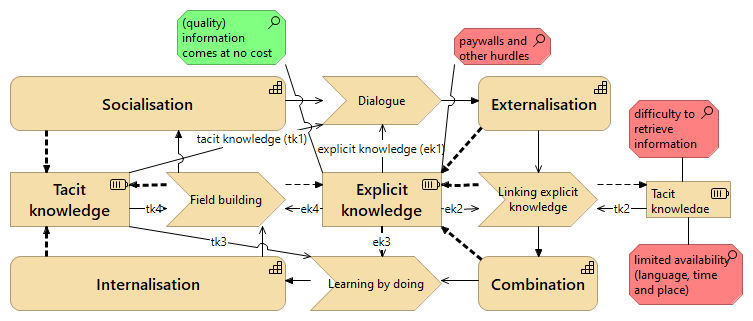
The figure also includes some assessments of the status of tacit and explicit knowledge in contemporary society. Explicit information, when shared via the internet and without paywalls or other hurdles (red), comes at (virtually) no cost (green). Tacit information on the other hand is difficult to retrieve and has a very limited availability (language, time and place of the person having it) (red).
When considering the implied availability of tacit and explicit knowledge in the micro, macro, meso and pico “decision making” journeys (chapter 3.11) SECI inefficiencies exist especially for the three latter journeys, while the knowledge conversion in micro journeys (mostly of companies and organisations) is most effective. This is summarized by the “gap” “SECI inefficiencies outside the micro-level of scope.
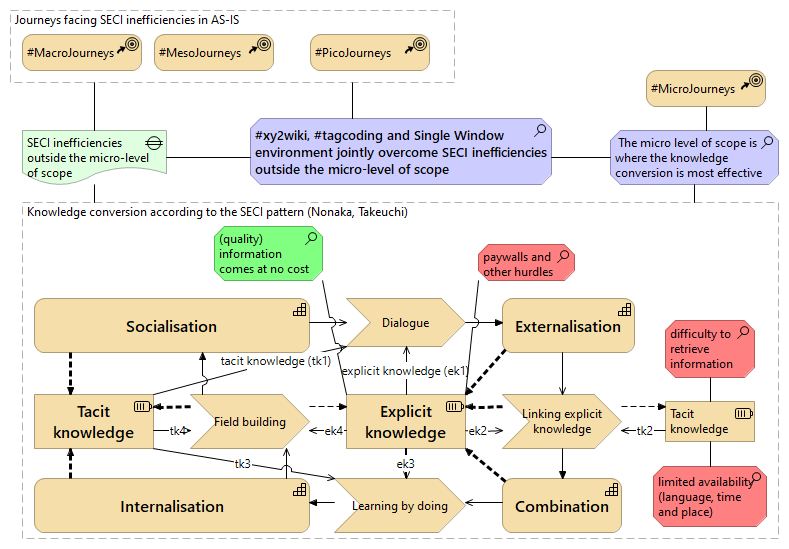
The mission of #xy2wiki, #tagcoding and single window environments () is to address the current inefficiencies in providing explicit knowledge for the macro, meso and pico “decision making” journeys.
The mission of scaling practices from the micro scope of engineering to other scopes has been articulated before (Goossenaerts et al, 2007).
Encyclopedia
The aim of the “Encyclopédie, ou dictionnaire raisonné des sciences, des arts et des métiers” (1751-1772) was to change the way people think, and for people to be able to inform themselves and to know things. Denis Diderot, its editor, wanted to incorporate all of the world’s knowledge and hoped that the text and the engravings could disseminate all this information to the public and to future generations (Isaac Kramnick, 1995).
In the figure below we give some key characteristics and figures about the first multi-contributor encyclopedia.
The encyclopedia used a taxonomy of human knowledge with three main branches: memory, reason and imagination.
Check Wikipedia for more details about how it was created and what impact it had on culture and society.
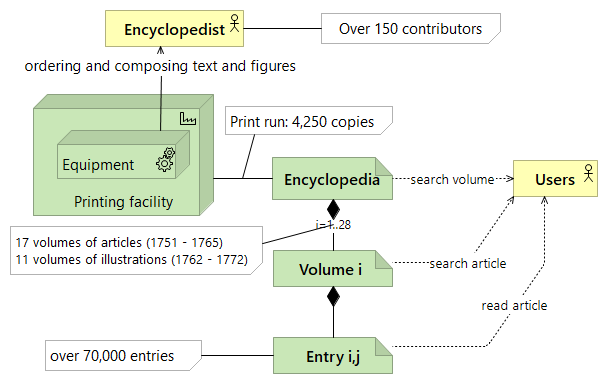
The simplified model of the first encyclopedia, and all other models in this book are made using the model elements of the Archimate Framework (The Open Group, 2017) in the Archi tool.
Mundaneum
The Mundaneum was created in 1910 by the Belgian lawyers Paul Otlet and Henri La Fontaine and aimed to gather all the world’s knowledge and classify it according to a Universal Decimal Classification.
In Traité de documentation (1934) Paul Otlet presented a novel scheme for remote access to data with minimal use of hard copy. Paul Otlet envisioned many of the features of the internet in order to make the “universal compilation of knowledge” that had started in the Mundaneum widely accessible via a communications network the radiated library and the televised book.
In the figure below we give some key characteristics and figures about the Mundaneum and Otlet’s scheme for remote access to the compilation of knowledge.
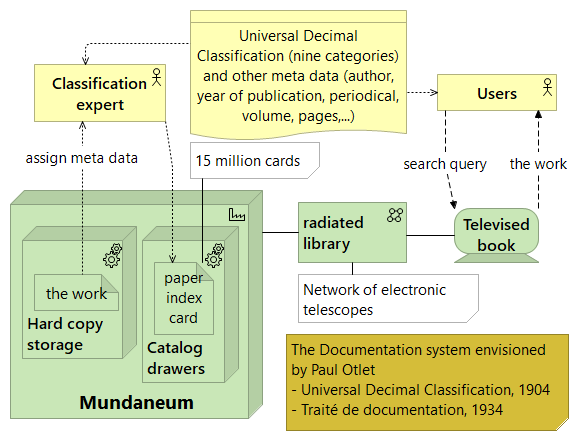
Both the encyclopedia and the Mundaneum were forerunners of other systematic knowledge projects such as Wikipedia and WolframAlpha.
The scheme for remote access to data that Otlet presented, but didn’t implement, was a forerunner of the Internet.
Wikipedia contains much more information about the Mundaneum and its creators.
Alex Wright (2014) also pays attention to the global political and socio-economic context of the era and how Otlet interacted with it.
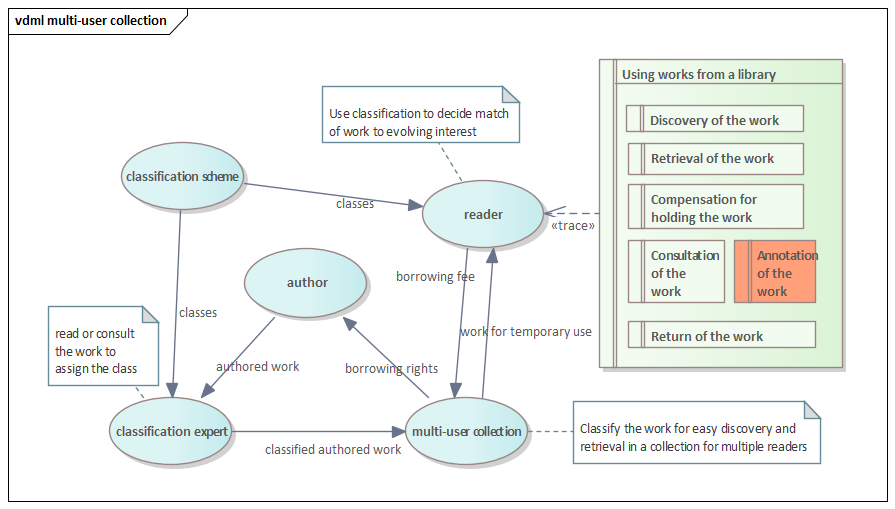
In the Mundaneum the classification scheme and classification experts play an important role which they still play in libraries or other multi-user collections.
In the figure below, which is a role collaboration diagram in the “Value Delivery Modelling Language” (or VDML) (OMG, 2018), the classification expert, usually the librarian, classifies the works of authors. Potential readers of the work may discover and retrieve it by means of the tags the work received in the classification. When using works from a library, the reader is typically not allowed to annotate the work. This is the reason why “the function” “annotation of the work” has a red color in the right hand overview of typical reader functional requirements. The other constructs are VDML roles. The arrows denote value exchanges between the roles. The roles are the author, the classification expert, the reader, the classification scheme and the multi-user collection.
The Internet
Today, the internet and search engines offer an information retrieval solution that makes content globally accessible. In contrast with the centralized Mundaneum information classified by experts, today’s Web has a “bottom-up” and widely sourced flood of content.
This makes the huge pile of online content and data unwieldy and unorganized.
In the figure below we model some key components of the internet eco-system, and in the purple boxes position some user-related assessments:
- it is difficult for many users to extract the information they need for particular work contexts;
- it is hard for authors to reach the audience that would benefit from the content and knowledge they contribute.
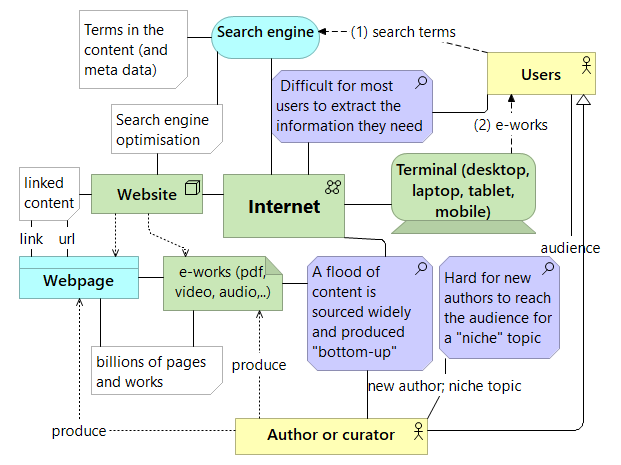
While the wide and bottom-up sourcing of content and the availability of search engines would generally benefit the access to and localization of knowledge, the user- and author-related factors apparently slow down such virtuous effects of the Internet.
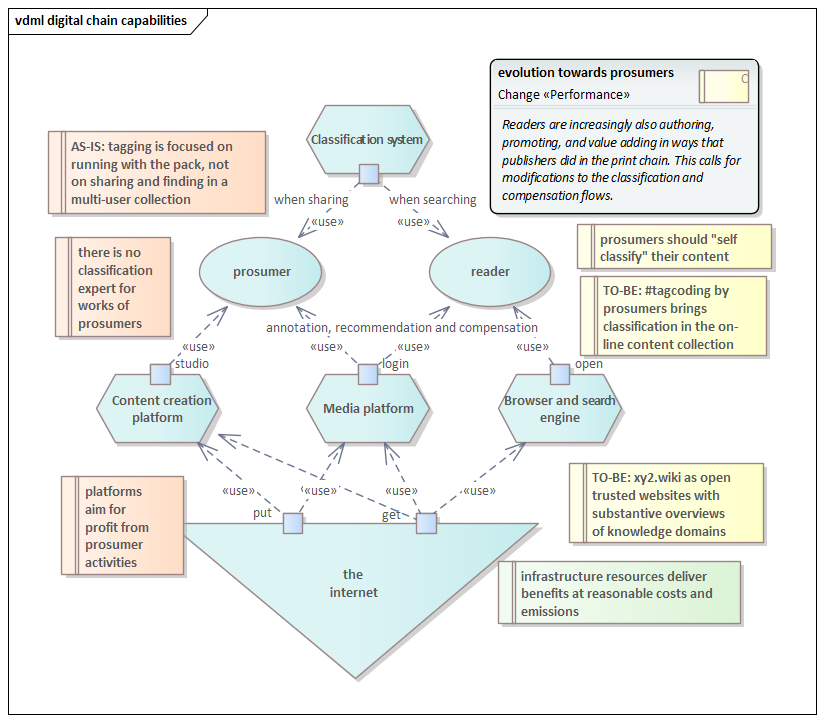
To appreciate the potential role of #tagcoding and xy2.wiki among the other digital chain capabilities a second VDML role collaboration model is included. In this figure the author role is replaced by the prosumer role. The classification system, the content creation platform, the media platform and the browser and search engine are capabilities, and the internet is a (huge) pool of content. On the left hand side some performance issues are depicted:
- The AS-IS use of hashtags is focussed on “running with the pack”, not on sharing and finding in a multi-user collection that must cater to a wide audience;
- Private profit is the all-important driver for the provision of platforms;
- There are no “classification experts”.
To bring some classification in the vast multi-user content collection that the internet is, prosumers might as well classify their content themselves. By doing so they could contribute to a social-benefit counter-balance for the excessive profit motives. After all the internet could as well deliver social benefits at very reasonable costs and emissions. Costs and emissions that are far below those that would be incurred when the knowledge diffusion would be using printed matter.
The further sections describe how these insights can transform the current micro-blogging and wiki platforms into a platform for collective intelligence.
Wiki based encyclopedias and micro blogs
Both wiki-based encyclopedias and micro blogs are among the best services the internet eco-system offers for the localization of knowledge.
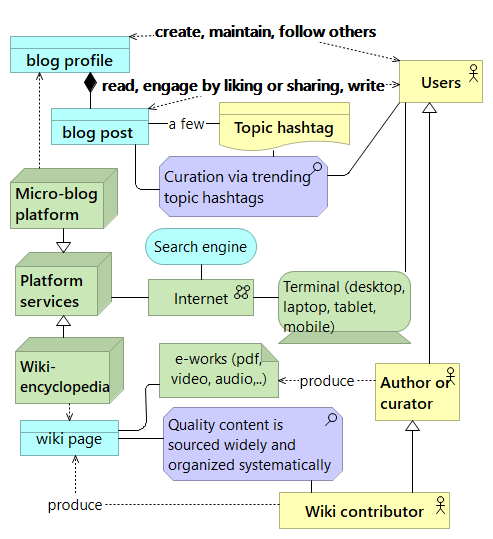
In the previous figure we model some key components of the wiki-encyclopedia and micro-blog eco-system. The purple boxes position some assessments regarding their services:
- In a wiki-encyclopedia, quality content is sourced widely, subjected to quality controls, and organized systematically;
- Micro-blogs, with Twitter in particular, support search and curation on the basis of hashtags which are especially used for trending topics.
Collaborative #tagcoding and wiki editing
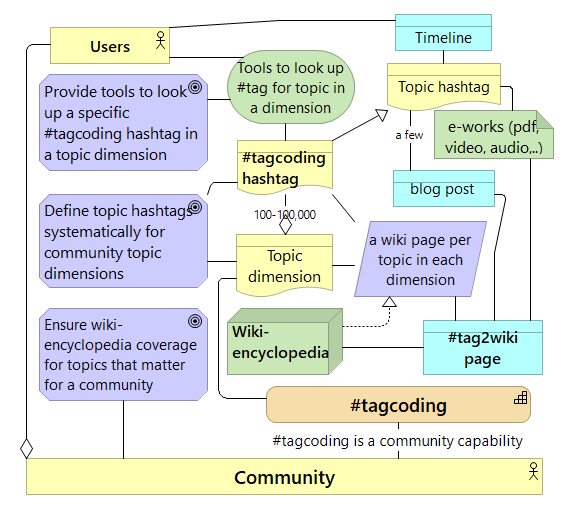
The #tagcoding capability builds upon topic dimensions to realise a number of goals that leverage wiki and micro blog services to accelerate the localization of knowledge:
- Define topic hashtags systematically for end-user topic dimensions (mono-dimensional), for instance #isic9101 for library and archive activities, and FJ, the ISO country code for Fiji;
- Create hashtags for multi-dimensional topics by combining (juxtaposing) mono-dimensional topic codes, for instance combine #isic9101 with FJ to form #isic9101FJ for library and archive activities in Fiji;
- Ensure local-language wiki (-encyclopedia) coverage for all topics in key end-user topic dimensions (with a focus on topics that matter for a community), for instance “all economic activities”, “all functions of government”, “all local government units”, and “all targets of the sustainable development goals”.
- Provide tools to look up a specific #tagcoding hashtag in a topic dimension.
In the figure below we position the key #tagcoding components with respect to those of the familiar internet eco-system.
The Actor Atlas started with:
- A wiki page for each economic activity as defined in the International Standard Industrial Classifications of All Economic Activities (ISIC) Rev.4 (UN Statistics Division, 2008);
- A wiki page for each function of government as defined in Classification of Functions of government (UN Statistics Division, 2000)
- An initiative book page for each country, with “placeholders” for initiatives for each function of government in the country.
Later on, the coding hashtags and the pages with goals and targets of the sustainable development goals were added to the Actor Atlas, and country-specific wikis were created by cloning a template wiki.
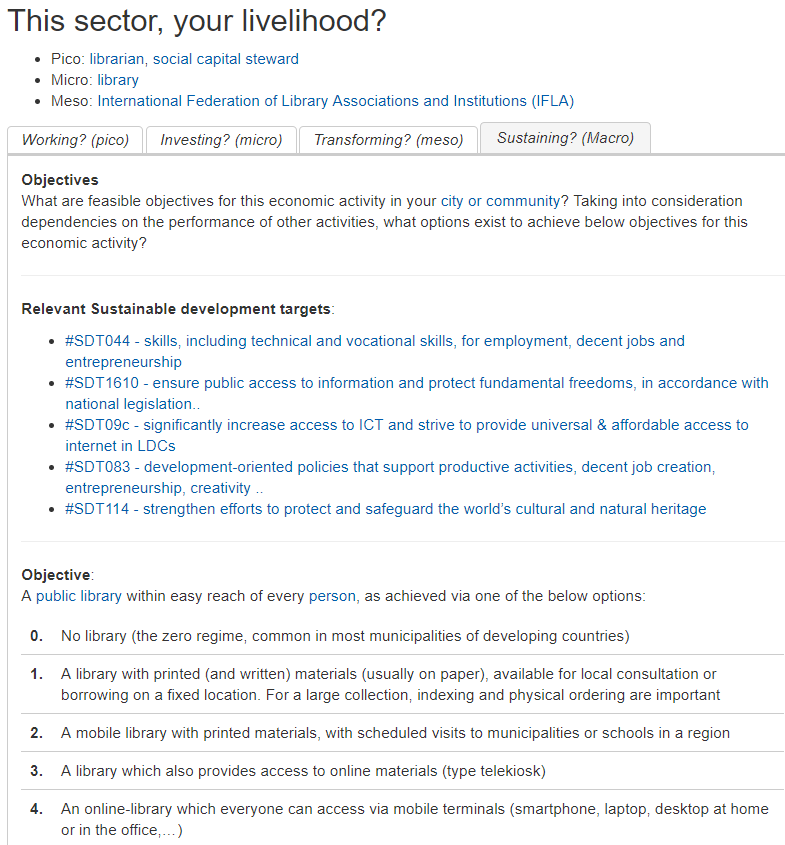
For each economic activity that matters to a community, a number of general facts, links to resources, and questions about improving it are included. For instance for #isic9101 - Library and archives activities some part of the content is displayed in the screenshot on the previous page.
A Platform for Collective Intelligence
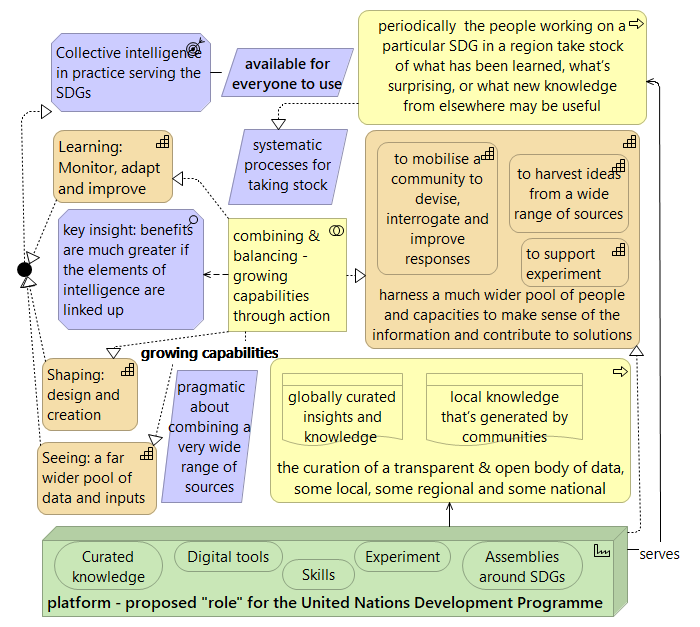
In a recent blog post Geoff Mulgan (2018) discusses how collective intelligence can support achieving the Sustainable Development Goals (and How the United Nations Development Programme (UNDP) could become more like a platform). In the figure below we have summarized some of the key points from the post.
While all the proposed processes and capabilities have their specific challenges, we conjecture that collaborative #tagcoding and wiki-editing would facilitate the communications among all stakeholders, and would free much time for the substantial action that is most needed.
A knowledge localization model
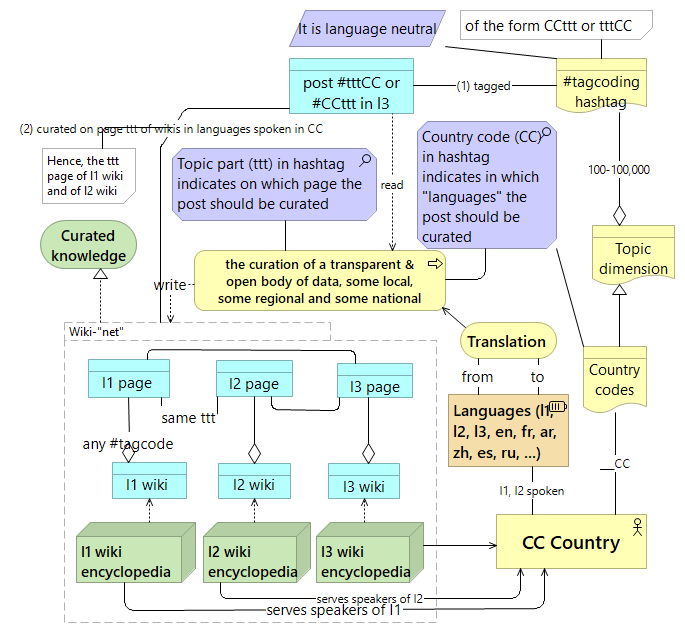
Within the broader platform for collective intelligence that was proposed in the previous section, this handbook’s focus is on the process “curation of a transparent and open body of data, some local, some regional and some national” and how it is facilitated by:
- #tagcoding, the use of standardized hashtags to relate online information to specific topics in order to structure it and retrieve it easily;
- #xy2wiki for language xy the creation of an initial wiki supporting #tagcoding of content in the language;
- #tag2wiki for local languages the joint creation, maintenance, and coordination of wikis for development communications in the local languages of a country.
The #lean2book process about authoring and publishing e-books that leverage #tagcoding and #tag2wiki wikis is not addressed in the figure.
Together, #tagcoding, #xy2wiki and #tag2wiki are important digital skills for accelerating both the production of curated knowledge in support of knowledge localization as envisioned by Joseph Stiglitz (2000) and the provision of a platform for collective intelligence and public debate.
Leading in the age of digital interdependence
In 2018, the UN Secretary-General António Guterres launched the High-Level Panel on Digital Cooperation. Its purpose was to advance proposals to strengthen cooperation in the digital space among Governments, the private sector, civil society, international organizations, academia, the technical community and other relevant stakeholders.
On June 10, 2019 the Panel released its report The age of digital interdependence. The assessment of the current situation, the gaps, the vision and the recommendations are summarized in the figure below.
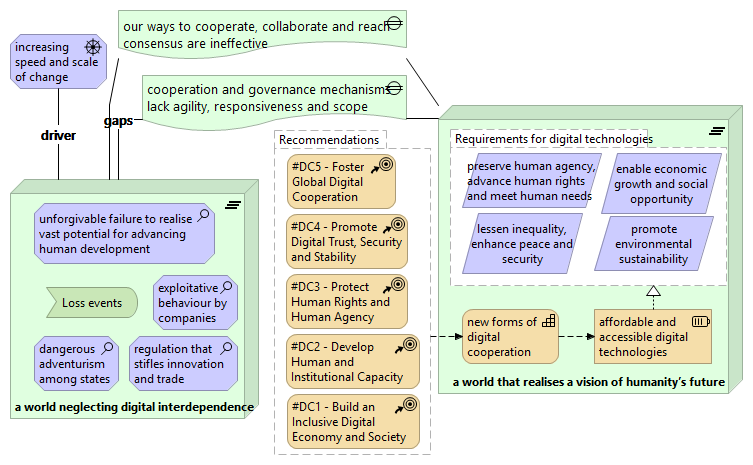
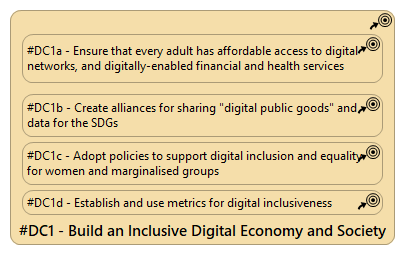
Collaborative #tagcoding and #tag2wiki are especially related to the recommendations “#DC1b - Create alliances for sharing “digital public goods” and “#DC1c - Adopt policies to support digital inclusion and equality for women and marginalised groups” which are part of the recommendation on building an inclusive digital economy and society.
#Tagcoding and decision making journeys: policy
In an inclusive culture, the leadership gives each individual personal attention and room to contribute, ask, learn and develop.
How would coding hashtags affect a country’s democratic decision making?
When a country’s parliament committee, an executive, or a local government unit puts a topic on their agenda, this event deserves a post that is tagged suitably, or a news article sharing the related hashtagcode. Stakeholders in the debate follow-up a tag’s timeline and can contribute their views “in the open” by #tagcoding their posts or by “liking” what others contributed (see also E-Parliament tagger, elaborated during a European hackathon in Brussels, early 2014).
Authors and public communicators only need a simple search for a #tagcoding hashtag to assess a debate’s coverage or neglect. When readers observe neglect, the coding hashtags empowers them to ask questions, “like” prior questions or answers, or contribute content to fill content gaps.
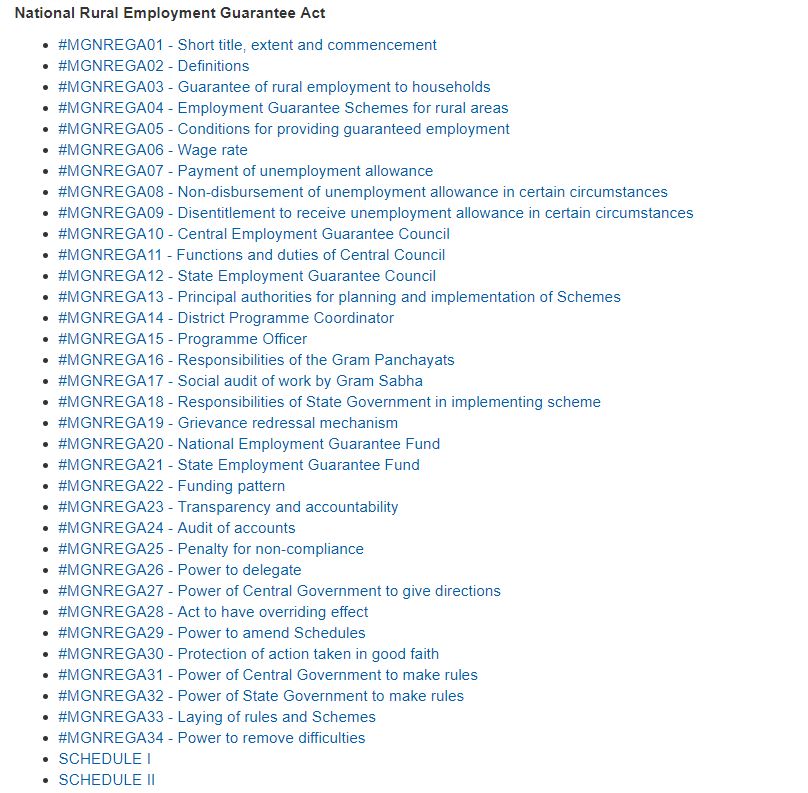
Where the topic is a lengthy proposed act, it is an option to use a single hashtag and wiki page for each article of the text, both before and after its enactment. This is illustrated for the Mahatma Gandhi National Rural Employment Guarantee Act, 2005 in the screenshot on the next page.
At the base of the digital pyramid consider farmers in a developing country using a tablet on a time-share basis, paying access to internet per minute, with low bandwidth. This model has been implemented by “info ladies” biking to remote Bangladeshi villages since 2008 (Julien Bouissou, 2013). Once the #tagcoding and #xy2wiki localization model has been adopted, and when a wiki in the local language is available, the farmers in remote villages could use the coding hashtags to quickly access content that matters to their livelihood. With the hashtags they can find recent, relevant and popular content in seconds. A short period of using a tablet will allow them to find answers, or to contribute to a topic or post their questions.
Using the contemporary internet and social media, the collaborative #tagcoding is a small step that would nurture and enable a radically more inclusive public-private discourse and localization of knowledge. Both the discourse and the access to knowledge are key characteristics of a civilized and open society, in all countries.
#Tagcoding and decision making journeys: Do-Check-Plan-Act
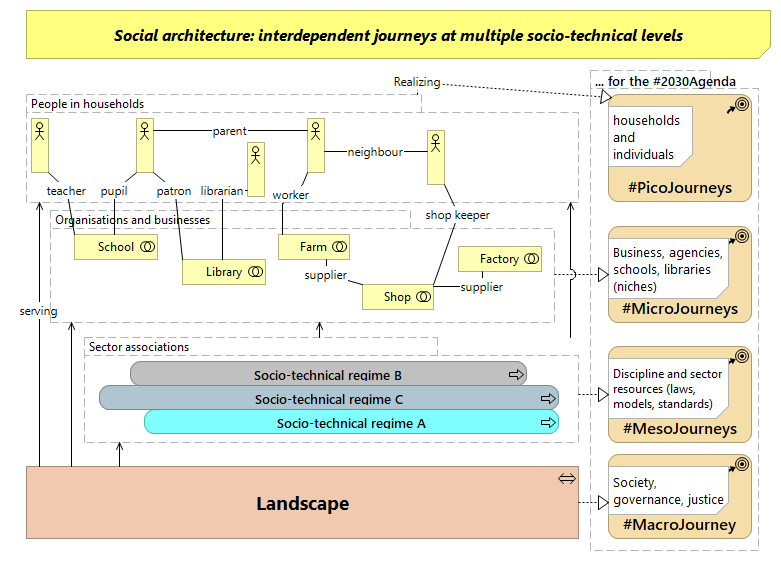
As knowledge creation is a general purpose need, the journeys that will be affected by #tagcoding are countless. The Actor Atlas page on multi-level social architecture proposes four kinds of journeys that are related to the level of scope of the knowledge creation and the decision making:
- pico journeys of households and individual persons;
- micro journeys of businesses and organizations;
- meso journeys of sectors of the economy;
- macro journeys of governance bodies with a local, over national to international extent.
The model below briefly clarifies the scope and the agency in each kind of journey.
Depending on the socio-technical level the scope of the work-system of an actor will vary. Yet each work-system, whether on the macro, meso, micro, or pico level, has operations in the “DO” stage (the Lifeworld. It’s value adding feature is reflected in the yellow colour. Improvements of the work-system, for instance better resilience, higher profits, smaller phone bills, better education, are typically achieved in “Check-Plan-Act” cycle, the so-called roundabout work capability. In these roundabout activities, knowledge sourcing from the “Peer knowledge system” is all important. The “air-like” feature of knowledge is reflected in the blue colour of the Peer knowledge system.
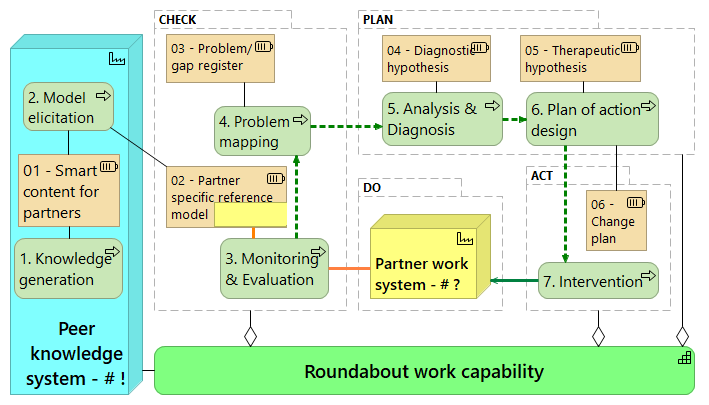
Relying on the available internet and social media platforms, the #tagcoding conventions proposed in this e-book establish at once communication channels between on the one hand, the global peer knowledge system usually providing answers (#!), and on the other hand, work systems in all economic activities, all functions of government, and for all products of the contemporary global economy, usually having questions (#?).
The sustainable development goals and targets would typically be part of the “02 - Partner Specific reference model”, with measurements for indicators clarifying the seize of problems.
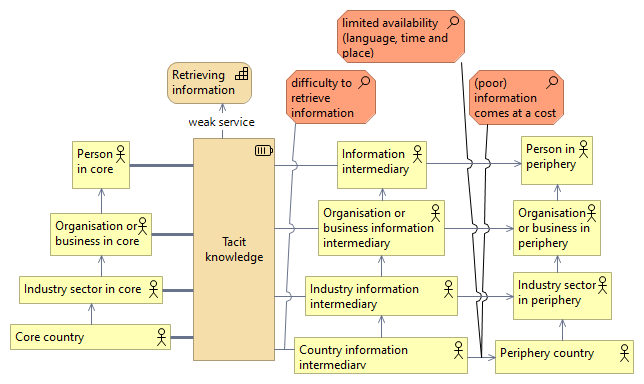
However, remember the SECI inefficiencies that exist outside the micro-level of scope (chapter 3.1) and consider the access to tacit and explicit knowledge of persons in the core or periphery of the “knowledge economy”.
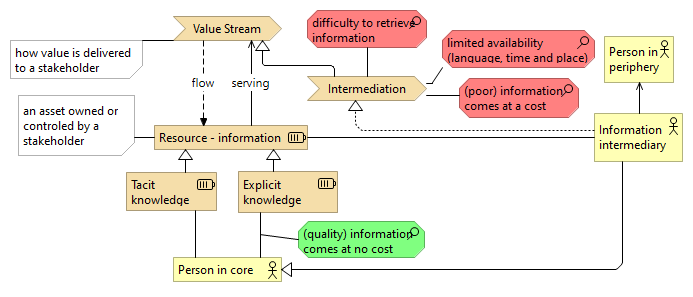
Persons in the core usually have easy access to both tacit and explicit knowledge, this is at no costs, or with costs that are proportional to the benefits of the access (green). In contrast, persons in the periphery depend on the services of information intermediaries for such access. The need for intermediation renders the information more difficult to retrieve, limit availability, and implies costs that are usually not proportional to the benefits of the access (red). The outcome is that knowledge is used far less in the periphery than in the core.
Or when focussing on the service that tacit and explicit knowledge offer to the “Retrieving information” capability, it can be concluded that explicit knowledge has the potential of offering a strong service, especially when there are no paywalls, and that tacit knowledge provides a weak service to the capability.
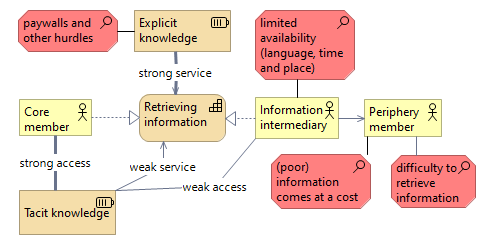
In the next two figures we apply the previous pattern at each level in the social architecture, for the actors in the respective journeys. For actors in the periphery, the combined inefficiencies for knowledge conversion that are induced by reliance on tacit knowledge are substantial, making key decision making tasks insurmountable.
In contrast, once explicit knowledge becomes directly accessible to actors in the periphery, the knowledge conversion transformation that it sets in motion will likely become able to move mountains in the decision making tasks.

Further details about how precisely #tagcoding and #tag2wiki can contribute to information retrieval as part the Capacity for the 2030 Agenda is provided at some pages of the Wikiworx Academy wiki.
Knowledge localization in more languages: #xy2wiki
Language is probably the most important determinant of being in the core or the periphery in the global society. In the previous section we argued that an inclusive platform for knowledge localization must use the local languages of all countries.
While this e-book and the wikis referenced in it are written in English, the provision of systematized content, explicit knowledge, via #xy2wiki wikis, the #tag2wiki curation of content, and the lean authoring of e-books (#lean2book) must be performed in many more languages. It is a necessity if we want broad-based knowledge localization that reduces the gap between the core and the periphery.
We must bridge the digital and knowledge divide that currently exists for many people who don’t master English or another major international language. Check the Local Content Accelerator - #DA2I for more ideas on and possible approaches to accelerate the provision of content in many more languages, and by doing so, contributing to poverty reduction and sustainable development impacts.
The #xy2wiki programme is only a small first step which should be implemented for the languages listed in Annex 6.
To facilitate this step Wikinetix makes available wiki-templates for cloning in the context of specific country-wide or stakeholder-specific wiki editing:
- For National Follow Up and Review - #NFUR00 a draft template is available.
- For Voluntary stakeholder reporting - #2030VSR a template will become available later.
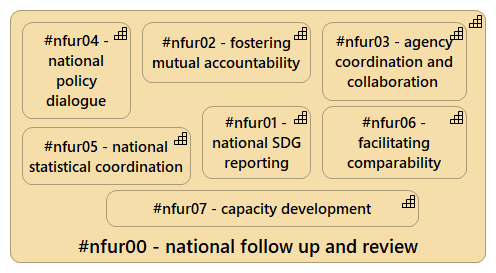
Both #tagcoding and #xy2.wiki are part of capacity development in a country, one of the pillars of National Follow Up and Review processes as depicted in the figure below. In the social architecture, the other 6 capabilities are best seen as the result of macro journeys. They will benefit from accessible explicit knowledge in the languages of the country, and facilitate decision making journeys of all stakeholders in a country, from citizens and households to local and national government agencies.