Preface to the third edition
Following the publication of the recommendations by the UN Secretary-General’s High-level Panel on Digital Cooperation, it seems fair to claim that by practicing #tagcoding, #xy2wiki and #tag2wiki one shows a commitment to the Declaration of Digital Interdependence:
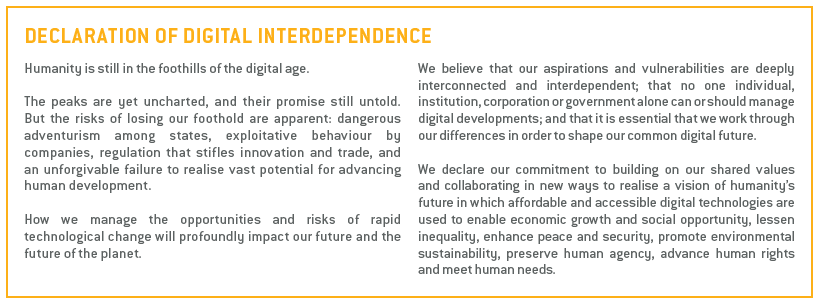
In the third edition have been added:
- Chapter 2.10 #Tagcoding and decision making journeys: Do-Check-Plan-Act explains how the #tagcoding and #tag2wiki eco-system models could supply knowledge and information to innumerable development partners improving their work systems;
- Chapter 2.8 Leading in the Age of Digital Interdependence explains briefly how #tagcoding and #tag2wiki practices fit some of the recommendations of the UN Secretary-General’s High-level Panel on Digital Cooperation;
- Chapter 7 on and Annex 4 with the coding hashtags for the Central Product Classification;
- Annex 5 with the coding hashtags for all the sustainable development goals and targets.
The eighty pages of annexes with coding hashtags are not intended for linear reading. The inclusion of the annexes gives support to readers using in-document search to look up #tagcoding hashtags for a topic. The online pages to which links are provided contain additional information that is not included in this e-book, for instance:
- the #tagcoding pivot for over 190 countries in the six official languages of the UN;
- definitions from the COFOG, ISIC, and CPC classifications;
- WWlgu #tagcoding hashtags for tens of thousands local government units around the world;
- for each sustainable development goal, there is information on the functions of government and the economic activities that are best placed to contribute to achieving the goal; and there are links to the engagements for the goal on the United Nations Partnerships for SDGs platform;
- for each economic activity with #isic hashtag, the wiki page lists corresponding CPC codes and coding hashtags, and vice versa.
In summary, the eighty boring pages of the annexes provide an entrypoint into an online resource of several thousands of wiki pages and links to databases.
My special gratitude goes to Gérard Chenais who translated the second edition of the #tagcoding handbook into French: “Manual de #tagcodage”. During the translation a small number of readability improvements were included in the French translation of the 2nd edition:
- ISIC and COFOG class urls in the annexes have been replaced by a far smaller number of urls for COFOG divisions and ISIC sections;
- The landing views for the #tagcoding pivots have been redesigned so that they fit on a single screen of a mobile phone (Chapter 3.5 #Tagcoding pivot pages per country);
- The figures have been improved.
These improvements have been included also in this third edition of the #tagcoding handbook.
I am aware that the book is rather brief in explaining the figures and tools. Why using many words if a figure says more than a thousand words? Suggestions pointing out which figures or tools need more explanation are most welcome in the Forum of this book and at the book’s feedback page.
Following the first translation of the #tagcoding handbook, and referring to the vision of advancing human development through shaping a common digital future, I wish to draw your attention to a call for translators and wiki-editors that will bring the #tagcoding and #xy2wiki skills into practice in as many languages as feasible.
If English isn’t your native language, may be you can contribute to affordable and accessible digital technology in your native language. Contact me via X, Bluesky, Mastodon or LinkedIn.
The author, Malle, June 16, 2019.