Standing on Giants’ Shoulders
Do you really see further or is the air just thinner up there?

Platforms are a common sight in daily life—they are normally a structure that you stand on; for example to catch a train or to get a better view. Generally defined as a raised level surface on which people or things can stand, technology platforms also appear to be raising things up a level or two. A platform model powers many successful companies, while cloud platforms have transformed modern IT operations by democratizing access to compute resources.
Platform effects are not new. In their like-titled book, Kim et al.1 link the success of the Roman Empire to an open ecosystem strategy enabled by 80,000 kilometers of roads. They created a multisided market that spanned much of Europe and reduced the friction for interaction between (not always voluntary) participants. The old saying that all roads lead to Rome seems to equally apply to large modern platform companies.
An eloquent—and widely cited—metaphor for using platforms are the words commonly attributed to Sir Issac Newton (although traced back to the 12th century):
If I have seen further, it is by standing on the shoulders of giants.
Many platform businesses have become giants, and architects have a keen desire to see further, so let’s begin by taking a look at the concept of platforms and their various flavors.
Platforms Elevate
A raised platform elevates you. This applies to train platforms as much as to product or technology platforms: building on top of a technology platform means you don’t need to start from scratch but can build on top of what others have created. Using a marketplace platform gives you instant access to a large set of merchants or customers. Publishing content to a social-media platform can elevate you to millions of participants consuming your content.
As powerful as platforms are, so elusive is their precise definition. Perhaps that’s why Kim et al. resort to cataloging platform definitions spanning more than a decade. In his course on platform strategy for MIT Sloan’s executive education, Zach Church aims for a definition of platform strategy:
Most definitions portray platforms as amplifiers: they create something bigger than just the sum of their parts. This characteristic helps explain the popularity of platforms, but also leads to another insight:
 |
Platforms generate value through the interaction between their participants. |
A platform without participants isn’t providing value. It’s like a farmers market that’s lacking farmers and customers.
To offset your instant enthusiasm for such a powerful model, Church quickly reminds us that building a platform is “really, really hard”. So, before you decide to jump on the platform bandwagon (there’s a fundamental flaw in that mix of metaphors that I am intentionally overlooking), you should take a closer look at common types of platforms, their characteristics, challenges, and benefits.
Platforms: Faster, Better, Cheaper. Really?
The popularity of platforms in both business and IT domains is easy to grasp when you see the outstanding results that platforms deliver. Just like any major buzzword, platforms are also subject to hyperbole and re-labeling. My bank is now a financial platform, the local bookstore has become a content platform, and the supermarket has evolved into a marketplace platform. If you take the words from marketing departments at face value, you might even believe that without a platform your business is utterly doomed.
Let’s put our feet firmly on the ground (or the platform, so to speak) and dissect the buzzword to understand the benefits platforms provide in different contexts:
- Platforms enable
-
Platforms generate value by allowing participants to benefit from the presence of others. Those participants can be buyers and sellers in a marketplace who gain access to a wider range of goods or prospects, respectively, and can transact more easily and safely. They can also be users of common technology platforms like cloud computing, which encourages experimentation with a consumption-based charging model. Content creators and consumers participate on social-media platforms to share and interact globally.
- Platforms democratize
-
Successful platforms make it easy for participants to join thanks to low barriers. For example, modern e-commerce platforms allow independent sellers to join with much less friction than trying to supply a major supermarket chain. Many influencers and content providers on social-media platforms started with a low initial investment, which would not have been possible in a traditional media model. Likewise, users can access powerful cloud platform services for pennies an hour.
- Platforms self-perpetuate
-
Platforms that enable the exchange of (virtual or physical) goods between sellers and buyers appear to provide a form of perpetuum mobile: more buyers make it attractive for sellers to sign up for the platform, which in turn leads to a wider selection, which attracts more buyers. Walmart has known for a while that having one store carry everything is a promising business model. Modern platforms do so without the endless aisles and long checkout lines. Meanwhile, onboarding a new participant carries a near-zero cost: Airbnb doesn’t need to build a hotel room to increase its inventory. Such near-zero marginal cost business models are a key tenet of fast-scaling digital business model success.
- Platforms accelerate
-
IT platforms and marketplace platforms alike handle common but laborious tasks (“undifferentiated heavy lifting” in the parlance of a major cloud provider). By making this toil go away, platforms allow their users to focus on innovation and differentiation, whether it’s an application that they are developing or social media content that they are uploading.
- Platforms don’t constrain
-
Many approaches that promise acceleration rely on a “my way or the highway” model: users benefit from lower friction if they abide by the rules of the framework. Platforms accelerate without constraining: Airbnb and other marketplace platforms offer more types of properties than traditional hotel chains, and cloud platforms allow users to build virtually anything on top.
Having been sold snake oil for decades, enterprise decision makers might look at these effects with a healthy dose of skepticism. Should we file platforms along with “model-driven architecture”, “executable design models”, and “seamless portability” in the large drawer of past technology ideas that not only sounded too good to be true, but actually were? Are platforms, in the words of a recent Twitter user, just reinventing the wheel? Not so fast! Platforms are for real and are here to stay.
Established Platform Models
The success of platforms comes at a price: the label is used for numerous, quite different constructs. Although they share similarities, the mechanisms behind the different types of platforms are quite diverse. On the upside, platforms aren’t an entirely new concept—it’s just a common IT misbelief that we invented everything. Extraordinarily successful platform examples from automotive manufacturing, e-commerce, media, and IT will put the power of platforms in context.
Automotive Platforms
I am well known for car analogies, so I take great pleasure in reporting that automotive manufacturers have been using a platform concept for many decades (see Wikipedia). Those companies realized that a huge amount of engineering effort went into a vehicle’s technical and safety components, such as engine, transmission, suspension, and anti-lock brakes. However, these engineering marvels are rarely visible to a prospective customer visiting the dealership. Even though the customer will consider safety ratings, power, and fuel consumption, which do result from the underlying components, purchasing decisions are often made based on the shape of the car, the interior finishing, the suppleness of the seats, or the badge on the trunk (boot).
It was a logical move, then, to reduce cost by conducting the base engineering effort once and reusing the chassis and its components across models. Following this strategy, car manufacturers could offer a variety of car models, targeted at different customer segments and often under different brands, without exploding engineering costs. Those cars exhibited a distinct look and feel despite sharing many components “under the hood”.
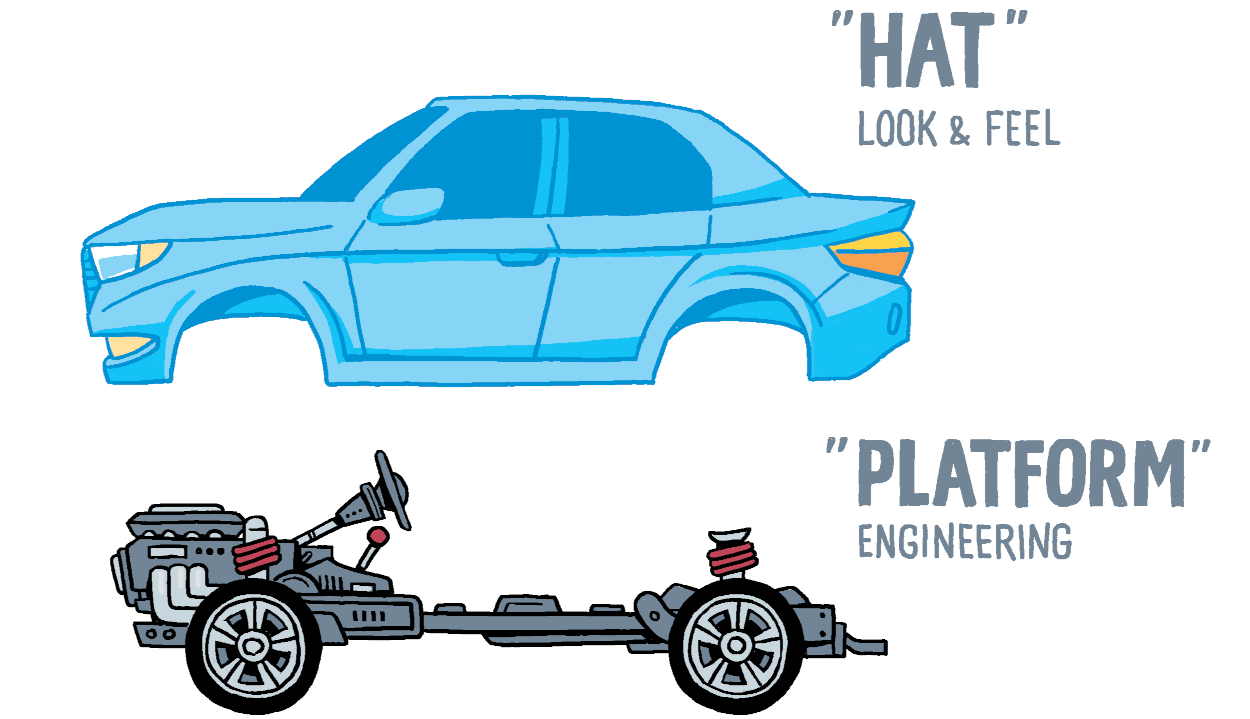
These kinds of platforms are often referred to as “product platforms” or “inner platforms” to distinguish them from external platforms that involve customers or partners. The initial incarnations reused a complete chassis and many body parts, leaving relatively little room for customization. Some manufacturers described this approach as placing a “hat” (the car’s body and interior) on top of the shared technical platform (the chassis).
Volkswagen, which began using automotive product platforms in the 1970s, evolved the platform concept into several modular platforms, such as the Volkswagen Group MLB platform. Roughly translating into “modular longitudinal toolbox” (longitudinal referring to the engine orientation), it forms the basis for an amazing range of vehicles, from the Audi A4 all the way to the Bentley Bentayga SUV (using the so-called MLBevo matrix). Volkswagen’s new MEB platform is looking to achieve the same for electric cars.
Against common belief, standardizing on shared platform elements didn’t reduce choice or stifle automotive innovation. It achieved the exact opposite by boosting product diversity and technical innovation. BMW, for example, expanded its model range from a handful of series (3, 5, 7), to eight sedan series, eight SUV/crossover series, seven electric car series, several M series, plus a range of Mini vehicles. Such model diversity would not be economically viable without a platform strategy.
|
Automotive platforms amortize large engineering investments across a diverse range of models. Harmonizing those elements boosts diversity and innovation in others. |
Common platforms provide better economies of scale for engineering innovations such as anti-lock brakes or autonomous driving. The standardization achieved via the platform (coupled with componentization) boosts innovation, one of magic properties of platforms.
With platforms, as with many other things, too much of a good thing can become an issue. The history of automotive platforms teaches a lesson about how much can be unified into the base platform and how much differentiation should remain on top of it. Based on the initial success, US car manufacturers took the platform idea a little too far in the 1980s by manufacturing essentially identical models that differed just in a few options or cosmetic elements. At its extreme, only the brand and model badges were different—a technique referred to as “badge engineering”.
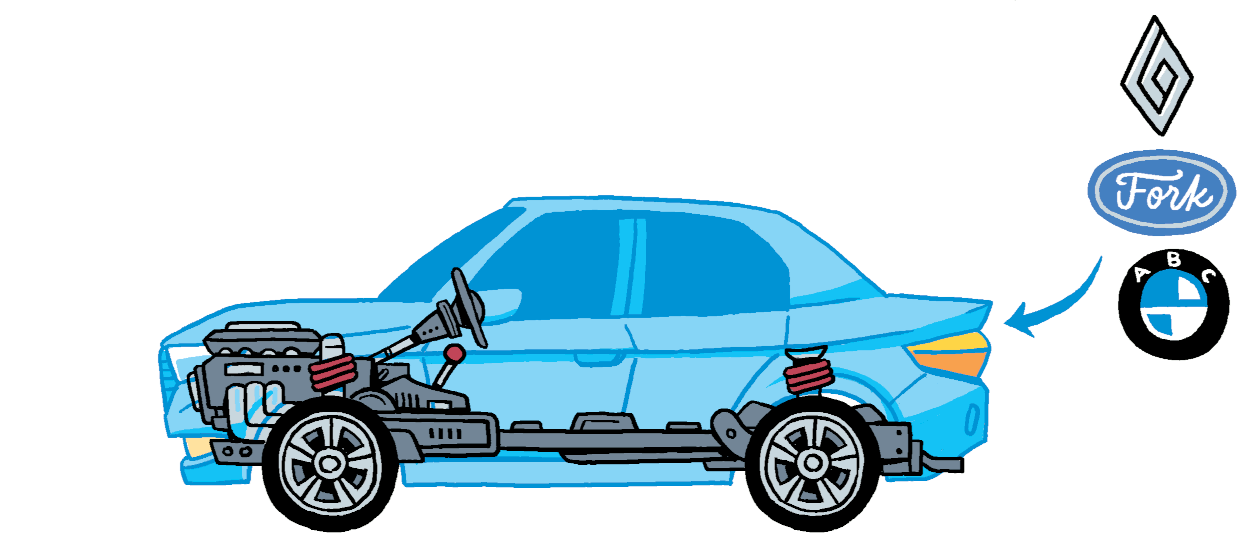
Although tempting, this approach negated a key platform benefit: supporting diverse models and boosting innovation. Unsurprisingly, these attempts largely backfired, immortalized by the Cadillac Cimarron, which was positioned as a luxury car but was virtually indistinguishable from a fully equipped economy-class Chevrolet Cavalier. Its abysmal market response earned it a place on Forbes’ list of Legendary Car Flops and its only contribution to the automotive world was lending its name to the “Cadillac Cimarron Effect”.
 |
Automotive history teaches us that both what’s in the platforms and what’s on top matter. Near replicas don’t work. |
A critical success factor for platforms is defining which aspects can be harmonized and which ones must be kept variable.
E-Commerce Platforms
When speaking about platforms these days, many people refer to digital ecosystems as embodied by companies like Amazon, eBay, Gumroad, Alibaba, and the like. These marketplace platforms connect buyers and sellers or people sharing a common interest.
A suitable definition that captures the intention of these business models can be found in Reillier’s book, also titled Platform Strategy:3
Not all marketplaces are platforms. An analogy from the retail business helps find the delineation. A supermarket connects buyers with goods to be sold while holding its own inventory and being directly involved in the purchasing transaction. In contrast, a farmer’s market connects buyers and sellers directly, letting them handle the transaction and maintain inventory. Whereas a farmer’s market is a “multisided platform”4, a supermarket is—strictly speaking—not. Farmer’s markets democratize and enable transactions between farmers and consumers (the two sides), whereas supermarkets actively manage—and control—their supply chain.
Physical marketplaces and e-commerce platforms enjoy broad flexibility in their pricing models:
- They can charge buyers, for example by charging admission to a trade fair or farmer’s market. Likewise, online platforms can charge membership fees to buyers, often pegged to premium services like fast or free delivery.
- They can charge sellers, for example by asking a fee for a farmer to have a stall. In the online world seller fees can be listing fees, transaction fees, membership fee, or any combination thereof.
- They can monetize through third parties, for example by inviting sponsors or selling advertising space, both in the physical world or the online counterparts. They can also monetize the data they collect by selling it to third parties.
This flexibility allows e-commerce platforms to offer services “for free” to select groups of the multisided market. Shifting pricing between participant groups or subsidizing specific types of transactions enables platforms to balance supply and demand, to drive growth, or, inversely, to moderate growth to uplift the quality of content or goods. Despite the risk of backlash, changes in pricing models are fairly frequent. Meetup provided a dramatic example by losing some 95% of their listings, but drastically improving quality, after starting to charge fee to organizers5.
As the platform enables direct interaction between participants, it steps into the background—just like a real-life platform that’s underneath the real action. Online platforms may be barely visible because they allow retailers to operate as white-label shops; for example, on Shopify. Likewise, when you visit the farmer’s market you might notice the organizer’s presence only by a banner at the entrance and a small organizer’s booth. This is quite different from a supermarket where you are keenly aware of whose “ecosystem” you are in.
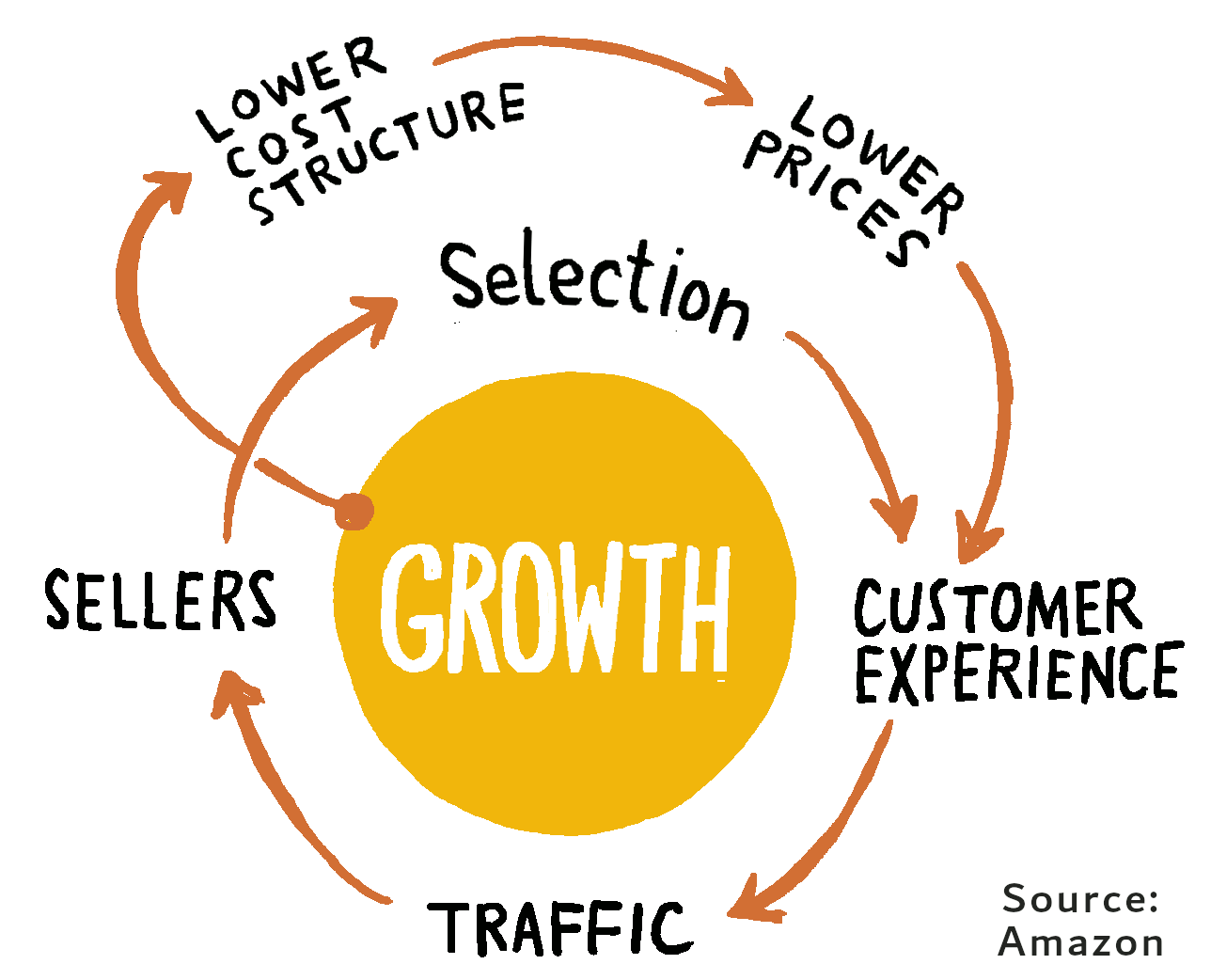
Major e-commerce platforms such as eBay, Amazon (which is careful to label itself as a marketplace), or Airbnb have harvested the perpetuating scale effects cited at the beginning of the chapter. Amazon refers to this virtuous cycle as The Flywheel, inspired by the model presented by Jim Collins in Good to Great.6
This wheel includes two positive feedback loops. The first occurs over the number of buyers and sellers, which fuel each other’s participation: more buyers attract more sellers, who carry a wider selection, which attracts yet more buyers. A secondary loop lowers the cost structure with increasing scale, which in turn allows lower prices, which then further fuel growth.
Such feedback loops are behind the tendency of e-commerce platforms’ toward a “winner takes all” scenario in which a single platform dominates its respective market segment. That’s the power of platforms and positive feedback loops.
Media Platforms
A close relative of e-commerce platforms are social and media/streaming platforms like Facebook, TikTok, Netflix, Twitch, and many others. Like their cousins, they operate a multisided market that connects providers and consumers of services, in this case, social data (photos, posts, events) or media such as audio and video streams. They enjoy a similar flywheel effect that attracts consumers to the platform with diverse content, which in turn attracts content providers because they’ll get more eyeballs. They may lack the outer loop of lower prices (their cost of goods tends to be near zero) but that hasn’t dampened their growth in the least bit.
 |
The internet bubble of 2000 was driven by the obsession with “eyeballs”, replacing traditional metrics like revenue or profit with the number of viewers. Two decades later, platforms have figured out how to scale and actually monetize those eyeballs. |
The primary revenue streams for these platforms are advertising or subscription fees. Some media platforms play the role of both the platform operator and a platform participant; for example, producing their own video content (“Netflix originals”) but also distributing third-party content. Platform companies enjoy a large amount of flexibility and tend to experiment all the time.
Cloud Platforms
Cloud computing has perhaps been the most significant IT innovation of the past two decades, being challenged just recently by the rapid rise of AI and large language models (LLMs). The cloud also gave birth to a hugely successful technology business models, with just the top cloud service providers (CSPs) generating combined $200 billion in annual revenue. The collection of on-demand IT services provided by these companies are commonly labeled as platforms, with Google’s cloud offering proudly carrying the label in its name: GCP—Google Cloud Platform.
The original motivation behind cloud platforms resembles that of automotive platforms. Just like cars, software requires a lot of heavy-duty engineering that isn’t directly visible to the end user. Underneath a successful piece of software lies a vast array of compute infrastructure like data centers, global networks, servers and storage, software delivery pipelines, monitoring and failover mechanisms, synchronizing data stores, backup and disaster recovery, and regulatory compliance reporting. Those aspects can consume a large portion of a software project’s timeline and budget before the first line of application code is ever delivered.
Combining those elements into common components that can be reused across many software projects allows developers to focus on providing customer value and differentiation; for example, through rapid feature delivery, unique functionality, or ease of use. They leave the heavy engineering work to the cloud platform providers, who have better economies of scale thanks to their broad customer base. IT departments consume those services in a low-friction way via a so-called cloud console (Web interfaces) or API calls that provision service instances to be used by custom applications.
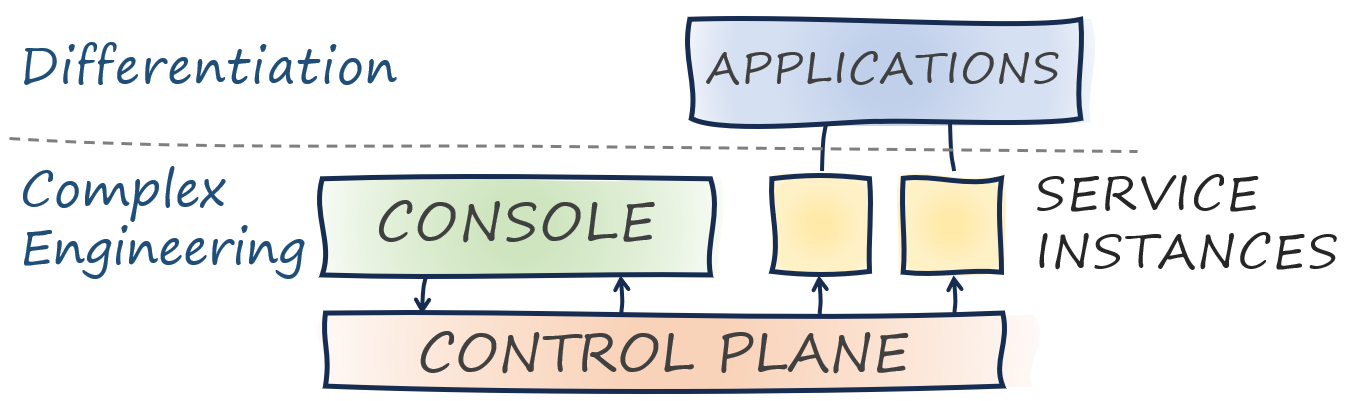
Although they follow similar approaches, cloud platforms also differ from automotive platforms in several ways—after all, they are software. First, usage and application diversity are much broader. Whereas an automotive platform supports a handful of models for a specific automaker, cloud platforms support software development across a vast variety of use cases. It’s the equivalent of using Volkswagen’s chassis, engine, transmission, and suspension to put your custom interior and bodywork on top. Although this model exists as so-called “kit cars” (which generally modify a finished car to simplify registration), it’s a small fringe business and large-scale automotive platforms lack such flexibility.7 Bits and bytes are more malleable than steel.
Second, cloud platforms allow developers to use the common components easily without any welding or assembling. A platform’s value isn’t just defined by what’s inside, but also by how easily its functions can be accessed. This is where cloud platforms shine. Even though they might look like traditional IT outsourcing from far away, the interaction between platform provider and platform user is notably different: month-long contract negotiations are replaced by an API call and near-instant provisioning.
Last, cloud platforms offer more fine-grained components than automotive platforms possibly can, offering several hundred individual services to customers. The only possible challenge remains an abundance of choice.
The success of cloud platforms is nothing short of phenomenal, creating a quarter-trillion-dollar market (according to Gartner) in just a decade-and-a-half. That’s no surprise when you consider that cloud computing has fundamentally transformed IT—from months of infrastructure planning and provisioning to running an automation script and waiting a few minutes.
Business Platforms
Business platforms aim to elevate what cloud platforms achieved for IT infrastructure toward business applications. Starting off as powerful applications, these products added more capabilities for customization by splitting common functionality from specific needs, much like automotive manufacturers did. Prominent examples include SalesForce for Customer-Relationship Management (CRM) and SAP for Enterprise Resource Planning (ERP). The SalesForce application sits on top of the “Force.com” (now SalesForce Platform) development platform, whereas SAP features a Business Technology Platform (BTP), both allowing customers to build their own business applications and customizations.
The critical progression from a feature-rich business application to a platform is twofold. First, the vendors transitioned to a Software as a Service (SaaS) operational model that vastly lowers the friction of both user adoption and platform evolution. Second, configuration settings, which often constrained customers, gave way to custom applications, which utilize the application domain’s data model but don’t place any constraint on the code developed on top. The combination is indeed powerful.
Cloud computing platform vendors haven’t been oblivious to the power of business platforms. Virtually all of them offer business capabilities as services, such as Amazon Connect for contact center management and the Microsoft Dynamics suite for accounting and related business applications.
The Platforms of Giants
There are valid reasons that platforms seem to be everywhere these days. Many platform providers are indeed giants, whether it’s automotive giants, e-commerce giants, or internet giants. That doesn’t mean, though, that there’s already a platform for everything or that you have to be a giant to build one. Let’s go on to catalog widely-used technology platforms, including those that are commonly built in-house.
Kim, Song, Im: Platform Strategy: a new paradigm for a changing world. World Scientific Publishing; 2020.↩︎
As you will discover throughout this book, entering a market is only part of a successful platform strategy, with many technology decisions and trade-offs to be made along the way.↩︎
Reillier B and L: Platform Strategy: How to Unlock the Power of Communities and Networks to Grow Your Business. Routledge; 2017.↩︎
Hagiu A: Multi-sided Platforms: From Microfoundations to Design and Expansion Strategies. Harvard Business School; 2006, working paper 07-094.↩︎
Parker, Van Alstyne, Choudary: Platform Revolution: How Networked Markets Are Transforming the Economy. W. W. Norton & Company; 2016.↩︎
Collins J: Good to Great: Why Some Companies Make the Leap and Others Don’t. HarperBusiness; 2001.↩︎
Volkswagen will, however, sell you a kit to convert your classic into an electric car: https://www.volkswagen.de/de/besitzer-und-service/magazin/elektromobilitaet/classic-cars-turn-into-electric-vehicles.html .↩︎