1. What is fodder?
According to many sources fodder is simply any agricultural foodstuff used to feed domesticated animals, such as goats, cattle, sheep, horses, donkeys, chickens, ducks, geese, rabbits, and pigs. In the case of this book though we are specifically referring to the growth of “micro greens” in a hydroponic 1 system over the course of roughly 7 days. You will see that you can take just about any grain bought at a local feed store, grain mill, or grocery store, and through proper care grow roughly 1 pound of grain into 5-10 pounds of fresh nutritious greens. We have found that these greens are readily consumed by every non-carnivore found on the farm.
Just to be clear, while fodder is indeed truly amazing and can certainly cut your feed bill in half, fodder is not a magic bullet for all animals. Many animals can largely consume fodder as their primary dietary input. But they may also require other supplemental feeds such as dry hay for cows and horses and possibly corn for your pigs. We will cover a proper diet including fodder for the majority of your livestock critters.
1.1 The general process for growing fodder
Sprouted fodder is an amazingly easy way of maximizing the nutrition you feed to your animals while minimizing the cost of your feed bill. We will get into great detail about sprouting fodder later in the book but I felt it was of great importance that we tackle the general principles of how to grow fodder early on. For that reason we will take a high level look into each step found in most fodder operations.
The seed
There are several types of seed that are appropriate for growing fodder. Some are higher in protein or energy than others. So mixing and matching them to build up the appropriate nutritional balance is important. But the thing to know about all seeds is that they have everything in them that is needed to start the plants life in the first few days.
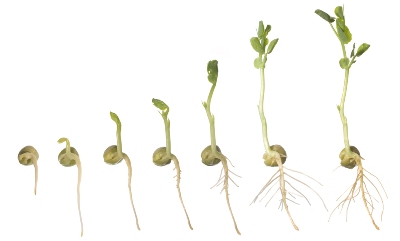
Seed growth chart
Some plants such as grass variants start life with one leaf (monocots). While other plants like beans start their life with two leaves (dicots). The seed is wrapped in a protective covering called the seed coat which protects the embryo of the plant. The seed also contains endosperm which is a food supply for the initial days of the seed until the plant can generate its own food.
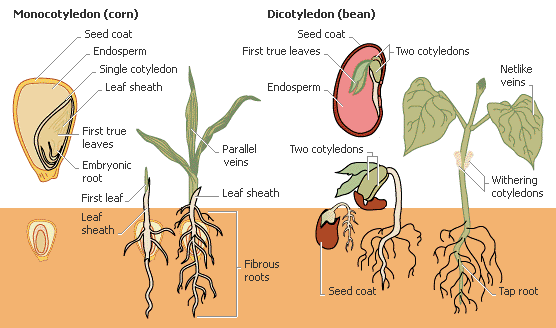
Seed anatomy
In a fodder system, most (but not all) people tend to pre-soak their seeds prior to spreading them out. The duration of this soak ranges from 4-12 hours. Soaking is thought to help weaken the seed coat to help the plant get started with life.

|
TODO: thoughts on an air stone in the soak bucket |
|
|
TODO: thoughts on H2O2 or bleach in soak bucket |

|
Over-soaking Soaking seeds for too long will effectively stop the seed from being able to grow thereby diminishing the number of seeds that will sprout. Each seeds soak rates are different. |
The growing container
There are various containers that you can sprout your fodder in. I will mostly discuss growing in trays as most systems use some form of tray. But any container that you can put your seeds in, fill with water, and drain efficiently can be used.
Trays can be bought from any hydroponics store, home supply stores, online. But you can also use Tupperware containers, cookie sheets, cat liter containers, pvc rain gutters, custom bent steel sheeting, etc.
One thing to keep in mind is that you will be interacting with these trays daily by way of removing fodder and spreading new seeds. For this reason you generally don’t want a tray that is overly flimsy. I built my first system with standard 10x20 plant trays. The plastic is too thin on these for long term use.
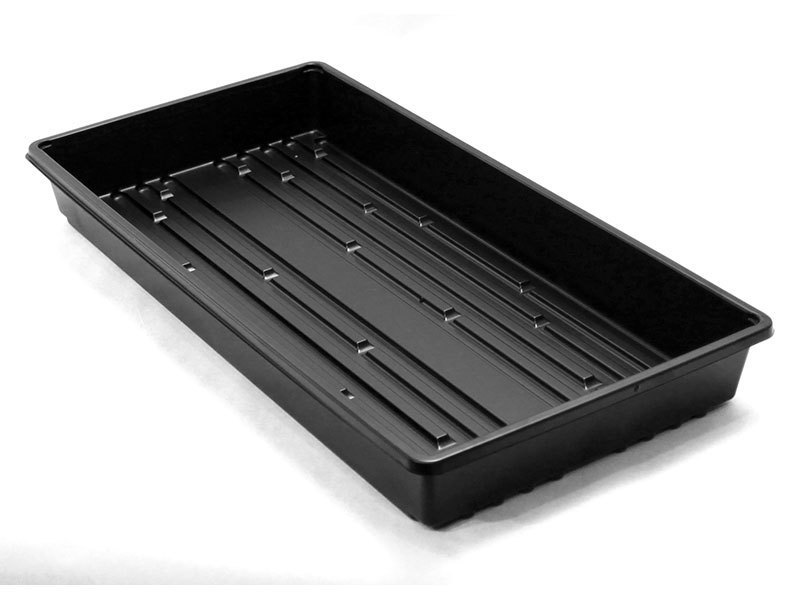
10x20 tray
Water
Once you have your seeds and a container chosen you need to think about how to get water to the seeds. Like all the other aspects of fodder, conveying water to the seeds can be done in many different ways.
Some folks just pour water from their sink faucet directly into their small systems.
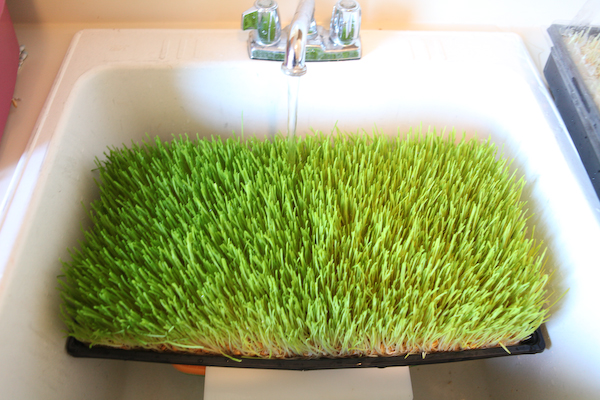
peakprosperity.com watering a tray of fodder
A few folks water their fodder like you would water your normal plants - with a hose and a soft shower wand. This is a great ideas if you have the time as each tray of fodder will get a nice even soak and no more water than it needs.
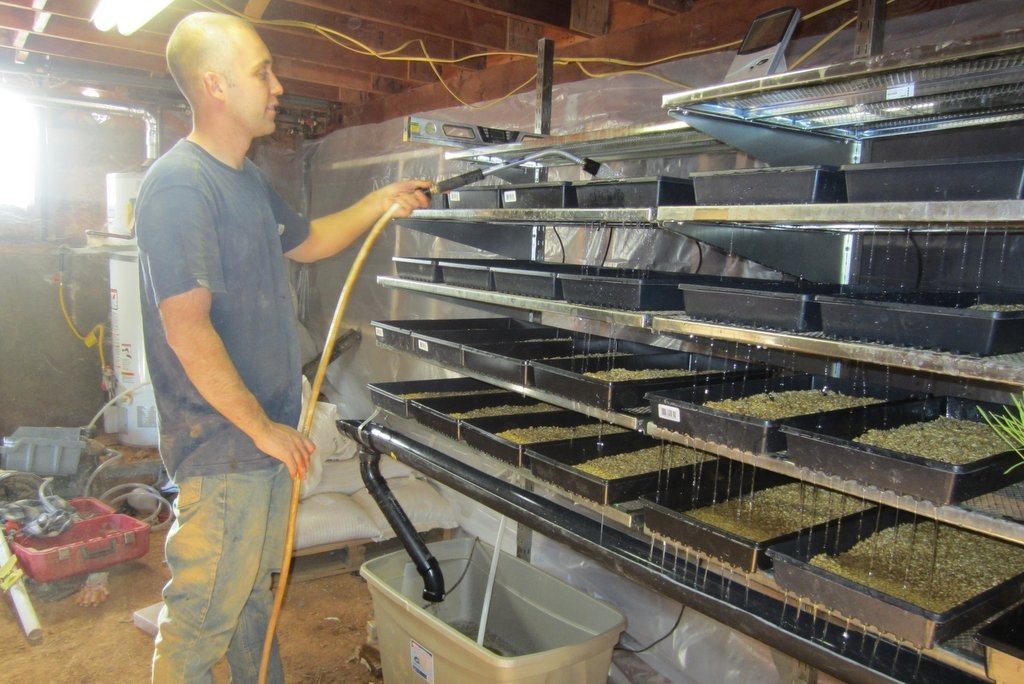
Quartz Ridge Ranch water with a soft shower hose wand
Others keep a large container at the bottom of their fodder system, called a sump tank, at the bottom of the system and pump the water up to their seed containers. You have to be careful with reusing the water from a fodder system. Similar to brewing beer, the longer you soak your seeds the more the starch levels build up in your water. Putting that on your fodder over and over again is a sure way to invite mold and other funky issues into your system.
|
|
Stinky sump tank? If you can smell your sump tank or notice that your water is not clear - change your water. Foul water will certainly impact your ability to grow good fodder. It can also invite mold and root gnats. |
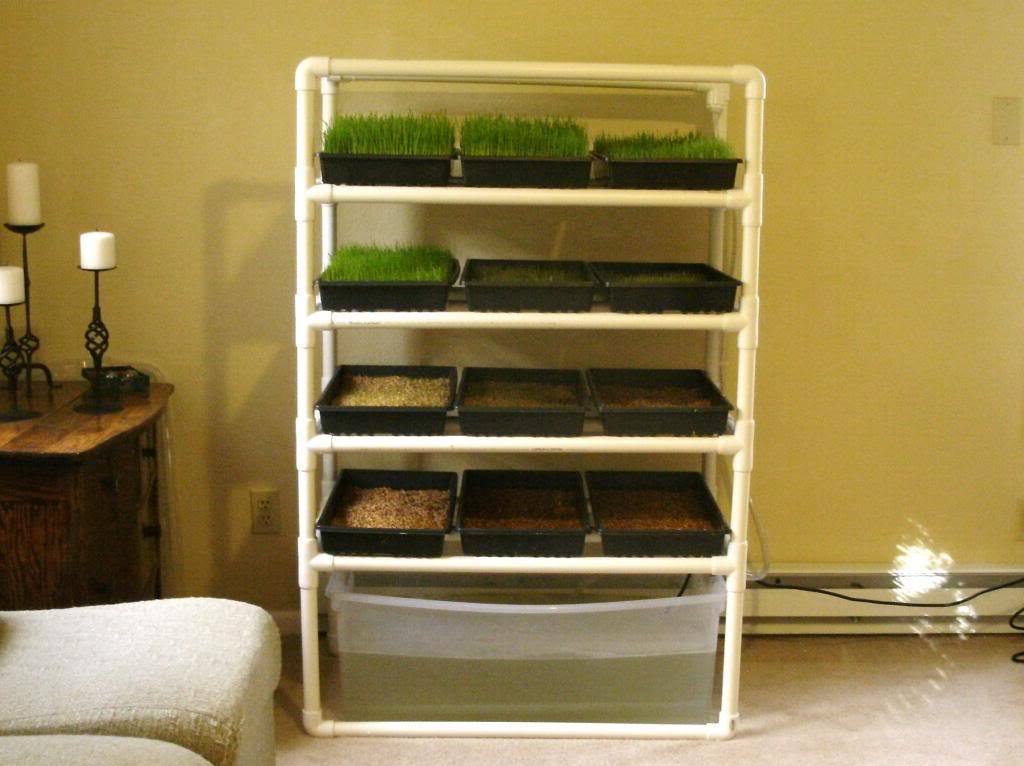
Half Pint Homestead 18 tray system
And some systems have fresh water piped directly in and distributed through irrigation controllers or similar flow controls.
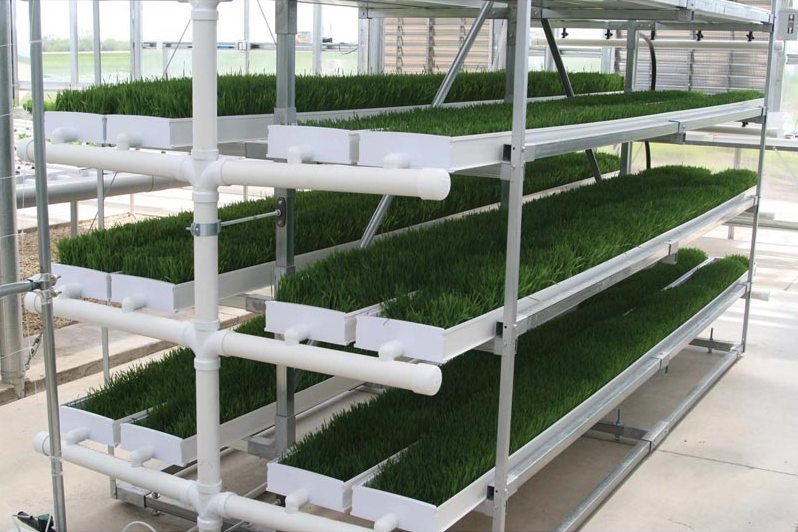
FarmTek Fodder Pro
Drainage
Once you get water into your system you next have to worry about getting all of the water back out. This can be done with a bunch of holes in the bottom of your trays. Or you can accomplish drainage with hydroponic drains. However you tackle this problem it is important that your seeds aren’t left to sit in water for long periods of time.
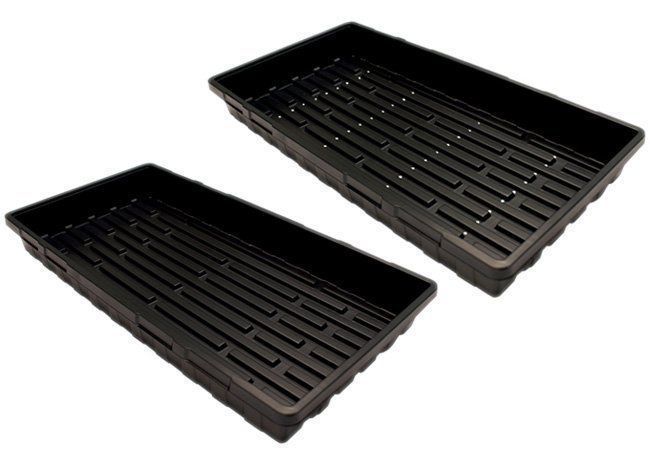
10x20 trays come in perforated and non-perforated
You can also put a commercial drain fitting into just about any format of tray you might have. This can be done by drilling a hole through the bottom of your tray and screwing in this water tight drain fitting. These are the ones first used in David Capocci’s Paca Pride fodder system.
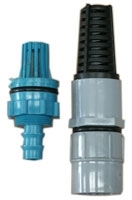
MPT Drain Fitting Kit
Build types
The best thing about growing fodder is that it is amazingly easy to set up a fodder system for yourself in numerous ways based on the amount of fodder you would like to grow each day and the budget that you have available. In this section we will take a quick look at a bunch of different types of fodder systems. In a later chapter we will look deeper into how each works.
Flood and Drain
Flood and drain is a hydroponic/aquaponic growing method where you fill a reservoir with nutrient rich water to feed and water the roots of a plant or plants. Once the water level gets to a predetermined point in the reservoir a drain mechanism kicks in and quickly removes all of the water from the container. This process can either be continuous, on a timer, or manual. In the realm of fodder, the water can be just water, and the drain mechanism might be as simple as holes in the bottom of the container.
Trickle Down
In a trickle down style system water is put into the top tray of a set of trays. From there one of two things can occur. The water then flows from one end of the tray to the other end of the tray where drain holes are located and drains out into the tray below it. Or there are a series of holes throughout the tray and the water just “rains” down on the next tray. This repeats until the water has passed through all the trays and ends in the holding tank or sump.
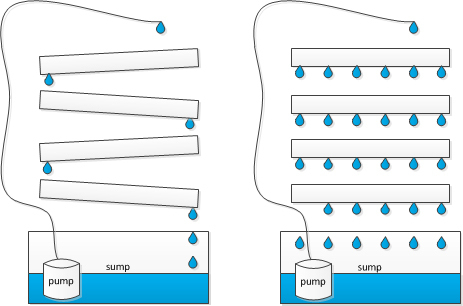
Trickle down fodder trays
There is no scientific evidence to say that one style is better than the other. As long as your water is evenly spread across your seeds for an appropriate amount of time you should be ok.
|
|
Over-soaking Do keep in mind that in both of these systems the time it takes to drain out the top tray all the way down to the bottom tray might take longer than you want your seeds to be under water. Over soaking can occur. And this will potentially kill your seeds. Time the complete cycle to ensure that the water is evacuated fairly quickly. |
Misting vs. Soaking
There are also systems out there that using misting heads at the end of their irrigation lines to thoroughly douse their fodder rather than filling the fodder tray with water. This is an unsolved controversy. However, here are my thoughts.
The seeds roots are what needs the water. Applying a thorough supply of water to the fodder leaves and not as much to the roots doesn’t quite make sense. That is sort of like washing my hair every day without drinking. I wouldn’t last very long with that approach!
Bathing the seed roots also aides in washing any built up impurities around the root system. The starches that slowly build up from soaking the seeds are around the seed husks, not the green leaves. When the seeds are soaked and then drained most of those fly attracting and mold feeding starches are washed away. Of course this only matters if you aren’t utilizing a sump in your system!
1.2 The math behind fodder
To me there are two interesting factoids about fodder. 1 - It costs me less to feed my animals a more nutritious diet. 2 - The price of fodder doesn’t fluctuate like the cost of hay in times of drought, extreme cold, or extreme heat. And like most things in life, the more you buy up front the cheaper it is on the back end.
Simple math with 50# bags
Let’s take a look at purchasing feed for pigs. If you are interested in feeding your animals a quality food then you are probably buying pig & sow blends or high quality cotton cake or similar. You might also be mixing in some whole corn.
Say a bag of pig and sow costs you $20 for 50 pounds at the local TSC. That works out to $0.40 cents per pound. Not horrible. Unless you are buying 30 bags every two weeks! That quickly becomes $600 every two weeks and only gives me 1500 pounds of feed.
Now lets look at a bag of seed for the purposes of sprouting. I buy a 50 pound bag of organic (no less) seed for $30 per bag. Wow that already sounds expensive. But using simple math and knowing that I can always get at least 5 pounds of fodder out of every 1 pound of seed (we will learn how to get a 10:1 conversion in later chapters) I know that the 50 pounds of seed becomes 250 pounds of feed. That is $0.12 cents per pound! Working backwards to see how many bags of seed I need to generate the same 1500 pounds of feed in the end: 6 bags of organic seed. Cost? $180 My pigs can eat all they want at that rate.
Better math when buying in bulk
Now we all know that anyone feeding large quantities of feed to a large herd doesn’t buy in the smallest quantities sold. We want to buy in bulk. I have land and I can store seed so I will buy as much as possible to get the price as low as possible.
|
|
This next paragraph contains heart throbbing information After reading this next paragraph, please take a couple breaths and count to 10. Then continue reading the rest of the book prior to running out and spending money on a new fodder system! |
So let’s talk in terms of bulk. Go buy 2,000 lbs of all organic seed at 37¢/lb (or $18.50 per 50lbs) and you are down to 7.4¢/lb! 7.4¢ for organic, non-gmo, no animal byproducts, feed me as much as I want fodder! The higher your yield the lower your cost.
- Hydroponics - Hydroponics is a subset of hydroculture and is a method of growing plants using mineral nutrient solutions, in water, without soil. The definition for the term hydroponics was sourced from Wikipedia at http://en.wikipedia.org/wiki/Hydroponics. ↩