4. Temperature
In general we try to seek the 65 degree mark. This seems to be where most people report having the best results. Having said that I have heard of people growing at the 55 degree mark. And I have personally grown at the 80 degree mark.
Growing at lower temperatures is totally possible. But the lower temperatures mean that the fodder grows slower. If you have an eight tray system this may be acceptable for you as you will still get a daily supply of fodder. But if you only have 4 or 5 trays in your system you will either have to skip a day or two or just feed sprouts instead of grass mats.
Growing at higher temperatures is also totally possible. Just know that the higher the temperature is the more likely you are to sustain mold damage. Keeping your humidity and temp in check is largely a method of keeping mold in check. Try to keep it close to 65 to be safe.
4.1 Heaters
As with most of these fixes to common problem, it really depends on the size of your fodder system and the size of the room the fodder system lives in. For example, if you have a small fodder system in a big room and you are trying to raise the temperature a couple of degrees, you will have to heat the entire room to get the air around your fodder system to raise in temperature. The size amount of air you are trying to raise the temperature on is the key.
Another factor is the insulation level in the space that your fodder system lives in. As an example, if you built your fodder system in a room wrapped in screen, you need to heat the world. This is a farce of course, but you get the idea. If the room has no insulation you will be fighting the cold. If you have good insulation and sprayed foam in the cracks to insure zero air loss or entry, then you will not need as much power to raise the temperature.
There are many options in the heating world. You can purchase a simple floor heater if you have access to electricity. If you are off grid you might consider a propane powered heater. And if you need a lot of heat for extreme cold then you might want to look at a rocket mass heater like the one Rob Torcellini built.
4.2 Air Conditioners
We all know about using an air conditioner. We turn it on in our home and glorious cold air comes out. However, most people don’t think they need an industrial size air conditioning unit on their fodder systems. And if you did you wouldn’t want the expense of the added AC bill.
Thankfully air conditioners come in all sorts of shapes and sizes. Generally, a window AC unit will work for our application. Just know that if you need to run that window AC for extended period of times it will likely generate an ice build up on the radiator and freeze over. Enter the CoolBot.
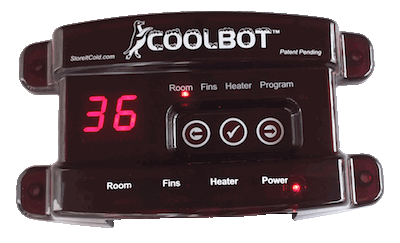
CoolBot
With the CoolBot, you can easily run a small window AC unit continuously. It claims that it can run an appropriately sized AC efficiently enough to get the room down to 32 degrees. As we only need the room to get down to 65 degrees this will work out perfectly for us!
The CoolBot closely monitors the environment of your fodder room. And if it senses anything that will cause the air conditioner to freeze up (literally, ice forms on the fins of the AC), it will shut the AC down. It continues to poke and prod the AC to get it to perform like a champ and cool your room to the appropriate temperature. And at $300, this is a must have for any medium to large size installation.
CoolBot