2. Fodder System Types
Fodder systems come in all shapes and sizes. If you are just feeding a couple bunnies or chickens you can grow in something as simple as muffin pans, glass jars, or small Tupperware containers. If you need to grow enough feed for a couple of cows you might look at a small shelf based system with a series of trays on each shelf. And if you have a full blown operation feeding a bunch of pigs, horses, or alpacas, then a dedicated fodder room with large trays on large shelves might be just the ticket.
Keep in mind when designing your system that the more manual steps there are in your system, the more likely it is to be a non-scale-able system from the start. Meaning expanding the system as your needs grow will exponentially add time to the care and maintenance required by the system. Washing a bunch of small trays, re-seeding all those trays, pulling small chunks of fodder, all takes time.
On the flip side though, the more automation a system has in it, the more scale-able it likely is. But keep in mind that automation adds to the complexity of the system. Which also adds to the cost of the system. And when you have a problem in your fully automated system (like a pump going out), the manual processes required to keep the fodder growing may be even more time consuming or worse, not possible.
2.1 Flood and Drain Systems
Flood and drain is a hydroponic/aquaponic growing method where you fill a reservoir with nutrient rich water to feed and water the roots of a plant or plants. Once the water level gets to a predetermined point in the reservoir a drain mechanism kicks in and quickly removes all of the water from the container. This process can either be continuous, on a timer, or manual. In the realm of fodder, the water can be just water, and the drain mechanism might be as simple as holes in the bottom of the container.
Muffin Trays
Growing small serving size fodder bits can be achieved in just about any container. But this method was especially clever. You can use any muffin tray that you have available. Foil trays like the one in the picture are especially cheap and semi-durable.
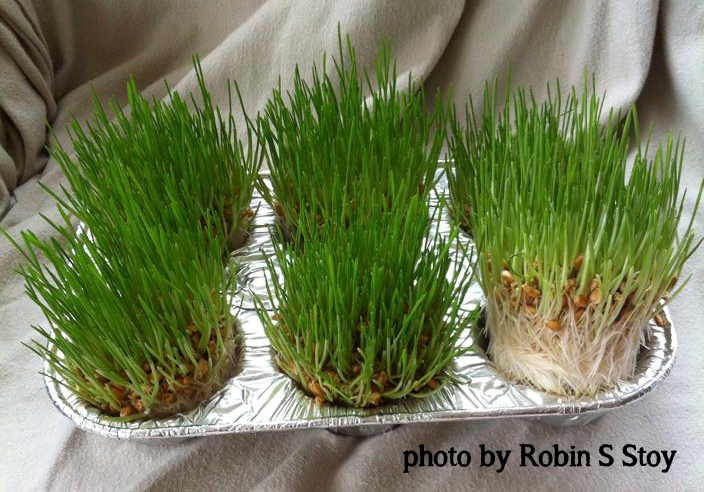
Fodder grown in a muffin pan by Robin S Stoy
Poke a couple of holes in the bottom of the tray. Line each cup with 1/2” of pre-soaked seed. Water once in the morning and once in the evening. And you have little fodder fragments which is perfect for a bunny or chicken.
This style of system is what is referred to as a flood and drain system. You fill the cups up with water. And the water slowly drains out of the bottom of the muffin cups. Simple.
In a Jar
As long as the basic requirements are met, you can grow fodder anywhere. In this case an experiment was being done to see if fodder could be grown in a jar. By placing the seeds in the jar, and tying a piece of cheese cloth over the top, the jar can easily be filled with water and then drained out. This method is also using the flood and drain method.
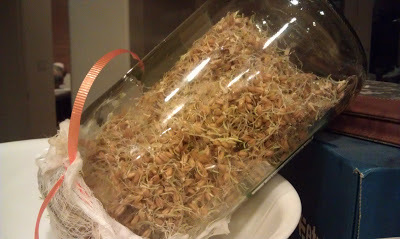
Fodder grown in a jar by Backyard Chicken Lady - http://backyardchickenlady.blogspot.com/
On a larger scale
All of these flood and drain systems work on the same premise which is what allows us to create small or large scale systems with similar understanding. The proper initial system allows you to quickly scale up to a point where you are producing 100’s of pounds of fodder each day. In this system you can see a copy of the fodder system first pioneered by David Capocci, owner of Paca Pride Guest Ranch. It uses a 13” x 40” tray (which David distributes for AmHydro) with a simple drain and overflow set up. In this system fresh water is pumpbed to each tray individually and then drains each tray individually. This sort of system is in use on a great many farms and reliably produces fodder day after day.
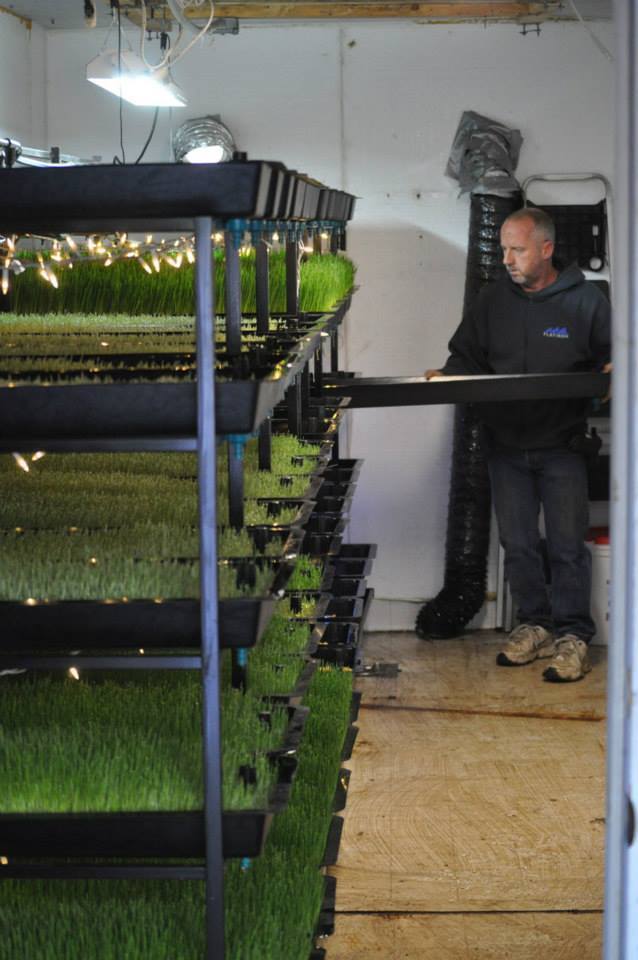
Fodder grown David Capocci style (of Paca Pride Guest Ranch)
2.2 Trickle Down Systems
In a trickle down system water is put into the top tray of a set of trays. From there one of two things can occur. In one system the water flows from one end of the tray to the other end of the tray where drain holes are located and drains out into the tray below it. On another style there are a series of holes throughout the bottom of the tray and the water just “rains” down on the next tray. This repeats in each tray until the water has passed through all the trays and ends in the holding tank or sump tank.
RabbitTalk.com slanted trays
In this system you can see that a baking rack has been utilized as the frame for their fodder system. A series of used baking trays were then used to hold the seeds. The water flows from one tray to the next using a simple overflow approach (no holes). The water slowly makes it’s way from tray to tray until it finds itself in a sump tank.
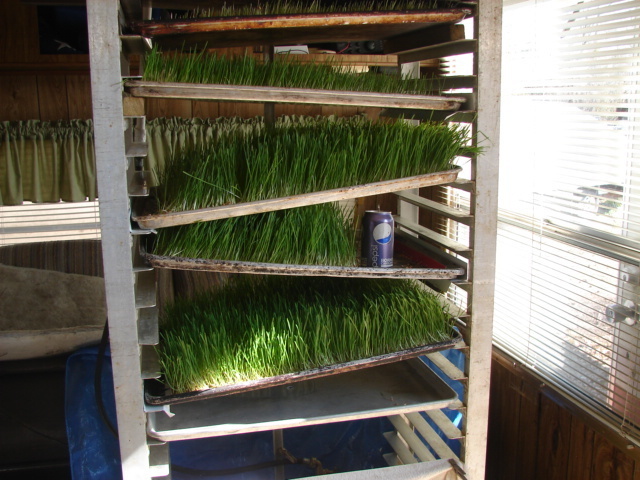
RabbitTalk.com slanted trays
Half-Pint Homestead 6 Tray Kit
This system is built out of parts that can mostly be sourced from a big box store like Home Depot. It is made from PVC for the frame and utilizes common 10x20 trays for the growing container. The big tank on the bottom is a sump tank which is used to capture and re-use the same water each time you cycle the system.
You will notice in the image below that the water is rained from one shelf to the next. This provides great coverage to all of the fodder below the top shelf. This is done with a series of holes poked in the trays. As water enters the top shelf it immediately drips down onto the trays below it. And ultimately collects in the sump tank.
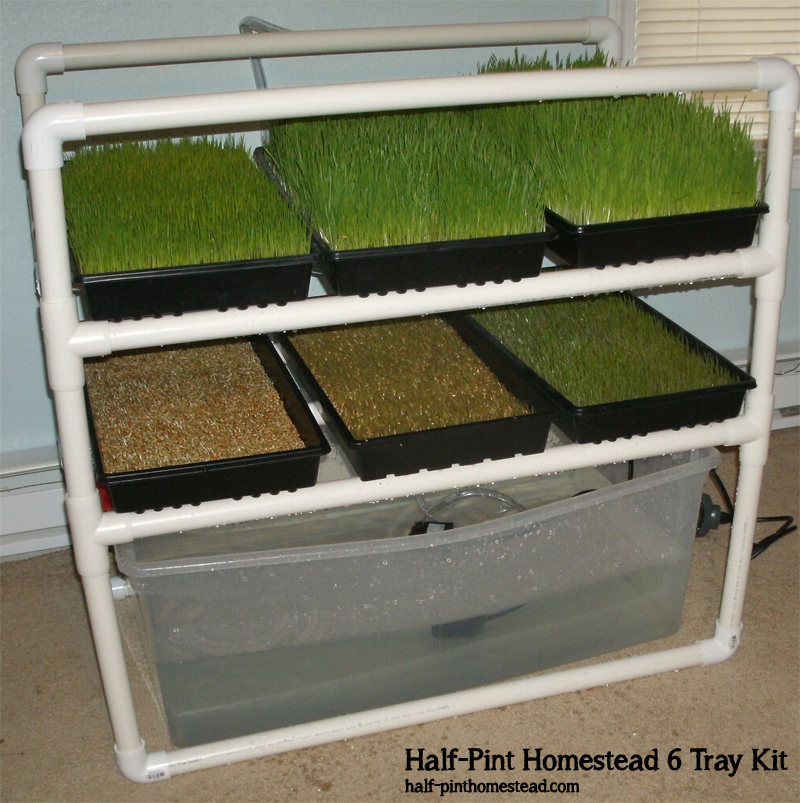
The Half-Pint Homestead 6 Tray Kit
Quartz Ridge Ranch
In this system water is sprayed in with a hose wand (similar to what you would use to water your plants). All the water then pools at the front of the tray and drain down to the next tray. Eventually the water gets to a gutter system below the bottom tray and is collected into a sump tank (which is then wisely pumped out with a pond pump to a near by garden).
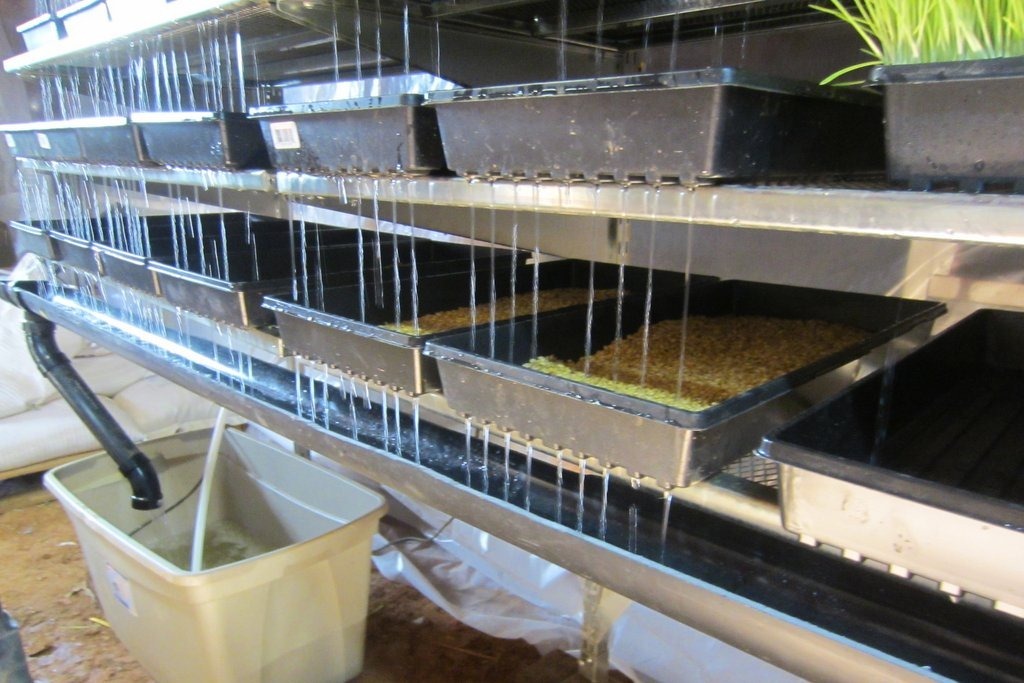
Quartz Ridge Ranch fodder system

|
Be careful when using a sump tank! When using a sump tank be sure to check the water quality. If the water smells or is visibly yellow, change it immediately. |
2.3 Commercial Systems
There are several commercial systems now available. These range in size from something you build and install into a pre-built fodder room to a full turn key system that is delivered to you ready to go. Some of these systems can be contained in a shipping container or semi trailer. May of these utilize computerized systems for monitoring and controlling the water flow and timing, temperature, humidity, and lighting.
Fodder King by Crop King
The Fodder King system is a very hydroponically inspired system. The trays used are common to growing in an NFT style hydroponic system for growing all sorts of plants. The plumbing is a PVC collector pipe that gathers all the water to a sump or other capture vessel. They provide a pump and everything you need to get fodder going very quickly. You just need to provide a temperature controlled room to house it in.
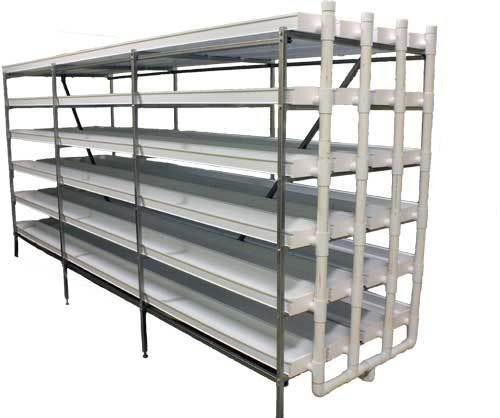
Fodder King by Crop King - 12x24 system - $2,950
Fodder Pro 3.0 by FarmTek
The Fodder Pro 3.0 is the latest from FarmTek. This is an industrial size system that is capable of producing “tons” of feed each day. If you run a dairy operation, organic farm, large cattle operation, have a large scale pig operation, or commercial size poultry operation then this is one of the systems you should be looking at. I have also heard stories from other fodder fanatics that they have been able to call FarmTek for help on non-FarmTek systems. Great company.
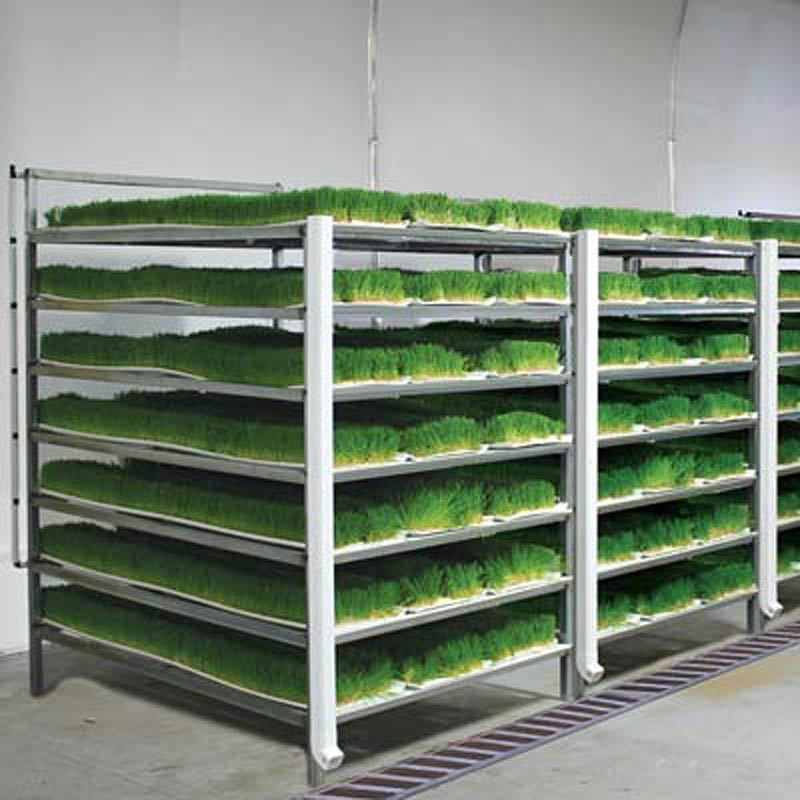
FodderPro 3.0 by FarmTek
Automatic Paddock by Fodder Solutions
If you are near a computer navigate over to youtube.com via this url: http://goo.gl/OMb4NU or search for “United Fodder Solutions automatic paddock”. Simply amazing.
This is a fully automated fodder generating system. It automates the seeding of trays, watering of trays, delivery out of the building into the back of your truck, washing the trays, and reseeding them.
It is capable of producing 4 tons of fodder daily!
2.4 Fixed or removable trays?

|
TODO: fill in this section |
2.5 Understand the daily rituals prior to picking a system type
Cleaning fixed trays can be hard
|
|
EXPAND Expand on the concept of cleaning fixed trays. Fixed trays at the top of a fixed tray system or in the middle of a fixed tray system may prove to be hard, require a ladder, etc. |
|
|
TODO: fill in this section |
2.6 Consider the systems scalability
|
|
TODO: fill in this section |
- small vs large trays
- fodder weight per tray (size matters)
- how much weight do you want to produce now vs later
- tedious tasks only get more tedious as you expand