5. Nutritional numbers around fodder
In this chapter we will take a look at the numbers around fodder. This will include how much fodder should be targeted for feeding your animals. The break down of each type of seed from a protein, energy, and other chemical break down of fodder. From this chapter you will have all the raw data you need so that we can enter the next chapter ready to discuss the dietary needs of each animal around fodder.
5.1 How much fodder should I plan to produce
A simple equation for calculating how much you want to feed your animals is to feed roughly 3-5% of the animals body weight in fodder. People often ask “why so much”. Remember that you are feeding wet food with fodder where as you were likely feeding dry food before.

|
Fast and loose calculations for where to startYou will have to validate the following calculations and the numbers used to ensure that they match your environmental capabilities. Your birds may average more or less weight per bird. Your fodder growing capabilities may produce more or less fodder per inch. Etc. Read this equation and then tweak it to fit your input values. |
An average back yard chicken might weigh in at the 6 pound mark. If we target 4% of a 6 pound bird we would need to provide roughly .25 pounds of fodder to each bird per day. On average you can convert one pound of seed to 5 pounds of feed. And we can grow about 25 pounds of fodder from a 10” x 20” tray. This means you can get about 1/8 lb of fodder per square inch of growing surface. For a chicken you would need at least 2 square inches in each days container. If you were using a 5x8” tray it would provide feed for roughly 20 chickens.
| Terms | Numbers |
|---|---|
| Average chicken weight (ACW): | 6lbs |
| Feed ratio (FR): | 4% |
| Feed per animal (FPR): | .25lbs |
| Seed conversion ratio (SCR): | 1:5 |
| Seed weight per sq/inch (SWPSI): | .025lbs |
| Feed weight per sq/inch (FWPSI): | .125lbs |
| Number of birds to feed (NBF) | |
| Inches of daily grow surface (DGS) |
Calculate feed needs in pounds per animal:
ACW * FR = FPR
Calculate inches needed for daily grow surface:
(FPR / FWPSI) * NBF = DGS
5.2 Types of seeds used in fodder

|
great read: http://www.ksre.ksu.edu/bookstore/pubs/MF2298.pdf |
There is a multitude of seeds that can be used for growing fodder. Some work really well while others don’t work at all. And seeds that by name should work really well for fodder may not work at all due to the facility you have purchased them from. For these reasons you will have to see what works for you based on the resources available to you but start with the well known seeds first.
And to add to this seed conundrum, also understand that while a certain type of seed may be easy to grow, it won’t necessarily be the appropriate seed for your type of animal’s diet. We will get into more detail about appropriate diets in a later chapter.
There are a multitude of different types of seeds that can be used in fodder. Some better than others. But the few that are most commonly used are wheat, barley, clover, and sunflower (BOSS - black oil sunflower seeds). Some are higher in protein than others. Some grow faster than others.
5.3 Cereal Grains
Maize (aka Corn)
Wheat (triticum)
Barley (hordeum)
5.4 Legumes
Alfalfa (lucerne) - perennial flowering plant in the pea family
Clover (trifolium)
Soy Bean
Of the proteins available in Soy Bean in the sprouted form, 5.74% of the protein is lysine.
Pea Nut
Green Peas
Chickpeas
6.69% of the protein is lysine
5.5 Nuts
Sunflower (helianthus annuus)
|
|
TODO: Need a grid for which plant has which thing in it. |
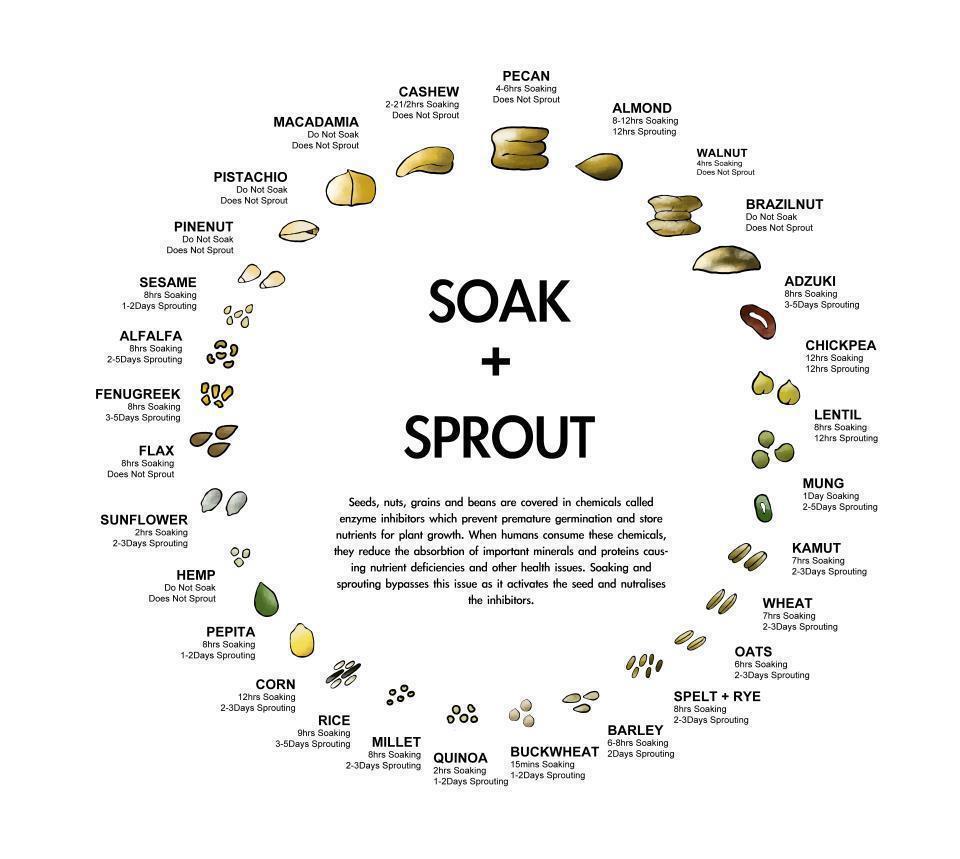
Soak and sprout chart
Know your germination rate
Before we take a look at seeds, lets talk about something that applies to all seeds. Germination rate. The germination rate (GR) is a way of telling the quality of the seed that you purchased from a given source. It helps you determine what the percentage of sprout-able seed is.

|
Calculate your germination rateYou can quickly calculate the GR of your seed by counting out 100 seeds (random sample). Place those 100 seeds on a wet paper towel. Keep the towel wet at all times. Over the course of 3-4 days you should see some seed begin life. Count how many out of the 100 seeds started. If 70 out of the 100 sprouted then your seed has a 70% germination rate. |
Why is this important? Let’s take a look at some simple numbers real quick. In each scenario we will start with a 50lb bag of seed of any type. Each bag of seed will cost us a specified amount. And the GR will be defined. From there we can do quick math to determine the cost of grown feed per pound. This table assumes that we will be able to convert one pound of seed to 5 pounds of feed.
| Cost | GR | Viable Weight | Grown Weight | Cost Per Pound |
|---|---|---|---|---|
| $30 | 70% | 35# | 175# | $0.17 |
| $38 | 85% | 42.5# | 212.5# | $0.17 |
| $40 | 90% | 45# | 225# | $0.17 |
Eh? I don’t understand! In each example the grown feed costs me a mere 17 cents per pound. This is already vastly cheaper than hay.
The key here is that you can’t pick out the seeds that won’t germinate prior to soaking them and spreading them out in your tray. If they don’t germinate then they just sit among your viable growing seeds souring. They are like the seed casing that is left there to rot. The funk that non-viable seed adds to your system is a key attractant to root gnats and mold. They put starch into your system which can thicken your water (in a sump based system) and slowly clog up the working parts of your pump.

|
Knowing your germination rate helps you before you startThe importance to knowing your germination rate is that the more seeds that sprout the less seeds there are to turn to trash and work against you. |
5.6 The nutritional building blocks required
Lysine
Lysine is one of the nine essential amino acids. This means that your critter cannot produce this amino acid on its own, and you must include it in their diet. Lysine is important for the production of carnitine, which is essential for helping turn fat into energy. Lysine also helps your body absorb calcium, and when combined with vitamin C, lysine aids in the production of collagen.