Practice – enhancing the senses
Enough of theory – time to get out of the armchair! So much of the dowsing space at present seems to be dominated by conversations over the Net: but whilst talk may be pleasant, on its own it rarely provides anything new. Instead, we need to engage the subtle senses of the Artist mode: and for that, getting our boots muddy, so to speak, is the only way that real change in discipline is likely to happen.
If your interest, like ours, is in archaeology and ‘earth-mysteries’, that literally means going out and getting your boots muddy: there’s a real shift that happens in spending time out in the field, dowsing in any weather, struggling with wind blowing the rods around, and rain down the back of the anorak! Or if your dowsing focus is more on healing and the like, get away from the charts and diagrams and lists for a while: your equivalent of ‘fieldwork’ would be something like massage, using the fingers and wrists and elbows to sense out the ‘musclescape’, its folds and curves, its overlays and layers, its smooth flows and locked, tangled places.
In fieldwork, we build relationship with place – whatever ‘place’ in the respective context might be. A New Age-style quick flit from one site to another won’t give space for this: it’d only deliver a few fleeting experiences, perhaps, a few brief encounters with beginner’s luck. Perhaps some sort of shallow appreciation overall, it’s true, but not much depth, nothing on which to build a real understanding. From our own experience, reaching for a deeper connection with place is like building a relationship with a skittish horse: there’s a crucial change in perspective that starts to settle in after three to six months or so – and that requires patience, a commitment to place, in all its modes and moods.
Also crucial is that most of the subtle details are visible only in the field. To see them, we need to develop ‘fieldworker’s eyes’, the fieldworker’s senses – and learn notice the differences, the edges, the subtle – or not-so-subtle – hints that things have changed.
Intervisibility is another type of connection that can only be identified in the field. At Avebury stone circle, for example, the ancient mound of Silbury Hill is just visible over the skyline: anyone standing on its summit would appear to float between the nearby ridge and the distant hills. More to the point, the notches on its sides, close to the top – which, courtesy of some truly amazing early engineering, have not faded or slumped in several thousand years – line up exactly with the line of the intervening ridge. There’s no way to identify this from a map, or an air-photograph: you’d have to be there to see it.
The same is true of most ‘ley-hunting’, searching for alignments of ancient sites in the landscape. Anyone can find any number of these with a ruler dropped onto a map – a matter of considerable excitement a few decades ago – but in reality, in most cases, it’s probably ‘just coincidence’. There are real alignments to be found: but they can only be verified by cross-checking the map with what can be seen and felt in the field. John Michell, in his study of ley-type alignments in Land’s End at the tip of Cornwall, found that the key standing-stones were each exactly on the skyline from one to the next – yet usually only one could be seen in each direction, on a line ‘of rifle-barrel accuracy’ over many miles. In a dowsing sense, there’s also a distinct ‘feel’ that goes with an alignment of ancient sites that seems to have been intentional: and one that’s not will usually feel ‘flat’, or ‘dead’, or simply have no feel at all.
So in fieldwork we need to get out of the usual over-reliance on the head, the intellect, the ‘truth’ of the Scientist and the Mystic, and instead explore the feel of places in their own context. The journey, the process of ‘pilgrimage’ to the place, often matters as much as the destination. And we need to engage not just our eyes, but sight, sound, scent, taste, touch, synaesthesia – all of the senses, all of the elements. Notice the nature of the site itself: slow down to notice the pace of the place, its seasons, its subtleties… moss, plants, water, the sound of wind through the leaves… butterflies and birds and other small creatures scuttling around in the undergrowth…
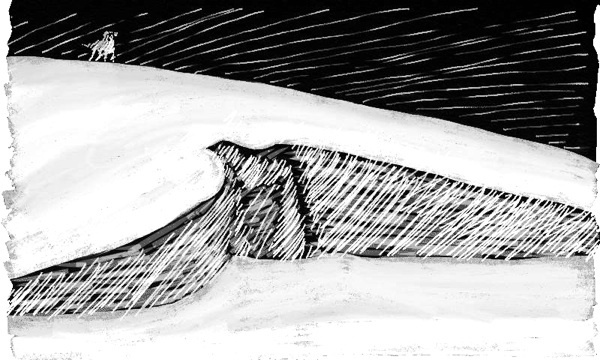
Belas Knap forecourt, with dog
It’s important, too, to watch for the Mystic mode’s tendency to create arbitrary boundaries between things, because they rarely help in the field. One such example is the imagined separation between city and country, and especially the common assumption amongst would-be pagans that ‘country is good, city is bad’ – because city-spaces do each have their own magic, even if it may be disguised deep beneath detritus, dust and diesel-fumes!
Enjoyment is important, too. Ritual and music and the like can help to engage the senses, but perhaps the wisest way is simply to have fun – laughter and merriment do matter! Having fun is also the best way to cope with fieldwork’s inevitable chaos… We do need also to watch for the tendency to be over-serious: we need a little craziness to break free of assumptions, and to jiggle the propensity to settle into the ruts of the Meaning Mistake or the Possession Problem.
To break free from the Meaning Mistake – and for that matter the Golden Age Game, or the Newage Nuisance in general – it’s essential to be able to go back to first principles, and use the Artist mode to provide hints and suggestions for suitable questions in the respective context.
An example here is a set of megalithic monuments at Meizo, in northern Portugal. At first sight one of the barrows looks like the entrance to a second-world war bunker, with rectilinear slabs of stone forming a zigzag entrance to the underground chamber: but in fact it dates back some six or seven thousand years – almost as old relative to the Stonehenge trilithons as the trilithons are to us.
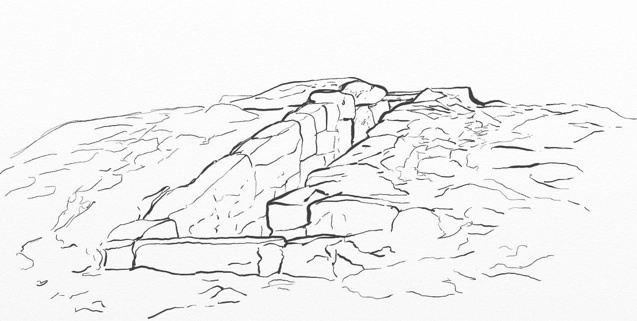
Meizo dolmen, northern Portugal
What dowsing questions would we use here? We could start with water-lines, perhaps, but even that soon fails to make sense in terms of anything else we know…
Thirty yards away lies another wrecked dolmen. Its ‘feel’ is completely different, but how would you describe that difference? Feels somehow wrong, sad, depressed, even dangerous…? How would you document that difference? – what words or images would you use? Again, what dowsing questions would make sense here? How much use is the cut-and-dried yes/no of conventional dowsing in this context?
The ‘feel’ of a place is often made up of small subtleties that may make no sense at all to anyone else – such as the sudden arrival and disappearance of an inquisitive little lizard from its home inside one of the dolmens at the Meizo site. What is it that makes sense to you? How would you express that sense to others? And in what ways would it matter to do so?
This sense of the importance of small subtleties has been championed by the English charity Common Ground. For example, their Rules for Local Distinctiveness provides a useful checklist to help open an awareness of these subtleties of place. One such theme that we’ve come across before, in the discussion on the Possession Problem, is that every place is both itself and part of something greater – a locale, a district, a region of the landscape. Everything is separate, yet there also is no separation: every place contains within itself every other place.
Another Common Ground theme is to “recognise and respect the local legends”. Every place has its stories, its interweaving of past and present.
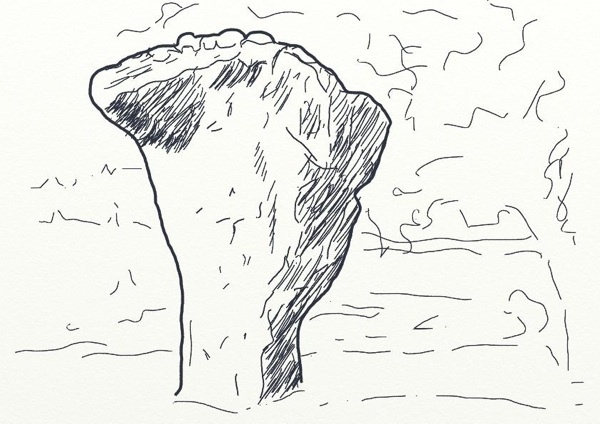
‘Wedding Stone’, south central Portugal
For example, there’s a standing-stone in south central Portugal nicknamed the wedding stone’. It stands about ten feet tall, oddly shaped like a partly-closed hand. The folklore there is that if you throw a stone up onto the flat ‘fingers’, and it stays on top, you’ll be married soon! Yet that story is only two or three hundred years old at most – whilst the stone itself has probably been there for at least twenty times as long, from Neolithic times, or even earlier.
In reality, the local legend tells us nothing about why the stone was put there in the first place. We have no way to know why ‘the Ancients’ did as they did in these places – we can only know how we, and others, respond to the Mask of each place in the ‘now’.
So history is also now – the interweaving of past and present and future. Everywhere is an interaction between people and place – and sometimes the place has choices too. Sometimes the interweaving may be uneasy, a somewhat unwilling coexistence, such as the modern highway that follows the Roman road in bending around the ancient mound of Silbury Hill. Sometimes the times can collide, as with the Puritan fanatic ‘Stonekiller Robinson’, who set out to destroy all of the megaliths at nearby Avebury, and was almost killed by them instead. But what doesn’t work is an attempt to ‘freeze’ time in the present, Heritage-style – because when a place can no longer change, it dies…
Common Ground also warn us that, if we’re not careful, we can end up ‘loving a site to death’. One example would be the Anta Grande dolmen, near Almendres in central Portugal. As the name suggests, it’s big: the passage is almost forty feet long, five feet wide, more than six feet high, whilst the inside of the chamber is an astonishing twenty feet high, and the vast mound – what’s left of it – is higher still.
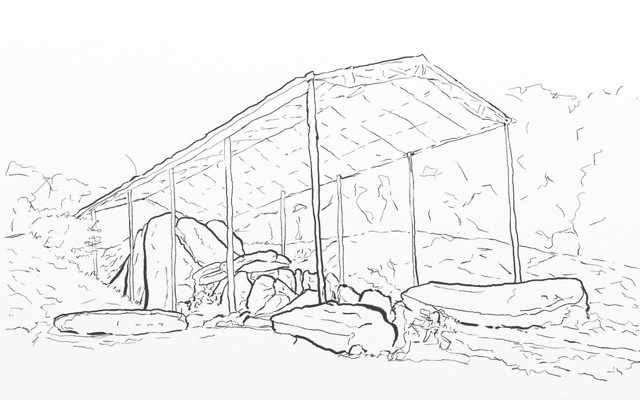
Remains of Anta Grande dolmen, Almendres, central Portugal
But after fifty years as an unmanaged tourist-site, it is, bluntly, a wreck: not much litter or graffiti, amazingly, but the passage is blocked with shoring-timbers, one of the main capstones has fallen, another fallen stone almost worn through by the footprints of countless visitors, whilst the whole is covered over by a rickety, rusting tin roof. Too popular. Too many people. Too many unrestored excavations. Ouch.
The same goes for so many places like poor old Stonehenge, of course, with something like a half a million disappointed tourists every year. Avebury is a much larger site, but even that shows many signs of struggling to cope. So we need a bit more discipline in this, too: spread the load among a much wider range of places rather than focussing only on the well-known few.
Might learn a bit more that way, too.