The disciplined dowser
If an emphasis on quality is bad enough, talking about discipline may well sound worse. Memories of primary-school, of standing in the corner, “not enough discipline” and all that…
Don’t worry – it’s not like that! (Well, maybe a little bit, we could say with a grin… But at least here we do explain what discipline is, why it’s a useful habit to develop – for your benefit, that is – and how to develop it. Which is more than they gave you at school, we’d guess?)
In itself, there’s nothing difficult in discipline. It’s very simple: it’s about developing a habit to plan and prepare for the work we intend to do; to notice what we do, and what we’re thinking whilst we’re doing it; to check whether these are in accord with what we’ve chosen to do; and take action as appropriate to change any of these if there are any concerns with quality.
In the business world this is known as the Total Quality Management cycle: Plan; Do; Check; Act.
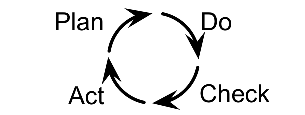
Total Quality Management cycle
In meditation, too, we prepare for the practice; do the practice; review and re-assess to check the practice; and act to change the practice where needed.
Different contexts, but the overall discipline – and the overall need for discipline – is much the same everywhere.
What complicates it a little in dowsing is that there are four distinct strands or modes or ‘disciplines’ that we need to keep track of within the overall discipline. We need to understand what these modes are, what we can and can’t do within each, and how and when and why to switch between them.
Remember our earlier summary of dowsing, that it’s about sensing at an identifiable location to derive information that’s meaningful and useful. The information comes from our sensing of a co-incide-ence between what we’re looking for and where we are, and it may be a quality (a direction, a ‘feel’) or a quantity (a number, a count, or a simple yes-or-no). So the four disciplines are these:
- sensing – the dowser as artist
- define what we’re looking for, identify where we are – the dowser as scientist
- derive meaning – the dowser as mystic
- derive usefulness – the dowser as magician
As for why we emphasise just these four modes, it’s probably simplest to explain with a diagram:
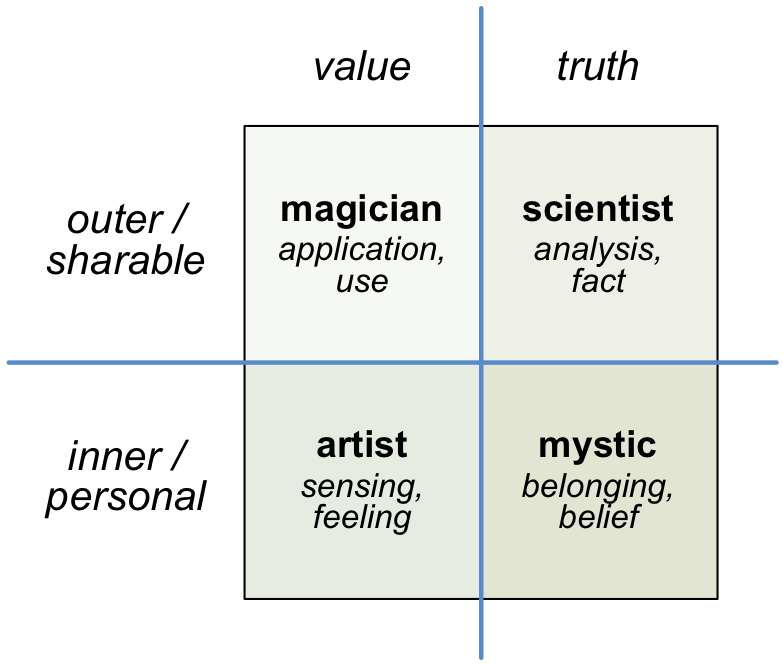
The four disciplines
In effect, this is a not-quite-arbitrary split of the world of dowsing-work across two dimensions:
- subjective <-> objective, or personal <-> shared / common
- value <-> truth, or qualitative <-> quantitative
This gives us four distinct modes: subjective value, subjective truth, objective truth, objective value. Each mode or discipline provides its own distinctive view into the whole, and also has distinct tactics that we would use within that mode – though only within that mode.
So for example, the discipline that we’re calling ‘dowser as artist’ is all about subjective value, those aspects of dowsing that are strictly personal, that belong to self alone – about the ways we sense and experience our various impressions of the site and its context. When we place our focus on that ‘artist’ mode, we pay careful attention to what we feel at each place, how we feel, what we sense, how we could portray what we sense, and so on, as well as the responses of any dowsing-instrument we might be using at the time.
What we don’t allow when we’re in that Artist mode is any intrusion from beliefs and expectations (from the Mystic, subjective truth), from matters of measurement and the like (the Scientist, objective truth), or from concerns about the end-purpose (the Magician, objective value). Each of those other modes is certainly relevant, and we need to pay our full attention to them all within the dowsing practice – but not at the same time.
At each moment, we’re in just one mode, using just one type of discipline; and to make sense of the whole, we move between the modes, cleanly, consciously, explicitly, moment by moment. There are paths between modes that are mutually supportive, such as Artist -> Magician -> Scientist -> Mystic, the dowser’s equivalent of the classic sequence ‘idea -> hypothesis -> theory -> law’ that’s so important in the sciences. Each mode is distinct, and some can be mutually antagonistic, particularly Artist <-> Scientist, or Mystic <-> Magician. And we also need to take care not to get stuck in one or two preferred modes, but maintain a balance between them all. So there’s also an implied fifth discipline about the process of switching disciplines – an integration that unites all these different views into the single overall discipline of dowsing.
It’s likely, then, that the single most important factor for quality in dowsing is understanding which mode we’re in at any given time, and working appropriately to match the constraints of that mode. And if our work is to be meaningful and useful to others, we also need to know how to present our results in ways that are appropriate to the respective mode: we don’t present ideas as facts, or vice versa.
So let’s look at each of these disciplines in more detail.