Landmarks of the Pelvis
To make controlling the hip joints easier it helps to know some landmarks of the pelvis.
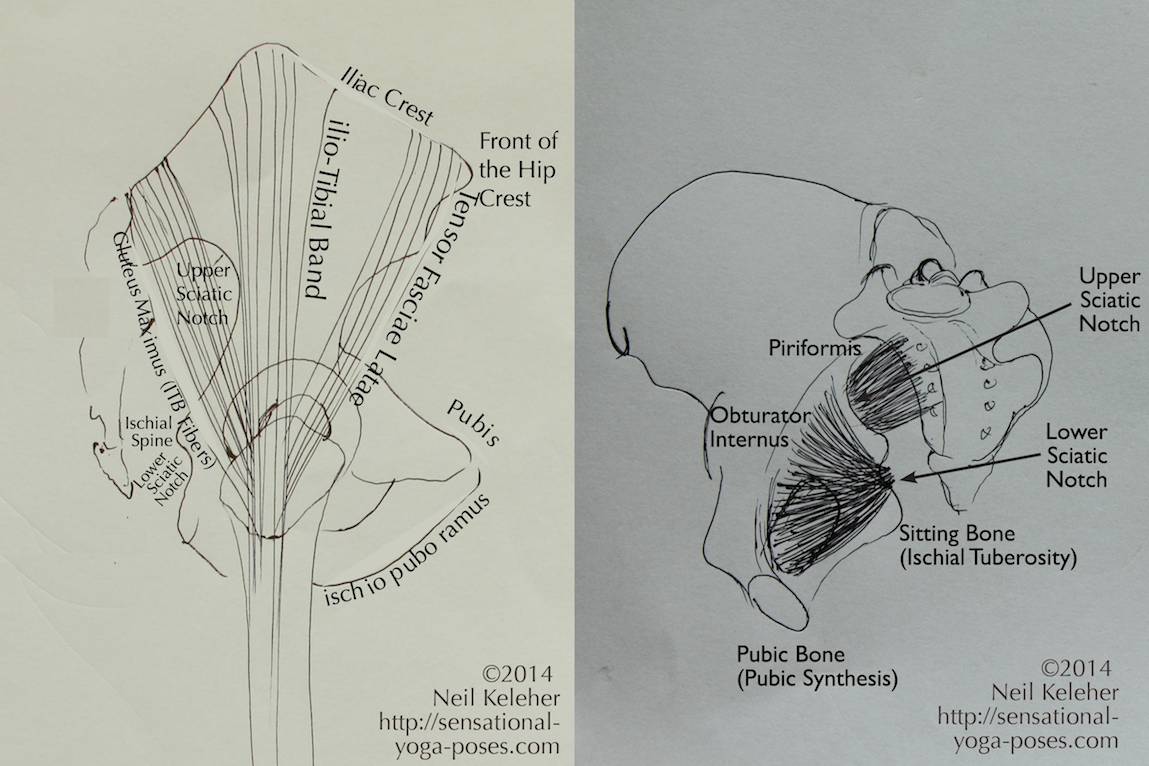
Pelvic Landmarks:
Side view (right side of pelvis) and Inside View (of right side of pelvis).
Note the tensors fascae latae muscle.
The Pubic Bone and Sitting bones are two of the easier landmarks.
- The sitting bones (ischial tuberosities) are the bones you feel when you sit down.
- The pubic bone (or pubis) is the bone at the front of your pelvis, around the location of your reproductive organs. It’s the bone at the bottom of your belly.
- The Sacrum is the triangular piece of bone that forms the base of the spine and whose tip (the tailbone) ends just behind the anus. (The tailbone acts as one end of the support for the anus.)
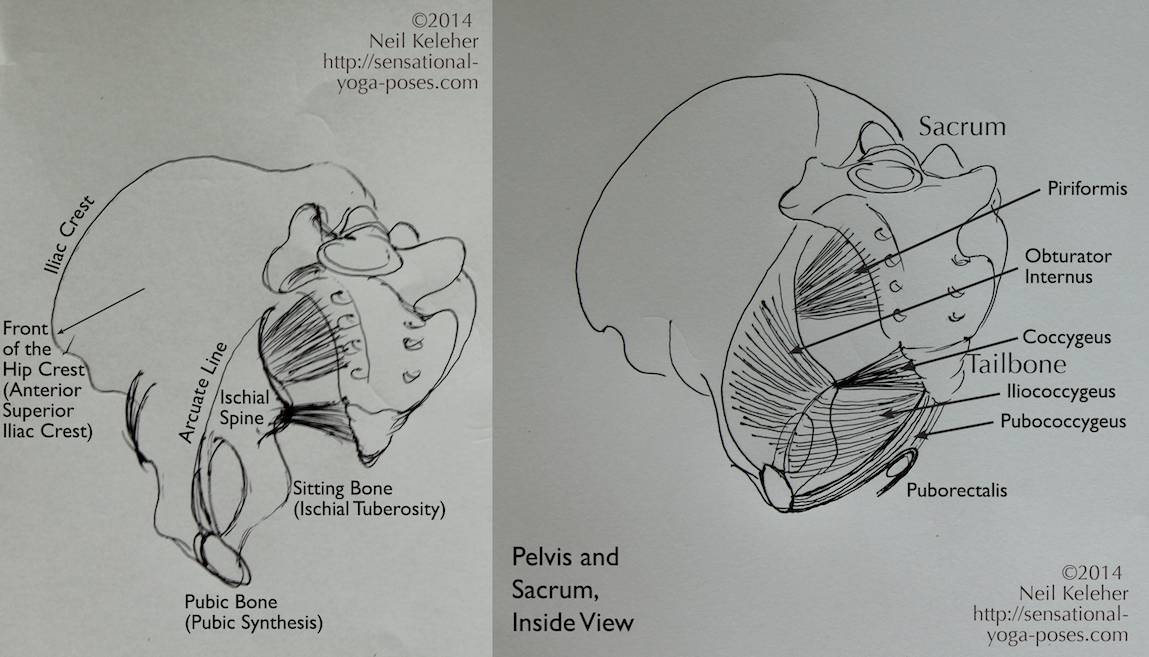
Muscles that connect to the sacrum and tailbone.
Although not covered in this guide, these muscles (iliococcygeus, pubococcygeus, puborectalis) can be used to pull the tailbone forwards (towards the pubic bone). The coccygeus can be used to pull the sitting bones inwards. The piriformis can be used to “suck” the sacrum forwards.
- The iliac crests are the crescents of bone at either side of the hip.
- The front of each Iliac Crest is called the anterior superior iliac crest (often shorted to ASICs.) I often refer to these points as the front of the hip bones.
Seated Spinal Awareness Exercise
I often use the sacrum as a reference when teaching a simple action like bending the lumbar spine backwards.
As an example, while seated (in a chair is fine, or you can be cross legged or kneeling) slowly lift your sacrum. Then allow it to lower. Repeat this a few times while focusing on feeling your sacrum.
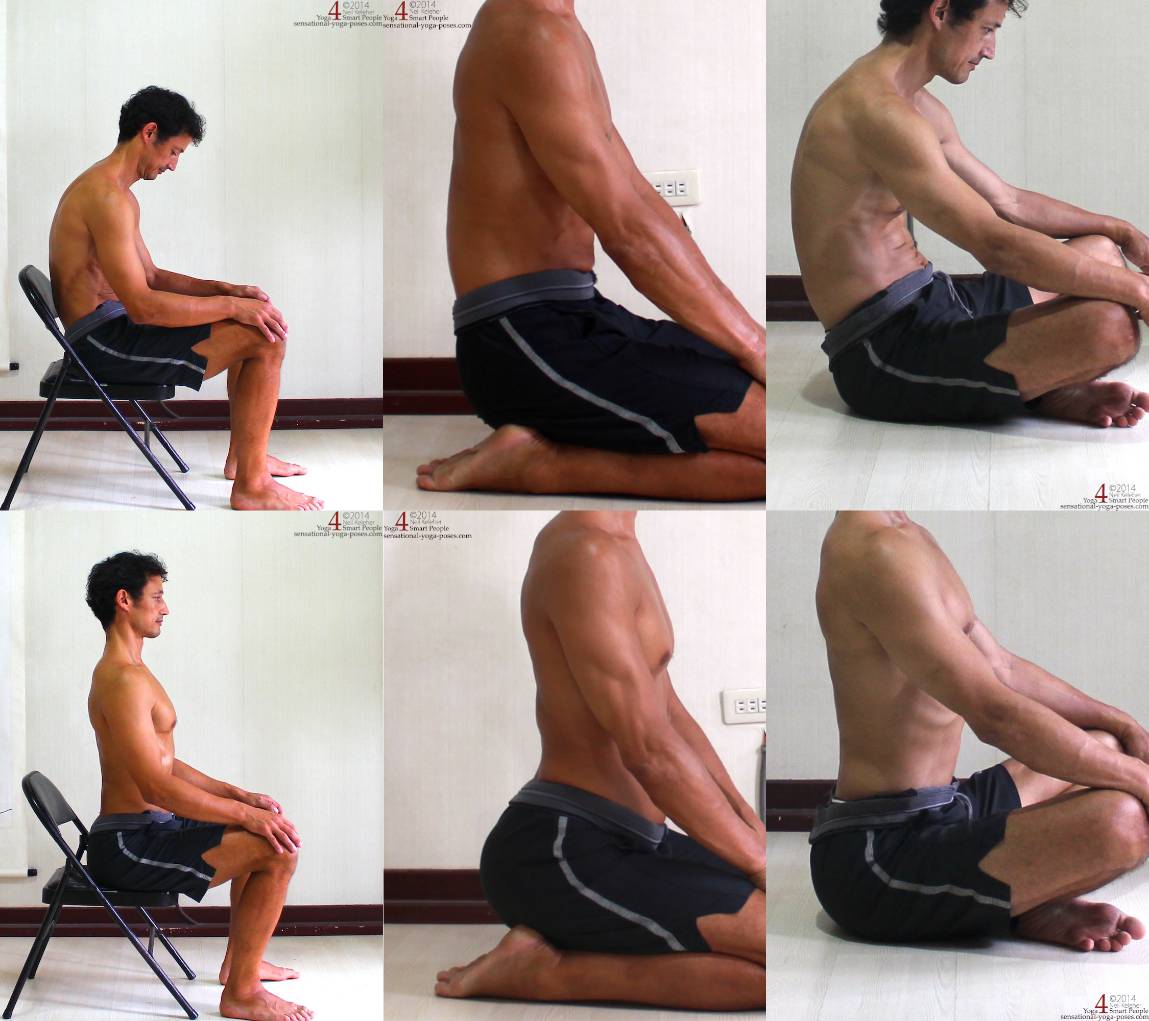
Practicing pelvic and Spinal Awareness while in a chair, kneeling and sitting cross legged. The top row shows a relaxed or “bent forwards” spinal position.
The bottom row shows a backwards bending spine with the pelvis rolled forwards (so that sacrum is lifted.)
Continue the same action and then bring your focus to your lumbar spine. As you lift your sacrum feel your lumbar spine bending backwards. Relax the back bend as you lower your sacrum.
Continue on with the same action but carry the back bend up into the thoracic spine.
As you lift your sacrum bend your lumbar spine backwards (you may feel your erector spinae muscles activating along either side of the spine) and then bend your thoracic spine (the back of your ribcage) backwards also.
The Upper and Lower Thoracic Spine
To make bending the thoracic spine backwards easier, divide the ribcage into a lower half (corresponding to the costal arch at the front of the ribcage) and an upper half (the part which attaches to the sternum.)
First focus on bending the lower half backwards. Then once you have a feel for the lower half then add the upper half.
Breath-Like Movements
You could imagine that the above movement is like your breath. The smoother and slower you move the slower and smoother your breath will be.
To emphasize the breath-like aspect of this simple movement bring your awareness to the front of your body. As you bend your spine backwards expand your ribcage (move the ribs away from each other) and lift your ribs (move the ribs upwards, away from your pelvis.)
As you relax, let your ribcage sink down.
Repeat this a few times. If you do it slowly and smoothly enough it can feel quite nice.
Adding Pelvic Awareness
Continuing the above exercise, next move your awareness to your pubic bone. As you lift your sacrum feel the way your pubic bone moves down (and perhaps slightly backwards.)
Focus on feeling your sacrum and pubic bone as you rock your pelvis.
Next focus on the sitting bones. As you lift your sacrum feel your sitting bones move back and up. Feel them move in the opposite direction as you lower your sacrum.
Then focus on the fronts of the hip bones. As you lift your sacrum feel these points moving downwards. As you lower your sacrum feel them moving upwards.