Making Learning, Communication and Recall Easier
Uniquely naming directories and files allows computer programs to find pieces of information and put them together meaningfully.
Ever notice how you can’t give two files in the same computer directory the same name? The same can be said when communicating information between people.
If the names that we use for pieces of information are unique, it makes it that much easier to communicate those pieces of information meaningfully and without error.
The naming conventions I used for positions and movements are designed to uniquely point to those movements and positions so there is minimal confusion.
Because movements and positions at the basic and complex level are unique, it makes it easier to isolate or recombine both positions and movements meaningfully.
This gives both the brain and your conscious mind a simple hook with which to file what is being learned and to easily recall it.
Basic Positions
Dance of shiva has 64 arm positions which are a combination of 8 basic positions. The 8 basic positions can be divided into two groups, horizontal and vertical.
- In the horizontal positions the palms face upwards and are named 1, 2, 3 and 4.
- In the vertical positions the hands face vertically outwards and are named a, b, c and d.
Horizontal Basics
In the horizontal positions the fingers either point outwards or inwards. In addition the hands are at head height or higher or at about the level of the waist as follows:
- 1 and 3: The fingers point outwards.
- 2 and 4: The fingers point inwards.
- 1 and 4: The hands are head height or higher.
- 2 and 3: The hands are belly button height (ish).
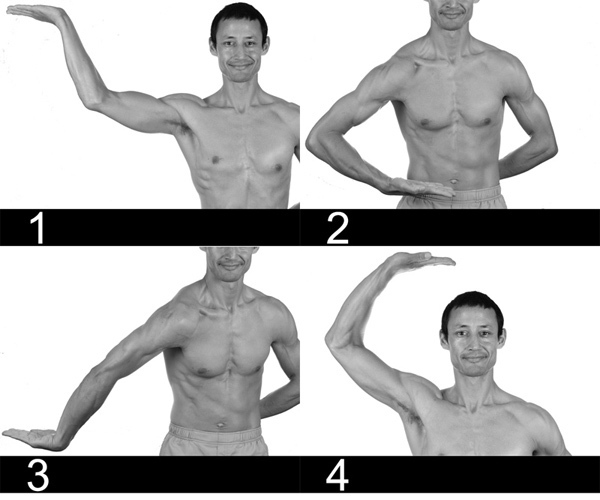
- For position 1 the hand is held with palm facing upwards with the fingers pointing outward to the side.
The elbow is positioned slightly higher than the shoulder. - For position 2, the hand is held palm up with the fingers pointing inwards just above the belly button. (This height may vary.)
The elbow points out to the side. - For position 3, the hand is held palm up with elbow and fingers both pointing outwards.
This position is challenging. Roll the top of the shoulder forwards. - For position 4, the hand above head height with the the fingers and elbow pointing outwards.
Vertical Basics
In the vertical positions the arms are between shoulder height and the height of the bottom of the sternum. The fingers either point forwards or rearwards. The elbows point outwards or inwards.
- a and c: Fingers point forwards.
- b and d: Fingers point backwards.
- a and b: Elbows point outwards.
- c and d: Elbows point inwards.
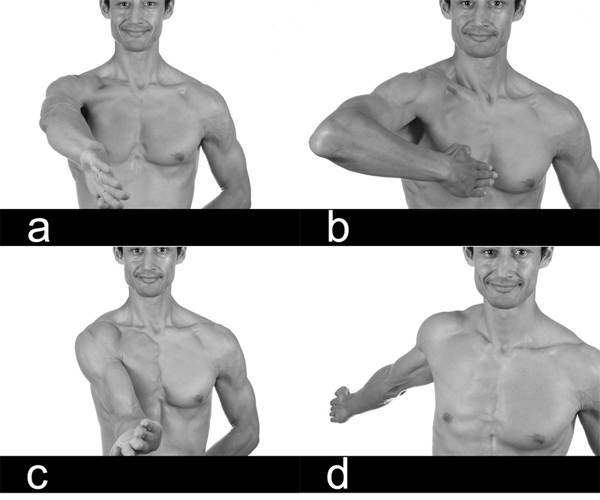
In position a, the hand stab forwards. Fingers point forwards and the elbow pointing outwards.
In position b, the elbow is bent and points forwards. The forearm, hand and fingers point backwards towards the chest.
Wrists are (ideally) straight.
In position c, the hand stabs forwards. Fingers point forwards but unlike position a, the elbow points inwards as much as possible.
In position d, the arm reaches backwards. The fingers point back and the elbows point inwards.
What About the Fingers?
With regards to the fingers.
- One option is to keep the fingers straight and together.
- Another option is to make them long and separate them slightly.
In either case, if you make a decision on how you want your fingers to be, you can then feel them and make corrections when your fingers fall out of line.
When picking how to “use” your hands it might help to have an imaginary intention.
- For the horizontal positions imagine balancing a tray on your finger tips. In this case the fingers will be spread and slightly curved.
- For the vertical positions you can imagine your fingers are like knives that you can cut and stab with.
One final option is simply to feel your palms and finger. And make them feel “alive” and comfortable.
To get this feeling open your palm and spread your fingers. And lengthen your fingers just a little.
Maximum Space and Minimum Effort
In a yoga pose one goal could be to create maximum space with minimum effort. The goal is tension that allows you to feel your body and control it.
This same idea can be applied to the hands. Find a balance between maximum space and minimum effort.