Combined Movements
Movements for both arms use a two digit code. The letter(s) on the left corresponds to the movement of the left arm, the letter(s) on the right that of the right arm:
- F-B means the left arm moves forwards, the right arm back.
- CT-C means the left arm does a change transquarter, and the right arm a change.
- CF-CB means the left arm does a change forward, and the right arm a change backward move.
To make learning combined movements easier we can group them according to movement types. This is to make learning easier and more efficient. First a look at the classifications.
Same Plane or Change Plane
One way to categorize single arm movements is as Same Plane or Change Plane movements.
- Same plane movements are movements which join positions in the same plane. They join letters to letters and numbers to numbers.
- Change plane movements are movements which join positions in different planes. They join letters to numbers and vice versa.
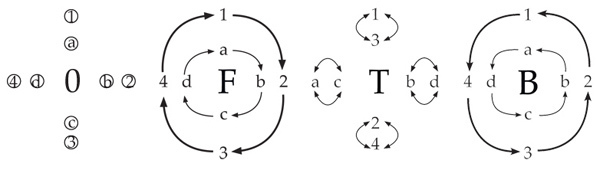
The same plane movements are called: zero, forward, transquarter, backward.
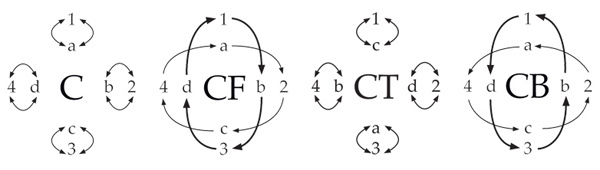
The four change plane moves are: Change, Change Transquarter, Change Forward and Change Backwards.
Cyclic or Acyclic
Another way to classify movements is whether they are Cyclic or Acyclic.
- The cyclic moves are forwards, backwards, change forwards, change backwards (F, B, CF, CB)
- The Acyclic moves are transquarter, change, change transquarter. (T, C, CT)
Cyclic moves connect four positions when repeated. Acyclic moves jump between the same two positions when repeated.
Why Classify Movements?
Why classify movements (and positions for that matter)?
Because it makes it easier to break up the movements and learn them in a meaningful fashion.
In the end, assuming you’ve learned all of the movements, the classifications won’t matter. But while learning they can be helpful because you focus on learning all the movements within a particular classification one by one. This may help reduce learning effort because you are focused on similar moves.
It also gives a sense of accomplishment once you’ve learned all of the moves with one particular classification.
Movement Combination Classifications
To make movements easier to learn I’ve grouped them as follows:
- zero (cyclics then a-cyclics)
- cyclics 1 (both same plane or both change plane)
- cyclics 2 (mixed)
- cyclic/a-cyclic combos 1 (both same plane or both change plane)
- cyclic/a-cyclic combos 2 (mixed)
- a-cyclics 1 (both same plane or both change plane)
- a-cyclics 2 (mixed)
We’ve already done the zero movements. These are movement combinations where one arm stays still.
The Cyclic groups are where both arms do Cyclic movements. In the first group both arms do same plane or change plane movements. In the second group one arm does a same plane movement and the other a change plane movement.
The Cyclic/Acyclic groups are where one arm does a cyclic move and the other an Acyclic move. In the first of these two groups both arms do either same or change plane moves. In the second of these two groups one arm is doing a change move the other a same plane move.
The final groups are where both arms to Acyclic moves.