Python Research Agent Using Google Agent Tool Kit
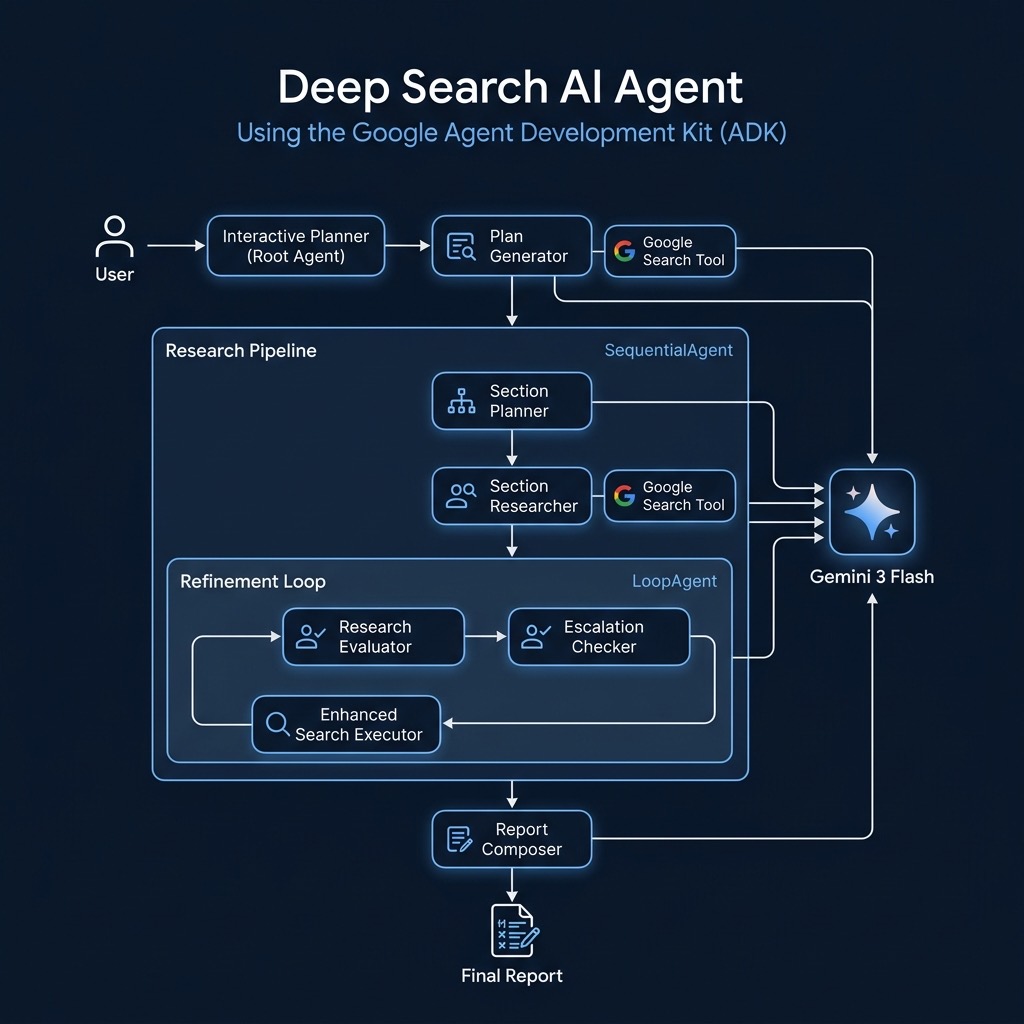
The Google Agent Development Kit (ADK) is an open-source Python framework for building multi-agent AI systems. In this chapter we build a deep research agent that plans investigations, executes web searches, evaluates its own findings, and produces a professionally cited report — all orchestrated by cooperating LLM-powered agents running on the Gemini model family.
Overview of Google Agent Toolkit
The ADK provides composable agent primitives — LlmAgent, SequentialAgent, LoopAgent, and BaseAgent — that let you assemble complex workflows from simple, single-purpose agents. Each agent has its own instruction prompt, optional tools (such as Google Search), and structured output schemas enforced via Pydantic models. Agents communicate through shared session state, and the framework handles the event loop, tool dispatch, and callback lifecycle automatically. This design makes it straightforward to build systems where one agent plans, another researches, a third evaluates quality, and a fourth composes the final output.
Research Agent
I rewrote Google’s full research agent web app example program, simplyfying it as a command line utility.
The following listing shows the complete deep search agent. It defines seven specialized agents wired together in a sequential pipeline with an inner refinement loop. The interactive_planner root agent receives a research topic from the user, delegates plan creation to the plan_generator, and upon approval hands off to the research_pipeline. Inside the pipeline, the section_researcher executes Google searches and synthesizes findings, the research_evaluator grades coverage quality, and the enhanced_search_executor fills any gaps — looping up to three times until the evaluator passes. Finally, the report_composer writes a Markdown report with inline source citations.
  1 # Derived from: https://github.com/google/adk-samples/tree/main/python/agents/deep-search
  2
  3 import re
  4 import datetime
  5 from typing import Literal, AsyncGenerator
  6
  7 from pydantic import BaseModel, Field
  8 from google.genai import types as genai_types
  9
 10 from google.adk.agents import BaseAgent, LlmAgent, LoopAgent, SequentialAgent
 11 from google.adk.agents.callback_context import CallbackContext
 12 from google.adk.agents.invocation_context import InvocationContext
 13 from google.adk.apps.app import App
 14 from google.adk.events import Event, EventActions
 15 from google.adk.planners import BuiltInPlanner
 16 from google.adk.tools import google_search
 17 from google.adk.tools.agent_tool import AgentTool
 18
 19 # Defaults to Gemini 2.0 Flash for balanced speed/reasoning
 20 MODEL_NAME = "gemini-3-flash-preview"
 21
 22 # Note: GOOGLE_API_KEY shuld be in your environment
 23
 24
 25 # --- Structured Outputs ---
 26 class SearchQuery(BaseModel):
 27     search_query: str = Field(description="A specific, targeted query for web search.")
 28
 29 class Feedback(BaseModel):
 30     grade: Literal["pass", "fail"]
 31     comment: str
 32     follow_up_queries: list[SearchQuery] | None = Field(default=None)
 33
 34 # --- Callbacks ---
 35 def collect_sources(callback_context: CallbackContext) -> None:
 36     """Aggregates sources from grounding metadata into state."""
 37     session, state = callback_context._invocation_context.session, callback_context.state
 38     url_map, sources = state.get("url_to_short_id", {}), state.get("sources", {})
 39     next_id = len(url_map) + 1
 40
 41     for event in session.events:
 42         if not (md := event.grounding_metadata): continue
 43
 44         # Map URLs to short IDs (src-1, src-2)
 45         chunk_map = {}
 46         for idx, chunk in enumerate(md.grounding_chunks or []):
 47             if not chunk.web: continue
 48             url = chunk.web.uri
 49             if url not in url_map:
 50                 short_id = f"src-{next_id}"
 51                 url_map[url] = short_id
 52                 sources[short_id] = {"title": chunk.web.title or chunk.web.domain, "url": url}
 53                 next_id += 1
 54             chunk_map[idx] = url_map[url]
 55
 56     state["url_to_short_id"] = url_map
 57     state["sources"] = sources
 58
 59 def replace_citations(callback_context: CallbackContext) -> genai_types.Content:
 60     """Converts <cite source='src-1'/> tags to Markdown links."""
 61     text = callback_context.state.get("final_cited_report", "")
 62     sources = callback_context.state.get("sources", {})
 63
 64     def replacer(match):
 65         sid = match.group(1)
 66         info = sources.get(sid)
 67         return f" [{info['title']}]({info['url']})" if info else ""
 68
 69     # Replace tags and fix spacing
 70     text = re.sub(r'<cite\s+source\s*=\s*["\']?(src-\d+)["\']?\s*/>', replacer, text)
 71     text = re.sub(r"\s+([.,;:])", r"\1", text)
 72     return genai_types.Content(parts=[genai_types.Part(text=text)])
 73
 74 # --- Agents ---
 75
 76 # 1. Plan Generator: Creates the initial strategy
 77 plan_generator = LlmAgent(
 78     model=MODEL_NAME,
 79     name="plan_generator",
 80     tools=[google_search],
 81     instruction=f"""
 82     Create a 5-step research plan.
 83     Prefix every step with either:
 84     - **`[RESEARCH]`**: For information gathering.
 85     - **`[DELIVERABLE]`**: For synthesis/output creation.
 86
 87     Start with 5 `[RESEARCH]` goals. If these imply a specific output (like a table), add a `[DELIVERABLE][IMPLIED]` step immediately after.
 88     If refining a plan based on feedback, mark changes with `[MODIFIED]` or `[NEW]`.
 89     Only use search if strictly necessary to clarify ambiguous topics.
 90     Date: {datetime.datetime.now().strftime("%Y-%m-%d")}
 91     """
 92 )
 93
 94 # 2. Section Planner: Outlines the report structure
 95 section_planner = LlmAgent(
 96     model=MODEL_NAME,
 97     name="section_planner",
 98     output_key="report_sections",
 99     instruction="""
100     Using the 'research_plan', design a Markdown outline (4-6 sections) for the final report.
101     Do not include a References section.
102     Format: # Section Name \n Brief overview...
103     """
104 )
105
106 # 3. Researcher: The heavy lifter (Search -> Synthesize)
107 section_researcher = LlmAgent(
108     model=MODEL_NAME,
109     name="section_researcher",
110     tools=[google_search],
111     output_key="section_research_findings",
112     after_agent_callback=collect_sources,
113     planner=BuiltInPlanner(thinking_config=genai_types.ThinkingConfig(include_thoughts=True)),
114     instruction="""
115     Execute the `research_plan` in two strict phases:
116
117     **Phase 1: Research**
118     Process all `[RESEARCH]` goals first. For each, generate 4-5 search queries, execute them, and summarize findings. Store these summaries internally.
119
120     **Phase 2: Synthesis**
121     Once Phase 1 is complete, process `[DELIVERABLE]` goals.
122     Use the stored summaries to build the requested artifacts (tables, reports, etc).
123     Do NOT search during this phase.
124
125     Final output must include all research summaries and deliverable artifacts.
126     """
127 )
128
129 # 4. Evaluator: Checks quality
130 research_evaluator = LlmAgent(
131     model=MODEL_NAME,
132     name="research_evaluator",
133     output_key="research_evaluation",
134     output_schema=Feedback,
135     instruction="""
136     Evaluate 'section_research_findings'.
137     Pass if coverage is comprehensive. Fail if there are gaps.
138     If Fail, provide 'follow_up_queries' to fix the gaps.
139     """
140 )
141
142 # 5. Search Executor: Fixes gaps found by Evaluator
143 enhanced_search_executor = LlmAgent(
144     model=MODEL_NAME,
145     name="enhanced_search_executor",
146     tools=[google_search],
147     output_key="section_research_findings", # Merges results back
148     after_agent_callback=collect_sources,
149     instruction="""
150     You are fixing a failed research attempt.
151     1. Execute all 'follow_up_queries' from the evaluation.
152     2. Synthesize new findings and merge them into 'section_research_findings'.
153     """
154 )
155
156 # 6. Escalation Checker: Breaks the loop if Passed
157 class EscalationChecker(BaseAgent):
158     async def _run_async_impl(self, ctx: InvocationContext) -> AsyncGenerator[Event, None]:
159         result = ctx.session.state.get("research_evaluation", {})
160         if result.get("grade") == "pass":
161             yield Event(author=self.name, actions=EventActions(escalate=True))
162         else:
163             yield Event(author=self.name)
164
165 # 7. Composer: Writes final report with citations
166 report_composer = LlmAgent(
167     model=MODEL_NAME,
168     name="report_composer",
169     output_key="final_cited_report",
170     after_agent_callback=replace_citations,
171     instruction="""
172     Write a professional report using 'section_research_findings' and 'report_sections'.
173     **CITATIONS:** You MUST cite sources using this format: `<cite source="src-ID" />`.
174     Do not create a bibliography; use inline citations only.
175     """
176 )
177
178 # --- Pipelines ---
179
180 research_pipeline = SequentialAgent(
181     name="research_pipeline",
182     description="Executes plan, refines via loop, writes report.",
183     sub_agents=[
184         section_planner,
185         section_researcher,
186         LoopAgent(
187             name="refinement_loop",
188             max_iterations=3,
189             sub_agents=[research_evaluator, EscalationChecker(name="checker"), enhanced_search_executor],
190         ),
191         report_composer,
192     ],
193 )
194
195 # The Root Agent: Interfaces with the user
196 interactive_planner = LlmAgent(
197     name="interactive_planner",
198     model=MODEL_NAME,
199     output_key="research_plan",
200     tools=[AgentTool(plan_generator)], # Uses the generator as a tool
201     sub_agents=[research_pipeline],    # Delegates to pipeline upon approval
202     instruction=f"""
203     You are a research assistant.
204     1. Receive user topic.
205     2. Call `plan_generator` to create a plan.
206     3. Show plan to user.
207     4. If user requests changes, call `plan_generator` again.
208     5. If user agrees, delegate to `research_pipeline`.
209     """
210 )
211
212 # --- Application ---
213 app = App(root_agent=interactive_planner, name="DeepSearchApp")
214
215 if __name__ == "__main__":
216     import asyncio
217     import sys
218     from google.adk.runners import InMemoryRunner
219
220     async def main():
221         print("\n--- Deep Search Agent Initialized ---")
222         topic = input("Enter the research topic: ")
223         print(f"Starting research for topic: {topic}\n")
224
225         runner = InMemoryRunner(app=app)
226
227         user_id = "cli_user"
228         session_id = "cli_session"
229
230         # Ensure session exists
231         await runner.session_service.create_session(
232             app_name=app.name,
233             user_id=user_id,
234             session_id=session_id
235         )
236
237         current_input = topic
238
239         while True:
240             try:
241                 message = genai_types.Content(parts=[genai_types.Part(text=current_input)])
242                 print("\n--- Agent Response ---")
243
244                 async for event in runner.run_async(user_id=user_id, session_id=session_id, new_message=message):
245                     # Debug printing
246                     print(f"DEBUG: Event: {type(event)}")
247                     if hasattr(event, 'content') and event.content:
248                         print(f"DEBUG: Content parts: {len(event.content.parts)}")
249                         for p in event.content.parts:
250                              print(f"DEBUG: Part type: {type(p)}")
251                              if p.function_call:
252                                  print(f"DEBUG: Function call: {p.function_call.name}")
253
254                     if hasattr(event, 'content') and event.content and event.content.parts:
255                         for part in event.content.parts:
256                             if part.text:
257                                 print(part.text, end="", flush=True)
258
259                 print("\n----------------------")
260
261                 current_input = input("\n(Enter to continue, or type feedback/instruction. Type 'quit' to exit)\n> ")
262                 if current_input.lower() in ["quit", "exit"]:
263                     break
264                 if not current_input.strip():
265                      current_input = "proceed"
266
267             except KeyboardInterrupt:
268                 print("\nExiting...")
269                 break
270             except Exception as e:
271                 print(f"\nError: {e}")
272                 import traceback
273                 traceback.print_exc()
274                 break
275
276     asyncio.run(main())
The deep search agent demonstrates several patterns that are broadly useful when building agentic AI systems: breaking a complex task into focused sub-agents, using structured Pydantic outputs to enforce data contracts between agents, implementing self-improving loops with quality evaluation, and tracking provenance through source citation callbacks. These same patterns can be adapted for other workflows such as competitive analysis, literature review, market research, or any task where iterative search and synthesis produces better results than a single LLM call.