Section:1 s4 - §1 Introduction & Context – in 5 slides
§1 s4 Hdr Intro & Context
- Being focussed on the exam has pros and cons.
- <Sync. 1 Exam>
- My reason for stating it right up front is so you appreciate what we cover in these AXELOS supplied course materials is centred what the AXELOS manual says.
- Neither your nor my opinions nor experience with other routes to successful projects counts in the exam.
- I will use my experience to illustrate learning points, I’ll sign-post many additions and alternatives in this training that might help you to be a better practitioner. Their detailed follow-up and study is probably best left until after you are qualified.
- So to give the best added value while staying true to an exam focus I will highlight where there are sources of more information than the exam focus demands and you decide if to save them till after the exam.
- Check-out our non-exam courses for the the best insights from all sources, compiled without fear or favour to specific exam boards
- To pass the exam it is important to ensure evaluation of questions and answers is made by strictly limiting your considerations to what is included in the manual, the syllabus and the exam’s scenario
Tough Exam
- Widest insights normally make the best courses but maybe not in this case; however this material is an excellent and pre-requisite foundation for those wider influences and ideas.
- Because The exam is really tough you may want to stay really focussed.
- Details of non-exam courses are in the course resources, at the end of the course within the video,, and on the web-site.
<Sync. 2 Man&Addy>
- The exam is based on the book. The book’s list price is 99quid, 99gb p , We have discounted it to £69 plus pnP. if you want copies visit LML Discount management books.
- I’ve tried really hard in this course to be exhaustive so that you don’t need to also read the manual as well as study this course. Two sources isn’t a benefit
- If I’ve succeeded that saves you time and money straight off.
- We know for sure that people use our standard prince materials and pass without needing that manual. Let me know your opinion - I’m always keen to hear your feedback on how to improve the course so passing the exam is as quick, easy and stress free as possible.
Repeat – The exam is tough
- While your thinking about whether you need the manual I want to repeat to you as of now, the exam is tough.
- I’ve taken the exam. This course is full of my lessons learned for your guidance. I think I can claim good insight. Once upon a time I was a prince examiner. I’m not now because now everything is marked by scanning tick-sheets but it taught me how exam questions are structured when created and I’ll share that for you as insight into how they are decoded
- To pass the exam you really are going to have to understand P2a’s reasons for its contents. That stands you in good stead for real world use too
- Good understanding is required to be able to make fine distinctions about how it applies in reality and so how to get the practitioner exam’s questions on use right. It is a good exam but none of that exam success stuff is in the 99£ book. But it is in these course materials.
- A tough exam should be good news. If you pass the exam it will confirm that you know this stuff at a much deeper level than just reading the manual. If the exam’s reputation is that it is tough it will count for something in the market place.
- Passing the exam means you know what agile behaviours and techniques to instil in your project participants and you know how to use them yourself
- Axelos has provided the course materials specifically to provide a training aid aimed at success in the exams while the manual is a reference that supplements, not replaces the training aid.
- If you purchase the manual, then you can use it in the exam. The exam is open book but you must be aware that axelos’ exams are designed to require that you understand topics examined so that expecting to pass by consulting the manual in the exam is unrealistic! More on that later
- So if you are cautious or your memory is like mine I think you should buy a copy. If you do that I recommend a paper copy rather than a pdf version. You can’t use the pdf version in the web-proctored exam although you can print it and take the printed copy in with you. Then the proctor wants to check you haven’t added anything to it. Better to buy a paper book and a highlighter
- To buy either version of the manual from me, see the course resources tab or visit LML P2 Home. Alternatively go to amazon and other online sources.
- Specialist book sellers have a faster but less personal despatch processes than me and some sell it with free shipping. I don’t think any match my discount
- What I do know booksellers can’t match is they can’t be your sponsoring ATO or reserve you an exam or support your study –By you following our course materials we are automatically your sponsoring ATO
- Lets prepare to explore course Objectives by considering some points of overview
- The first point to note is that in giving you overview I’ll use a few terms ahead of their detailed explanations.
- I’ve made the assumption you’ll cover the materials in order. If so then explanations build on each other so that everything is introduced gently to start and is treated in detail before the end. The overview gives breadth. All the depth is methodically explained as we go.
- The overview point that really deserves to be first is that P2a is the whole of P2. Nothing deleted and lots added.
- <Sync. 3 Next>
- By added I mean two things…next slide/page/video
End §1 s4 0716 Hdr Intro & Context
Slide and exam illustration Copyright ©AXELOS Limited 2015 Reproduced under licence from AXELOS Limited. All rights reserved. From PRINCE2 Agile® section as detailed on slide image. Explanatory text and web items ©Logicalmodel Ltd 2016
§1 s5 = Course Objectives – 1/5
§1 s5 Objectives
- Following on from our previous lesson; what is added to p2 by p2a is the interpretation of the whole of the prince method using techniques for many planning and scoping needs that p2 assumed that we would already be familiar with, so p2 omits covering them. In p2a we get techniques,, for example for requirements and for scheduling, we get agile tools and ways of working that are pragmatic and non bureaucratic.
- P2A tailors prince to work with an agile mindset. The mindset is [behaviours, concepts, techniques and frameworks] – internalise that set of 4 items as a checklist when answering exam questions
- The manual and hence the exam dwell on three of the many frameworks; scrum, kanban and lean-startup, their values and beliefs. Other approaches get a mention but not a lot more.
- Sometimes the interpretation of p2 given is in ways that many of us will say ‘of course that is the sort of common sense I’ve been applying since I passed my prince practitioner exams and used prince for real.
- Each time that is your reaction then great. But any time you catch yourself saying the equivalent “That’s not how I’d do it” put that thought aside till after your through earning your qualification.
- <Sync. 1 Flow>
- If your prince is rusty because you haven’t thought about it much since your practitioner exam then that is only an extra few degrees in the gradient of your learning curve.
- It isn’t a huge additional issue over the challenge of the P2a content to the exam. I’ll refresh it for you where significant, I have revision support aids for you to download and you can ask for more, recall this is an instructor supported training course
- We will explore the details of this prince on a page graphic in the next lesson. P2a’s obvious focus is the 6 boxes middle centre, Three {{Controlling a Stage}} to three {{Managing Product Delivery}} red for work with yellow for quality at their centre’s. It is the key interface. But P2a is a lot more than the obvious interface. Key messages are about infusing the agile mindset into everything up to and through the project manager’s and Project Board’s behaviours too
- Let me also tell you here that I’ll make many key points as we go. When introduced as key, or quotable or a big message or when you hear something being repeated you should recognise it as key to the exam
- When I use these sign-posts you’ll know what to make notes about. My guess is everyone except those people with exceptional memories or those people who are very clear on their own study methods are going to need to make notes. I’ve gathered all the key and quotable items into the revision aids for you too, but note taking is still potentially valuable.
- The exam is open book. You may make annotations on the manual. The book designer included clear separation of topics by including blank pages that are useful for you to use to include notes, diagrams and other personal aide-memoirs but only if you hand-write them onto the books pages. You must not stick, staple or other wise attach anything to the manual used in the exam
- When you hear me say sync from now on that is a prompt to me to synchronise animations. In a video it will roll on. If in an app everything halts you need to <Sync. too. Some apps carry on instead of pausing when I say sync. If you are reading it means we’ve moved on to another feature of the slide’s contents or element of a diagram.
- <Sync. 1-6>
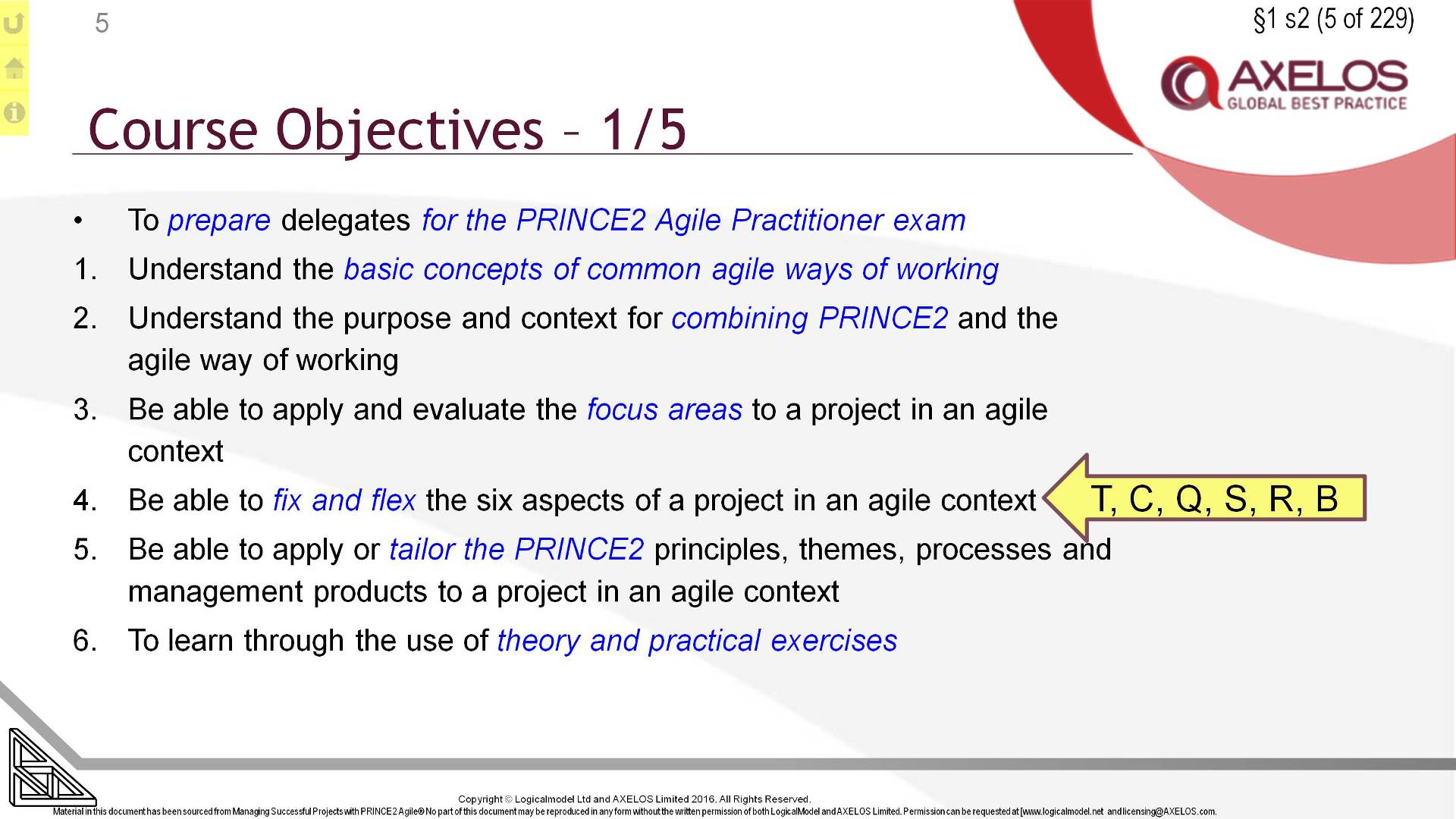
- For exam success you will have to master the exam’s 5 Learning Outcomes. They are the first 5 of the six Course Objectives shown here. I’ll explain the syllabus detail when we get to slide/ lesson/ video 9. Real world use is course objective number 6.
- <Sync. 1txt & yellow P1>
- Starting with Objective number 1 you will have to understand behaviours, concepts, techniques and frameworks considered more or less agile
- Lots of details as we go. You’ll come to appreciate how agile provides a product delivery focus – ie a focus on doing the work that creates business outputs and so enables the benefits or value.
- We might call it the technical specialist’s work as opposed to the manager’s control work.
- Technical work is activity like building a bridge, running a marketing campaign, arranging a concert tour, or developing a new product with multiple work-streams spanning concept development and perhaps also including a marketing campaign as a work-stream with its own team manager. Agile gives us focus on the products that the business needs to generate value.
- <Sync. pt 2>
- Prince gives us a light-weight, un-intrusive and adaptive control structure.
- Yeah that might not be its reputation but when used correctly it is actually the truth. P2a might just be the mechanism that raises people’s appreciation to be well-informed rather than miss-informed.
- Combining prince and agile creates synergy. prince is already fully agile enabled, note the phrase and this one “nothing is removed from prince to use it in agile ways & with an agile mind-set.
- <Sync. pt-3>
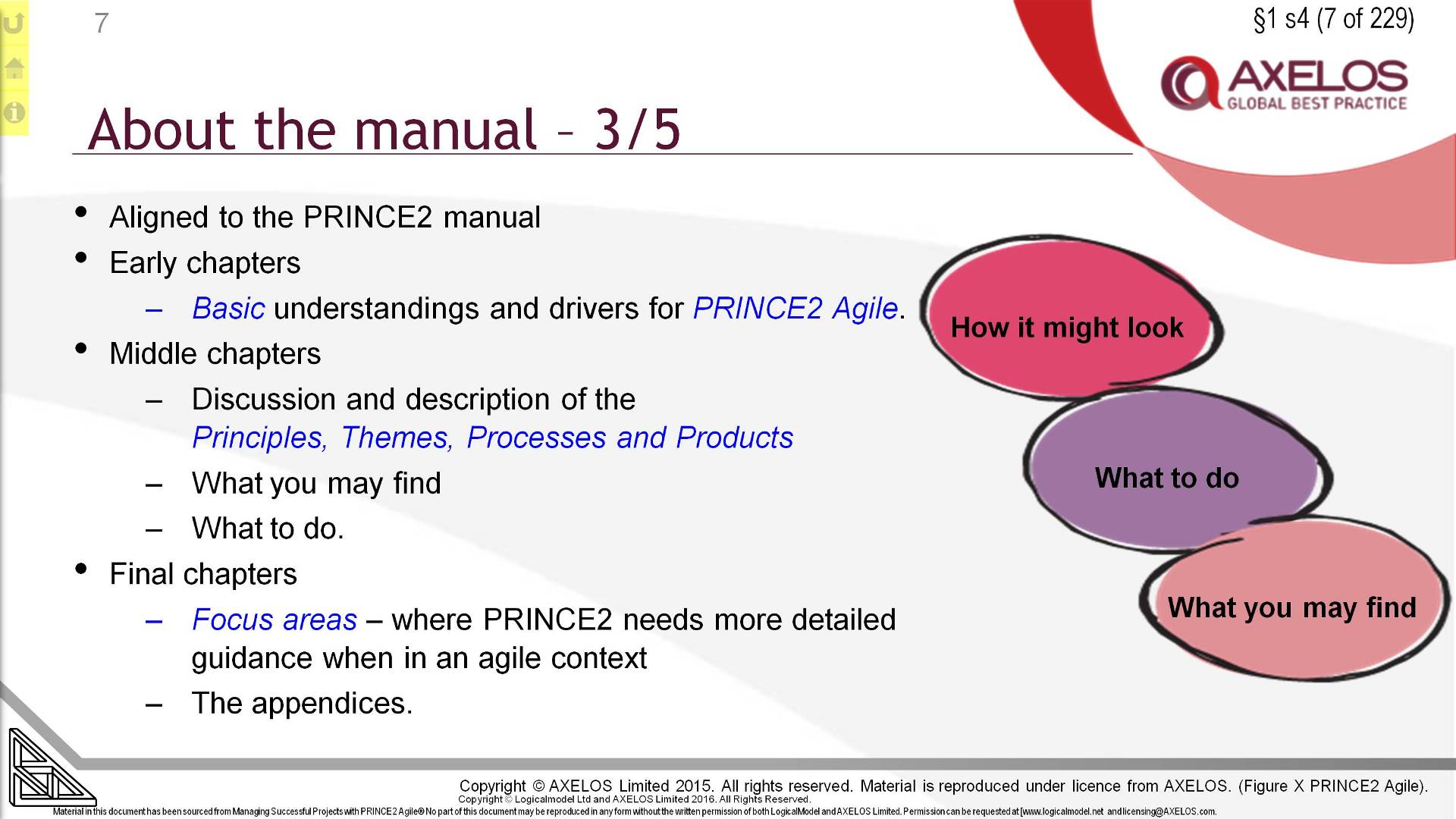
- The P2a official manual is 28 chapters and 8 appendices. The last 5 chapters are called focus areas
- In reverse order the focus area are: How to do contracts in an agile world, The concept of frequent releases for incremental delivery and A focus on rich communications like burn charts and ‘information radiators’. IRs are high visible status boards on the walls of the delivery team’s work-place. Wall displays are lo-tech and tactile, and the team keeps them updated in real-time
- The last 2 focus areas are Agile techniques for the expression of requirements such as user stories and firstly (recall I’ve done this list in reverse order) a 6 scale “Suitability metric” called under the very 1980’s style sobriquet the AgiloMeter.
- The Agil-O-Meter highlights any risk we should consider responding to that is created by choosing to use an agile mindset and the business’ readiness to actual do what being agile requires, for example to trust and empower people
- <Sync. pt-4>
- P2a takes prince’s 6 dimensions of flexibility or tolerance.
- Now here is a small test: (Can you recall those?, Maybe hit pause before I give you a hint.
- <Sync. 5Hint Arrow>
- Here’s a hint on the 6 tolerances.
- Maybe hit pause to have thinking time?
- They are…Time, Cost, Quality, Scope, Risk and Benefits. P2a says T & C are baselined so changing them is a big deal involving change control. Treat them always as fixed. But scope and quality are treated as fully flexible to accommodate constraining time and cost.
- Actually this is’nt draconian or a daft decree or an excuse for poor quality but I’ll need to explain the P2a view of the mechanisms and concepts that are the application of Agile to prince and application of Prince to agile
- <Sync. 6 pt-5>
- P2a is prince’s 7 principles, 7 themes, 7 processes, 9 roles, 12 baselines, 6 sets of records and 8 pre-defined reports (these last three sets being the 26 entries of appendix A that have always been called document templates but are now information sets. P2a reinterprets all the principles etc. So the 26 information collections of Apdx A don’t have to be documents they can be lo-tech, tactile wall displays
- <Sync. 7 pt-6>
- Through out I’ll introduce exercises and exam question analysis. They give you a break from theory input mode.
- Exercises are important so that you consider the meaning of and relationship between the things I explain to you. Exercises test your practical understanding.
- I’ll also pose and then analyse practice exam questions through out. They will show you the exam style. You will have to get into the head of the question setters to answer the questions.
- <Sync. 8 fade>
- In my real exam there were about a dozen questions I was sure of the answer the examiner wanted, about 25 that had some ambiguity and about a dozen where the scenario could be interpreted in so many ways I ended up guessing.
- Informed guesses from a deep understanding of the P2a manual perhaps but never the less still ending with a need to play the percentages split across more than one seemingly reasonable answer. We have plenty of practice exam questions to come where I can illustrate the points
- Take comfort in the fact that the pass mark is only 60% and its 2-1/2 hours for 50 mc questions so 3mins per question and open book – if you spend the £99.
End ss1 s5 0716 Objectives
Slide Copyright ©AXELOS Limited 2015 Reproduced under licence from AXELOS Limited. All rights reserved. From PRINCE2 Agile® section as detailed on slide image. Explanatory text and additional items ©Logicalmodel Ltd 2016
§1 s6 = About yourself – 2/5
§1 s6 Introductions
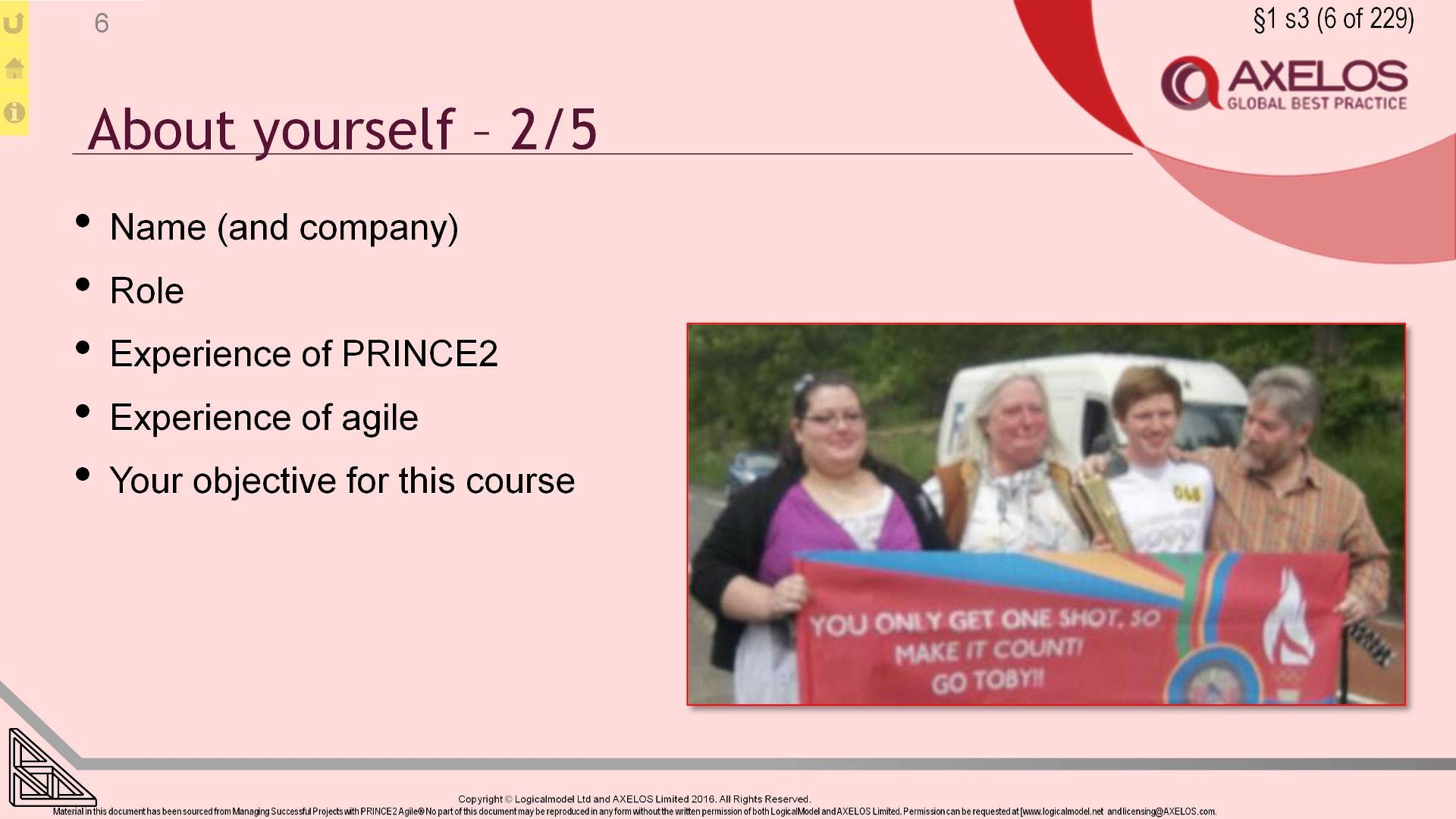
- For in-the-same-room training and for ‘virtual’ instructor led classroom based courses, both known as ILT,, which stands for Instructor Led Training,, we can all introduce ourselves in person.
- eLearning includes on-demand video where we are not all present at the same time. here I invite you to do your introductions through the discussion facilities rather than in virtual classes and physical classes where we can do our introductions face2face in real-time.
- Video on demand elearning is still ILT because I’m contactable and support you anytime you ask.
- If you’re on the learning portal at LML Training Portal then the disqus forum is automatically linked to materials. Otherwise Mail me mailto:p2a@logicalmodel.net and I’ll give you the details of how to join the support group
- In this medium I’ll introduce me.
- I live in Edinburgh Scotland with my wife Lea and my adult returned to the nest daughter and son Jessica & Toby who enjoy a low overhead rent free existence – at least for now
- I started work as a programmer and then project manager and have worked across many organisation as divers as GE the UN, banking, oil and gas and defence. Clients are an alphabet soup of global blue-chips through to small niche companies.
- During that time I’ve run projects, troubleshot operational departments, been a prince2 examiner and taught a wide variety of project management training courses from prince2 and PMP exam preparation to Effective team development and communication and more besides
- My consulting activities focus on improving the state of the art in project management Something an agile mindset combined with openness to adopt, adapt and integrate the best of ideas from all sources greatly enhances.
End
Slide Copyright ©AXELOS Limited 2015 Reproduced under licence from AXELOS Limited. All rights reserved. From PRINCE2 Agile® section as detailed on slide image. Explanatory text and photo items ©Logicalmodel Ltd 2016
§1 s7 = About the manual – 3/5
§1 s7 The manual
- The P2a Manual is 342 pages long.
- The P2a manual gives us about 150 pages of guidance whose detailed understanding is vital to a realistic expectations of being able to correctly answer exam questions from all topics.
- <Sync. 1 pgi-xv>
- After the official manual’s initial pages that list the chapters, figures and illustrations are three major SubSections Parts 1 to 3 and then the 8 appendices.
- <Sync. 2 HiLt>
- The first part is Introduction and overview. Its 40 odd pages.
- <Sync. 3 Manual>
- It looks like this in over view. Here I’ve removed 17 structuring, but otherwise blank pages from the illustration.
- The second section is P2a’s guidance on using quote agile behaviours, concepts & techniques and on tailoring prince – this is where all the how-to will be covered after the rather conceptual start – sorry about that but bear with it you do need the concepts as foundation for practitioner insight that is coming
- <Sync. 4 Mid>
- Part two includes guidance on applying P2a’s view of agile techniques. This second section is just about 100 pages worth of detail excluding blanks, chapter headers and filler pictures
- In here we get an explanation of how agile works, mostly from the perspective of three frameworks: scrum, kanban and Lean Start-up.
- The middle and last section are the two place where we will spend the most time.
- The middle section starts with a chapter on the 7 prince2 principles then gives us one chapter for each of the 7 prince themes, then 6 chapters for the 7 prince processes (the su and Initiation Stage are combined).
- Finally the P2a manual’s middle section ends with a chapter on tailoring prince2’s 26 appendix A management products or information sets
- By the time we have covered part 2 we mostly know what P2a considers to be agile and what P2a tells us we need to do to tailor prince and blend the best of two heritages for the strongest synergies.
- Each the theme and processes chapters have a similar structure.
- <Sync. 5 Ovals>
- First of all we get a reminder of what the standard prince manual says
- This is not examined and these AXELOS supplied official training slides omit the contents. Qualified P2-practitioners are assumed to know it – I’ll refresh it before we get to section 4 of these slides. I also have some revision aids that may help. And recall the course is instructor supported, just ask if you need more support
- After the ‘normal prince’ bit of each chapter we get an interpretation or explanation of agile concepts and techniques followed with discussion of the practicalities.
- Finally a summary which includes acknowledgements and further reading.
- Further readings –
- like following up on my added value observations - are not required for the exam because the exam is based on the Manual but further reading is useful if you come to the topic and want more background or detail in the agile concepts being discussed.
- I suggest saving exploration outside the course and manual for after the exam. You don’t want alternate opinions in your head till after you’ve answered the exam questions.
- <Sync. 6 FinalChs>
- The third section is the focus areas which is the next 50 pages and then the appendices which are the last 70 or 80 pages. These approximate counts include the blanks
- Do you recall the 5 focus areas that I mentioned in reverse order earlier?
- Maybe Hit pause to think? Is this Welcome Back after the pause?
- They are 1) Agil-O-Meter to measure risk from using agile, 2) Requirements; the mindset and techniques for the evolution of scope, 3) Rich communications; a focus on face to face, the use of models and pictures and workshops over documents and eMails, 4) Frequent releases of capability for early generation of both project feedback and business benefits, and 5) the treatment of contracts in agile situations.
- The appendices also deserve itemising.
- They are first a précis of the regular Apdx A) Template information set, B) is Role descriptions for prince and P2a roles, C) is a pj health-check questionnaire, D) the pbp example reproduced from the prince manual, E) the agile manifesto and a largish list of the values and principles of many agile frameworks, F) Thoughts on the transition when increasing organisational project agility, G) Advise to PMs using agile which is excellent and Apdx H) is a reprint of Sutherland & Schwaber’s Definitive Guide to Scrum.
End
Slide and base diagrams Copyright ©AXELOS Limited 2015 Reproduced under licence from AXELOS Limited. All rights reserved. From PRINCE2 Agile® page 1-xiv & 1-37, Explanatory text and additional items ©Logicalmodel Ltd 2016
§1 s8 = About the exam – 4/5
§1 s8 About the exam
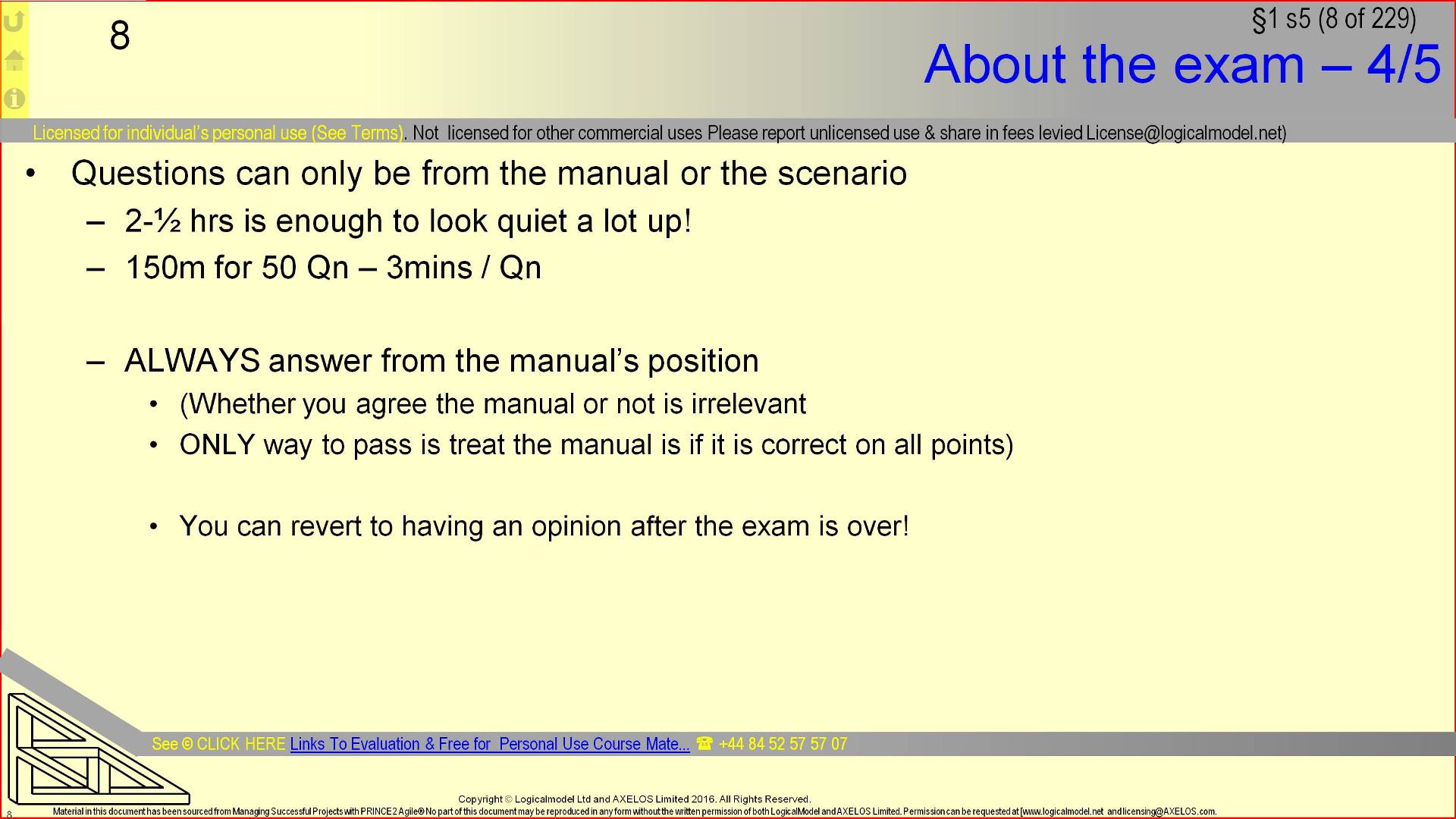
- All these mentions of the exam will reduce when we get past this initial stuff. But to illustrate our target so we can stop mentioning it quiet so much! Here is a little more detail.
- The exam is 150 minutes for 50 open book multiple choice questions. The first 7 questions are likely to be a test of your memory but nothing more. Since the exam is open book if you bought it then you’ll have time to look them up! The revision aids and my use in the course’s design of techniques such as repetition will mean your prepared even if you don’t buy the manual.
- The next 43 questions are a test of your memory, comprehension, sanity and more.
- There are two official sample exam papers within the course materials put together by the same team that sets the live exams.
- You are going to need to study the sample exam questions carefully! You need to learn to read from them the Role and or Timing and or other relevant element such as which theme or process the answers must match,, It takes practice, but I’ll guide you.
- An exam paper’s structure is three parts
- While studying we have a fourth part – the answers!
- <Sync. 1 WholePaper>
- First is a scenario that tells a story. Axelos’ practitioner Exams are always based on a scenario. The course’s Case-Study and the two sample practitioner exams use the same case study with minor adjustments and extensions. The two are close but not identical., the differences are immaterial. The exam’s version looks like this in total
- The story is divided into information that applies to all questions and information that is relevant to specific sub-sections of questions only.
- <Sync. 1 Text> Here is the Exam Scenario core text in full, its also in the Exam downloads in section zero. The Exercise and Case Study Work Book-Download includes the very slightly different version.
- When doing the exam at home the proctor will give you opportunity to print the scenario at the exam’s start (and outside the allotted question answering time)
- When on paper the second part is the answer blank.
- When on an exam that is paper based we will cover that then not now
- <Sync. 2 Qn_35>
- And third the question paper with the 50 questions. They look like this. Each counts one mark, there is no negative marking for those questions you have to guess at and you will have to guess some. The pass mark is 30 out of 50 or 60%.
- A rule of thumb might be that about 10-15 questions are bankers, the answer is something you can be confident of if you have studied.
- This includes the first 7 straight fact questions. Ace these so you have 20 minutes extra in your time bank.
- Check-out the course resource - revision aids. They will help you get fluency and thus speed here
- Back to rules of thumb. Maybe 25 Qns have a justification you can describe even if its not a black-and-white choice and 10 are too grey to call one way or the other.
- Check-out Qn 36 maybe hit pause to consider it (and 35)? Maybe welcome back? Q Qn 36 is a banker the answer is C – If it isn’t clear at this stage that’s fine, don’t worry we will discuss question analysis in the context of each course topic.
- Qn 35 is definitely A or B (C & D are factually wrong) but you’ll have to recognise that only B explains why we use retrospectives as opposed to how we set them up. You’ll have to learn to read the question stems. In this case “how well” requires that the explanation answers “why”
- I’ll show you truly ambiguous ones later – you need more context for the discussion to be useful
- I suggest you mostly focus on paper 1 while you sequentially study new materials and reserve paper 2’s questions for when you get to the end of your full pass through materials. Make the fisrt look at paper-2 a full mock exam to spot where revision will be most useful; then use the extra resources in the revision aids
- A simple but vital rule is always give the manual’s opinion. Knowing how to find that is going to take study of all the resources you have, particularly the practice exams.
- <Sync. 3 ExamQn>
- I’ve inserted official questions with their rationales at the end of most sections for discussion of exam technique.
- There formatting looks like this. These are the official mock questions just reformatted
- Maybe Hit pause if you want to try this one because the answer is coming in a few seconds. This question should be a banker. I’ll explain in a moment.
- Welcome back?
- <Sync. 4 ShowCEs>
- The red section is the Chief Examiner’s rationale. This is the fourth part of the exam only available in the training course. Something you’ll never get for the live exam!
- In this qn we are told of requirements. A recurrent idea in P2a is that scope is traded for deadlines.
- The mantra is “Always be on time”. We are further told youTube is a must-have, instagram is a should have and Facebook is mostly irrelevant so
- Answer A) doesn’t make youTube zero tolerance – another way of saying it is a must have,
- b) requires you appreciated the significance of the question stem’s detail that say “acceptance criteria…for where the video is available”
- c) makes all the delivery platforms equal importance when the question stem tells us they are not equal and
- d) is a close match for the sentiment of the marketing team’s beliefs so the answer we need.
- Hopefully you appreciate that the words in the question need to be paid close attention! Perhaps you also see that understanding of P2a’s expression of mindset – here that we sacrifice scope to hit deadline – is key and together the wording and concepts are the core of this question
- You’ll be able to ace these questions before you get to the exam. Maybe you aced it already and based on the right rationale.
End
Slide and Explanatory text ©Logicalmodel Ltd 2016 exam illustrations copyright AXELOS limited, Based on AXELOS PRINCE2 Agile® material. Material is reproduced under licence from AXELOS Limited. All rights reserved.
- Chestertons’ Exam Scenario ‘Golden Clog’ - Introduction: The Chesterton family started out as farmers, and four years ago they successfully moved in to the making and selling of a wide range of cheeses. They now employ 80 people.
- Chestertons sell most of their cheese to national supermarkets (referred to as ‘trade customers’). However, two years ago they decided to sell cheese directly to the public by telephone or over the counter at the farm shop. They did this in order to open up a new market in case their trade customers became less profitable.
- One of their cheeses, the Chesterton Blue, has been nominated for the International Cheese of the Year Award. The winner of this award will be announced at the International Cheese Festival being held in Amsterdam in three months’ time. Chestertons are expecting to see a significant increase in demand resulting from the publicity.
- In order to cope with the extra demand, Chestertons have decided to undertake a project which they have called ‘The Golden Clog Project’.
- Scope: The initial scope of the project includes:
- Rebranding of Chestertons Cheese;
- Creating a marketing campaign to highlight how successful Chestertons have been and to publicize their new branding;
- Moving to new premises where the manufacturing of the cheese and the support office will be in one place;
- Creating a new website.
- The Project has been set up with four work streams to deliver this work: 1. Rebranding; 2. Marketing campaign; 3. Website; 4. Move Premises.
- Project Background: Most of the staff at Chestertons have been trained in PRINCE2 Agile. Last year a project office was created to support best practice in the way Chestertons worked.
- Due to the importance of this project, the Directors have decided to release the Board Room for use throughout the project’s duration.
§1 s9 = Exam structure – 5/5
§1 s9 Exam Structure
- <Sync. 1 OB>
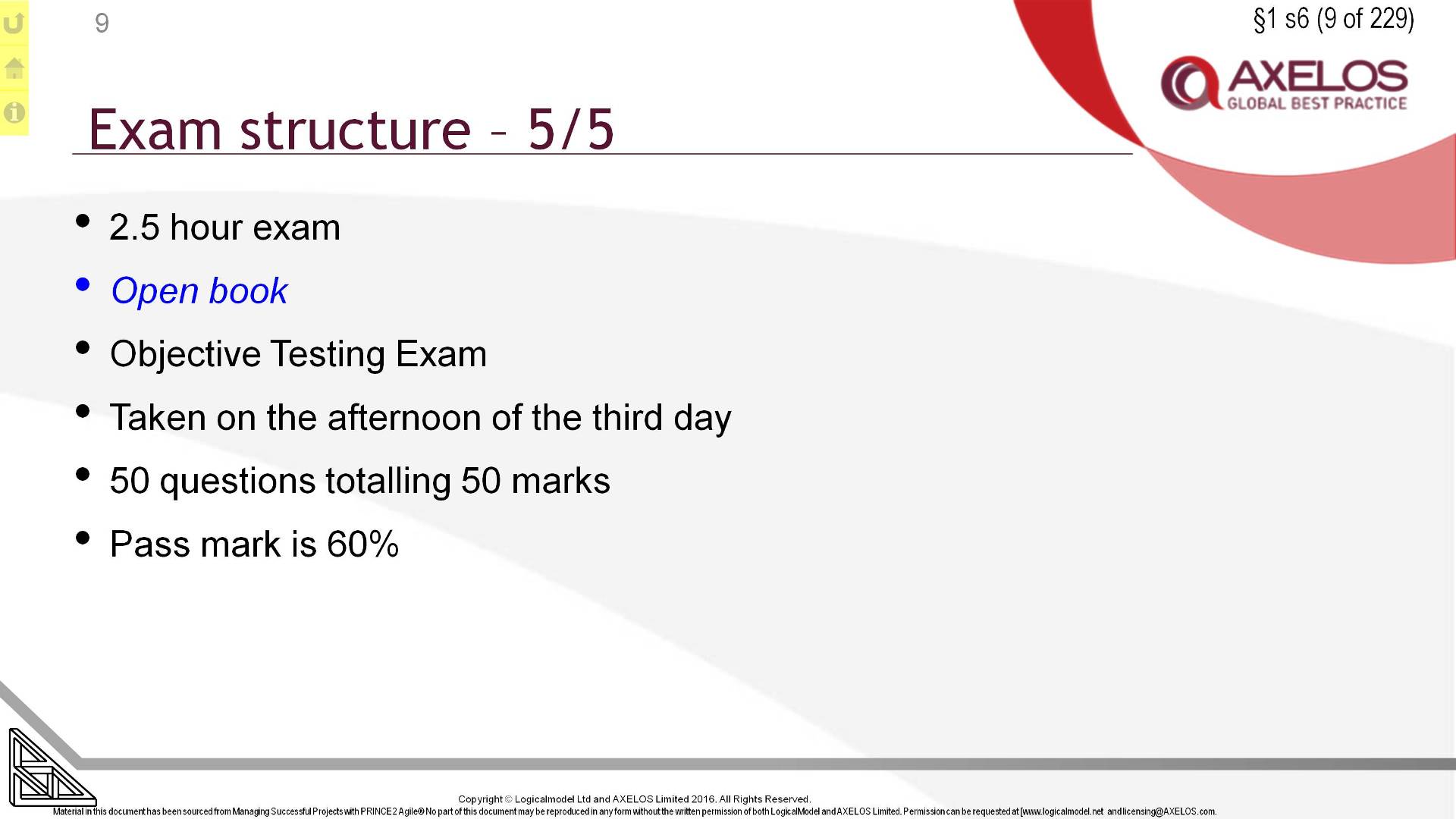
- Hey did I give you the good news already! The exam is open book!! And the not so good
- Hmm but only if you spend an extra £99 plus shipping if you buy at full price (Why would you!?) less if you buy from us. Our book shop.
- During the exam it is useful to refer to some specific pages 40 & 41, 50, 58 & 59, maybe 84, 138 definitely 205-8 and 216, and highly likely are those like 147 & 164.
- Since these pages are useful I’ve been careful to include their essence in the Revision Aids. There is a lot in the materials including the revision aids when we really get going to ensure you know what is required to pass the exam. It will take study to internalise the facts and relationships.
- A necessary caveat on the ’open book’ element of the exam is that if you are trying to look up lots in that open book then 150 minutes is no longer a generous timeframe. Axelos exams are designed to use the time given.
- <Sync. 2 OTE>
- I spent just on 2hrs.
- But I was still working out the exam style and I studied from the manual not from training materials. It may be an OTE (Objective Test Exam) made up of Multiple choice questions but we will see just how carefully the potential answers given need focussed reading, cross-reference to the principles and specific words used.
- It is for this reason you’ll get the number of quotes and key messages coming your way as we go. As well as careful reading of questions in the exam you might need some teeth sucking and chin stroking before plumping for an answer.
- During study at each chapter’s end you might find it helpful to summarise each chapter’s key points.
- Note when I highlight quotable phrases. They can crop up in exam questions; I’ll give lots to you as we go and the revision aids in the course resources are specifically aimed at helping here, but in essence as you read or listen be alert for decision making discriminators, definitions and facts, sequences and roles etc.
- By etc here and everywhere else I just mean ‘this is not a complete list’. When etc its not at the end of a list I believe it is complete. These materials are as rigorous as I can make them after multiple iterative and incremental edits.
- Here is the standard disclaimer. These materials are offered as is without promise of suitability for any specific purpose. The user should satisfy them selves as to their suitability for specific purpose. No liability is accepted for error, omission or addition nor for any consequences arising from use.
- Real-world success requires you add, subtract and adapt for your own context. Easier when you have sound grasp of the theory.
- Exam success benefits from practicing the exam questions and chase down their rationale’s for all those you get right or wrong.
- Yep rationale’s for what you get right and wrong is the way to prepare because the rationales reveal the style of the question setters and the manual’s author.
- Expect to be tired after the exam, and expect to use the time.
- <Sync. 3 50qn>
- But also expect that your study effort will reward you with 30 or more correct answers and the 60% required to pass.
- The number of questions available to you, is extended by the questions I have created to support your training journey. My questions are not the manual author’s style so they will help you explore from different perspectives. Check-out the course resource downloads for details. Sesction Zero Download-1
- Included in these questions are ones like “what does this quotable phrase convey?” These questions are my way of drawing your attention to what matters.
<Sync. Refs>
- When axelos built the syllabus they did so against the 5 learning outcomes we saw listed under Course Objectives and repeated in the notes here.
- The exam syllabus breaks the learning outcomes into 63 courseware items assigned against 20 Assessment criteria.
- You don’t really need to be interested in any of this except that each exam question and when we get into the detail slides you’ll see almost all,, cross reference the criteria in the notes. Also each slide has reference to the relevant official manual’ paragraphs and tables, its in the bottom right hand corner but axelos don’t supply a route to link exam assessment criteria to manual references to to course contents.
- BUT So that you can chase-down the related elements of the course for revision needs revealed by using the exams,, I have compiled a full set of cross-references. They are in the downloads in Subsection zero.
- My intention is that you are comfortable that the course is fully self-sufficient. Let me know if you need any thing else.
- I will do my level best to tell you everything material that the official manual says. p2a@logicalmodel.net or the course’s discussion facilities.
- Obviously this AXELOS slide’s reference to a third day
- <Sync. 4 3day> assumes an in-class event of three days!
- If your not inclass then you will need to book an exam via us as your sponsoring ATO. The most convienient route available to you is an anywhere 24x7 anytime online booking.
- All you need is a computer with web cam speakers and microphone – but not a headset – and a clear desk or table in a quiet cheat-free room.
- <Sync. 5 > Click through the link in the course resources to make a booking (for the community not using an app it resolves to LML P2 Home.
- You’ll also find the exam questions and all other resources through this link or on LML Training Portal
- Time now for section 2.
..”..
References
End
Slide Copyright ©AXELOS Limited 2015 Reproduced under licence from AXELOS Limited. All rights reserved. From PRINCE2 Agile® section as detailed on slide image. Explanatory text and additional items ©Logicalmodel Ltd 2016
Learning Outcomes and Assessment Criteria
- All content from the PRINCE2 Agile Manual may be examined with the exception of: PRINCE2 refresher content and concepts covered in Foundation and Practitioner qualifications, Examples used to illustrate p2a application, Learning outcomes 6 & 7 that refer to examination preparation methods.
- The exam is aligned to Bloom’s Taxonomy Levels 2 3 and 4
- BL2 Know the facts
- BL3 ‘Use’, ‘Apply’, ‘Make adjustments’ Application - Carry out or use a procedure in a given situation.
- BL4 ‘Evaluate’, ‘Assess’, ‘Analyze’ - Break material into its constituent parts and determine how the parts relate to one another and to an overall structure or purpose
- LO-1 3 Exam Questions(6%) Understand the basic concepts of common agile ways of working
- AC-1.1 BL2 Describe the fundamental frameworks (Scrum, Kanban, Lean Startup), behaviours, concepts and techniques of common agile ways of working
- AC-1.2 BL2 Explain how PRINCE2 Agile is used only in a project context, including the difference between projects and business as usual
- AC-1.3 BL2 Explain which agile ways of working are suitable for use with PRINCE2 Agile
- LO-2. 3 Exam Questions(6%) Understand the purpose and context for combining PRINCE2® and the agile way of working
- AC-2.1 BL2 Recognize common perceptions of traditional methodology (e.g. waterfall, command and control, bureaucracy, detail up-front)
- AC-2.2 BL2 Recognize the eight guidance points regarding PRINCE2 Agile
- AC-2.3 BL2 Explain benefits (to organization, to projects, to programmes, to people, etc.) of combining PRINCE2 with agile
- AC-2.4 BL2 Describe the need to ‘blend and weave’ PRINCE2 with agile at all levels of a project (project direction, project management and product delivery)
- LO-3. 12 Exam Questions (24%) Be able to apply and evaluate the focus areas to a project in an agile context
- AC-3.1 BL3 Use focus areas and their key techniques to tailor PRINCE2 effectively
- AC-3.1a BL3 Agilometer,
- AC-3.1b BL3 Requirements,
- AC-3.1c BL3 Rich communication,
- AC-3.1d BL3 Frequent releases
- AC-3.1e BL3 Contracts
- AC-3.2a-e BL4 Evaluate the application of focus areas (as 3.1a-e) and their key techniques in a project in an agile context
- LO-4. 8 Exam Questions (16%) Be able to fix and flex the six aspects of a project in an agile context
- AC-4.1 BL3 Set the tolerances for the six PRINCE2 aspects of a project in an agile context, taking into account the rationale behind the five targets = a) Quality, b) Scope, c) Time/ cost/ benefit/ risk
- AC-4.2 BL4 Evaluate the impact of the tolerances set for the six PRINCE2 aspects of a project in an agile context, taking into account the rationale for the five targets (§4=Ch:6.1, Ch:6.2, Ch:6.3, Ch:6.4, Table 6.2) = a) Be on time and hit deadlines
- LO-5. 24 Exam Questions (48%) Be able to apply or tailor the PRINCE2 principles, themes, processes and management products to a project in an agile context
- AC-5.1 BL4 Assess the level of maturity of a specific project environment with respect to agile
- AC-5.2 BL3 Apply PRINCE2 principles to meet the needs of a project, using a range of agile frameworks, behaviours, concepts and techniques
- AC-5.3 BL4 Evaluate how PRINCE2 principles can be applied to meet the needs of a project, including the use of a range of agile behaviours
- AC-5.4 BL3 Tailor PRINCE2 themes to meet the needs of a project using a range of agile frameworks, behaviours, concepts and techniques
- AC-5.5 BL4 Evaluate how PRINCE2 themes can be tailored to meet the needs of a project, using a range of agile frameworks, behaviours, concepts and techniques
- AC-5.6 BL3 Tailor PRINCE2 processes to meet the needs of a project, (including the PRINCE2 journey when using agile) using a range of agile frameworks, behaviours, concepts and techniques
- AC-5.7 BL4 Evaluate how PRINCE2 processes can be tailored to meet the needs of a project (including the PRINCE2 journey when using agile)
- AC-5.8 BL3 Tailor PRINCE2 management products to meet the needs of a project using a range of agile frameworks, behaviours, concepts and techniques
- AC-5.9 BL4 Evaluate how PRINCE2 management products can be tailored to meet the needs of a project
§1 s10 = Revision Aid: Our 1st Quiz
§1 q10 Quiz to Recap
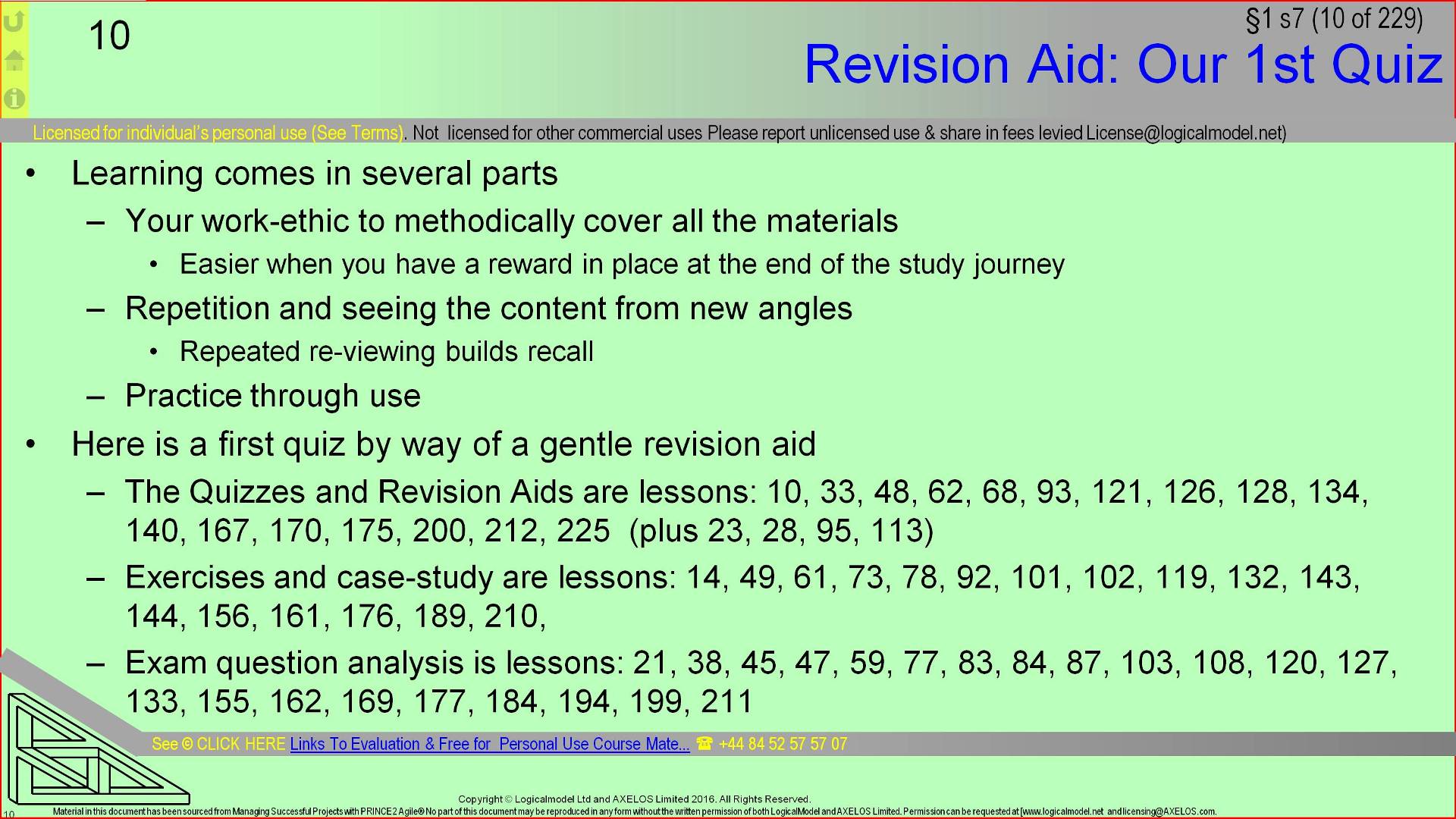
- Our first stop to review.
- You’ll have to consult the course notes, the online eLearning facilities or the downloads as I’ve not narrated this quizzes questions. When you look at the quiz questions note that none of the ones to come later will be this easy!
- They ARE all designed to either INTRODUCE details or RE-Inforce key points!
- Select the answers that you think are correct - You can select more than one correct answer to many question
- On eLearning platforms - then click “Check” to mark the question and “Continue” to move to the next question. In the downloads where relevant there is an answers section.
- I suggest you take quizzes and review revision aids more than once; it builds recall and understanding. For those reasons you’ll find the same contents is in other formats of revision aids too.
- Third time around (or second) I hope rather than saying “I’ve seen that somewhere, now what was the answer?” you’ll be saying “Ah yeah, new 1st time but knew it second time, now I’ve also got understanding of context not just an isolated fact”
End of Section! Celebration!! Visible progress!!!
- Get your kids (colleagues> etc) to make you a lapel pin-badge “I completed §1”
- </frivolous>
- This is the end of section_1’s coverage of who we all are, the manual and the exam .
- Next section_2 is one of our longest with 10 lessons, a Back@Work_Skill-Builder™ Skill_Builder case study and our first exam Qn analysis. Section_2 covers the typical, original work context of agile in ongoing business as usual software development and prince’s focus on projects in any environment and any industry. We will also discuss a few agile frameworks.
..”..
Q1 Who provides practitioner certification? (Select all that are correct)
- AXELOS are the certifying body
- The exams are administered & proctored by our appointed Examining Institute
- Course materials are provided by Logical Model Ltd heavily augmented from AXELOS’ official template materials
Q2 How much of prince is used in P2a?
- 100%
- P2a just uses agile ideas based on the principles
Q3 What are the manual’s major chunks (Select all that are correct)?
- Early chapters - Basic understanding and drivers
- Mid chapters - What you may find & do for each of the p2 Principles, Themes, Process_activities and Products(Information sets)
- Final chapters - 5 focus areas [ Agile risk assessment, Requirements, Rich comms, Frequent releases, Contracts] and Appendices A-H [A:Info-sets, B:Roles, C:Health check, D:PBP, E:Agile manifesto, extract, F:Transition, G:Advice to PMs, H:Scrum-guide]
Q4 Exam facts - Select all that are correct - I won’t keep saying this now…
- Duration 150 minutes
- Number of questions 50
- Scenario based
- First 7 questions simple facts
- Remaining 43qns are tough interpretation of BEST application of the manuals
- Available online 24 x 7 x 365
- Proctored by a live proctor through bespoke exam management software
Q5 What are the course’s quotable phrases?
- Fragments and concepts from the official manual that have a probability of turning up in exam questions
- Highlighted and introduced as “Key…” or “Quotable…” or “Quote…” throughout the course materials
- Repeated as a consolidated list in lesson 175
End
Slide and base diagrams Copyright ©AXELOS Limited 2015 Reproduced under licence from AXELOS Limited. All rights reserved. From PRINCE2 Agile® section as detailed on slide image. Explanatory text and additional items ©Logicalmodel Ltd 2016
VnCtl:14/08/2016 18:26:54 This file is part of Logical Model Ltd’s p2a training course