Apdx: LML’s P2a Practitioner Back@Work™ SkillBuilder {#ApdxB@W}
§2 s14 = Baseline Exercise-0: What is Agile, PRINCE2 and Project Management?
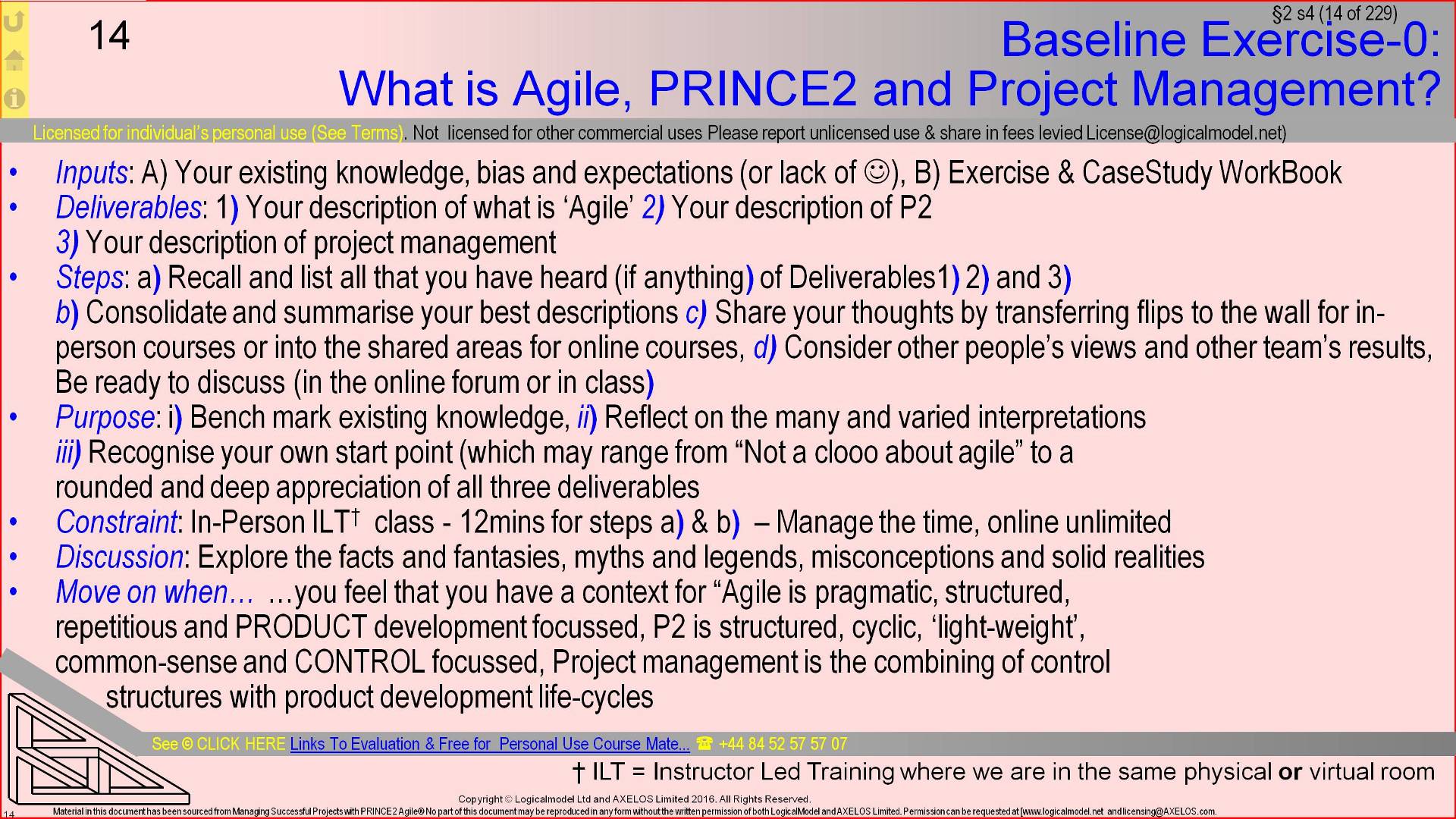
§2 b@w™14 – Exercise What is Agile
- The first of our exercises which together with the case study give breadth to your capability development
- Exercises and the case study are supported by the Exercise & CaseStudy WorkBook which is downloadable from ss0 DL-1 it’s a consolidation of the relevant course notes rather than additional contents.
- It duplicates all the video Exercises and Case Study material in what I hope is a convenient off-line format.
What is agile?
- The question to address in this exercise is “What, perhaps if anything, do I believe agile is?” In the context of a live ILT class based course – physical or virtual class - it’s a discussion intended to survey the wide range of views that exist.
- We haven’t actually defined agile beyond the now oft repeated fragments that I’ll put into a phrase that is quotable after I’ve given you chance to define your own answer
- You might pause now and ask yourself
- Some reflection on what is agile might help you before we move on.
- Pause?
- Welcome back?
- Typical views range across; “its a way of seeing and being, it’s a mindset” to “obviously it is scrum. Full-stop.”. The normal debate typically raises another view. Agile is a religion or at least some people are as passionate and so sadly alos bigoted as the strongest religious cults can create.
- P2a is sensitive to ideas such as “anyone with the title manager implies lack of trust”. P2a still says a Project Manager is mandatory. Perhaps because of that the longest chapter is the organization theme as it attempts to blend and weave prince roles with agile concepts.
- The quotable is “P2a is a mindset comprised of Concepts, Behaviours and Techniques as applied by some frameworks”.
- By framework we definitely mean something that provides procedures and may also mean provides roles descriptions
- By framework we equally mean method or approach
- Quotable means reliable for the exam but you should also think beyond the exam.
- Also think beyond the exam.
Exam Booking
- By the way have you booked your exam yet.
- The commitment of booking will help you succeed. Define a time box and be successful in delivering to time.
- eMail me <p2a@logicalmodel.net> and I’ll share a sample revision diary with 21 mini-milestones. Add your own dates and amend assignments to suit your self directed study targets. Give yourself rewards for achievements on the way to success. Let us all know via the shared areas and I’ll post acknowledgement of your progress.
End
References
Slide and Explanatory text ©Logicalmodel Ltd 2016 Based on AXELOS PRINCE2 Agile® material. Material is reproduced under licence from AXELOS Limited. All rights reserved.
§4 s49 = Back@Work_Skill-Builder™ Exercise-1: What Is Chestertons’ Investment?
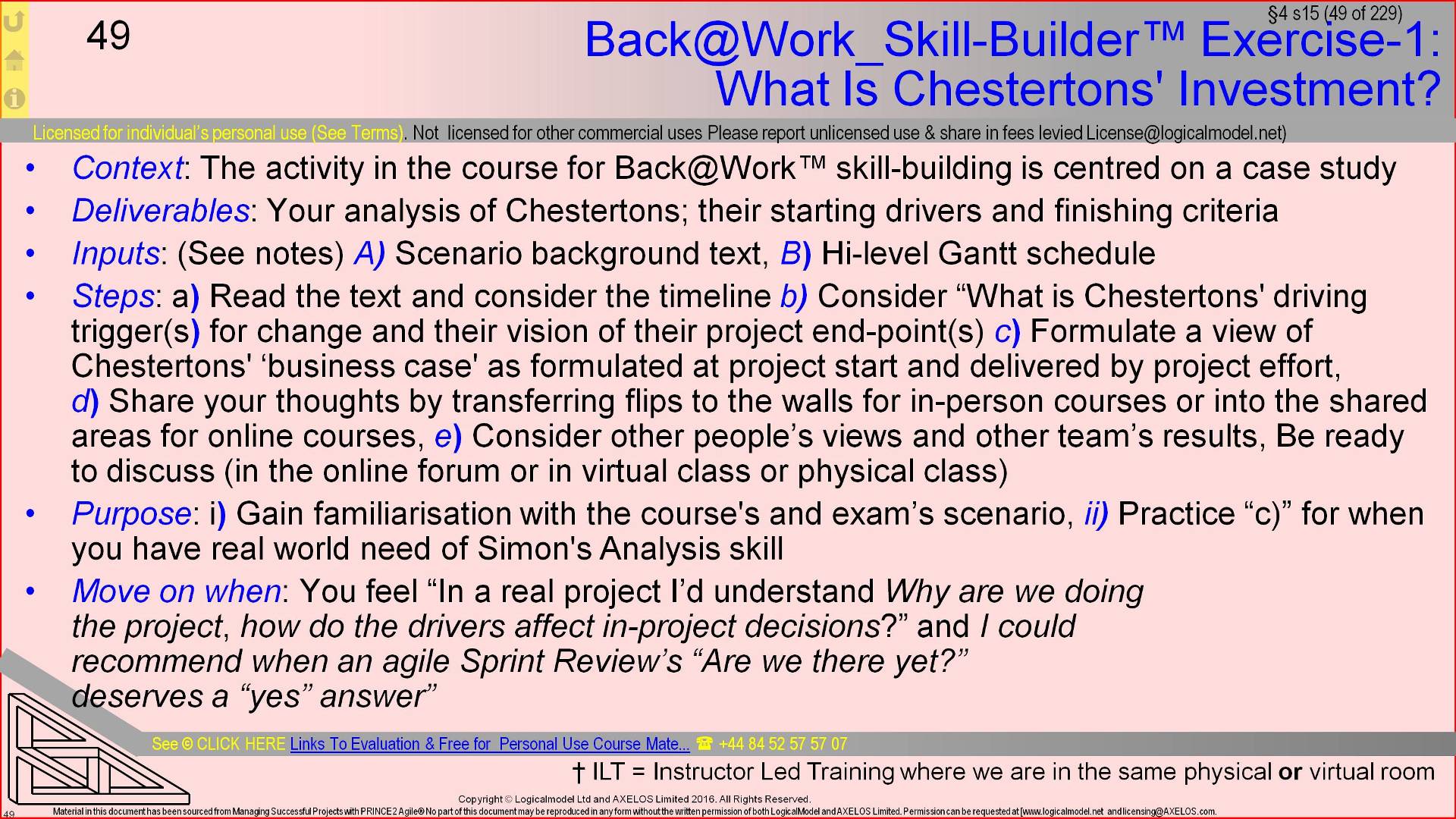
§4 b@w™49 Case Study - Investment
- ~~
- Time for our first Back@Work skill builder that focuses effort on use of p2a outside of exam preparation. This is the focus where the most value is to be had.
- You might like to read the on slide guidance or if your platform’s resolution is low then consult the Exercise & CaseStudy Workbook (from ss0 DL1, the full link is in the course notes P2a Enrolled Downloads). Pause? Welcome back?
- The exam questions we’ve examined so far for example Qn 19 which was the first we saw on slide ss1 s8 are like all P2a exams; They are based on a scenario. So too are our preparations for use of p2a skills in real projects.
- <Sync. Scenario> For convenience here is the scenario text. If the details onscreen here are illegible look in the resources-downloads for the Chestertons’ Cheese Golden Clog scenario.
- <Sync. Gantt>Here is the schedule. Both are also on this slide’s notes page.
- The scenario is a suitable vehicle for building real world skills. Have a read and ask your self:-
- What is the project?
- Hit pause till your ready for some thoughts
- Welcome back
- The business driver is to streamline operations and boost market awareness.
- Attractive results might include diverting some ‘phone traffic & replacing it as web-site traffic so that employee time is freed to be spent on more valuable business development.
- If you don’t sell more cheese is it a success? Yes if the cheese is sold at a lower level of staff time per sale
- With the right focus and maybe some luck a web-site might also increase sales. Making the right luck will involve some epics about marketing and promotional activity
- Consolidating premises also creates efficiencies, Brand building increases turn over which even wit out efficiencies should boost profits but is doubly helpful if cost of sales are also reduced
- I leave you to Read the Case Study Scenario about Chestertons Cheese which is in the Exercises and Case Study Work book and the course notes
..”..
Chestertons Cheese Scenario for Case Study (P2a vn 1.0.1)
- The Chesterton family are farmers, and they successfully moved in to the making and selling of a wide range of cheeses.
- Chestertons sell most of their cheese to national supermarkets (referred to as ‘trade customers’). However, two years ago they decided to sell cheese directly to the public by receiving orders by telephone or over the counter at the farm shop. They did this in order to open up a new market in case their trade customers became less profitable.
- They employ several staff who help with the running of the machinery, customer service and distribution. Deliveries to the public are done by courier. Trade deliveries are carried out using the 6 company vans.
- They are currently receiving an increasing number of phone orders from the public for cheese every day and they have now reached a point where they are looking at selling cheese ‘online’.
- The Chestertons currently have a website but it is very old and only has pictures of the farm, basic details about their cheeses and contact details. It will need to be completely replaced.
- The Chestertons are looking for a website which will shift most of the phone traffic and visits to the farm shop onto the web.
- From the research they have done so far it looks likely that they could possibly increase cheese sales to the public without recruiting more staff. The cost of the website looks like being 20,000 to build with a service contract of 400 per month. Initial estimates suggest that increased sales could pay for this within 12 months.
Personnel
- Mrs. Chesterton: Strong accountancy skills. Authorised all of the new initiatives. Very decisive. Doesn’t like the impersonal nature of the internet. Will only eat organic cheese.
- Mr. Chesterton: Likes to play around with ideas. Starts many things off but rarely finishes anything. Decides where the family business should be going at a strategic level. Very keen on technology and gadgets. Wears a watch that tells him how high he is above sea-level but no one is sure why.
- Jake Chesterton: ‘Hands-on’ day to day running of the cheese business. Leads a small team that handles all sales calls. Is very operationally focussed on getting the right thing to the right customer. Takes many of the calls. Very reactive – fire-fights problems as they happen. Likes to go for long walks on his own.
- Kerry Chesterton: Leads the Customer Service and Marketing department. Generally keeps everyone happy. Responsible for dealing with any queries including those about new types of cheese. Responsible for the ‘image’ of Chestertons Cheese. Cares passionately about the environment.
- Mirek Kowalski: The I.T. Manager who started as a website designer at Chestertons three years ago. Knows all of the existing systems and applications in a lot of detail, works long hours and leaves his phone on all the time in case of problems. Likes to straighten the pictures that hang in the reception area.
- Mimi Bertillon: Leads a small team that handles order fulfilment. Is involved in the vital part of the process where the orders are packed and addressed according to the picking note information provided by Jake’s team. Is allergic to cheese.
- Sanjay Patel: Responsible for looking after the delivery side of the business. This includes receiving raw materials and the dispatch of packaged orders. Very good inter-personal skills. Really loves cheese.
- Sam O’Farrell: Has a lot of experience of many areas of the company. Has worked for the Chestertons for many years and is seen as the ‘old stager’. Is currently looking after the production lines, ensuring that they run as well as possible. Affectionately known as ‘Grumpy’. Believes cheese is only cheese if it is hard.
End
Copyright © AXELOS Limited 2015. All rights reserved. No part of this publication may be reproduced in any form or by any means without permission in writing from AXELOS Limited. This information is part of the official PRINCE2 Agile® sample examination paper
§6 s61 = Back@Work_Skill-Builder™ Exercise-6: Rank the 5 behaviours
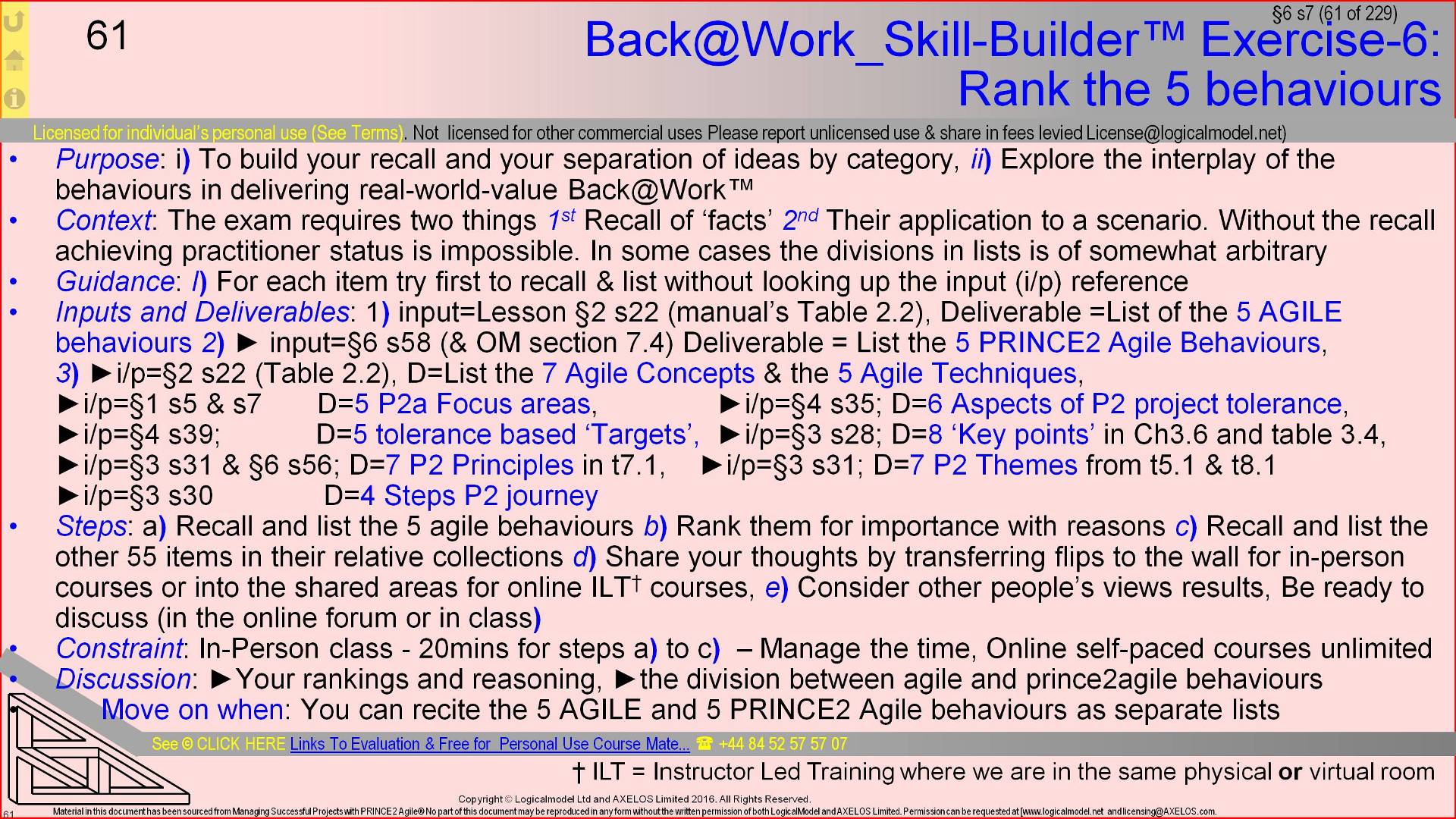
§6 b@w™61 Rank the 5 Behaviours
- You might like to consult the Exercise & CaseStudy Workbook (from §0 DL1 P2a Enrolled Downloads) or hit pause to read the slide’s guidance notes. Pause? Welcome back?
- As well as passing the exam we need to build Back@Work_Skill-Builder™ real world skills if the exam pass is to really be useful.
- Since we have covered agile and P2a’s list of behaviours you should explore their implications
- It might help to do a simple recollection test first. Actually not so simple. See how you do to recall these. If recall is still a challenge, which is fair enough, then list them out from the answers hit pause to think then I’ll fill-in all the blanks. Pause? Welcome back?
- <Sync. Ans>
- Here is that reminder of the two sets of behaviours and a whole bunch of other things we have covered
- Lets now consider
- Trace the implications of the 5 behaviours in the context of P2a to actions and attitudes of the role holders around you in your current working environment. Are they what P2a calls for. Why and why not. How could they be improved, what’s in it for each stakeholder
- You may choose to send me your suggested answer or Join the online discussion of what do the descriptions mean, which behaviours matter most, which are hardest, when and in what context?
..”..
Purpose:
- i) To build your recall and your separation of ideas by category, ii) Explore the interplay of the behaviours in delivering real-world-value Back@Work™
Context:
- The exam requires two things 1st Recall of ‘facts’ 2nd Their application to a scenario. Without the recall achieving practitioner status is impossible. In some cases like this the recall is of somewhat arbitrary divisions in lists
Deliverables:
- 1) List of the 5 AGILE behaviours in Table 2.2 2) Plus; if you’re up to it the 5 PRINCE2 Agile Behaviours in section 7.4, 3) Plus it would be in your interest to confirm: the 7 Agile Concepts in t2.2, the 5 Agile Techniques in t2.2, the 5 P2a Focus areas Ch23-28, the 6 Aspects of P2 project tolerance from t6.1, the 5 tolerance based ‘Targets’ of t6.2, the 8 ‘Key points’ in section 3.6 and table 3.4, the 7 P2 Principles in t7.1, the 7 P2 Themes from t5.1 & t8.1
Inputs:
- A) Lesson §2 s22 for the 5 Agile behaviours, 7 Concepts & 5 Techniques B) §6 s58 for the 5 prince2 agile behaviours, §4 s35 – 6 Aspects, The 8 Key Guidance points in §3 s28, P2 principles & Theme §3 s31, 7 principles also in §6 s56 and §4 s39 for the 5 Targets C) Later Revision Aids §21 ra167, §21 s170, §29 s121 are also designed to help.
Steps:
- a) Recall and list the 5 agile behaviours b) Rank them for importance with reasons c) Recall and list the other 55 items in their relative collections d) Share your thoughts by transferring flips to the wall for in-person courses or into the shared areas for online courses, e) Consider other people’s views and other team’s results, Be ready to discuss (in the online forum or in class)
Constraint:
- In-Person class - 20mins for steps a) to c) – Manage the time, Online self-paced courses unlimited
Discussion:
- Your rankings and reasoning, the division between agile and prince2agile behaviours
Guidance:
- I) Research in the course notes to recall the list and write them out for recall Move on when: You can recite the 5 AGILE and 5 PRINCE2 Agile behaviours as separate lists
End
Slide and Explanatory text ©Logicalmodel Ltd 2016 Based on AXELOS PRINCE2 Agile® material. Material is reproduced under licence from AXELOS Limited. All rights reserved.
§8 s73 = Back@Work_Skill-Builder™ Exercise-2: Classify Chestertons’ Project
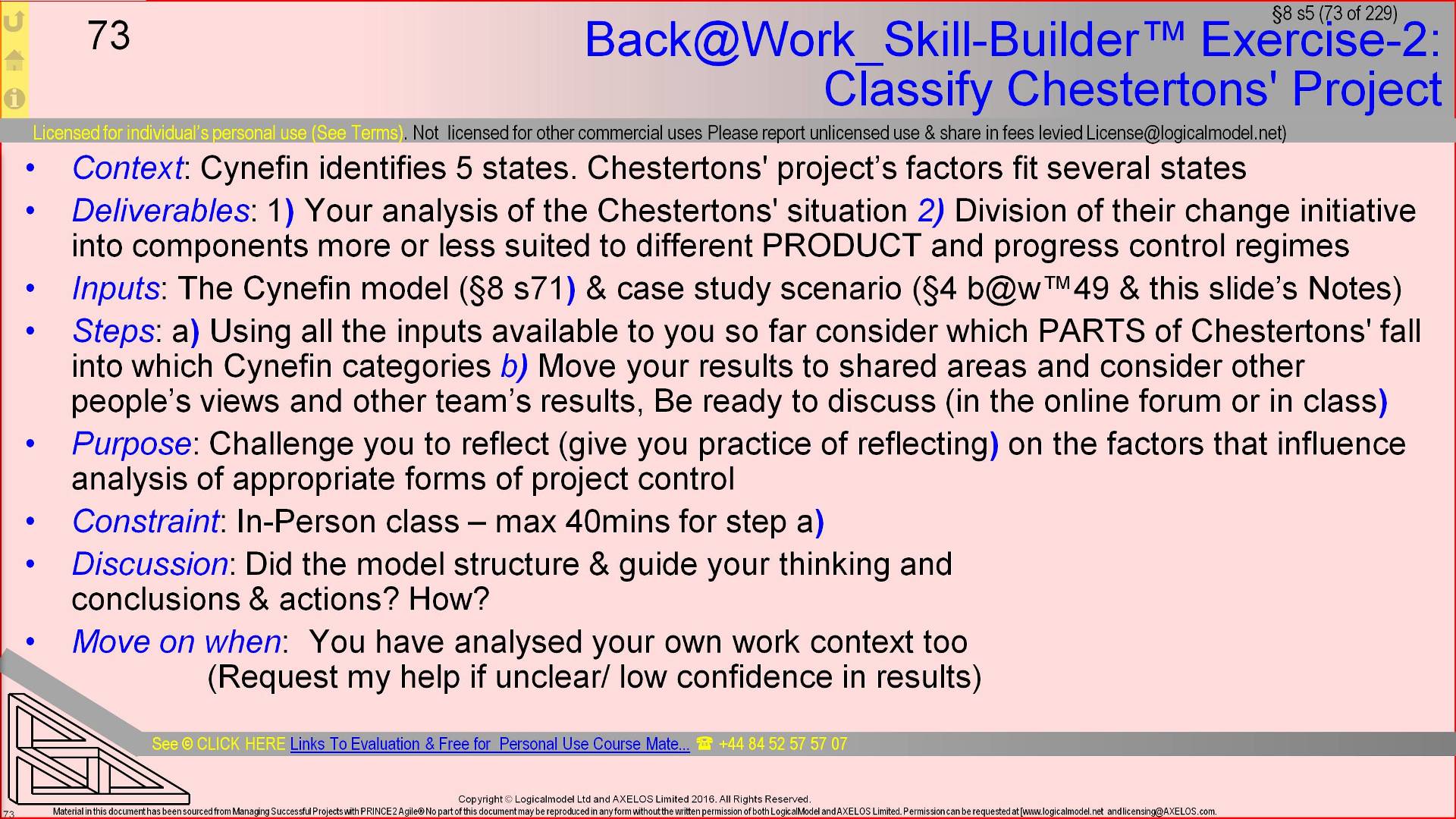
§8 b@w™73 Case Study – Chestertons’
- Returning to developing real world skills as well as passing the exam.
- Maybe hit pause and read the guidance notes. Either on-screen or from your course downloads (§0 DL1)
- Consider the Chestertons’ scenario
- Apply the Cynefin framework, perhaps by asking how to categorise the aspects of the scenario.
- Where would you place Chestertons?
- Why?
- As a result how should we apply agile (that is Behaviours, Concepts, Techniques and Frameworks) to the conduct of the project?
- What actions are you as Project Manager going to take?
- Study the scenario in the notes, on slide or in the Exercise and Case-Study WorkBook and think how the factors expressed as context affect either; pre-defined solutions for simple well understood work, or,, expertise following known approaches for complicated work or the need to experiment for complex work. I don’t think we yet have the need to recover any aspect of Chestertons’ the – Chaos part of snowden’s model.
- Pause to read and consider. Welcome back?
- So how did you decide where to place the scenario on the scale? In the next section we wil look at the Agil-O-Meter to see how that will help.
End
Chestertons Cheese Scenario for Case Study (P2a vn 1.0.1)
- The Chesterton family are farmers, and they successfully moved in to the making and selling of a wide range of cheeses.
- Chestertons sell most of their cheese to national supermarkets (referred to as ‘trade customers’). However, two years ago they decided to sell cheese directly to the public by receiving orders by telephone or over the counter at the farm shop. They did this in order to open up a new market in case their trade customers became less profitable.
- They employ several staff who help with the running of the machinery, customer service and distribution. Deliveries to the public are done by courier. Trade deliveries are carried out using the 6 company vans.
- They are currently receiving an increasing number of phone orders from the public for cheese every day and they have now reached a point where they are looking at selling cheese ‘online’.
- The Chestertons currently have a website but it is very old and only has pictures of the farm, basic details about their cheeses and contact details. It will need to be completely replaced.
- The Chestertons are looking for a website which will shift most of the phone traffic and visits to the farm shop onto the web.
- From the research they have done so far it looks likely that they could possibly increase cheese sales to the public without recruiting more staff. The cost of the website looks like being 20,000 to build with a service contract of 400 per month. Initial estimates suggest that increased sales could pay for this within 12 months.
Personnel
- Mrs. Chesterton: Strong accountancy skills. Authorised all of the new initiatives. Very decisive. Doesn’t like the impersonal nature of the internet. Will only eat organic cheese.
- Mr. Chesterton: Likes to play around with ideas. Starts many things off but rarely finishes anything. Decides where the family business should be going at a strategic level. Very keen on technology and gadgets. Wears a watch that tells him how high he is above sea-level but no one is sure why.
- Jake Chesterton: ‘Hands-on’ day to day running of the cheese business. Leads a small team that handles all sales calls. Is very operationally focussed on getting the right thing to the right customer. Takes many of the calls. Very reactive – fire-fights problems as they happen. Likes to go for long walks on his own.
- Kerry Chesterton: Leads the Customer Service and Marketing department. Generally keeps everyone happy. Responsible for dealing with any queries including those about new types of cheese. Responsible for the ‘image’ of Chestertons Cheese. Cares passionately about the environment.
- Mirek Kowalski: The I.T. Manager who started as a website designer at Chestertons three years ago. Knows all of the existing systems and applications in a lot of detail, works long hours and leaves his phone on all the time in case of problems. Likes to straighten the pictures that hang in the reception area.
- Mimi Bertillon: Leads a small team that handles order fulfilment. Is involved in the vital part of the process where the orders are packed and addressed according to the picking note information provided by Jake’s team. Is allergic to cheese.
- Sanjay Patel: Responsible for looking after the delivery side of the business. This includes receiving raw materials and the dispatch of packaged orders. Very good inter-personal skills. Really loves cheese.
- Sam O’Farrell: Has a lot of experience of many areas of the company. Has worked for the Chestertons for many years and is seen as the ‘old stager’. Is currently looking after the production lines, ensuring that they run as well as possible. Affectionately known as ‘Grumpy’. Believes cheese is only cheese if it is hard.
End
Copyright © AXELOS Limited 2015. All rights reserved. No part of this publication may be reproduced in any form or by any means without permission in writing from AXELOS Limited. This information is part of the official PRINCE2 Agile® sample examination paper
§9 s78 = Back@Work_Skill-Builder™ Exercise-7: Apply the Agilometer
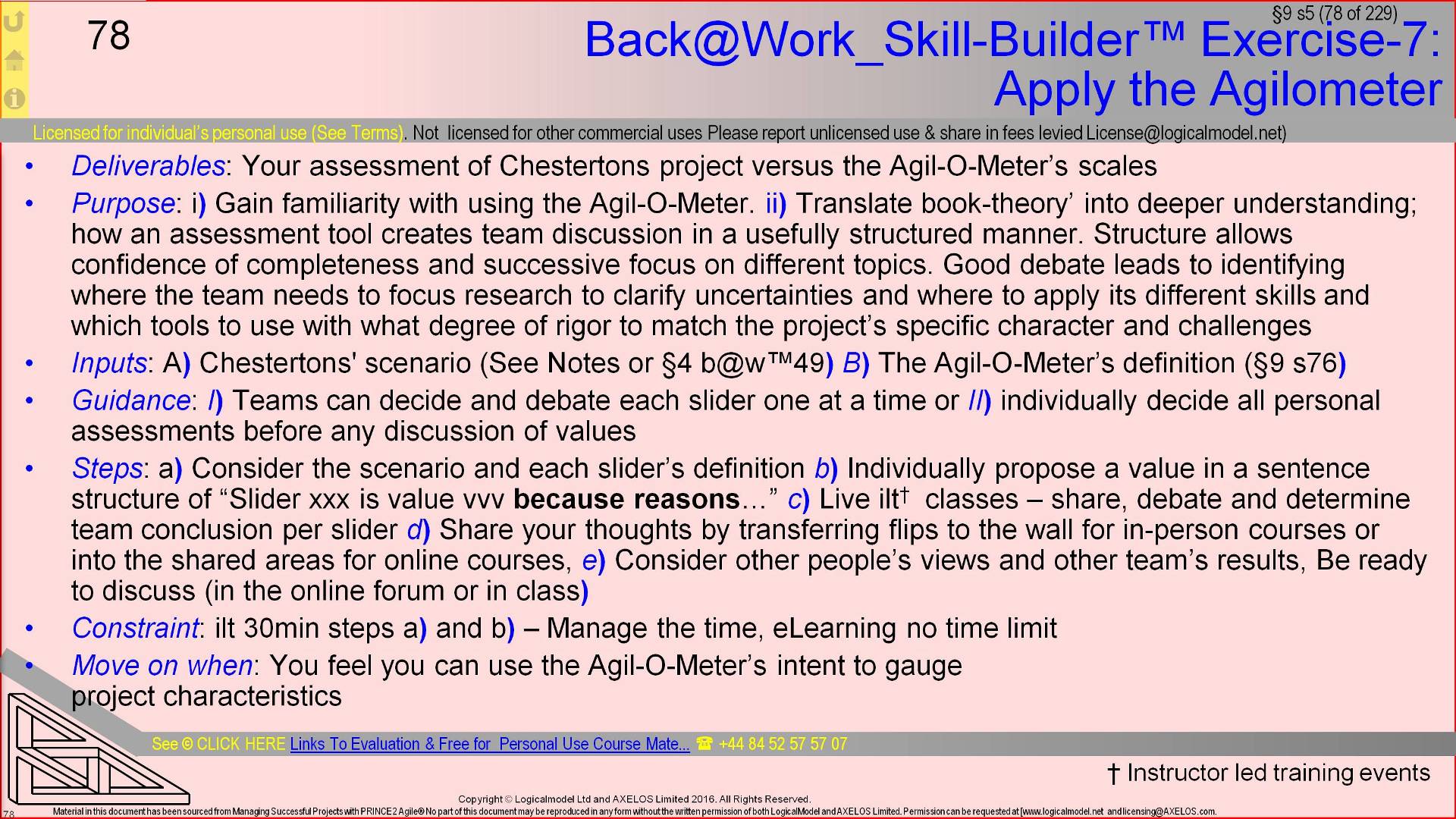
§9 b@w™78 Apply Agilometer to Chestertons’
- Maybe pause to consider the guidance on-slide.
- Return to Chestertons scenario (duplicated in this slide’s notes and the course downloads) and consider
- What evidence is there that affects the value for each Agil-O-Meter slider?
- Pair the facts in the scenario with the slider’s definition & illustrations
- You can use a fact in more than one slider’s influences
- Decide the values you’ll assign, They may vary by work stream
- Decide the actions you could take to promote agility and reduce execution risk
- A way to structure you analysis is with a matrix
- Place the 6 scales on one axis, the project’s factors on the other and their interaction ± in the intersections
- Responses and responsible person could also go in the intersections
- If you want clarification, confirmation or feedback then send me your analysis when you’ve done it
End
Chestertons Cheese Scenario for Case Study (P2a vn 1.0.1)
- The Chesterton family are farmers, and they successfully moved in to the making and selling of a wide range of cheeses.
- Chestertons sell most of their cheese to national supermarkets (referred to as ‘trade customers’). However, two years ago they decided to sell cheese directly to the public by receiving orders by telephone or over the counter at the farm shop. They did this in order to open up a new market in case their trade customers became less profitable.
- They employ several staff who help with the running of the machinery, customer service and distribution. Deliveries to the public are done by courier. Trade deliveries are carried out using the 6 company vans.
- They are currently receiving an increasing number of phone orders from the public for cheese every day and they have now reached a point where they are looking at selling cheese ‘online’.
- The Chestertons currently have a website but it is very old and only has pictures of the farm, basic details about their cheeses and contact details. It will need to be completely replaced.
- The Chestertons are looking for a website which will shift most of the phone traffic and visits to the farm shop onto the web.
- From the research they have done so far it looks likely that they could possibly increase cheese sales to the public without recruiting more staff. The cost of the website looks like being 20,000 to build with a service contract of 400 per month. Initial estimates suggest that increased sales could pay for this within 12 months.
Personnel
- Mrs. Chesterton: Strong accountancy skills. Authorised all of the new initiatives. Very decisive. Doesn’t like the impersonal nature of the internet. Will only eat organic cheese.
- Mr. Chesterton: Likes to play around with ideas. Starts many things off but rarely finishes anything. Decides where the family business should be going at a strategic level. Very keen on technology and gadgets. Wears a watch that tells him how high he is above sea-level but no one is sure why.
- Jake Chesterton: ‘Hands-on’ day to day running of the cheese business. Leads a small team that handles all sales calls. Is very operationally focussed on getting the right thing to the right customer. Takes many of the calls. Very reactive – fire-fights problems as they happen. Likes to go for long walks on his own.
- Kerry Chesterton: Leads the Customer Service and Marketing department. Generally keeps everyone happy. Responsible for dealing with any queries including those about new types of cheese. Responsible for the ‘image’ of Chestertons Cheese. Cares passionately about the environment.
- Mirek Kowalski: The I.T. Manager who started as a website designer at Chestertons three years ago. Knows all of the existing systems and applications in a lot of detail, works long hours and leaves his phone on all the time in case of problems. Likes to straighten the pictures that hang in the reception area.
- Mimi Bertillon: Leads a small team that handles order fulfilment. Is involved in the vital part of the process where the orders are packed and addressed according to the picking note information provided by Jake’s team. Is allergic to cheese.
- Sanjay Patel: Responsible for looking after the delivery side of the business. This includes receiving raw materials and the dispatch of packaged orders. Very good inter-personal skills. Really loves cheese.
- Sam O’Farrell: Has a lot of experience of many areas of the company. Has worked for the Chestertons for many years and is seen as the ‘old stager’. Is currently looking after the production lines, ensuring that they run as well as possible. Affectionately known as ‘Grumpy’. Believes cheese is only cheese if it is hard.
- End
Copyright © AXELOS Limited 2015. All rights reserved. No part of this publication may be reproduced in any form or by any means without permission in writing from AXELOS Limited. This information is part of the official PRINCE2 Agile® sample examination paper
§12 s92 = Back@Work_Skill-Builder™ Exercise-16: Identify the MVP
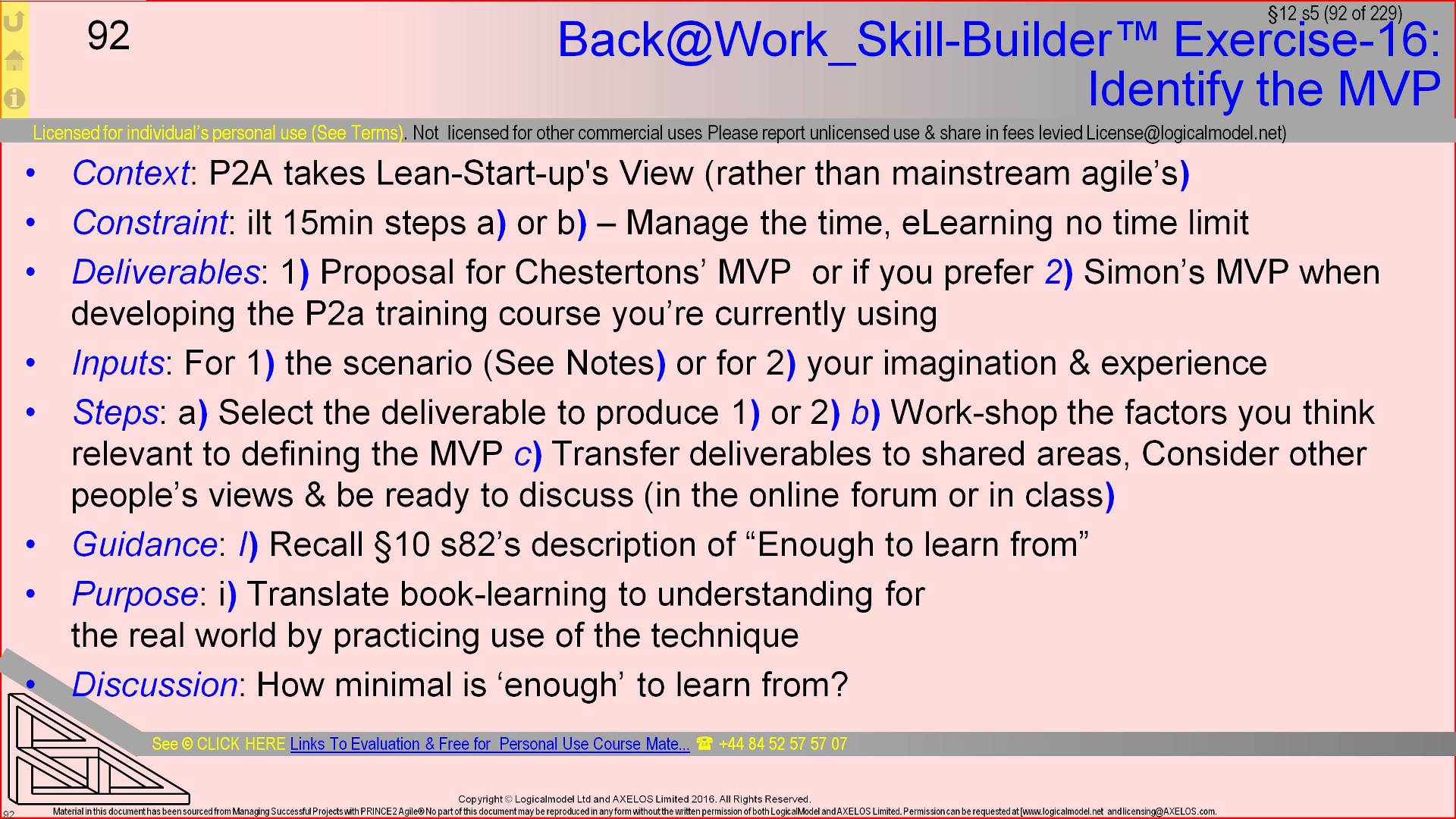
§12 b@w™S92 Back@Work_Skill-Builder™ Identify MVP
- Here I am today, literally in the midst of creating a training course. I’ll need to consider is it viable? What is my MVP?
- Likewise Chesertons’ needs to consider there mvp. Maybe hit pause to read the guidance on the slide
- To carry out the exercise consider;
- what are the questions that I need answers to?
- How could I validate learning about each question?
- Here is a question to start you off; is the audio sufficiently loud that someone listening during a journey too/ from work can hear easily over their ambient background noise?
- You might like to consider Chestertons’ web-site as an alternative?
- Step one – what questions?
- Step two – How to construct a test?
- Step three – How to gather data?
- Step 4 – How to analyses and synthesis meaning?
- Step 5 – What resultant action ?
- The results then are either implement into the evolving / finalised(?) product offering and or the steps are recycled End
Chestertons Cheese Scenario for Case Study (P2a vn 1.0.1)
- The Chesterton family are farmers, and they successfully moved in to the making and selling of a wide range of cheeses.
- Chestertons sell most of their cheese to national supermarkets (referred to as ‘trade customers’). However, two years ago they decided to sell cheese directly to the public by receiving orders by telephone or over the counter at the farm shop. They did this in order to open up a new market in case their trade customers became less profitable.
- They employ several staff who help with the running of the machinery, customer service and distribution. Deliveries to the public are done by courier. Trade deliveries are carried out using the 6 company vans.
- They are currently receiving an increasing number of phone orders from the public for cheese every day and they have now reached a point where they are looking at selling cheese ‘online’.
- The Chestertons currently have a website but it is very old and only has pictures of the farm, basic details about their cheeses and contact details. It will need to be completely replaced.
- The Chestertons are looking for a website which will shift most of the phone traffic and visits to the farm shop onto the web.
- From the research they have done so far it looks likely that they could possibly increase cheese sales to the public without recruiting more staff. The cost of the website looks like being 20,000 to build with a service contract of 400 per month. Initial estimates suggest that increased sales could pay for this within 12 months.
- .
Personnel
- Mrs. Chesterton: Strong accountancy skills. Authorised all of the new initiatives. Very decisive. Doesn’t like the impersonal nature of the internet. Will only eat organic cheese.
- Mr. Chesterton: Likes to play around with ideas. Starts many things off but rarely finishes anything. Decides where the family business should be going at a strategic level. Very keen on technology and gadgets. Wears a watch that tells him how high he is above sea-level but no one is sure why.
- Jake Chesterton: ‘Hands-on’ day to day running of the cheese business. Leads a small team that handles all sales calls. Is very operationally focussed on getting the right thing to the right customer. Takes many of the calls. Very reactive – fire-fights problems as they happen. Likes to go for long walks on his own.
- Kerry Chesterton: Leads the Customer Service and Marketing department. Generally keeps everyone happy. Responsible for dealing with any queries including those about new types of cheese. Responsible for the ‘image’ of Chestertons Cheese. Cares passionately about the environment.
- Mirek Kowalski: The I.T. Manager who started as a website designer at Chestertons three years ago. Knows all of the existing systems and applications in a lot of detail, works long hours and leaves his phone on all the time in case of problems. Likes to straighten the pictures that hang in the reception area.
- Mimi Bertillon: Leads a small team that handles order fulfilment. Is involved in the vital part of the process where the orders are packed and addressed according to the picking note information provided by Jake’s team. Is allergic to cheese.
- Sanjay Patel: Responsible for looking after the delivery side of the business. This includes receiving raw materials and the dispatch of packaged orders. Very good inter-personal skills. Really loves cheese.
- Sam O’Farrell: Has a lot of experience of many areas of the company. Has worked for the Chestertons for many years and is seen as the ‘old stager’. Is currently looking after the production lines, ensuring that they run as well as possible. Affectionately known as ‘Grumpy’. Believes cheese is only cheese if it is hard.
”..
Copyright © AXELOS Limited 2015. All rights reserved. No part of this publication may be reproduced in any form or by any means without permission in writing from AXELOS Limited. This information is part of the official PRINCE2 Agile® sample examination paper
§13 s101 = Back@Work_Skill-Builder™ Case Segment Exercise-3: User Stories
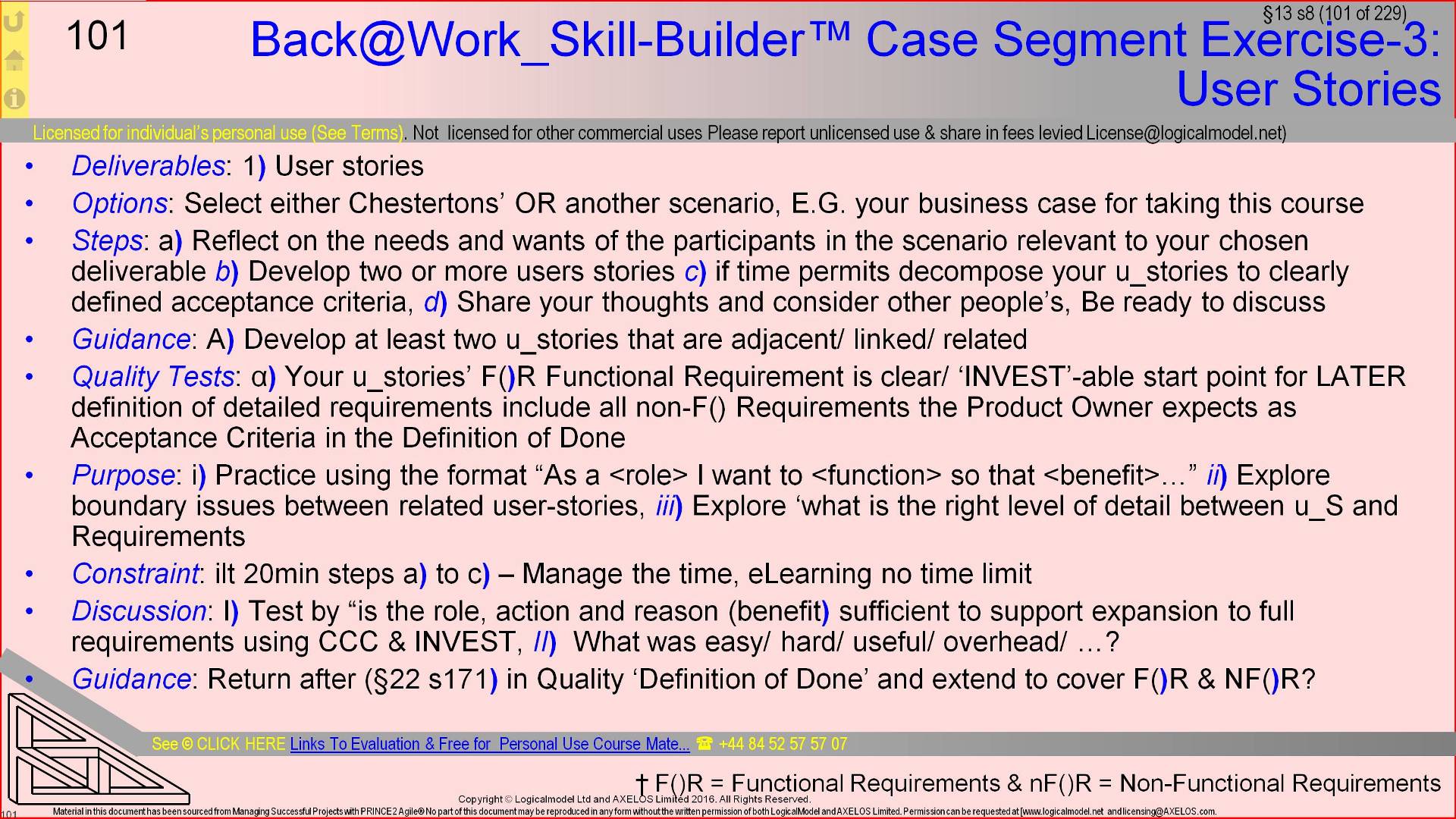
§13 b@w™101 Case Study: User Stories
- Time for two back-to-back Back@Work_Skill-Builder™ skill building
- Hit pause to read the guidance on slide or in the download. Welcome back?
- Try writing some User stories.
- In class I suggest write several in pairs, debate and share your best with the class and then class critique
- Here I’ll suggest that if you are in an eLearning course with community then post them for comment otherwise eMail me p2a@logicalmodel.net and I’ll respond
End
Chestertons Cheese Scenario for Case Study (P2a vn 1.0.1)
- The Chesterton family are farmers, and they successfully moved in to the making and selling of a wide range of cheeses.
- Chestertons sell most of their cheese to national supermarkets (referred to as ‘trade customers’). However, two years ago they decided to sell cheese directly to the public by receiving orders by telephone or over the counter at the farm shop. They did this in order to open up a new market in case their trade customers became less profitable.
- They employ several staff who help with the running of the machinery, customer service and distribution. Deliveries to the public are done by courier. Trade deliveries are carried out using the 6 company vans.
- They are currently receiving an increasing number of phone orders from the public for cheese every day and they have now reached a point where they are looking at selling cheese ‘online’.
- The Chestertons currently have a website but it is very old and only has pictures of the farm, basic details about their cheeses and contact details. It will need to be completely replaced.
- The Chestertons are looking for a website which will shift most of the phone traffic and visits to the farm shop onto the web.
- From the research they have done so far it looks likely that they could possibly increase cheese sales to the public without recruiting more staff. The cost of the website looks like being 20,000 to build with a service contract of 400 per month. Initial estimates suggest that increased sales could pay for this within 12 months.
Personnel
- Mrs. Chesterton: Strong accountancy skills. Authorised all of the new initiatives. Very decisive. Doesn’t like the impersonal nature of the internet. Will only eat organic cheese.
- Mr. Chesterton: Likes to play around with ideas. Starts many things off but rarely finishes anything. Decides where the family business should be going at a strategic level. Very keen on technology and gadgets. Wears a watch that tells him how high he is above sea-level but no one is sure why.
- Jake Chesterton: ‘Hands-on’ day to day running of the cheese business. Leads a small team that handles all sales calls. Is very operationally focussed on getting the right thing to the right customer. Takes many of the calls. Very reactive – fire-fights problems as they happen. Likes to go for long walks on his own.
- Kerry Chesterton: Leads the Customer Service and Marketing department. Generally keeps everyone happy. Responsible for dealing with any queries including those about new types of cheese. Responsible for the ‘image’ of Chestertons Cheese. Cares passionately about the environment.
- Mirek Kowalski: The I.T. Manager who started as a website designer at Chestertons three years ago. Knows all of the existing systems and applications in a lot of detail, works long hours and leaves his phone on all the time in case of problems. Likes to straighten the pictures that hang in the reception area.
- Mimi Bertillon: Leads a small team that handles order fulfilment. Is involved in the vital part of the process where the orders are packed and addressed according to the picking note information provided by Jake’s team. Is allergic to cheese.
- Sanjay Patel: Responsible for looking after the delivery side of the business. This includes receiving raw materials and the dispatch of packaged orders. Very good inter-personal skills. Really loves cheese.
- Sam O’Farrell: Has a lot of experience of many areas of the company. Has worked for the Chestertons for many years and is seen as the ‘old stager’. Is currently looking after the production lines, ensuring that they run as well as possible. Affectionately known as ‘Grumpy’. Believes cheese is only cheese if it is hard.
End
Slide and Explanatory text ©Logicalmodel Ltd 2016 Based on AXELOS PRINCE2 Agile® material. Material is reproduced under licence from AXELOS Limited. All rights reserved.
§13 s102 = Back@Work_Skill-Builder™ Case Segment Exercise-4: MoSCow The Requirements List
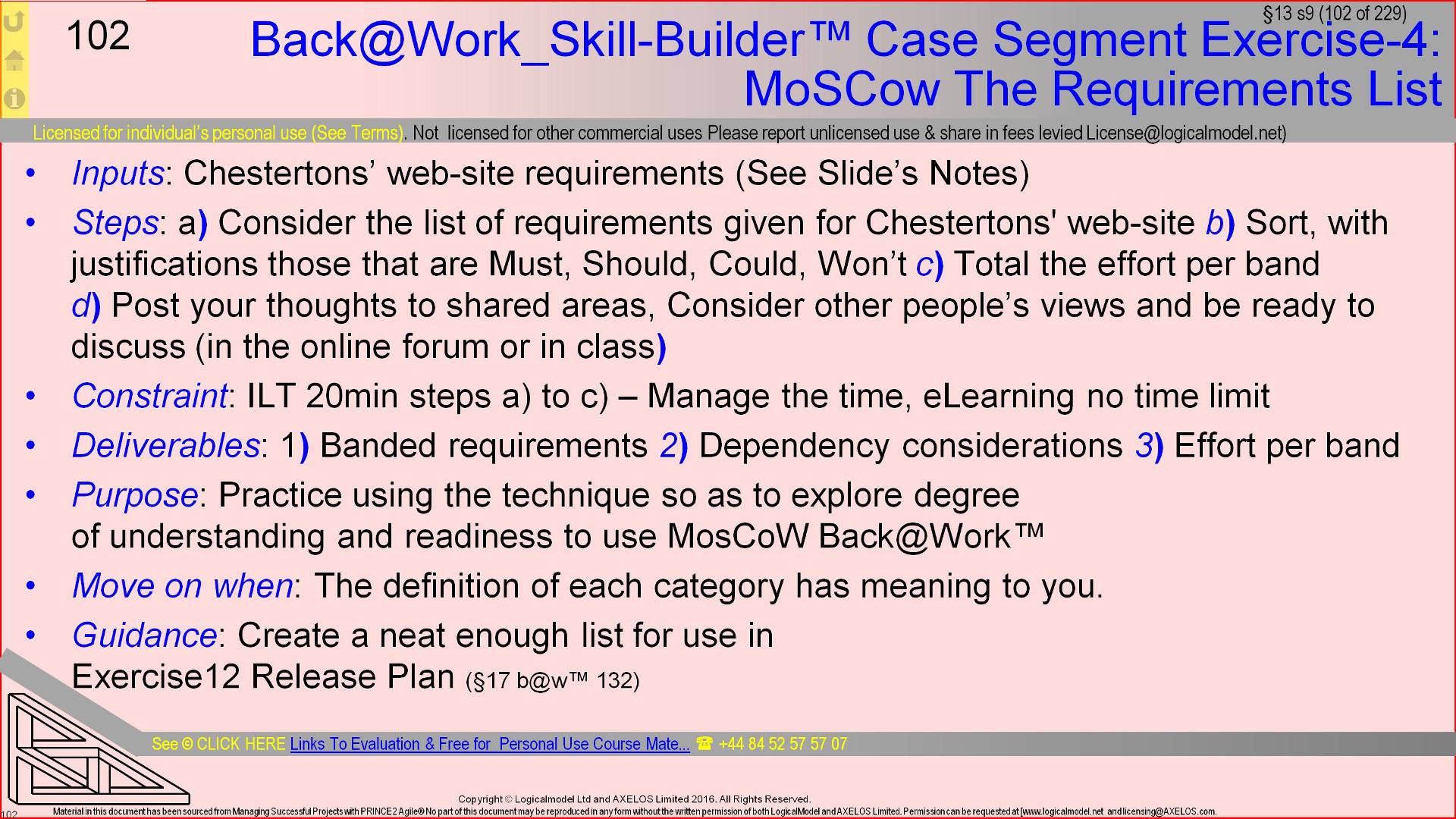
§13 b@w™102 Exercise: MoSCoW
- Chestertons’ cheeses Web requirements list needs to be analysed for what are Musts and Wonts using Moscow.
- Maybe pause to read the guidance on slide? Welcome back?
- For convenience here is the requirements list but if your device has a small screen then the list is in the course support materials.
- Ignoring the estimates column sort the requirements into Must/ Should/ Could/ Wont at the project level and if you wish the Stage level
- In class
- Obviously we debate the musts
- As you are listening to this your not in a face-to-face class so post to the forum, comment on other people’s posts or send me your analyses with a rationale and I’ll comment
- That email again is p2a@logicalmodel.net
End
Web-Site Requirements
- No. Requirement Estimate(days)
- 1 Create an order 4
- 2 Change an existing open order 3
- 3 Create customer account/login 3
- 4 Choose order gift wrappig 1
- 5 Browse product information 2
- 6 Show price & list of cheeses 5
- 7 Secure web payment 3
- 8 Search and filter cheese list 2
- 9 Sign up to newsletter 2
- 10 Provide a feedback facility 1
- 11 Promote special offers 2
- 12 Enter invoice address 2
- 13 Enter delivery address 2
- 14 ‘About us’ information 1
- 15 Pay by credit card/debit card 6
- 16 Authorise card payment 3
- 17 Pay by PayPal etc 2
- 18 Notify customers order sent 2
- 19 Maintain customer details 5
- 20 Trade customers area 4
- 21 Apply scaled discounts 2
- 22 Offer choice of delivery times 3
End
Slide and Explanatory text ©Logicalmodel Ltd 2016 Based on AXELOS PRINCE2 Agile® material. Material is reproduced under licence from AXELOS Limited. All rights reserved.Copyright © AXELOS Limited 2015. All rights reserved. No part of this publication may be reproduced in any form or by any means without permission in writing from AXELOS Limited. This information is part of the official PRINCE2 Agile(r) sample examination paper.
§15 s119 = Back@Work_Skill-Builder™ Exercise-5: Assign Roles
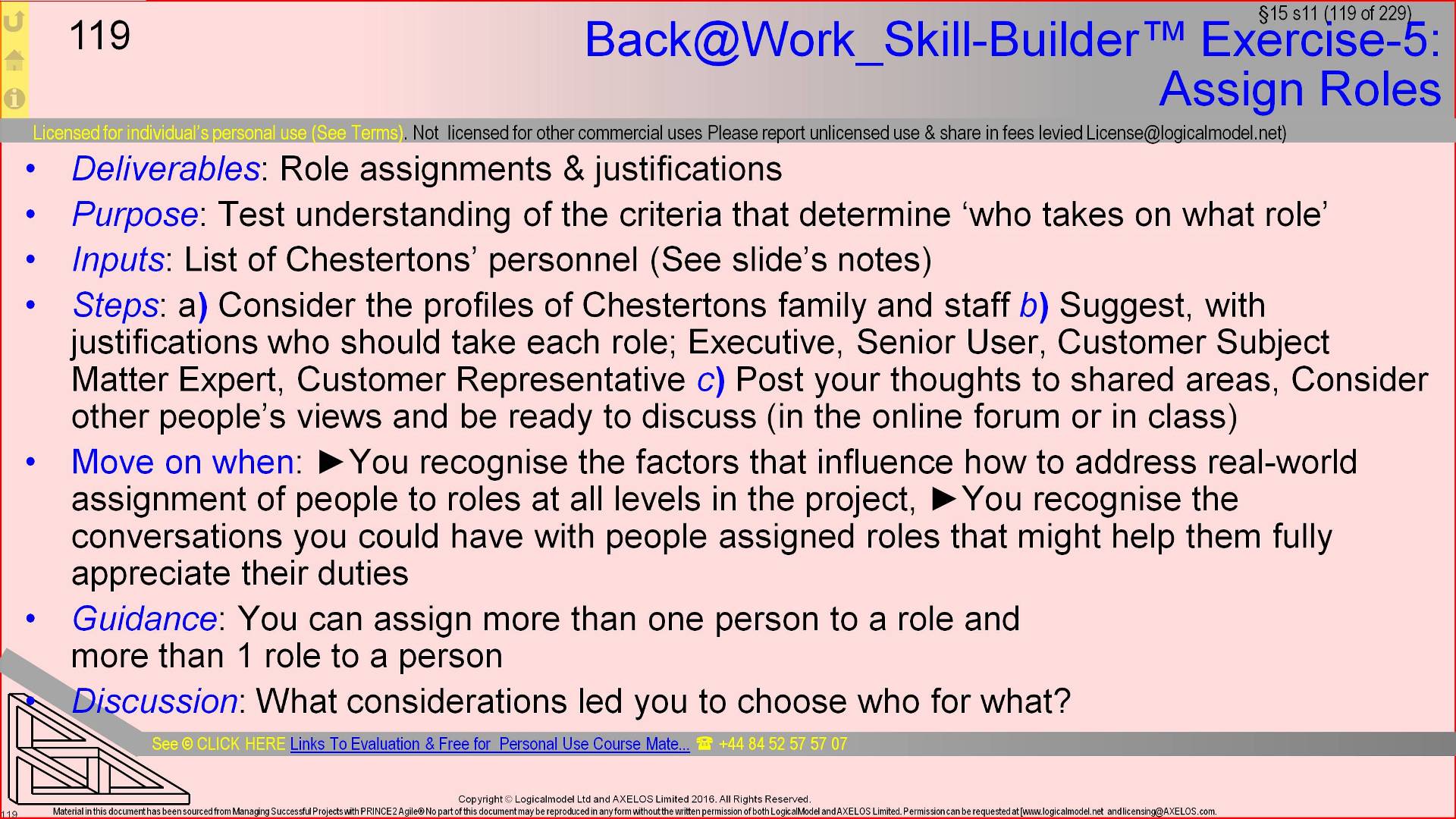
§15 b@w™119 Case Study 5 Roles
- Here is this section’s b@w skill builder
- Chestertons Cheese need people assigned to roles.
- Pause to read the on-slide guidance notes
- <Sync. 1 x>Here is the background information [[PreView]] and
- <Sync. 2 People> thumbnail sketches of the stakeholders
- Considering the characteristics of the roles that enable projects in P2a to succeed.
- Read the word pictures of people’s skills and outlooks. Who should be assigned to what role and why?
- In Physical and Virtual classes we can discus.
- In off-line situations eMail me or use the course platform’s facilities and I’ll respond
End
Chestertons Cheese Scenario for Case Study (P2a vn 1.0.1)
- The Chesterton family are farmers, and they successfully moved in to the making and selling of a wide range of cheeses.
- Chestertons sell most of their cheese to national supermarkets (referred to as ‘trade customers’). However, two years ago they decided to sell cheese directly to the public by receiving orders by telephone or over the counter at the farm shop. They did this in order to open up a new market in case their trade customers became less profitable.
- They employ several staff who help with the running of the machinery, customer service and distribution. Deliveries to the public are done by courier. Trade deliveries are carried out using the 6 company vans.
- They are currently receiving an increasing number of phone orders from the public for cheese every day and they have now reached a point where they are looking at selling cheese ‘online’.
- The Chestertons currently have a website but it is very old and only has pictures of the farm, basic details about their cheeses and contact details. It will need to be completely replaced.
- The Chestertons are looking for a website which will shift most of the phone traffic and visits to the farm shop onto the web.
- From the research they have done so far it looks likely that they could possibly increase cheese sales to the public without recruiting more staff. The cost of the website looks like being 20,000 to build with a service contract of 400 per month. Initial estimates suggest that increased sales could pay for this within 12 months.
Personnel
- Mrs. Chesterton: Strong accountancy skills. Authorised all of the new initiatives. Very decisive. Doesn’t like the impersonal nature of the internet. Will only eat organic cheese.
- Mr. Chesterton: Likes to play around with ideas. Starts many things off but rarely finishes anything. Decides where the family business should be going at a strategic level. Very keen on technology and gadgets. Wears a watch that tells him how high he is above sea-level but no one is sure why.
- Jake Chesterton: ‘Hands-on’ day to day running of the cheese business. Leads a small team that handles all sales calls. Is very operationally focussed on getting the right thing to the right customer. Takes many of the calls. Very reactive – fire-fights problems as they happen. Likes to go for long walks on his own.
- Kerry Chesterton: Leads the Customer Service and Marketing department. Generally keeps everyone happy. Responsible for dealing with any queries including those about new types of cheese. Responsible for the ‘image’ of Chestertons Cheese. Cares passionately about the environment.
- Mirek Kowalski: The I.T. Manager who started as a website designer at Chestertons three years ago. Knows all of the existing systems and applications in a lot of detail, works long hours and leaves his phone on all the time in case of problems. Likes to straighten the pictures that hang in the reception area.
- Mimi Bertillon: Leads a small team that handles order fulfilment. Is involved in the vital part of the process where the orders are packed and addressed according to the picking note information provided by Jake’s team. Is allergic to cheese.
- Sanjay Patel: Responsible for looking after the delivery side of the business. This includes receiving raw materials and the dispatch of packaged orders. Very good inter-personal skills. Really loves cheese.
- Sam O’Farrell: Has a lot of experience of many areas of the company. Has worked for the Chestertons for many years and is seen as the ‘old stager’. Is currently looking after the production lines, ensuring that they run as well as possible. Affectionately known as ‘Grumpy’. Believes cheese is only cheese if it is hard.
End
Copyright © AXELOS Limited 2015. All rights reserved. No part of this publication may be reproduced in any form or by any means without permission in writing from AXELOS Limited. This information is part of the official PRINCE2 Agile® sample examination paper
§17 s132 = Back@Work_Skill-Builder™ Exercise-12: Release Plan
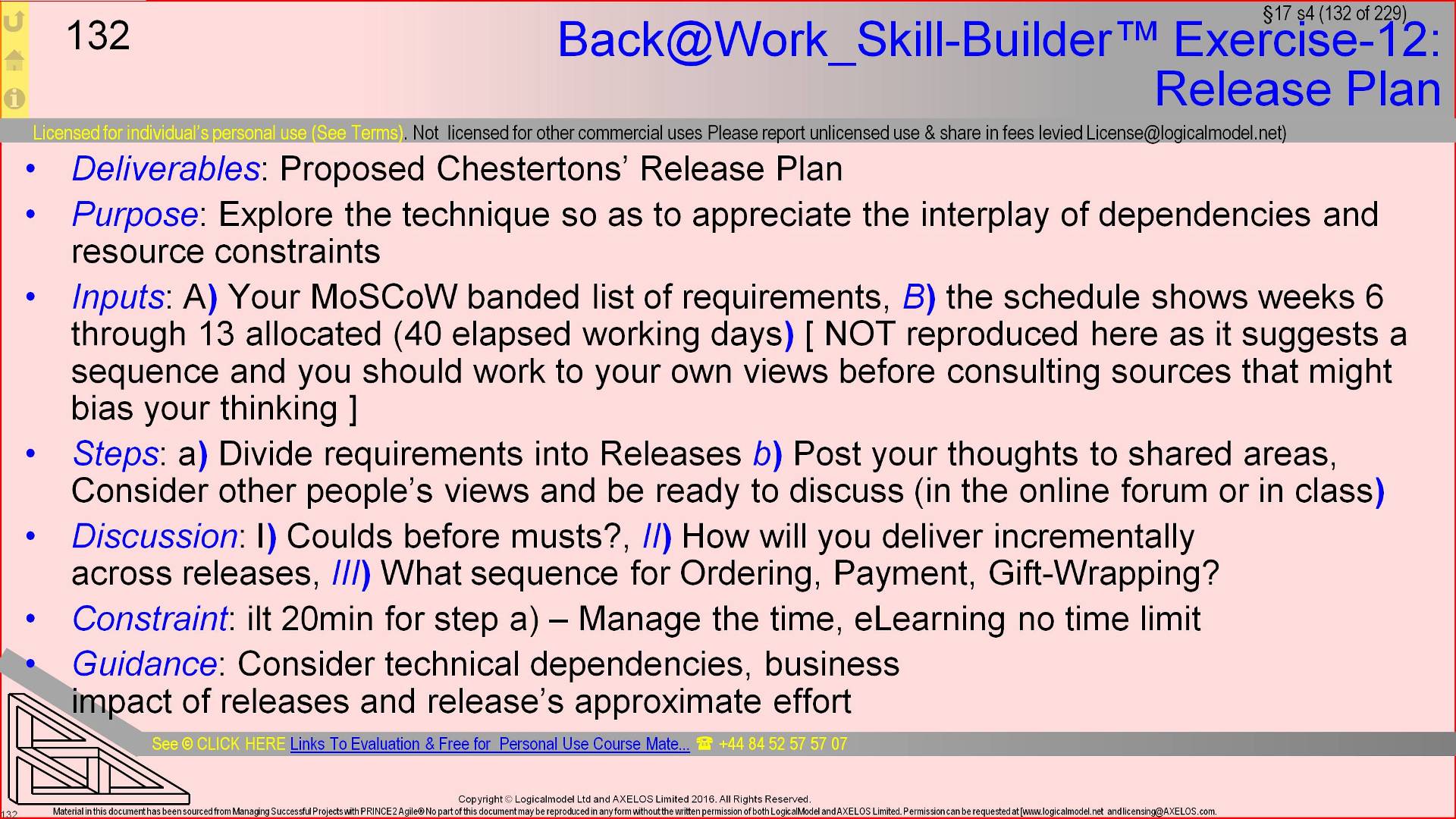
§17 b@w™132 Chestertons’ Release Plan
- Here is our B@W Skill Builder
- Maybe hit pause and read the slide’s guidance? Welcome back? Or check-out the Exercise and CaseStudy work book
- Chestertons’ website work has been estimated at 60 days of effort and the timeline shows 8 working weeks duration.
- Using the project backlog and your previous assessments of MoSCoW prioritisation consider:…
- What makes a sensible release plan and why, consider business benefits and technical dependency?
- If you eMail me your solutions I’ll respond. p2a@logicalmodel.net
- Next an Exam question analysis
End
Web-Site Requirements
- No. Requirement Estimate(days)
- 1 Create an order 4
- 2 Change an existing open order 3
- 3 Create customer account/login 3
- 4 Choose order gift wrappig 1
- 5 Browse product information 2
- 6 Show price & list of cheeses 5
- 7 Secure web payment 3
- 8 Search and filter cheese list 2
- 9 Sign up to newsletter 2
- 10 Provide a feedback facility 1
- 11 Promote special offers 2
- 12 Enter invoice address 2
- 13 Enter delivery address 2
- 14 ‘About us’ information 1
- 15 Pay by credit card/debit card 6
- 16 Authorise card payment 3
- 17 Pay by PayPal etc 2
- 18 Notify customers order sent 2
- 19 Maintain customer details 5
- 20 Trade customers area 4
- 21 Apply scaled discounts 2
- 22 Offer choice of delivery times 3
End
Copyright © AXELOS Limited 2015. All rights reserved. No part of this publication may be reproduced in any form or by any means without permission in writing from AXELOS Limited. This information is part of the official PRINCE2 Agile® sample examination paper
§18 s143 = Back@Work_Skill-Builder™ Exercise-8: Critique a Work-Package
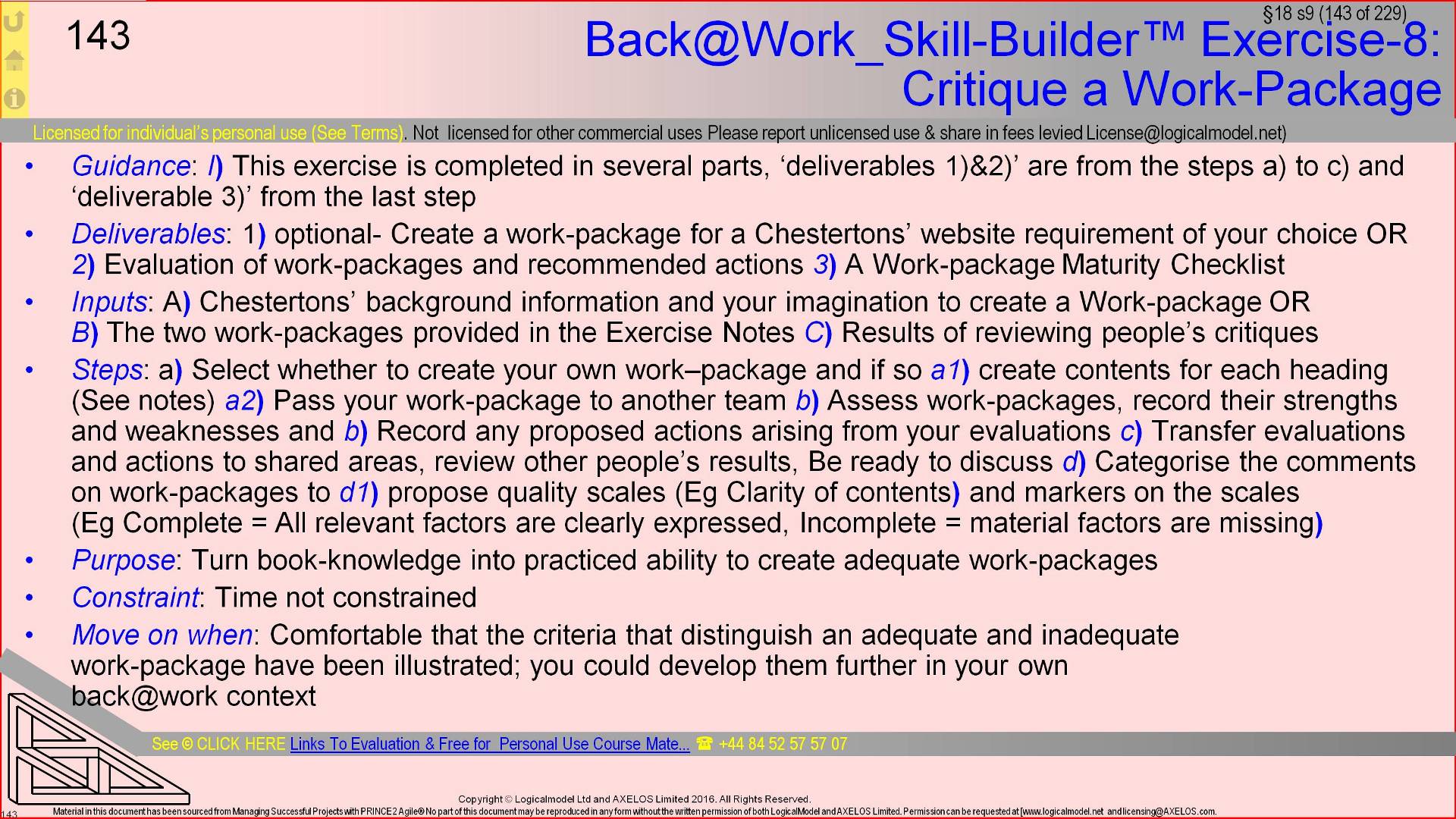
§18 b@w™143 Case WorkPackage
- Here is the 1st of two back-to-back skill-builders. Hit pause, review the on-slide guidance
- Review the list of work packages from Chestertons’ Cheeses and draft a work package.
- Post to the online forum or eMail me
End
Work-package Headings from P2 A.26
- Receiver’s identity
- Product descriptions (containing quality standards and verification methods)
- Approval authority and method to validate products versus acceptance criteria
- Description of the work to be done Techniques, tools, standards, processes or procedures to be used
- Interfaces (people and technical) to be maintained at any stage of the product’s life-span.
- Configuration management arrangements
- Constraints and tolerances on product or development activity
- Normal and Exception Reporting timings, contents, participants and actions
- Context references – EG Project/Stage schedule
- Dates & authorities of status changes (Eg Work Started, Products accepted)
P2 suggestion of A.26.5 Quality criteria
- Clearly defined and understood by all
- Product Description for each product, with clear acceptable quality criteria
- Product Description(s) match other Work Package documentation
- Standards for the work are agreed and are in line with those applied to similar products
- Quality checking arrangements in place
- Interfaces have been defined
- Reporting, Issues and Risk arrangements in place
- Agreement between the Project Manager and the recipient on exactly what is to be done
- Constraints, and tolerances agreed and match other controls (eg Project Plan)
End
Work-Package: Relocate Cheese Packing Area to New Premises
- Who: Removals_R_Us
- Result: All blue-tagged items in the old dairy are positioned in the new processing plant as per drawing Layout-PA-1 vn3. Equipment has not sustained damaged. Protective wrappings have been disposed off
- Approvals: Jake & Mr C in person. Mimi’s team will operate each piece of equipment before making a recommendation
- Work: Protect, transport, position all blue-tagged items, BAR Code of Practice BAR Code of Practice
- Interfaces: Plumbing and electrical teams (Disconnect/ ReConnect), Mimi-Tagging, Jake-everything else
- ConfigMgmt: N/A (Service work)
- C&T: To be completed before 6am of day after task start. No damage to any equipement, No injuries to anyone involved, Delivered result is operationally safe
- Reporting. Escalations to Jake’s cell-fone immediately, Reports during planning (P1) verbal in daily scrum, Reports during move Hourly updates from Team Leader
- X-References: P2/P3 Refrigeration Room (Commissioning)
- Start-Date: TBA
Work-Package: Brand Logo
- Who: Brand-U-Like
- Result: Logo that Kerry likes
- Approvals: Kerry
- Work: Design new logo
- Interfaces: Kerry
- ConfigMgmt: All Creative Briefs, Drafts and Minutes to be labelled CB or D or M, Dated and Sequenced numbered and Version numbered. A log of all item’s ID, Title, Description, Creator and Approver is to be maintained
- C&T: Agreed image & words by start wk4, Print Ready graphics by end wk5
- Reporting: Brand-U-Like team leader to Kerry
- X-References
- Start-Date: Monday Wk2
End
Slide and Explanatory text ©Logicalmodel Ltd 2016 Based on AXELOS PRINCE2 Agile® material. Material is reproduced under licence from AXELOS Limited. All rights reserved.
§18 s144 = Back@Work_Skill-Builder™ Exercise-9: Executing Projects in Sprints
§18 B@W™144 Exercise Lego Animals
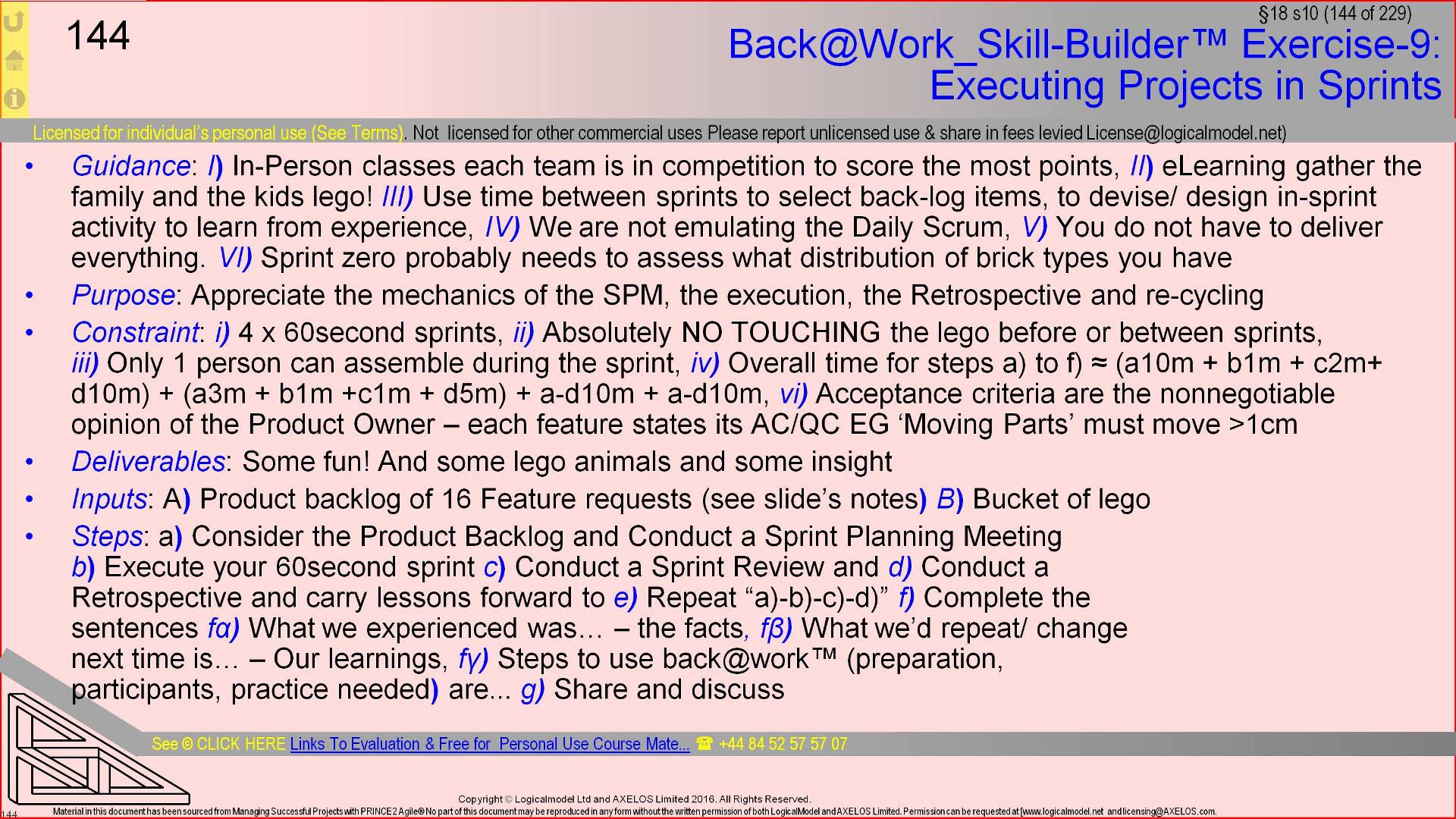
- Here is an exercise that needs eLearning individuals to rope in some other participants, perhaps your kids around the Sunday morning breakfast table! You also need a bucket of lego.
- Pause the video to read the instructions or consult the Ex&CS-WkBk from ss0 DL-1
- You need the discipline to stop when the sprint timer stops.
- If we are together in class then when the timer stops be stopped or be disqualified – your target always is to be finish BEFORE the deadline
End
Backlog Feature List
- Legs = 40 points
- What The animal must have 4 legs, Why So that it can walk to food
- Acceptance Criteria/Quality Criteria None of the 4 legs touch each other and they are all the same size
- Feet = 20 points
- What The animal should have 4 feet, Why So that it can run to avoid predators
- AC/QC There is a foot on the end each leg and the foot sticks out
- Eyes = 40 points
- What The animal should have 2 eyes, Why So that it can see and estimate distance
- AC/QC The eyes are the same colour and not touching each other
- Hair = 10 points
- What The animal’s head should have hair on it, Why So that it can avoid getting sunburnt
- AC/QC The hair is a different colour to the head
- Nose = 20 points
- What The animal must have a nose, Why So that it can smell things to eat and predators to fear
- AC/QC The nose sticks out from the head
- Tail = 20 points
- What The animal should have a tail, Why So that it can communicate to other animals
- AC/QC The tail sticks out from the body
- Head = 50 points
- What The animal must have a head, Why So that it can perform basic life support functions such as thinking and eating
- AC/QC The head is not touching the body and is the highest part of the animal
- Body = 40 points
- What The animal must have a body, Why So that it contains vital organs like the lungs and stomach
- AC/QC The body is longer and wider then its depth
- Ears = 30 points
- What The animal should have ears, Why So that it can hear predators
- AC/QC The ears are not the same colour as the eyes and they stick out from the head
- Moving Part = 30 points
- What The animal should have a moveable part, Why So that it can attract other animals
- AC/QC The part moves >1cm without any rebuilding
- Stands Up = 10 points
- What The animal should stand up on its own, Why So that it has less chance of getting attacked
- AC/QC It does not fall over when light pressure is applied to it
- Neck = 30 points
- What The animal should have a long neck, Why So that it can eat food from high trees
- AC/QC The neck is longer than the legs
- Tree = 40 points
- What The enclosure should have a tree in it, Why So that it can provide shade for the animal
- AC/QC The tree should have three branches and be taller than the body of the animal
- Black and Yellow = 20 points
- What The animal should not have any black(red) bricks touching any yellow (blue) bricks, Why So that the animal doesn’t die
- AC/QC There are no black(red) bricks touching any yellow(blue) bricks
- More Legs = 20 points
- What The animal should have 6 legs, Why So that it can run very fast to get water when water is scarce
- AC/QC None of the 6 legs touch each other and 4 of them are all the same size
- Enclosure = 50 points
- What The animal should live in an enclosure, Why So that it is safe from predators
- AC/QC The animal must be fully contained within the enclosure when viewed from above. The enclosure is a single joined-up structure.
- End
Copyright © AXELOS Limited 2015. All rights reserved. No part of this publication may be reproduced in any form or by any means without permission in writing from AXELOS Limited.
§19 s156 = Back@Work_Skill-Builder™ Exercise-15: Kanban
§19 b@w™156 Back@Work_Skill-Builder™ Kanban
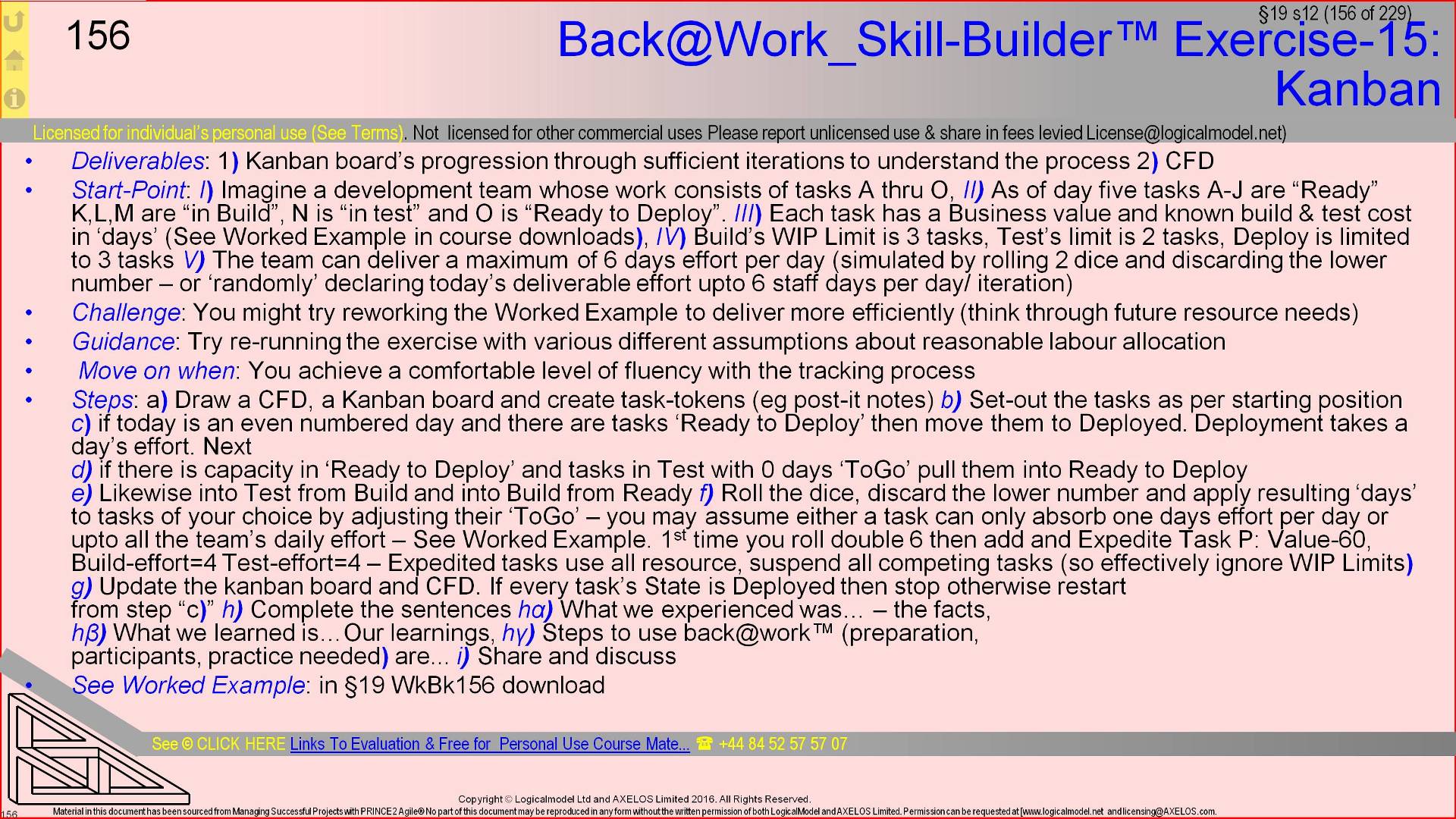
- Practical use requires fluency and confidence with the techniques.
- Pause to read the slide’s guidance.
- Creating CFD’s from raw data requires a little practice and I have a great simulation for you here.
- Reality requires a discussion of progress achieved that is then mapped to the kanban board to move progress markers. Here the raw data is in a table. You’ll have to apply the numbers to the kanban board you draw (or the templates I provide in the separate download for this Back@Work)
- I’ve provided three things I hope help!
- First a worked example from the same start point as the exercise but with some differing progress assumptions. Following it through takes effort to understand. Understanding this topic definitely takes effort if you are to internalise the topic.
- The worked example progresses the kanban board and the CFD day-by-day against some assumptions. The solution I’ve given illustrates the process but my solution is very inefficient. One challenge you can take on is ‘Can you vary the order of work assignments in search of greater resource efficiency’? 0 Clearly you can! :-)
- Second and third are two blank templates. To emulate how I processed the data you can use one or both. One template is for pencil and paper –print it out to give yourself a work-space. The other is an empty .xlsx for you to populate – If you discover a bug in its formulas please let me know – It works ok for me!
- Have fun and as ever just shout in any of the available forums to let me know when you need support.
- The downloads are in this section of the eLearning Course and freely accessible §19 wkbk156 Worked Example (create a login if you don’t have one, access to these downloads is free)
End
Copyright © AXELOS Limited 2015. All rights reserved. No part of this publication may be reproduced in any form or by any means without permission in writing from AXELOS Limited. This information is part of the official PRINCE2 Agile® sample examination paper
§20 s161 = Back@Work_Skill-Builder™ Exercise-10: Estimating
Copyright © AXELOS Limited 2015. All rights reserved. No part of this publication may be reproduced in any form or by any means without permission in writing from AXELOS Limited. This information is part of the official PRINCE2 Agile® sample examination paper
§20 b@w™161 Estimating exercise
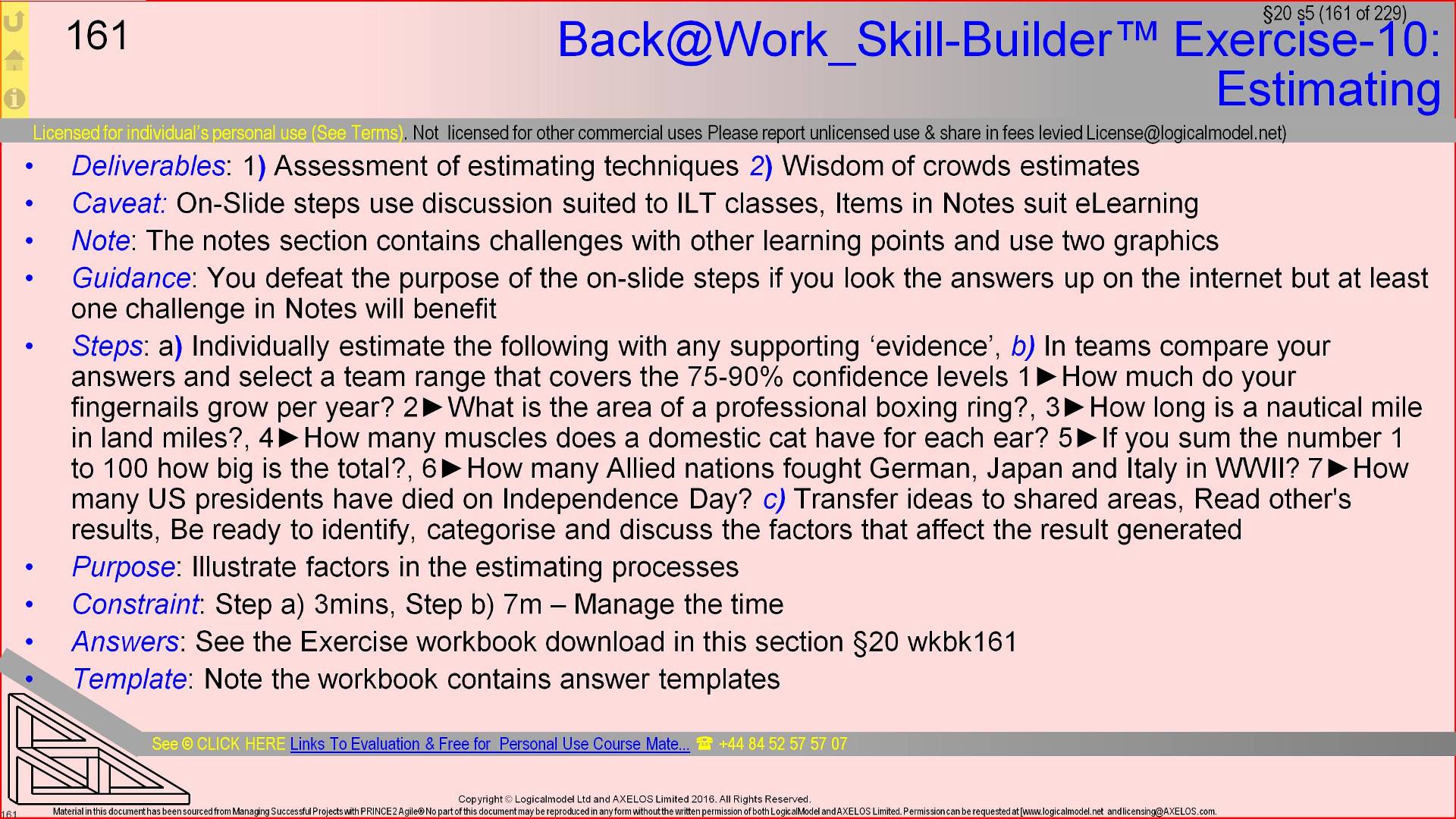
- Agile estimating is ‘empirical’, based on Locke’s “what we have experienced” – as an aside that suits those whose Myers-Brigs personality type includes Sensing (types xSxx) – with perhaps the Sensing-Perceiving folk most in-tune –
Here are some empirical estimating challenges.
- Estimating based on experience can of course use other people’s experience as an input but the team will need to arrive at their own ‘gut-feel’
- On the slide are some estimating challenges and there are more here in the notes.
- For the Geographic and house-building ones in the notes I have two graphics to help. The first – pause? – welcome back – The second pause again? They are on the notes page two
End
Empirical estimating:
- List 20 cities and without research arrange in order of size. When ordered align Poker Scale numbers to ‘representative’ cities.
- Do the next 2 steps before researching
- Identify 20 (or more) ‘journeys’ that you make or plan to make in addition to these: Home to work, Bed to kitchen, To last (or next) Holiday destination, ‘Work-station’ to your work-lunch-place, Last or next weekend away, Home to typical food-shopping, Home to a family gathering.
- When you have a list apply Fibonacci (½ , 1, 2, 3, 5, 8, 13…) score to each based on distance and complexity
- Estimate the Latitudes and Longitudes of each city and each journey’s start & finish given that London is 51N 0W, Hong Kong 21N 114W, Mumbia is 19N 72W and the Grand Canyon is 36N −112W.
- Research your estimates & determine accuracy
Further Estimating Challenges
- Consider T-shirt sizing to assess the following costs: If a McDonalds burger is a Small what is an XS, M, L and XL?
- The relative frequency of letter usage is well known for any language. Which letters are in the XS through to XL buckets for your language?
A Different Angle
- How many bricks and how many brick-layers to build the walls of the illustrated house – State all assumptions, facts, formulas used and their reliability/ source
- The volume of the Gt Pyramid of Giza is ≈2,568,900 m3, it contains ≈2.3 million blocks of stone and weighs ≈5,955,000
- tonnes – How long would you need to build it?
- For all the above, consider and share conclusions
- ‘Answers’ or at least discussion is in the Ex & Case download
End
§22 s176 = Back@Work_Skill-Builder™ Exercise-11: Advert Quality Planning for Quality Criteria
§22 b@w™176 Exercise Advert QP
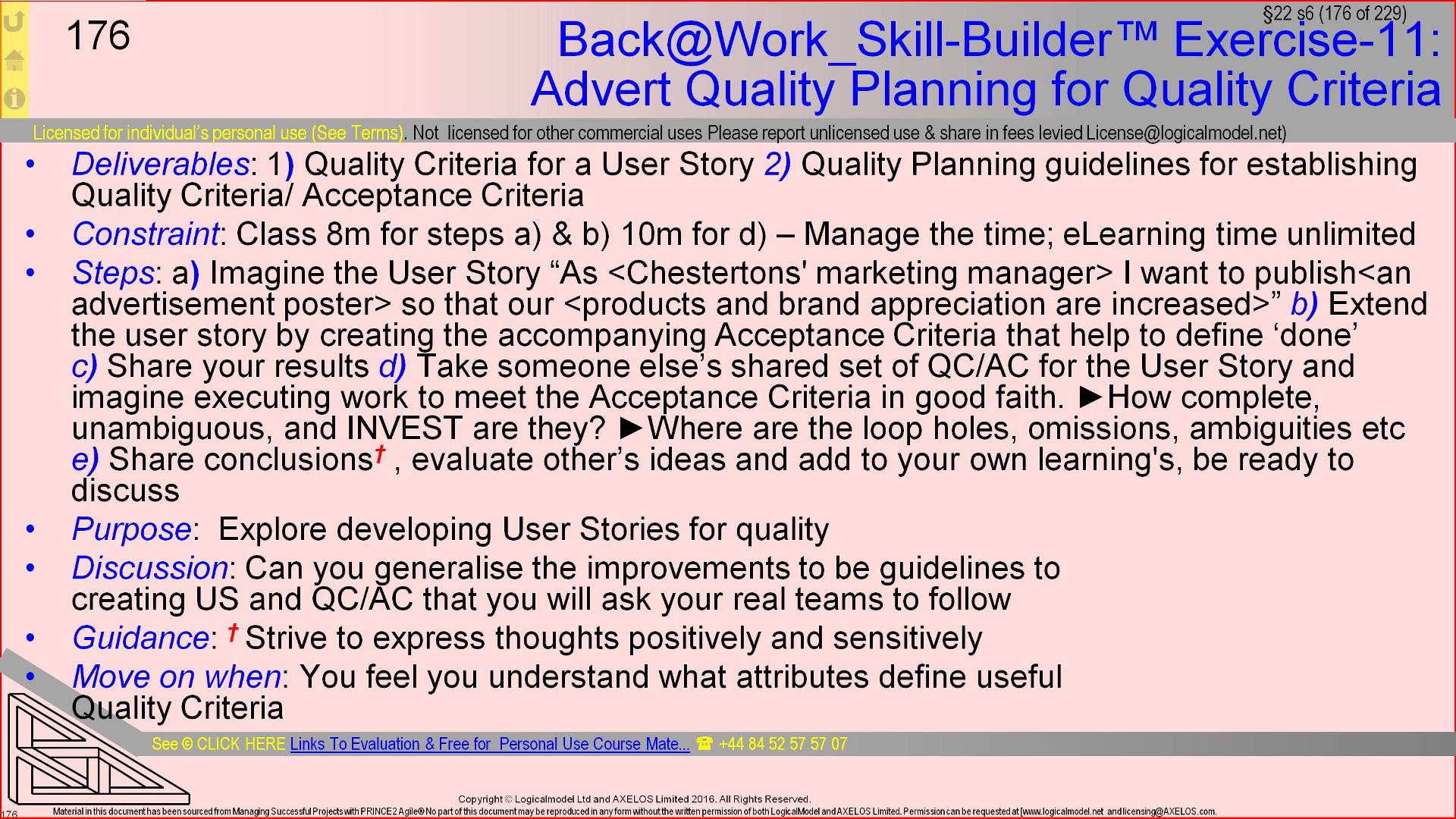
- Here is a Back@Work_Skill-Builder™ skill builder.
- Step one is to imagine the user story “As <Chestertons’ marketing manager> I want to commission <an advertising poster> so that our <products and brand appreciation are increased>”
- Step 2 is translate the User Story to Acceptance Criteria and share with me and the discuss forum
- Step 3 is take someone else’s shared set of Acceptance Criteria for the User Story and imagine executing work to meet the AC in good faith. How complete, unambiguous, and matched to INVEST are they? Where are the loop holes, omissions, ambiguities etc
- How would you improve User Story or Acceptance Criteria?
- Can you generalise the improvements to be guidelines to creating User Story and Acceptance Criteria that you will ask your real teams to follow
- Lastly post/ share your guidelines
End
Copyright © AXELOS Limited 2015. All rights reserved. No part of this publication may be reproduced in any form or by any means without permission in writing from AXELOS Limited. This information is part of the official PRINCE2 Agile® sample examination paper
§24 s189 = Back@Work_Skill-Builder™ Exercise-13: Retrospectives
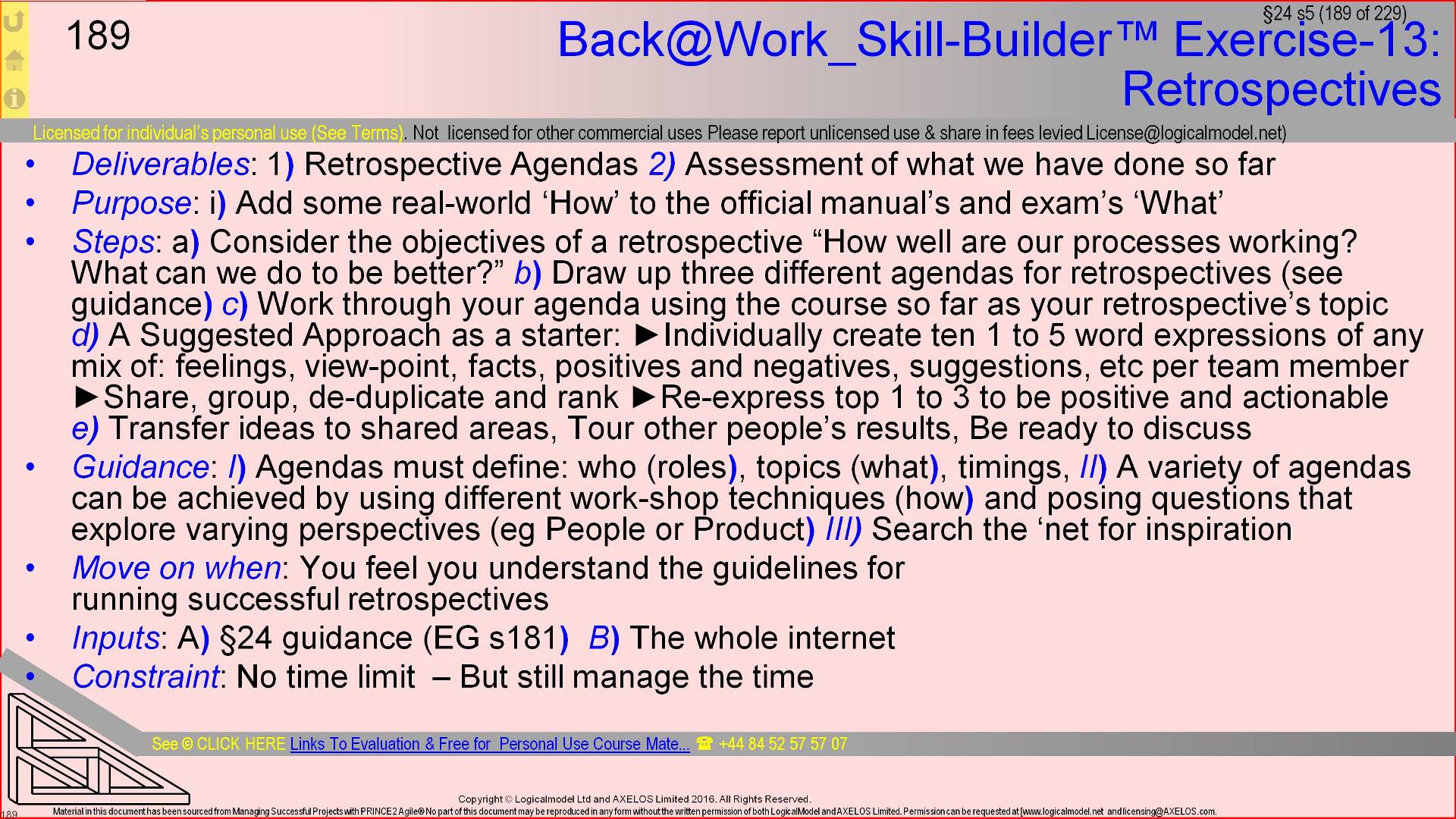
§24 b@w™189 Back@Work_Skill-Builder™ Hold your own retrospective
- Consider retrospectively what has worked well for you in the exercises and in the course etc so far. Also what could be better. For each “Is good” say why and for each “could be better” how would we recognise better and if possible what actions would deliver it?. Post to the forum or eMail me.
End
Analysis © Logical Model Ltd, Exam Question Copyright © AXELOS Limited 2015. All rights reserved. No part of this publication may be reproduced in any form or by any means without permission in writing from AXELOS Limited. This information is part of the official PRINCE2 Agile® sample examination paper
§29 s210 = Back@Work_Skill-Builder™ Exercise-14: Preparing a Workshop
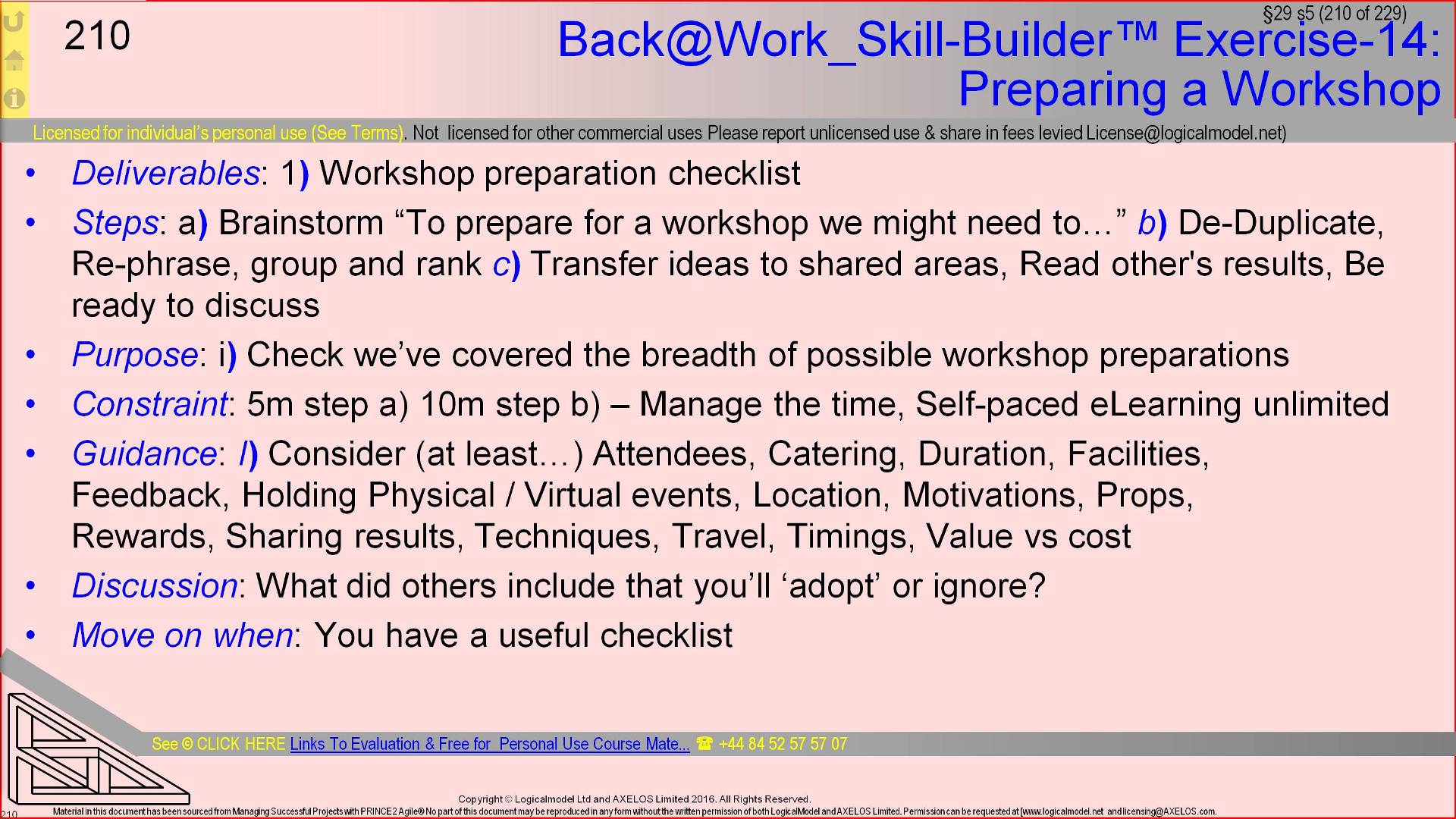
§29 b@w™210 Pre a Workshop
- Imagine you are preparing to run a workshop at Chestertons’ to kick-off the Golden Clog project.
- What preparation steps will you undertake?
- Be as complete as you can, roles, desired conclusions, steps, techniques matched to steps and results etc etc.
- When done check-off with the checklist in the revision aid (or manual table Ch:26.1 pg239)
- Did you get the steps covered?
- Post to any of the course’s sharing mechanisms as well
- And lets look at our last exam question within the sequential exploration of the materials
End
Slide and Explanatory text ©Logicalmodel Ltd 2016 Based on AXELOS PRINCE2 Agile® material. Material is reproduced under licence from AXELOS Limited. All rights reserved.