Section:3 s18 - Sub-Section 3 The Exam (& Course’s) Contents

§3 V1 (18 of 454)::The Exam (& Course’s) Contents::
- In this sub-section we cover 6 points
- The syllabus’ 15 topics in syllabus order, not the order we will take them in
- The online location of the examining institute’s page for you to register for your exam
- Navigation central, the links to course materials in gentle order and an introductory explanation of them
- Conventions for references to the official manual and other resources such as The Guide to the Project Management Body of Knowledge (PMBoK®-G)
- Personal introductions for online community joiners, and my self-introduction
- A request for your feedback that will improve the course
- In the next sub-section we will cover the whole of what is p2 and how does it work? At a high level
§3 s19 = The 15 Syllabus Areas† The Up-Coming Contents Is…
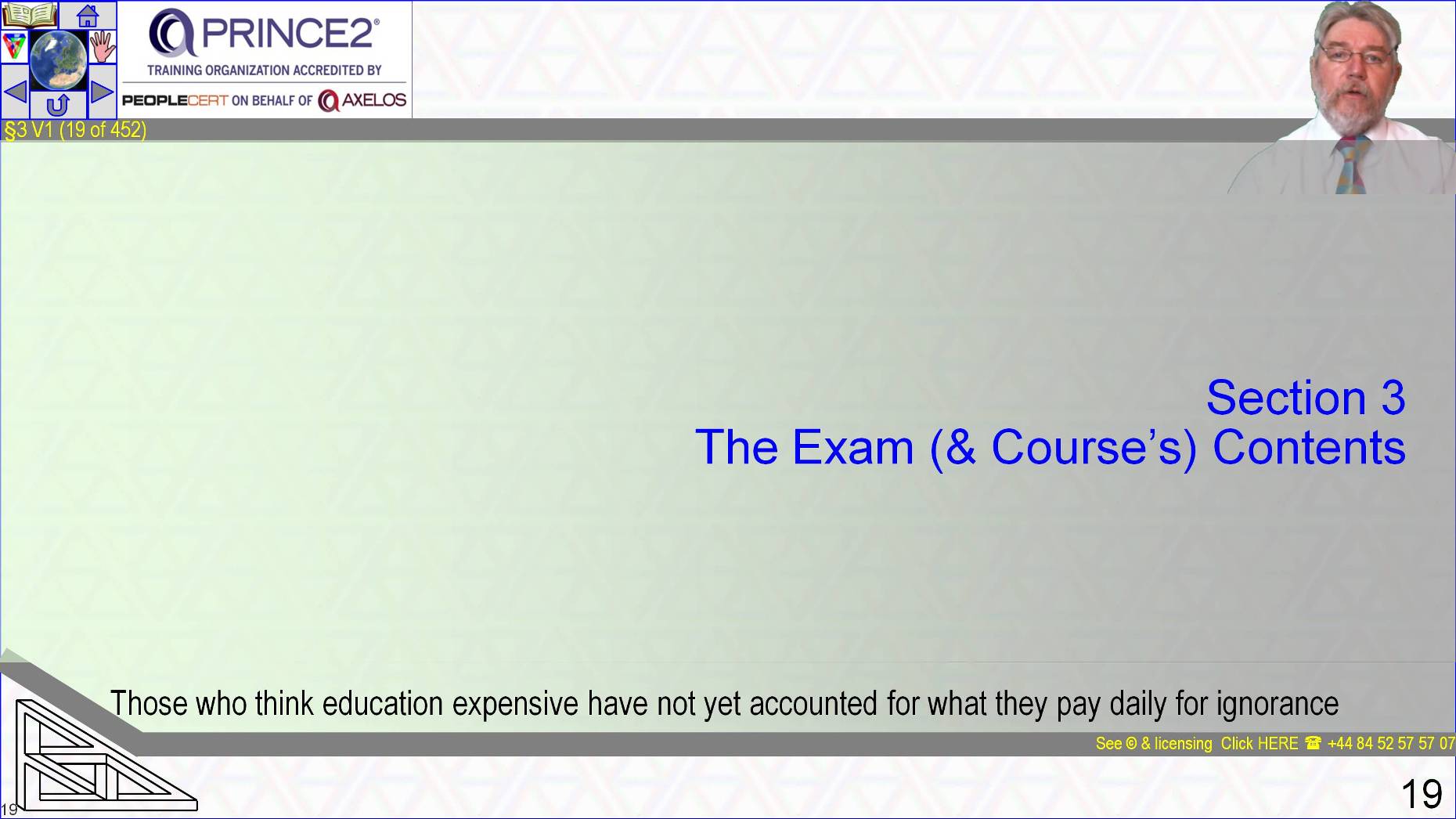
§3 V2 (19 of 454)::The 15 Syllabus Areas The Up-Coming Contents Is…::
In recognition of our first objective here is the exam syllabus’ top level.
- 15 headings in the order the official manual presents them.
- That is not the order we will cover them in for reasons of good instructional design.
- The instructional design principle relevant here is that people tend to understand best when given stories that follow a timeline. Lets do exactly that on the next slide which I call Navigation Central.
Note when later you are revising that each heading here is a link to the treatment in the course materials. Dependant on your presentation platform’s ability to provide links of course –If you bought the exam then you always have access to the other formats
~~
§3 s20 = Registering For Your Exams
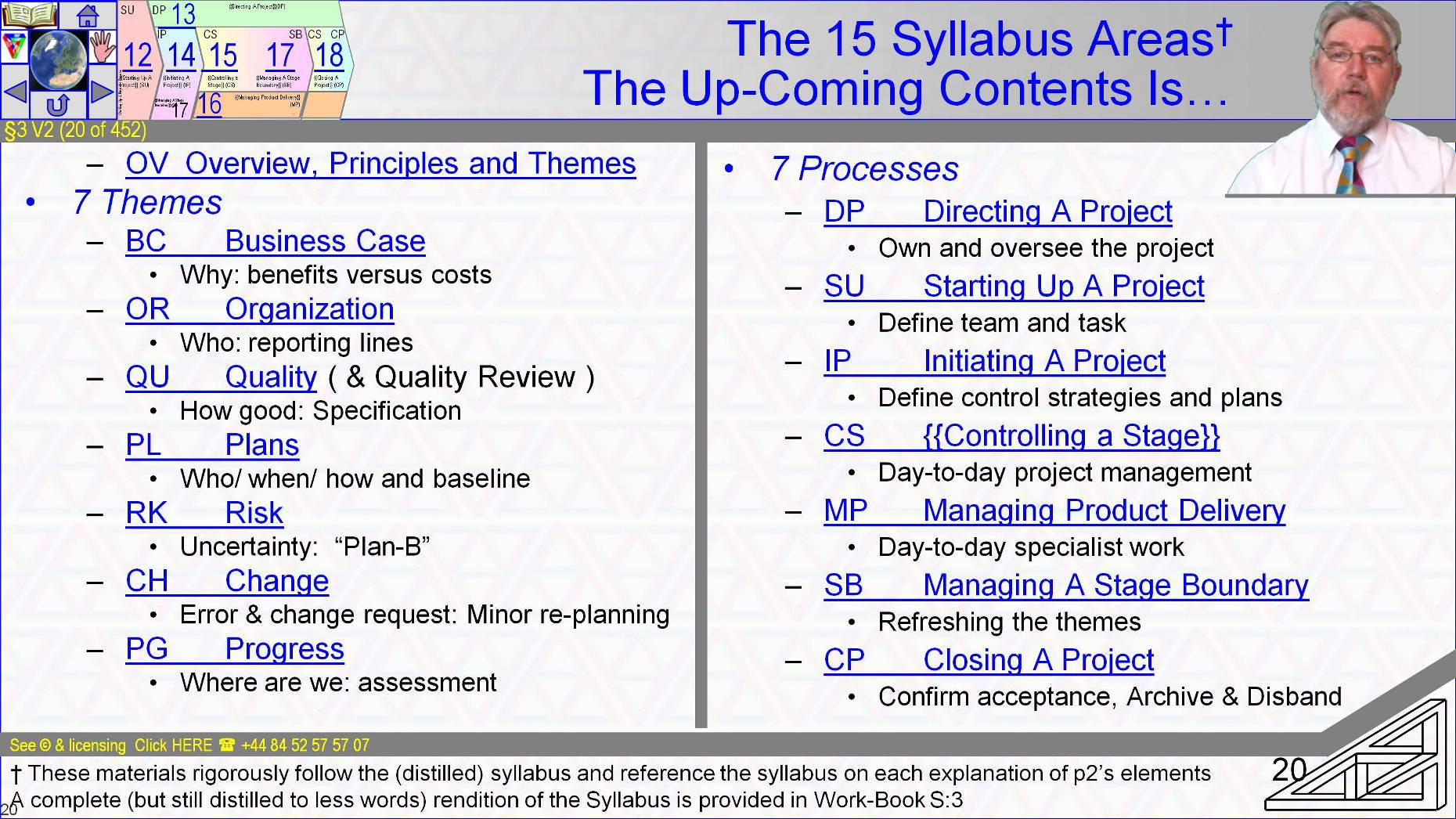
§3 V3 (20 of 454)::Registering For Your Exams::
The exam fee is unavoidable, it is charged by Axelos, the copyright holders and collected by their examining institutes when accredited training organisations book exams on behalf of candidates. What I can do for you is offer the exam at reduced rates compared to other providers.
- <Next lmlsite> Visit our website for our current best prices
- <Next free> Our exam bookings include free, full, instructor Supported elearning materials. I’ll talk though the booking process in Sub-Section §5. In §7 I’ll direct you to the procedure to test your online exam set-up and give a brief overview of what the exam software looks like and what guidance notes are sent to you at the stages of the process.
- The summary for booking is create an ID on PeopleCert’s candidate’s system <Next URL>, Via the Create Account <Next ca> button
- <Next LangTab>Official practice exams and guidance notes are available in a variety of languages, here they are.
- Everything is available in English and this course is entirely English (I’m interested in proposals for translation), here are the other language options for exams – let me know what you need via the Online forum, I’ll include the table in the text notes too.
- <Next certs>Your target is these documents, well really the pink one is the one of interest.
- Lets examine the structure by which we get there
~~
§3 s21 = Navigation Central (in html & pdf formats)
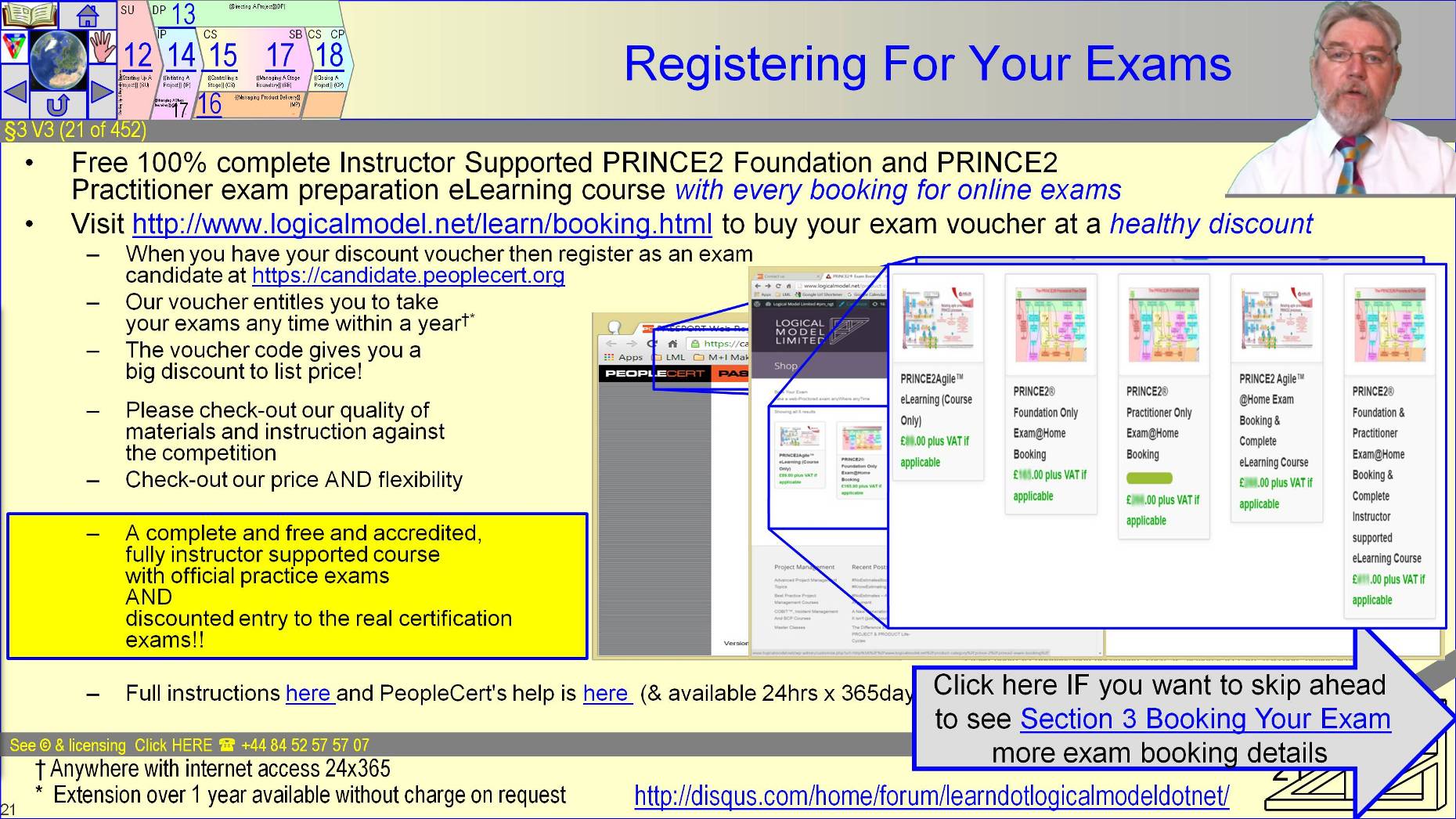
§3 V4 (21 of 454)::Navigation Central (in html & pdf formats)::
This Slide is Navigation Central for any interactive format and a forward looking introduction of all that is to come in every format
- It’s a list of links to our contents in the order we will cover the topics.
- These links include the lessons that cover exam booking and other topics necessary to satisfy the course’s primary objective of guiding you to becoming certified. Listed here are the lessons that target explaining the official manual’s 15 syllabus topics and extra practical non-exam needs
- Where ever you are in the course materials the home button brings you here – dependant on presentation platform capabilities of course.
- these links then take you onwards to the topics.
Our story has so far has covered some administrative needs and there is a little still to go but pace of information coming your way will start to pick-up from here. In §4 we will tour the whole of p2’s contents to give Big-Picture structure in preparation for assimilating the forest of details that must be covered.
- After lesson 4’s complete breadth of coverage we’ll cover the process of booking the exam.
- Access to following chapters depends on signing-up.
- From §6 onwards we are into depth of treatment on each topic that needs to be covered.
- In §6 we cover the 7 principles and link them to the 7 themes coming in lessons §14 to §20. §6 is preparing for understanding the procedural journey through a p2 project’s timeline. Preparation continues in §7 this explains the exam question types found in the foundation exam.
- §8’s exploration is full blown p2 in full and final detail but reduced scope, the scope is the activities of the {{Starting up a Project}} process. SU’s activity’s prepare a description of a potential project. After the definitive coverage of SU I’ll suggest you try some foundation questions at the lesson’s end.
- As your first questions they will be quite a challenge but good preparation for you to appreciate what to be looking for and listening to as we cover the rest of the materials in each syllabus topic.
- Next we’ll explore practitioner question types like the infamous Assertion/Reason questions in preparation for practicing them. At the end of this §9, I’ll suggest that you try the official Axelos questions at practitioner level related to the SU topic we just covered. That will also be quiet a challenge so I won’t yet suggest you try it under time pressure yet.
- Now the course’s regular structure starts to emerge. A structure of topics covered against foundation level syllabus entries, then practitioner syllabus items then you practice foundation and practitioner questions.
- §10 covers the whole of the {{Directing A Project}} process, mostly to introduce it because DP contributes an activity here and there along the timeline. L10 ends with relevant exam questions to try at foundation and practitioner level
- §11 covers the Initiation Stage from the {{Initiating a Project}} process perspective while §12 extends that to the Initiation Stage’s use of {{Managing a Stage Boundary}}. Both lessons end with relevant exam questions to practice. Now will be a good time to add the challenge of answering questions at exam pace or faster. In part that is hard to simulate for the practitioner exam without attempting a whole paper in one go. As such I suggest we hold one official practitioner paper in reserve until you reach the end of lesson §26
- Woven through that narrative of a project’s start and the coming discussion of the project’s middle and end is important continual stuff like appraisal of the projects value via a business case and of its risks by following the management procedures of the risk theme. Recall that concerns with a continual need for consideration are called themes in p2, there are 7 of them; we saw them in §2 V3. Can you list them before I remind you, Pause? Welcome back? How many could you recall? Here is a clue, pause ? Welcome back? Ok they are ►Business justification, ►Learn From Experience, ►Define Roles & responsibilities, ►Use of Stages, ►Manage By Exception, ►Focus on the Products, and ►Tailoring
- Now we have a firm foundation §13 through §23 give detailed coverage of all the themes that initiation has addressed. §13 is the general stuff the syllabus calls overview like the definition of a project according to the p2 official manual. §14 covers the reason for a project IE the Business Case theme. We also need the team, that is §15’s explanation of the Organisation theme, §16 is the theme of Quality, §17 through 20 are Planning as a theme. As a p2 technique and as a real world team activity, §21 is Management of Risk and §22 Management of Change. §23 Measuring and reporting progress. Each sub-section ends with exam practice at Foundation and Practitioner Level
- §24 recaps the whole journey so far so that we can cap off our coverage with treatment of running project execution and closing the project down in §25 and §26 respectively.
- §25 explains quote the controlled middle.
- The project’s middle is three cycles of interaction that are cared for by the {{Controlling a Stage}} process. One cycle for routine management of technical work via managing product delivery, this is where either waterfall phases or agile cycles like scrum or kanban slot in. Two more p2 cycles are the ones for routine reporting and handling of routine stage/sprint/release or project end. We must also have a communications flow for handling escalations to the Project Board of issues and abnormal stage or project end. Project end is when we enter quote the controlled end of a PRINCE2 Project. The controlled end comprises the activities of the Closing A Project process and the last Directing A Project process DP5 which is the Project Board activity to authorize project closure.
- At the end of §26 I suggest that you do the whole reserved practitioner paper. After that §27 is definitely last. It is the slides in which we will close out the course coverage although your instructor support continues through your exam and beyond for as long as you wish.
~~
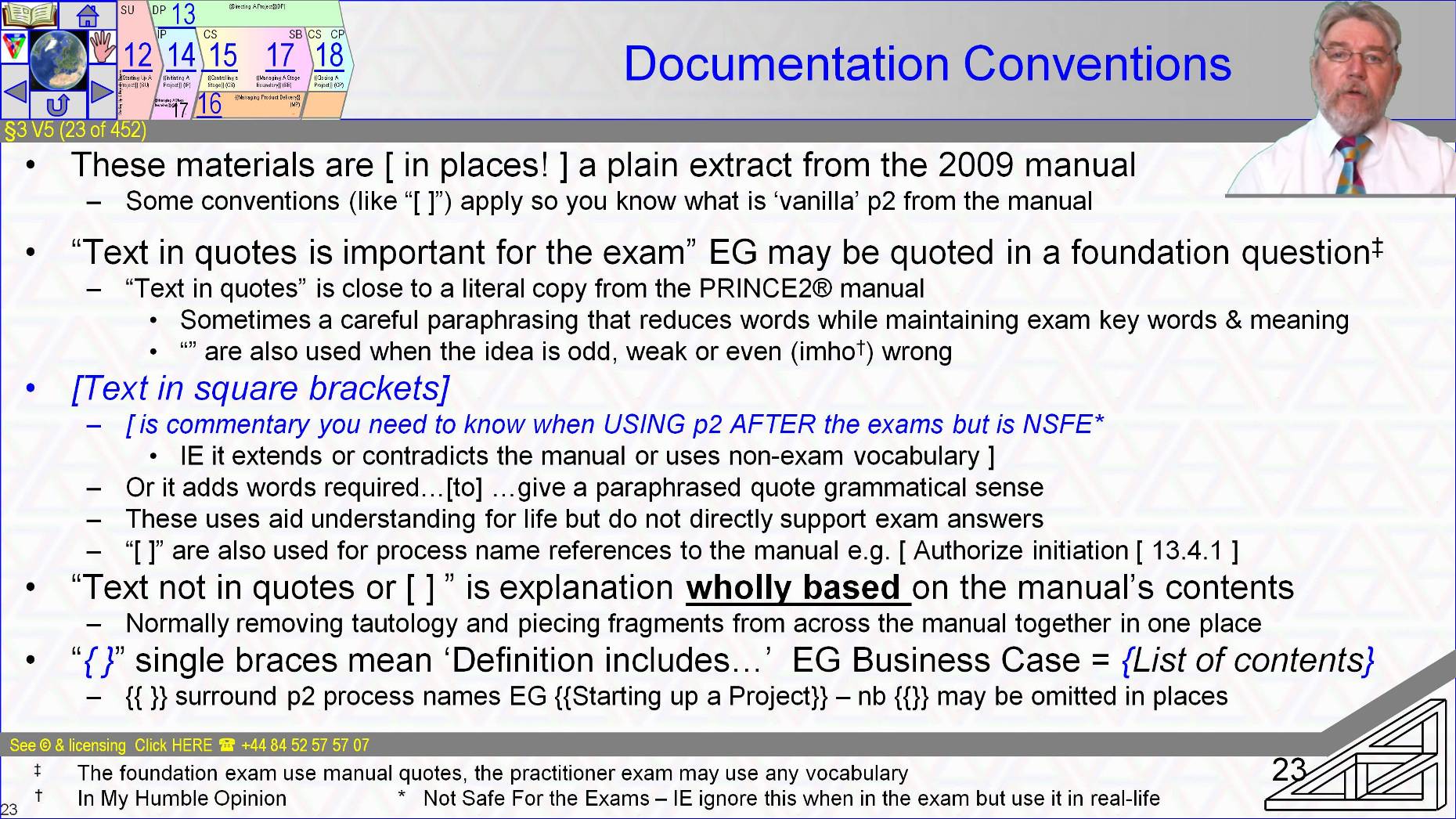
§3 s22 = Documentation Conventions
§3 V5 (22 of 454)::Documentation Conventions::
To find the correct answer to each questions in the exam you need to know the manual’s view of the activities, roles, principles themes etc so I need to show you a few conventions.
- For example to distinguish what is interpretation of the manual’s content - from what is extracted verbatim.
- The Foundation exam quite often uses direct or near direct quotations from the official manual. Where those are reproduced in the course materials I’ll introduce them as Quote… and they will be in “speech marks” in order to indicate that future recognition of the idea in either identical words or at least words basically similar to this text is helpful for the exam.
- In these cases the quoting conventions show that we’re closely following the manual’s expression.
- Note that text in “Speech marks” may sometimes paraphrase or selectively extract an idea but is always close to a literal expression of what’s in the manual and will maintain exam trigger phrases like “slow drift into operations”, or “sum of the products”
- Quotation marks are also used where in my humble opinion (imho) something said is expressed in an odd way to phrase the idea. If (imho) it’s even more odd or just wrong for reality but important for the exam then the quote will be followed by the Latin S-I-C sic, to say “literally so”.
Text in square brackets is used for three purposes.
- One to encompass the 40 activity names within the seven processes. But not initially; I’ll let you get some familiar with the rhythm of p2 before being strict about defined activity names and numbers.
- Another use of “[ ]” square brackets is to indicate commentary on or addition to the official manual’s text.
- Commentary text in square brackets is non p2 thinking and or p2’s words You should ignore it for the exam. I’ve used it when it gives additional understanding or is commentary that in real-world use is, in my experience helpful
- A third use is to insert words into selective quotes that restore grammatical English e.g. “…[to ensure] the project’s controls are balanced with the project’s level of risk”
- Text not in quotes or square brackets is also explanation of the manual’s content. Mostly this is explanation for the Practitioner Exam that you’ll need to know how to consider in order to find the right answers. Normally a careful piecing together of fragments from different chapters and different topic areas that are all talking about the same subject.
- One of the official manual’s ‘quirks’(?) shared by many project management writings offering both a process view and a topical view is the fragmentation of related information.
Lastly single curly braces define the contents of things such as Appendix A Management templates and double braces delimit the names of the 7 defined process. But again not initially while we are establishing some comfortable familiarity and being less strictly formal in use of names in order to convey p2’s rhythm or feel
~~
§3 s23 = References To Syllabus and Official Manual Explained
§3 V6 (23 of 454)::References To Syllabus and Official Manual Explained::
Familiarity with the referencing conventions that relate to the syllabus and so to the exam and then to the course materials and the official manual and back to the syllabus is also helpful.
- When we get to it, then the syllabus is closely cross referenced throughout the course materials
<Next >In each syllabus reference there is a two character syllabus area code
- For example IP for {{Initiating A Project}}
- Then there is an exam ID which can only be P for Practitioner for F for Foundation.
- Next a Learning Level from Bloom’s Taxonomy which I will explain when we get to looking at the exam make up later
- Then the last element is an item number which simply runs in sequence to a low number normally less than ten
- Anytime you see something like SU colon F colon 3-1, you can decode it as in this case {{Starting Up A Project}}, Foundation exam, Question level 3 number 1.
<Next >Alternatively; anytime you see an entry such as 10.3.2.3 then these are Chapter and paragraph numbers from the official manual.
- This one means “within chapter 10 which is the chapter on Progress then if we look at 10.3 and within 10.3 at 2.3 we get the paragraphs on technical stages.
- So 10.3.2.3 is the whole conversation about technical stages within the official manual.
- If we need to look at a lower level of definition below that then P3 or BP2 stand for Paragraph three or Bullet Point two counted from the beginning of the itemised chapter sub-heading.
- Pg99 Bp6 means the 6th bullet from the top of page 99.
- Try this if you are bothering with a copy of the manual! Find 10.3.2. The second bullet point underneath it will say “give the ability to ensure” and at 10.3.2.3 paragraph 3 we can count one, two, three to “Often the boundary…”
Entries in angle brackets < and > are synchronisation of narrations or references to The Guide to the Project Management Body of Knowledge (PMBoK-Guide®-G) 5th Edition chapters and inputs tools and techniques and outputs together know as the ITTOs.
~~
§3 s25 = Introductions: Who are we all?
- §3 V7 (25 of 454)::Introductions: Who are we all?::
- For in-the-same-room training and for ‘virtual’ instructor led classroom based courses, both known as ILT which stands for Instructor Led Training we can all introduce ourselves in person.
- eLearning includes on-demand video where we are not all present at the same time. here I invite you to do your introductions through the discussion facilities rather than in virtual classes and physical classes where we can do our introductions face2face in real-time.
- Video on demand elearning is still ILT because I’m contactable and support you anytime you ask.
- If you’re on the learning portal at LML Training Portal then the disqus forum is automatically linked to materials. Otherwise Mail me mailto:p2a@logicalmodel.net and I’ll give you the details of how to join the support group
- In this medium I’ll introduce me.
- I live in Edinburgh Scotland with my wife Lea and my adult returned to the nest daughter and son Jessica & Toby who enjoy a low overhead rent free existence – at least for now
- I started work as a programmer and then project manager and have worked across many organisation as divers as GE and the UN, also in industries like banking, oil and gas and defence. Clients are an alphabet soup of global blue-chips through to small niche companies.
- During that time I’ve run projects, troubleshot operational departments, been a prince2 examiner and taught a wide variety of project management training courses from prince2 and PMP exam preparation to Effective team development and communication and more besides
- My consulting activities focus on improving the state of the art in project management. Something p2 structure, pmbok tools and an agile mindset combined with openness to adopt, adapt and integrate the best of ideas from all sources greatly enhances.
End
§3 s28 = Feedback Online Events
§3 V8 (28 of 454)::Feedback Online Events::
I’m always grateful for feedback that will help you and other students gain the most from the materials.
- If you spot places of confusion or errors or omissions please let me know.
- Please send feedback to p2@logicalmodel.net
Alternatively open a thread in the online forum by using the top-left corner hand-icon. If you don’t have any active links the URL is in the notes >>>Link<<<{Discussion Forum].
Thanks
<Next > -onward when you have read the slide and are ready
~~
VnCtl:29/08/2016 21:42:05 This file is part of Logical Model Ltd’s p2FdtnAndPrctnt training course