Section:2 s8 - Sub-Section 2 Course Teaching Approach
§2 V1 (8 of 454)::Course Teaching Approach::
- Coming in this sub-section:
- First I’ll give a little explanation of the course’s layered approach so that you can take maximum advantage of it’s design.
- Second I’ll walk you through our unique Exam Question Analysis tool or is it a technique? Either way it gives you a methodical way to work towards correct answer selection or wrong answer elimination and is especially helpful for cracking tough questions.
- I think this sub-section is the last to mention what study materials I provide, this is the summary list, you should have discovered them all
- The last topic is a recommended approach to turning the course’s presentation of knowledge to you, my bit into your own internalized consolidated understanding, your challenge. It could be the single most important lesson in the course.
- ~~
§2 s9 = Layered Approach
§2 V2 (9 of 454)::Layered Approach::
I said earlier there is nothing complicated about P2 but there is a lot of it.
- As we get into the details then most people, at some point doubt their ability to absorb it all
- This leads some people to attempt to find more and more resources and that is mostly a mistake
- Instead focus on studying what you have. For example by writing out lists (some detailed guidance in v5 of this §), also redrawing the diagrams and by following the lessons in order – I’ve been careful to create a sequence that builds increasing detail, explains terms on introduction and establishes abbreviations before they are used as short hand
- Building up the level of detail is part of the Instructional Design I mentioned in §0. The ID techniques will help you in your journey to confidently sit your exam; mostly they don’t need to be discussed (Unless L & D is your hot topic! ;-) if so drop me an eMail, p2@logicalmodel.net
- However I will explain the use of a layered approach to successively expand the level of detail and provide lots of reinforcement through repetition. Lets explore layers, reinforcement and a third idea, consistency of colour coding and the representations of the elements that make up p2 like processes<Next Tableau>
I base all process and activity descriptions on this procedural model and reference the elements back to the Official Manual’s numbering Chapter 12 to 18 for the processes and the exam syllabus’ topic identifiers su, ip, dp, cs and mp, sb, and cp for the processes. I leave you at this stage to map initials to names from the diagram.
The base diagram is so that you always have an anchor reference to see p2’s structure and make cross-linkages.
- Learning is in part gathering facts like “p2 uses processes and stage” but is much more about understanding relationships between these elements like “a stage is made up of a combination of some subset of the 7 p2 processes”.
- The processes are colour coded so you should see from this diagram that a delivery stage uses three processes, two of which are always CS = {{Controlling a Stage}} and MP {{Managing Product Delivery}}
- I will take you through the overview of these elements shortly and the details in the rest of our Lessons together.
This first view is complete in breadth;
- Chapters 12 through 18 of the manual are the chapters that explain the 7 processes
- Each time I make a reference to the official manual’s descriptions of the project team’s activities you can link it back to this structure via its chapter reference repeated on every slide header.
- The tableau in the header is a composite of quick access links.
- <Next> World> Expanding the detail is my p2 world map. This shows all 40 activities within the 7 processes and how processes are combined to make-up stages ( as explained next ). It lacks the depth of description that explains the internal activity structure of the processes but it does list the names of the whole set of actives. This is the complete set.
- Expanding the detail again - it takes lots of explanation <Next CS-MP> to fully describe the interactions between all those activities such as the ongoing dialogues between Project Manager and team members that occurs to delegate work-packages and track work achievements – when we get to them then each element of this slide is animated and narrated and 100% complete representation of what the official manual says in all its references. IE I’ve read and consolidated information from across different parts of the whole manual so you don’t have to.
To cover all 7 processes and 7 themes takes about 19 of these detailed activity maps
- (The animated build-ups are also reproduced in the online version of the Quick-reference & Revision Aid which are Smartphone friendly. But that means animations aren’t downloadable or easily legible on small screens – the resolution IS there, so if you have a good screen you’ll be ok? Anyway the pdf is fully hyperlinked, downloadable and scales and zooms with great resolution.
With so much detailed, sequential and parallel process-flow within PRINCE2® it is vital to have another perspective to complement the activity timeline, it is also half of the 15 syllabus topics. That other view is thematic.
<Next A1 Map>
- As well as the process flow that follows a project’s timeline there is a topical perspective that traces all the project disciplines such as risk and organisation that run concurrently through the processes.
- PRINCE2®’s thematic view traces each specific topic from project start to project close.
- I’ve included 16 of these ‘theme versus activity’ reference maps.
- The Globe-Icon takes you straight to the list of links but beginners beware this is concentrated stuff for revision after I take you through gaining sufficient context to avoid being overwhelmed.
- My advice is accept the guiding hand now so I can build foundations. This way is quicker and easier for you in the long run
- If you follow through everything that’s included in the course materials then you can approach the exam calmly knowing that you have prepared everything you need to be ready.
Always remember that the syllabus is the same for every exam.
- The scenario is at a superficial level different for every exam but they all describe some people with skills and duties who are at some point in a project’s timeline, usually early on, and are concerned to create some deliverables.
- You then have to identify who fits what role according to a small number of guidelines in the official manual. You also have to decide which scenario facts appears against which template heading and describe which principle or theme is satisfied by some action. While there is a lot of it it is all pretty easy and predictable when you have familiarity, its like doing a jigsaw puzzle, at the start no piece makes sense but before long you can spot a piece is “part of the tree on the left, the brick building” etc, its about getting your eye in. That will take a while to develop but it will come.
A note on using etc. When I use it I mean “and there is more, this list is partially complete”. If I don’t use it you can rely on lists being complete.
To recap the two structural views
- The processes integrate many themes that are concurrently active, it’s a time view, for example the start of the project integrates the topics of Business Case, risk, team development, and establishing project controls concurrently.
- A theme concentrates on a single topic for example Risk to describe everything of interest from project start to project finish done by the role holders.
- Exam questions always need awareness of information template, theme etc, lets take a look in the next lesson
~~
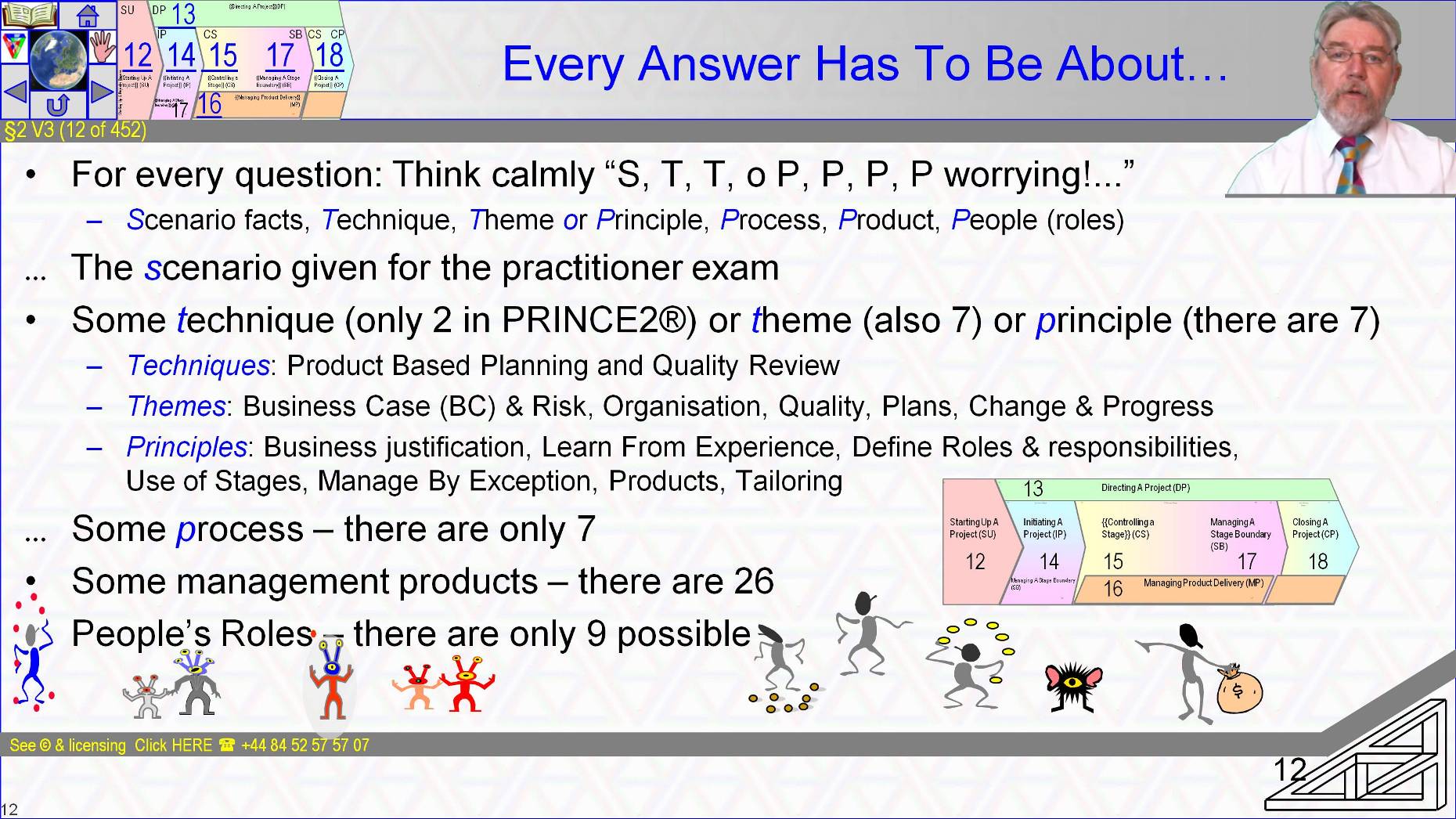
§2 s11 = Every Answer Has To Be About…

§2 V3 (11 of 454)::Every Answer Has To Be About…::
Every exam question and therefore every exam answer has to be about one of only a few well known elements.
- For now, let’s catalogue what they are and later we’ll explore that content and the interrelationship between their component parts.
The practitioner exam is based on a scenario.
- It and the official manual are the only two sources of exam answers in the practitioner
- For the foundation answers are exclusively from the official manual
- Every question has to be about some process. There are seven processes in PRINCE.
- 1st There is the Starting Up a Project process whose activities receives the project’s trigger, builds the team and identifies what it is that we are trying to achieve. The trigger is called a Project Mandate.
- The next process is the Initiating a Project process that says how we’re going to approach delivering the required result and is the principle content of the Initiation Stage’s work. This first stage prepares the control regime and builds plans
- The {{Controlling a Stage}} and Managing Product Deliver processes contain the cycle of activities of the Project Manager and the specialist team members who are building products. Together they control the progress made. They are the content of Delivery Stages and may be agile based
- The Managing a Stage Boundary process refreshes plans each time we get to a position where we’ve worked forwards through a defined stage but still have more project work to do. SB must occur at the end of the Initiation Stage and will also occur in all but the last delivery stage
- The Closing the Project process controls activity as we finish the project’s last delivery stage
- The 7th set of activities are all the decision making activities that happens between all other chunks and above the level of the Project Manager. These are the 5 activities of the Directing A Project process.
The seven processes interact by creating and exchanging some of the 26 pre-defined project management products as well as whatever specialist and technical products the project is creating for the user community.
- The 26 predefined management products cover information sets like Progress reports and Exception reports and Configuration Item Records and a number of other record keeping needs. These reports and records and baselines are maintained by people fulfilling specified roles while carrying out the activities.
There are nine possible roles.
- The Executive Senior User and Senior Supplier together comprise the Project Board.
- The Executive is the decision maker perfectly juggling with golden balls
- The Senior User(s) says what is required and
- The Senior Supplier(s) provides the expertise to make (or acquire) it.
- These three roles together retain assurance accountability and they also hold Change Authority. They may delegate both Project Assurance and Change Authority activity to other people.
- Delegation is normally on the basis of finding people with the right expertise and sufficient time.
- Roles also include the Project Manager and of course the technical team members.
- Team members may be organized such that they have team managers
- Project management may be such a large amount of activity that it needs someone in a Project Support role.
- Project Support is a typical some or some group like a Project Support Office with skills like Critical Path Analysis and perhaps administrative support in terms of things such as collating progress reports and booking meeting rooms.
P2 Elements
- As well as the three elements of 26 management information set templates, 9 role descriptions and 7 processes p2 has two more groups of sevens elements that we need to consider; the 7 principles & 7 themes plus two techniques
- p2 is founded on the basis of seven principles. Those seven principles say
- There must always be a business justification for a project.
- That we should continuously strive to Learn From Experience.
- That the people following the business justification and using their experience have defined roles and responsibilities
- That the role-holders manage and conduct the activities of the project on the basis of stages.
- Each stage has defined tolerance levels and
- When those tolerance levels are under threat we Manage By Exception (no news is good news is the other way of expressing that one).
- Finally that all of this is only done in order to produce products
- The p2 manual says these principles are generally applicable to all projects in all contexts, everybody’s specific project and specific context will need the method to be tailored to the specifics but the principles always hold true.
There are also seven themes which largely implement the 7 principles.
- So the business justification principle is maintained, documented, supported and managed by the creation and progressing of the Business Case theme throughout the life cycle of the project.
- The principles are further supported by a theme focussed on the consideration of risk.
- The roles and responsibilities are expressed in the Organization Theme’s organogram charts with reporting lines and delegated accountabilities.
- The creation of the project’s products to the requirements of the customer obviously require an understanding of how to do testing and other Quality Theme activities.
- Always in a p2 Project, we are expected to follow a plan by tracking the progress that we’ve made and comparing that progress against the plan to understand whether we have achieved what we had expected to achieve or not. This is the progress theme
- There are times when our project has achieved more or less of what was intended or when we want it to achieve something different to originally envisaged. Under those circumstances we need a theme for control of change to baselines. This is the Change Theme. Its approach is the same as the PMBoK-guide but its philosophy isn’t aligned to agile approaches.
P2 recognizes that many techniques are required to deliver projects but it only prescribes the use of two for us.
- That’s the Product Based Planning Technique which has many ideas in common with backlogs, definition of done and conditions of satisfaction and the pmbok definition of the breakdown structure IE start with the products. The other technique p2 gives us is the Quality Review Technique. Basically a structure and minuted meeting that records actions arising from peer review.
I hope I can now present this so you see that you can STToPPPP worrying. Every p2 exam question has to be about
- The Scenario if there is one – practitioner only
- One of only Two techniques.
- Then one of the Seven themes and seven principles which are almost the same topic list,
- One or more of the seven processes and or
- One or more of the 26 products and or
- One or more of the nine roles,
If the answer is not directly from a subset of the manuals elements then it must be something in the practitioner exam expressed in the exam paper’s scenario and that’s the end of the options.
- So here’s a very simple thinking aid whenever you get an exam question and you think I wonder what the answer to that should be. Think “STToPPPP”.
- Then think are there any Scenario facts apply
- Is a TECHNIQUE mentioned or relevant and how does that apply? In the practitioner this may be linked to the scenario?
- What THEME or PRINCIPLE is the question based on? So therefore
- What PROCESS, management PRODUCTS and PEOPLE (in Roles) are they referring to?
Since both exams are multiple choice the above procedure should have eliminated the false answers and if more than one candidate answer is left then guess and move on.
- There’s no negative marking, so a final resort of guessing from a reduced list after analysis preserves precious practitioner exam time and gives you the chance of a mark that you wouldn’t otherwise of got
- The practitioner exam is likely to put you under time pressure but the Foundation Exam should not. More on that in §9 Practitioner Exam Question Types & Advanced Techniques For Answering.
~~
§2 s12 = Study Materials
§2 V4 (12 of 454)::Study Materials::
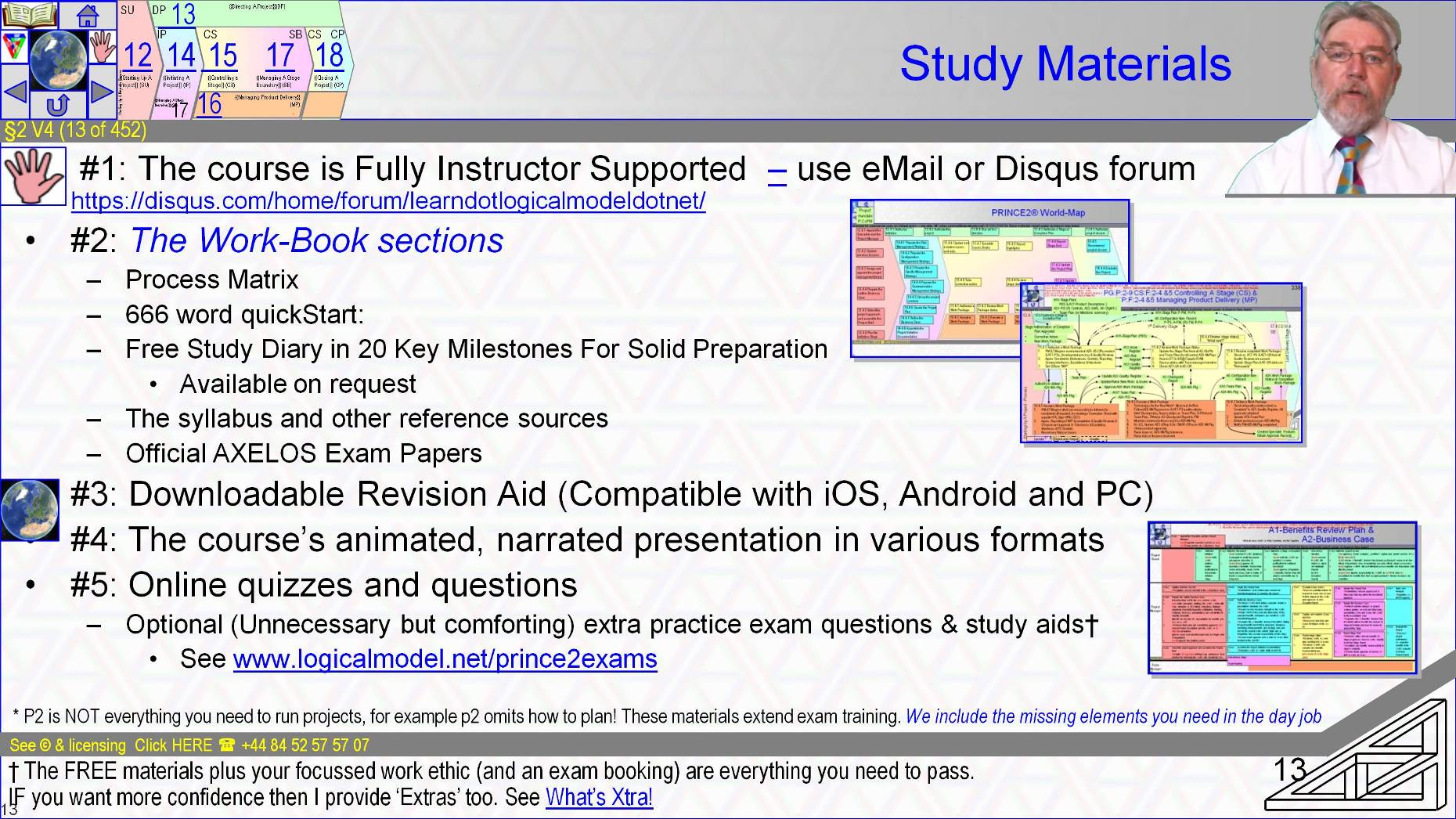
- You should survey the resources that are included in your exam booking fee so you can take maximum advantage of each resource.
- Currently your following the course notes in one of several (nearly) identical formats that include Talking Head Video, PodCast, and eBook. Several times so far I’ve suggested downloading and consulting various Sections such as the Cross-References, revision Aids and Exam Question Analyses.
- It is fine to follow the videos without looking at the downloads for now. I’d suggest looking at the downloads before starting the Themes and Principles though (§6). You’ll definitely need the official exam papers by the end of the first real study chapter on {{Starting up a Project}} §8
- If you have downloaded and looked at the early Sections of the Work-Book you’ll recognise the quick-starter, the jargon buster etc. My recommendation is you read these sooner than waiting till §6
Resource #3 is the collection of revision aids.
- The revision aid distils the 19 and 16 maps into terse aide-memoirs –
- Item #5 is the collection of official exams and extra quizzes and test questions, also accessible from the web-page
- Resource #1 is my support. This course is fully instructor supported.
- Not everyone needs instructor support beyond these narrations but clicking the hand-icon visits the online support where you can join in discussions and post questions. You can access my direct support by sending an email to p2@logicalmodel.net, the online route usually delivers the quicker response.
Within the materials the resources fall into three categories.
- First) there are the explanations of core p2 method details from the syllabus
- Many include Foundation Exam relevant quotes from the official manual in literal words.
- We will talk about the conventions for quotes and for syllabus and manual references next.
- Quotes and facts are the focus of what you need to know how to apply to questions in order to pass the exams.
- Listen out for when I say “Quote” it introduces a phrases that could appear in a Foundation exam question. Foundation tests knowledge of what the book says. Practitioner is less dependant on quotes as it tests interpretation of what the book means
- Also listen out for when I say “Note” or “Key”. They both introduce facts that are specifically examined but not in the form of quote.
- Second) are the reference materials,
- It may be that your best approach to internalising the facts they contain is to hand-copy them. A great place to copy them to is blank pages of te official manual if you bought one.
- Alternatively you might print them off but then they are not admissible to the exam.
- Only the official manual with personal hand-made notes written directly onto the manual’s pages is admissible. The practitioner exam is referred to as open book but be aware that it is designed to put you under time pressure so realistically there is not time to look things up in that open book – I’ll give you the details in Sub-Section 9.
- The third category) to the course resources are the navigational elements of Lessons and hyperlinks that simply give us structure and effectively tick off the syllabus elements as we cover them, one after another. The lesson structure is important so you can see your progress. How do you eat an elephant? In small bite-sized chunks.
- Another source of visible progress is the milestone diary. If you’d like a sample, suggested set of milestones with which to fill-in the blank in the course notes then drop me an eMail p2@LogicalModel.net.
- I suggest you complete it as soon as you have surveyed the resources that you have
~~
§2 s13 = Revision Notes Review the Sub-Section just gone and capture NOW…
§2 V5 (13 of 454)::Revision Notes::
Every lesson ends with one (or two) of these slides. Two is only for on-paper pagination control.
- <Next > This may be the most important slide for all the objectives of certification and real world competency
- When we get into more detail these slides are very significant as places you have to be active rather than passive listener
It is crucial for exam success that you internalise what we cover
- One way that works for most people is to make summary notes in your own words or diagrams.
‘Make a list three times’ is a good strategy.
- By that I mean attempt to list the lesson just gone from memory.
- Start by listing what you know easily from memory of what we have just covered. This helps to extend your recall.
- Crucial is to note what is confusing or now ‘seen but not understood’
- Then using the Section of the Work-Book that is the copy of the slides, list what you have to remind yourself of by studying the slides.
- For anything with low understanding or recall study the materials or ask for help, perhaps in the online forum, or by eMail p2@logicalmodel.net
- When you have created a complete list, part recall and part assisted revision repeat the steps a second or even third time; From memory and then by reference – List everything while attempting to look-up less each time.
- Of course the target by the third step is to list everything from memory.
Use the official exam questions referenced in each course sub-section and the additional quizzes we supply to identify where you’ll benefit by returning to content already covered and where you will benefit from review of your notes.
- For some online quizzes you can elect to send the results back to me.
- If you include your email where asked then I can see how to support you and as you make progress we can celebrate achievement.
- Study and achievement earns progress recognition , makes you feel good and so boosts both your energy and your certainty of success.
~~
VnCtl:29/08/2016 21:42:05 This file is part of Logical Model Ltd’s p2FdtnAndPrctnt training course