Section:1 s4 - Sub-Section 1 Domestics
§1 V1 (4 of 454)::Domestics::
Let’s take a time-out to handle necessary ‘domestics’! For Example knowing about the html mobile player is definitely helpful for study–, so is accessing the workbooks from the downloads.
- Every slide has narrations that are these notes or very nearly these notes behind it as a script. Dependant on platform access to them will be more or less obvious.
- Materials are in sections, sub-sections and lessons; eg all the videos or slides are section two, subsections are the collections of lessons on a topic and items such as Videos V, Revision Aids RA and Exam Question Analysis EqA. There numbering runs in sequence and includes a slide count, some slide count numbers are omitted, its admin, for example to insert a lunch break in onsite in-person course deliveries. Its not a mistake, you haven’t missed out on something – your welcome to take a break any time!
- You may be on a Kindle and so reading the notes directly! You may be on iOS and html5 in the slide player where screen size makes finding them a several step process
- I’ve tried hard to leave as much control as possible in your hands
- Navigating your player will become second nature, It benefits from a little exploration
- If I try to explain everything for each combination of html or video on iOS, Android and Windows, Google Cardboard, ePub, youTube or Scorm LMS platforms this Sub-Section would be very lengthy as detail varies between each platform.
- Generally; on anything interactive a click on the slide’s back-ground is best. The next lesson covers some specifics which you can skip but the online player has some very handy feature such as full search through all the narration text. More on the next slide in its video or notes.
<Next wkbkFC> The Work Books contains a wealth of material. Note that each mobi or ePub or pdf’s has a Table of Content that are bookmarks to jump directly to Sub-Sections.
- In this workbook the first dozen pages are a step by step guide to how to embrace study ¿which may be something you’ve not done in a few years?
- Everything you need to pass is in the eBook, the videos or other slide delivery formats and the Work-Book’s Sections.
<Next p. matrix>
- Also in this Work-Book’s first Section is a blank Process versus Product Matrix to complete as you study.
- Being exhaustive with the matrix is not required but you’ll probably find tracing the path of the more significant products such as the Business Case and the Quality Register is really helpful
Examples of what the Work Book’s Sections contain include:…
- <Next 666> A 666 word summary of p2, that’s about 4minutes of reading; Surely a short and sweet replacement of the 300 and something pages of the Official Manual!
- Well may be not replacement! But definitely a complete overview that gives holistic coverage without detail, a skeleton against which to record the details as they come, and there is a lot to come.
- In this workbook Part two is the slides reproduced with the hyperlinks that will not be active if you are watching a video and may not be very legible if your platform is a Smartphone screen
- Later course Sub-Sections and other workbooks include the official Axelos practice exams and the rationales for the correct answer.
- Exam questions are also online but the rationales are not. [[ToDo]]
- The Rationales are very useful to illustrate examiner thinking about why right and wrong answers are right and wrong.
You are a rare and lucky person if you can internalize all the facts and their relationships without note taking and review.
- You don’t have to copy down what I’m saying as it is all transcribed within the course’s written note formats.
- As you will see as we go in places there is a great deal of detail in the graphics and in the provided notes. The notes are the video and animated format’s narration or vice versa. Graphics plus notes equals full interpretation of each topic
- I suggest successful students often cope by taking an iterative approach and that is what the presentation is iterative and incremental of details. Take multiple passes at different speeds.
Each pass through the materials has different aims.
- You might take a first whizz through to see what is here, 10 minutes or less, ‘a helicopter view’. Then take a first methodical pass. Aim to get the general end to end flow and each topic’s specific details.
- At this stage don’t worry about recall of the details or how all the topics interconnect
- I think this is mostly listening to the narrative or reading their transcript in the notes pages.
- Things to look out for are ►the roles involved, ► the headline purpose of each activity and ►the process flow as a whole.
- Also note which management products the activities use and how generally each output becomes some input elsewhere.
For Back@Work™ capability development that takes you beyond the exam imagine who in your workplace might carry out each role, and notice that many of the activities might really happen iteratively or partially and in parallel and out of text-book order to achieve the process’ aims in a real world setting.
- To help you with study tasks like noting which management products are created where, I’ve included a template in the Work-Book. Its use is optional but I think helpful.
- Perhaps print the relevant page or redraw it on some blank part of the official manual like the inside front cover?
- Sub-Section 24 is a review of everything covered up to that point and what will come afterwards. There is an argument to use it as precise before doing a detailed pass to hint at what is coming. The 666 word summary in the Work-Book is perhaps the better preview.
- I’ve included a number of complex models which in html5 build slowly with animations. If seen as a static whole without introduction they will likely feel overwhelming on first viewing. They are excellent revision when you know it all and just need to do some fact checking or want a comprehensive refresh in the minimum of words.
- Remember that all the detailed explanations that I give you as you view the Slides about activity purpose or product content is within the eBook (or if your reading the eBook it is all animated in the additional materials that are free with an exam booking. You don’t have to book and exam to access the online materials but in that case a fee applies).
- SO; you don’t need to rush and struggle to write down what I say as I say it in the narrations because its already written out in the notes.
- What ever your delivery platform you have text-notes access somehow.
<Next Clear> //There is one other factor! Passing also absolutely demands that you have booked an exam! Access to the full course materials is included, for free when you book an anytime anywhere online remote proctored exam through our web-site. Book your Exams.
- Last time we looked we where the cheapest source of exams even before you consider we add a fully instructor supported course for free, others often charge several hundred pounds for time limited access
- We think that makes our whole package MUCH cheaper than everyone else as well as much better content
- Let us know if you find a deal anywhere else that you’d like us to consider matching for you - eMail p2@logicalmodel.net
<Next >
§1 s5 = Navigational Help
§1 V2 (5 of 454)::Navigational Help::
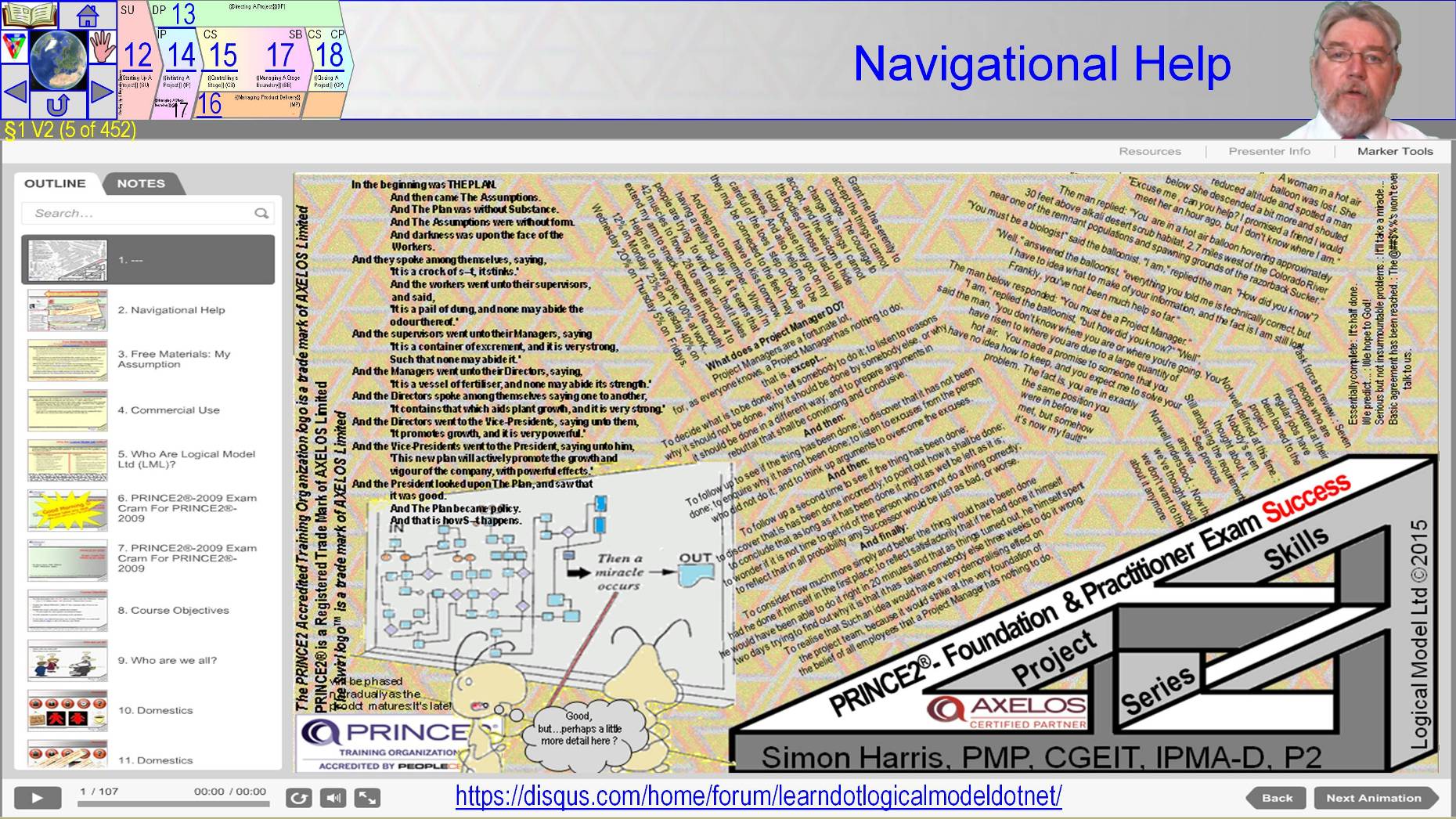
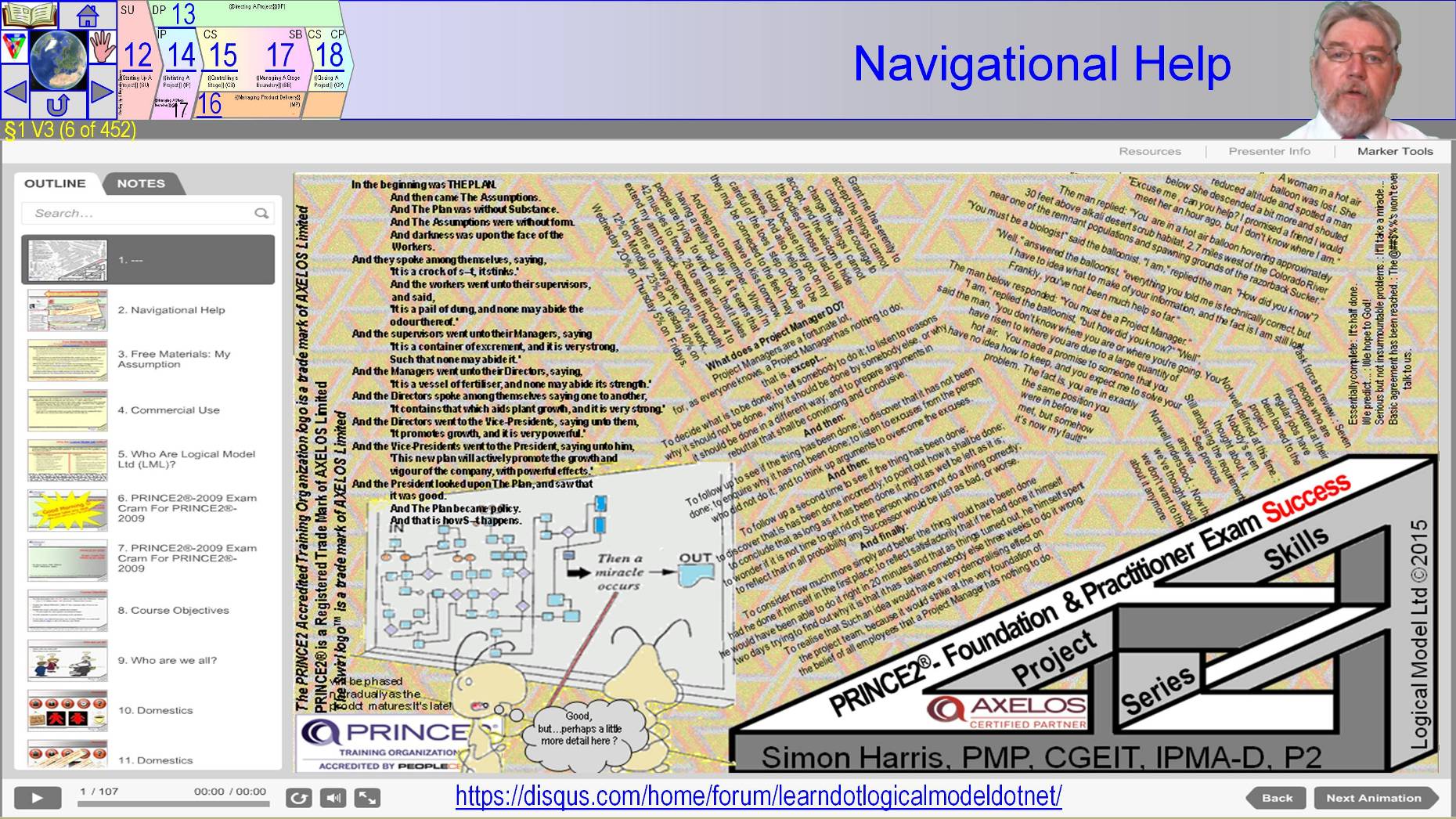
This slide, like many to come is a mix of synched narrations and animations. In the video I’ll handle the synchronisations, my Next or Sync markers on other platforms youll need to supply the click
- Here I’ll introduce the navigation across several alternate platforms available to you. Together they have a lot of facilities that complement the videos like full search capability!
- <Next Search> When accessed as html5 or distilled as a pdf the search box and hyperlinks are very useful. Links don’t have relevance in pure video formats that progress serially frame by frame
- In html and the pdf WorkBook formats a click on the top left on-slide process-overview’s-p2-manual-chapter-numbers takes you straight to the relevant process map. In html5 they then build up animation by animation. A click on the body of interactive slides will take you onwards, generally one animation step at a time.
- You’ll truly appreciate this when we get to sub-sections that use the detailed process maps.
- The U shaped button steps backwards through your history. Some platforms go back and back others toggle between two places, some like acrobat ignore it but acrobat has a ‘previous’ button on the navigation’s button bar – right click the button bar to configure it as visible. The Globe and the home buttons take you to link pages. The home button’s links are in the gentle course sequence for studying p2’s individual elements in a methodical sequence. The globe’s destination is laid out for reference if you want the fast track or after you’ve done introductory study and are ready to reinforce and deepen comprehension of how p2’s bits link together. The Book Icon takes you to a jump menu that links to the 26 information set templates in appendix A of the official manual that support p2 role holders in their decision making.
- In the player the back or prev and next animation buttons and the up down cursor keys all move you by a single animation (well probably, it’s a little dependant on your configuration!)
- The Page-Up/Down and the on-slide triangles top left skip the in-slide animations and immediately advance a whole slide at a time skipping animations & narrations that remain within the slide.
- Even in non-interactive video the pause-play button allows you to stop narrations - useful when you want to make notes.
On interactive platforms the time slider (is it bottom left for you?) counts up as animations and narrations are running. So if it has stopped the player is waiting for input from you
- Often where there is a slider you can grab it and scrub it back and forth to advance or rewind and repeat parts of the video that may have just faded out of sight
- If your on an interactive platform then look for the notes tab – may be you are reading along with the narrations? The text and narrations are very close but not always identical, for example I tend not to narrate long URLs but do put them on screen. You can switch between either notes or narrations in which every context suites, you won’t need both; for example a podcast format might be best if your on a spin cycle in the gym, while video works on a wifi enabled commute and text may perhaps be best on a plane or for revision of topics that you need to focus on?
- If your course delivery platform is one of the online formats then before we go much further together look for a resources tab or other platform mechanism to link to the downloads. For online video there is a full downloads lesson in sub-section zero §0 for subscribed course members and a sample set of downloads for the undecided and those accessing the public portions of the course. The url is in the text formats and on screen p2 Course.
- The downloadable revision materials (and Recall the globe icon) include process on a page and ‘syllabus-subject-on-a-sheet’ distillations (i.e. just the terse reference stuff to look at after you’ve done initial study or are on fast track)
- Or visit our website www.logicalmodel.net/prince2exams [LML’s Central P2 hub] is always a central hub if you have no links onscreen As is the online forum whose link is the onscreen hand-icon – not normally click-able in a video but great in any of the html formats. The URL is in the notes and on-screen. [[It is at this URL Disqus Forum. ]]
- The Online forum is where you can get the promised full Instructor Led Support for all your remaining queries. It operates across our course titles. By the way; the Escher triangle icon takes you to our other course offerings
- And recapping the difference between the globe and the Home button of similar links; the home page is in course-running-order for all the gentle introductions needed to be able to cope when starting out and not yet ready for the distilled revision aids.
- I want to explain why the running order is as it is but we have other topics to cover first. Indeed there are a lot of topics all of which I’d like to have been first but obviously that isn’t possible
- Returning to the Work-Books I suggest that you download and read the Introductory Section, it contains a gentle intro to p2 and a guide to study.
<Next >
~~
§1 s6 = Course Objectives
§1 V3 (6 of 454)::Course Objectives::
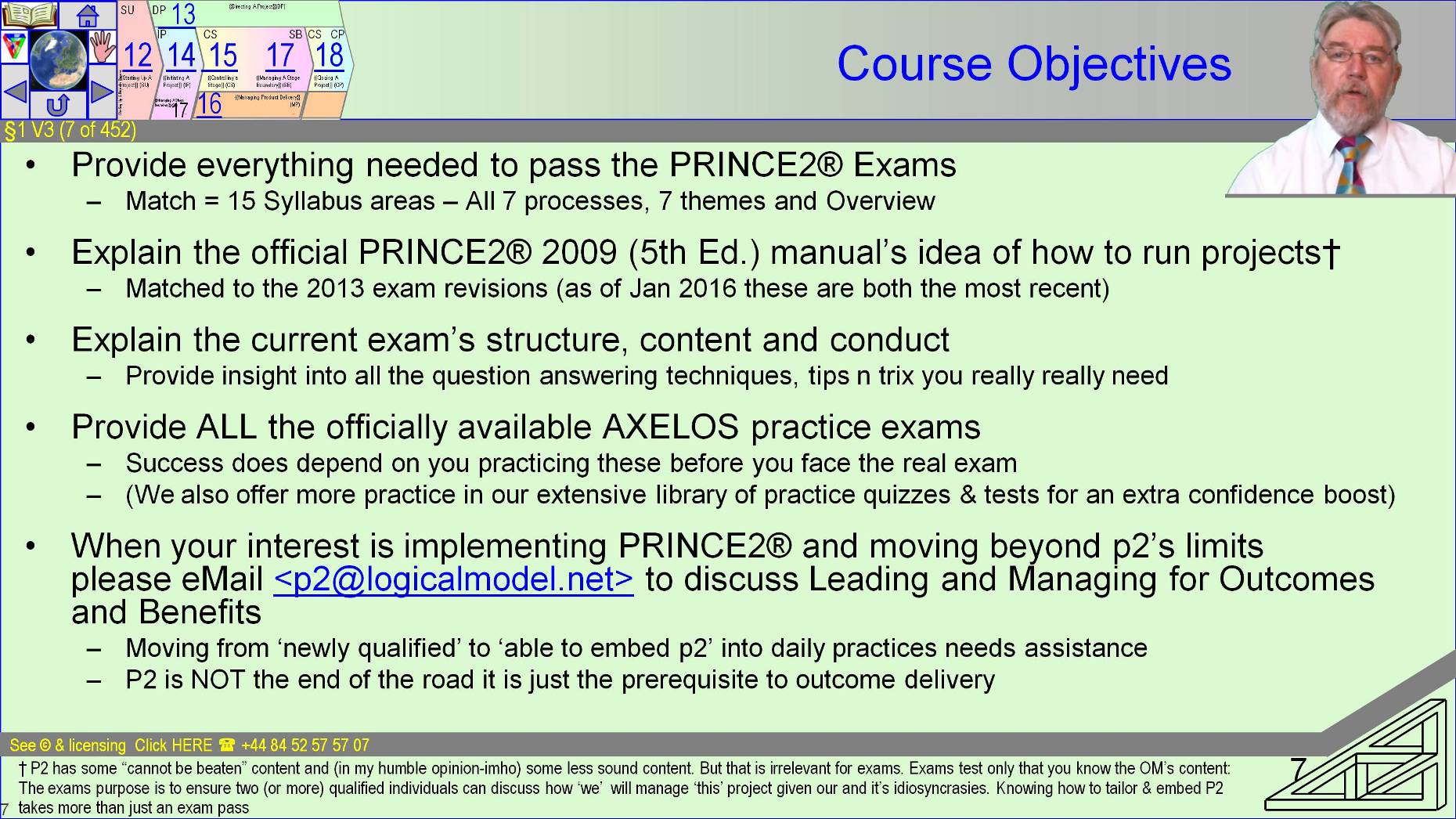
This course aims to create project managers.
- PMs who are capable of running small non-complex projects and so gain the experience to run large and complex ones.
This course aims to get you through the exams.
- <Next bp1>We provide all the information needed all carefully matched to the syllabus references, the official manual paragraph numbers and the course sub-sections
- The course covers foundation and practitioner because the work required is about the same for both exams as it would be for just the foundation.
- Those taking the practitioner on a pmp or ipma exemption still need the foundation level knowledge
- The syllabus is referenced throughout the course slides as well as in Work-Book Section 3.3
- <Next > 2>The current, most recent official manual is in its fifth edition and was published in 2009
- <Next > bp3>The exams current as of 2016 are the 2013 structure
- These materials explain the exams’ structure, their content and question types and give tips and tricks for approaching each question type.
- The insight into question answering techniques and practice questions we provide are everything you need to build ability and confidence.
- We provide all of the Foundation and Practitioner Exams that are currently released as official, authorized exam materials plus more that you probably don’t need but are an optional extra for confidence boosting.
Passing the exam takes a lot of effort because of the volume of information to internalise-the-relationships-between elements but it’s very easy in every other way.
- There’s nothing complicated about PRINCE2.
It’s a qualification widely required to get passed the initial round of filtering in job applications.
- With a choice of candidates it’s always those who have made the effort to achieve a globally recognized benchmark of their knowledge who get called for interviews.
- For employers it’s also useful when responding to contract tenders.
- It’s a great advantage to be able to reference that staff are independently verified as competent.
Introducing the exams a little: Foundation is a knowledge only, closed book exam so our objectives include giving you the facts in memorable ways.
Practitioner is based on the ability to apply that knowledge.
- In the practitioner exam, application is by showing it’s usage for a scenario. Our exam aim is thus to show you how to recognise the key scenario and question facts so you can match them to give the required answers.
- The only difference in your workload to pass the second exam is the practice of Practitioner questions.
- Upcoming sections of the downloads and sub-sections of the videos or notes have reference to the Practice Exams & Work-Book Sections that in total include the full set of official practice questions for both levels of exam.
- Practice exams measure your progress as you proceed through assessing your level of readiness from just starting out to fully ready - More on that later.
If and when your interest is one of applying p2 to your organization and <Next Fn> implementing and embedding p2 then please feel free to contact us to discuss your needs.
- The skills that you need to pass the exam are not as great or quiet the same as those that you need in order to be able to embed p2 into an organization’s norms and culture.
My parallel objective is to build your ability to apply p2 in the real world.
- For that we need to add to what is in the manual which I have done in places and we also need to caveat some of the manual’s advice. Mostly in this course I have not done more than sign-post that other opinions exist so as NOT to create possible confusion when taking the exam. So extension but not contradiction.
- After your through your exam I have further course materials that you can use to broaden your thinking in ways that compliment or even contradict p2.
- Particularly those focussed on Leading and Managing for Outcomes and Benefits. They build on the foundations of a solid understanding of p2, agile and PMBoK-Guide knowledge that will help you address the challenges of the project manager role as it is evolving in organisations at the moment.
~~
§1 s7 = PRINCE2® is A Registered Trade Mark of AXELOS Limited
§1 V4 (7 of 454)::PRINCE2® is A Registered Trade Mark of AXELOS Limited::
- Some Good news might be that for exam and real-world skill purpose you can skip reading the slide, it is not examined and it doesn’t help you develop real ability and the narrations only last about another 20 seconds
- It is here to explain some context on who is responsible for what.
To book exams you have to have a Sponsoring ATO
- For me to be a sponsoring ATO I have to be accredited by AXELOS who own the P2 Intellectual Property. I pay them fees for that.
- The accreditation process reviews the course material’s accuracy and instructor’s capabilities.
- Accuracy of materials includes correct use of trademarks and symbols and procedures for carrying out exams
- If you are interested in that stuff please study the slide’s text or ask in the online forums
- Otherwise move on
~~
For Exam Questions: Copyright © AXELOS Limited 2015. All rights reserved. No part of this publication may be reproduced in any form or by any means without permission in writing from AXELOS Limited. This information is part of the official PRINCE2® sample examination paper. Copyright © AXELOS Limited 20??.
VnCtl:29/08/2016 21:42:05 This file is part of Logical Model Ltd’s p2FdtnAndPrctnt training course