Chapter 5 - How I Got Started
I’d like to share my journey towards volunteering my skills, to give you some more background on why I am writing this book.
One of the most rewarding volunteer projects for me was my work on increasing recycling rates at Kinnick Stadium.
I grew up in Iowa City my whole life, and that is where the University of Iowa is located. Kinnick Stadium is where the college football team plays their games. I attended many games growing up, and my dad worked security on the field for the team during my youth. During high school, our football team would clean up the stadium on Sunday mornings (after the Saturday home games). It was not much fun, since it was usually early in the morning and cold outside (two things I dislike).
After high school, I attended school at the University of Iowa, and I was fortunate to play football in that stadium for 4 years.
During my awakening to the problems of climate change, and the impact that humans are having on the planet, I decided to go back to school to get more education. I enrolled in a sustainability certificate program at the University of Iowa in 2010. After taking a few classes, I started to make new connections within the university, specifically in the Office of Sustainability, and the Athletics and Facilities departments.
For about 6 years, I had moved away from Iowa, and was living in Florida, so I hadn’t been attending football games very often. When I moved back to Iowa, and started to attend football games again, I started to notice the lack of recycling options inside and outside the stadium.
A light bulb went off in my head (probably a solar-powered LED bulb)! Here is a problem that I knew how to solve, and I probably have the network and connections to do something about it. Thus began my first volunteer project to apply my skills to a cause I was passionate about!
In fact, this was the first time I had ever initiated a volunteer activity. In the past, someone had to ask me to volunteer, or it was required or mandatory. I had been so focused on my own personal and professional goals that I never stopped to look around me, or think about how I could help others. At the time of the recycling project, I had been practicing Lean and Six Sigma for about 10 years, and was gaining confidence in my ability to successfully solve problems.
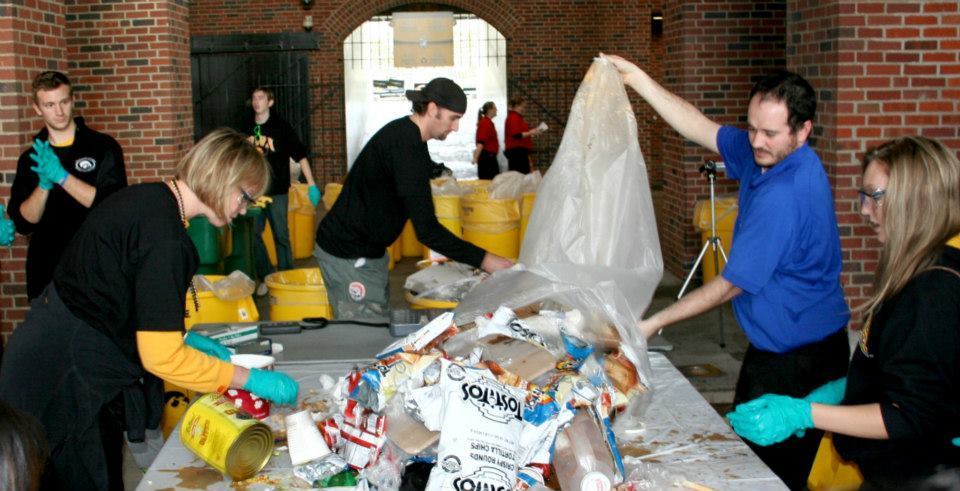
I approached the problem like a Lean Six Sigma project, with a Project Charter, baseline data, sponsors and champions for the project, and lots of enthusiasm to make some improvements. It was not a very complicated problem, but there were some challenges.
After evaluating many different options with many stakeholders involved, we decided to add recycling bins on the outside of the stadium, and better educate the high schools students about what can be recycled on Sunday mornings (the same group that I was forced to volunteer with during high school). Each bin outside the stadium was staffed with student volunteers, to help educate fans about what can and cannot be recycled. After the first year, we were able to increase recycling diversion rates from 25% to an average of 50% in the first year. To sustain the improvements at around 40%, the Delta Tau Delta fraternity agreed to take over the coordination of the volunteers17. The project started in the fall of 2012, and it is still going today, which makes me very proud!
Around the same time as the football stadium project, I also kicked off an electricity reduction project at work. Coincidentally, this was the most rewarding project at work I ever had.
Looking at the company’s carbon footprint report, it was easy to find the largest building within the company with the highest electricity usage. I wanted to make a significant reduction in the carbon emissions, and prove that Lean and Six Sigma could be used to address environmental impacts within this organization.
This project was more complicated than the recycling project, so I had to use my statistics background to help accurately estimate the potential cost savings, and sell some of the improvement ideas to upper management. We determined that the biggest opportunity was to reduce the heating and cooling that was running 24 hours a day, 7 days a week. After analyzing employee occupancy in each area of the building, and addressing concerns from the employees, we were able to set back the temperatures during off-hours. This led to a cost reduction of $300,000 per year, and saved around three million kilowatt hours (kWh) of electricity! This equates to powering 400 homes per year, or the removal of 500 vehicles off the road.
These projects didn’t happen overnight. It took years to get into a position where I could launch these projects, and execute them successfully.
If you’d like to learn more about these projects, I’ve compiled some details on my other website: https://www.LeanSixSigmaEnvironment.org 18
The success of these projects is what made me decide that I wanted to spend the rest of my life helping others apply Lean and Six Sigma techniques to address people and planet issues, as well as helping companies increase their business, reduce risk and save money.
The topics I’m concentrating on right now are as follows:
- Vegan: Promoting a vegan lifestyle to reduce animal harm and the environmental impacts of meat production19
- Solar: Increasing solar energy adoption to reduce carbon emissions
- Food: Reducing wasted food going to the landfill to reduce methane emissions impacting climate change
- Coffee cups: Promoting reusable coffee cup usage to reduce tree cutting and cup production impacts
Key Takeaway for Chapter 5: If you don’t like the direction your life is headed, only you have the power to make a change