Chapter 3 - Sustainability
What is Sustainability?
There is a lot of confusion about the term “sustainability.” Most people think that sustainability refers to long-term results that are maintained after process improvements. While that is true, sustainability has a much broader definition than that.
Here are some definitions I find useful:
- “…meets the needs of the present without compromising the ability of future generations to meet their own needs.”6
- “…the capacity to improve the quality of human life while living within the carrying capacity of the Earth’s supporting eco-systems.”[^fooIUCN]
- A long term perspective of an organization that leads to “…successful operations for at least 1500 years”7
- Decision making based on the triple bottom line (people, planet, profit)8
How do you define sustainability? Use whatever definition bests suits you, as there is no one right answer.
To keep things simple, let’s focus on the “triple bottom line” definition, where decisions should be made that equally weigh the trade-offs between people, planet and profit.
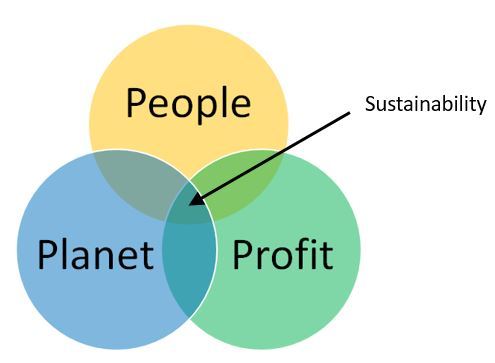
Profit is already the primary focus. That is how most companies and organizations make decisions today. What is needed is more focus around people (social) and planet (environmental) issues.
There is a perception that organizations that start to focus on people and planet will have a negative impact on their profits. However, when people and planet are not considered, an organization cannot survive in the long term. They cannot continue to provide their products and services because raw materials are depleted or become too expensive, or they cannot attract and retain employees to work for them. This negatively impacts quality and delivery to their customers, and their business suffers.
A new focus on the “triple bottom line” can actually drive profitability and growth to companies. It can bring in stronger candidates for job openings, open the market up to new customers, and reduce the risk of fines, penalties and negative publicity (such as those experienced by BP9, Wells Fargo10 and Apple11).
According to SustainAbility and GlobalScan’s Sustainability Leaders Survey in 201712, the most sustainable organizations are:
- Unilever
- Patagonia
- Interface
- IKEA
- Tesla
- Marks & Spencer
- Natura
- Nestle
- General Electric (GE)
- BASF
- Nike
These are well-known and successful businesses that place a strong importance on People and Planet.
That being said, being on a sustainability list doesn’t mean these companies are free from controversy, or are doing things perfectly. They are simply balancing the triple bottom line better than the majority of organizations (across a wide range of sustainability categories). There are other rankings and lists you will find online, so this is not meant to be an all-encompassing list of sustainable organizations. Each ranking you find looks at different aspects of sustainability. using different data sources and weighting criteria.
Another way organizations can show that they are attempting to be more sustainable is by publicly communicating their progress and impact. One popular framework is the Global Reporting Index (GRI)13, which is the first and most widely adopted global standard for sustainability reporting. You can visit the website of any organization to see if they are publicly sharing their sustainability or social responsibility report.
Aside from all the rankings and reports, here’s another test to determine the sustainability of an organization. How do they currently make business decisions?
- Is it weighted by 33% profit (makes them money), 33% people (good for community or employees) and 33% planet (less harmful to environment)?
- Or is it 80% profit, 10% people and 10% planet?
- Or worse yet, is it 100% profit, 0% people and 0% planet?
The triple bottom line thinking became quickly apparent to Roberto Pedote, Vice President of Finance at Natura Cosmeticos, S.A. (tied for 5th on the list above), a successful cosmetics company in Brazil.
“I was asked to analyze three possible sites for a new service center and make a recommendation to the executive committee. Following my presentation and recommendation, I was asked “What impact does this decision have on employment opportunities and income distribution in the various regions? What are the possible environmental impacts of each alternative and what are the different levels of carbon emissions for each possible location?” It was an experience I will never forget and it served to demonstrate that sustainability is a serious issue to Natura’s leadership.”14
If most of the decisions at your company are based on profit, you may have a harder time finding rewarding work within your organization. You may need to spend time outside of work to have a real impact on Planet and People, or potentially look for a different employer.
Key takeaway for Chapter 3: Your improvement skills are valuable, and we need those skills to help make our world a better place!
In the next chapter, we’ll go into more detail about People and Planet by looking at some sustainability goals established by the United Nations (UN).