Value Stream 3: Existence
Value Stream 3 A3 Report:
- Genchi Genbutsu is a Lean term directing managers to go to the source of all production called the Gimba
- Lean suggests the Gimba may be reached by asking “why” five times to reach the cause of any given problem
- Leanism takes you well past five “whys” to the problem of existence itself and thus to the cause of all true-north value
- The three types of true-north value are “Universal,” “Process” and “Personal” (“UPP”), with each having certain commonly agreed degrees of truth-value
- The payment of money represents a para-scientific test of whether customers perceive what they bought as being worthwhile to their existences, thereby providing a means to measure the converged consensus of what true-north value is
- The Ontological Medium (the “OM”) is the vehicle through which this converged consensus occurs, gets measured and drives people toward greater heights
- You can better identify what most consumers will buy by using an Intuition Bracket (the “IB”) to examine the broadly applicable universal and process values, leaving aside ones that are only personal in nature
- The Ontological Teleology (the “OT” or “Ought”) is the possibly tautological goal of all consumption within the IB and OM
- Ontologically Prospective Projects (“OPPs”) are those goal directed activities consumers do to advance upward along the OT within the OM and IB
Value Stream 3 now investigates the Lean concept of Genchi Genbutsu, a Japanese term that directs managers to get out of the board room and go to the “Gemba”, which is the source of all production in Lean. To follow Genchi Genbutsu to the Gemba within the metaphysics of Lean, you must seek the source of all Lean value streams to get to the genesis of all original work. You get to the ultimate Gemba by asking “why” at least five times, which is the most important question about the origin of true value you can find since it leads to the first cause or mover. Once you get as close as you can to the source of the ultimate, “why,” you must then follow the true-north value streams you find across blue oceans toward the horizon of who all consumers are. Genchi Genbutsu requires that you get down as close as you can to the source of all knowledge and existence in the Gemba within the the Lean House of Quality from which all profit originates:
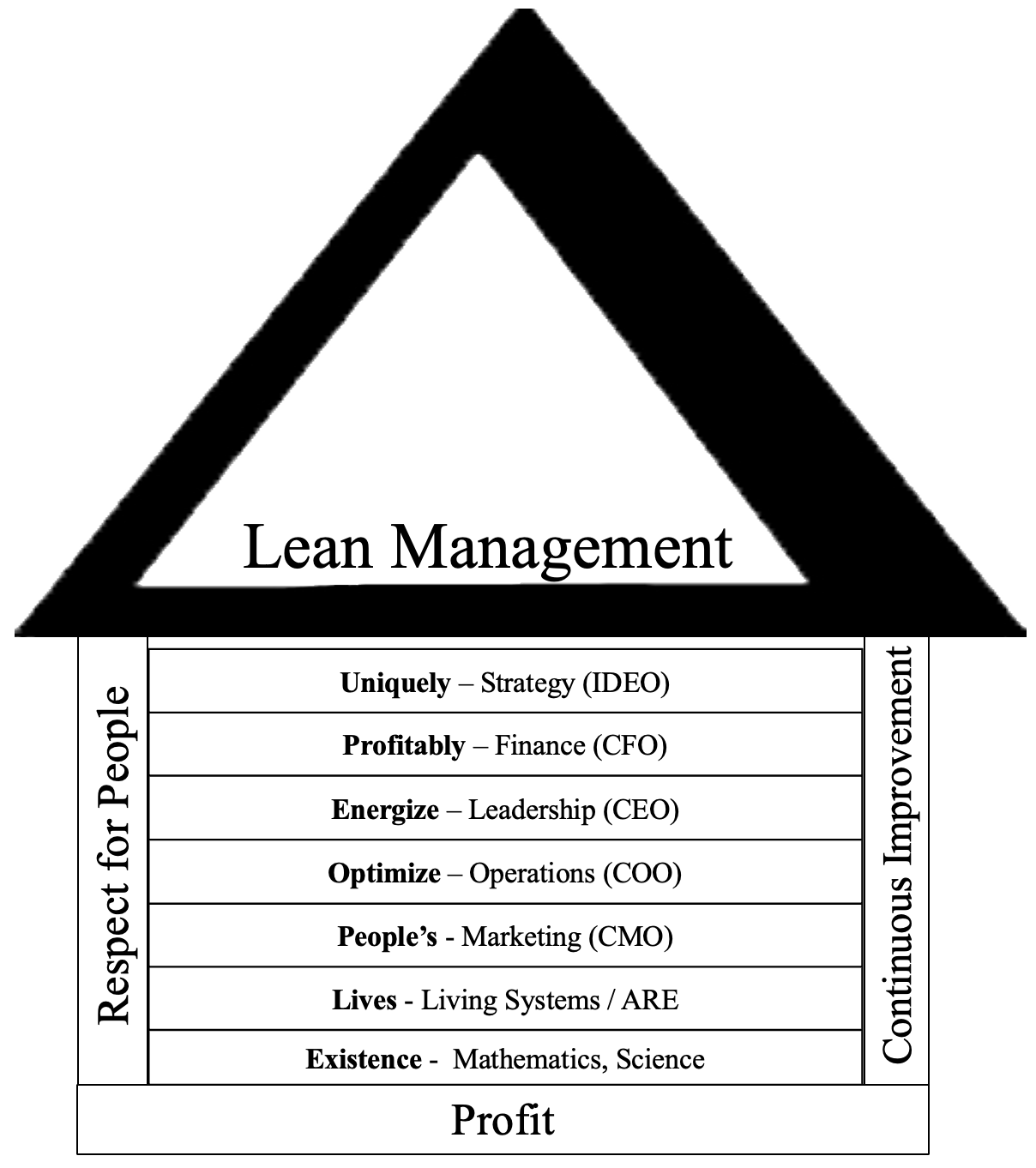
Since this process of Genchi Genbutsu takes you to the penultimate question of why customers’ deepest problems exist, it explains all that they fundamentally value, find most meaningful, will consume and pay for. Thus, following Genchi Genbutsu to the Gemba universally leads you to the edge what causes all consumption. When you reach the first degree of causation, you then have found the cement on which the foundation of a HQ may lean.1 The causation of consumption and existence is the first brick from which you will build an understanding of the major philosophical, scientific, scientismic, theological and intuitive perspectives. By understanding these perspectives you will construct a well of knowledge from which all consumers’ value streams will spring.2
As stated before, the metaphysics of Lean provides you with the clearest perspective on existing knowledge to reach the greatest profits. I want you to deduce the causal link between who consumers are at their existential limits and what you ought to reproduce for them so that you will make more money.3 When people seek rational answers to these amazing questions, they usually go too far down an intellectual path to communicate back in any sort of concise way, but I anxiously hope to do exactly that here on this side of nonsense.4
Existence and Ontology Defined
Let’s start with a formal definition of “Existence.” The Oxford English Dictionary defines “Existence” as:5
Existence, n. /ɛɡˈzɪstəns/
1. Actuality, reality.
b. Continued being; continuance in being.
2. a. Being; the fact or state of existing; ‘actual possession of being’. in existence: as predicate = ‘extant’.
c. Continuance of being as a living creature; life.
3. A mode or kind of existing
b. Something that exists; a being, an entity.
4. a. All that exists; the aggregate of being.
“Ontology,” however, is the philosophical, scientific and business term for “Existence” and the nature of being. The Oxford English Dictionary uses the word “Existence” to define “Ontology” as:6
Ontology, n. /ɑnˈtɑlədʒi/
1. a. The science or study of being; that branch of metaphysics concerned with the nature or essence of being or existence.
The Leanism lexicon leans on the term “Ontology” a great deal as a technical reference, so please get used to reading it164] To emphasize how important "Ontology" is to Leanism and estimating true-north value in the *Gemba*, you could write ontology with a circumflex pronunciation accent "” over the letter oh, which is officially pronounced with the short oh sound of “ah,” like “ôccupation,” “ôntologically,” or “paôs.” As you may recall, the formal Lean symbol “Ô” also stands for the Japanese term, Hōshin Kanri, meaning, “Compass Guided Management,” representing the direction of all true-north value.7
Thus, understanding normative value through consumers’ ontologies allows you to:
- Intuit, infer or induce universal assumptions with some degrees of confidence as to why something matters most to consumers; and
- Deductively measure how you create true-north value for consumers necessarily committed to a shared ontology by living together within the open-ended universe.
You could likewise carry this circumflex “^” accent over the letter oh to other, related concepts within Leanism, like “ôptimization.” However meaningfully symbolic it may be, I will hold back my use of the circumflex for the sake of legibility.
Many non-philosophical disciplines use the term ontology as well to describe everything from gene expression in biology8 to process ontology in computer science engineering to business models in business.9 Informatively for developing a higher order ontology for your Lean business ideology and metaphysics, the noted Stanford computer scientist Tom Gruber10 who co-created Siri on the iPhone defines ontology in the software context as:
… an explicit specification of a conceptualization. The term [ontology] is borrowed from philosophy, where an Ontology is a systematic account of Existence. For AI [Artificial Intelligence] systems, what exists is that which can be represented… We use common ontologies to describe ontological commitments for a set of agents so that they can communicate about a domain of discourse without necessarily operating on a globally shared theory. We say that an agent commits to an ontology if its observable actions are consistent with the definitions in the ontology.
Tom Gruber, in this quote above says that agents, like consumers, commit to an ontology if the agents (think consumers) act consistent with their own shared ontologies. At the foundational level of the Gemba, are consumers’ observable actions consistent with their shared ontologies by living together within the universe? If so, just like for Paul Samuelson’s Revealed Preference Theory, this definition of ontological commitment is tautologically circular because it means that consumers commit to who, why, what and how they think they are by sharing a common Gemba, a common world, and a common universe - a common ontological medium - by sharing it with all other living, biological systems, and thereby defining their essential natures through their existential actions in common with all others to simply, further be, without any further, external reference.
Beyond an ontology being a simple set of rules reflexively committing consumers to certain actions in support of themselves within the Gemba and the global marketplace, some computer science ontologies define themselves by dynamically and self-reflexively optimizing a given set of information through algorithms, like nearly all those used for artificial intelligence. These ontologies reflect what they model by fitting their results to data. These ontological optimization algorithms best fit data being analyzed to what is Ontologically Realized, and to what becomes revealed as the rules to which the search agents (think consumers or AIs) commit. Such computer ontologies invoke so called genetic algorithms, evolution strategies, evolutionary programming, simulated annealing (from the metalworking context), Gaussian (statistical) adaptation, hill climbing, and swarm intelligence (e.g. ant colony and particle swarm optimization)… each metaphorically alluding to a job to be done that enhances consumers’ biological or economic fitness to better live and exist.
This computer science definition of ontology conforms with everyday economics by describing the common basis by which consumers agree with what they all value in Lean terms, like two people agreeing that a popular product fits their definition of being good. If a product fits the classification of “good” for both people, it must have been perceived as valuable for both people in circular fashion. Since what people perceive as valuable determines who and why they are, the good product defined those customers’ ontologies by furthering who and why they are when they consumed it, just like Tom Gruber saying about agents (again, think consumers) in a software context that, “… an agent commits to an ontology if its observable actions are consistent with the definitions in the ontology.”
Businesses’ inner cores are their ontologies as defined by their business models, or that which ultimately reproduces Lean value for their customers. Since businesses’ commit to those ontologies that realize true-north value for their customers, customers’ Lean values consequentially determine businesses’ own ontologies up along the value stream. Businesses best fit themselves around what their customers want and need to be and become more of who and why they are. Businesses thus act just like how consumers decide what they want and need – consumers’ and businesses’ ontologies become symbiotic and converge by reciprocal definition within the ultimate Gemba.
The Ontological Realization and origin of you, consumers and organizational HQs is that which is, Critical to Ontological Realization (i.e. what is “CORE”). Understanding what is CORE to consumers helps you improve who and why they and organizations are.11 Optimizing profits by enhancing consumers’ lives and existences in-turn improves organizations’ own viability. Such analysis enhances everyone’s ability to ask correct and beautiful questions, measure specific benefits, and optimize an organization’s activity to increase the probability of profiting within any given meta, micro, meso and macro-economic constraints that a Lean corporation faces. Doing so though requires you to go down into the well of all knowledge and come back up, which is no easy task.
Tripartite Perspectives on Existence - Universal, Process and Personal truth-values
To understand consumers’ essence so you may capture the largest portion of their mindshare and wallets, you must expand your own imagination as far as it will go, inducing it to the point of complete abstraction, and then aligning that metaphysical perspective with consumers’ actual existence. From a complete abstraction of consumers’ pure existence, you can then sub-divide consumers’ minds (and the universe itself) into categories and perspectives. There are (generally) three truth-value perspectives of existence, which are: (1) the ideal or “Universal” truth-value perspectives; (2) the outside-in or “Process” truth-value perspectives; and (3) the inside-out or “Personal” truth-value perspectives. I define each of these perspectives on existence here for you to begin building a House of Quality within your Lean business ideology to fully divine who and why consumers truly are for a profit:12
(1) Universal Perspective: The Universal perspective relates roughly to Platonism, idealism or epistemic rationalism. In a modern context, universal truth-value means the perspective of predictable, inviolable concepts such as mathematical and physical axioms that have no proven space or time dependencies.13 The universal perspective also includes certain physical concepts that are predictably unpredictable, like certain aspects of quantum physics – universals simply must have predictive consistency (even if predictably unpredictable) across all dimensions to the nth degree. Their interaction results in consumers’ ultimate physical manifestation. The universal perspective is notable for being unreasonably effective at explaining natural law14 and conforms with the notion that all existence ultimately equates with mathematical coherence.15 Specific examples of universal concepts include prime numbers and the speed of light.16 The universal perspective is the fundamental, immutable structure of the universe that all process true-north values use forward and backward as their common denominator and ultimate ontology.
(2) Process Perspective:17 The Process perspective relates to the perspective that all events sequentially occur in spacetime regardless of whatever consumers may personally believe. If you look out toward the event horizon of spacetime, along the way toward resolving all problems, everything you think of as a person or object eventually becomes a process due to the continual, cosmic dispersion of matter and energy. Thus, the process perspective explains how consumers came to be and how they eventually fade away over time in contrast to the universal mathematical and scientific laws that always seem to have existed since the start of and possibly before the universe came to be.18
The process perspective says that in the ultimate long-run at universal scale, consumers and all things may simply be perceived as a set of temporal relationships always changing at some point in time if you set your horizon out far enough. For example, if you were to dramatically speed up time from your own perspective, you would eventually see mountains change, oceans run dry and the greatest corporations dissolve. For evidence of this creative destruction, the average time for a company to remain on the S&P 500 narrowed from 61 years in 1958 to 25 years in 1980, and 18 years in 2012. From 1955 to 2014, 89% of all Fortune 500 companies were either dissolved or acquired during that time. And 75% of the S&P 500 is expected to be replaced by 2027.19
As another example of long-term processes reaching forward into current events, consider how the process of natural selection led to consumers now considering purchasing product in stores today. The process perspective includes all events occurring from the inception of the physical universe immediately following the creation of natural laws. It specifically includes everything that eventually happened to cause consumers’ subjective, individual beliefs to arise within them today. Thus, processes dynamically originate from the chaotic interaction of universal laws, and end at the point of intuitive, speculative belief.
The process perspective thus also inserts itself into discussions such as in mind-body distinctions, with some arguing that consumers’ minds operate as physical processes reproducing self-awareness,20 and some arguing that consumers’ consciousness is something sitting beyond the physical universe and is only knowable as a personal truth. To this end, Universal and Process true-north values constitute normatively true economic value supporting what consumers really personally value and who they consider themselves to be regardless of where their consciousness originates. From this physical perspective, Process true-north values may be thought of as instrumental rationality, or what consumers consequentially aim to achieve up along the crooked arrow of time.
(3) Personal Perspective:21 The Personal perspective is how consumers, employees, and collectively businesses, find themselves at some point in spacetime within universal processes regardless of how they believe they may have been created.22 Personal true-north value describes the point at which people very personally became aware of their wants, needs and ability to consume in a real and immediate sense. Thus, their Personal perspectives also relate to Descartes’ famous phrase, “I think therefore I am,” that he used to distinguish himself within his profession.
Consumers’ Personal perspectives are the cumulative outcome and function of universal laws and their resulting processes leading to individual intent.23 So, while the Universal and Process perspectives apply to everything that exists, consumers’ emotional, Personal perspectives are only applicable to them as self-reflexive, sensing people who decide to buy product at points of purchase. For example, their very first shopping experiences reflected Personal true-north value as a self-aware intent to further their universal and systemic existences.
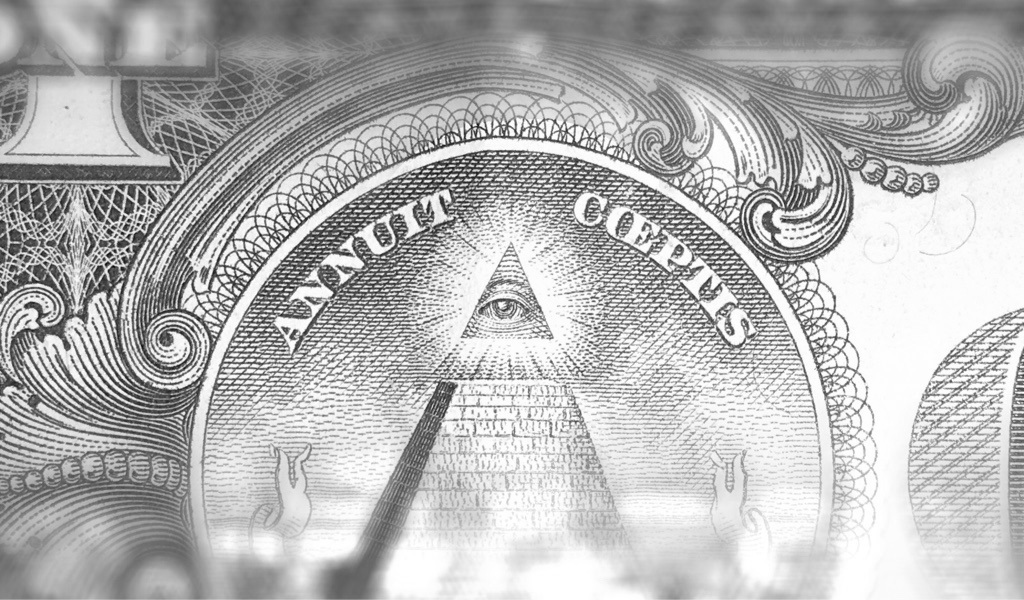
Consumers’ personal perspectives are the same as the one you have right now as you read these words and personally consume this book. Consumers’ personal perspectives provide a consistent version of themselves through time and space that is much the same as when you started reading today. Think of consumers’ personal perspectives like a video camera sitting on their foreheads that they turned on to record all that passed by during their lives from the time they became self-aware until now. Consider this perspective as being like the all-seeing, “Eye of Providence,” on the United States one dollar bill, or an omniscient ID Kata having a singular, personal focus:
However, while a person may privately consider certain beliefs held from within his or her own Personal perspective to be truly Universal, society as a whole may not be convinced to the same degree. Thus, a person’s beliefs held from within h/er Personal perspective are only universalized to the extent h/er society, environment and/or political system agree, but people are otherwise unlimited when professing their beliefs within their own imaginations.
You, the Plane and the Lottery – On UPP as a Universal, Process, Person
Einstein’s Specific Law of Relativity serves well as a literal and figurative analogy illustrating the differences between the Universal, Process and Personal perspectives to better understand Lean true-north value and existence itself. To illustrate, presume you take an overnight flight on a private, customized business jet like the Embraer Legacy 1000E shown below. Imagine that you board this plane, and given your wealth, you have had the sleep cabin decorated exactly like your bedroom at your home. While your plane flies around the world, you go to sleep in the private jet’s bedroom. Other than very minor turbulence in the jetstream, you hardly know the difference between the bedroom on the plane and the one at your home. You can even reach over and grab a cup of water while the airplane is flying and comfortably take a sip before going to sleep and drifting off to other worlds.

Albert Einstein explained long ago that no practical difference exists between being in bed at your home and sleeping on the jet while it is travelling at a constant speed and direction. The laws of physics are the same from every philosophical perspective.24 Thus, from outside the airplane, you are engaged in the process of flying through the air at high altitude supported by universal axioms and processual systems, but from inside of the plane, your personal, intuitive self would be the same as if you were on the ground in your bedroom at home. You wouldn’t know the difference unless you looked out the window at whatever went past down below as you flew by.
Andrew Wyeth’s painting “Otherworld” (2002) comes to mind when I think about this concept, which depicts a women riding in a plane and looking out the window at scenes outside her immediate existence. Just like the woman sitting inside the plane in that painting, from consumers’ personal, subjective perspectives, they are largely the same people with their same names held in a constantly present state of consciousness as their internal processes turn over, passing them by while supporting who they are. In an airplane, consumers will arrive as themselves at a new location even though they changed slightly during the trip. Consumers will similarly, self-reflexively identify themselves every new day they wake up by the same, universal name, even though who their persona is slightly changed from time to time.
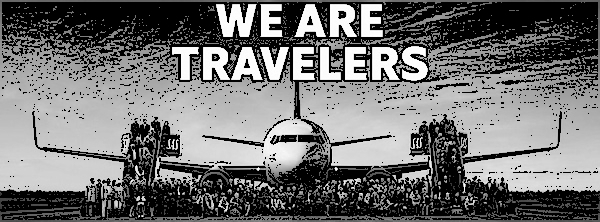
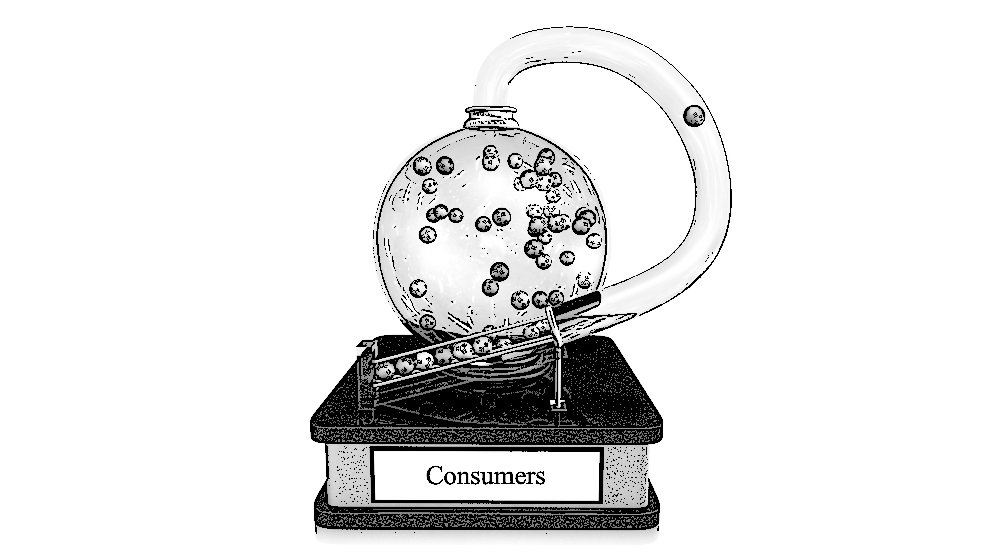
Analogously, from a doctor’s perspective, consumers’ bodies are like airplanes flying around the Earth. Customers’ bodies are a collection of processual systems constantly changing through time while who they are inside goes along for the ride. Another good analogy to the interrelation of the universal, process and personal perspectives is that of a lottery machine produced by eGameSolutions Inc., a Global Lottery Provider™. eGames’s lotto machine produces winners by randomly spinning, timeless, universal numbers around a wheel for a definite amount of time until its operator releases the numbers upward from the machine. The lottery machine randomly extracts those numbers from the spinning process at a specific point in time. Consumers compare those numbers to the ones that came out of a lotto machine at the point of purchasing a lottery ticket that people bought for a chance at a new life. Further back in time, you can analogize this lottery machine to those same lotto customers spinning out of the womb, looking back out at the apparent apparatus from which they were conceived, with the chance of becoming winners. Like the lottery machine, you can simultaneously conceive of consumers from the universal, process, and personal perspectives. While we may know that eGames created this lottery machine, do not ask who created the one that ultimately produced who all we consumers are!
You know that from a universal perspective that the world is composed of physical and mathematical laws. Once created, those physical and mathematical laws led to the universe as you know it, and the relations between those universal laws created the bedrock of processes that you think of in-part as time. Over a very long period of time, these processes led to consumers’ personal perspectives within the universe. To the best of science’s understanding, the length of time that passed from the creation of universal laws through natural processes to create consumers’ personal perspectives occurred over many billions of years – over amounts of time that are hard for our minds to consider fully. Look below at this 24 hour clock of Earth’s development located within the Museum of Natural History in New York City. In this clock, humans arose at the top 40,000 years ago, which corresponds to a fraction of a second before midnight:
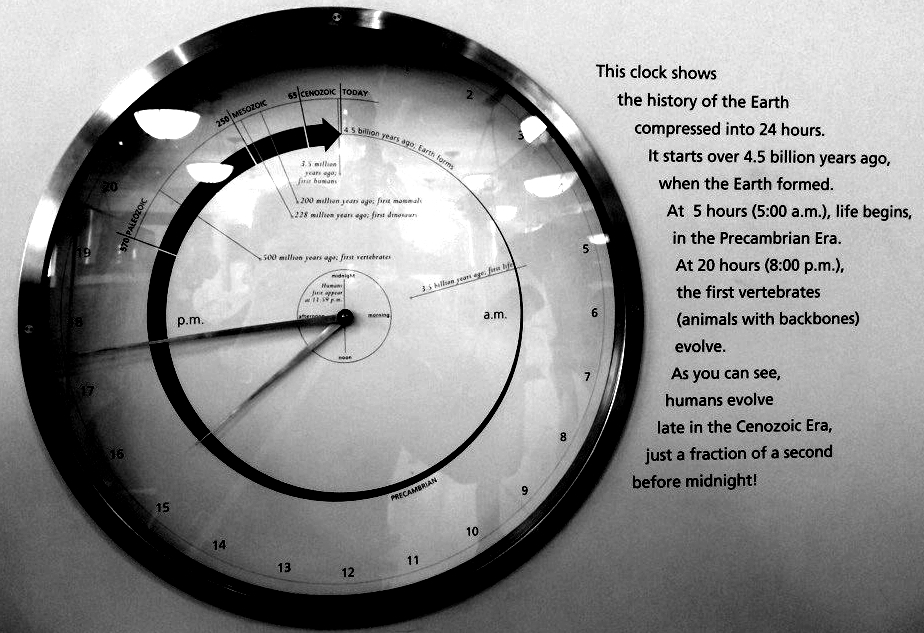
This clock represents well the tension between the teleological (i.e., purposefully goal directed) and seemingly tautological (i.e., unintentionally, logically circular) nature of existence in the Gemba depending on whether the universe is finite or infinite in time and space. To illustrate the tension in these concepts, even this figurative clock unintentionally, yet correctly, tells you what time it is once a day.
You can also see consumers’ subjective existences within this clock from their personal perspectives, from who they think they are, as a result of pre-existing processes such as their mother’s pregnancies and labor. Thus, at business scale, you can also measure the interactions between physical and mathematical axioms that create product along the assembly line of universal existence to enhance consumers’ living processes and personal perspectives. Consumers’ personal perspectives depend on those processes that in-turn depend on physical and mathematical axioms that further depend on a universal cause that people do not yet commonly agree on, even after asking more than five whys. An ultimate cause may or may not exist, or may exist in some way people do not universally agree on due to lack of predictably experiential evidence, but in the meantime you may go onward and upward regardless and as if there were.25 To summarize, here is a chart of these levels of dependent existence as gradations of true-north value perspectives:

Three Lean Truth Types Aligned with Universal, Process and Personal True-North Value Perspectives
These are the three broad and overlapping, but ultimately dependent, categories of true-north value that align with the Lean value you must uncover as you pursue a profit:26
(1) Axiomatic truth-values27: Axiomatic true-north values are those truth-value propositions from the universal perspective that we have every reason to believe are uniform in nature and based on the seemingly timeless, universal axioms of science and math, like the speed of light and prime numbers, from which you deduce further true-north values. Axiomatic validity is generally assumed due to its coherence and predictability with at least five sigmas (≥5σ) of confidence or ≥ 99.9999426697%. For example, particle physicists generally consider a discovery to be an axiomatic truth if it can frequently be verified within five sigmas (5σ) of confidence.28 The four axiomatic physical forces physicists agree on right now with five sigmas (5σ) of confidence are the electromagnetic, gravitational, and strong and weak atomic forces.29 Axiomatic truth-values qualify as facts for physicists by their very definition as universal, intersubjective truths, and are a sound basis for understanding customers’ physical ontologies. For comparison, a standard of six sigmas (6σ) of confidence, or ≥99.9999998027% of intersubjective agreement, represents the pragmatic idealism we pursue beyond five sigmas (5σ), while an infinite sigma (/σ∞) of confidence can only be hypothetical yet pursued nonetheless in our unending attempt to attain perfection;
(2) Systemic truth-values:30 Systemic true-north values are those truth-value propositions arising from causal, process perspectives within science that you have reason to believe cannot be axiomatically defined. Systemic validity is based on something’s general coherence on an empirical, best fit basis with universal axioms.31 Like axiomatic truths, systemic truth-values also increase their validity in proportion to the number of fully informed people that agree with them and the general failure of our attempts to falsify them. Systemic truths differ from axiomatic truths in that systemic truths are valid due to their general, but not unwavering, coherence with reality, rather than being experienced as axiomatically self-evident.32 Qualitatively, you might also describe systemic truths as being nearly universal, intersubjective truths.
Something may qualify as most likely a fact and systemic truth-value if it leans toward two or more sigmas (/≥2σ) of confidence, or ≥ 95.4499736% of intersubjective agreement among all fully informed people. Under this standard, people would describe the systemic truth as common sense if fully informed of its details. However again, since you can only hypothetically assume that people will be fully informed of all knowledge in the real world, including people’s own biases that affect their understanding, you ought to look for a higher standard of measurement before considering something to be a systemic truth and common sense.
While you ideally want to measure all fully informed people, you may have to rely on the opinions of a consortia of experts to determine systemic truths because fully-informed people simply do not exist. A couple of examples of this form of support include the process of peer-reviewing academic papers, and the associations of journalists who increasingly certify public truths as not being fake news. However, reliance on experts and authority figures can compound those people’s interpersonal subjectivity rather than clarifying what is systemic, true-north value based on the impressions of all people.33 Unfortunately, there is no clear way out of this conundrum, which is why we must view systemic true-north value from different perspectives. So, anything goes when trying to assess systemic truths, so long as you test whether a Lean business process leads customers to a purchase for which you charge them in return.
(3) Intuitive truth-values: Intuitive true-north values are those truth-value propositions arising from consumers’ personal perspectives that they speculate and lean toward based on their scientismic, spiritual and/or theological intuitions with less than two sigmas (<2σ) of confidence, or < 95% of common agreement among all fully informed people. Consumers’ intuition may be called anything from “emotion” to “faith.”34 Strictly personal intuitive truths are those that are truly speculative, for which no known processual or universal truths provide validation up to and beyond a single sigma (≤σ) of confidence, or <68.2689492% of common agreement among well informed people, and yet consumers nonetheless feel are true to an infinite degree. To be clear, intuitive truths are not consumers’ psychological intuitions that they can confirm or deny with known universal or processual truths if they had access to the universe of knowledge. Rather, intuitive truths are limited truths for which greater than two sigmas (>2σ) of informed people have not been convinced that they are not false (i.e. those for which not enough well qualified and experienced people have been convinced to the necessary degree).35 Intuitive truths may be intersubjective assuming more than one person believes the intuitive truth. Examples of intersubjective, intuitive truths include political opinions or a religious faith that requires no degrees of confidence, both of which can still be considered true even if only a single person believes them to be true.36
Like consumers’ perspectives, each of these three truth-value types are arranged in the relational order of supervening dependency, with systemic truth-values and resulting processes dependent on the validity of axiomatic truth-values or “universals.” Intuitive truth-values depend on both axiomatic and systemic truth-values that provide the ontological medium of the Gemba in which people work, and of the universe within which consumers intuitively speculate and purchase.
Keep in mind though that the logical dependency of intuitive truths becomes circular to who consumers are. Once consumers’ intuitive truths lead them to dogmatically believe both what they find personally valuable and what are universal true-north values, like those that may be espoused by a deity or demagogue, consumers then believe in a co-dependency between intuitive, systemic and axiomatic truths arising in their minds’ eyes.
Thus, speculative belief can act like an intuitive tail wagging an axiomatic dog. Problems arise when an intuitive tail fails to lead axiomatic and systemic dogs (or consumers) to food, safety and shelter. In other words, while we cannot directly access Universal and Process truth-values, they ultimately check all consumers’ intuitive speculation since we must follow the true-north values of Leanism where they lead. True-north values thereby stop consumers’ intuitive tails from wagging their axiomatic and systemic dogs, as is only common sense.37 Cults of personality can exemplify this with intuitive speculation, such as when a cult’s charismatic leader espouses axiomatic or systemic dogmas that lead people nowhere. And yet, it is the intuitive truths that people repeatedly pursue in the search for some universal meaning.
While keeping this interplay between these forms of true-north value in mind, these truth types are arranged below in descending order of commonly agreed validity, much as the three perspectives on existence were in the preceding chart in this Value Stream.38

To provide a scientific example of an assertion that is currently being reclassified in some degree from an intuitive, scientismic truth to a systemic, processually scientific truth, and maybe even a universal, axiomatic truth, look to the research for the Higgs Boson or the “God Particle.” The CERN (Conseil Européen pour la Recherche Nucléaire) laboratory in Switzerland has been searching for the presence of the Higgs Boson particle whose existence would help complete the standard physical model that is now agreed on as being at least a processual true-north value within the scientific community.
The Higgs Boson was predicted based on this standard physical model but had not yet been actually experienced by scientists through their instruments. Experiments at the CERN laboratory in-fact reproduced results demonstrating the Higgs Boson leans within at least five sigmas (≥/5σ) of certainty, thereby affirming the Higgs Boson’s existence as a systemic truth. Due to the explanatory power of Higgs Boson and its coherence with the Standard Model of natural laws, this test set the stage for revalidating the existence of the Higgs Boson over time so the God Particle itself might become an axiomatic true-north value like gravity pulling water downstream.39
An example of another intuitive, scientismic truth-value that people are working to convert into at least a systemically processual, scientific true-north value is the stipulation that the universe was created in the Big Bang. Scientists describe the Big Bang as a processual system initiated by cosmic inflation, whereby the universe rapidly expanded from a single point outward over about 14 billion years to what you experience today. In an attempt to make the Big Bang theory a processually systemic truth-value, scientists have been studying whether cosmic inflation created ripples like waves in an ocean in the outer reaches of spacetime by observing the Big Bang’s effect. The scientific validation of the processual truth of these ripples in spacetime is very much in flux at the moment, 40 but some scientists intuitively believe that they exist with increasingly systemic predictability. Scientists personally believe they can empirically validate the process of the Big Bang that eventually produced consumers’ personal existences from this one dimension in the past.
As you might expect, something falling into more than one of these truth-value classifications increases its validity as a Lean true-north value. For example, consumers can say that axiomatic truth-values, such as mathematical proofs, reside supreme and unassailable. On the other hand, all three truth-value categories ontologically realize themselves by what consumers actually experience. Critically, a thing or process falling within all three truth-value types would be the most valid of all since such a thing or process would be the most completely Ontologically Realized by consumers.41 In fact, the only thing fully falling into all three truth types is who consumers are in their totality at personal, process, and scientific levels. Consumers evidence all three truth types, and this allows a House of Quality to lean philosophically toward these three truth-value types in the products it produces for them. That product creates the true-north value and meaning of the money customers give to exchange who they were for something at least ten times better.
While consumers’ lives, existences and buying experiences are temporal processes, from consumers’ personal perspectives, the only time they personally know is the time they have been actually alive, such as when they began shopping. However, consumers only presume that time itself existed before they were born, and will continue after they die. For all consumers know, they became consciously aware at some point and believe they will die because they witness all others doing so over the course of their lives and histories. Consumers feel themselves getting older, but they do not otherwise know for sure that they will die other than by defining their ontologies as being mortal based on all of the evidence they received during their lifetimes.42 Thus, because all consumers experience this evidence directly, they have great confidence that they are the result of natural and biologically processual systems that terminate at some point within the OM due to old age, and that they will eventually become not alive because they witness others doing so unless they interrupt that process in some currently inconceivable way.
Similar to how they view their own mortality, consumers speculate whether or not the physical universe itself was self-causing or caused by something else. Consumers’ speculation though is neither an axiomatic nor a systemic truth-value, unlike consumers’ biological processes, due to insufficient certainty and agreement across the right people. Thus, consumers’ personally intuitive consciousness remains the most valid truth to them, the surest thing they know, since it represents all three types of true-north value. This is why Rene Descartes’ statement, “I think therefore I am,” has held such philosophical, and subsequently scientific, energy for so long due to its true-north validity from the Universal, Process and Personal (UPP) perspectives. Descartes could have also used UPP in his day to pursue objective knowledge with varying degrees of certainty.
The balance of Leanism leverages these true-north value perspectives by focusing on what consumers can commonly lean toward with at least two sigmas (≥2σ) of processually systemic truth-value, while recognizing the validity of leaning toward personally intuitive true-north values with less confidence (<2σ). You must bracket and recognize these Lean, personally intuitive truth-values that have no axiomatic or systemic truth-value validity so you can most accurately identify why, what and how consumers will purchase from you based on who they fundamentally are within the common ontological medium of the universe.
To consolidate these matters in a Lean business ideology, you can correlate the forms of truth-value we described, UPP perspectives, degrees of explanation, and the methods of analysis in a single chart:
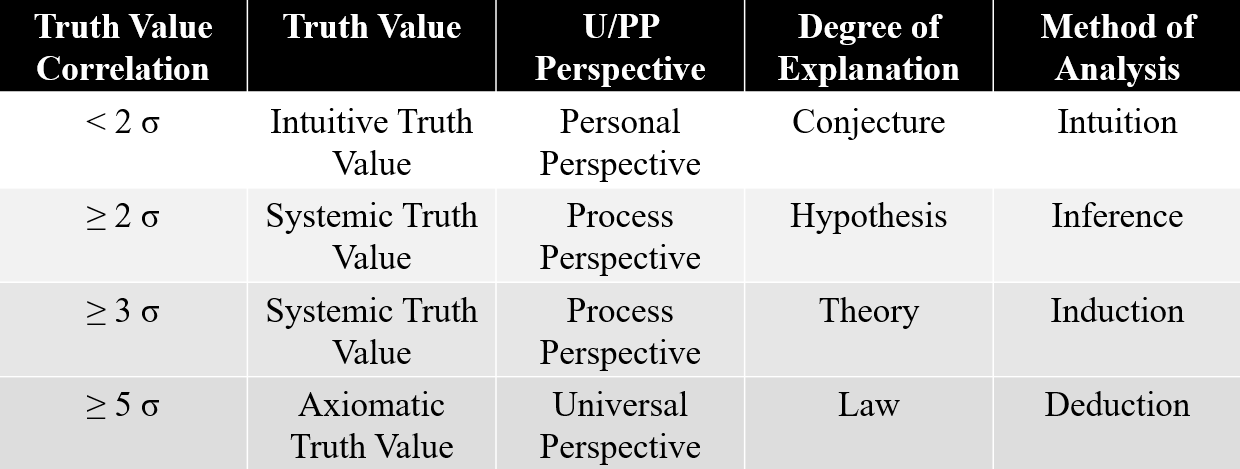
Consumers’ commonly-shared lives and existences ontologically depend on pragmatic, best-fit, systemic truths relying in-turn on axiomatic truths, and yet consumers are fundamentally motivated by their intuitive truths that create seemingly non-circular end-goals for them to be more than they are. This intuitive boundary outside processual and universal true-north values leaves room for personally intuitive speculation about what is not commonly agreed, or what consumers personally feel is best regardless of any common agreement among all people. When consumers intuitively speculate, they have faith that what they live for is better than what they know is certainly not.
The only condition for businesses to accommodate consumers’ intuitive beliefs is that those beliefs must not interfere with certain processually systemic and universally axiomatic truth-values generally agreed by others. That is true unless consumers willingly agree on who may be considered fully informed and convince those people to lean toward that truth with at least two sigmas (/≥2σ) of common agreement that their intuitive truths qualify as processually systemic or universally axiomatic truths to an amazing degree. Consumers ought not impose their personal beliefs on others unless they meet this standard.43 Moving an opinion from being a personal truth to a process or universal truth is one of convincing others that no better explanation or product can be found, which is the burden of proof an organization must carry when creating a new product category.
While businesses do not have perfect insight into all that influences what consumers decide to purchase, for the most part, you can intuit, infer and/or induce consumers’ Universal, Process and Personal values (i.e. their ontologies), by observing their behaviors and preferences that they reveal to you. As suggested by Samuelson, once you have ascertained consumers’ UPP values from their stated beliefs or behavioral data, you can compare those values against the ones you know with various degrees of certainty. You may then conjecture, hypothesize, theorize (or even lobby to legislate) those universal truths that are in-line with those believed by customers to achieve righteous business results from the satiating product you sell.
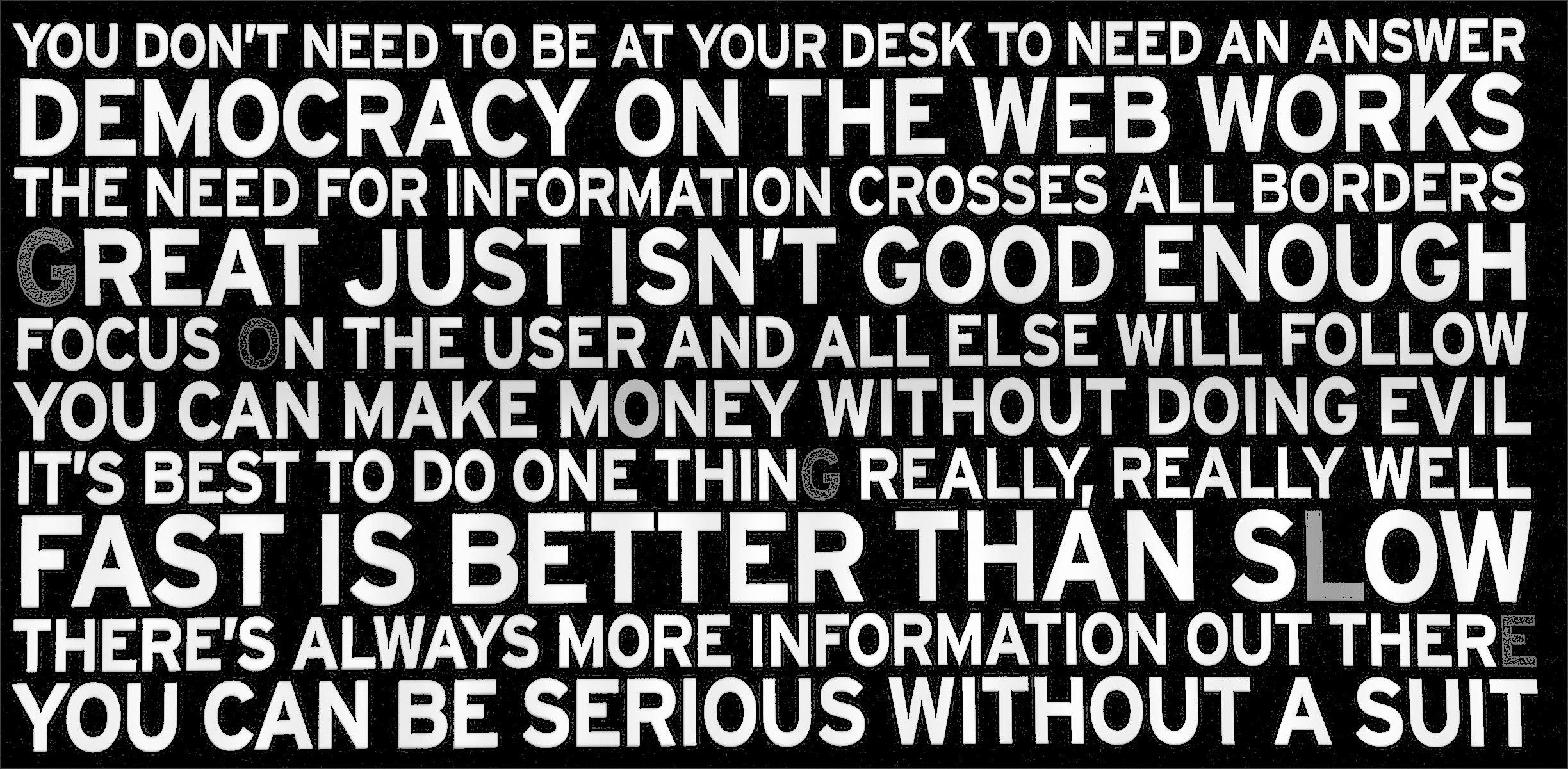
For example, suppose you want to sell product to Google, Inc. as a corporate consumer. Like a hermeneutic interpretation of the Ten Commandments, analyze what Google Inc. intuited, inferred, induced and deduced is good based on its stated business ideology, ontology and corporate philosophy of, “Ten Things We Know to Be True.” Consider whether you also intuit, infer and/or induce what Google believes are its Universal, Process and Personal true-north values from these statements. Determine whether Google’s corporate behavior deductively reflects these stated true-north value beliefs as its ontology, which you can see Google has written below as its own commandments.
Google Inc.’s 10 truth-values44
- You don’t need to be at your desk to need an answer.
- Democracy on the web works.
- The need for information crosses all borders.
- Great just isn’t good enough.
- Focus On the user and all else will follow.
- You can make mOney without doing evil.
- It’s best to do one thinG really, really well.
- Fast is better than sLow.
- There’s always more information out therE.
- You can be serious without a suit.
Reason, Causation or Nothing
Intuiting, inferring, inducing and deducing human or corporate ontologies to create true north value within the philosophy of Lean requires that you ground an ideology on a presumption of universal reason, and its necessary corollary, causation. Causation itself is a form of formal Lean “Root Cause Analysis” (RCA)45 that originates from an ancient philosophical concept called the “Principle of Sufficient Reason” (PSR). Both RCA and the PSR may also be thought of as an, “Axiom of Causation,” that assumes every reason or cause must have a prior one, back to the start of existence itself. This PSR and Axiom of Causation is the basis for the Lean process of RCA and asking five “Whys” through the Lean process of Genchi Genbutsu.
The PSR, Axiom of Causation, RCA and the “5 Whys” posit that for every fact, there must be an explanation as to why that fact is.46 The PSR most particularly holds that each action resulted from a prior cause down to an ultimate self-causing cause (a Sui Generis in Latin).47 In the PSR, causation is an assumed abstraction of the relations between every series of events. Thus, the PSR underpins most classic explanations for existence, and yet this theory has the earlier stated limitation of not yet being proven as either a processual or axiomatic truth-value itself.48 To date, people have found no common agreement as to even a processual self-causing cause, much less an axiomatic truth, explaining the origin of the universe. Thus, consumers, whether scientist, atheist, theologian or organization, can only intuitively believe in the PSR at a universal scale even if they might only employ RCA and the 5 Whys in a far more limited capacity within their business environments.49
Like the PSR, formal “Lean Thinking” uses the Axiom of Causation in the form of RCA and the 5 Whys to find the root cause of any given business problem by simply asking why five times, which hopefully is enough. However, the conversations within an HQ will benefit from moving beyond a mere five whys toward analyzing who consumers are through an infinite number of whys until a House of Quality is ultimately bounded by infinities, paradoxes and tautologies.50 A Lean business ideology ought to lead you to the edge of axiomatic and systemic explanations of the universe, to the bare existence of an empty, infinite set at the conceptual inception of something rather than nothing at all.
Finally, an empty, infinite set is the last thing consumers ought to consider before moving past reason, beyond spacetime itself to something other-than-reason.51 Since a business ideology cannot now axiomatically or systemically say whatever is beyond reason as its inverse, neither consumers nor organizations can axiomatically or systemically know how many “whys” will reach what is certainly not here without intuitively speculating.52
Reason as Causation from Aristotle’s Perspective, with Modification
In the Western/Occidental tradition, you can trace one of the first definitions of pure reason at the boundary of what may be considered rational to Aristotle’s “Four Causes,” which are the “Formal,” “Material,” “Efficient” and “Final” ones. Like Blank’s, “Four Steps to the Epiphany,” Aristotle’s “Four Causes” may be roughly conceptualized and related to Lean philosophical thinking as follows:
- Formal ontological causes explain the shape of how consumers and product came to be. Since formal causes generally don’t make sense in the scientific age, in the philosophy of Lean, I somewhat modify the formal cause to be what I consider a self-defining ontological one encapsulating all that consumers, organizations and product are, including all consumers’ personal speculation, emotions, and dreams arising as a course of their personal perspectives. The formal cause simply is as it is because it is in circular fashion; 54
- Material physical causes define what physical processes led to consumers’ and products’ existence as a subset of the formal, ontological causes. The material cause roughly aligns with modern scientific explanations of how natural law emerged through axiomatic and systemic truth-values. Thus, the material cause relates to how organizations actually produce product for customers;
- Efficient first causes generally equate with the very first, initial cause whether material or not that initiated existence through the Axiom of Causation and eventually led to who consumers are, what they experience, and how organizations produce product for them; and
- Final teleological causes explain the end-goal/factor/motives of the universe and why the efficient cause created consumers and product at all. The final cause is also synonymous with the teleological cause, the end purpose of all learning, which is a combination of the Greek τέλος, telos (root: τελε-, end, purpose) and -λογία, logia (a branch of learning).55
In this post-post-modern world, these formally ontological, materially physical, efficiently first and finally teleological causes may seem logically circular or tautological in that they lack unification or an axiomatic origin without another extended self-causing cause standing outside of known axiomatic and systemic truths. Nonetheless, consumers cannot help but experience their generally consistent personal perspectives as the synthesis of all these causes combined into their present state of who they identify themselves as being. Meaning emerges for them through this constant, simultaneous tension between the apparent tautological causation of the universe and consumers’ assumed teleology based on their intuitive beliefs.
Not coincidentally, the religious philosophy of Buddhism widely adopted in Japan where Lean thinking developed into a holistic business philosophy, describes an apparent causal circularity for the universe through a concept called “pratītyasamutpāda,” which Buddhist monk Thich Nhat Hanh explains:56
Pratitya samutpada is sometimes called the teaching of cause and effect, but that can be misleading, because we usually think of cause and effect as separate entities, with cause always preceding effect, and one cause leading to one effect. According to the teaching of Interdependent Co-Arising, cause and effect co-arise (samutpada) and everything is a result of multiple causes and conditions… A cause must, at the same time, be an effect, and every effect must also be the cause of something else. Cause and effect inter-are. The idea of first and only cause, something that does not itself need a cause, cannot be applied.
Relating Aristotle’s Four Causes to Lean Levels of True-North Value
By seeing ultimate causation of consumers’ lives and existences as a possibly circular co-arising through pratītyasamutpāda for business purposes, you can effectively map all four of the Aristotelian causal explanations to consumers’ and organizations’ universally axiomatic, processually systemic and personally intuitive perspectives and truth-values as explained here:
(1) Universally Axiomatic: Aristotle’s four causes may be seen as universally, axiomatically explaining the origin of consumers’ existences in a logically self-defining sense not related to a cause outside of existence itself. Examples include axioms such as the Western Ontological Argument trying to prove God by the very definition of perfection, Eastern philosophical traditions like pratītyasamutpāda, and modern scientific notions of the universe spontaneously co-arising57 under the laws of quantum physics58 through such things as quantum fluctuations.
A universally axiomatic cause is generally based on the logic that nothing exists in the truest sense since nothing cannot be by its own definition.59 Even for efficient first and final teleological causes residing at the existential extremes of all spacetime, the basis of such causes may be seen to be axiomatically self-regenerating in this way. But, I would like to re-emphasize that no philosophical or scientific explanation for consumers’ ultimate existences today may be deemed axiomatic with predictive, universal certainty of infinite confidence (/σ∞). As stated, all people, whether theistic or not, must rely on systemically hypothetical and personally speculative explanations for their own existences and essences.
(2) Processually Systemic: Aristotle’s formal and material causes may be seen as providing processually systemic explanations for consumers’ and organizations’ existence, such that consumers’ and organizations’ existences arise due to natural processes. Consumers emerged from efficient or final causes arising systemically at the extremes of existence cohering with the overall system of the universe in which consumers exist. The Lean value stream of physical or logical processes extends to the boundaries of known causation, creating consumers from an intelligible, systemic reason that may or may not be tautologically self-defining.60 To be clear, no ultimate philosophical or scientific explanation for consumers’ existences today may be deemed a systemic truth such that it coheres sufficiently with people’s commonly shared, predictable experiences to lean toward at least two sigmas (/≥2σ) of confidence.
(3) Personally Intuitive: Aristotle’s efficient first and final causes may be seen like personally intuitive explanations for consumers’ existences when they lead to a spiritualism or theology standing outside consumers’ universally systemic and common experience. For example, consumers seeking Aristotle’s materially physical cause may lead them to a scientismic belief that science will ultimately determine the origin of existence. Like other personally intuitive truths, scientismic true-north values ultimately revert to self-defining speculation because they lack further support in universally axiomatic or processually systemic true-north values of their own, even if they seem intuitively true based on some limited evidence or belief in the consistent explanatory power of science.61 Or as Emerson Sparz, otherwise know as the “Internet Meme Meister” said:62
Rational Agnosticism- Existential Causation in the Eastern Traditions
However, both Western and Eastern perspectives are represented within the philosophy of Lean since Lean originated from a synthesis of both occidental and oriental cultures and concepts.63 In contrast to occidental philosophies’ explanations for existence, with the limited exception of the Buddhist principle of co-arising, oriental philosophies have generally considered questions as to the cause of the universe’s creation to be without purpose, instead choosing to be rationally agnostic. Instead, when they have attempted to discern the ultimate “why,” Eastern philosophies attempt to prove existence from the very fact that consumers perhaps falsely presume that the universe could not exist. Coming from Western culture myself, I like to think about Henri Bergson’s quote below from 1911 when he was considering this conundrum:64
…If I ask myself why bodies or minds exist rather than nothing, I find no answer, but that a logical principle, such as A=A, should have the power of creating itself, triumphing over the nought throughout eternity, seems to me natural…. Suppose, then, that the principle on which all things rest, and which all things manifest, possesses an existence of the same nature as that of the definition of the circle, or as that of the axiom A=A: the mystery ‘o existence vanishes.
Eastern philosophy thus is almost an inverse of the occidental concept of, “From nothing, nothing comes,” being more, “There is because there must be.”65 According to the 14 unanswered questions attributed to Buddha, much of the logical, Axiom of Causation and the Lean “5 Whys” reasoning is ultimately pointless because consumers’ very existence means that consumers or something else must have always existed, which is quite smart. To this end, there have historically been 14 unanswerable questions attributed to Buddha that define what he apparently believes we cannot know and need not ask any further.66 You can see them organized below into four lean, philosophical categories according to their subject matter:
Questions concerning the existence of the world in time:
- Is the world eternal?
- …or not?
- …or both?
- …or neither?
(Pali texts omit “both” and “neither”)
Questions concerning the existence of the world in space:
- Is the world finite?
- …or not?
- …or both?
- …or neither?
(Pali texts omit “both” and “neither”)
Questions referring to personal experience:
- Is the self identical with the body?
- …or is it different from the body?
Questions referring to life after death:
- Does the Tathagata (Buddha) exist after death?
- …or not?
- …or both?
- …or neither?
By leaving these questions unanswered, Buddhists take a logically agnostic position in regards to the mind/body duality and the universe’s origin. Buddhists instead address the pratītyasamutpāda/co-arising by deeply pursuing questions of who consumers are today rather than focusing on why they came to be.67
Philosophers, physicists and mathematicians all have something to say about this. The ancient Greek Parmenides who also proposed this, “From nothing, nothing comes” concept, also stated that the last conceivable thing that could be before true nothingness would be an empty set or knowledge that nothing existed. And scientists often step further into this discussion by saying that the very structure of information itself comes from the mere possibility of true nothingness.68 Mathematicians added to this concept by saying that an empty set still has enough information value to be considered more than completely empty.
You likewise may choose to view causation within a Lean business ideology in a modified form resulting in an infinite regression and becoming self-defining since nothing could never be accordingly the very definition of “nothingness,” thereby leading to circular reasoning.69 This leads to the startling conclusion that you may be making a false presumption in business that no profit could be when in fact businesses can always learn something very valuable from their mistakes.70 However, a business of course cannot ever test that theory since it would never be around to experience the result should it go defunct. According to Buddha, his form of reasoning may be the very reason that you and all businesses exist!
Boundaries of Reason – Self-Causing Causes, Gödel’s Second Incompleteness Theorem and Simon’s Bounded Rationality
Unfortunately, as you now see, no one demonstrates why information itself exists within at least two sigmas (≥2σ) of intersubjective, scientific validity, thereby making any ultimate explanation for the origin of business logic a merely speculative story.71 Going even further, the greatest problem for science in proving an intelligible reason for the universe’s existence and ultimately who and why consumers are is that while some scientific evidence exists that the universe originated from a singular event like the Big Bang, science has not been able to describe such origin axiomatically or systemically, and thus scientists themselves still engage in theoretically intuitive speculation as a form of scientismic belief.72
Beyond our own scientific ignorance, many famous philosophers and mathematicians, such as David Hume, Bertrand Russell and Kurt Gödel, provided significant reasons why reason cannot explain itself.73 Even Immanuel Kant, though he intuitively believed that human experience requires reason, famously limited the application of reason to human experience, which forms the basis for the scientific empiricism that allows you to test what a product is worth in a coherent way.74 I provide a brief synopsis of these limits to reason within a Lean business ideology below from a more logically systemic perspective so you may better know where the rational foundation of UPP true-north value begins and ends that you seek to produce and provide to consumers.75 Or as T.S. Eliot better said in 1943 in his, “Four Quartets”:
One well-known circularity to true-north value that is almost always described by authors writing on this subject is Gödel’s Second Incompleteness Theorem (1931).76 Alfred North Whitehead and Bertrand Russell, in their book titled “Principia Mathematica” written at the turn of the 20th century, attempted to construct a logical, non-mathematical system starting from universally axiomatic truths, to prove all further truths from these initial postulates.77 While Whitehead and Russell thought they constructed a system for universally deducing all reason from these axioms, Kurt Gödel proved otherwise by demonstrating that some truth-values within Whitehead and Russell’s system, though true, could not be proven within the system itself.
A common, one-phrase synopsis of Gödel’s proof is the expression within Whitehead and Russell’s logic that stands as the mathematical equivalent of, “I cannot be proven.” “I cannot be proven,” creates an immediate, obvious and obnoxious paradox, since if the sentence could be proven, its plain language meaning is false. However, if the statement could be proven that it cannot be proven, then that proof creates a logical contradiction for the system itself that is supposed to deductively prove everything non-tautologically. Thus, while true within the system, this paradox caused a big problem for people who wanted to understand and apply true-north value in a singularly consistent way!
Many mathematicians have validated what Gödel showed, which is that neither a logical nor mathematical system based on real numbers could exclude paradoxes and self-reference. The mathematical, logical conundrum stated by Gödel’s Second Incompleteness Theorem is one that can be easily seen in Bertrand Russell’s “Reference Paradox,” which is something that I refer to often in personal conversations. The Reference Paradox states that the, “list of all lists cannot contain a listing of itself,” by the very definition of a list since the nth item in the list would always need a further list to capture the list’s total meaning.78 This infinite logic creates a paradox to the definition of a list or set, sort of like an index to a library that would have to include itself but never stand outside the library’s own reference collection.79
The full details of Gödel’s proof likewise fall outside the scope of this book, but I encourage you to read further through the footnoted references for you to lean philosophically because this is so important to understand the universe in which consumers and organizations operate.80 You are left with the fact that consumers’ existences cannot be explained entirely through universal and process true-north values, but rather only through personally intuitive speculation at this point in time. You cannot exclude all forms of tautological self-reference for who consumers are or why they buy anything at all at the furthest edges of what life has in store for them.
So why does this matter to the metaphysics of Lean and counting the money that you make? Because one would think that mathematics based on real numbers could be self-contained since it is so widely heralded as the big data elixir to understand all that consumers truly value and will buy. However, Gödel showed that Whitehead and Russell’s Principia Mathematica failed to create a mathematical system without self-reference, and that all mathematical systems based on real numbers invariably break down and fall into strange, logically tautological loops at some points.81 Mathematicians have already seemed to settle the question for their discipline, accepting as an axiomatic truth that they cannot find a single axiom to explain all mathematical theories in light of Gödel’s incompleteness theorems, among many other mathematical paradoxes in existence.
You can find many paradoxes beyond Gödel’s own inside and outside of mathematics.82 Modern concepts beyond Gödel’s Second Incompleteness Theorem, such as quantum physics and relativity theories appear to show that reason has its limits in a general, universal sense - that some truths cannot be logically deduced, some are relative, and some arise from matters of pure chance.
A common example of this provided by physicists and non-physicists is the scientismic debate around Heisenberg’s Uncertainty Principle83 under the Copenhagen interpretation that states that observing matter and energy at a quantum level actually in some ways determines its existential state and Ontological Realization. The competing Everette/Schrodinger interpretation says that these particles cohere/discohere with many other worlds like homonyms and phrases with parallel meaning.84 Quantum theory is the next great debate - equivalent to that of a flat world or heliocentrism - whether we will sail off the edge of reason we do not yet know, but we nonetheless have a duty to be optimistic.85
Given academic uncertainty even about the Heisenberg Uncertainly Principle, the theories of relativity and other physically scientific true-north values appear to become subjective, personal and require scientismic belief at sufficiently quantum or intergalactic scales - we do not know for sure the source of knowledge at this time on an axiomatic basis. Even if the laws of physics are deterministic, consumers as self-conscious, self-interested, and self-centered agents, freely and willingly optimize toward an infinite, indeterminable, and possibly tautological universe. While this does not mean that knowledge cannot ultimately be explained, it evidences the tension between reason and apparent paradox in matters beyond logic, just as physicists recently did when attempting to demonstrate super-symmetry by discovering the Higgs Boson “God Particle” in the Large Hydron Collider that pushed scientists up against the limits of what makes physical sense.86
You don’t want to misapply these limits to matters of reasonable certainty.87 In fact philosophers make fun of other philosophers who do. However, you ought to understand them in a general way to become aware of the boundaries of what consumers can truly value at this point in time. Bringing this discussion back to Lean organizations, Herbert Simon’s Bounded Rationality demonstrated in any event that customers’, employees’, and organizations’ irrationality stays well within the narrower boundaries of the walls and U-shaped cubicles in which Lean organizations operate.88 Nonetheless, the very act of expanding the boundaries of knowledge is the same as creating wealth, which is what you ought to do regardless of where it might lead.89
20th Century Fragmentation of Unification
Given these limits that 20th century mathematics ran into, science and even philosophy turned away from universal, systemic analysis that tries to induce a single explanation for everything from all that people specifically think they know. Thought leaders stopped trying to connect all details within a universal theory and instead segregated their analysis into discrete, disconnected fields of knowledge for the sake of advancing each domain independently. These more specific insights became much more effective at describing and predicting true-north value than could all the proposed unifying theorems, even if more specific theories could not be used to explain other true-north values.
Contemporary philosophers went so far as to concentrate only on problems they felt stood safely outside of science’s reach.90 While professional philosophers maintain this intellectual posture in this post-post-modern era, rather ironically, leading physicists like Stephen Hawking and David Deutsch among others have recently noodled on overarching physical theories of all true-north value in books like “Grand Design,” and through physical concepts like “String Theory,” while philosophers largely abandoned that explanatory goal.91
Even if both contemporary philosophy and science dislike over-arching, unifying theories, they cannot avoid the fact that all underlying axioms and systems resulted in all consumers’ personal presences and consciousness that are unified for most intents and purposes. On balance, consumers’ unified consciousnesses cause them to buy product, which makes the money organizations earn truly meaningful. Consumers bring together all of the natural laws and their biological processes into their personal presences being who they are as consumers. So to understand what people will buy, you must look at customers in the same way as cohering the three perspectives and truth types within who they are as lean people. To conduct effective business analysis, you must apply all discrete axiomatic and systemic evidence, and all speculatively intuitive notions of true-north value, to who you believe consumers are and why you believe they will buy product in meaningful quantities, which Leanism helps you do.
Money as Unified Lean Metaphysics
However, a tension arises between the unification of the universe, the different perspectives consumers bring to how they perceive the universe, and the true-north value of the product within it. You must recognize how consumers’ mutations and adaptations in their underlying physical processes created divergent perceptual and cognitive biases within them, which behavioral economists and marketing neuroscientists increasingly explain. Marketing departments in all businesses analyze consumers’ different personal perspectives on various products on a daily basis in order to sell them more.
And yet, while consumers may have been created by universal axioms and processual systems, they nonetheless stand in a singular, intersubjective universe that yields different personal perspectives on it. Common sense indicates that you ought to be able to discuss the full meaning of market research in largely coherent fashion, even in this post-post-modern, deconstructed world. Since these days deconstructionist scientific and literary theories have largely accomplished their end-goals,92 organizations now operate in the deconstructed aftermath of a post-post-modern world striving (perhaps pointlessly) toward some common sense reunification to make an effective difference in what consumers commonly experience from the product they buy. This unified experience ultimately informs what gets bought in the singular exchange of product for money that the philosophy of Lean represents.
With this intellectual history in mind, I propose a unifying, coherent, Lean business ideology that leans an organization philosophically back into consumers, while simultaneously helping you become completely aware of the intellectual difficulties of creating over-arching, and over-sold, business schemes.
You must keep the scientific, literary and philosophical sophistication of consumers’ underlying, divergent, fundamental processes in mind while you recognize that customers identify themselves as buying product from a singularly unified, lean, personal perspective. Because regardless, consumers inevitably look to explain the coherence of their lean personal identities from that perspective and uplift themselves by buying product. Thus, Leanism is a “meta-modernist” or “pseudo-modern” business philosophy optimistically attempting to synthesize this reality while keeping in mind all this post-modern skepticism.93
Beautiful Question Marks??
Keeping this post-modern intellectual legacy in mind along your journey up the true-north value stream, in order to motivate them to purchase something, you ought to find some unifying reason for the origin of who consumers are from universally axiomatic, or processually systemic truth-values that lean with at least two sigmas (/≥2σ) of confidence. Otherwise, you will be selling into a speculative market. However to do so, science must be able to resolve all outstanding philosophical (or theological) questions, which science has not done to date. This counter-poses to Stephen Hawking’s statement in his book “Grand Design” that logical philosophy was a historical relic, and that quantum physics had assumed all of the burden of explaining why consumers exist and buy now.94 Perhaps Hawking stated an axiomatic truth, but then science has not to date explained all outstanding philosophical questions, such as what might be a universally recognized, self-causing cause.95 This leaves businesspeople still pursuing a unifying, scientific explanation for the most valid and predictable consumer insights.
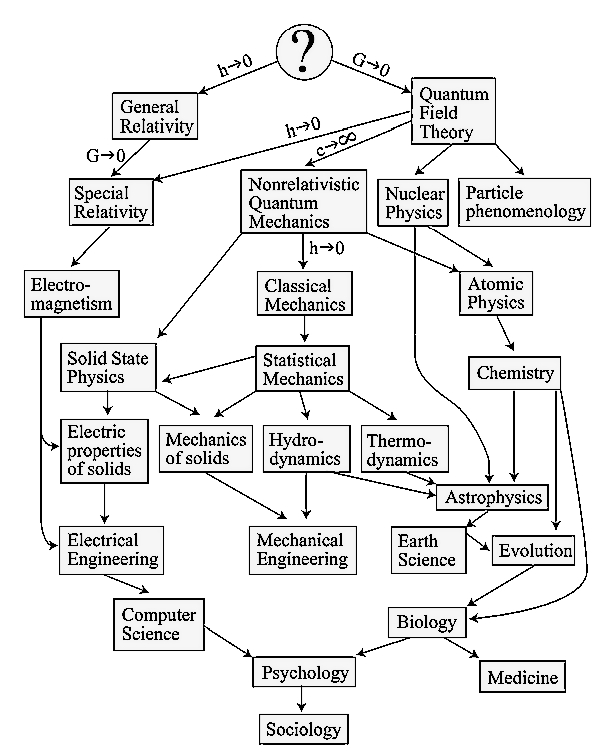
Science has clearly done a remarkable job in explaining discrete facets of the universe and predicting consequences based on such insights. So to provide a high level perspective of the relationship of scientific theories leading back to the gap that science still has to fill about the origin of consumers’ and organizations’ existences, consider this chart created by Professor Max Tegmark at MIT.96
Below in Prof. Tegmark’s chart97 you can see a range of scientific disciplines explaining many discrete aspects of consumers’ existences. In fact, philosophy, physics and math are all degrees of the same “thing” from different perspectives, each informing the other to create a cohesive body of knowledge (BoK) within the great ontological medium of the universe.98 Or as Galileo Galilei said, “Philosophy is written in this grand book, the universe, which stands continually open to our gaze… It is written in the language of mathematics.”99 However, neither mathematics, science nor philosophy conclusively explain the origin of existence as indicated by the question mark ? at the top and bottom of this universal true-north value stream. To complete this chart, I added a question mark at the end of Tegmark’s chart to represent the necessarily unbounded intuitive speculation about what is not. If you imagine seeing this chart in three dimensions, these two question marks are one and the same, folding back on each other to touch and complete the possibly circular ontological teleology of consumers’ value streams within the ontological medium of all known existence:
?
Figure 3.11: Chart of scientific and humanities fields back to the inception indicted by a question mark ? at the top and bottom of this value stream. Prof. Tegmark’s Chart of Disciplines (© Professor Max Tegmark)
Like Douglas Hofstadter did in his book, “Gödel, Escher, Bach,” I am including a picture by Maurits Cornelis Escher within this discussion of circularity. Here you may compare this image of Escher’s to Tegmark’s chart. Escher’s grand image, “Waterfall,” shows how clearly Escher (and Hofstadter) understood this Lean true-north value stream:
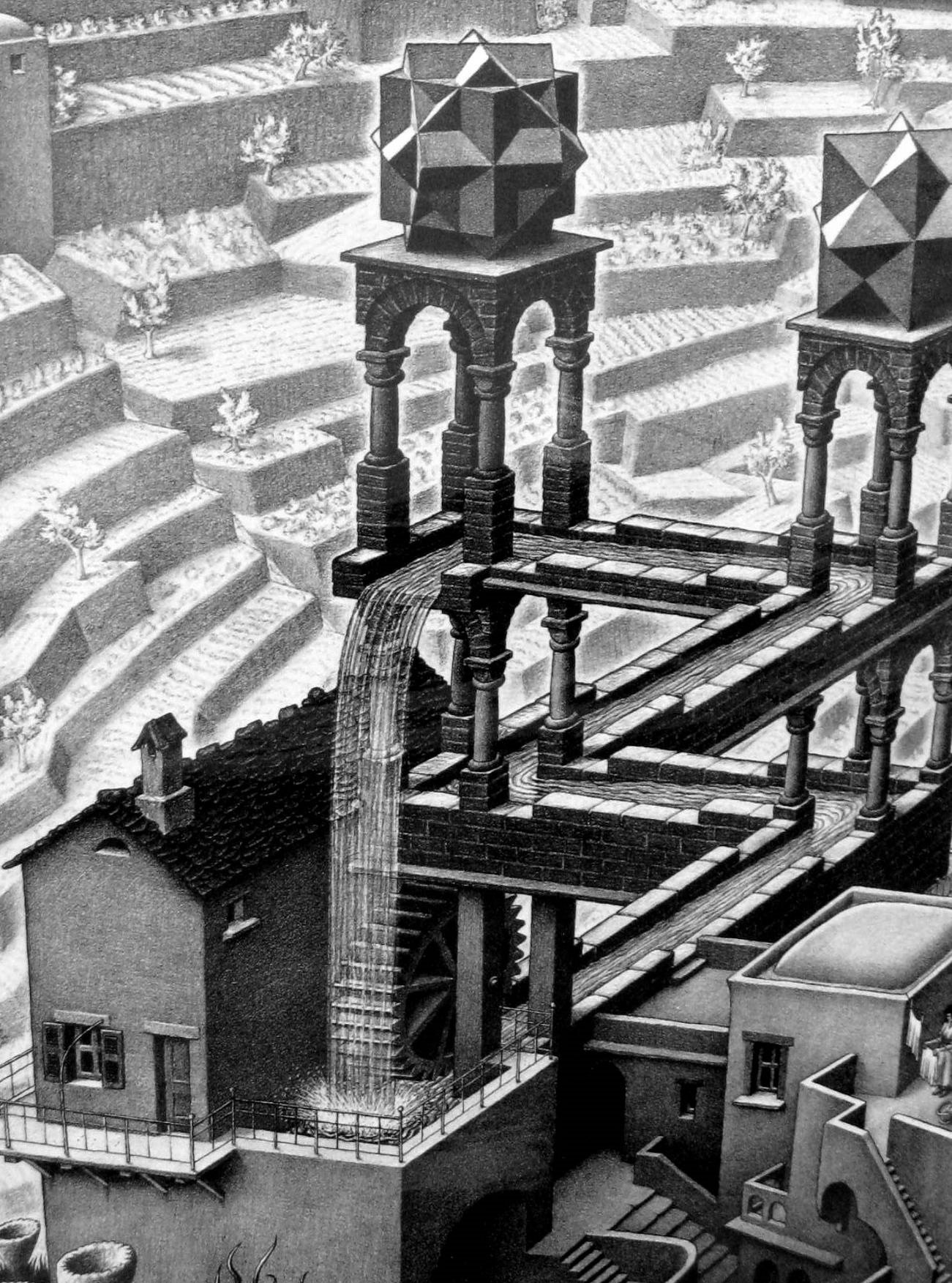
By turning Prof. Tegmark’s chart upside-down, you can see how it aligns with our earlier delineation of the great fields of knowledge as seen again here:
You may further compress this spectrum of knowledge down to UPP true-north values that are similarly bounded by a question mark at each end:
You may finally extend this fountain of knowledge into a Leanism by likewise putting question marks on either end:
“U” stands for universal truth, “Lean” represents a processual truth, while “People” are a personal truth only truly knowable through empathy.
Fecund Universes?
To better understand consumers’ existences from a physical perspective, let’s revisit a little more closely one of the intuitive, scientismic explanations for consumers’ possibly circular existences we discussed earlier called “fecund universes.” One of the most intuitively speculative, scientismic conceptions for existence is that of “parallel” or “fecund universes,” which describes unlimited levels of universes representing all possible universes that could be.100
In the inverse of the concept of, “From nothing, nothing comes,” the term “fecund universes” describes the notion that every possible thing exists, and what you know as the universe simply represents one version of infinite universal variations in infinite regression.101 In this scenario, consumers are a statistical result of the fact that something must exist, and if something exists then everything exists, and if every conceivable universe exists then consumers exist in the one iteration that provides for consumers’ existences as you personally know them now online or in-line in stores. In a way, the argument for fecund universes is reminiscent of the ontological argument for God’s existence since proponents get close to saying that if you could imagine any universe then that universe does exist. However, if you think this notion is completely far-fetched, consider the small irony that you like all people hopefully spend a third of your life each day in fairly random, parallel universes that are very personally real to you every time you go to sleep. Or as John Lennon is attributed as saying, “I believe in everything until it’s disproved… It all exists, even if it’s in your mind. Who’s to say that dreams and nightmares aren’t as real as the here and now?”102
This concept of infinitely many universes actually originated with Plato and has been brought forward by modern physicists to conform with modern mathematics.103 This adapted scientific concept of many worlds follows from the details of quantum mechanics that fall outside the scope of this book, but this general concept ought to help you gain perspective on what may be in the fullest sense and what may be not at all.104
This concept of fecund universes in one sense may also be seen as the “Anthropic Principle” set into scientific terms, meaning that you should expect that the structure and cause of the universe as consumers have come to know it is consistent with one that intelligibly results in consumers being who they are.105 The fecund universes concept conforming with the Anthropic Principle is thus just another way of stating that a consistent stream of reasoning exists far past “5 Whys” from consumers’ existences back to a sui generis, or self-causing cause, of everything simultaneously being since nothing simply could not be by its own definition.106
Other Scientismic Theories
Aside from parallel or fecund universes, quantum physicists have posited many other theories for the origin of existence and all true-north value over the last several decades as quantum physics has advanced. Each real advance of quantum physics often directly affects the philosophy of Lean when determining the reason for consumers’ existences and source of true-north values. Quantum physicians such as Alex Vilenkin and Steven Weinberg have put forward several explanations for why consumers exist beyond fecund universes, from quantum fluctuations creating a complex universe of net zero energy, to quantum physics experiments showing the possibility of matter appearing out-of-order in time, thus voiding the concept of ultimate causation altogether as a mere mirage.107 Other physicists have examined a real probability that the universe in which consumers exist is merely a simulation just like “The Lean Startup’s” IMVU as discussed in Value Stream 1, even though such answer would not resolve what created our simulated universe in the first place.108
Alternatively, some philosophers have suggested that this universe as you know it exists because it is the best one that could be and still logically cohere. Thus, if something were to exist at all, it must be as you actually know it, which is a strong form of the “Anthropic Principle.”109 Unfortunately, all such theories remain unprovable at the current moment, merely standing as intuitive, scientismic speculation not yet validated as processually systemic or universally axiomatic truths. While physicists and some philosophers continue to conjecture as to why consumers exist, none can yet prove it axiomatically or systematically, which is not to invalidate their speculation but rather to note the degree of speculation.110
Physicists, and some philosophers of science, present all of these conjectures as they do for all scientific and philosophical explanations under a general “best fit” principle, under a presumption that they can only know reality directly to the extent testable data fits to a given theoretical model. This is what fecund universes and other physical theories do to explain the origin of existence within the domain of physics, by fitting current scientific evidence to universal, true-north values. The search for the Higgs Boson “God Particle” most recently reconfirmed this method in some degree by failing to disprove the Standard Model.111 By better fitting evidence to known truth-values, and occasionally changing those truth-values in response to conflicting evidence, physicists continue to better understand how the universe came to be and how physical laws led to consumers’ existences. They also shed more light on the normative true-north value consumers demand when they buy product from their unified, personal perspectives.112
Consumers’ Existences Are As If Self-Defined
To meaningfully monetize consumers’ normative and real true-north values in Lean fashion, you must discover their ignorances, infinities, circularities and paradoxes.113 To physicists, consumers are bounded at the atomic level by the difficulty in detecting particles and anti-particles, and at the cosmological level by the speed of light multiplied by the time light takes to travel from the furthest edges of the known universe.114 To mathematicians, consumers are bounded by infinities and inherent paradoxes that limit their ability to construct a universal, non-self-referential ontology.115
From the universally axiomatic perspective, you can view consumers’ existences as if they themselves were self-defining, as if their existences did not have an initial self-causing cause that gives them an ultimate “why.” From a processually systemic perspective, consumers’ reason to exist may seem logically tautological, as if they exist simply to further and more fully be even though logic suggests they ought to exist due to some finally agreed on, causal reason. And yet, consumers personally intuitively speculate, either as spiritualists, theists, scientismists or other -ists, about an ultimate third-party cause for their lives and existences.
I only restate here the common sense notion that consumers universally and processually experience existence as if they exist simply because they do regardless of creed, but they may also speculate about a theological or scientismic purpose not yet agreed on by at least two sigmas (≥2σ) of informed people.116
Thus, if only for the purpose of leaning metaphysically toward much of the true value that consumers consume, I suggest that you ought to at least recognize the possibility that consumers exist entirely due to mathematical and/or scientific reasons, which is to say, entirely due to universally axiomatic and/or processually systemic truths. Your understanding this perspective strictly for business purposes will allow you to see more clearly consumers’ existences as if they were Ontologically Teleological. Seeing all consumer’s existences as if they were operating up through an Ontological Teleology is different than seeing them as coming from whatever open-ended intuitive speculation you or they may have as to why they exist. An Ontological Teleology recognizes the fact that consumers’ ultimate cause may actually be tautological but may also be not - we don’t know.117 You benefit though from witnessing the upward genesis of their Ontological Teleology by better identifying and creating salable value. You do this by seeing them as if their purpose was possibly Ontologically Teleological in nearly circular form, which I understand is difficult at first to comprehend. For starters, here are a couple of personally intuitive hypotheticals of consumers with different belief systems, from theists to scientismists, to exemplify how you may better identify these consumers’ distinct forms of true-north value by drawing clear lines around them regardless of what they believe:
Theists
On the flip-side of scientific axioms, theists assume that an intuitive, theological, or emotional explanation of existence is an axiomatic true-north value. However, no spiritualistic or theistic explanation changes the fact that what theistic customers commonly experience is as if they lived in an Ontological Teleology given that they still live in a rational universe. Their faith simply acts as a personal self-causing cause to move them beyond the apparent circularity of existence that they experience. Thus, theistic customers seek meaning by speculating with personally intuitive, sublime forms of truth that ascend beyond the apparently circular chain of explanation of their commonly shared existence with other people who do not share the same theistic perspective. Theologians most often stipulate that their own personally perceived, intuitive experience and speculation is what they consider actually meaningful and only falsifiable on a mythical or emotional level until certain miracles, Nirvanas or end-of-days arrive. Theologians find Ontological Teleological true-north value by serving their physical needs as a means to find non-tautological true-north value through open-ended, non-falsifiable, religiously dogmatic axioms that will answer all their prayers.
Scientismists
Similar to theists, some consumers generally believe or have faith in reason itself to explain existence, despite the PSR, RCA, Axiom of Causation and 5 Whys not yet having axiomatic validity as I have defined it here.118 People who place their faith in science to answer the biggest questions of their existence are called scientismists.119 Your scientismic customers assume that a rational explanation for their ultimate existence exists. Just like theists who constantly receive spiritual stimulation and emotional validation, scientismists have their faith substantially and commonly reinforced by advances in modern science that empirically prove further consequential reasons for their lives and existences. These scientismic customers push the explanatory boundaries for their existences further and further by pursuing yet unproven, scientismic theories. This scientismic faith leads scientismists to speculate that reason within their existences holds to a physically valid self-causing cause such as might exist under quantum physics. Just like theists, scientismists faithfully find Ontologically Teleological value in serving their physical needs to hopefully find an ultimately self-causing physical axiom as an answer to all their theories, hypotheses, conjectures and prayers.
Intuition Bracketing (“IBing”) Speculation for Money
Now, to accurately measure the salable normative, real and monetary value that Lean organizations ought to be producing for money, I suggest that you carefully identify consumers’ speculative, scientismic and theological notions of intuitive value and differentiate them from known universal and process true-north values. Your product will serve each of those true-north values separately. For an organization to reproduce products that accurately addresses these true-north values, it must ground itself as well as possible in what it can axiomatically and systematically validate within consumers’ lives and existences, while recognizing that what consumers believe transcends the apparent circularity of their existences. This is especially true if starting a risky business venture or operating in a new market with limited historical profits since an organization will be bridging itself philosophically forward across unchartered waters toward true-north value that no one has yet discovered.
Like the money veil over what people monetarily value, a veil exists over what consumers normatively value within who they consider themselves to be, which requires further distinction. Consumers’ intuitive speculation makes identifying truly normative value within the domain of the ID Kata difficult, and therefore requires you to differentiate true-north value types so you can know how to produce meaningful product worth lots of money. To define this value veil for Lean business purposes within an HQ, I recommend developing a U-shaped, conceptual value lens that I call an Intuition Bracket (IB) structuring who consumers are and may be. The IB conceptual lens sees through the veil covering the truly normative value of existence, while what the IB filters out is open-ended, intuitive speculation. The Intuition Bracket is thus the summation of an infinite set within which all Lean true-north value (a.k.a. reason) resides, and is synonymous with understanding consumers’ specific place in the universe.120
Chart of the Intuition Bracket or IB
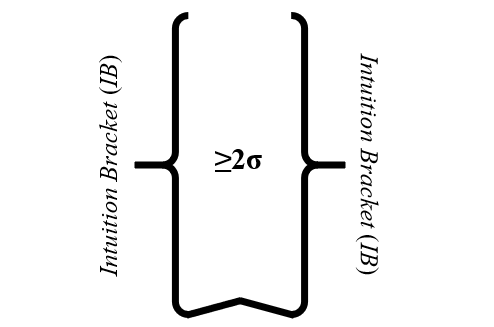
As prescribed above, the conceptual IB allows a Lean business ideology to separate consumers’ universally axiomatic and processually systematic existences from what they personally, intuitively believe. You simultaneously ought to diverge such perspectives within your Lean business ideology while keeping both in mind. Such an Intuition Bracket allows you to easily exclude consumers’ intuitive speculation, but still allows you to define consumers’ (and corporations’) existences within the limits of the IB.121 As a reminder of what David Packard who founded HP said in 1965 as quoted from Good to Great:
I want to discuss WHY [emphasis his] a company exists in the first place. In other words, why are we here? I think many people assume, wrongly, that a company exists simply to make money. While this is an important result of a company’s existence, we have to go deeper and find the real reasons for our being.
David Packard could have used the IB to identify consumers and companies’ essential reason for being by delineating different true-north value types. The bracket aspect of the IB creates an abstract category between the UP and personal true-north values, and I propose, allows you to more deeply categorize existence itself to analyze, identify and try to measure consumers’ real and monetary value as David Packard suggests.
The interior part of the Intuition Bracket contains that which consumers, and thus all of society, agree on an axiomatic or systemic basis. The IB contains that which belongs to consumers themselves, or by their very natures, that which is inherent, essential, proper, of their own, leaving outside the bracket their and all other people’s speculative, intuitive true-north value perspectives they cannot lean toward axiomatically or systematically with at least two sigmas (/≥2σ) of common agreement.122 Let me reemphasize that what I mean by intuition is not what you might psychologically consider intuitive, but rather what people in general cannot axiomatically or systematically agree on at the moment with available knowledge.
I fully admit that the boundaries between these true-north value types can be unclear at first given the fact that science and perception, like “The Bed of Procrustes,”123 often operate on a best fit basis. However, you can draw reasonably clear lines between that which can be falsified with empirical evidence through data and has some predictive validity through time with a reasonably certain degree of confidence, and those true-north values about which people speculate but have no widely agreed evidence or consensus.124
So within the IB, reason stands as that which you axiomatically and empirically lean toward on its own based on widely agreed data across time, unlike intuitive truths that are not commonly agreed as predictably repeatable within at least two sigmas (≥2σ) of universal confidence. Standing immediately outside of and adjacent to the IB are the true-north value perspectives consumers personally believe, which may be beyond any reason. Let me now provide you with another schematic to represent the IB and the boundary of pure reason that you may use in a business ideology:
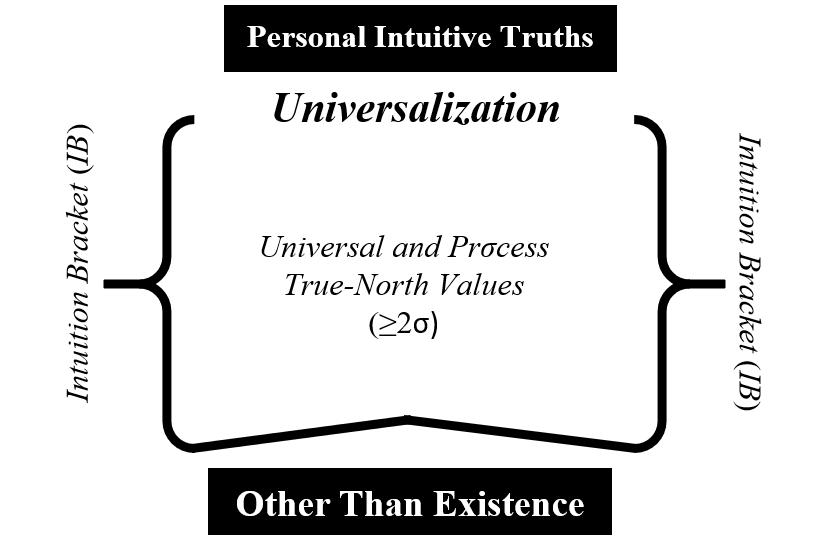
Inside the Intuition Bracket resides natural law, axiomatic and systemic truths, and all else that stands in juxtaposition to what is beyond consumers’ widely shared conceptions of existence. Whether by intuitive or scientismic causes, bracketing axiomatic and systemic true-north perspectives within the IB allows you to focus on who consumers are when they find themselves in the world, hemmed in by their ignorances, infinities, circularities and paradoxes.
Let me reemphasize for clarity sake that existence only appears this way for consumers on first impression, and that consumers must scientifically, intuitively or philosophically speculate to determine what caused the purpose of their existences. This matters in business because their purposeful meaning ultimately leans them toward buying product to further exist toward that end-goal, whether such end-goal is within the IB or not.
In the 1900s, the philosopher and psychologist Karl Jaspers was one of the first to define the IB when he created the term, “Existenz.” “Existenz” stands for the proposition that all people recognize these rational limits, and once known, begin to reconstruct personal identities reflecting who they authentically are within those known limits. Jaspers’ Existenz was the intellectual precursor to and inspiration for Existentialism.125 Thus, within Leanism, you might even write this notion as, “Σxistenz,” replacing the “E” with the capital sigma “Σ.” The capital sigma Σ indicates that “Σxistenz” sums all of who consumers are, and all that they want to buy, which they at least intuitively believe leans them philosophically toward all meaning. This philosophical process allows you to move beyond the origin of consumers’ existences to lean that much further up their universal value streams to see what originally delights them.
The oriental religious philosophies that contributed to the development of Lean also support this concept of Intuition Bracketing. Since Buddha refused to systematically contemplate ontological arguments by setting those questions aside as moot,126 by following the philosophy of Lean, you may in general for all practical purposes bracket what consumers intuitively believe caused their own existences so you may further lean toward what they need to buy while never underestimating what faith they have. Thus, IB’ing helps you identify consumers’ needs for sustenance, consumers’ intuitive speculation, and ideally the complementary combination of the two to pursue the greatest profit.
Ontological Medium (the OM)
Since the IB includes within itself axiomatic and systemic true-north value perspectives, it captures concepts such as universal spacetime and physical processes that you can refer to as an Ontological Medium, or an “OM” pronounced as, “AUM.” The OM is thick and pregnant with the Ontological Teleology,127 consisting of all that you would expect within the IB, such as spacetime, chemistry, and the biodiversity of all life. Thus, the OM incorporates all of the assets that an organization manages.128
While consumers have some ideas as to the origin of their existence, applying whatever theological or intuitive causes they choose outside the IB, you and consumers can bracket those causes outside the bounds of the physical OM and conceptual IB to advance up along whatever ought to be within those boundaries. You ought to employ the hypothetical concept of the IB in your business philosophy with at least two sigmas (≥2σ) of confidence to better isolate consumers’ Lean true-north values. Doing so allows you to effectively bracket the origin of the OM through which consumers buy product. When the OM is bracketed in this way, purchasing products furthers the consumption of more products to further be for nearly-circular purposes. I hope this concept of the Ontological Medium, a medium through which customers exist in spacetime and within stores, further explains for you the source of normative, real and monetary true-north value that products reproduce and customers consume.
I am now going to provide a modified chart of the IB adding the OM to it:
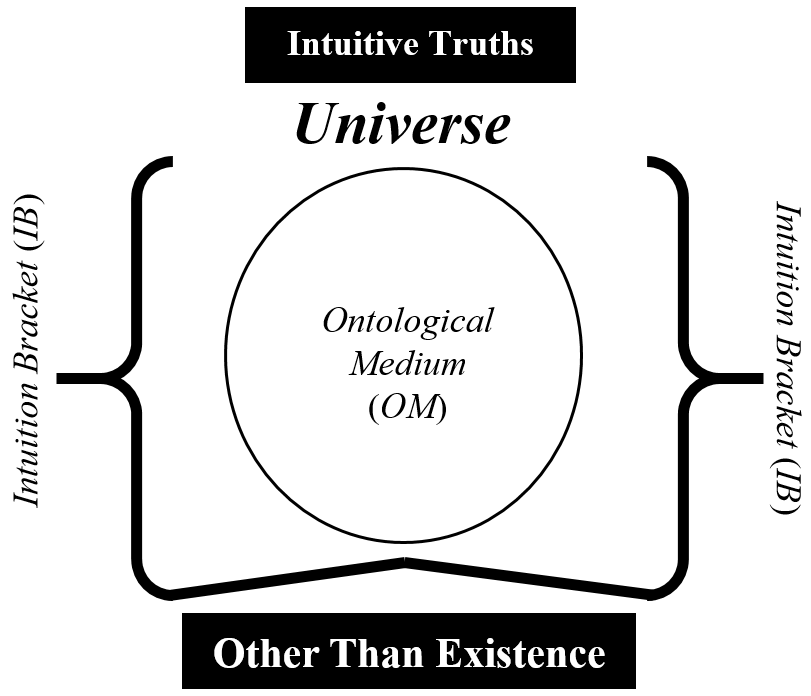
While all the forms of matter and energy within the domain of physics and other sciences reside within the Ontological Medium, within the Intuition Bracket, matter and energy self-organizes itself on a cosmological scale. This process occurs on balance within all universally axiomatic, immutable, and predictable physical transformations. The consistency of those transformations though seems to be impacted by the observer, and so the observer has a certain mesmerizing effect within the universal OM. This is why financial prophesy is inevitably heresy to some degree because the very act of planning and observing the results affects the very predictability of results that financial systems most reward. It is also why degrees of confidence increase with the number of people who agree with a truth-value proposition, because they cohere their collective, overlapping consensus as they do.
The Ontological Teleology (the OT)
If you remove any notions of a “grand design” from existence that people have devised or discovered, or any faith that science will ultimately explain why consumers exist at all, and you take existence simply as consumers’ find it right now at this very moment, both within the IB and what stands in juxtaposition to it, you arrive at an apparently self-defining, Ontological Teleology, or in short, the “OT.” The OT determines whether any consumption was nominally valuable, meaningful and thus good, and underlies all true-north value as defined by the fields of economics, psychology, and neuroscience, among all other disciplines. Since “Ontology” means existence, and “Teleology” means end-goal, “Ontological Teleology” simply means, “the end-goal of further existing.” Thus, the concept of the OT within the IB has a possibly circular, self-defined meaning.
Much like how you can see, the word “Toyota,” spelled out in its logo below, you can also see the overlapping O and the T of the Ontological Teleology within it:129


The Oxford English Dictionary further defines “Teleology” as:
The doctrine or study of ends or final causes, esp. as related to the evidences of design or purpose in nature; also transf. such design as exhibited in natural objects or phenomena.
Consumers’ singular objective within the IB through the OT is an apparent end-goal to further exist to find meaning within the boundaries of axiomatic and systemic truths. Generally, people consciously consider only their immediate satisfaction and not their teleological purpose when consuming product within the Ontological Medium as bounded by the Intuition Bracket. Consumers search for meaning through the OT by attempting to spring away from its apparently circular paradox by rational or irrational deed or creed to find linear, goal directed purpose.130
The OT ultimately moves upward in a spiral motion along the curvature of spacetime because the present and future are always similes (though not facsimiles) of the past, so consumers are bound to reinvent history as they reach new heights.131 Or to paraphrase the ancient Greek philosopher, Heraclitus of Ephesus (c. BCE 535 BCE – BCE 475), “[N]o man ever steps in the same river twice because it is never the same river, and it is never the same man.” All goal-directed activity is teleologically non-circular to consumers within the boundaries of the IB so long as they only consider their beginning and final causes as being within the strict confines of the OM. Consumers can and do often choose to disregard the apparently logical circularity of their existences, or at least choose to believe in another cause not demonstrated through their common senses within axiomatic and systematic truths. For example, customers generally do not consider the apparently circular nature of their existences when consuming products, because shopping does not seem tautological within the bounds of a store or shopping cart and consumers’ everyday lives generally removed from existential extremes.
At the same time, referring back to the earlier discussion of the circular nature of Samuelson’s Revealed Preference Theory and Lean true-north value, that economic model generally fails to accurately map consumers’ activities because it does not incorporate consumers’ seemingly random search for meaning outside the IB. The oscillation between circular and non-circular belief causes people to waver between rational and irrational activity. Consumers’ wavering toward seemingly irrational activity becomes validated when it helps them self-organize more effectively through the OT toward the Ontological Realization of who they wish to be. For example, putting massive resources into churches in the middle ages and space exploration in more modern times with little certain benefits other than achieving a sense of awe demonstrate how people attempt to boldly go where the apparent paradox of the OT is not and actually self-organize around truly teleological meaning. All this represents the collective human will to universalize, which can be immensely profitable if you market this very valid true-north value to move consumers along the upward curvature of the OT.
Ontologically Prospective Projects (the OPPs)
Please find below our universal diagram expanded to include an existentially goal directed Ontological Teleology recognizing Ontologically Prospective132 Projects as “OPPs” or “OPPortunities.” In this chart, OPPs contrast with potential threats people avoid in order to survive as the leanest within the OT. People engage in OPPs to maximize their own lives and existences. OPPs are synonymous with optimizing, and are explicitly related to consumers’ Ontological Realization by engaging in activity that ultimately orients them upward along the Ontological Teleology.133 The chart below shows a twisting, Ontological Teleology that somewhat correlates with the physical arrow of time carving its way through the OM.134
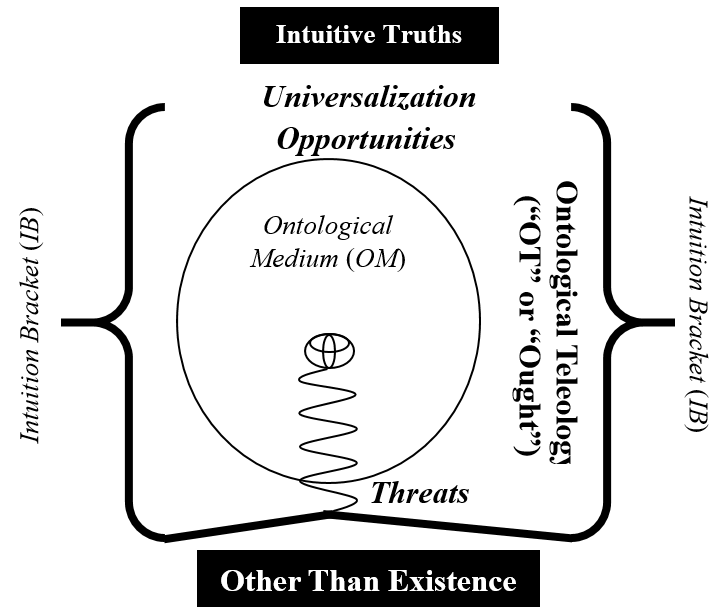
In this chart, consumers move between the existential extremes of:
- Opportunities to pursue a universalized, Lean perfection of instantaneous and seamless problem resolution and satisfaction that consumers seek and yet only know as a hypothetical possibility; and
- Threats to consumers’ pursuit of perfection, or more accurately, being “other-than” perfection, which consumers know all too well and must correct for by thinking and behaving differently.
Consumers’ pursuit of perfection is their taking action to move toward real or perceived opportunities to reproduce as well as they can upward along the OT as they self-define it and away from threats to their becoming not. Each of these actions constitutes the resolution of the unique problem of existence. For example, customers optimize toward opportunities and away from threats by purchasing products that they perceive either as providing them with an OPP or removing a threat to their lives and existences. Customers like products with a thumbs up or down on a sliding scale with one to five stars as to whether consuming a product acts as an OPP to in-fact improve their ability to live better within the OM, or toward what they believe is outside the IB, so they may achieve meaningful moments of true-north value135 by resolving their utmost problems, as seen again here in this chart:
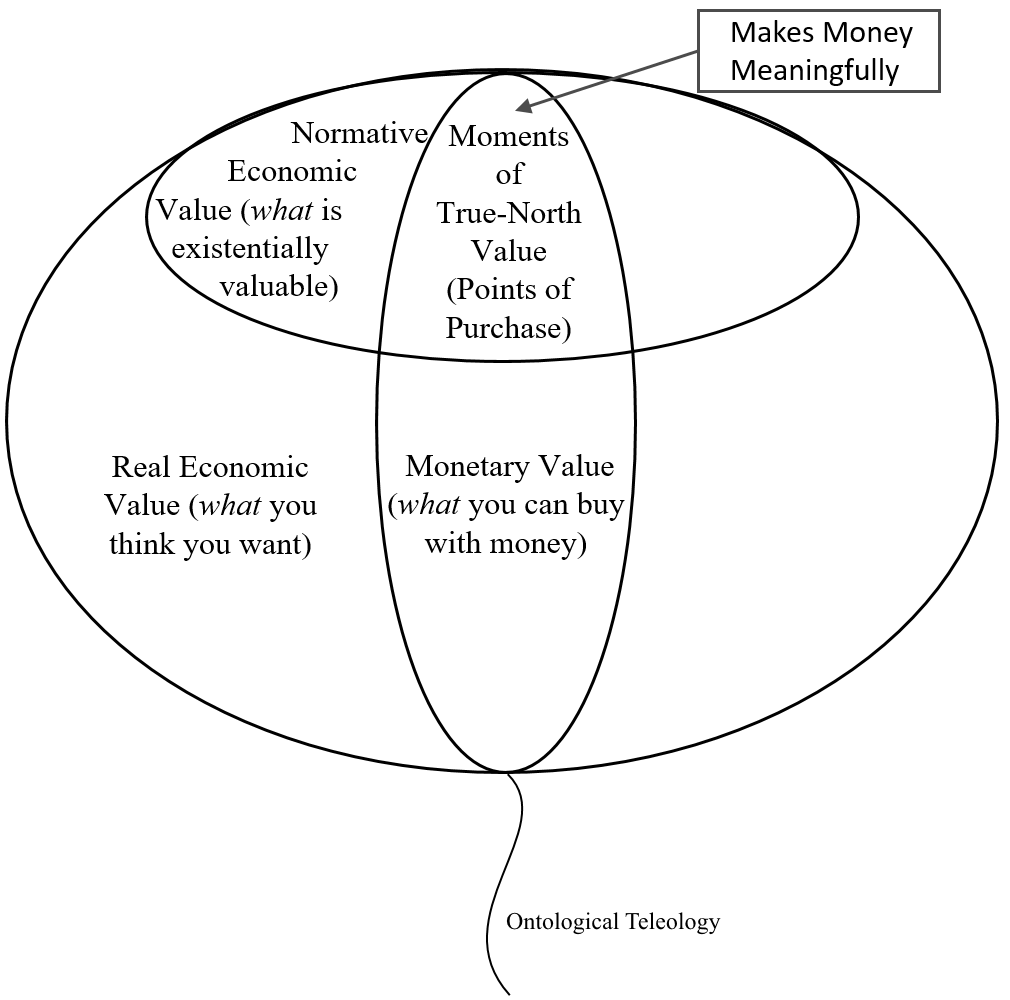
Teleology v Teleonomy
Now is an appropriate time to differentiate between the terms “Teleology” and “Teleonomy” for you to best understand which Lean end-goals consumers chose to pursue for their meaningful OPPs. In its historical sense, Teleology describes a system whereby people intuit, infer, and possibly induce from the sophistication and organization of existence that: (1) creation exists to achieve a final end-goal due to its generally intelligible nature; or that (2) an intelligible first cause created a final end-goal that can only be speculated. However, “Teleology” in its modern sense and as used in this philosophy of Lean means that organisms operate in anticipatory fashion to predict their future Ontological Realization according to their reliance on the truth of axiomatic, systemic or intuitive values. In other words, teleology intentionally seeks a specific end-goal.
However, modern behavioral scientists dislike the term “Teleology” because they generally criticize historical teleology as having a time reversal problem in that the future goal of teleology in its historical sense must dictate present events. This entire notion violates natural law because the arrow of time within the context of the OM only moves in one direction as far as we know.136 This time reversal problem arises from the fact that considering physics and biology to be goal directed violates the evolutionary principle held by most scientists with at least five sigmas (≥5σ) of confidence that behavior is unintentionally shaped by natural selection and environmental conditioning. Instead, behavioral scientists state that the evolution occurred “purposeively” as a result of natural laws operating through complex systems, and not guided “purposefully” toward an end-goal that may have been intentionally specified in advance.137
To overcome this time reversal problem of teleology, in 1958 the behavioral scientist C.S. Pittendrigh created the alternative term “Teleonomy” that has since been adopted by a number of behavioral scientists for this same reason.138 Teleonomy is just a biological term for life’s purposive nature. Thus, changing the terminology of “Teleology” to “Teleonomy” emphasizes the fact that natural laws act as the guiding force of the OT concurrently and coincidentally in complex, dynamic systems, resulting in the Ontological Realization and origin of biological creatures, rather than toward any predefined or purposeful goals.139 Teleonomy is generally used to separate biological behavior from its more historically controversial first or final explanations in a universal, Aristotelian sense.140
Behavioral scientists’ jobs are to think about the root causes of behavior in animals in order to better understand, predict and manage them. In that light, “Teleonomy” attempts to overcome these temporal problems and some theological connotations associated with the term “Teleology” based on its historical use to prove an intuitively speculative self-causing cause. Teleonomy is thus a fairly recent term used to describe the appearance of design in nature that does not have any inherent end-goal, but rather appears as if it was designed to achieve a goal due to its being naturally selected for maximum efficiency in regenerating and becoming further Ontologically Realized through time. Or as Timothy Ferriss said in his book, “The 4-Hour Workweek,” “Being efficient without regard to effectiveness is the default mode of the universe.”141
I consider the teleonomic from teleological distinction useful at the beginning of describing consumers’ existences within the OM and IB in that the linear, existential development of life from organic matter prior to the creation of consumers’ independent agency of themselves reflects purposive teleonomic activity regulated by the external dynamics of the complex universe. However, at the point where teleonomic activity results in organisms with degrees of independent agency like consumers, that agency expresses a purposeful, teleological, goal-seeking cognition measured by how it acts to further become Ontologically Realized within the OM, IB and universe. Consumers’ Darwinian fitness gets both teleonomically self-organized and teleologically intentionally shaped upward along the OT.
For example, when bounded by the IB, even Aristotle’s own final cause or end-goal of further existing seems to be for Aristotle himself to simply further exist as a living system in seemingly logically circular fashion. Sadly, Aristotle no longer is, but his thoughts lived on through us. Existence likewise is where the first and final causes of who and why consumers are emerge into their unified personal perspectives to leave behind whatever present and residual effect their lives may have. Consumers exist within a universe that results in an inherent end-goal of their further simultaneously and optimally being both toward and away from what is other than existence. In other words, people live to avoid becoming not in a physical sense while also simultaneously living for what they speculatively believe to be so (i.e. what may be not) at the same time. This is true because at this moment any determination of whether the first or final causes were by grand design or not stands outside the IB as a speculative, intuitive truth.
Thus, the IB nearly equivocates Aristotle’s efficient and final causes, almost connecting them around the teleological bend, so you can measure to some degree those causes’ systemic expression and Ontological Realization along the upward curvature of the OT. The OT thus allows you to define and measure who consumers are within the limits of the IB because the Ontological Teleology is the great simpliciter and regulator of itself without further external reference outside the OM and IB. Either consumers are or they are not within these empirical boundaries.142 For example, natural selection as Ontologically Realized through the OT demonstrates a survival of the fittest, telos, or Lean end-goal of true-north value for genes143 to exist to a greater degree. So, while all consumers optimize themselves against universal possibilities, the OT simpliciter is what gets Ontologically Realized because it is ontologically self-reinforcing, which is what allows you to measure it. Within the IB, the only thing that matters is what certainly is with a fairly high confidence, while keeping in mind what is not, and what may be.
Thus, this measurable, ontologically, teleonomically, purposive aspect of the universe results in consumers who have teleologically, purposefully, and subjectively cognitive faculties with independent agency that furthers their apparently tautological, Ontologically Teleological goal of extending and optimizing their existences by in-part buying and consuming the products you produce for money. Just because the ultimate goal of universalization is hypothetical, that does not invalidate its practical application to the here and now in order to make more money.144 Consumers have a purposefulness that generally conveys a survival advantage and provides a higher standard of existence to them through their ability to spend money and consume energy to the greatest degree of all.
The Open-Ended Paradox of the OT
However, the OT through which consumers exist to a greater and greater degree appears paradoxical in an open-ended sense, since the origin of being and knowledge only seems self-defining when you bracket out intuitive speculation. Said another way, within the bounds of what people commonly experience, scientist, business person and theologian alike must all be collectively, intersubjectively agnostic while personally and professionally speculative about whether or not the OT ultimately self-defines what purpose their existences may have.
This existential condition leaves consumers either:
- Personally or publicly declaring irresolvable ignorance as to the ultimate causation of the OM in an agnostic sense;
- Attempting to leap beyond the apparently tautological, Ontological Teleology in an otherwise unexplained universe by thinking and acting irrationally;
-
Engaging in intuitive spiritual, theistic, or scientismic belief and speculation as a rational response to the apparent paradox of the OT by placing faith in:
- A spiritualism that may or may not be commonly experienced;
- In one or more deities that may or may not be commonly agreed; or
- In the Principle of Sufficient Reason, Axiom of Causation, RCA and/or 5 Whys due to science’s consistent explanatory success.
Most people actually seem to live day-to-day by simultaneously engaging in a mix of all three of these strategies. As you know from experience, some people conflate intuition with processual or axiomatic facts. Some people profess and orient their actions toward their intuitive beliefs out of ignorance. Or, some people profess belief in intuitive truths to conform to society but otherwise live like pragmatic agnostics. And others still hold personally intuitive beliefs that go against the OT and what appears to be their self-interest even after being fully educated as to why, what and how they are within the OM and IB to the best of existing knowledge. While all of these responses to the OT allow consumers to exist with the least cognitive dissonance vis-a-vis the apparent tautology of the OM within the IB, very rarely if ever do consumers execute any one of these strategies consistently throughout their entire lives.
Instead, consumers employ a complementary mix of these strategies to uniquely/profitably extend and optimize their existences within the OM. For example, intuitive speculation allows consumers to conceptualize what is hypothetically possible in their hearts and imaginations, but is not (yet) Ontologically Realizable.145 Consumers then test whether such intuitive speculation results in their experiencing a greater Ontological Realization of who they are. Such intuitive speculation also functions as a method for consumers to test their self-organization with passion and meaning to reinforce and validate (or not) their non-circular, personally intuitive true-north values. This passion play gets repeated until consumers switch to agnosticism or scientism, or just act a little crazy to see what happens, to see whether such other strategies more effectively enhance their standard of existence.
Whatever consumers happen to intuitively speculate gets validated to the extent it expands the volume and velocity of those consumers’ Ontological Realizations, which is equivalent to who, why, what and how they are and all Lean value. From a Darwinian, processually systemic perspective, within the bounds of the universe, IB and OM, people’s conscious experience and activity is simply an endeavor to ontologically reinforce their survival as the leanest through offspring, monuments, memoirs, academic theories, charitable foundations, pseudonymous corporations and the like. Even if you assume a logical circularity of purpose within the IB, the increasing organization of nature within the OT leads somewhere, most namely to universalizing people through successive regenerations onward and upward in an Ontologically Teleological fashion. Thus, intuitive beliefs constitute a rational response to the soft paradox of the OT and are effective so long as they facilitate and do not hinder people’s overall expansion and optimization.146
For example, imagine passengers’ journeys if you were an airline serving food to people with religious beliefs. If those religious beliefs forbade eating certain types of food, like spaghetti, then the airline’s food should conform to passengers’ intuitive true-north values for religious purposes as well as their process true-north values by being nutritious. At the same time, the act of serving the nutritious, religiously observant food cannot conflict with the axiomatic or systemic truths applicable to all people, like the ability for other passengers to have nutritious food. The food ought to reciprocally conform to all passengers’ various forms of intuitive speculation as well within a free society. All these true-north values must somehow cohere within the singular, overlapping consensus147 and seemingly open-ended paradox of the universe. You can witness this existential sentiment reflected in the, “COEXIST” stickers commonly adhered to the backs of people’s automobiles:
Even scientismists admit that they do not know precisely how existence originated within several sigmas of confidence, and so they themselves hold personally intuitive, scientismic beliefs when existentially pursuing their work. So, whether you are a scientismist or not, you must recognize the extreme ignorance and the apparent tautologies, circularities and paradoxes in which all researchers and consumers find themselves existing regardless of their speculative persuasion.148 People have no axiomatic or systemic explanation for what originated within the boundaries of the OM. At the same time, you likewise must appreciate that while intuitive true-north values are not axiomatically or systemically valid, they are Ontologically Realized within consumers’ personal perspectives (i.e. within their hearts, memories and imaginations). This may affect what and how customers purchase from you when you orient the production of product toward their true-north values through the philosophy of Lean.
Consider further that the apparently circular nature of the OM within the IB would be shattered if all fully-informed people willingly agreed to at least a Lean two sigmas (≥/2σ) of common agreement that a self-causing intuitive true-north value, like a deity, was one of Aristotle’s efficient or final causes. This may in fact have been the case in ancient times within highly theistic societies. For example, at any religion’s peak, did at least 95% of the informed population truly consider its dogmas to be systemic truth-values if not axiomatic truth-values? Did these theologies bring their dogmatically stated, efficient-first or final-teleological causes from outside of the IB to inside the IB as a universally axiomatic or processually systemic true-north values for their adherents?
Even if so, those theistic truths had to be ontologically validated to hold onto believers and continue to exist over time. Theologies ultimately live and die over time by their true-north viability, which is the Ontological Realization of their professed adherents within the OM.149 Even where one or more people hold an intuitive true-north value, that personally held intuitive truth-value either does or does not obtain by creating Ontological Realization over time when interacting with other axiomatic or systemic truth-values and religions. This is the process by which speculative true-north value gets created and tested for falsification.
Silly Suds
A rather silly example of this dynamic is the “Pastafarian” movement started at the turn of this millennium. In 2005, a small group of people called themselves Pastafarians and satirically agreed that a Flying Spaghetti Monster® both created itself and the known universe. Pastafarians started doing that to protest the Kansas Board of Education’s decision to teach intelligent design in Kansas schools, evoking the famous 1925 “Scopes Monkey Trial”150 challenging the teaching of evolution in Tennessee public schools.151
Pastafarians satirically held that people’s Ontological Teleology would be to serve the wishes and purposes of the Flying Spaghetti Monster®. The Pastafarians’ proposed that the Flying Spaghetti Monster® (the “FSM”), as its greatness is officially called, was either a Universal or Process true-north value, which may also be considered to be an objective fact with large degree of certainty.152
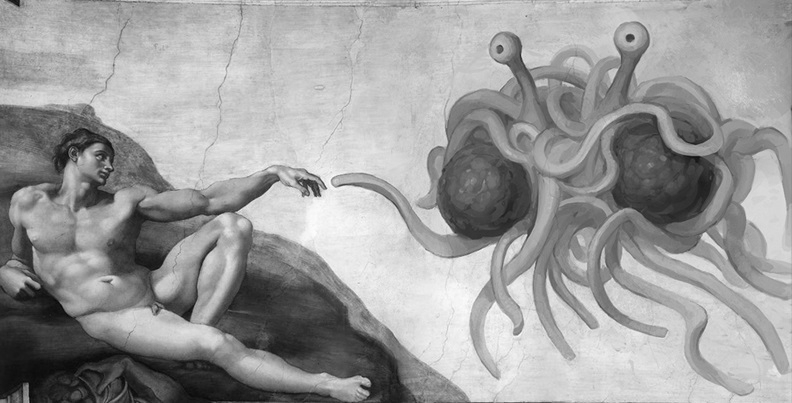
If you want to know why the FSM held such satirical sway, presume for a moment you and all consumers are in-fact Pastafarians. If so, the FSM would be an axiomatic truth, keeping all else you know the same. In that case, Pastafarians’ existential purpose within the OM would still appear as if it was Ontologically Teleological, with the goal still being to become universalized in juxtaposition to what may be not. Keeping all else the same, including a presumption of free markets, you would still ask how the FSM’s new axioms may interact with previously known axioms to increase Pastafarians’ Ontological Realization upward through the OT. Thus, the Pastafarians would become customers and buy a product based on that product’s real or perceived ability to increase their Ontological Realization through the OT in coordination the new, axiomatic fact of the FSM. The Pastafarians would do this by adapting their consumption of product to all the dogmas of the FSM, whatever they may be, to best extend and optimize their existences under this new deity.153
On the flip-side, presume you and all people are not Pastafarians but rather scientismists who believe science has the ultimate explanatory power for what caused the OM beyond the IB. Presume further that a scientismist’s dogma is that existence is fully expressed in string theory, much like Pastafarians believe in pasta. This string theory says that this universe in which consumers now reside is but one possibility of an infinite number of Ontological Realizations, with each string representing infinitely many possible universes. In that case, consumers would accept that fact and continue to shop much the same. Customers would still seek to become further Ontologically Realized as they define themselves by buying product unless a string somehow caused their behavior to change. Whether the Pastafarians or scientismists were correct would not necessarily change people’s consumption patterns without further guiding detail to each of their dogmas.
Thus, the OM contains within itself today teleological, goal seeking customers looking to further their own existences by shopping up along the OT as if this was the only universe that mattered. Thus, we now move along the Ontological Teleology within the universal value stream to Value Stream 4: Lives, to consider the OM generally as teleologically ontological for the sake of clarity and to show some continuity with the history of philosophical thinking about true-north value and all meaning for living things. I will use “Teleonomy” only to the extent I intend to specifically indicate a goal directedness based on the measurable, dynamic confluence of axiomatic and systemic true-north values within the OM as bracketed by the IB with at least two sigmas (≥2σ) of confidence.