Value Stream 1: Headwaters to Leanism
Value Stream 1 A3 Report:
- Lean is a global business discipline used to make money by improving commercial outcomes
- Lean has been applied throughout the business environment to all size companies and extended to all types of organizations
- Lean combines Western philosophies that investigate what is true through the scientific process, along with some aspects of Eastern religious philosophies like Buddhism to determine what has real value
- Many of the most truly successful business leaders today have seriously studied and written about philosophy
- Leanism leverages this tradition by summarizing and extending the philosophy of Lean to explain what “True-North Value” truly means in the context of all Lean business activity and life in general
- Leanism synthesizes and delivers this knowledge through creative symbolism and writing for improved learning
- Leanism provides a people-focused business model and a heuristic called an “ID Kata” that allows you to apply the philosophy of Lean to all business and life in general
- The ID Kata teaches you a method of forward analysis to discover true-north value by pursuing a series of who, why, what, and how questions
The business discipline of Lean is more than a set of manufacturing techniques or a way to start up new organizations. It is a holistic philosophy that can help you identify what to produce that people will truly value and purchase. Leanism shows you the way to wealth in all its many forms.1 To reach the greatest profit of all, you ought to lean philosophically to reach the highest point of true-north value for your customers using the metaphysics of Lean. You can make money using Lean by meaningfully observing and fervently divining who consumers are, why they may buy something, and what they want to buy from you, so you can delight them the most. Leanism extends your abstract thinking toward better understanding what creates true-north value to help you implement that knowledge in life and business. You lean philosophically so you can make meaningful amounts of money while feeling satisfied that you did good work.
However, like looking at the sun, such high-level, abstract thinking is painful, disorienting, and best done through a conceptual lens for you to see customers most clearly. Leanism filters all complex subjects to help you better see who consumers truly are from their deepest problems up through the universal value stream. You will then discover what they find most personally meaningful in the products and/or services you serve. I suggest that you put on a thinking cap and eye-shades before reading further because these abstract concepts will help you see true-north value if you learn to look carefully enough.
Since commercial value gets measured in money, money is the mythical icon toward which all true-north value in business leans. When deciding whether to buy now and receive meaningful true-north value from you, consumers consider how much money they must pay at the point of purchasing products and/or services. Likewise, you as a business person want to know how much money you can earn through great work. Without clearly understanding why and what consumers want to buy, and how you deliver their greatest satisfaction, you cannot uplift your profits to where you think they ought to be.
While what exactly consumers individually believe to be truly valuable remains beyond what all people commonly agree, philosophy logically coheres and mediates the true-north value of money within our overlapping consensus of the way life is.2 Importantly, philosophy will also guide you past any idolatry of money that will blind you to consumers’ true religion. When you lean metaphysically, you will consider how best to create true-north value for all people, which in-turn supports who consumers are and what consumers individually believe to be most worth their money.
Why Lean?
While the concepts behind Lean that lead to producing superior products have a long intellectual tradition primarily formed from the Western “Philosophy of Science” and Eastern religious philosophies, Lean consolidated those ideas and has become the leading business discipline/fad/trend/paradigm used by people to make money in our time. Lean as a formal business discipline was formed from studying what made the Toyota Motor Corporation so successful for so long. In the 1980s, business researchers developed the modern concept of Lean from this intellectual legacy and extensive body of practical knowledge. A gentleman named John Krafcik, under the tutelage of James Womack, first coined the term “Lean” in a 1988 article he wrote for the Massachusetts Institute of Technology (MIT) about Toyota’s highly successful production systems when he said, “[I]t needs less of everything to create a given amount of value, so let’s call it ‘lean.’”3 From that point forward, the term “Lean” represented a modern business philosophy whose tenets organizations continue to pursue and iteratively perfect today, which is well captured by this quote from Antoine de Saint Exupéry in 1939:
From a fundamental metaphysical perspective, Lean business techniques focus on creating the truest value by removing all forms of waste and adding only what most satisfies consumers’ demands, just as Toyota continues to do today. However, while not complex on its face, Lean demands a different way of doing business.5 In fact, since one of Lean’s main points is to wash away everything but that which provides consumers with value however truly defined, it is a far more abstract money making methodology than most businesses are used to considering. At the same time, businesses have evolved Lean into a practical philosophy of continuous improvement, which the Japanese word, Kaizen (改善), represents. Kaizen is a portmanteau meaning to restore (Kai (佳)) and make good (Zen (禅)) through thoughtful reflection, and is key to any continuous effort to reduce waste in an HQ.
In the spirit of Kaizen, Lean was iteratively improved in the 1990s and 2000s by intersecting it with more quantitative disciplines like Six Sigma that Motorola (once a division of Google but now a part of Lenovo) developed at the same time. Motorola designed Six Sigma in the 1980s to ensure production of its information technology within six standard deviations of statistical precision. Thus, businesses use Lean to accurately target what people most value, while Six Sigma and other quantitative methods precisely lean organizations of people in that direction. Countless books evidence this intellectual legacy of Lean, Six Sigma and other people-oriented, evidence-focused business insights that are referenced throughout the ten “Value Streams” of Leanism that you can surface with any search.
Thus, Lean is the best paradigm for philosophically analyzing business because it has the highest rate of problem solving power as evidenced by its efficacy in generating consistent profits.6 Lean has evolved to become widely used by most companies7 of all sizes in some way as part of their organizational DNA — from start-ups to large corporations — just ask any business person whether his or her organization uses Lean in some way!
Lean, like most business theories, must be approached abstractly but applied concretely through specific actions to determine what delights the most customers for the greatest profit. However, if any criticism has been levelled at Lean, it’s the irony that Lean practitioners overly rely on the plethora of tools, diagrams and instruments that Lean consultants produce without espousing an overriding ethos for their detailed implementation in the chaos of everyday business. Consultants promote these tools because customers prefer to pay for repeatable mechanisms than abstract theories that require deep thought to implement.
However, if you move beyond all of the tools, diagrams and instruments provided by Lean, if you study it carefully enough, you will see that Lean represents a history of thought from the Ancient Greeks, the European Scientific Renaissance and the Far East that extends into all we as producers and consumers think about today. In this amalgamation, Lean articulates a good overriding ideology - a good unified philosophy - because Lean accepts the possibility of, desirability for and progress toward an infinitely optimistic future to reach commercial Nirvana.8
Why Leanism?
The intersection of Lean tools along with the sound business philosophy of Lean can generate radical wealth in this domain.9 Yet, despite countless business books falling into the Lean canon, a gap still exists in the Lean literature due to these proponents failing to identify what true-north value businesses actually lean toward. “Leanism: The Philosophy of Business,” attempts to fill this void by embodying the intellectual legacy of Lean in a set of high-level steps you can take to make money meaningfully in-line with all consumers’ value streams.
While philosophy is said to “bake no bread,” the metaphysics of Lean helps you analyze what bread you ought to bake and how to bake bread that gets bought and broken. For example, baking either a wedding cake, Communion bread, or table bread requires you to satisfy consumers’ very different fundamental needs in Lean fashion. Knowing who consumers are and why and what they most truly value further determines how you will bake bread that helps customers better become who they want to be, whether that is either married, saved or well-nourished. If philosophy is dead, why not put it to practical use within Lean to find the true-north value of life and business and make money meaningfully? Lean metaphysically if for nothing else than to more effectively guide you to consumers’ point of physical, emotional and intuitive satisfaction.10
Leaning metaphysically toward consumers is not about endless speculation, but rather about analyzing data with continuously new metaphysical perspectives in a unified way to make real decisions about how to make money well in all business environments. This isn’t science fiction, but rather the best knowledge available about reality itself. It solves the problem of explaining what true-north value is and how to create it for money. It does that by explaining who and why consumers are in the grandest scheme of things for you to apply specifically to business. Knowing how to analyze business data implies that an organization knows what realistic, true-north value that data reflects and why the data means anything at all to consumers and other stakeholders, which philosophy explains. Thus, organizations lean metaphysically to extend and optimize their businesses through their data about consumers’ lives and existences and what they personally find meaningful.
However, analyzing valuable data without continuously knowing who consumers are and what they find most meaningful prevents an organization from reporting as much money as possible inside its headquarters.11 Getting to this point of profit in the metaphysics of Lean requires both deeply respecting humanity and always improving, such as how Pfizer’s upper management periodically does within so within its global HQ.12

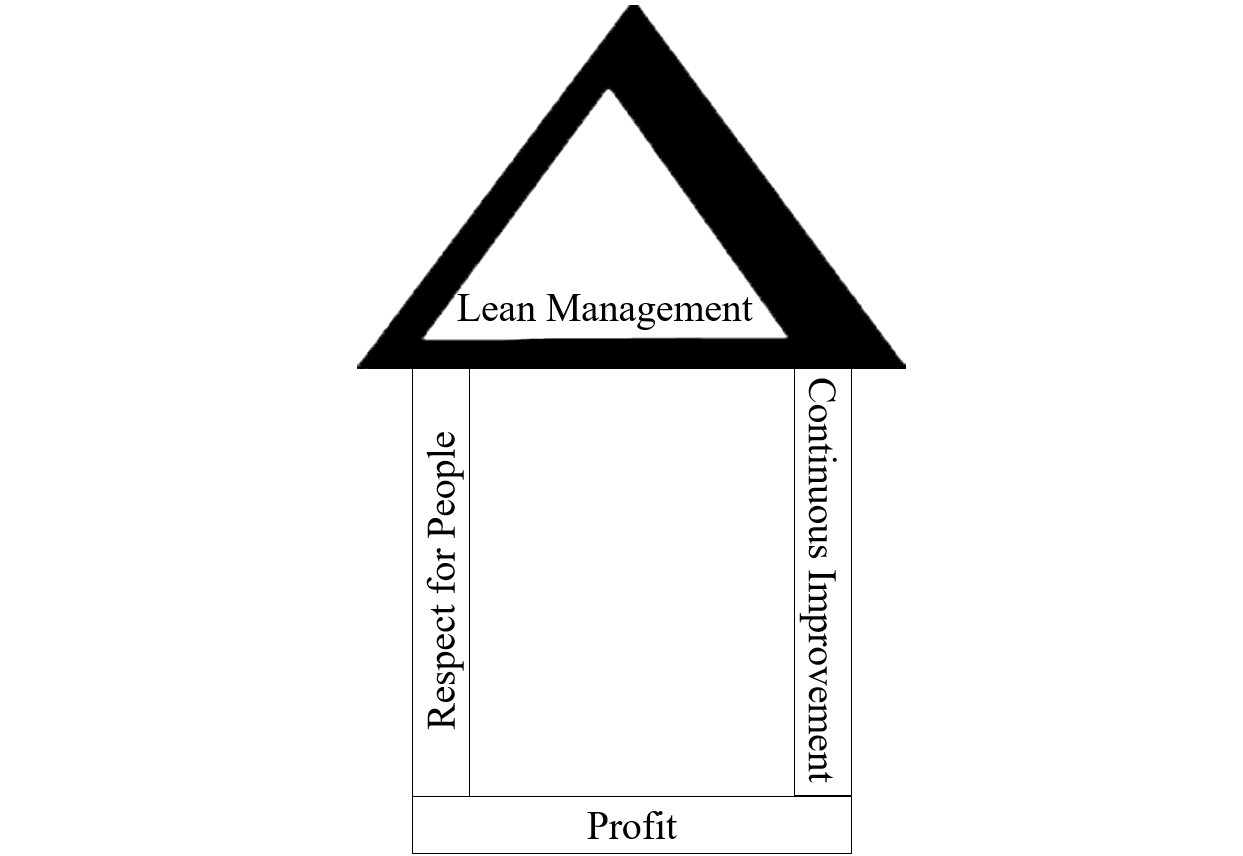
Thus, the two pillars of any Lean HQ are Sonchō (尊重), which is Japanese for “Respect for People,” and Kaizen (改善), which means good change and has evolved to further mean “Continuous Improvement” in Lean parlance. To help you visualize these concepts, here is a diagram of a corporation’s HQ with a Lean management system up top using profit as its foundation and bottom line:13
Getting Around “Leanism”
Leanism structures its chapters, which I call “Value Streams,” around the “U/People” (again, “You lean toward people”) acronym. U/People stands as a meta-heuristic, upper ontology and business model14 for use by an organization to Uniquely/Profitably Extend and Optimize People’s Lives and Existences.15 “Lean” (aka “/”) within this “You lean toward people” acronym stands as an adjective indicating those people and organizations that lean metaphysically toward other people. Lean also acts as a verb implementing the philosophical imperative to make money the right way toward what consumers most truly value. For example, Toyota Motor Corporation leans metaphysically as a fictitious person,16 through its employees and other stakeholders as natural people, and toward its customers’ true-north value in an open-ended universe, which I will explain further as we go along.
Leanism runs quickly through each part of its main acronym, from one Value Stream to the next, by synthesizing the essential qualities of each for you to better relate subjects and build a personal “AHA” moment and organizational House of Quality (an HQ (舎)) and ideology from its two pillars - Respect for People17 and Continuous Improvement. This business model and vocabulary - as supplemented by all the work cited within this book - allows an organization to point its own “True-North” value compass leading out from its “House of Quality” toward profitably analyzing data to increase consumers’ standard of existence. “True-North” is the metaphorical direction of all true-value in Lean terminology, and an HQ / House of Quality / Head Quarters is where true-north value is reproduced and a profit is reached.18 As you can see here, “Lean” symbolism gets conveyed in the geographical direction of “True-North,” around which the earth circles while moving forward in time.
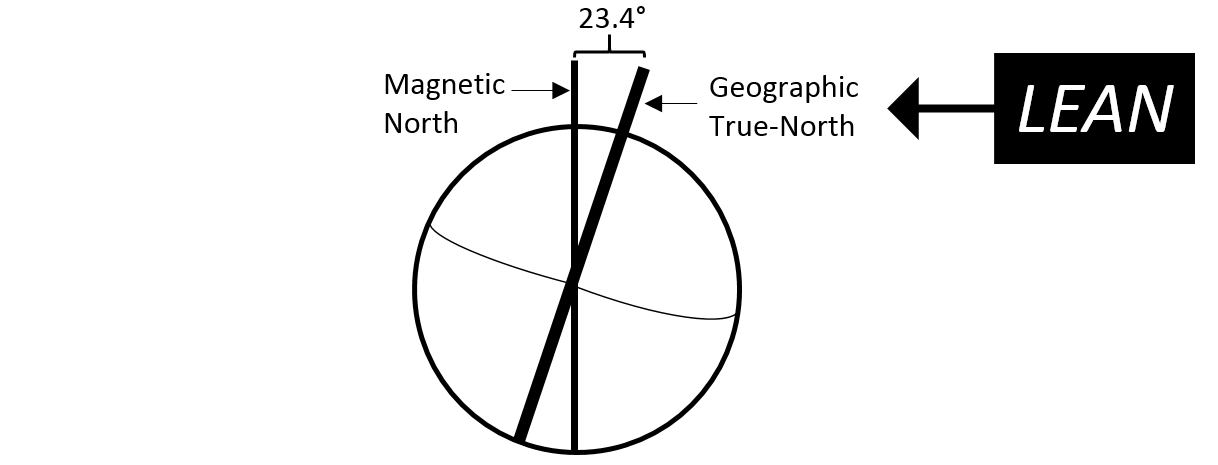
And “True-North” is where you chart your way to the greatest profit, slightly off-center, up and to the right.

As you might anticipate, this monograph on the philosophy of Lean could never be exhaustive within a single volume, much less a part, Value Stream, section, paragraph, sentence and/or word as may be devoted to any given aspect of this universal subject of true-north value that defines all problems, which ultimately makes all money meaningful as well. The further analysis and research I could do for this book is necessarily limitless, since like every thing, it could be infinitely improved. My end-goal is to provide you with a fountain of knowledge that always allows you to identify and improve who consumers are by intuiting, inferring and possibly inducing why they buy, and then assumptively deducing what should be reproduced and how you ought to create truly valuable products and/or services for them.
To help with this stretch assignment in plain-language philosophy so you may better understand the genesis of true-north value, this discussion cites the brilliant19 work of those who understand the contents of this book so well. The biblical amount of footnotes and further commentary ought to supplement your own personal discovery and learning while building a Lean HQ and ideology for making money meaningfully. I footnote where I can recognize prior thoughts, but given the breadth of this discussion bridging together diverse disciplines, please forgive inadvertent omissions that I am sure you will surface! I strongly encourage you to use the references and footnotes as best fits your reason to lean philosophically that you have in an HQ. The footnoted references support all that I write by providing you from the ground up with even better explanations that will give your own research further reach.
The business concept of Lean, as philosophically expanded by this book, is a vector of discovery by which you may synthesize existing, well-regarded Eastern and Western philosophies, ideologies, -isms, and business concepts in an HQ toward the ultimate goal of delighting customers for a profit. If you must call this something, you might call it a “Universal Optimism,” which anticipates the panglossian future value consumers and organizations will receive by your doing the right thing.20
Further Reasons to Leanism
If you need some further reason to lean metaphysically toward making money meaningfully, the following six reasons elaborate on why you ought to do so:
1) Consistently Reach Higher Profits. You can help an organization meaningfully differentiate the products and/or services it creates to reach a profit the right way. Ideally, a profit represents the true-north value in customers’ lives and existences created with products and/or services over and above the economic cost deducted in order to produce and provide for them. In a competitive environment, a profit also represents the true-north value provided to consumers in excess of the similar value consumers could have received from competitors.21 However, as you know, you must qualify this idea of true-north value’s association with financial profit since it comes with many caveats, like the “Tragedy of the Commons” where people free-ride on public goods like natural resources.22 Nonetheless, ideally, you profitably uplift customers, employees, investors and society best while avoiding such pitfalls by leaning up toward true-north value. In the end, you must lean metaphysically so you can consistently understand what will be truly profitable for all.
2) Develop a Core Ideology, Purpose and Values: You ought to adapt the U/People acronym and business model to an organization’s core value theory to make money meaningfully by leaning through all business fads/trends/disciplines/paradigms, including Lean itself that will eventually fade away given sufficient time.23 Ray Dalio, founder of the world’s largest hedge fund, Bridgewater Associates, writes, “… adopting pre-packaged principles without much thought exposes you to the risk of inconsistency with your true values.”24 Ultimately, an organization must relate customers’ true-north values to what they pay so a business can more effectively serve them products and/or services that expand and optimize the profits that rain down on managers and other stakeholders.
3) Evidence Long-term Efficacy. Beyond zealously producing short-term profits, applying humanities-focused business models like “U/People” and concepts such as “Corporate Social Responsibility,” improves business performance and increases stakeholder returns in the long run.25 Common justifications for humanities-focused value streams flowing within such business models and concepts include reputation management, risk management, employee satisfaction, innovation and learning, access to capital, and financial performance.26 Collins and Porras in “Built to Last” said that they did not find a profit motive to be the dominant explicit motivation of successful companies, but rather found that profits were generated by successful companies as a consequence of their seeking to provide the greatest value to consumers.27 The authors found that organizations pursuing consumers’ greater purposes are better able to motivate employees and other stakeholders while uniquely expanding and optimizing their profits over the long-run as an indirect effect.28 This concept has been reinforced by numerous other studies as you see referenced throughout this book.
In regards to how a business treats internal stakeholders, scholars Jeffery Pfeffer and John Veiga wrote a well-received article in 1999 titled, “Putting People First for Organizational Success.” Pfeffer and Veiga compiled a number of studies correlating the efficacy of well-run people-services programs and organizational profitability.29 A number of subsequent studies confirmed this as well.30 These authors’ research suggests that corporate cultures that self-organize themselves around what people most value perform better overall in the short, medium and long-run.
4) Innovation. Chiat\Day art director Craig Tanimoto asked each of us to “Think Different” in Apple’s same titled 1987 ad campaign.31 By pursuing the philosophy of Lean in the practice of true-north value discovery, you too will think differently about how you may build wealth by upgrading consumers’ lives and existences. Where the metaphysics of Lean really takes off is in pursuing orthogonal innovation because this solution space is where you can become unmoored from organizational constraints.32 As André Gide wrote in, “Les Faux-Monnayeurs,” in 1925, “You can’t discover new lands without losing sight of the shore.” When you lean metaphysically, your business analysis reaches further heights to allow you to experience greater consumer insights. Philosophical, abstract thinking allows you to draw lines between science and the fundamental human needs being addressed, providing a way for you to exchange competitors’ solutions for truly novel ones that are at least ten times better. Philosophy thereby allows you to evaluate Lean and all business theories organically from first principles to reach new outcomes to make money meaningfully at a workplace.
An organization ought to lean toward who consumers are to identify how to improve their basic human condition for a profit. Clearly understanding what consumers believe is phenomenally valuable and allows an organization to pivot flexibly toward what better solves consumers’ problems for the widest margins. As Steve Jobs said to the BBC in 1990, “No market research could have led to the development of the Macintosh or the personal computer in the first place,” However, I believe that Jobs used a combination of his intuitive empathy combined with the Japanese religious philosophy of Zen Buddhism, as evidenced by the correlations between his quotes and the philosophy of Lean espoused within this book.
Innovating requires an organization to find the confluence of what is possible, practical and demanded. Data analyzed through metaphysics toward what consumers most meaningfully value can help you find this intersection. By leaning philosophically, you may iteratively reconfirm that your Lean thinking remains on this side of non-sense (or non-cents) as you develop and market products and/or services. You can then incrementally test whether customers really experience a revelation of true-north value from the products and/or services you reproduce. Through this process, an organization coheres its business ideology with what consumers will actually purchase so they increasingly congregate at its stores.

5) Increase the Probability of Profitability. The principles described in this book increase the probability that you will make profitable business decisions despite fickle markets. While empirically studying whether you make more money when you lean toward what consumers most meaningfully value is outside the scope of this book, these principles cohere with well-regarded advice from scores of renowned tycoons, scholars, philosophers, theologians and poets who are all liberally quoted here.33 Leanism improves the chances of effectively achieving its obvious yet often disregarded main point that an organization ought to fervently seek true-north value to make money meaningfully. This book provides the fundamental structure for you to answer for yourself why and how that occurs.
You may quickly measure how effectively you lean metaphysically by analyzing how consumers respond when you follow this book’s precepts with what they purchase. While predicting human behavior always involves some degree of randomness due to consumers’ rational irrationality, which limits the accuracy of any business projections you make, Leanism allows you to better identify the difference between what is tactically correct and what is not for the greatest chance of achieving profitable success. Or, as John McKay the founder of Whole Foods Market that was sold to Amazon says, “Values Matter.”34
6) Meaningfully Analyze Data. Most importantly, observing true-north value in life and business allows you to guide your business methods, particularly when clean data is lacking, as increasingly large datasets improve the ability to quantify and understand what consumers most truly value beyond what they purchased. Leanism connects metaphysical abstraction to how consumers actually live, exist and confess their deepest needs within whatever blessed consumption data you may obtain.35 Lean is the philosophy of business, and business remains the most legible of all the social sciences.
The best, most recent attempts to quantify true-north value outside of economics and marketing have been in the fields of psychology and neurology. Behavioral economics and “marketing neuroscience” increasingly identify what consumers most truly value before they pay a price by quantifying consumers’ systemic biases and responses. However, to complement these studies and balance a dogmatic focus on obtaining data, Leanism leverages conjecture through theory to discover what matters most both before it can be counted and when it cannot be counted at all. While the management consultant W. Edwards Deming famously said, “In God we trust; all others must bring data,” Leanism helps you get the right data and make sense of the data you receive by asking the right questions in the first place.
This mentality of approaching business through profound interrogatories is similar to what the famous management guru Peter Drucker wrote about the Japanese, the same Asian culture that produced Toyota’s Production System, when he stated that the most important element in decision making to them is defining the questions to be asked.36 Likewise, Jeffrey Leek, Ph.D., professor of data science at Johns Hopkins said, when further quoting Dan Meyer, that asking the best questions goes to the heart of the philosophy of data science itself.37 Or, as Albert Einstein and Leopold Infeld wrote in their 1938 book, “The Evolution of Physics,” that the formulation of a problem is more essential than its solution, which the philosophy of Lean helps you to do.38
The philosophy of Lean truly excels at asking the best open-ended business questions to discover the highest value. Since all problems are solvable within the universal value stream,39 Leanism allows you to properly infer and deductively question the meaning of and correlations within data as it applies to consumers’ lives and existences. Leanism bridges gaps in business analysis so you may ask beautiful questions and answer wicked problems with what good data you can obtain.40 To reach the greatest profit, you ask the biggest questions to reach the deepest problems you can find that customers will pay you to resolve. Thus, Leanism’s Socratic method represents a form of Design Thinking by leading with empathy and crossing all business disciplines within the U/People business model. This allows an organization to wholly identify why, what and how consumers will buy goods and/or services. You ask “who” to maintain an empathetic customer-centeredness, “why” to define problems, pierce ambiguities and achieve more “AHA” moments, “what” to ideate and produce, and “how” to prototype and test really tangible benefits that may be exchanged for money.41
Thus, by normalizing how you discuss true-north value across an organization through “Design Thinking,” “Systems Thinking,” and altogether “Lean Thinking,” you can better connect all topics and disciplines to holistically identify and quantify how you can meaningfully make the most money by doing good from analyzing the data you have well. For example, of any business fields, finance excels at gathering and synthesizing big data sets, and yet, finance still shows limited (though still highly lucrative) success in accurately predicting true-north value creation.42 As I hope you will see, all financial analysis boils down to philosophical perspectives as well and could be improved through these same Socratic methods.
Every organization must ask beautifully inspired intuitive, inferential, inductive and deductive questions43 to create true-north value with either a lot, little or no data by knowing why and how its business leans toward who consumers truly are.44 Once a business determines who its customers are or who they ought to be mostly by what they do, it then can relate why consumers value those activities to what it can satisfy them with the most. It deduces what metaphysically related products and/or services, functions, features or benefits consumers will actually buy. This allows a business to better hypothesize how to make the most meaningful amounts of money by identifying and relating these metaphysical factors to consumers’ lives and existences to enter, expand or create new markets. This process will naturally transform an organization’s upper-management into chiefly functional, meaningful and innovative officers. Once this is done, its HQ will uniquely/profitably extend and optimize consumers’ lives and existences from analysis to execution.
Why Lean More Specifically?
You lean in business by developing customers to consume products and/or services that you efficiently reproduce in exchange for the money on which every corporation’s very existence and identity depends. Given the basic use of Lean principles in business, let’s look at the common definitions of Lean to understand why the term “Lean” philosophically applies to business. And since the formal use of Lean as a business term is relatively new in the history of the English language, I suggest that you ought to use all of its ancient meaning as a vehicle for a people-oriented, business ideology to pursue the greatest profit.
In the common vernacular of Old English, the Oxford English Dictionary defines “Lean” as “Reward, recompense,” which accords with the modern spelling of “Lien” as meaning a right to a debt to be repaid in exchange for a product and/or service that has been provided. A Lean business owes its customers and society at large true-north value for the money it charged, deducted and now gets to redistribute to shareholders, employees, contractors, vendors, philanthropies and politicians.
The Oxford English Dictionary also defines “Lean” as, “The act or condition of leaning; inclination.” This definition means that whatever or whoever leans, does so against something or someone else, just like how any business organization fundamentally supports itself by leaning on its paying customers, and just like how shareholders do in-turn by leaning on the organizations in which they invest.
Lastly, the Oxford English Dictionary defines Lean as, “Wanting in flesh; not plump or fat; thin.” This definition indicates that whatever or whoever is lean efficiently processes energy, much like any effective organization maximizing stakeholder value; however, this definition of “Lean” does not mean gaunt, but rather athletically tautological as you will see.
With all this intellectual heritage, Lean can be summarized in formal terms as meaning the creation of “value” by removing waste from an organization’s production system on which stakeholders depend. Any waste that does not create true-north value is referred to in Lean as “Muda” (無駄). The other forms of Lean waste are “Mura” (斑), meaning any unproductive variance in reproduction such as those caused by bad performance metrics so often employed by companies, and “Muri” (無理), meaning waste caused by overburdening production systems and not fully respecting people. This Lean legacy of waste avoidance can be traced to the Buddhist and Shinto concept of Mottainai (もったいない), which is a term of Japanese origin meaning to reproduce, re-use, recycle, and reinspect wherever possible. Leanism synthesizes these forms of waste by defining Lean waste as activities that do not reduce consumers’ existential pains.
Lean, like most business theories, determines what most profitably satisfies the most customers and how to do that best. Like the formal discipline of “Lean” in quotes, the U/People business model directs you to bow from within an organization’s HQ toward uniquely/profitably extending and optimizing consumers’ lives and existences by solving their greatest problems for a profit.45 The world’s largest companies lean philosophically in this way, since “Lean” is, as we have discussed, also a term-of-art commonly used in business to mean a set of principles organized from studying of what made the Toyota Motor Corporation so successful for so long by being amazingly prophetic about the future of the automobile industry.46
Academics have further developed and defined Lean principles. James Womack and Daniel Jones in their well-regarded 2010 book, “Lean Thinking,” established the five fundamental principals of Lean as:
- Identify value: “The critical starting point for lean thinking is value…Value can only be defined by the ultimate customer. And it’s only meaningful when expressed in terms of a specific product (a good or a service, and often both at once) which meets the customer’s needs at a specific price at a specific time”; 47
- Identify value stream: “The value stream is the set of all the specific actions required to bring a specific product (whether a good, a service, or, increasingly, a combination of the two) through the three critical management tasks of any business…problem solving…information management…and the physical transformation”;48
- Flow: “In short, things work better when you focus on the product and its needs, rather than the organization or the equipment, so that all the activities needed to design, order, and provide a product occur in continuous flow”;49
- Pull: “You can let the customer pull the product from you as needed rather than pushing products, often unwanted, onto the customer”; and
- Perfection: “As organizations begin to accurately specify value, identify the entire value stream, make the value-creating steps for specific products flow continuously, and let customers pull value from the enterprise, something very odd begins to happen. It dawns on those involved that there is no end to the process of reducing effort, time, space, cost, and mistakes while offering a product which is ever more nearly what the customer actually wants. Suddenly perfection, the fifth and final principle of lean thinking, doesn’t seem like a crazy idea.”50
While Krafcik, Womack, Jones and others established Lean as a business discipline following Krafcik’s coining the term, a lot more has been written about Lean processes and application to making money since then, even if not a lot has been written regarding “Lean Thinking’s” item number (1) Identify Value. For example, the entrepreneur Eric Ries applied Lean to early stage product and/or service development by coining the term, “Lean Startup,” in his same titled book, “The Lean Startup.” Ries described how he built an online avatar business, “Instant Message Virtual Universe” (“IMVU”), through iterative user testing. However, Ries’ para-scientific, “Build-Measure-Learn” methodology focused entirely on people’s revealed preferences without philosophically identifying the meaning of the data being received from end-users. Observing what people do and the how they pay for it follows a process of trial and error correction, but without any guiding insight as to what to ask and how to identify meaningful revelations. This leads to waste and missed commercial opportunities.51
Thus, despite Lean’s various applications to date, very little has been written to fully identify true-north value, other than this iterative process of offering minimally viable products and/or services to see what consumers purchase. This is because people have somewhat ignored the historical and philosophical legacy of Lean that consistently points in the proper direction. By better understanding the history and philosophy of Lean, organizations may quickly apply Lean to all their operations, while improving their insights with market testing. For example, people ought to know the origin of the Lean Japanese term “Jidoka” (自働化) to apply Lean best. Jidoka originated from Sakichi Toyoda, the founder of the Toyota Group, when he installed a device called a “jido” on an automatic textile loom that allowed human operators to make autonomous judgments to improve production.52 Jidoka is thus a historical process of human trial and error correction in the context of the industrial revolution, which Toyota has now modernized to mean automation with a touch of guiding human knowledge.53 True-north value identification through Jidoka comes from the integration of human philosophical insight (in Lean terms, “Genchi Genbutsu” (現地現物)) and error correction (in Lean terms, “Poka-Yoke”) to create the greatest true-north value for consumers. Jidoka is the best measure of quality that any Lean system of management can apply as it iteratively tests whether its products and/or services fit its markets well.
As you extend the iterative process of Jidoka out toward consumers and business in general, you ought to:
- Follow the Western philosophical tradition of empathizing who consumers truly are called “Phenomenology” (which is best described in Lean terms again as, “Genchi Genbutsu”);
- Conjecture, hypothesize, and theorize what creates the most true-north value for them with your guiding intellect (which is best described in Lean terms again as, “Jidoka”); and
- Then criticize through market tests whether a solution provides at least an adequate profit (which is best described in Lean terms again as, “Poka-Yoke”).
Thus, to align value streams toward a horizon of commercial possibility, you must fully lean toward consumers by empathizing with the best evidence you can gather from the start. Then, from this universe of empathy, you relate the unlimited problems consumers have to the price you may charge them for their resolution. The Japanese company Nissan reflects this notion in its implementation of a variety of Lean called, “Nissan Production Way” (“NPW”). NPW pursues the “Two Neverendings” of: (1) “Douki-seisan” (同気生産)) which is a perpetual synchronization with the customer, and (2) the, “never ending quest to identify problems and put in place solutions” for a price.54 You can see where the value streams of problem and price meet at the point of empathy with the customer in the logo for Nissan’s luxury car brand, Infiniti:
Leanism’s four primary interrogatories of who, why, what and how complement the never-ending, iterative development processes of Kaizen and Jidoka by uniquely guiding product and/or service ideation, innovation, design and monetization.55 These lean interrogatories will lead you toward products and/or services that are practically useful, aspirational and profitable. I summarize the Socratic questions of who, why, what and how in the shorthand form of “3WH.” Since these interrogatories are critical to the philosophy of Lean, here are their definitions from the Oxford English Dictionary:
- Who, pron. (and n.), As the ordinary interrogative pronoun, in the nominative singular or plural, used of a person or persons: corresponding to “what” of things;
- Why, adv. (n. and int.), In a direct question: For what reason? From what cause or motive? For what purpose?;
-
What, pron., adj., and adv., int., conj., and n.:
1. As the ordinary interrogative pronoun of neuter gender, orig. sing., in later use also pl., used of a thing or things: corresponding to the demonstrative “that”;
2. Of a person (or persons), In predicative use: formerly generally, in reference to name or identity, and thus equivalent to “who”; in later use only in reference to nature, character, function, or the like; and - How, adv. and n., Qualifying a verb: In what way or manner? By what means?
Notice that the interrogatory “what” flows through all these definitions, and that “who” and “what” are essentially equivalent by their reciprocal references to one another in their above definitions. All of the 3WH interrogatories are interrelated to derive “what” matters most as a whole in ontological, and thus metaphysical terms, much like the four interlocking rings of the Audi automobile logo:
By following these interrelated, four-word steps of 3WH, you will consistently reach epiphanies about what you ought to produce to most uniquely, profitably extend and optimize consumers’ lives and existences in all commercial environments.56 However, instead of only reviewing what consumers say or reveal, Leanism’s 3WH method of analysis abstracts Lean value theory toward philosophically framing true-north value in life and business within which all consumers’ preferences best fit. 3WH is a reformation of true-north value when you recognize that consumers ultimately seek true-north value beyond what is immediately known. Thus, the power of a Lean business ideology is to apply this abstract knowledge to identify specific solutions across all business problems you may face.
Leanism, through the 3WH process, makes Lean applicable to all aspects of business by further intersecting Lean with the Western study of true-north value called “Axiology.” Axiology may be considered the combination of what attracts consumers to buy through aesthetics, and what consumers ought to do through ethics. The Japanese term, Kinobi (機能美) standing for the principle that aesthetics (and by extension ethics) equate with utility, is used in Leanism to channel both sides of Axiology through sound Lean value theory within business to help you make money meaningfully.
Philosophically Leaning Your Business Ideology
Those attempting to philosophize like me often paraphrase the famous 20th Century mathematician and philosopher Alfred North Whitehead57 as saying that the whole of Western philosophy was, “… a series of footnotes to Plato.”58 Whitehead captured the notion that trying to build a true-north value theory is like attempting to add your own deeply buried footnotes to countless thinkers before. Similarly, you lean metaphysically by collecting ideas together and applying them within your own context. You use Lean as a vessel to navigate through channels of timeless value streams.
By explaining who consumers are, and why and what they most value, Leanism enhances the art and para-science of business. Like Eric Ries described with his, “Build-Measure-Learn” methodology in “The Lean Startup,” business as a whole is a para-science because while science tests the causes of various effects, the desired effect of producing a profit in business is plainly obvious.59 The challenge is causing such a financial outcome by universalizing true-north value for consumers as exceptionally complex people. You as a businessperson have the difficult task of optimizing consumers’ standard of existence to the greatest extent in all domains, leaving neither markets untapped nor money on the table.
Philosopher Kings and Queens
As Jim Collins wrote in “Good to Great”, “The good-to-great leaders… They are more like Lincoln and Socrates than Patton or Caesar.”60 World famous business people today most often describe their own, “business philosophies,” with modern philosophical and scientific principles. For example, the famous entrepreneur Elon Musk advocates for all people to reason from first principles when he said during a 2012 interview,
First principles is kind of a physics way of looking at the world. You boil things down to the most fundamental truths and say, ‘What are we sure is true?’ … and then reason up from there.
However, none of these business people seem to provide other people with a way to think effectively from first principles without thoroughly educating themselves in esoteric philosophy and similarly dense subjects – this Leanism book is enough! Thus, business philosophy often devolves either into vague aphorisms that do not lend themselves to functional analysis, or into logically weak insights that eventually become entangled in their own reasoning when rigorously applied, leaving other business people frustrated when trying to borrow from these billionaires’ brilliance.61
However, quite a few examples of rigorously philosophical billionaires exist. Billionaire trader George Soros writes with diligence and vigor when describing his philosophical concept of “Reflexivity” in his 1983 book, “The Alchemy of Finance.” You can also see Soros’ concept of reflexivity in Alfred North Whitehead’s and Nicholas Rescher’s, “Process Philosophy.”62 Carl Icahn earned a B.A. in philosophy at Princeton, having written his senior thesis about the definition of meaning from the empiricist tradition.63 These philosophical concepts from Soros and Icahn even play themselves out in the tautological economic models of Revealed Preference Theory proposed by Herbert Simon, which is widely used by mainstream economists today.
For further examples of self-made philosophical billionaires, Dr. Patrick Byrne, founder of Overstock.com, earned a Ph.D. in philosophy from Stanford University. Reid Hoffman, founder of LinkedIn, earned a masters degree in philosophy at Oxford before joining Apple.64 Michael Bloomberg studied philosophy at New School after graduating from Harvard Business School.65 Steve Jobs, CEO and one of the principal founders of Apple Inc., studied, practiced and was influenced by the Eastern religious philosophy of Zen Buddhism.66 Ray Dalio, founder of Bridgewater Associates, described his value theory in his manifesto, “Principles,” where he begins by instructing all to start their business analysis by asking the epistemological and ontological question, “Is it true?” like Elon Musk.67 Apple Inc. espoused this epistemological sentiment when the company designed its logo to be a piece of fruit from the tree of all knowledge with a byte taken out of it.68

While each of these business people lean philosophically in some way, try as they might none provides a broadly applicable, logical framework for organizing the first principles of the human condition from which all meaningful true-north value, and thus all consumer demand, ultimately originates. Business people write business books that invoke philosophy, but what may be more helpful in making real progress is a philosophy book about business, particularly one that places the philosophy of science at its core while synthesizing ancient wisdom through the modern business discipline of Lean. I present what I consider to be the philosophy of business within the paradigm of Lean, and hope to channel the thoughts of these great leaders for you to lean an organization’s business philosophy forward in their homage.69
Supporting this approach, Collins and Porras in “Built to Last” stated, “Contrary to popular wisdom, the proper first response to a changing world is not to ask, ‘How should we change?’ but rather to ask, ‘What do we stand for and why do we exist?”’70 Collins and Porras described their pragmatic idealism as one that companies built to last use in the Yin and Yang symbols, adapting while preserving core values and purposes around a figurative fly wheel.71 Steve Jobs said when introducing the “Think Different” advertising campaign to Apple employees:
All these great business leaders propose a Yin/Yang approach to business, mixing oriental with occidental philosophies together as a business ideology to make money consistently. Thus, oriental religious philosophies, like Confucianism, Shintoism and Buddhism, combine in tension in a Yin/Yang with the occidental Philosophy of Science and Western consumerism to great effect. Lean is a philosophy of business grounded in ancient wisdom while always changing in the face of new demands and discoveries. Likewise, Lean is the existential core of every business, and what essentially changes is its implementation. Or, to paraphrase Aristotle from the 4th century B.C.E., “[Lean] philosophy begins in wonder, seeking the most fundamental causes or principles of things, and seems the least necessary but is in fact the most divine of [business] sciences.”73 Or, as Marcus Aurelius more recently said in 167 A.C.E., “No [organizational] role is so well suited for [Lean] philosophy as the one you happen to be in right now.”74 [the bracketed additions are my own of course].
By going beyond what a company certainly knows, the philosophy of Lean can help an organization determine what ought to be its core true-north values whatever it decides best extends and optimizes all people. Alfred North Whitehead, the previously referenced philosopher and mathematician who wrote “Mathematica Principia” with Bertrand Russell, said, “Philosophy is the critic of cosmologies, whose job it is to synthesize, scrutinize and make coherent the divergent intuitions gained through ethical, aesthetic, religious, and scientific experience.”75 I would add that the philosophy of Lean also upends false assumptions and enhances a business’ perspective to guide an organization’s quantitative and qualitative insights into what consumers and all stakeholders find most meaningful.
Going one step further, Greek philosophers such as Cynics, Skeptics, Epicureans and Stoics analyzed: (1) what was truly valuable and what was not, and (2) how one could find true-north value and protect oneself against longing for false, valueless things.76 Further in time, the Roman Cicero said that, “To study philosophy is to prepare oneself for death.” This means that you ought to use the philosophy of Lean to discover what consumers truly value for the most meaningful amounts of money before a business meets that same fate.77 Thus, I hope you agree that the philosophy of Lean is the formal study of true-north value in life and business, and that the exchange of Lean value for money is (or perhaps ought to be) all organizations’ ultimate source of viability.
In the end, Leanism does not see philosophy so much as a means toward an independent truth (though philosophy can be a leading indicator for science), but more as an effective way to bridge your understanding of consumers’ personal perspectives with what you know about them from math and science, or otherwise emotionally intuit.78 Philosophy in this way helps guide you toward best satisfying consumers’ basic needs so they will be shattering the doors of stores to become customers!
The Philosophy of Lean in the Grand Design
However, to make clear philosophy’s role in analyzing true-north value, let’s play devil’s advocate with the great, late Stephen Hawking. Stephen Hawking was a famous theoretical physicist, who once derided traditional philosophy as having lost its ability to answer the bigger questions of existence given recent scientific advancements toward that goal.79 He said that philosophy has nothing to say regarding the origin of what consumers most truly value, and thus says nothing about how an organization may make money meaningfully.80
Presuming for argumentative purposes that Stephen Hawking was and still is correct, which he could very well be, and theoretical physics succeeded philosophy (and religion for that matter) as the tool with the greatest explanatory power for consumers’ lives and existences, I propose that philosophy’s rigorously analytical tools developed by tremendous minds over millennia can and ought to be repurposed to frame the analytical questions of what Lean true-north value in business is so it can be most effectively monetized by you. Summarized well, philosophy can structure products and/or service innovation and guide business processes toward profitable and ethical success to make meaningful amounts of money over generations, which is all that truly matters to the ultimate viability of an organization.
In sum, mathematical, scientific, philosophical and intuitive insights into who and why consumers are provide the logical underpinnings of Lean true-north value theory, and thus, the foundation for organic growth. The philosophy of Lean acts both as the middleware between an organization’s scientific and intuitive business analysis, and helps you identify true-north value at the intersection all reason and speculation. By implementing these insights, an organization will make money meaningfully when the currents of science, economics and philosophy intersect at the fjord of satisfaction that products and/or services ought to produce for consumers. Leanism thus approaches Lean true-north value from its very inception and streamlines it for business success.81
So while modern philosophy and the rest of the humanities respect mathematics and scientific knowledge as the most widely shared and predictable true-north values, the humanities still function to illuminate and speculate what are the overall ultimate processes leading to consumers’ lives and existences and the associated meaning their lives may have. In the end, the humanities inform the existential limits an organization and consumers inevitably run into, bounded by their ignorance, circularities, infinities and paradoxes.82 No matter how intelligent they are, consumers and organizations are surrounded by marginal event horizons and cosmic censorship, left only to hope for something more. Where neither science nor philosophy fully informs who consumers are and why they buy products and/or services, consumers’ individual agnosticism, intuitive spiritualism or speculative scientism fulfills the third rail in businesses’ value worship. As Steve Jobs famously said,
Part of what made the Macintosh great was that the people working on it were musicians and poets and artists and zoologists and historians who also happened to be the best computer scientists in the world.83
From the modern, post-modern, or post-post-modern (sometimes referred to as “pseudo-modern” or “meta-modern”) perspectives, you can see levels of validated, commonly shared beliefs about consumers’ reality in the golden braid of mathematics, science, philosophy and intuition. These domains identify Lean true-north value with decreasing levels of common agreement among all potential customers as you move up the universal value stream:
Mathematics and science provide the most technically validated and commonly agreed forms of information.84 On the other end of this spectrum, religious, spiritual and scientismic intuition fills a void where science and philosophy do not qualify as commonly agreed values. Consumers realize these latter forms of true-north value by what they intuitively/religiously/spiritually/scientismically speculate, even if what they believe is not commonly held by all people. In contrast, philosophical principles function as abstractions that may be used to reach better solutions to business problems by seeing through to the truth (“Is it true?”) underlying all technical detail. The Lean business philosopher thus ought to have a competitive advantage to more effectively reproduce and monetize true-north value for this reason. So, you will walk away from this text with new, Lean philosophical acronyms and analogies that you may use as rules of thumb to monetize meaning regardless of the origin of your ideas.
An excellent question exemplifying a point where science, philosophy and intuition intermix to determine what consumers most truly value is, “What created natural, physical laws, consumers, and the universe in the first place?” This question is represented by the question mark “?” at the beginning and end of the above value stream running through fields of inquiry. I’m sure consumers have some intuitive belief, faith, or agnosticism marking that question, and their attitudes toward it particularly determine why, what, and how they purchase. Let’s look at this question briefly from the respective perspectives of science and religion to see what role the philosophy of Lean plays in mediating between these fields today to identify true-north value and the secret meaning of money as we move along all fields of knowledge to reach the greatest profit.
Science
Physicists generally attempt to describe the origin of consumers’ existences, and thus all true-north value, by statistically analyzing theories, or they theorize classical notions of what the universe is or is not to get to that same point. Scientists generally make these physical explanations for why consumers exist intentionally circular since they base these explanations on physical laws of unknown origin.85
For example, a certain classical theory in vogue is multi-verses specifying that the universe consumers personally know is one of an infinite number of them, and they are but one variation of infinite possibility. The laws in such universes are randomly created with whatever probabilities might exist in such warped domains. Within some variations of this theory, each black hole holds a universe unto itself, each with its own variation of the laws of physics. Another theoretical variation demonstrates the multi-verse by explaining quantum mechanics itself as a consequence of the coherence and discoherence of the subatomic units of parallel universes within the multi-verse. These theories hold that each parallel universe is well designed in its own unique way while remaining fungible at its most basic level, much like the multiple meanings simultaneously arising from the homonyms, symbolism and acronyms.86
Alternatively, consider that if consumers could see past the limit of the speed of light racing toward them from the edges of the known universe, they might find further cosmoses within the same spacetime continuum if only they could lean far enough to see them. Finally, if you project far enough into the future, you might conclude that video games, like Eric Ries’ Instant Message Virtual Universe, or The Sims, would improve to such a degree with each new version that this universe you know so well might itself be a simulation.87 We might be characters within IMVU at this very moment. Who is winning?
While these scientific theories are all grand, consumers must recognize that no such purely physical or computational theory to date conclusively answers in non-circular fashion why the physics (or programs) guiding their lives exists at all- what explains why anything exists at all, and thus why consumers live and buy anything at all other than to subsist. The ongoing faith an organization has that consumers will find the products and/or services it provides truly valuable leaves open all forms of intuitive speculation by upper management.88 Ultimately, consumers’ true religion is hard to define, but Leanism diagrams its contours for you as you will see below.
Religion
To begin understanding what creates Lean true-north value, you cannot ignore the very personal topic of religion. It must be discussed for this conversation to be complete. To address it head on for your Lean business ideology, look at one of the most widely adopted academic definitions89 of religion that was proposed by the anthropologist Clifford Geertz. Geertz described religion as a system of symbols that acts to:90
- Establish powerful, pervasive, and long-lasting moods and motivations in people;
- Formulate conceptions of a general order of existence;
- Give these conceptions an aura of factuality; and
- Make these moods and motivations seem uniquely realistic.
Not coincidentally, Geertz’s definition of religion leans a business metaphysically through the 3WH value creation interrogatories of who, why, what, and how. Like the four parts of Geertz’s definition, consumers’ true-north values determine:
- Who consumers are as emotionally motivated people;
- Why consumers buy products and/or services to better exist;
- What consumers conceive as factually valuable; and
- How consumers really get uniquely and emotionally motivated to buy products and/or services with money.
Thus, religion, just like science, also seeks to answer who, why, what, and how, except with intuitive speculation rather than scientific investigation. “Why” in religion speculates a general order of existence from a higher power, while “what” grounds religion in the soil of experience by what people actually believe. “Who” in religion divines who people are by which deities they ultimately follow, while “how” in religion determines the beliefs held, rituals followed, sacrifices made, indulgences paid, or lives lived to reach Nirvana. We will explore further these 3WH interrogatories as you proceed up through the U/People business model with a religious devotion to all consumers whatever they may believe.
Limits to Business Quantification
You as a business person reasonably tend to rely heavily on the quantifiable aspects of true-north value measurement, such as with accounting, finance or econometrics. Monetary or other quantitative measurements provides a fairly uniform way to discuss business processes globally. However, the common expressions, “Not everything that counts can be counted,” and, “Businesses measure everything and understand nothing,” articulate the fact that, significant, unresolved, and often under-appreciated limits exist in money’s ability to quantify and measure what people truly find meaningful in an absolute sense. In the difference between science and religion, you come to the natural limits of what the four-step Lean 3WH value interrogatories can quantify and predict since no one has a firm grasp on what permits or limits open-ended, infinite intuitive, spiritual, scientific and/or religious speculation.91
Leanism will clarify and explain those limits more precisely for understanding exactly what money and other metrics do and do not measure and mean. Understanding the difference will not only improve a business for societal profit, but will also improve financial profits by taking you to the edge of what an organization can monetize so you can focus on what you have reason to believe is most profitable.92 The difference between making meaningful amounts of money and making money meaningfully is that while the former immediately satisfices, the latter allows you to achieve greatness and build a company that will carry your legacy onward and upward.
So while money reasonably accurately quantifies people’s preferences, accounting, finance and econometrics cannot entirely direct research, development and marketing toward what best satisfices and optimizes consumers – many things are difficult to measure well, due to incomplete information and knowledge, which are often referred to as business intangibles. In fact, the more knowledge we as people have and apply toward our own ends, the less we can predict the future.93 Thus, despite very well developed financial measures and operational metrics, businesses still pray for epiphanies as to what meaningfully making money means through the Lean value stream, and how such insight might further guide quantitative analysis toward blue oceans of profit in an unchartered universe.
The U/People Business Model
By constructing a comprehensive true-north value theory to apply Lean thinking to an organization, you ought to be able to understand the context in which an organization measures true-north value for all of its stakeholders regardless of their religious beliefs. By all stakeholders, I mean customers, employees, board members, shareholders, and/or society. Thus, a Lean business ideology ought to be a universal system of thought grounded in true-north values, but also related to the apparent paradoxes inherent in all stakeholders’ lives and existences. It ought to bring together a wide range of ideas and disciplines in a unified structure for analyzing and predicting what all stakeholders find most truly valuable and therefore will want to buy.
By way of example of Leanism’s flexibility for building a meaningful true-north value theory, references to businesses, corporations, or organizations may likewise be read throughout this book to include governmental or not-for-profit entities. You can replace “customers” with taxpayers, donors, or congregants, since they are all ultimately “consumers” of existential solutions. For example, in the charitable context, charitable recipients and society are the indirect beneficiaries of charitable activities. Charitable beneficiaries are part of the products and/or services actually sold to donors. Donors in-turn indulge in the satisfaction of, possibly receive some prestige for, and certainly universalize their influence as a result of naming buildings and institutions after themselves.94 That is a very real way to look at the business of charity, but making abstract theory really applicable to what consumers most truly value is why you lean philosophically toward people.
Synthesizing Subjects
Hopefully, given this introduction to Leanism thus far feeding a Lean analysis of what matters most to stakeholders, you can appreciate how an overarching true-north value theory that philosophically organizes business information ought to be useful to you. Quite commonly, researchers at the highest levels of different fields independently examine the same concepts from different perspectives within their own disciplines. Authors generally write in one discipline or another without interrelating their disciplines to others with which their domain of expertise intersects. However, as you have seen, the philosophy of Lean will help you do just that for remarkable business insights.
For example, as Fred Gluck, the founder of McKinsey’s strategy practice, said that strategic planning is an exercise in continuously evolving the most effective rules of thumb that yield the greatest business results.95 Philosophical metaphysics and strategic metadata create these rules of thumb exceedingly well if brought down to Earth. For example, consider all knowledge from the top down. Philosophy was the intellectual parent of modern physics, which in turn determines chemistry, which informs biology, which affects psychology, which combines chemistry and biology into psychopharmacology that can change who consumers are and their philosophical perspectives on life and existence. At some point, all these fields of knowledge intersect and inform one another in circular fashion, since all academic subjects ultimately reduce themselves toward the goal of best understanding and improving consumers’ lives and existences, which is philosophy’s ultimate domain of inquiry as well.
Steve Jobs consistently said as much, as further evidenced by his interview with the Smithsonian Institution on April 20th, 1995 while he was running NeXT Computer:96
I actually think there’s actually very little distinction between an artist and a scientist or engineer of the highest caliber… They’ve just been to me people who pursue different paths but basically kind of headed to the same goal, which is to express something of what they perceive to be the truth around them so that others can benefit by it.
However, the polymath- a person who could truly excel across multiple disciplines- is increasingly rare if not already extinct due to the fact that the quantity of knowledge needed to enhance any part of the body of knowledge of any given general field of knowledge stands beyond what any one person is currently capable of understanding in a lifetime.97 This has been truly said for some time, and will only become truer as our knowledge exponentially increases, and sub-disciplines of knowledge continually grow, while we increasingly rely on artificial intelligence to cross these domains.98
Making a genuine contribution of knowledge to any given subject these days consumes a person’s entire intellect and a lifetime of dedication, so seeing beyond existing knowledge and interrelating the collective body of knowledge in general, particularly in business, becomes increasingly difficult even as the information within sub-disciplines becomes more effective at addressing specific problems. This situation is sub-optimal for leaning an entire organization toward all that consumers most truly value because of the difficulty in knowing and synthesizing all this information intelligently.99
Leanism thus becomes a type of product and/or service of its own, a philosophical and pragmatic body of knowledge for a corporation, constituting the sum of the expertise that went into creating and aligning it with what consumers truly value, allowing you to lean across multiple disciplines, and ask AI better questions, to serve them best. Likewise, think about what consumers truly value when they employ chemical and mechanical engineers the next time they use a toothbrush. Think about the expertise of the aerospace engineers consumers hire the next time they fly. Consider the cumulative medical knowledge gathered through millennia of trial and error in the process of Jidoka and Kaizen that doctors currently lean on and re-transmit when a consumer enters a doctor’s office for a check-up.100
While Leanism provides this intellectual leverage, an organization will never make money rotely with the philosophy of Lean and the U/People business model.101 Even though Leanism is not a deductive formula for success, I guarantee that you will gain confidence from knowing when you are on the right path if you flow that embodied expertise about customers’ lives and existences through your own business ideology. You will have the confidence that you are providing the products and/or service you ought, which ought to produce for you the greatest profit of all.
For example, if making money meaningfully involves understanding consumers’ lives and existences, then even the financial industry can make more money by following these precepts when they intuitively understand the human condition and why people enter into economic exchanges to live and exist. While financial engineering does not require understanding people’s lives in all the ways described in this book, the negotiations and strategies used to execute financial transactions require understanding the counter-parties engaging in those transactions and all that they truly value, which the money being negotiated reflects.102 As another example, leverage aside, private equity does actually depend to a great extent on effectively operating companies as much as mathematically engineering their acquisition and divestment to produce financial gain.103 This means that even private equity firms and hedge funds must have a business ideology to understand what and how products and/or services get bought and sold to produce satisfactory returns most days.
While the U/People business model and acronym may describe what creates wealth and what you ought to lean toward in greater detail, and describes how wealth gets generated by higher order economic activity, it will fail to identify how to make money meaningfully in mechanical fashion, since money making is of course an open-ended endeavor.104 The philosophy of Lean is about your developing a value theory of continuously improving and pursuing perfection however unattainable it might be. The U/People business model by no means automates economic advancement, but it will provide you with a universal set of true-north values, processes, and methods to guide you to make the money you earn genuinely meaningful for everyone’s benefit.
Quantifying Lean Abstraction and Analogies for Sales Success
In addition to the foregoing benefits to studying Lean, the analogical (or dis-analogical) reasoning that is pervasive throughout the philosophy of Lean allows you to differentiate between partial and impartial truths that drive sales efficiency. Analogies, similes, metaphors, phrases, proverbs and fables all go into telling the sales stories of true-north value that get products and/or services bought and sold. You can in-turn use mathematics to produce precise descriptions, probabilities and measurements of these partial or impartial true-north values to determine the corresponding accuracy of analogies and similes in consumers’ minds. Examples include any time you compare a new business initiative to others and see the differences in how you served people’s true-north values from one period to the next. Once you identify the analogical comparables, you may ask questions like:
The philosophy of Lean provides a business ideology with tools to see the organic essence of any given situation and analogically reason from there to provide a greater return on customers’ investments in a product and/or service. True-north value originates from existential dichotomies in the difference between one period in time to the next, and how you reason analogically between those periods to identify and classify what has Lean value and what does not for consumers. This is especially true when comparing two different points in time from the present state to a future state, which lets you readily communicate and quantify the change in that true-north value to consumers.105 You lean metaphysically through a binary business ideology of what has true-north value and what does not toward an infinite sales potential.
From Zero to One106
Consumers make analogies and use binary computers to improve their human condition and better describe themselves in relation to what is or is not in the universe. In dichotomous fashion, they compute 1 as being not like 0 just like they self-reflexively identify their I as not being like not into infinite, counterfactual detail.107 In fact, consumers do this to determine how best to ontologically realize themselves being in the universe. Through the processes of time, however, the data of life and existence defines consumers and describes their behavior in some of these ways, which allows you to attempt to predict what consumers truly value. Both analogy making and mathematics converge to illuminate the fundamental, binary condition of consumers’ existence in all of its probability of “being” or “not being” to help you determine what might get bought by and sold to people.
Since Leanism improves analogical thinking, it also sharpens your business acumen by helping you make more sense out of markets, since abstract concepts in consumers’ minds shape their behavior, to which you can relate. The better you understand the abstractions consumers are thinking, the more fully you will be able to explain who consumers truly are.108 For example, the modern sociological researcher James Flynn, famous for the “Flynn Effect” demonstrating rising IQs across time, presented significant data showing that your own IQ score will increase once you increase your capacity to abstract and analogize between yourself and other people.109
As abstraction increases your own intelligence quotient, it likewise increases your appreciation of consumers’ and all other stakeholders’ IQs as well. Absorbing new true-north value streams grows your mindset110 toward abstracting a metaphysical business ideology to more intelligently serve your markets. Leanism is thus like the abstract artwork you pass by everyday in the hallways of an organization, which serves as a palette for your imagining ways to grow your future profits by meaningfully providing true-north value to customers.111
The U/People business model and acronym - Uniquely/Profitably Extending and Optimizing People’s Lives and Existences - and all the acronyms I use throughout this book, are acrobatic rules of thumb for you to use in a metaphysical business ideology to compress and unify widely divergent information together to lean toward consumers more profitably.112 The multiple definitions, word combinations, acronyms and phrases derived from Leanism’s meaning demonstrate that the business model’s concepts exceed the individual letters, symbols and words composing it, allowing you to reach across all value streams.113 At its very best, Leanism might even be analogized (or dis-analogized) to a long poem, since actual poetry represents the most compressed and extreme example of analogy making between concepts, thereby further abstracting and re-categorizing life, value and meaning for all people.114
You will in-fact find quite a bit of actual poetry interwoven throughout Leanism. With this, hopefully, you will see how analogy making is a powerful tool for abstraction that complements quantification to guide an organization’s faith toward better learning, understanding and predicting what really works.
For example, much of the premium you place on an employees’ work experience originates from their generally large set of examples of past problems, failures and solutions so they may efficiently analogize toward an iterative, Lean solution to present business problems. A business ideology will allow you to better see how employees lean their past experiences toward solving consumers’ problems by serving their fundamental true-north values. Think of the last time you were at work or took a test and you recognized familiar problems and were able to more effectively propose solutions or answers – that is how you analogically lean philosophically.
Analogy making from past experiences particularly relates to the details of the industry in which you operate. Look at how an organization asks interview questions of candidates’ past experiences, like the Gallup-style tests for employee selection repeatedly questioning interviewees from different perspectives.115 Look also at the interaction of qualitative and quantitative analysis when employers decide who to hire based on their own past experience within an industry. Analogy making is especially important in day-to-day situations in organizations that seek to continually improve, and a true-north value theory enhances an organization’s ability to analogize when it does not have the ability to quantify every decision.
The Symbols - The Forward Slash, Circumflex, and Sigmas
To facilitate the highly conceptual and artistic nature of this discussion, you will notice some instances where I use homonyms, homographs and homophones, and refine standard English with additional symbolism as listed in the Glossary. For example, I use the forward slash / to mean Lean, which is a segment of the spiraling value curve of the ontological teleology. I use this symbolism because while I write in American English, you lean philosophically in a sign-language that all consumers comprehend, such as through the trademarks that businesses use.116
I look to reveal the implicit meaning within the words we use in business every day regardless of whether a word’s etymology explicitly supports that meaning. So, using symbols like “/” will likewise help you universally improve the lives of all people for a profit. I also hope to reveal how business vocabulary itself guides the direction of true-north value when you pause for a moment to examine and deconstruct it carefully.117 As the philosopher Ludwig Wittgenstein wrote in 1953 at paragraph 129 of his, “Philosophical Investigations”:
The aspects of things that are most important for us are hidden because of their simplicity and familiarity… — And this means: we fail to be struck by what, once seen, is most striking and most powerful.
Consider for instance the circumflex carrot “^” over the o, like so Ô. In the parlance of Lean, the Ô generally symbolizes a true-north value compass described by the Japanese principle of Hōshin Konri (方針管理). Hōshin Konri is a combination of Hoshin (方針), meaning policy or plan like a guiding compass, with Kanri (管理), meaning management, administration or control. So together the symbolic Ô is generally interpreted as “Compass Guided Management” leading toward true-north value. Ô also happens to be the diacritical pronunciation of the “ah” sound (as in “aha”) carried throughout words like “ôntology.” Furthermore, Ô is also similar to that used in statistics to indicate the necessary, actuarial estimation of reality that a metaphysical business ideology must take.
So, to emphasize all these points from here on but make things a bit simpler, please consider the word “Truth” to be an interchangeable portmanteau of “True” and “North,” and representative of “Ô,” with “True-North” being the metaphorical direction of all that is uniquely useful in the Leanism vernacular. To further show Lean symbolism in the real world,118 you can see the Hōshin Kanri “Ô” in the logo of the Acura® luxury division of Honda Motor Co., Inc.:

In fact, here is an actual slide from a presentation that Toyota Motor Corporation gives exemplifying this symbolism used in Toyota’s real-world business environment of Toyota’s Production System (a.k.a. “TPS”). This slide fairly presents both TPS and Lean as business ideologies geared toward customer satisfaction and human development, representing a people-focused, true-north value theory:119
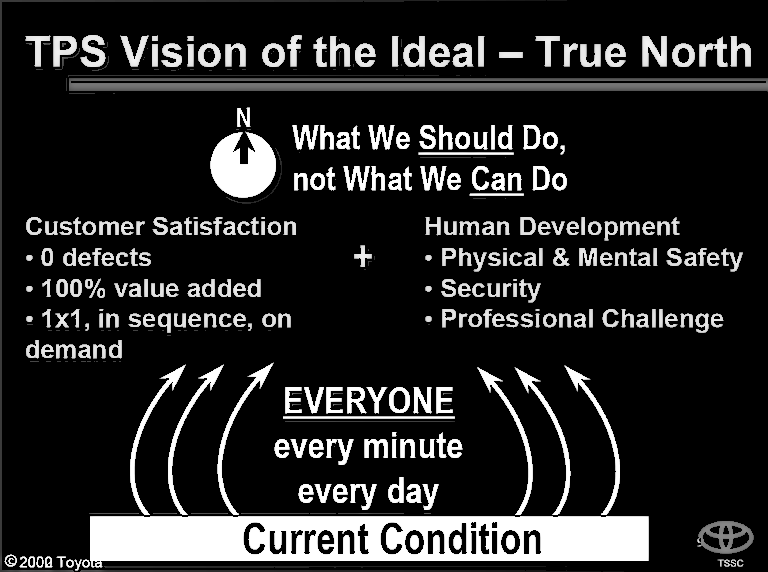
Lastly, the capital sigma Σ you may see reflected in various places within this book either in its normal orientation or turned up, represents the paradoxical summation of open-ended value inherent in the human condition. I hope all these symbols will become as clear to you as a well-fed spring by the time you finish reading Leanism.
U People / Toward 6σ
For another example of this symbolism, Leanism compresses the term Lean Six Sigma, into “/6σ.” The forward slash “/” naturally represents all Lean true-north value theory in addition to a metaphysical focus on what consumers’ most meaningful problems are; the six “6” represents the attempted quantification and measurement of what people value; the sigma “σ” represents the necessary estimation of what true-north value is in the universe. Since the infinity symbol “∞” is the elusive, circular perfection we all pursue, “/6σ” overall represents the pragmatic pursuit of perfection.
The “U” in U/People is partially inspired by the U-shaped work “cells” implemented by Toyota when it developed the Toyota Production System (“Toyota Seisan Houshiki”), and the office cubicles where office workers sit. Beyond Toyota’s U-shaped work cells, the U in U/People also applies figuratively as a universal condition of people either at work as a core concept of /6σ efficiency, or in serving customers, which the U shape facilitates. The “U/People” business model is thus both ego-centric to an organization and allo-centric to consumers at the same time. All people lean philosophically toward all other real or legally fictitious people by providing them with meaningful true-north value. “U” is thus open-ended organizationally, logically and ethically.
For example, philosophers use “U” to mean abstract concepts like Universal Egoism, economists use it to mean Utility, and academics use it to mean learning at a University. All of these meanings around “U” align and cohere within U/People sitting in cubicles, working in U-shaped cells, and serving as optimistic, upwardly mobile, white- and blue-collar people creating what moves consumers up along toward who and what they most want to be.
U/People in the Lean True-North Value Stream
The application of the philosophical principles embodied by the U/People business model is not new, as you might expect. People-oriented business ideologies have been advocated since the dawn of management science. The entire history of business theory applies notions of true-north value to people’s everyday lives within well-known concepts that you may have studied. For example, IBM’s “Three Basic Beliefs” stated by Thomas Watson Jr. in 1962 are strikingly similar to Lean principles:120
- Respect for the individual,
- Superlative customer service, and
- The pursuit of excellence
And in 2003, IBM employees in a ValueJam revised these Three Basic Beliefs to be:121
- Dedication to every client’s success;
- Innovation that matters—for our company and for the world; and
- Trust and responsibility in all relationships
The philosophy of Lean thus reconstructs old concepts in new ways because businesses like IBM still struggle to learn from and implement them with each new technological change, which is no easy task.122 Furthermore, the field of management science as exemplified by the Lean-oriented books continuously improves on and expands Lean concepts below,123 such as Lean’s intersection with Six Sigma. An extremely small sample of recent business titles focused on “Lean” each year over the last couple of decades includes:
- “AI-Powered Lean: How to Apply Artificial Intelligence to Improve Processes, Cut Waste, and Deliver Faster Results” (2025)
- “Lean in Government and Education: Applying Lean Thinking Beyond the Factory” (2025)
- “The Lean Brain : How Neuroscience Can Supercharge Continuous Improvement” (2025)
- “Lean for CEOs” (2024)
- “The New Lean” (2024)
- “Lean Project Management” (2023)
- “The Lean Supply Chain” (2018)
- “Lean Strategy” (2017)
- “Lean Six Sigma” (2016)
- “Lean Enterprise” (2015)
- “Lean Customer Development” (2014)
- “Lean Analytics” (2013)
- “The Lean Mindset” (2013)
- “Lean for Dummies” (2012)
- “The Lean Startup” (2011)
- “Lean Thinking” (2010)
As of 2025, Amazon.com lists an excess of 30,000 books on the topic of “Lean” with over 10,000 in the business genre. Leanism adds to this discussion by encompassing all of these domains, moving beyond start-ups or any other single aspect of business to provide the best explanation and goals for all business activity so you may deploy Lean most powerfully in an HQ.
Elaborating on Lean as a philosophy though requires knowing what Lean really is as a business discipline in the context of all this history. While James Womak and Daniel Jones delineated one of the most widely revered descriptions of Lean in the book, “Lean Thinking” in 2010, despite all this time and effort, no universally recognized, internally consistent definition of Lean exists. To provide some symmetry between how Toyota Motor Corporation defines Lean and all the other definitions of Lean generally, I broadly define Lean within Leanism as:124
- Fairness and respect for people;
- Viewing the customer as the “true-north”;
- Elimination of waste to add true-north value; and
- Creating scientific, knowledge-driven continuous improvement.
Leanism’s item (1), “fairness and respect for people,” describes how business workers in Lean processes are as dignified as the organization’s own customers. Leanism’s item (2), “viewing the customer as the ‘true-north,’” emphasizes that since an organization exists most fundamentally to serve the interests of customers who pay money, stakeholders receive that money only as a consequence of that service toward what customers ultimately value. For an example of this Leanism item (2), “viewing the customer as the ‘true-north’,” in a business context, consider what Tim Cook, who succeeded Steve Jobs as CEO of Apple, Inc. and is one of the world’s foremost experts on Lean manufacturing and supply chains, said in his keynote at the company’s 2016 developers’ conference:
I would like to take a moment to talk about why we do what we do at Apple. Our North Star has always been about improving people’s lives by creating great products that change the world.125
Just as importantly, Leanism’s item (3) of its definition of Lean, “elimination of waste to add value,” along the lines of Muda, Mura and Muri, explicitly states that the overall mission of Lean is to eliminate work that does not directly or indirectly create true-north value for the customer. The philosophy of Lean revolves around optimizing opportunities by avoiding misallocating resources. Leanism’s item (3) can thus be summarized as optimizing efficiency to enhance profits while avoiding overly exploiting people.126
Leanism’s item (4), “creating scientific, knowledge-driven continuous improvement,” emphasizes the empirically iterative nature of Lean arising both from the Buddhist presently experiencing self and the Western Philosophy of Science to discover and reveal what most philosophically leans an organization toward consumers’ highest values and thus leads them to sustain and enhance their being.
Pay Us over the Pay Wall at the Margin of Existence
You must recognize that while all definitions of Lean emphasize maximizing true-north value for consumers, none identifies true-north value beyond what customers actually purchase or use. Lean to date has focused on identifying true-north value by what people purchase at the point of sale. This Lean method of analyzing what consumers reveal they prefer is the most direct and efficient method of understanding their greatest problems, since they are by and large what they do. However, when you lean further philosophically, you reach deeper, beyond what consumers do or say, to more accurately conjecture, hypothesize, theorize and identify who consumers are by better interpreting their data that you receive. This greater insight leads you to why customers truly value a product and/or service beyond what I call this “pay wall,” “pay us wall” or “point of purchase.”127
A pay wall is generally used by online media and information services to indicate the content that consumers must purchase with money. However, even in cases where media companies provide information without charging money, they generally do so in exchange for selling the viewers’ data and attention to advertisers, which forms its own sort of “pay us wall.” As the economist Herbert Simon said, “In an information-rich world, the wealth of information means a dearth of… attention and a need to allocate that attention efficiently among the overabundance of information sources that might consume it.”128 The “pay us” wall gets viewers to spend their attention and personal information viewing the advertisements instead of money as its own form of value to other businesses.
Advertisers in-turn directly charge people for their own products and/or services. The pay us wall represents the often unclear boundary between what people actually do that leads to meaningful monetization, and what organizations provide that creates true-north value for people in exchange. You likewise can use a U/People-oriented business methodology within an HQ to define what pain points consumers pray that you sooth at the pay us wall. A business creates points of purchase by predicting what true-north value customers shall be blessedly given by consuming its products and/or services.
Identifying the Four Steps to Lean
To get out of an HQ and move past consumers’ pay us wall, you must develop an overarching understanding of who consumers are and why they value products and/or services up along the Rubicon129 of their value streams. You must reach toward the firmament of true-north value in its most intangible, abstract sense and work back down to the specific activities, instruments and tools used by an organization to realize the specific details of those true-north values in consumers’ lives and existences through the products and/or services an organization reproduces. Where within this outcome space products and/or services satisfy consumers depends on the intersection of who, why, what, and how they are.
Along this Lean line of thinking, Peter Drucker130 said in, “The Practice of Management,” in 1954:
If we want to know what a business is we have to start with its purpose. And its purpose must lie outside of the business itself. In fact, it must lie in society since a business enterprise is an organ of society. There is only one valid definition of business purpose: to create a customer.131 [emphasis added]
This image of creating a customer reminds many of Drucker’s commentators as well as me of an unfinished sculpture Michelangelo created in 1525-30 CE titled, The Awakening Slave.132 This image depicts the body of a slave half-way carved out and created from the stone, as if the sculptor is in the process of bringing the slave to life.
However, I believe that organizations often misapply Drucker’s quote by only considering his statement regarding, “creating a customer.” This implies that organizations can artificially develop who consumers are and push products and/or services to them as if they were somehow slaves to an organization. However, if you read Drucker’s full quote, it says that organizations create a customer by meeting people as they are in front of the pay wall before they make a purchase. As Peter Drucker says a paragraph further down in, “The Practice of Management”:
It is the customer who determines what a business is. For it is the customer, and [s/he] alone, who through being willing to pay for a good or for a service, converts economic resources into wealth, things into goods.
The metaphysics of this statement— “[I]t is the customer who determines what a business is.”[emphasis added] — since “is” is a form of “to be,” ought to become apparent as you lean metaphysically through the U/People business model, toward those people who want to buy from you. With this customer-oriented business model, you may reach over the pay us wall to reproduce profits from who, why, what and how customers are as consumers, which leads to all consumption.
You thus speculate with every personal and business decision you make as to whether you can improve who customers are (or want to become) to satisfy them. The only way for you to increase the probability of success is by sufficiently aligning your speculative, intuitive beliefs about value with what consumers value. You ought to consider consumers less like slavish minds to hack, and more like Rodin’s, “The Thinker,” leaning toward what you ought to produce for them to better be.133
The Para-Science of Business and Lean
Besides deploying radical empathy, the best way to discover consumers as they are is to test them like Eric Ries did for his product, “IMVU” with his “Build-Measure-Learn” process. By doing this iterative testing, you too will surface consumers’ deepest demands that you in-turn philosophically analyze. Because all business value flows up through people, who still exceed anyone’s complete comprehension, business analysis still requires this philosophical synthesis of qualitative and quantitative information. Business cannot yet be managed by numbers alone for this reason. Thus, business is a para-science to which you may apply a scientific process of testing who consumers truly are with degrees of confidence in their revealed preferences.
As a contemporary of Fredrick Taylor, Walter Shewhart was one of the first, modern people to apply scientific empiricism to business to achieve customer success. Walter Shewhart invented the para-scientific, “Specification-Production-Inspection,” Shewhart Cycle134 in the early 1900s. Following Shewhart’s lead, Edward Deming famously modified the Shewhart Cycle into, “Plan-Do-Check-Act” as the “PDCA” or Deming Cycle. Deming introduced his PDCA Cycle to Japan in the 1950s.135 Through Toyota’s initial leaders like Eiji Toyoda and Taiichi Ohno, Toyota most particularly internalized PDCA in the 1950s within its industrial processes to create the foundation of the industrial Kaikaku (改革) that we now call Lean (厘). Kaikaku is the Lean term meaning a revolutionary improvement in a value stream to quickly create more value with less waste by up-ending the status quo. This cross-breading of Western, para-scientific business analysis with the legacy of Japanese theologies and philosophies is the pedigree and evolutionary beginning of the Lean meme.
In 2003, the venture capitalist Steve Blank in his book, “Four Steps to the Epiphany: Successful Strategies for Products that Win,”136 refined and applied these Kaikaku cycles toward starting up new businesses. In “Four Steps,” Blank described the four steps necessary to reach a commercial epiphany as a “Customer Development Model.” Blank’s Customer Development Model applies the Shewhart and Deming Cycles, and Drucker’s notions of customer development, toward building viable, new businesses. The Customer Development Model for new businesses follows the four steps of:
- Customer Discovery;
- Customer Validation;
- Customer Creation; and
- Company Building.
You can see the cover of Blank’s book here with Michelangelo Buonarroti’s, “The Creation of Adam,” painted on the ceiling of the Sistine Chapel. Blank notably added a light bulb between God137 and man who has an exclamation mark over his head.
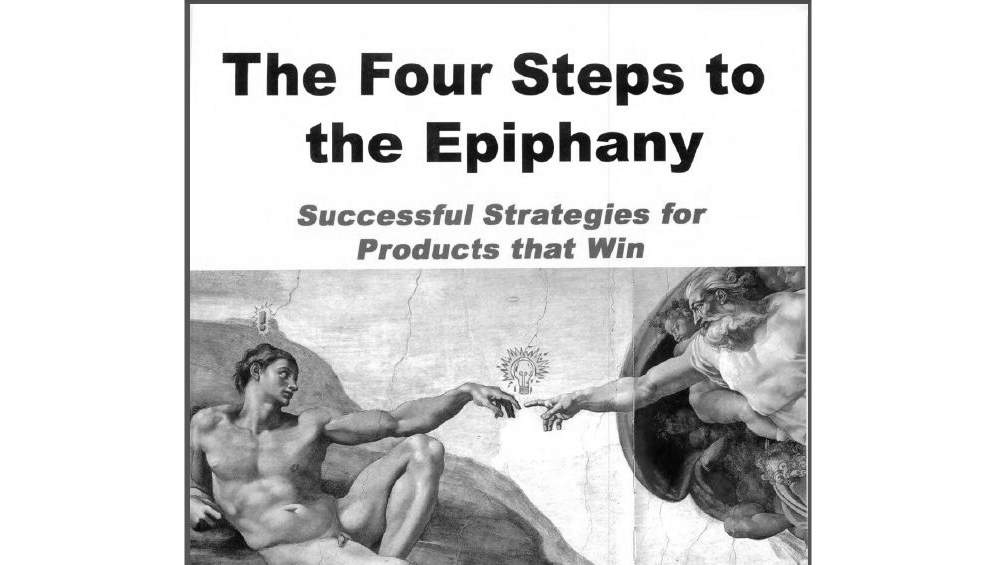
Eric Ries further consolidated the Shewhart, Deming and Blank cycles with his, “Build-Measure-Learn” process, and applied it to start up businesses as described by his book, “The Lean Startup.”138. Even though Ries skipped over initially intuiting what he thought ought to be built before he had something to measure and learn from, he applied this line of empirical thinking that reached back not only to Deming, Shewhart and Taylor, but also to the philosopher, Sir Francis Bacon (1561-1626) and scientist Galileo Galilei (1564-1642) during the European Renaissance. All of these empiricists emphasized testing rather than making deductive assumptions based on an abstract ideal. To emphasize how old this concept is, one of the first people to even think this way was actually the Arab scientist Ibn al-Haytham from 1000 C.E. Thus, Ries’, “Build-Measure-Learn,” methodology received wisdom from old masters and applied it to startup companies.
Reis was lauded for reintroducing empiricism to new product and/or service development since too many early stage business decisions were being made with bad effect based only on mental models of who consumers were and why they would purchase - mental models that were only created by analogy from empathy without any real data. However, true-north value is found at the pragmatic intersection of both conjecture from intuition and criticism from market testing in a virtuously para-scientific business cycle.139 Both are necessary to triangulate and truly know what consumers value.140 All these cycles, methods and models are all part of Leanism and the philosophy of Lean.141 They all require deeply empathizing with consumers’ pain points that you abduct from an intuition, infer from the problems they state, induce from their behavioral data, and deduce from the products and/or services they already purchase. Thus, you can reach commercial epiphanies by following the universal, Lean 3WH interrogatories as seen here:
- Who: Customer Discovery - Discovering who consumers are;
- Why: Customer Validation - Identifying why consumers are;
- What: Customer Creation - Constructing what makes consumers become who they want to be; and
- How: Company Building - Deducing how consumers become who they consider themselves to be as customers for the greatest profit.
Any organization may pursue this 3WH customer development process by discovering who consumers are, identifying why they value who they are, learning what they want to consume that makes them further be, and understanding how an organization ought to charge for what consumers will actually buy that cyclically supports their further becoming who, why and what they are and want to be. Or, as Eric Ries wrote, “If we do not know who the customer is, we do not know what quality is.”142
The ID Kata
Better discovering, identifying and quantifying the money you can make requires that you engage in Hansei (反省) by repeatedly reflecting on who consumers truly are in-line or on-line at stores, why they wish to purchase, and what will delight them most. How you reach your greatest profit through Eastern and Western philosophical traditions gets determined by continually improving your respect for people and revitalizing your competitive advantage through a traditional Lean process called a Kata (型 or形).143 Kata is a term of Japanese origin describing a repetitive method that links certain thoughts and behaviors together in parallel. In essence, a Kata is a logical system. You will better align the seemingly disconnected portions of consumers’ value streams by creating a mental Kata of the highest order, one that allows you to abduct, infer, induce, and deduce what value you can exchange for the most money.144
For those unfamiliar with logical systems, I will review and explain these terms so you have them in your head. Abduction and deduction are the technical terms for when you rely on your intuition or a law to tell you what creates the most true-north value for consumers.145 Deduction comes from a specific principal or fact, but abduction comes from having a hunch, leaning forward with your best intuition, and deeply empathizing with consumers’ lives and existences while bracketing all else you think you know. For the sake of simplifying our Lean lexicon, we will use “intuition” to simply mean abduction going forward.
Inference and induction, on the other hand, allow you to hypothesize and theorize a general maxim from evident and specific data you have observed, rather than from any gut feeling (abduction) you may have. Rarely, if ever, will you have all possible data to make an true induction - though statistics carries a lot weight here - so you usually are inferring why or how much people value something in order to hypothesize how much money you will make. The best hypothesis to test is the one that not only delineates how you will make money, but also distinguishes between why you will achieve one result rather than another.146 And regardless of whether you conjecture, hypothesize, or induce, you must always test and deduce how you will make money. You may only deduce what consumers will value without making an assumption when you already know what consumers pay for, and you are absolutely confident that a product and/or service will be perceived by them to be a perfect solution, which is the ideal goal you always strive to perfect but will never achieve.
If you look closely at the capstone of a metaphysically HQ as shown below, you will see that beyond twin pillars of, “Respect for People” and “Continuous Improvement,” the Lean Management portion is composed of increasingly plentiful values, systems, processes, methods, techniques, and activities that ultimately result in the products and/or services delivered as you move toward your customer base. Through this process, a Lean HQ forms a temple, pyramid and/or steeple-shape above its foundation like the Greek delta symbol (“Δ”). It forms a symbolic, traditional Kata that fundamentally aligns its twin pillars of Respect for People and Continuous Improvement with all the people truly value as seen again here:
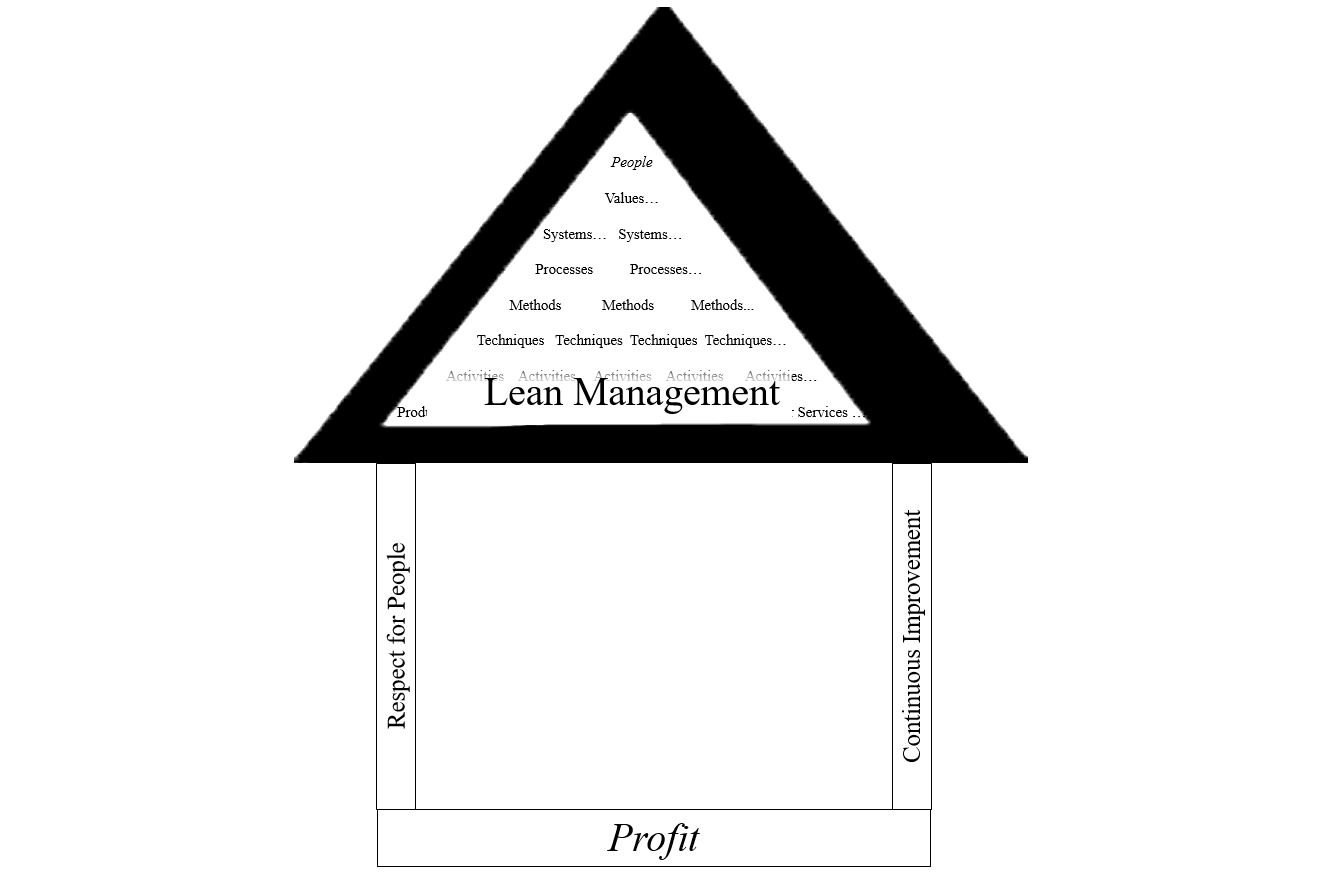
Following this pyramid principle,147 I likewise graphically represent “Lean Management” as an “ID Kata” in a delta “Δ” shape with “/” representing why, “_” representing the what, and “\” representing how. The sum of this ID Kata represents the entire exchange of who customers were in the present state for who they will become in the future state by purchasing the products and/or services that a Lean business provides. With the ID Kata, a Lean management team in the C-Suite can gain penetrating insight that might help an organization become something special, like a rocket ship or unicorn.
Using this traditional ID Kata, once you discover who consumers are largely by what they do, you intuitively, inferentially and/or inductively theorize through conjecture why consumers’ deepest problems cause them to truly value your goods and/or services. You match up why customers will buy anything at all with how you expect to exchange a solution for the greatest profit of all. Between why and how extending from who customers are around this ID Kata, you identify the solution by determining what products and/or services an organization ought to produce to serve their Freudian ids, egos and super-egos. The difference between why and how is the problem space that you resolve. A solution ultimately represents all of the values, systems, processes, methods, techniques, activities, and ultimately, products and/or services that remove customers’ problems in exchange for the price you charge and deduct from them.
Using the ID Kata, you can triangulate any given side or angle from the other two. You can determine who customers are in the difference between why they actually purchase now and how / how much they will pay for it - e.g. if customers pay a lot of money for potable water, it means they are thirsty. If they pay a lot for a sports car, there is a deeper psychological need. The difference between who customers are and what they want to buy can be extrapolated from the delta of why they want to live and exist and how they currently pay to do so. To begin this process, you must engage in customer discovery and identification with an n number of why’s along the left-side, rightward leaning y axis, as seen here.148
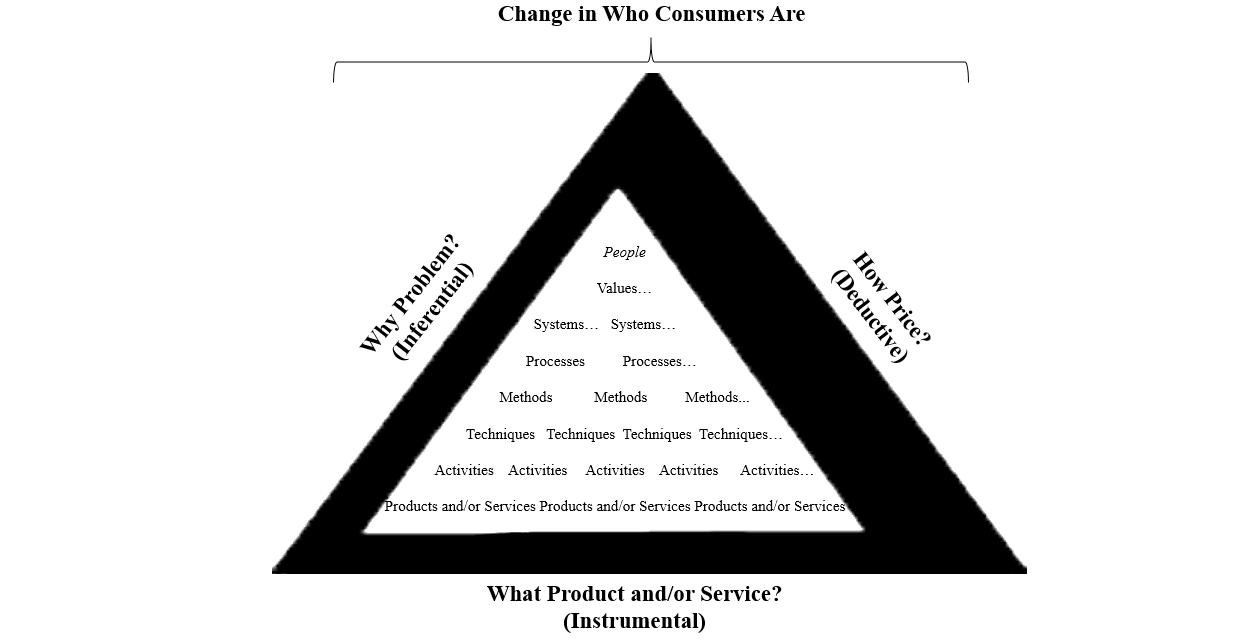
Along the y axis, you then proceed with a downward progression of increasing precision by intuiting, inferring and/or inducing what specific products and/or services solve consumers’ utmost problems until you conjecture a value theory. The right-side, leftward leaning line reflects how consumers will value each activity that produces the products and/or services they purchased with the price they paid. In the philosophy of Lean, if any activity reflected in the ID Kata does not support a profit, then it is considered one of the many forms of waste (in Lean terms, Muda, Mura, and Muri) and must be diverted from this organizational structure.
Finally, along the bottom x axis, you specifically determine what products and/or services best support who customers are and why customers will exchange anything for them at all. Since this x axis is a cost base that determines the bottom line, the closer you align why and how in parallel, the leaner an organization will be, the closer to customers you will become, and the greater the profit margins will be as you increasingly make a dent in the universe like the skyscrapers of companies’ HQs.149
To follow the four steps of the ID Kata, you ought to trace them as follows:
- Who - From the top of the ID Kata, ask who you have reason to believe potential customers are based both on intuition and data, by empathizing with why, what and how they wish to purchase solutions that solve their problems to further and better be;
- Why - Going down to the left, ask why values, systems, processes, methods, techniques, activities and products and/or services provide true-north value to a target market, solving their problems to further and better be, so you may intuitively conjecture, inferentially hypothesize or inductively theorize what you will sell them and how you will make meaningful amounts of money;
- What - Rounding out the bottom, ask whether what products and/or services you wish to offer in-fact delights and satisfies consumers with the most narrowly tailored solution possible with sufficient margins for error correction; and
- How - Heading back toward potential customers, ask how all the line-items of the products and/or services, activities, techniques, methods, processes, systems and values that you construct and provide lean back toward supporting the greatest profit, in perfect alignment with the human problems they resolve, with the least waste possible.
In between the four steps of 3WH are three acts of empathizing, conjecturing and criticizing tying the ID Kata together:
- Empathizing with consumers through data;
- Conjecturing from intuition, hypothesizing from inference, theorizing from induction, and/or legalizing from deduction (whenever possible) what best solves consumers’ problems for the greatest profit; and
- Criticizing whether products and/or services produce the greatest true-north value by rigorously testing whether they will generate the highest profit.
Here you can see the addition of these three elements around the ID Kata here:

These degrees of explanation align with the para-scientific methods of analysis you will employ in your business ideology (a.k.a. your ‘ID’eology). These explanations follow certain patterns of reasoning with decreasing degrees of confidence, from deductive laws to inductive theories to inferential hypotheses, and finally to intuitive conjectures. These patterns of reasoning originate from the entire tradition and legacy of the Western Philosophy of Science. The correlation between these Methods of Analysis and Degrees of Explanation used in the ID Kata are organized in this table.
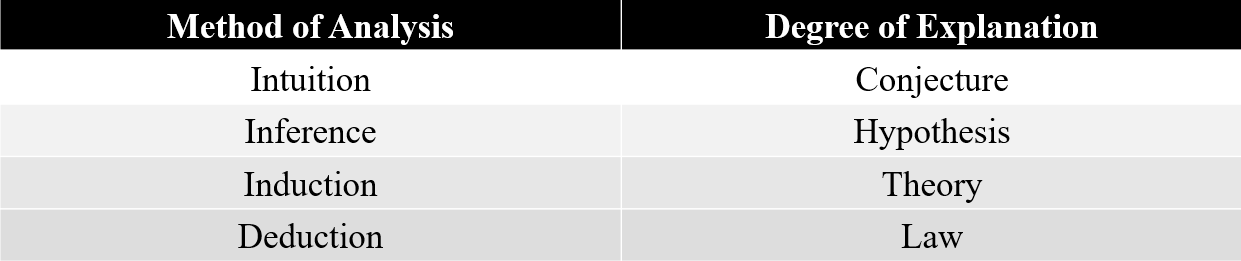
As you better learn to apply these Methods of Analysis and Degrees of Explanation around the ID Kata, the more you will engage in the Lean process of Shu-ha-ri (守破離).150 Shu-ha-ri is a Lean term of Japanese origin meaning: (1) learn from tradition, (2) iteratively improve tradition, and (3) transcend tradition in the process of mastering Leanism.151 The traditional ID Kata will eventually flow through your practice of Shu-ha-ri, so that you may intuitively apply Lean principles toward making money by creating the truest value.
High Flying Mamas
For a fairly obvious example of using this complete ID Kata and Shu-ha-ri process, presume you own an airline and wish to market services to mothers who often have a large say in how a family’s travel budget gets spent. You have learned that these mothers purchased large, safe, but otherwise unremarkable minivans (in their own opinion) that they use to transport their children in one piece. Your data gives you reason to believe that why these mothers live and exist is in large part for their children as a physical and emotional extension of themselves. Naturally, this is a universal, true-north value, and thus a very powerful one. Given this knowledge, you theorize from this data that these mothers will most value a specific class of airline service that will keep their families seated together, near a bathroom, with diapers and other sanitary items provided in a large seat-pocket in front of them. You believe it will induce them to purchase higher priced seats at the back of the plane than they otherwise would have knowing they will have these conveniences handy. You may now transcend this speculation and test your profit conjecture with a few sample consumers to hypothesize whether this new tier of service increase profits when all is said and done. Based on those test results, you can then iteratively improve your family-oriented flight offer until you confirm that it best extends and optimizes the lives of the mothers who fly, and thereby increase your runaway.
I recommend that you extend this Lean ID Kata technique through the Lean process of Shu-ha-ri to consumers’ much more obscure identities and motivations. By following Shu-ha-ri, you apply the ID Kata by carefully observing and applying it to what consumers physically and virtually say and do in relation to who they are. You always analyze how you can make an effective difference in consumers’ lives and existences for the greatest profit in a semi-circular, U-shaped pattern around the ID Kata, moving first from either why customers have a problem or how they will pay for a solution. Once an organization identifies who customers are in this difference, the ID Kata flows naturally to explain why, what and how that organization intuits, infers, induces and/or deduces what customers most truly value to conjecture, hypothesize, theorize, and in some cases legalize what they want to buy from you.152 The best explanation for how a business will make money is the one that can be tested at each point in the ID Kata’s abstract stream of causes, and the better the explanation for how that business will make money, the more universally profitable the business will become.
In the early stages of explaining who customers are and why and what they most truly value, you may choose to use intuition instead of inference or induction even if it may require more second guessing from you later on. This analytical process will be more fully elaborated as Leanism proceeds. Most importantly, how you apply the ID Kata toward making money meaningfully defines the core ideology around which your business interests revolve.
For example, you can see the structure of the ID Kata represented in Toyota’s Lexus division’s, “Relentless Pursuit of Perfection,” advertising campaign made famous in the 1980s and 1990s. The image from the advertisement below shows a temple of champagne glasses standing up on the engine of a Lexus luxury car while it spins its wheels inside Toyota’s HQ.
Once Toyota discovered who its target market of luxury buyers were, it used an inference engine like the ID Kata to abstract why people wanted to buy anything from them at all. Before determining who would become its customers, Toyota first needed to determine who were consumers of transportation and why. With who and why firmly in mind, Toyota then identified what form of transportation to reproduce just in time to make their future customers become more of who they wanted to be. In the process, Toyota deduced how to charge for why and what its customers really wanted to buy in Takt time. Takt time is a Lean term of German origin meaning a perfect pace of production designed to meet customers’ ongoing demand just-in-time to provide their utmost satisfaction.

Toyota’s competitors and all organizations adhere to these same developmental processes and spacetime constraints for developing products and/or services in Takt time. You can see this measurement of Takt time symbolized broadly by the calipers within the Acura logo for Honda’s luxury division, in the Infiniti logo for Nissan’s luxury division, and the similar, pyramid shape of the ID Kata. As you remove the space and time constraints of organizational processes by eliminating waste, you increasingly make more money with increased margins in Lean fashion by creating narrowly tailored solutions upwardly focused on who, why, what and how consumers ought to be.
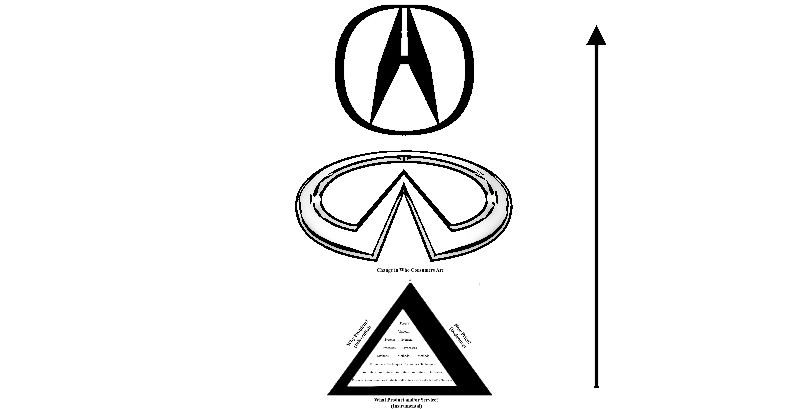
Toyota’s Lexus division’s Relentless Pursuit of Perfection advertisement with its champagne glasses stacked upward was made at the same point in time that John Krafcik first coined the term “Lean” to describe Toyota’s own “Production System.” Toyota’s luxury Lexus division demonstrated the concept of Lean in this advertisement by accurately inferring why Lexus’ target customers had a problem with the cars currently in the market, theorizing what to precisely produce and deliver, and then assumptively deducing how to price those benefits in exchange for the greatest profit. That is why this ad made luxury car buyers want to purchase and pay Toyota’s price.
Following the ID Kata around like you see reflected in the Infiniti and Acura logos, your true-north value theory should intuit, infer and/or induce why consumers want to buy from who you discovered they are in the context of their real lives and existences. You abstract and then assume why consumers are from the problems they have to hypothesize what and how to reproduce meaningful goods and/or services that they will buy. You deduce what specific processes, methods, activities, instruments and people that consumers ought to be paying for to serve their highest values, which is how you make money meaningfully, as seen again here in detail for reference.
Once you transcend the ID Kata through Shu-ha-ri, you will reach even greater commercial heights.
UP in the Air
For example, consider this ID Kata as an analytical process for investigating the provision of business class airplane service to consumers up in the jetstream:
- Who are the target customers?: They are age 35-60 professionals who travel frequently and upgrade classes whenever their companies will pay for those seats;
- Why do they value travel?: They value safely accomplishing business goals to earn a living to support their lifestyles and families; potentially meeting other business people and experiencing some prestige; possibly experiencing new or favorite places (i.e. fun); and hopefully escape the daily grind a bit - those are their valuable problems;
- What do you produce that serves those values?: They consume safe movement from one location to the next; preferred member lines for prestige and convenience; lounges for mingling with other business travelers and working; and travel guides to encourage discovery at destinations;
- How do you price these products, services, methods, and systems to align them with why consumers fly so you may reach the greatest profit?: An organization’s value and profit gets built from the mechanics and pilots employed; the schedules kept; the destinations served; and the lounges staffed, which all contributes to the price charged. You ought to align the price you deduct from customers to exchange who they were as a person present in one location, with who they wish to become as the same person delighted to be at the destination of their choice.
Clearly though, airlines could do a lot more to serve who their business-class customers are and why they value business class travel to better monetize their becoming more of who their business-class customers want to be and become. Airlines ought to lean right toward consumers to discover who their customers are and why they value being to most accurately reproduce what their target markets wish to further be and become, which is well-travelled, in a virtuous business cycle.
Leaning up toward people’s true-north values through the ID Kata and Shu-ha-ri considers both the source and satisfaction of consumers’ demands. At this point your perspective dramatically changes, and you circle around and call it a business revolution and change in business paradigm.153 In Lean terms, you call this, “Kaikaku,” which again, is a revolutionary improvement of a value stream to quickly create more value with less waste. Given how meaningfully a Kaikaku business revolution affects consumers’ lives and existences, and an organizations’ prospects for producing profits, take a moment to reconsider and reflect on The Oxford English Dictionary’s definition of Revolution:154
***Revolution • (noun) Brit. /ˌrɛvəˈl(j)uːʃn/ , U.S. /ˌrɛvəˈluʃ(ə)n/:
I. A circular movement
II. Change, upheaval
III. Consideration, reflection***
Consumers are Always Right
Clearly, you ought to lean an organization toward consumers’ highest values by aligning who customers want to be with what an organization will provide throughout the U/People business model. Taking the U/People business model one step further: If you think of the ID Kata in three dimensions at each level of an organization, you can see below a depiction of this parallel alignment on its side facing rightward, with the flow and pull of the ID Katas running across each division of an organization’s value stream. You can see again Auguste Rodin’s, “The Thinker,” standing in for consumers on the right, who are themselves lean thinking, trying to extend and optimize their own lives and existences, in Figure 1.21:156
<< (1) an organization infers who consumers are<<

>> (2) an organization flows matter and energy represented by products and/or services up U/People’s true-north value stream, which are pulled forward by customers’ demand as a last step>>
Notice that when you focus on how right customers are by testing what they most value, each ID Kata within an organization leans so that its y-axis becomes the hypotenuse of each division. However, when the price charged customers is larger than the problem they perceive a business to be solving, then that organization leans away from customers in the wrong direction, which is not good. As you know, in a Lean HQ, profit is its bottom line, but the aim of Lean Management is always toward customers. In fact, many factory rooftops share this same pattern like you see on these here in New York.

All organizations ought to likewise lean philosophically not through false profits but rather toward consumers through the U/People business model to, Uniquely/Profitably Extend and Optimize People’s Lives and Existences. A profit arises only as a consequence of keeping U/People in mind, rather than being self-caused by its own pursuit, which is an important point many managers miss.
Thus, an organization’s profit represents an oracle of business, to whom you refer when seeking consumers’, and by extension an organization’s, highest values. Jim Collins and Jerry Porras, in their 1994 book “Built to Last,” agreed with this when they quoted David Packard, one of the founders of the multi-billion dollar information technology company Hewlett Packard (now called “HP”), who said in 1960:157
I want to discuss why [emphasis his] a company exists in the first place. In other words, why are we here? I think many people assume, wrongly, that a company exists simply to make money. While this is an important result of a company’s existence, we have to go deeper and find the real reasons for our being. As we investigate this, we inevitably come to the conclusion that a group of people get together and exist as an institution that we call a company so they are able to accomplish something collectively that they could not accomplish separately—they make a contribution to society, a phrase which sounds trite but is fundamental… You can look around [in the general business world] and still see people who are interested in money and nothing else, but the underlying drives come largely from a desire to do something else—to make a product—to give a service—generally to do something which is of value. So with that in mind, let us discuss why the Hewlett-Packard Company exists…. The real reason for our existence is that we provide something which is unique [that makes a contribution].
Collins and Porras summarize this discussion by David Packard as:
[W]e see David Packard ruminating about what we can best describe as corporate existentialism, pondering about the philosophical, noneconomic ‘reasons for being’ of his company.
You use the U/People business model to better discover a company’s reason for being based on what you already know about how to make money. You may use the U/People acronym to aggregate and unify all the information you have access to beyond the ability of any single person to completely understand it. Yet you may universally apply U/People to decisions because the explanations it provides reach toward Hellenistic levels of abstraction so you may deduce and measure how much something is really worth to the customers you serve. To do this, you must balance the problem you ought to solve with the price consumers will pay to exchange their dissatisfaction for delight.
This form of pragmatic idealism satisfies consumers’ normative and true-north values as well as possible within any given circumstances since intuition, inference and induction are pragmatic, while deduction is ideal for knowing why consumers will pay the price for products and/or services. Pragmatic idealism reflects the tension in the history of thought between rational, logical progress and moral and aesthetic values.
As Collins and Porras wrote in “Built to Last,” “The dual nature—the pragmatic-idealism—of many of the visionary companies in our study. They are not purely idealistic; nor are they purely pragmatic. They are both.”158 Collins and Porras go on to write, “Marriott Corporation, like Motorola and HP, explicitly embraced the paradox of pragmatic idealism,”159 which means they strive to be perfect as far as they can be within the universe even if that perfection is ultimately unattainable. Toyota itself creates this paradox by using Lean within its own organization by requiring cooperation and coordination while encouraging independent thinking and action.160
The business ideologies proposed in “Built to Last” and by Toyota using Lean reconcile what really is with what ought to be. This tension between the pragmatic and the ideal, the Yin of all existential problems and Yang of prices representing perfect solutions, is the same philosophical problem described by the famous philosopher David Hume in the 1700s, which he referred to as the, “Is-Ought” problem. You will use U/People from here on to attempt to reconcile the Is-Ought problem in your business ideology, between intuitive, inferential, inductive and deductive methodologies, to expand and optimize all organizations’ profitability. Ideally the ontology of your business model is what ought to be to most profitably serve customers’ lives and existences. This concept is much like what Stephen G. Simpson, Mathematics Research Professor at Vanderbilt University said regarding certain mathematical proofs, “There’s this ongoing tension between the idealization and the concrete realizations, and we want both.”161
U/People and Michael Porter’s Value Chain
Michael Porter, a Harvard Business School professor and one of the most widely respected business strategists, described the ideal business model ontology with what he called the, “Generic Value Chain.” In a way, you can see the U/People value stream simply as a reformulation of Michael Porter’s Generic Value Chain from his seminal strategy book, “Competitive Advantage: Creating and Sustaining Superior Performance.”162 Here is a diagram of Michael Porter’s Generic Value Chain for reviewing and comparing the departments of the U/People business model to Porter’s own chart:163
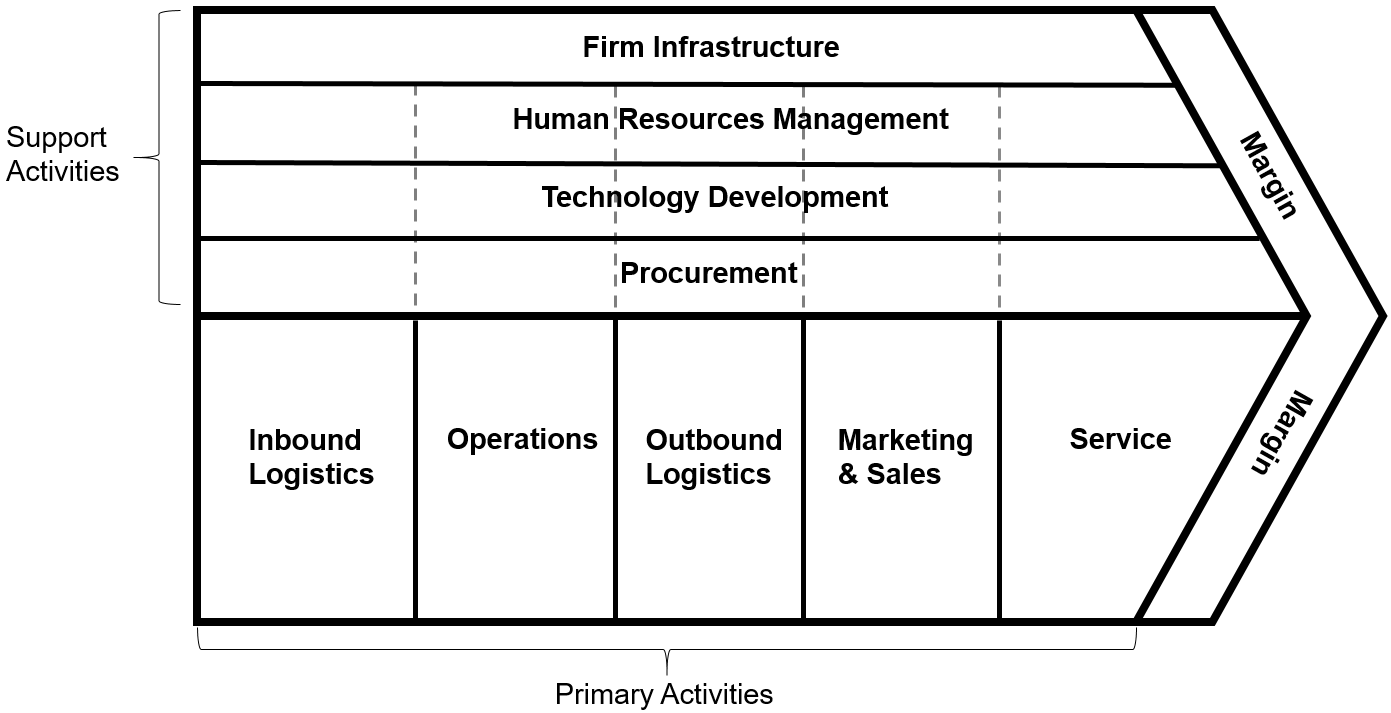
The U/People business model aligns with the traditional business functions and academic disciplines of Porter’s value chain by similarly providing an overall diagram of these concepts, breaking each out separately throughout this book’s Value Streams. Margin in Porter’s diagram as reflected above gets made by what an organization leans toward in the balance of revenues minus expenses, or in the terms of Leanism, the solution to consumers’ complaints over the economic cost to all people.
However, distinct from Porter’s value chain, the U/People business model flows beyond the borders of an organization both to all economic activity and to the source of all true-north value from consumers’ perspectives.164 As you lean metaphysically, you advocate for Lean value streams based on customers’ fundamental human needs at a deeper and more integrated level than even Michael Porter describes. Instead, you lean philosophically at an intuitive, metaphysical and physical level in addition to all else you know about who people really are beyond Porter’s Generic Value Chain. A Lean business ideology more specifically describes how you identify and exchange ideally normative and pragmatically personal true-north values for money.
By extending Porter’s Generic Value Chain to its most extreme, you could instead perceive margin on the right side of the diagram as matter and energy flowing toward customers in the opposite direction as money, from which you would subtract the economic cost of producing the energizing material (i.e. products and/or services) provided from the left. As you learned from elementary physics, matter and energy (or “ME” like in “MEaning”) are equivalent when units of matter are multiplied by the speed of light. Energy is simply matter actually (or with the potential) to move through spacetime due to universal, physical forces. For ease of reference, I may periodically refer to matter / energy just as “energy” moving upward along the crooked arrow of time.
This idea around energy relates to a highly abstract, naturalistic perspective of business applicable to all people-oriented value theories like Lean.165 From this perspective, utility is a direct or indirect satisfier of fundamental human needs like matter and energy, and money is the contractual right to consume that matter and energy based on the social contract to which an organization is soundly bound. Since the term “Lean” also means the efficient use of matter and energy, I propose that is why people intuitively gravitate toward Lean as a universal business principle, which you now know as a business oriented metaphysics.
By uniquely/profitably extending and optimizing people’s lives and existences, you may abstract these concepts within your own business ideology like within Porter’s Generic Value Chain. You may also apply the U/People framework to an organization without over-simplifying or over-complicating its execution. You may understand each word of the U/People business model as an element of a Lean business ideology from which you can reproduce metaphysical profit at each stage of the business cycle that eventually gets realized from the order-to-cash process that a CFO maintains, or as equity gains or dividends promised to stakeholders. Here again is each level of the U/People organizational chart for you to review:
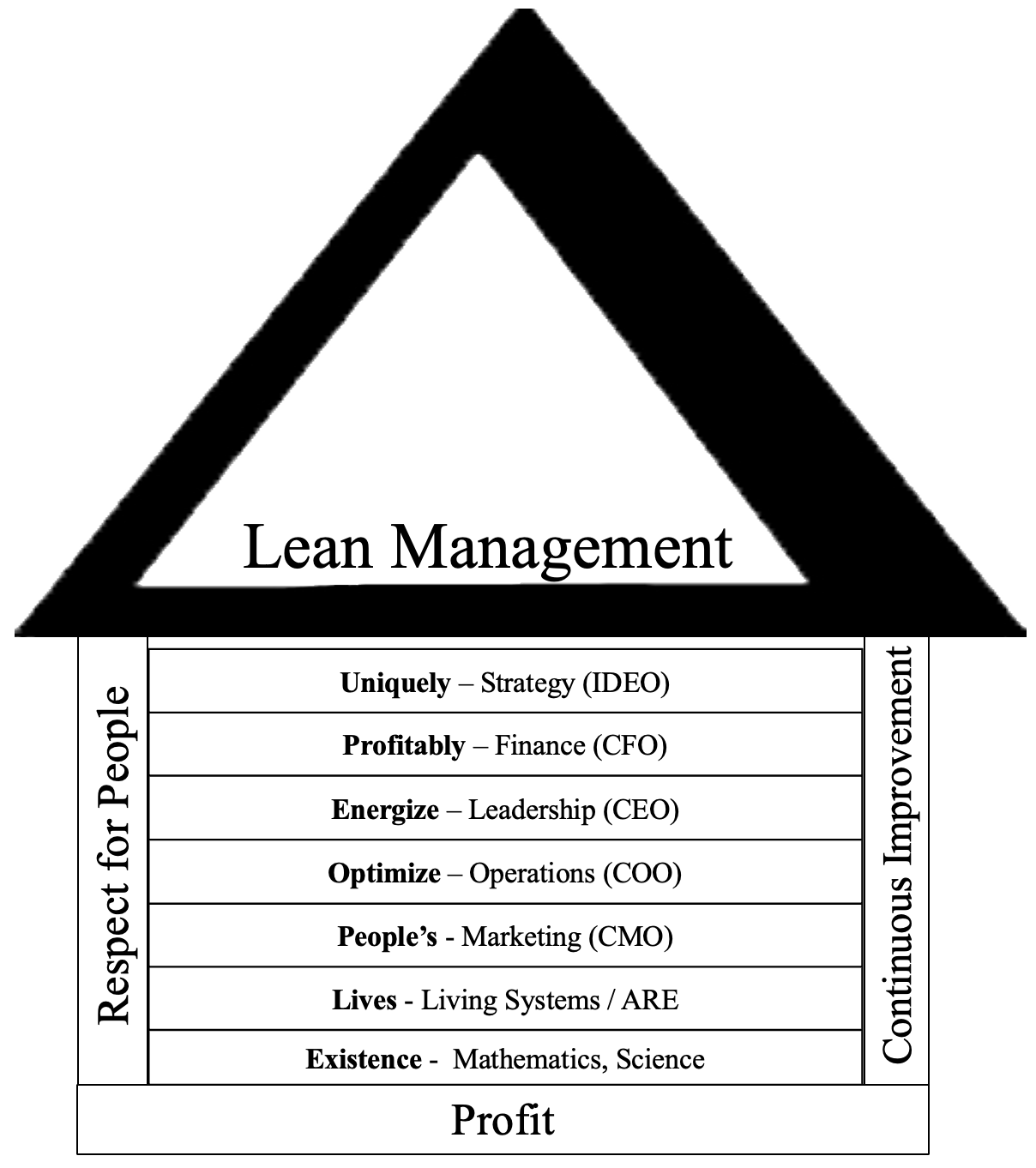
Per the above, you may relate Uniquely to an Information, Innovation and Design Officer, the IDEO; Profitably to the accounting and finance divisions through a Chief Function Officer, the CFO; Extending to the primary manager of all stakeholders through a Chief Energizing Officer, the CEO; Optimizing to a Chief Optimization Officer, the COO; People’s to a meaningful marketing department through a Chief Meaning Officer, the CMO; Lives to consumers as living systems that you support with products and/or services; and Existence to why you, organizations and customers are here and consume anything at all.
Leanism first emphasizes that all true-north value starts with who you discover consumers are and why they want to buy as living systems through mathematics, science and intuition. Once you intuit, infer or induce why customers buy based on who they are, an organization must then lean toward and attempt to deduce what increasingly tangible methods, techniques, activities, products and/or services will extend and optimize consumers’ lives and existences for which they spend, buy and invest that will generate the greatest profit. From marketing to accounting and finance, money is the bridge between these activities. Along these lines, understanding consumers allows you to lean an organization up toward what consumers most value beyond everyday matters to create uniquely competitive advantages for a company to get consumers to choose your products and/or services first.166
Like the U/People business model, this corporate hierarchy is not new. In “Built to Last,” Collins and Porras also noted that Johnson & Johnson did the same in 1943 where they said,
J&J has periodically reviewed and slightly revised the wording of the credo since 1943, the essential ideology—the hierarchy of responsibilities descending from customers down to shareholders and the explicit emphasis on fair return rather than maximum return—has remained consistent throughout the history of the credo.[emphasis added]167
Like Johnson & Johnson, you will find that U/People organizational chart provides a people-focused value system identifying what stakeholders find most meaningful in philosophical, scientific, psychological, economic and monetary terms. Leanism advances this arrangement by placing the CEO in the middle of the Gemba (現場), which is Lean parlance for the center of an organization, as shown in the U/People organizational chart above.168
L-Shaped Reflection of What U/People Value
If you were to lay the U/People business model out horizontally from left to right again like Porter’s Generic Value Chain as you can see in the chart below, the horizontal alignment of what people truly value across customers’ value streams reflects who customers are and what customers’ demand to support themselves through an organization’s people, functions, and products and/or services in exchange for large amounts of money representing the legal right to direct the consumption of other products and/or services - of other matter and/or energy - procured further up along the economic value stream.
Starting with consumers flowing demand as information to an organization, an organization in-turn reflects that demand in “L” shaped fashion at the bottom of the (rightward facing) “U” by sending products and/or services back to customers. The L-shaped logo of Toyota’s luxury Lexus division as seen below demonstrates how an organization ought to lean toward its customers to reflect their demand, flowing products and/or services back up to them in the pragmatic pursuit of their perfection:
(1) << Information flows from consumers’ highest values from right to left

(2) >> Around the “L” so customers may pull products and/or services back up their true-north value streams
As an organization provides products and/or services in exchange for money, you might modify the above value stream to something curling into a six “6,” and eventually leaning into something that looks like a sigma “σ,” as seen here in a Lean Six Sigma “/6σ”:

As consumers think about your products and/or services, and you receive further feedback, the reproduction cycle begins to form a single figure eight, which when oriented on its side, is the symbol for infinity. This symbolic dynamic will become critical as you proceed to iteratively pursue customers’ perfection “/σ∞”:

You Leanism When Marketing Toward People
Given that Peter Drucker said that marketing as well as innovation are the two primary entrepreneurial functions of business,169 marketing naturally stands as a business discipline explicitly charged with both: (1) measuring consumer demand for products and/or services; and (2) communicating what innovative products and/or services get offered to best provide what customers want and need. Marketing formally executes in both directions of the production cycle like a palindrome informing both what you produce and communicating the true-north value of products and/or services to customers in the end. Marketing may be perceived as just being an advertising and promotion function, or it may be seen as a place of central analysis synthesizing production with demand, matching products and/or services to the appropriate consumers, and engaging in Lean, metaphysical thinking.
For an analogy that helps describe this marketing process through the business functions, consider an organization bowing toward customers based on what you provide them (/), and customers needfully leaning back (\) to hand an organization money based on how those products and/or services further support who they are. The intersection of an organization and consumers through the exchange of products and/or services forms a fulcrum (Δ), or delta, over the point of purchase in the center of the business cycle. This fulcrum stands between the production of products and/or services as structured matter / energy and consumers’ willingness to exchange money170 over this “pay us” axis so it springs forth and trickles down in return.
For companies to most effectively focus on the end-goal of customer satisfaction, each employee in a business ought to at some level understand why customers decide to exchange money for what an organization offers across the point of purchase. Modern, creative employees’ greatest intrinsic motivation depends on their understanding what they contributed toward producing customers’ lean satisfaction, however indirectly, because they identify themselves as good, productive people. Employees’ highest form of motivation will come from caring about improving customers’ and stakeholders’ lives and existences. While this can be highly intellectual, Leanism is not dealing in vague aphorisms, but rather real science and philosophy supported by substantial evidence and the intellectual history of humankind.
By understanding employees’ intrinsic motivation, you may in-turn provide them with the resources to understand why customers consume products and/or services as opposed to competitors’.171 Once employees understand their contributions to customers’ lives and existences, an organization as a whole can communicate more effectively throughout the business cycle to achieve business objectives for the short and long-term success of stakeholders and society-at-large.172
Everyone at an organization ought to be able to relate each of his or her daily tasks to the specific wants and needs of customers and think through how they, their departments and/or organization may change to do so more effectively. Everyone ought to better understand what customers truly value, and be able to relate that insight across all organizational functions. While it is a truism that maximally effective businesses execute well on assessing consumers needs and delivering relevant products and/or services, I doubt that even executives at Toyota Motor Corporation would say that their entire organization simultaneously leans forward toward all consumers’ needs and backward in applying that understanding to address those needs most profitably.
Some executives might say that not every employee in his or her organization needs such a heavy intellectual burden. However, to the extent this converged philosophical perspective can be effectively reduced to easy to grasp acronyms, it will benefit every employee’s engagement and efficiency in serving customers. Furthermore, acronyms like U/People can help employees understand the value creation process for their specific products and/or services better, which would increase intrinsic motivation and improve change management. A lean, business ideology ought to provide an organization with a common dialogue about true-north value that focuses everyone on the true end-goal that the best businesses pursue.
While a form of “consumer oriented marketing” has been proposed and used for some time by marketers to measure and iterate the development and purchase of products and/or services based on consumers’ express or implied demand,173 I am proposing for an organization’s business ideology something far more expansive. I am proposing a business model and method for taking that customer centric analysis to the back of an office and forward into consumers’ lives and existences. I want to make it easy for you to go to the furthest reaches of space, time and all intuitive speculation so you may make some sense of it all to apply it universally across all cultures for a profit.
I am asking you to empathetically conjecture who and why customers and stakeholders are down to the first principles of knowledge, and then to test how an organization can reproduce that true-north value throughout the production cycle. I am asking you to use those insights to supplement and guide quantitative and qualitative business measurements to achieve it. From the top of this mountain of knowledge, you will transcend existing knowledge to see true-north value streams manifestly heading into blue oceans, extending toward a universal horizon, reaching a profit you never thought you would meet.174
Products and/or Services > P. and/or S. > PAOS > Pay Us > SOAP.com
The products and/or services (“PAOS”) all organizations reproduce embody the Lean true-north value that floats upward. “PA/OS” sounds like, “pay us,” and represents all problem resolution, and thus all true-north value.175 “PAOS” may be easily remembered as, “soap,” spelled backward.176 The term “PA/OS” thereby abstracts all the structured matter and energy you and customers consider and connote with consuming. You can see the concept of PA/OS synthesized in Amazon.com Inc.’s subsidiary, SOAP.com®, as shown by its logo here:

You can also see the concept of PA/OS within the Purity line of philosophy® brand soap:
From here on, for the sake of simplicity and ease of reference, I will refer to products and/or services as “product.” People generally use the word “goods” to refer to “product,” but perhaps after reading Leanism, you may find that adjective goods presumptive of products’ true-north value. You almost certainly find now many products are in fact bad. This makes the term “goods” a bad one to use since we have so many alternative words available that scrub out value judgments.177
People often use the terms “good” and “best” as nouns, adjectives and value qualifiers, and economists often describe products as goods as well, which tells of their own mind-set in regards to economic value theories. So Leanism does not refer to products as goods, so as not to falsely presume that a product is good when in fact it may be not. Referring to goods as PAOS if you so choose helps you launder any preconceived value judgments you may have about how much PAOS ought to cost. It allows you to freshly perceive and measure how truly meaningful products are to people. It forces organizations to analyze whether they consider a product to be better than the status quo, or no good at all. All good product must fundamentally reproduce true-north value within customers regardless of form. When you lean philosophically, you consider what a good actually means to more effectively create truly valuable product that customers really do consider to be and are in fact good, and for which customers willingly exchange their money for over the, “pay us wall.”
Analyzing why customers buy from concrete actions178 to first principles179 in a business ideology requires you to understand what and how product effects them. In a true-north value theory, you must understand the context that product will get used in consumers’ lives down to the scientific, philosophical and irrational levels.180 You must know why in the confusing confluence of consumers’ minds they decide to trade their money for product. You must understand what they value and how product leans toward them with equal or greater potential effect on their lives and existences than what the money spent with you could have otherwise purchased from competitors. Thus, the division over which you reach to get product purchased with money guides all value streams in commerce.
Value Stream 2: Money & Economics as True Value
The following Value Stream 2 will now take a brief tour through money and economics. Value Stream 2 focuses on money as the common medium of value exchange across the Rubicon of all true-north value streams. Money is the basic basis of self-organization for companies, and for the most part, society. Understanding money allows you to best lean into how consumers better live and exist due to who they are and what they truly value. To get this straight, Value Stream 2 will review some theories that will relate the various forms of philosophical, scientific, ethical and personally speculative values to money. Value Stream 2 will put money in the proper academic, historical and economic context for developing a business ideology as you move on up within the philosophy of Lean. It will also guide you through some caveats as to what makes money truly meaningful so you better understand what direction money takes to lead you to true-north value.