5. Scalaz Typeclasses
In this chapter we will tour most of the typeclasses in scalaz-core.
We don’t use everything in drone-dynamic-agents so we will give
standalone examples when appropriate.
There has been criticism of the naming in Scalaz, and functional programming in
general. Most names follow the conventions introduced in the Haskell programming
language, based on Category Theory. Feel free to set up type aliases if
verbs based on the primary functionality are easier to remember when learning
(e.g. Mappable, Pureable, FlatMappable).
Before we introduce the typeclass hierarchy, we will peek at the four most important methods from a control flow perspective: the methods we will use the most in typical FP applications:
| Typeclass | Method | From | Given | To |
|---|---|---|---|---|
Functor |
map |
F[A] |
A => B |
F[B] |
Applicative |
pure |
A |
F[A] |
|
Monad |
flatMap |
F[A] |
A => F[B] |
F[B] |
Traverse |
sequence |
F[G[A]] |
G[F[A]] |
We know that operations which return a F[_] can be run sequentially
in a for comprehension by .flatMap, defined on its Monad[F]. The
context F[_] can be thought of as a container for an intentional
effect with A as the output: flatMap allows us to generate new
effects F[B] at runtime based on the results of evaluating previous
effects.
Of course, not all type constructors F[_] are effectful, even if
they have a Monad[F]. Often they are data structures. By using the
least specific abstraction, we can reuse code for List, Either,
Future and more.
If we only need to transform the output from an F[_], that is just
map, introduced by Functor. In Chapter 3, we ran effects in
parallel by creating a product and mapping over them. In Functional
Programming, parallelisable computations are considered less
powerful than sequential ones.
In between Monad and Functor is Applicative, defining pure
that lets us lift a value into an effect, or create a data structure
from a single value.
.sequence is useful for rearranging type constructors. If we have an F[G[_]]
but need a G[F[_]], e.g. List[Future[Int]] but need a Future[List[Int]],
that is .sequence.
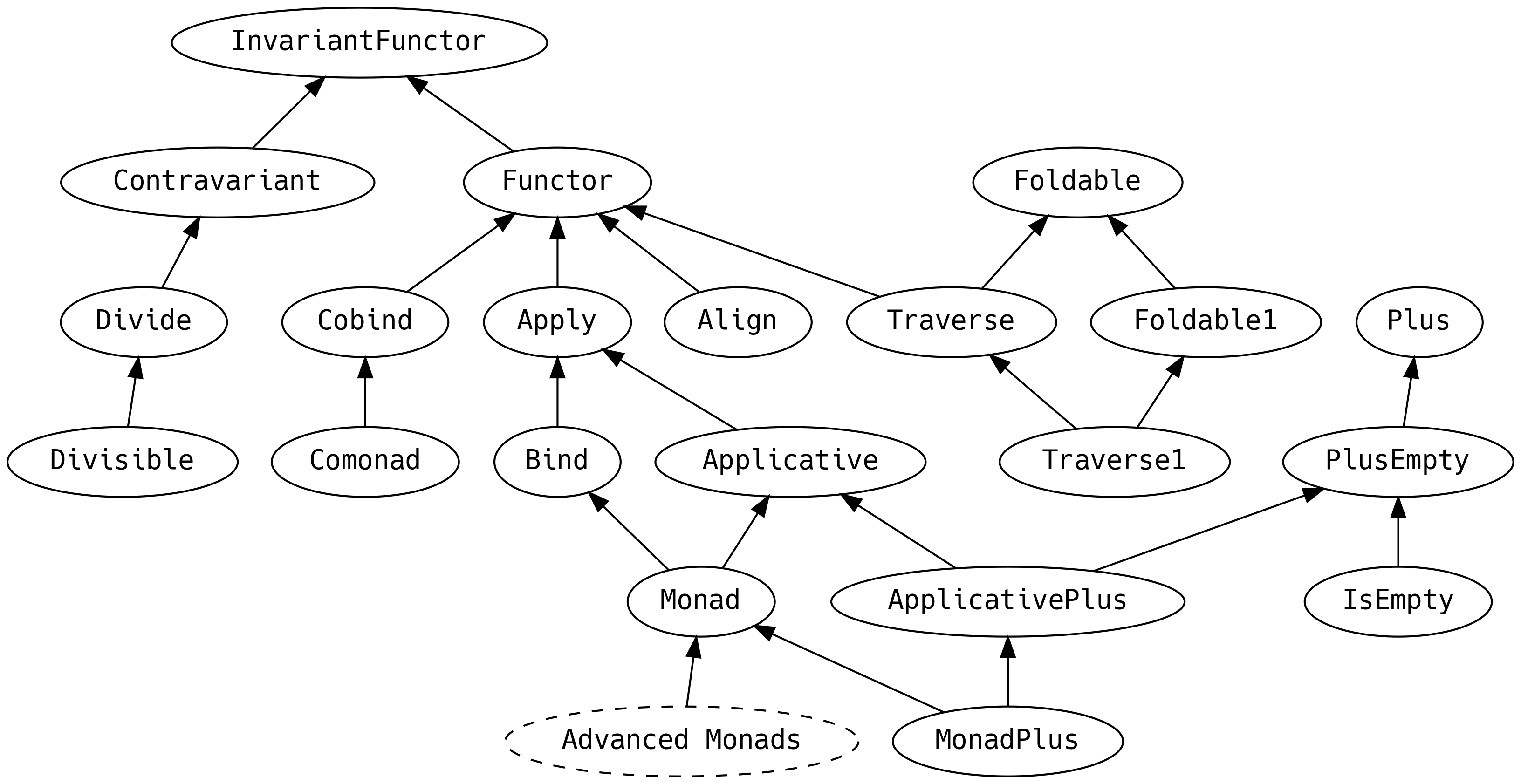
5.1 Agenda
This chapter is longer than usual and jam-packed with information: it is perfectly reasonable to attack it over several sittings. Remembering everything would require super-human powers, so treat this chapter as a way of knowing where to look for more information.
Notably absent are typeclasses that extend Monad. They get their own chapter
later.
Scalaz uses code generation, not simulacrum. However, for brevity, we present
code snippets with @typeclass. Equivalent syntax is available when we import
scalaz._, Scalaz._ and is available under the scalaz.syntax package in the
scalaz source code.
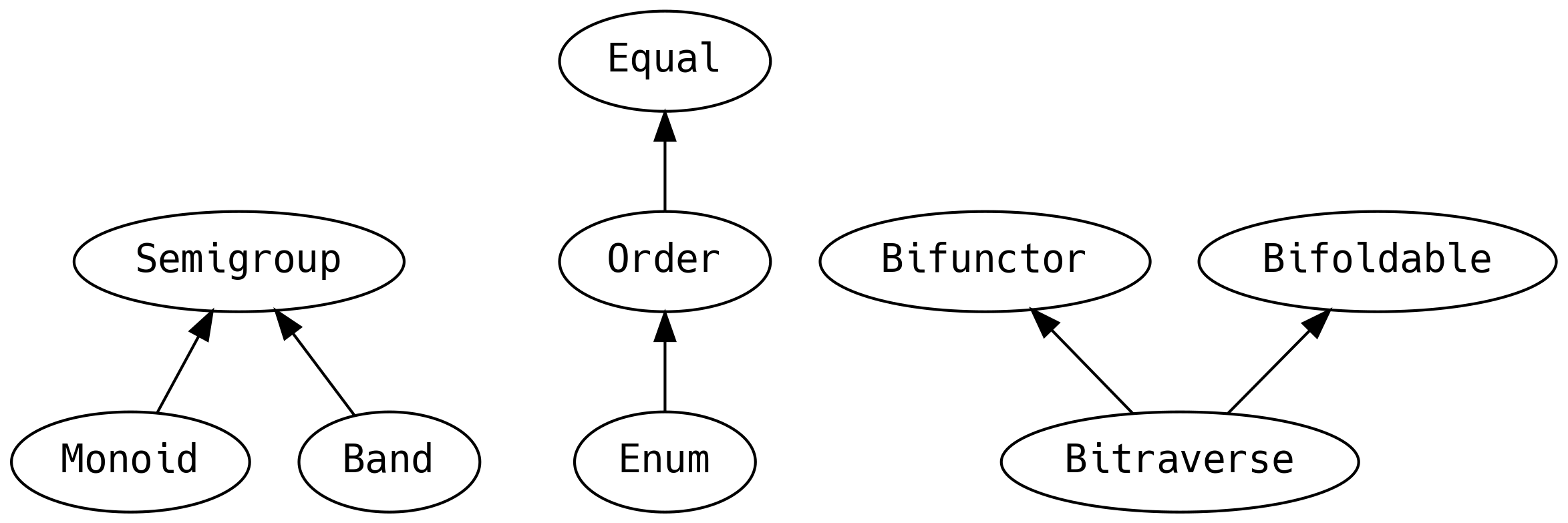

5.2 Appendable Things
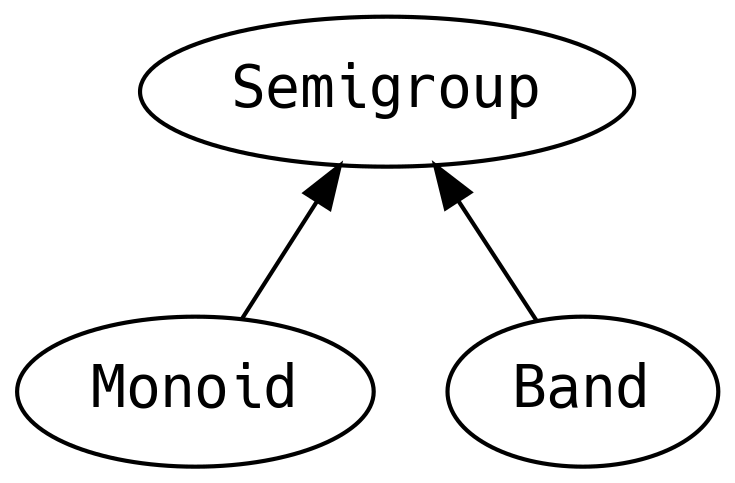
A Semigroup can be defined for a type if two values can be combined. The
operation must be associative, meaning that the order of nested operations
should not matter, i.e.
A Monoid is a Semigroup with a zero element (also called empty
or identity). Combining zero with any other a should give a.
This is probably bringing back memories of Numeric from Chapter 4. There are
implementations of Monoid for all the primitive numbers, but the concept of
appendable things is useful beyond numbers.
Band has the law that the append operation of the same two
elements is idempotent, i.e. gives the same value. Examples are
anything that can only be one value, such as Unit, least upper
bounds, or a Set. Band provides no further methods yet users can
make use of the guarantees for performance optimisation.
As a realistic example for Monoid, consider a trading system that has a large
database of reusable trade templates. Populating the default values for a new
trade involves selecting and combining multiple templates, with a “last rule
wins” merge policy if two templates provide a value for the same field. The
“selecting” work is already done for us by another system, it is our job to
combine the templates in order.
We will create a simple template schema to demonstrate the principle, but keep in mind that a realistic system would have a more complicated ADT.
If we write a method that takes templates: List[TradeTemplate], we
only need to call
and our job is done!
But to get zero or call |+| we must have an instance of
Monoid[TradeTemplate]. Although we will generically derive this in a
later chapter, for now we will create an instance on the companion:
However, this doesn’t do what we want because Monoid[Option[A]] will append
its contents, e.g.
whereas we want “last rule wins”. We can override the default
Monoid[Option[A]] with our own:
Now everything compiles, let’s try it out…
All we needed to do was implement one piece of business logic and
Monoid took care of everything else for us!
Note that the list of payments are concatenated. This is because the
default Monoid[List] uses concatenation of elements and happens to
be the desired behaviour. If the business requirement was different,
it would be a simple case of providing a custom
Monoid[List[LocalDate]]. Recall from Chapter 4 that with compiletime
polymorphism we can have a different implementation of append
depending on the E in List[E], not just the base runtime class
List.
5.3 Objecty Things
In the chapter on Data and Functionality we said that the JVM’s notion
of equality breaks down for many things that we can put into an ADT.
The problem is that the JVM was designed for Java, and equals is
defined on java.lang.Object whether it makes sense or not. There is
no way to remove equals and no way to guarantee that it is
implemented.
However, in FP we prefer typeclasses for polymorphic functionality and even the concept of equality is captured at compiletime.
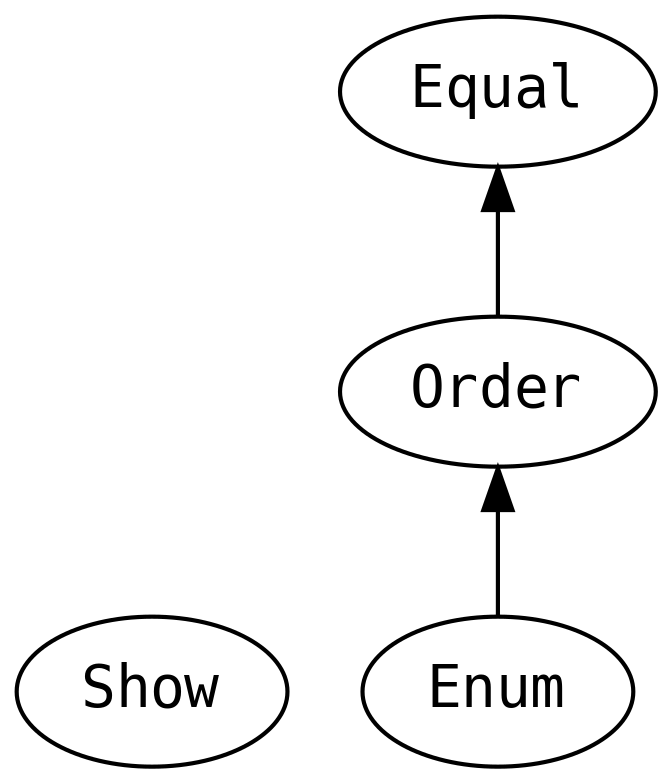
Indeed === (triple equals) is more typesafe than == (double
equals) because it can only be compiled when the types are the same
on both sides of the comparison. This catches a lot of bugs.
equal has the same implementation requirements as Object.equals
-
commutative
f1 === f2impliesf2 === f1 -
reflexive
f === f -
transitive
f1 === f2 && f2 === f3impliesf1 === f3
By throwing away the universal concept of Object.equals we don’t
take equality for granted when we construct an ADT, stopping us at
compiletime from expecting equality when there is none.
Continuing the trend of replacing old Java concepts, rather than data
being a java.lang.Comparable, they now have an Order according
to:
Order implements .equal in terms of the new primitive .order. When a
typeclass implements a parent’s primitive combinator with a derived
combinator, an implied law of substitution for the typeclass is added. If an
instance of Order were to override .equal for performance reasons, it must
behave identically the same as the original.
Things that have an order may also be discrete, allowing us to walk successors and predecessors:
We will discuss EphemeralStream in the next chapter, for now we just need to
know that it is a potentially infinite data structure that avoids the memory
retention problems in the stdlib Stream.
Similarly to Object.equals, the concept of .toString on every class does
not make sense in Java. We would like to enforce stringyness at compiletime and
this is exactly what Show achieves:
We will explore Cord in more detail in the chapter on data types, we need only
know that it is an efficient data structure for storing and manipulating
String.
5.4 Mappable Things
We’re focusing on things that can be mapped over, or traversed, in some sense:
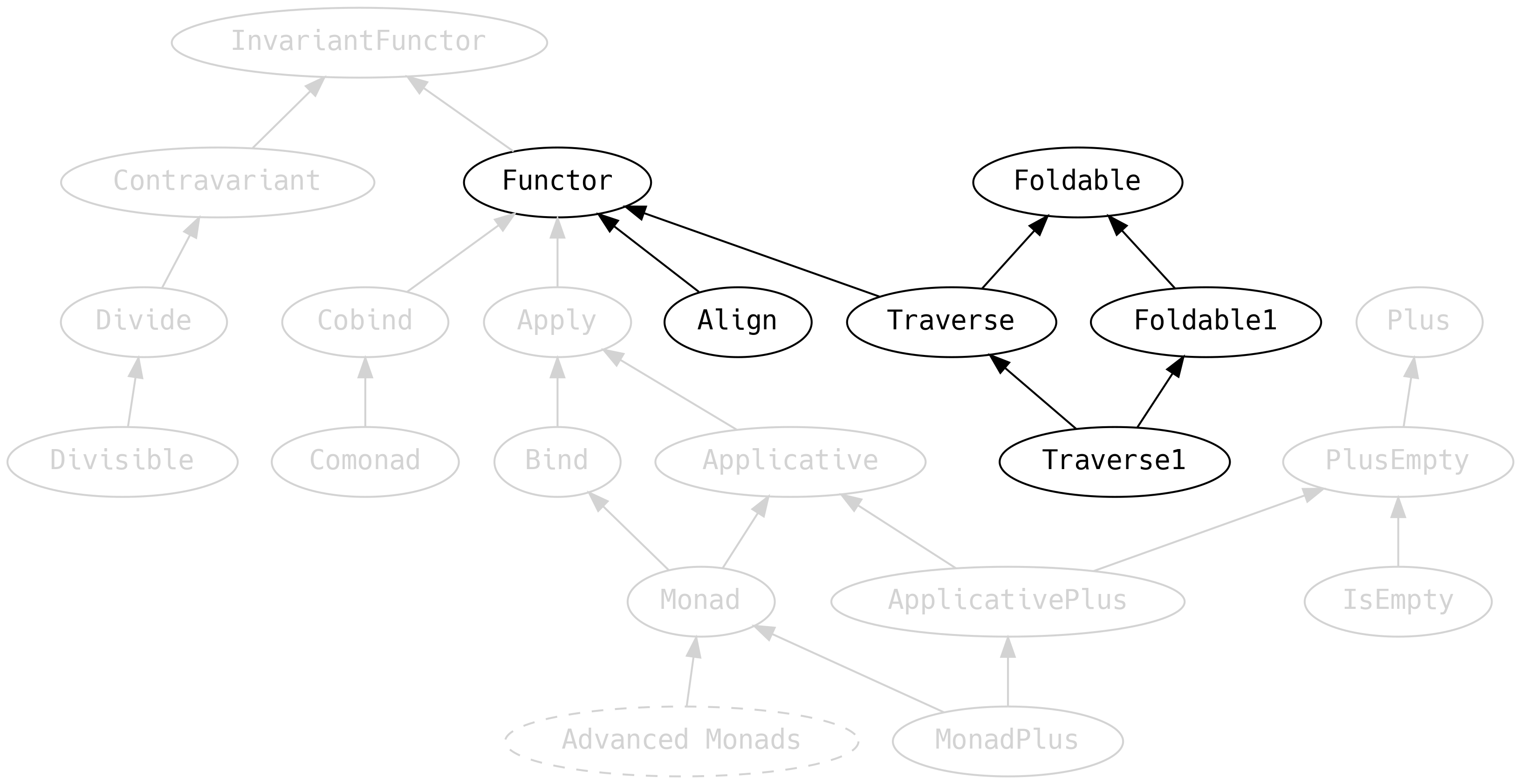
5.4.1 Functor
The only abstract method is map, and it must compose, i.e. mapping
with f and then again with g is the same as mapping once with the
composition of f and g:
The map should also perform a no-op if the provided function is
identity (i.e. x => x)
Functor defines some convenience methods around map that can be optimised by
specific instances. The documentation has been intentionally omitted in the
above definitions to encourage guessing what a method does before looking at the
implementation. Please spend a moment studying only the type signature of the
following before reading further:
-
voidtakes an instance of theF[A]and always returns anF[Unit], it forgets all the values whilst preserving the structure. -
fproducttakes the same input asmapbut returnsF[(A, B)], i.e. it tuples the contents with the result of applying the function. This is useful when we wish to retain the input. -
fpairtwins all the elements ofAinto a tupleF[(A, A)] -
strengthLpairs the contents of anF[B]with a constantAon the left. -
strengthRpairs the contents of anF[A]with a constantBon the right. -
lifttakes a functionA => Band returns aF[A] => F[B]. In other words, it takes a function over the contents of anF[A]and returns a function that operates on theF[A]directly. -
mapplyis a mind bender. Say we have anF[_]of functionsA => Band a valueA, then we can get anF[B]. It has a similar signature topurebut requires the caller to provide theF[A => B].
fpair, strengthL and strengthR look pretty useless, but they are
useful when we wish to retain some information that would otherwise be
lost to scope.
Functor has some special syntax:
.as and >| are a way of replacing the output with a constant.
In our example application, as a nasty hack (which we didn’t even
admit to until now), we defined start and stop to return their
input:
This allowed us to write terse business logic such as
and
But this hack pushes unnecessary complexity into the implementations. It is
better if we let our algebras return F[Unit] and use as:
and
5.4.2 Foldable
Technically, Foldable is for data structures that can be walked to produce a
summary value. However, this undersells the fact that it is a one-typeclass army
that can provide most of what we would expect to see in a Collections API.
There are so many methods we are going to have to split them out, beginning with the abstract methods:
An instance of Foldable need only implement foldMap and
foldRight to get all of the functionality in this typeclass,
although methods are typically optimised for specific data structures.
.foldMap has a marketing buzzword name: MapReduce. Given an F[A], a
function from A to B, and a way to combine B (provided by the Monoid,
along with a zero B), we can produce a summary value of type B. There is no
enforced operation order, allowing for parallel computation.
foldRight does not require its parameters to have a Monoid,
meaning that it needs a starting value z and a way to combine each
element of the data structure with the summary value. The order for
traversing the elements is from right to left and therefore it cannot
be parallelised.
foldLeft traverses elements from left to right. foldLeft can be
implemented in terms of foldMap, but most instances choose to
implement it because it is such a basic operation. Since it is usually
implemented with tail recursion, there are no byname parameters.
The only law for Foldable is that foldLeft and foldRight should
each be consistent with foldMap for monoidal operations. e.g.
appending an element to a list for foldLeft and prepending an
element to a list for foldRight. However, foldLeft and foldRight
do not need to be consistent with each other: in fact they often
produce the reverse of each other.
The simplest thing to do with foldMap is to use the identity
function, giving fold (the natural sum of the monoidal elements),
with left/right variants to allow choosing based on performance
criteria:
Recall that when we learnt about Monoid, we wrote this:
We now know this is silly and we should have written:
.fold doesn’t work on stdlib List because it already has a method
called fold that does it is own thing in its own special way.
The strangely named intercalate inserts a specific A between each
element before performing the fold
which is a generalised version of the stdlib’s mkString:
The foldLeft provides the means to obtain any element by traversal
index, including a bunch of other related methods:
Scalaz is a pure library of only total functions. Whereas List(0) can throw
an exception, Foldable.index returns an Option[A] with the convenient
.indexOr returning an A when a default value is provided. .element is
similar to the stdlib .contains but uses Equal rather than ill-defined JVM
equality.
These methods really sound like a collections API. And, of course,
anything with a Foldable can be converted into a List
There are also conversions to other stdlib and Scalaz data types such
as .toSet, .toVector, .toStream, .to[T <: TraversableLike],
.toIList and so on.
There are useful predicate checks
filterLength is a way of counting how many elements are true for a
predicate, all and any return true if all (or any) element meets
the predicate, and may exit early.
We can split an F[A] into parts that result in the same B with
splitBy
for example
noting that there are two values indexed by 'b'.
splitByRelation avoids the need for an Equal but we must provide
the comparison operator.
splitWith splits the elements into groups that alternatively satisfy
and don’t satisfy the predicate. selectSplit selects groups of
elements that satisfy the predicate, discarding others. This is one of
those rare occasions when two methods share the same type signature
but have different meanings.
findLeft and findRight are for extracting the first element (from
the left, or right, respectively) that matches a predicate.
Making further use of Equal and Order, we have the distinct
methods which return groupings.
distinct is implemented more efficiently than distinctE because it
can make use of ordering and therefore use a quicksort-esque algorithm
that is much faster than the stdlib’s naive List.distinct. Data
structures (such as sets) can implement distinct in their Foldable
without doing any work.
distinctBy allows grouping by the result of applying a function to
the elements. For example, grouping names by their first letter.
We can make further use of Order by extracting the minimum or
maximum element (or both extrema) including variations using the Of
or By pattern to first map to another type or to use a different
type to do the order comparison.
For example we can ask which String is maximum By length, or what
is the maximum length Of the elements.
This concludes the key features of Foldable. The takeaway is that anything
we’d expect to find in a collection library is probably on Foldable and if it
isn’t already, it probably should be.
We will conclude with some variations of the methods we’ve already seen.
First there are methods that take a Semigroup instead of a Monoid:
returning Option to account for empty data structures (recall that
Semigroup does not have a zero).
The typeclass Foldable1 contains a lot more Semigroup variants of
the Monoid methods shown here (all suffixed 1) and makes sense for
data structures which are never empty, without requiring a Monoid on
the elements.
Importantly, there are variants that take monadic return values. We already used
foldLeftM when we first wrote the business logic of our application, now we
know that it is from Foldable:
5.4.3 Traverse
Traverse is what happens when we cross a Functor with a Foldable
At the beginning of the chapter we showed the importance of traverse
and sequence for swapping around type constructors to fit a
requirement (e.g. List[Future[_]] to Future[List[_]]).
In Foldable we weren’t able to assume that reverse was a universal
concept, but now we can reverse a thing.
We can also zip together two things that have a Traverse, getting
back None when one side runs out of elements, using zipL or zipR
to decide which side to truncate when the lengths don’t match. A
special case of zip is to add an index to every entry with
indexed.
zipWithL and zipWithR allow combining the two sides of a zip
into a new type, and then returning just an F[C].
mapAccumL and mapAccumR are regular map combined with an accumulator. If
we find our old Java ways make us want to reach for a var, and refer to it
from a map, we should be using mapAccumL.
For example, let’s say we have a list of words and we want to blank out words we’ve already seen. The filtering algorithm is not allowed to process the list of words a second time so it can be scaled to an infinite stream:
Finally Traverse1, like Foldable1, provides variants of these methods for
data structures that cannot be empty, accepting the weaker Semigroup instead
of a Monoid, and an Apply instead of an Applicative. Recall that
Semigroup does not have to provide an .empty, and Apply does not have to
provide a .point.
5.4.4 Align
Align is about merging and padding anything with a Functor. Before
looking at Align, meet the \&/ data type (spoken as These, or
hurray!).
i.e. it is a data encoding of inclusive logical OR. A or B or both A and
B.
alignWith takes a function from either an A or a B (or both) to
a C and returns a lifted function from a tuple of F[A] and F[B]
to an F[C]. align constructs a \&/ out of two F[_].
merge allows us to combine two F[A] when A has a Semigroup. For example,
the implementation of Semigroup[Map[K, V]] defers to Semigroup[V], combining
two entries results in combining their values, having the consequence that
Map[K, List[A]] behaves like a multimap:
and a Map[K, Int] simply tally their contents when merging:
.pad and .padWith are for partially merging two data structures that might
be missing values on one side. For example if we wanted to aggregate independent
votes and retain the knowledge of where the votes came from
There are convenient variants of align that make use of the
structure of \&/
which should make sense from their type signatures. Examples:
Note that the A and B variants use inclusive OR, whereas the
This and That variants are exclusive, returning None if there is
a value in both sides, or no value on either side.
5.5 Variance
We must return to Functor for a moment and discuss an ancestor that
we previously ignored:
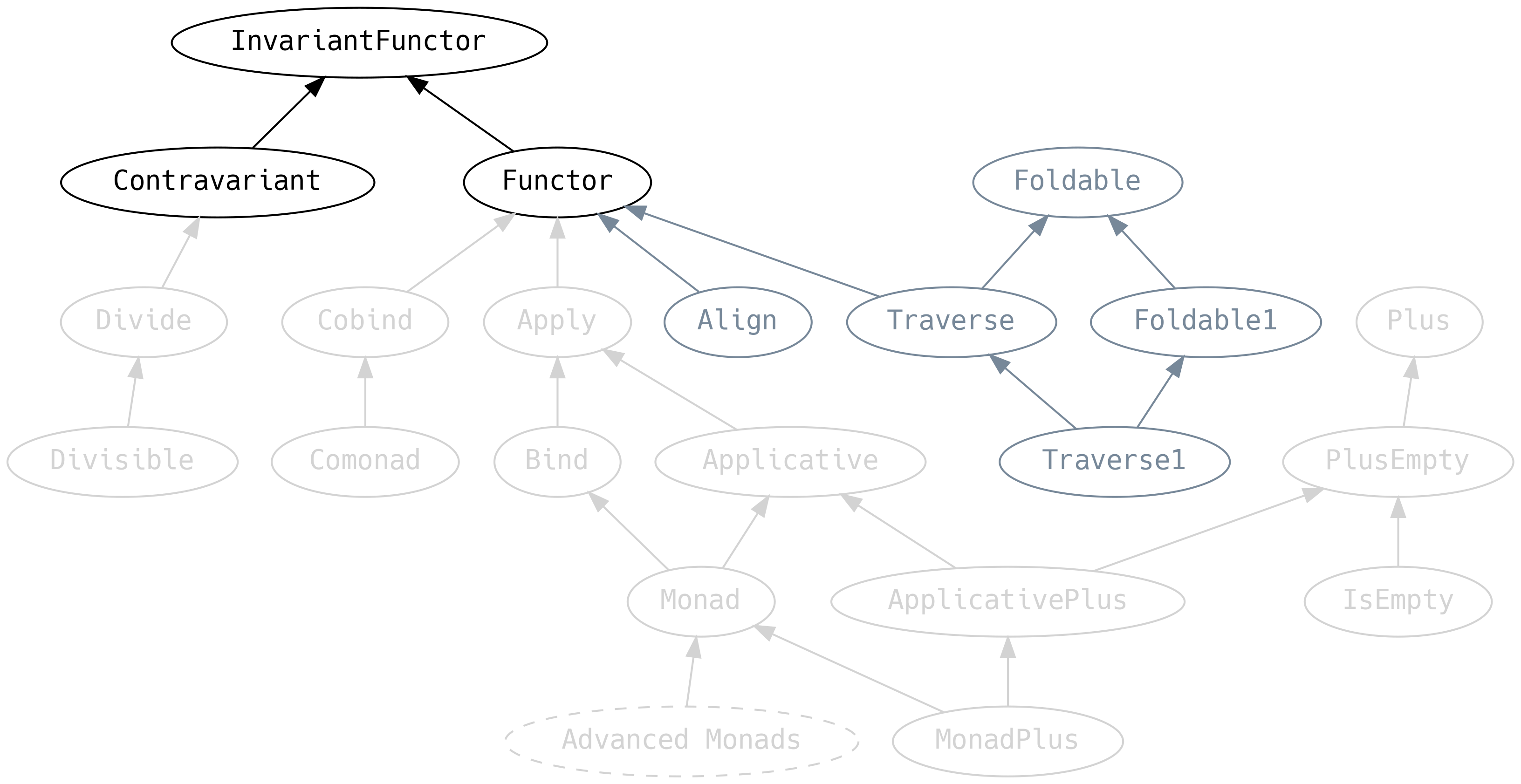
InvariantFunctor, also known as the exponential functor, has a
method xmap which says that given a function from A to B, and a
function from B to A, then we can convert F[A] to F[B].
Functor is a short name for what should be covariant functor. But
since Functor is so popular it gets the nickname. Likewise
Contravariant should really be contravariant functor.
Functor implements xmap with map and ignores the function from
B to A. Contravariant, on the other hand, implements xmap with
contramap and ignores the function from A to B:
It is important to note that, although related at a theoretical level,
the words covariant, contravariant and invariant do not directly
refer to Scala type variance (i.e. + and - prefixes that may be
written in type signatures). Invariance here means that it is
possible to map the contents of a structure F[A] into F[B]. Using
identity we can see that A can be safely downcast (or upcast) into
B depending on the variance of the functor.
.map may be understand by its contract “if you give me an F of A and a way
to turn an A into a B, then I can give you an F of B”.
Likewise, .contramap reads as “if you give me an F of A and a way to turn
a B into a A, then I can give you an F of B”.
We will consider an example: in our application we introduce domain specific
types Alpha, Beta, Gamma, etc, to ensure that we don’t mix up numbers in a
financial calculation:
but now we’re faced with the problem that we don’t have any typeclasses for
these new types. If we use the values in JSON documents, we have to write
instances of JsEncoder and JsDecoder.
However, JsEncoder has a Contravariant and JsDecoder has a Functor, so
we can derive instances. Filling in the contract:
- “if you give me a
JsDecoderfor aDouble, and a way to go from aDoubleto anAlpha, then I can give you aJsDecoderfor anAlpha”. - “if you give me a
JsEncoderfor aDouble, and a way to go from anAlphato aDouble, then I can give you aJsEncoderfor anAlpha”.
Methods on a typeclass can have their type parameters in contravariant
position (method parameters) or in covariant position (return type). If a
typeclass has a combination of covariant and contravariant positions, it might
have an invariant functor. For example, Semigroup and Monoid have an
InvariantFunctor, but not a Functor or a Contravariant.
5.6 Apply and Bind
Consider this the warm-up act to Applicative and Monad
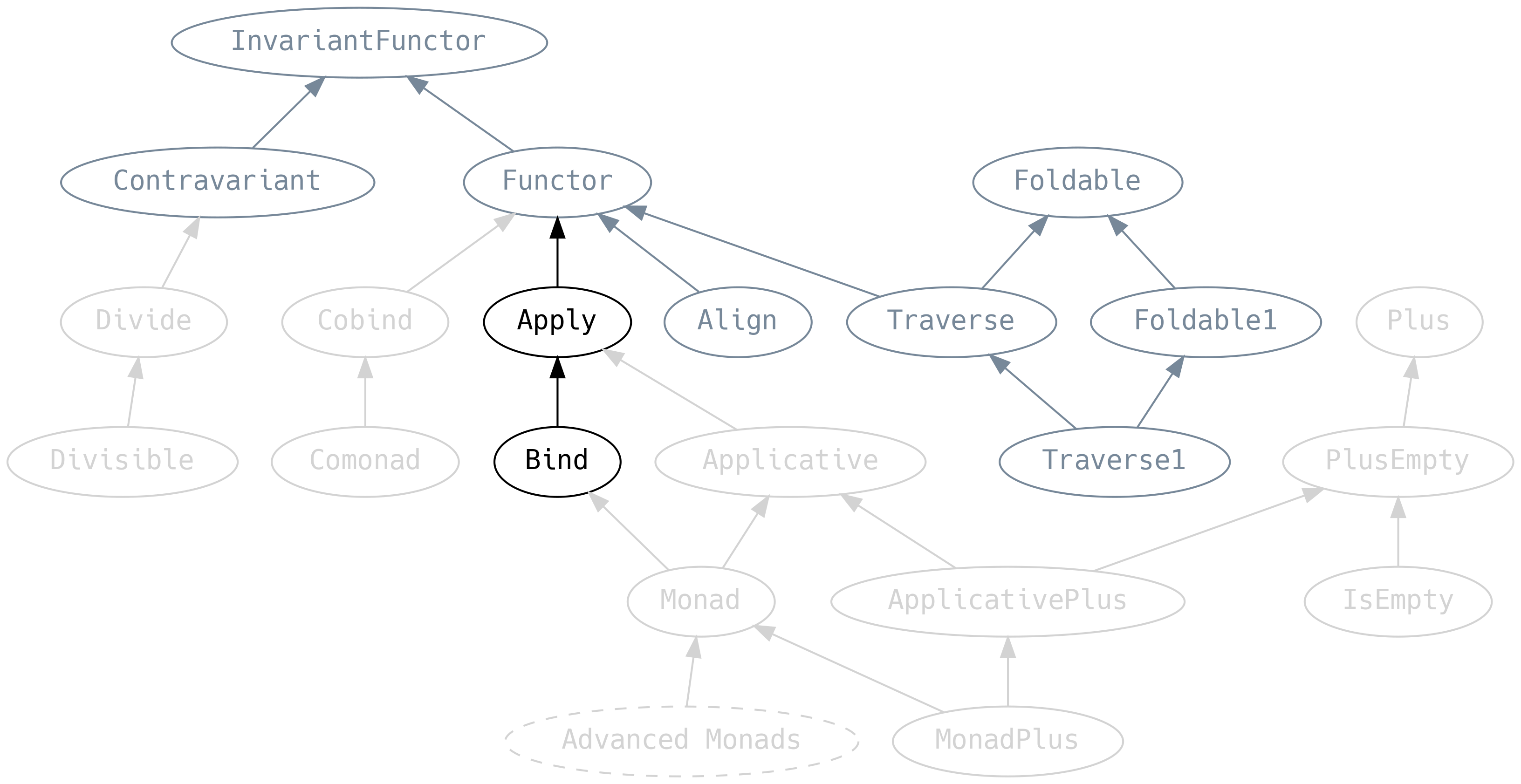
5.6.1 Apply
Apply extends Functor by adding a method named ap which is
similar to map in that it applies a function to values. However,
with ap, the function is in the same context as the values.
It is worth taking a moment to consider what that means for a simple data
structure like Option[A], having the following implementation of .ap
To implement .ap, we must first extract the function ff: A => B from f:
Option[A => B], then we can map over fa. The extraction of the function from
the context is the important power that Apply brings, allowing multiple
function to be combined inside the context.
Returning to Apply, we find .applyX boilerplate that allows us to combine
parallel functions and then map over their combined output:
Read .apply2 as a contract promising: “if you give me an F of A and an F
of B, with a way of combining A and B into a C, then I can give you an
F of C”. There are many uses for this contract and the two most important are:
- constructing some typeclasses for a product type
Cfrom its constituentsAandB - performing effects in parallel, like the drone and google algebras we created in Chapter 3, and then combining their results.
Indeed, Apply is so useful that it has special syntax:
which is exactly what we used in Chapter 3:
The syntax <* and *> (left bird and right bird) offer a convenient way to
ignore the output from one of two parallel effects.
Unfortunately, although the |@| syntax is clear, there is a problem
in that a new ApplicativeBuilder object is allocated for each
additional effect. If the work is I/O-bound, the memory allocation
cost is insignificant. However, when performing CPU-bound work, use
the alternative lifting with arity syntax, which does not produce
any intermediate objects:
used like
or directly call applyX
Despite being more commonly used with effects, Apply works just as well with
data structures. Consider rewriting
as
If we only want the combined output as a tuple, methods exist to do just that:
There are also the generalised versions of ap for more than two
parameters:
along with .lift methods that take normal functions and lift them into the
F[_] context, the generalisation of Functor.lift
and .apF, a partially applied syntax for ap
Finally .forever
repeating an effect without stopping. The instance of Apply must be
stack safe or we will get StackOverflowError.
5.6.2 Bind
Bind introduces .bind, synonymous with .flatMap, which allows functions
over the result of an effect to return a new effect, or for functions over the
values of a data structure to return new data structures that are then joined.
The .join may be familiar to users of .flatten in the stdlib, it takes a
nested context and squashes it into one.
Derived combinators are introduced for .ap and .apply2 that require
consistency with .bind. We will see later that this law has consequences for
parallelisation strategies.
mproduct is like Functor.fproduct and pairs the function’s input
with its output, inside the F.
ifM is a way to construct a conditional data structure or effect:
ifM and ap are optimised to cache and reuse code branches, compare
to the longer form
which produces a fresh List(0) or List(1, 1) every time the branch
is invoked.
Bind also has some special syntax
>> is when we wish to discard the input to bind and >>! is when
we want to run an effect but discard its output.
5.7 Applicative and Monad
From a functionality point of view, Applicative is Apply with a
pure method, and Monad extends Applicative with Bind.
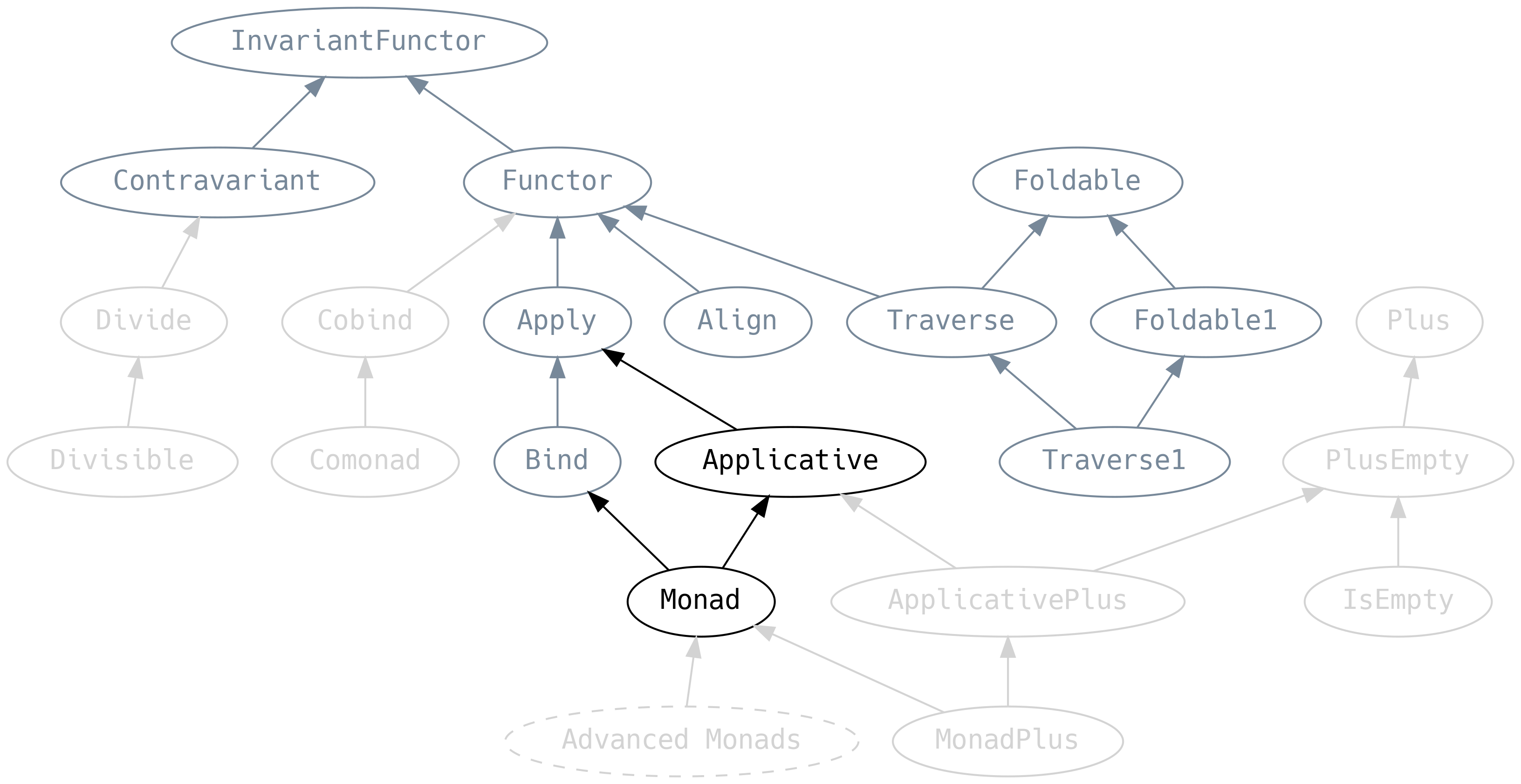
In many ways, Applicative and Monad are the culmination of everything we’ve
seen in this chapter. .pure (or .point as it is more commonly known for data
structures) allows us to create effects or data structures from values.
Instances of Applicative must meet some laws, effectively asserting
that all the methods are consistent:
-
Identity:
fa <*> pure(identity) === fa, (wherefais anF[A]) i.e. applyingpure(identity)does nothing. -
Homomorphism:
pure(a) <*> pure(ab) === pure(ab(a))(whereabis anA => B), i.e. applying apurefunction to apurevalue is the same as applying the function to the value and then usingpureon the result. -
Interchange:
pure(a) <*> fab === fab <*> pure(f => f(a)), (wherefabis anF[A => B]), i.e.pureis a left and right identity -
Mappy:
map(fa)(f) === fa <*> pure(f)
Monad adds additional laws:
-
Left Identity:
pure(a).bind(f) === f(a) -
Right Identity:
a.bind(pure(_)) === a -
Associativity:
fa.bind(f).bind(g) === fa.bind(a => f(a).bind(g))wherefais anF[A],fis anA => F[B]andgis aB => F[C].
Associativity says that chained bind calls must agree with nested
bind. However, it does not mean that we can rearrange the order,
which would be commutativity. For example, recalling that flatMap
is an alias to bind, we cannot rearrange
as
start and stop are non-commutative, because the intended
effect of starting then stopping a node is different to stopping then
starting it!
But start is commutative with itself, and stop is commutative with
itself, so we can rewrite
as
which are equivalent for our algebra, but not in general. We’re making a lot of assumptions about the Google Container API here, but this is a reasonable choice to make.
A practical consequence is that a Monad must be commutative if its
applyX methods can be allowed to run in parallel. We cheated in
Chapter 3 when we ran these effects in parallel
because we know that they are commutative among themselves. When it comes to interpreting our application, later in the book, we will have to provide evidence that these effects are in fact commutative, or an asynchronous implementation may choose to sequence the operations to be on the safe side.
The subtleties of how we deal with (re)-ordering of effects, and what those effects are, deserves a dedicated chapter on Advanced Monads.
5.8 Divide and Conquer
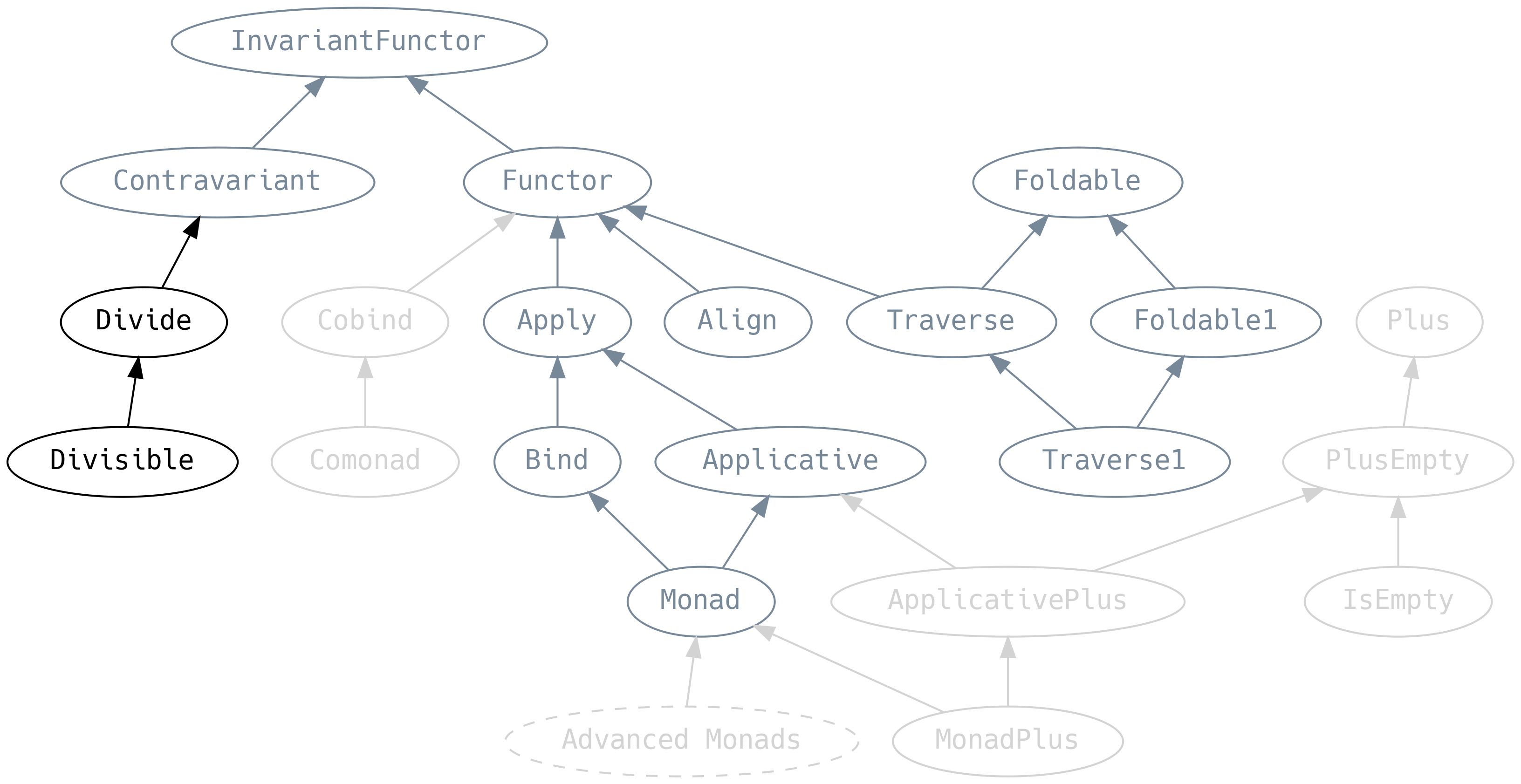
Divide is the Contravariant analogue of Apply
divide says that if we can break a C into an A and a B, and
we’re given an F[A] and an F[B], then we can get an F[C]. Hence,
divide and conquer.
This is a great way to generate contravariant typeclass instances for
product types by breaking the products into their parts. Scalaz has an
instance of Divide[Equal], let’s construct an Equal for a new
product type Foo
Mirroring Apply, Divide also has terse syntax for tuples. A softer
divide so that we may reign approach to world domination:
Generally, if encoder typeclasses can provide an instance of Divide,
rather than stopping at Contravariant, it makes it possible to
derive instances for any case class. Similarly, decoder typeclasses
can provide an Apply instance. We will explore this in a dedicated
chapter on Typeclass Derivation.
Divisible is the Contravariant analogue of Applicative and introduces
.conquer, the equivalent of .pure
.conquer allows creating trivial implementations where the type parameter is
ignored. Such values are called universally quantified. For example, the
Divisible[Equal].conquer[INil[String]] returns an implementation of Equal
for an empty list of String which is always true.
5.9 Plus
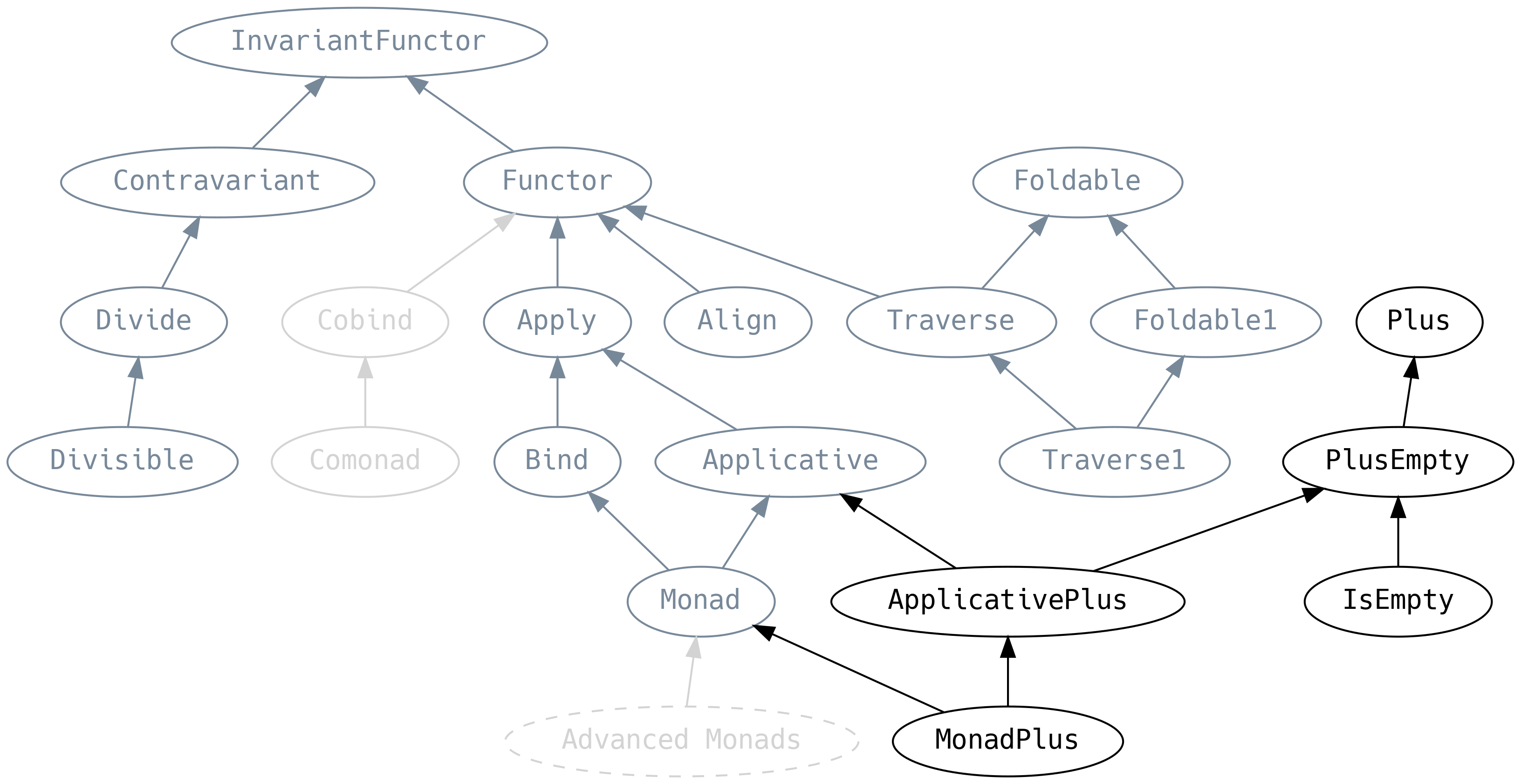
Plus is Semigroup but for type constructors, and PlusEmpty is
the equivalent of Monoid (they even have the same laws) whereas
IsEmpty is novel and allows us to query if an F[A] is empty:
Although it may look on the surface as if <+> behaves like |+|
it is best to think of it as operating only at the F[_] level, never looking
into the contents. Plus has the convention that it should ignore failures and
“pick the first winner”. <+> can therefore be used as a mechanism for early
exit (losing information) and failure-handling via fallbacks:
For example, if we have a NonEmptyList[Option[Int]] and we want to ignore
None values (failures) and pick the first winner (Some), we can call <+>
from Foldable1.foldRight1:
In fact, now that we know about Plus, we realise that we didn’t need to break
typeclass coherence (when we defined a locally scoped Monoid[Option[A]]) in
the section on Appendable Things. Our objective was to “pick the last winner”,
which is the same as “pick the winner” if the arguments are swapped. Note the
use of the TIE Interceptor for ccy and otc with arguments swapped.
Applicative and Monad have specialised versions of PlusEmpty
.unite lets us fold a data structure using the outer container’s
PlusEmpty[F].monoid rather than the inner content’s Monoid. For
List[Either[String, Int]] this means Left[String] values are converted into
.empty, then everything is concatenated. A convenient way to discard errors:
withFilter allows us to make use of for comprehension language
support as discussed in Chapter 2. It is fair to say that the Scala
language has built-in language support for MonadPlus, not just
Monad!
Returning to Foldable for a moment, we can reveal some methods that
we did not discuss earlier
msuml does a fold using the Monoid from the PlusEmpty[G] and
collapse does a foldRight using the PlusEmpty of the target
type:
5.10 Lone Wolves
Some of the typeclasses in Scalaz are stand-alone and not part of the larger hierarchy.

5.10.1 Zippy
The core method is zip which is a less powerful version of
Divide.tuple2, and if a Functor[F] is provided then zipWith can
behave like Apply.apply2. Indeed, an Apply[F] can be created from
a Zip[F] and a Functor[F] by calling ap.
apzip takes an F[A] and a lifted function from F[A] => F[B],
producing an F[(A, B)] similar to Functor.fproduct.
The core method is unzip with firsts and seconds allowing for
selecting either the first or second element of a tuple in the F.
Importantly, unzip is the opposite of zip.
The methods unzip3 to unzip7 are repeated applications of unzip
to save on boilerplate. For example, if handed a bunch of nested
tuples, the Unzip[Id] is a handy way to flatten them:
In a nutshell, Zip and Unzip are less powerful versions of
Divide and Apply, providing useful features without requiring the
F to make too many promises.
5.10.2 Optional
Optional is a generalisation of data structures that can optionally
contain a value, like Option and Either.
Recall that \/ (disjunction) is Scalaz’s improvement of
scala.Either. We will also see Maybe, Scalaz’s improvement of
scala.Option
These are methods that should be familiar, except perhaps pextract,
which is a way of letting the F[_] return some implementation
specific F[B] or the value. For example, Optional[Option].pextract
returns Option[Nothing] \/ A, i.e. None \/ A.
Scalaz gives a ternary operator to things that have an Optional
for example
5.11 Co-things
A co-thing typically has some opposite type signature to whatever thing does, but is not necessarily its inverse. To highlight the relationship between thing and co-thing, we will include the type signature of thing wherever we can.

5.11.1 Cobind
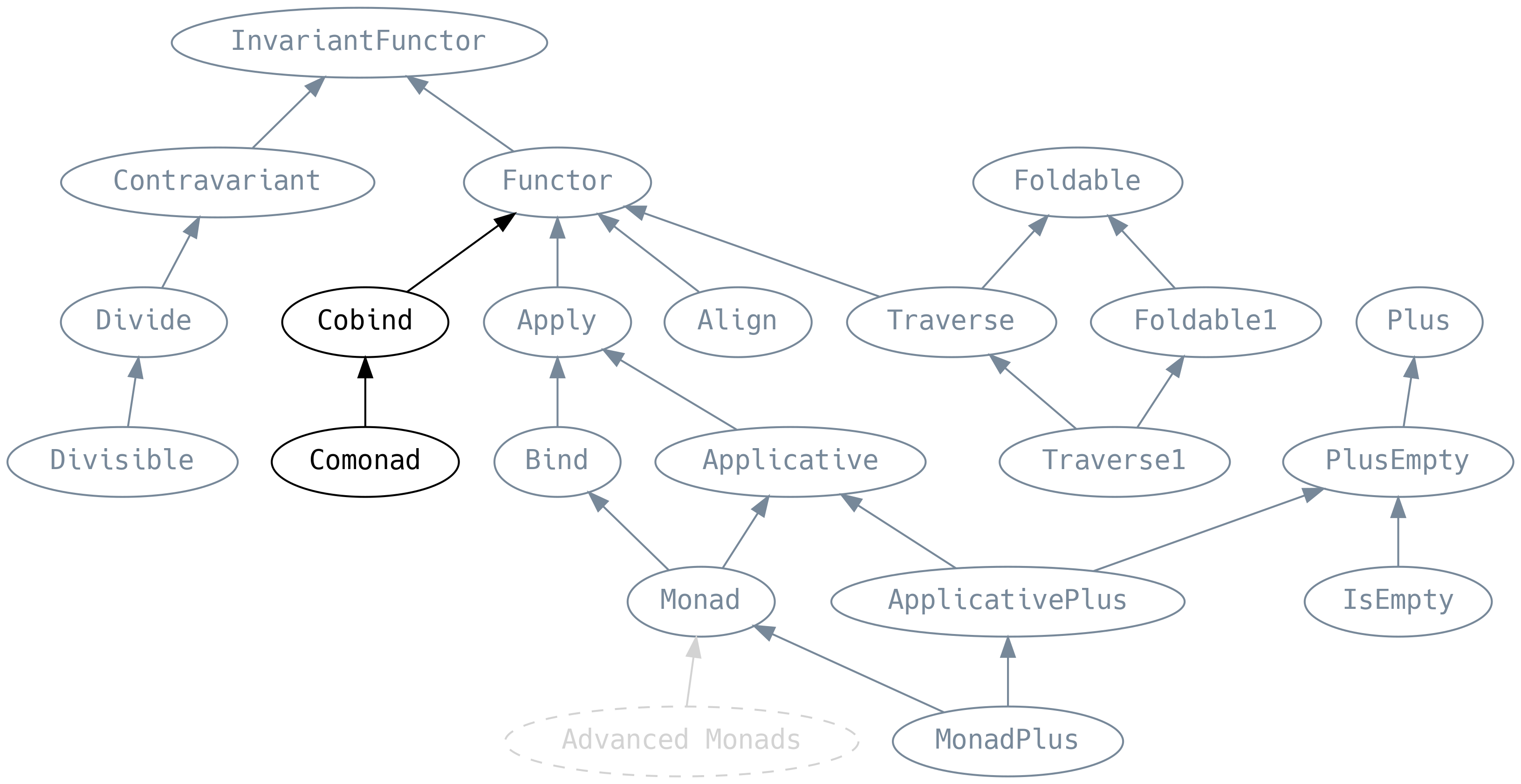
cobind (also known as coflatmap) takes an F[A] => B that acts on an F[A]
rather than its elements. But this is not necessarily the full fa, it can be a
substructure that has been created by .coflatten.
Compelling use-cases for Cobind are rare, although when shown in the
Functor permutation table (for F[_], A and B) it is difficult
to argue why any method should be less important than the others:
| method | parameter |
|---|---|
map |
A => B |
contramap |
B => A |
xmap |
(A => B, B => A) |
ap |
F[A => B] |
bind |
A => F[B] |
cobind |
F[A] => B |
5.11.2 Comonad
.copoint (also .copure) unwraps an element from its context. The Id type
alias that we encountered in Chapter 1 has an instance of Comonad, so we can
reach into an Id and extract the value it contains. Similarly, Name has a
Comonad with .value effectively being the Value strategy.
Another example of a Comonad is the NonEmptyList, where .copoint returns
the .head element and .cobind operates on all the tails of the list.
Effects do not typically have an instance of Comonad since it would break
referential transparency to interpret an IO[A] into an A.
Comonad allows navigation over elements of a data structure and eventually
returning to one view of that data. Consider a neighbourhood (Hood for
short) of a list, containing all the elements to the left (.lefts) of an
element .focus, and all the elements to its right (.rights).
The lefts and rights should each be ordered with the nearest to
the focus at the head, such that we can recover the original IList
via .toIList
We can write methods that let us move the focus one to the left
(.previous) and one to the right (.next)
.more repeatedly applies an optional function to Hood such that we calculate
all the views that Hood can take on the list
We can now implement Comonad[Hood]
.cojoin gives us a Hood[Hood[IList]] containing all the possible
neighbourhoods in our initial IList
Indeed, .cojoin is just positions! We can override it with a more
direct (and performant) implementation
Comonad generalises the concept of Hood to arbitrary data
structures. Hood is an example of a zipper (unrelated to Zip).
Scalaz comes with a Zipper data type for streams (i.e. infinite 1D
data structures), which we will discuss in the next chapter.
One application of a zipper is for cellular automata, which compute the value of each cell in the next generation by performing a computation based on the neighbourhood of that cell.
5.11.3 Cozip
Although named cozip, it is perhaps more appropriate to talk about
its symmetry with unzip. Whereas unzip splits F[_] of tuples
(products) into tuples of F[_], cozip splits F[_] of
disjunctions (coproducts) into disjunctions of F[_].
5.12 Bi-things
Sometimes we may find ourselves with a thing that has two type holes
and we want to map over both sides. For example we might be tracking
failures in the left of an Either and we want to do something with the
failure messages.
The Functor / Foldable / Traverse typeclasses have bizarro
relatives that allow us to map both ways.
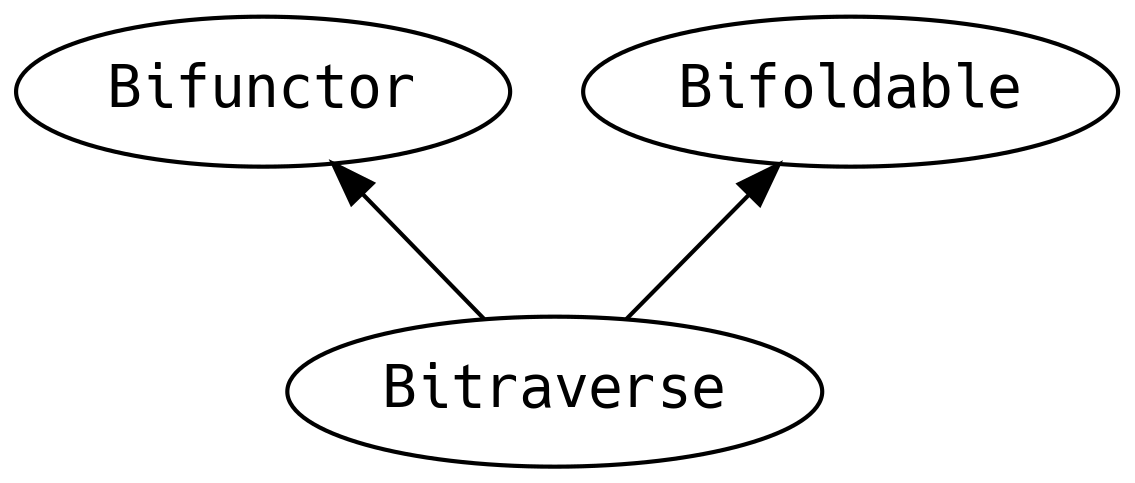
Although the type signatures are verbose, these are nothing more than
the core methods of Functor, Foldable and Bitraverse taking two
functions instead of one, often requiring both functions to return the
same type so that their results can be combined with a Monoid or
Semigroup.
In addition, we can revisit MonadPlus (recall it is Monad with the
ability to filterWith and unite) and see that it can separate
Bifoldable contents of a Monad
This is very useful if we have a collection of bi-things and we want
to reorganise them into a collection of A and a collection of B
5.13 Summary
That was a lot of material! We have just explored a standard library of polymorphic functionality. But to put it into perspective: there are more traits in the Scala stdlib Collections API than typeclasses in Scalaz.
It is normal for an FP application to only touch a small percentage of the typeclass hierarchy, with most functionality coming from domain-specific algebras and typeclasses. Even if the domain-specific typeclasses are just specialised clones of something in Scalaz, it is OK to refactor it later.
To help, we have included a cheat-sheet of the typeclasses and their primary methods in the Appendix, inspired by Adam Rosien’s Scalaz Cheatsheet.
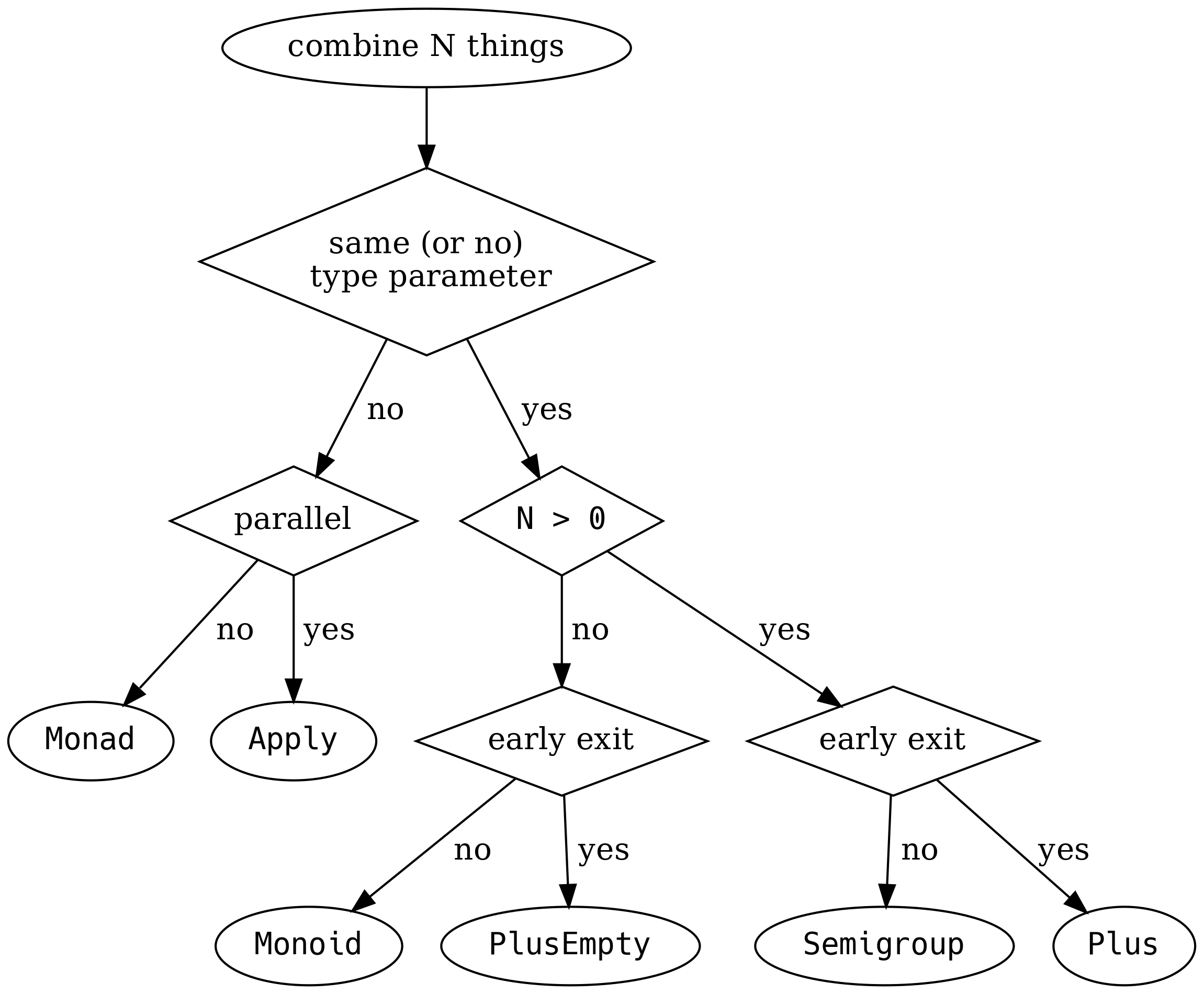
To help further, Valentin Kasas explains how to combine N things: