3. Application Design
In this chapter we will write the business logic and tests for a purely
functional server application. The source code for this application is included
under the example directory along with the book’s source, however it is
recommended not to read the source code until the final chapter as there will be
significant refactors as we learn more about FP.
3.1 Specification
Our application will manage a just-in-time build farm on a shoestring budget. It will listen to a Drone Continuous Integration server, and spawn worker agents using Google Container Engine (GKE) to meet the demand of the work queue.
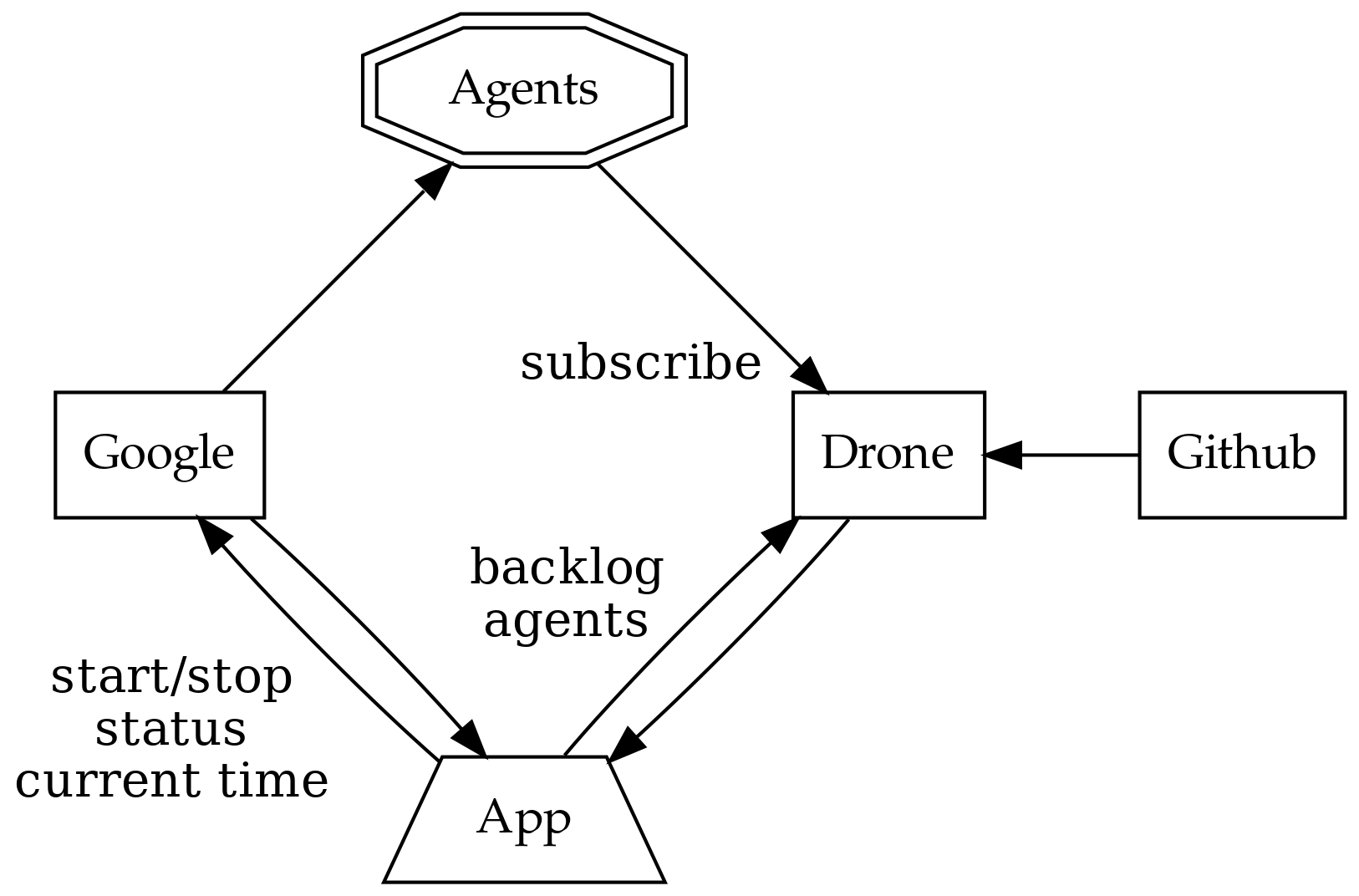
Drone receives work when a contributor submits a github pull request to a managed project. Drone assigns the work to its agents, each processing one job at a time.
The goal of our app is to ensure that there are enough agents to complete the work, with a cap on the number of agents, whilst minimising the total cost. Our app needs to know the number of items in the backlog and the number of available agents.
Google can spawn nodes, each can host multiple drone agents. When an agent starts up, it registers itself with drone and drone takes care of the lifecycle (including keep-alive calls to detect removed agents).
GKE charges a fee per minute of uptime, rounded up to the nearest hour for each node. One does not simply spawn a new node for each job in the work queue, we must re-use nodes and retain them until their 58th minute to get the most value for money.
Our app needs to be able to start and stop nodes, as well as check their status (e.g. uptimes, list of inactive nodes) and to know what time GKE believes it to be.
In addition, there is no API to talk directly to an agent so we do not know if any individual agent is performing any work for the drone server. If we accidentally stop an agent whilst it is performing work, it is inconvenient and requires a human to restart the job.
Contributors can manually add agents to the farm, so counting agents and nodes is not equivalent. We don’t need to supply any nodes if there are agents available.
The failure mode should always be to take the least costly option.
Both Drone and GKE have a JSON over REST API with OAuth 2.0 authentication.
3.2 Interfaces / Algebras
We will now codify the architecture diagram from the previous section. Firstly, we need to define a simple data type to capture a millisecond timestamp because such a simple thing does not exist in either the Java or Scala standard libraries:
In FP, an algebra takes the place of an interface in Java, or the
set of valid messages for an Actor in Akka. This is the layer where
we define all side-effecting interactions of our system.
There is tight iteration between writing the business logic and the algebra: it is a good level of abstraction to design a system.
We’ve used NonEmptyList, easily created by calling .toNel on the
stdlib’s List (returning an Option[NonEmptyList]), otherwise
everything should be familiar.
3.3 Business Logic
Now we write the business logic that defines the application’s behaviour, considering only the happy path.
We need a WorldView class to hold a snapshot of our knowledge of the
world. If we were designing this application in Akka, WorldView
would probably be a var in a stateful Actor.
WorldView aggregates the return values of all the methods in the
algebras, and adds a pending field to track unfulfilled requests.
Now we are ready to write our business logic, but we need to indicate
that we depend on Drone and Machines.
We can write the interface for the business logic
and implement it with a module. A module depends only on other modules,
algebras and pure functions, and can be abstracted over F. If an
implementation of an algebraic interface is tied to a specific type, e.g. IO,
it is called an interpreter.
The Monad context bound means that F is monadic, allowing us to use map,
pure and, of course, flatMap via for comprehensions.
We have access to the algebra of Drone and Machines as D and M,
respectively. Using a single capital letter name is a common naming convention
for monad and algebra implementations.
Our business logic will run in an infinite loop (pseudocode)
3.3.1 initial
In initial we call all external services and aggregate their results
into a WorldView. We default the pending field to an empty Map.
Recall from Chapter 1 that flatMap (i.e. when we use the <-
generator) allows us to operate on a value that is computed at
runtime. When we return an F[_] we are returning another program to
be interpreted at runtime, that we can then flatMap. This is how we
safely chain together sequential side-effecting code, whilst being
able to provide a pure implementation for tests. FP could be described
as Extreme Mocking.
3.3.2 update
update should call initial to refresh our world view, preserving
known pending actions.
If a node has changed state, we remove it from pending and if a
pending action is taking longer than 10 minutes to do anything, we
assume that it failed and forget that we asked to do it.
Concrete functions like .symdiff don’t need test interpreters, they have
explicit inputs and outputs, so we could move all pure code into standalone
methods on a stateless object, testable in isolation. We’re happy testing only
the public methods, preferring that our business logic is easy to read.
3.3.3 act
The act method is slightly more complex, so we will split it into two
parts for clarity: detection of when an action needs to be taken,
followed by taking action. This simplification means that we can only
perform one action per invocation, but that is reasonable because we
can control the invocations and may choose to re-run act until no
further action is taken.
We write the scenario detectors as extractors for WorldView, which
is nothing more than an expressive way of writing if / else
conditions.
We need to add agents to the farm if there is a backlog of work, we have no agents, we have no nodes alive, and there are no pending actions. We return a candidate node that we would like to start:
If there is no backlog, we should stop all nodes that have become stale (they are not doing any work). However, since Google charge per hour we only shut down machines in their 58th minute to get the most out of our money. We return the non-empty list of nodes to stop.
As a financial safety net, all nodes should have a maximum lifetime of 5 hours.
Now that we have detected the scenarios that can occur, we can write
the act method. When we schedule a node to be started or stopped, we
add it to pending noting the time that we scheduled the action.
Because NeedsAgent and Stale do not cover all possible situations,
we need a catch-all case _ to do nothing. Recall from Chapter 2 that
.pure creates the for’s (monadic) context from a value.
foldLeftM is like foldLeft, but each iteration of the fold may return a
monadic value. In our case, each iteration of the fold returns F[WorldView].
The M is for Monadic. We will find more of these lifted methods that behave
as one would expect, taking monadic values in place of values.
3.4 Unit Tests
The FP approach to writing applications is a designer’s dream: delegate writing the implementations of algebras to team members while focusing on making business logic meet the requirements.
Our application is highly dependent on timing and third party webservices. If this was a traditional OOP application, we’d create mocks for all the method calls, or test actors for the outgoing mailboxes. FP mocking is equivalent to providing an alternative implementation of dependency algebras. The algebras already isolate the parts of the system that need to be mocked, i.e. interpreted differently in the unit tests.
We will start with some test data
We implement algebras by extending Drone and Machines with a specific
monadic context, Id being the simplest.
Our “mock” implementations simply play back a fixed WorldView. We’ve
isolated the state of our system, so we can use var to store the
state:
When we write a unit test (here using FlatSpec from Scalatest), we create an
instance of Mutable and then import all of its members.
Our implicit drone and machines both use the Id execution
context and therefore interpreting this program with them returns an
Id[WorldView] that we can assert on.
In this trivial case we just check that the initial method returns
the same value that we use in the static implementations:
We can create more advanced tests of the update and act methods,
helping us flush out bugs and refine the requirements:
It would be boring to go through the full test suite. The following tests are easy to implement using the same approach:
- not request agents when pending
- don’t shut down agents if nodes are too young
- shut down agents when there is no backlog and nodes will shortly incur new costs
- not shut down agents if there are pending actions
- shut down agents when there is no backlog if they are too old
- shut down agents, even if they are potentially doing work, if they are too old
- ignore unresponsive pending actions during update
All of these tests are synchronous and isolated to the test runner’s thread (which could be running tests in parallel). If we’d designed our test suite in Akka, our tests would be subject to arbitrary timeouts and failures would be hidden in logfiles.
The productivity boost of simple tests for business logic cannot be overstated. Consider that 90% of an application developer’s time interacting with the customer is in refining, updating and fixing these business rules. Everything else is implementation detail.
3.5 Parallel
The application that we have designed runs each of its algebraic methods sequentially. But there are some obvious places where work can be performed in parallel.
3.5.1 initial
In our definition of initial we could ask for all the information we
need at the same time instead of one query at a time.
As opposed to flatMap for sequential operations, Scalaz uses
Apply syntax for parallel operations:
which can also use infix notation:
If each of the parallel operations returns a value in the same monadic
context, we can apply a function to the results when they all return.
Rewriting initial to take advantage of this:
3.5.2 act
In the current logic for act, we are stopping each node
sequentially, waiting for the result, and then proceeding. But we
could stop all the nodes in parallel and then update our view of the
world.
A disadvantage of doing it this way is that any failures will cause us
to short-circuit before updating the pending field. But that is a
reasonable tradeoff since our update will gracefully handle the case
where a node is shut down unexpectedly.
We need a method that operates on NonEmptyList that allows us to
map each element into an F[MachineNode], returning an
F[NonEmptyList[MachineNode]]. The method is called traverse, and
when we flatMap over it we get a NonEmptyList[MachineNode] that we
can deal with in a simple way:
Arguably, this is easier to understand than the sequential version.
3.6 Summary
- algebras define the interface between systems.
- modules are implementations of an algebra in terms of other algebras.
-
interpreters are concrete implementations of an algebra for a fixed
F[_]. - Test interpreters can replace the side-effecting parts of the system, giving a high amount of test coverage.