Food Categories & The ReachVitality Food Chart
Understanding Food Categories
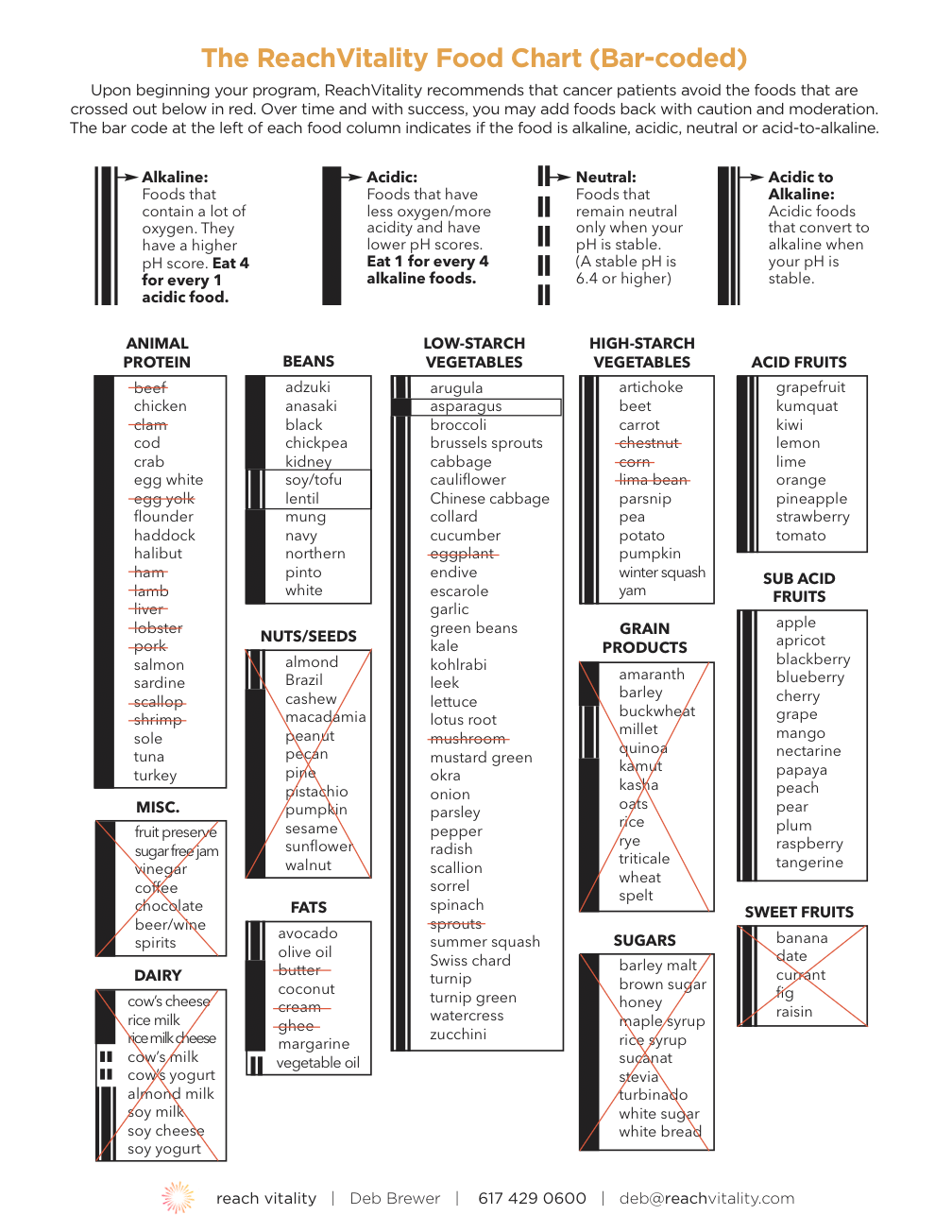
ReachVitality and its partners have developed a food chart, specifically for preventing and fighting cancer. The goal of the Chart is to provide a quick reference to which foods are acidic, alkaline, or neutral, as well as to guide patients to which foods are the safest for consumption while fighting cancer. These recommendations are designed to fuel your body, not your cancer.
Food Safety Indicators
On The Food Chart you’ll see some sections completely crossed out, and in other sections, individual foods are crossed out in red. These are unsafe for cancer patients. ReachVitality advises that those with cancer do their best to avoid all unsafe foods. As your health improves and your cancer has stabilized, some unsafe foods may be added back to your program in moderation.
 |
Important Note As there is no ‘safe amount’ of an unsafe food, caution is advised. Consuming raw or undercooked animal proteins are not recommended for those with cancer. |
Animal Proteins
For cancer patients, moderate amounts of high-quality animal proteins are important because they provide essential amino acids needed for immune function, tissue repair, and maintaining strength during treatment.
High-quality animal proteins are those that provide all nine essential amino acids in adequate amounts, are easily digestible, and supply important nutrients like iron, zinc, and B vitamins. These proteins are considered “complete” because they contain the full amino acid profiles.
However, for cancer patients, some animal proteins are not as beneficial as others.
Why Some Animal Proteins Are Unsafe:
Lamb, Ham, Beef:
- High in saturated fat, triggering chronic, low-grade inflammation that supports tumor growth and progression
- Affects cellular repair and alters cell membranes
- Substances called heterocyclic amines (HCAs) and polycyclic aromatic hydrocarbons (PAHs) are created when meat is cooked at high temperatures. Research shows HCAs and PAHs can alter DNA, possibly increasing cancer risk
- May worsen insulin resistance and increase growth signals (like IGF-1), which some cancers use to fuel their spread
Clams, Lobster, Scallops & Shrimp:
- Shellfish may carry pathogens and toxins that can damage cancer-fighting DNA, T-cells, and weaken immune systems
- Can accumulate heavy metals such as cadmium, which can be an endocrine disruptor and potentially promote cancer cell growth, particularly in breast cancer cells
Important Note: Animal proteins are acidic, thus they are advised to be consumed in moderation (4:1 alkaline to acid ratio). A food portion is considered to be the size of the palm of your hand.
Beans
Beans fuel the body with plant-based protein, fiber, and are loaded with antioxidants and phytonutrients that strengthen immunity, improve digestion, and create conditions less favorable for cancer to thrive. However, there are several beans on the Food Chart that are acidic. When consuming these variations, please be sure to adhere to the 4:1 alkaline to acid ratio.
Nuts & Seeds
Nuts and seeds can be a very popular source of energy, protein and nutrients for healthy individuals. However, for cancer patients, they aren’t a safe choice.
Potential Reasons Nuts & Seeds Are Discouraged:
Contain arginine that fuels tumor growth: Arginine is a semi-essential amino acid that plays a key role in cell division and protein synthesis. Some tumors use arginine to accelerate their growth, so the concern is that high intake could “feed” cancer cells.
Mold/aflatoxin risk: Nuts (especially peanuts, pistachios) can harbor aflatoxins, which are carcinogenic. Mold is especially dangerous for cancer patients.
Dairy
Most practitioners and research indicate dairy products unsafe for cancer patients. The primary reasons are:
Growth factors (IGF-1): Dairy can raise levels of insulin-like growth factor 1 (IGF-1), a hormone linked to cell proliferation. High IGF-1 may encourage cancer cell growth.
Hormones in milk: Conventional dairy may contain natural or added hormones that can influence hormone-sensitive cancers (like breast or prostate cancer).
Research supports: High saturated fat causing inflammation; digestive stress and potential mucus production.
Fats
The healthiest fats for cancer patients are unsaturated fats—especially omega-3s from fish, soy, and plant oils—which reduce inflammation and support immunity. In contrast, saturated fats from meat and dairy, and trans fats from processed foods, can impair DNA and cellular repair.
Low Starch Vegetables
Most of the vegetables in the low starch (low carbohydrate) category are very beneficial for cancer patients, for their anti-cancer properties (low carb as well as alkaline, cruciferous, antioxidant, amongst many other benefits). However some are unsafe:
Mushrooms: Fungal connection – because mushrooms are fungi (fungus), some practitioners suggest cancer patients avoid them, as they may “feed” fungal overgrowth.
Sprouts: Raw sprouts (like alfalfa, mung bean, broccoli, clover) are high risk for bacterial contamination, and can compromise immune system.
High Starch Vegetables
Why high-starch (high carbohydrate) vegetables can be a concern for cancer patients:
They raise blood sugar quickly: Starchy vegetables (like potatoes, corn, peas, and winter squash) are rich in complex carbohydrates that break down into glucose. Cancer cells rely heavily on glucose for energy (known as the Warburg effect), so diets that cause frequent blood sugar spikes may fuel tumor metabolism.
They can increase insulin levels: When blood sugar rises, the body releases insulin to bring it down. Chronically high insulin and insulin-like growth factor 1 (IGF-1) can stimulate cell proliferation — a process cancer cells can exploit for faster growth.
They may crowd out more nutrient-dense, alkalizing foods: A plate full of starchy vegetables leaves less room for high-fiber, low-carb, antioxidant-rich vegetables (like leafy greens, cruciferous veggies, and colorful non-starchy options) that help reduce inflammation and oxidative stress.
They can affect body weight and inflammation: Too many high-starch foods can contribute to weight gain, inflammation, and metabolic stress — all of which are linked to poorer outcomes in many cancers.
Grain Products
They raise blood sugar quickly: Similar to high starch vegetables, grains are rich in complex carbohydrates that break down into glucose. Cancer cells rely heavily on glucose for energy (known as the Warburg effect), so diets that cause frequent blood sugar spikes may fuel tumor metabolism.
Arginine: While not universally harmful, excess arginine can fuel tumor growth, blood vessel formation, and survival in fast-growing cancers. ReachVitality recommends limiting high-arginine foods (certain grains, nuts, seeds, soy, and meats) and avoiding arginine supplements to help restrict cancer metabolism.
The ReachVitality Food Chart
The complete food chart categorizes all foods by their pH properties (alkaline, acidic, neutral, or acidic-to-alkaline) and marks unsafe foods for cancer patients. The chart covers:
- Animal Proteins
- Beans
- Nuts/Seeds (avoid)
- Fats
- Low-Starch Vegetables
- High-Starch Vegetables
- Grain Products
- Acid Fruits
- Sub-Acid Fruits
- Sweet Fruits
- Sugars
- Dairy (avoid)
- Miscellaneous items
The bar code at the left of each food column indicates if the food is alkaline, acidic, neutral or acid-to-alkaline.
Key:
- Alkaline: Foods that contain a lot of oxygen. They have a higher pH score. Eat 4 for every 1 acidic food.
- Acidic: Foods that have less oxygen/more acidity and have lower pH scores. Eat 1 for every 4 alkaline foods.
- Neutral: Foods that remain neutral only when your pH is stable. (A stable pH is 6.4 or higher)
- Acidic to Alkaline: Acidic foods that convert to alkaline when your pH is stable.
 |
Recommendation Upon beginning your program, ReachVitality recommends that cancer patients avoid the foods that are crossed out. Over time and with success, you may add foods back with caution and moderation. |