What I Did, the Long Version
On August 15-16, 2018, I hiked the Yoshidaguchi trail of Mount Fuji. The Yoshidaguchi trail is 19 kilometers long from the base to the peak, rising 2856 meters from a base of 850 meters to a peak of 3706 meters.
Day One
Getting to Mount Fuji Station, 7-11 and the Shrine
I woke up in Tokyo just after 5 AM on the Wednesday. I got dressed, packed the food from my bar fridge into my backpack, and walked to the Asakusabashi station from my hotel.
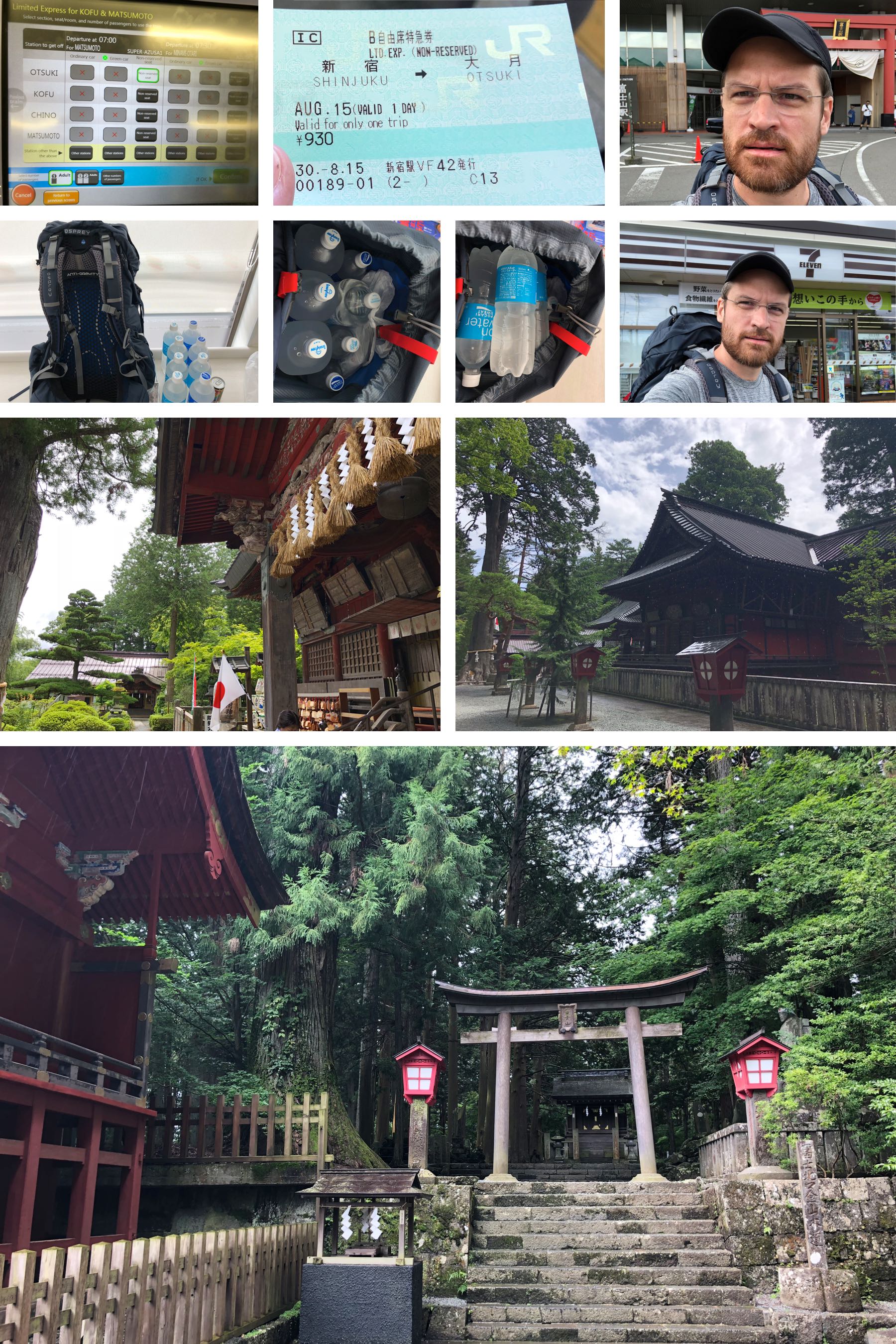
I took the train from Asakusabashi station to Shinjuku station, and then bought a limited express train ticket from Shinjuku to Otsuki using my Suica card. (For a longer distance like this, I think you need to get an advance ticket, not just swipe your Suica card.)
The train was a Super Azusa to Matsumoto; the Otsuki station was the first stop along the way. I bought a non-reserved seat ticket for 930 yen. There are photos of the ticket machine and my ticket later.
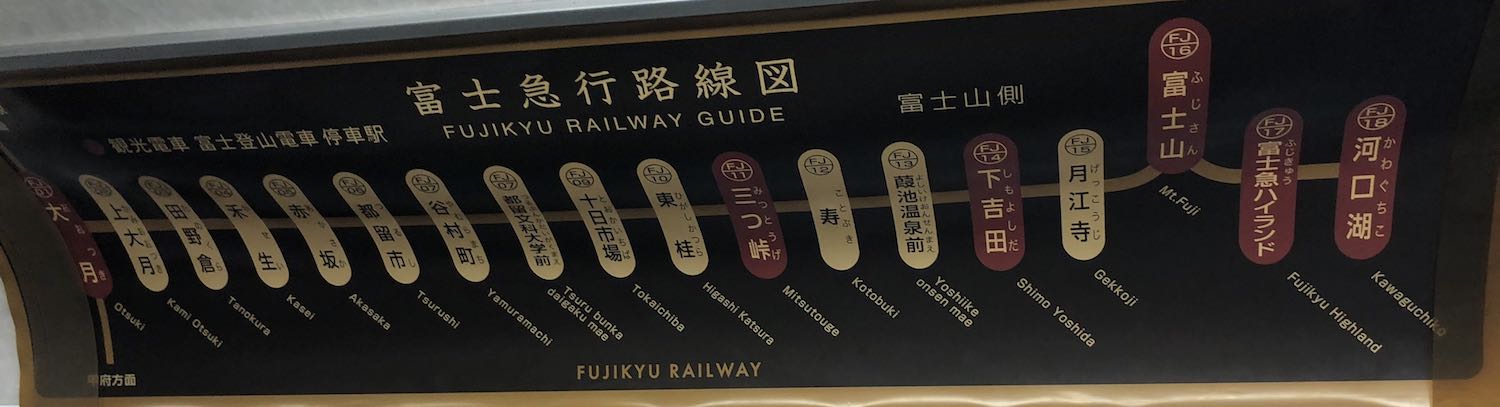
From Otsuki, I got the Fujisan Otsuki line train to Mount Fuji station. This is operated by a separate (non-JR) railway company called Fujikyu Railway, but your Suica card works to pay for it as well. Just swipe at the IC machine at the gate.
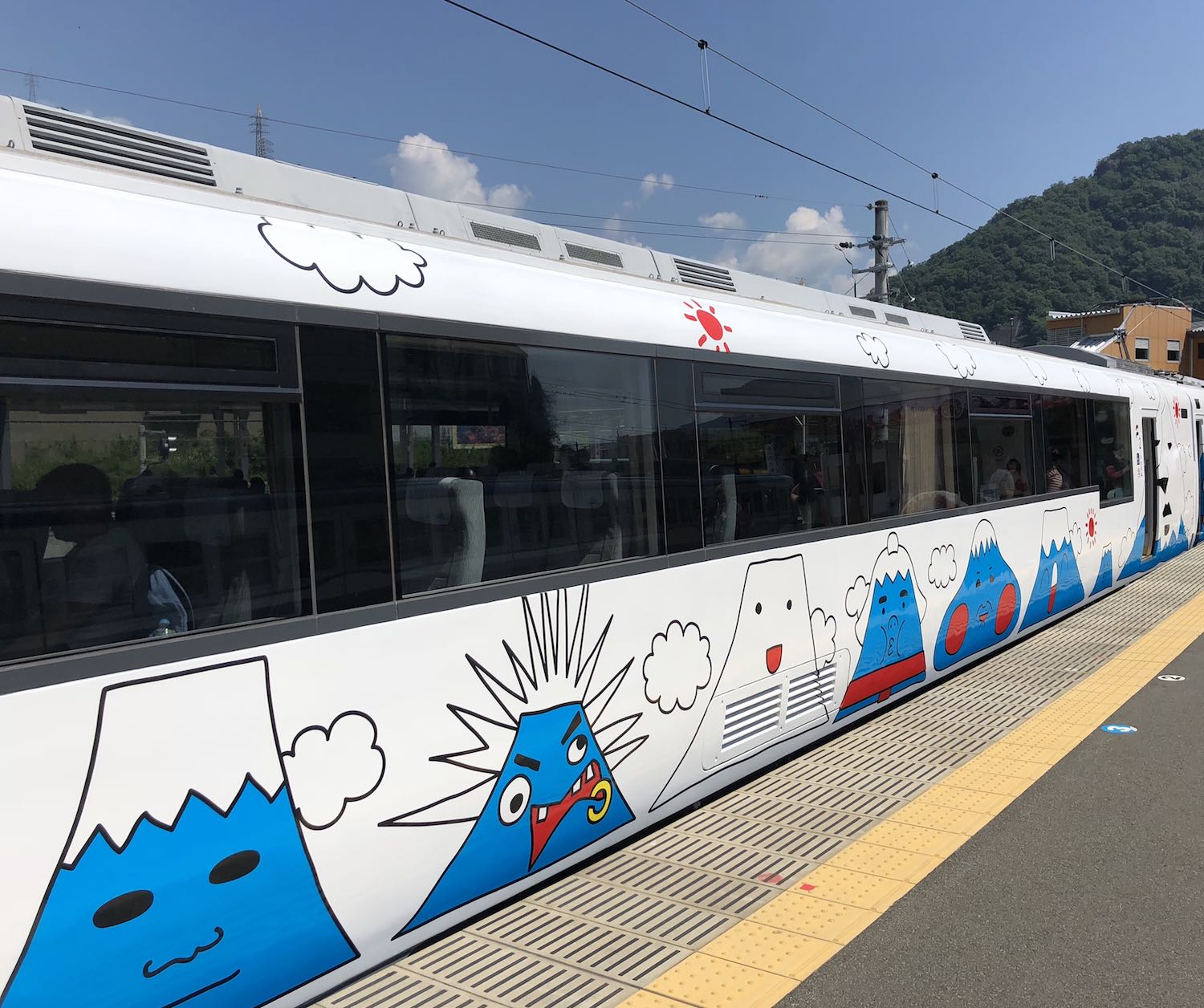
There are some fancier trains with cute cartoons of Mount Fuji on it, and there are some normal trains as well. I had previously taken one of the fancy ones with my wife and son when we stayed at Guesthouse Sakuya after our trip to Matsumoto; in this case, I just got a normal one, since it was the next available train. (The fancy ones need an extra ticket, which can also be bought from the agent at the gate using your Suica card.)
I arrived at Mount Fuji station (FJ 16) at about 9 AM. I walked across the street to the visitor center, and got a paper map of the Yoshidaguchi trail. The agent cheerfully but quizzically confirmed “Yoshidaguchi?” to me, differentiating it from just the Yoshida trail which starts at fifth station.
To be honest, it was a bit intimidating, but it made me feel like I was about to embark on an adventure—and in modern life there typically aren’t that many opportunities for adventure. Besides the free paper map, she also gave me a postcard of Mount Fuji, which made the reality of what I was going to attempt sink in.
From the visitor center, I walked back to the train station, and took a cab to the 7-11 near the Kitaguchi-hongu Fuji Sengen Shrine. This is where I stocked up on all those sports drinks and water. From there, I made the 10-15 minute 700m walk to the shrine.
Hiking to Umagaeshi
I went to the Kitaguchi-hongu Fuji Sengen Shrine first, and I recommend it.
If you have a Goshuincho, you can bring it and receive Goshuin at the shrine. Goshuin feature beautiful calligraphy and are received at Buddhist temples and Shinto shrines. (There is also a shrine near 8th station, and you can receive a Goshuin there as well.
From the shrine, I walked down the road a little bit, and cut over into the woods where there is something that looked like a path. If you think that sounds vague: it is. I missed it the first time, and walked back and forth a little bit. Trust your instincts here. When I had done the right thing, I saw a sign for the Yoshida Recreational Footpath (photo on the next page). It encouraged me to “Please enjoy nature walking to Umagaeshi”. Looking at the sign, Umagaeshi was something that looked about halfway between where I was, and where the peak of the Yoshidaguchi trail was. That was about accurate in distance, but not elevation gain or time.
So, I had been to “station 7-11”, been to the shrine, and found the start of the Yoshidaguchi trail!
It started to rain. I put my old Arc’teryx Beta AR Gore-Tex jacket on, and quickly realized that I had not restored the water repellency of it as well as I had thought I had. Oh well.
I also forgot to put my rain cover on my Osprey Atmos 65 at first. However, the first time I stopped for a break and a snack of “Energy in” plus a Pocari Sweat Ion Water, I corrected this.
The Yoshida Recreational Footpath hike was very gentle in terms of elevation gain at this phase, which was good given the 33 pounds of liquid I was carrying. I took my jacket off and plodded onward under the weight. Soon, my shirt was wet more with sweat than with rain.
There were signs warning about the presence of a bear in the area. I’m Canadian, so I’m a lot less concerned about bears than I am about snakes—thankfully there were no signs warning me of the presence of Mamushi (a pit viper, not some kind of Pokémon) like there were on Mount Misen!
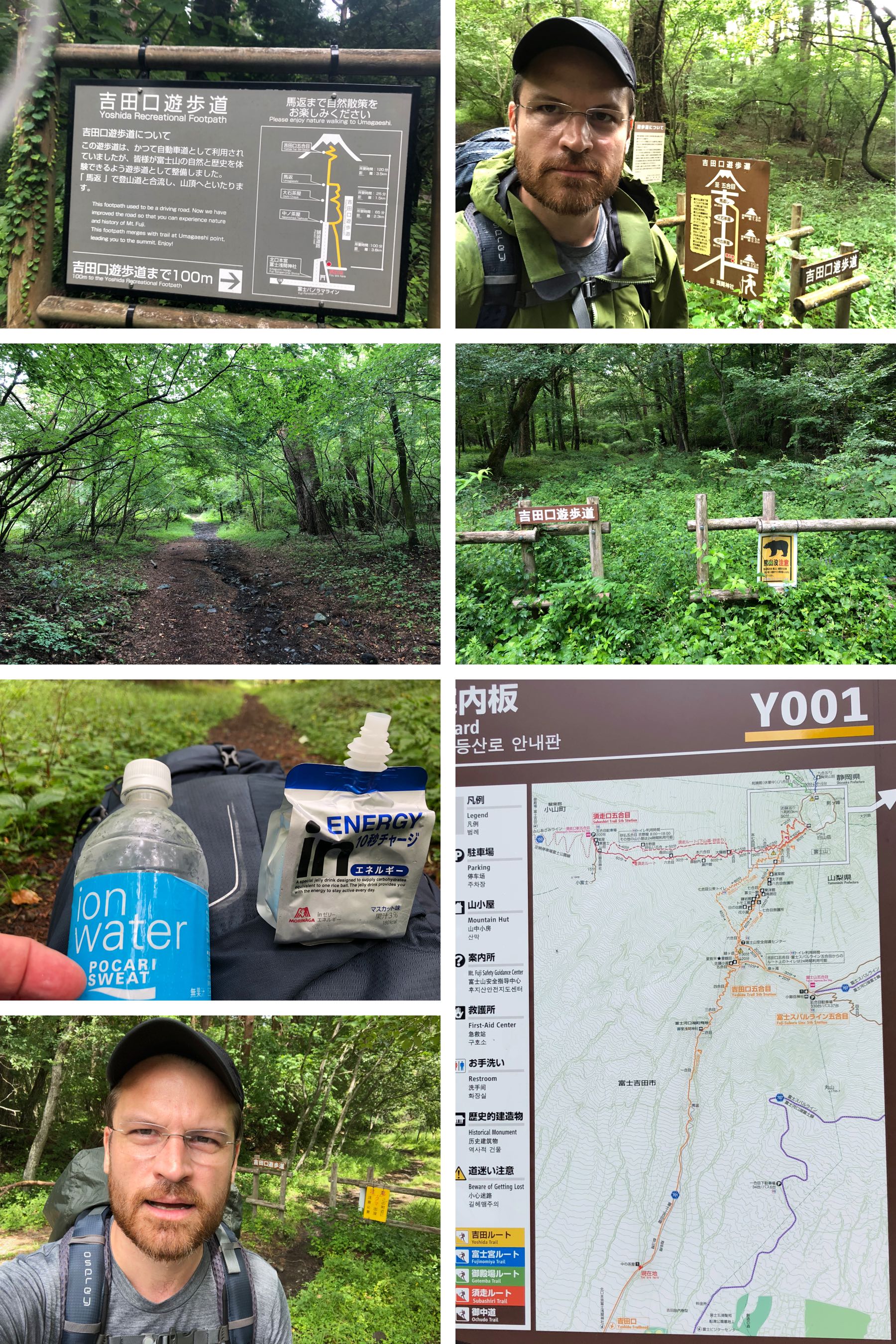
I trekked on toward Umagaeshi. It was a bit daunting to get to the Y001 board (shown on the previous page), and see the little red dot showing where the “You Are Here” location was. In case you missed that on the bottom of the previous page, let me show you the closer photo I took of the bottom of that board:
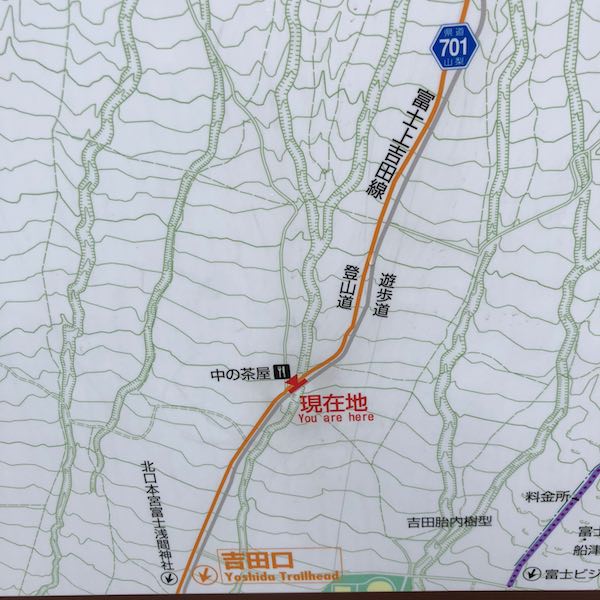
I trekked on, passed the (closed) Nakanochaya tea house at 1100m elevation, and I finally got to Umagaeshi.
As the very helpful sign at Umagaeshi says, Umagaeshi is where the horses used to stop: uma is horse; gaeshi is turn-around. (The irony is that up to Umagaeshi, I was carrying so much extra water and energy drinks that I felt like a pack horse! In the last couple kilometers up to Umagaeshi, I had sweated through my shirt, and my right hip was starting to hurt.)
In the past, hikers took horses to this point. Then, they took a bus to this point. Now, they take a bus a lot farther than this point, to Fuji Subaru Line 5th Station, so almost no one comes here.
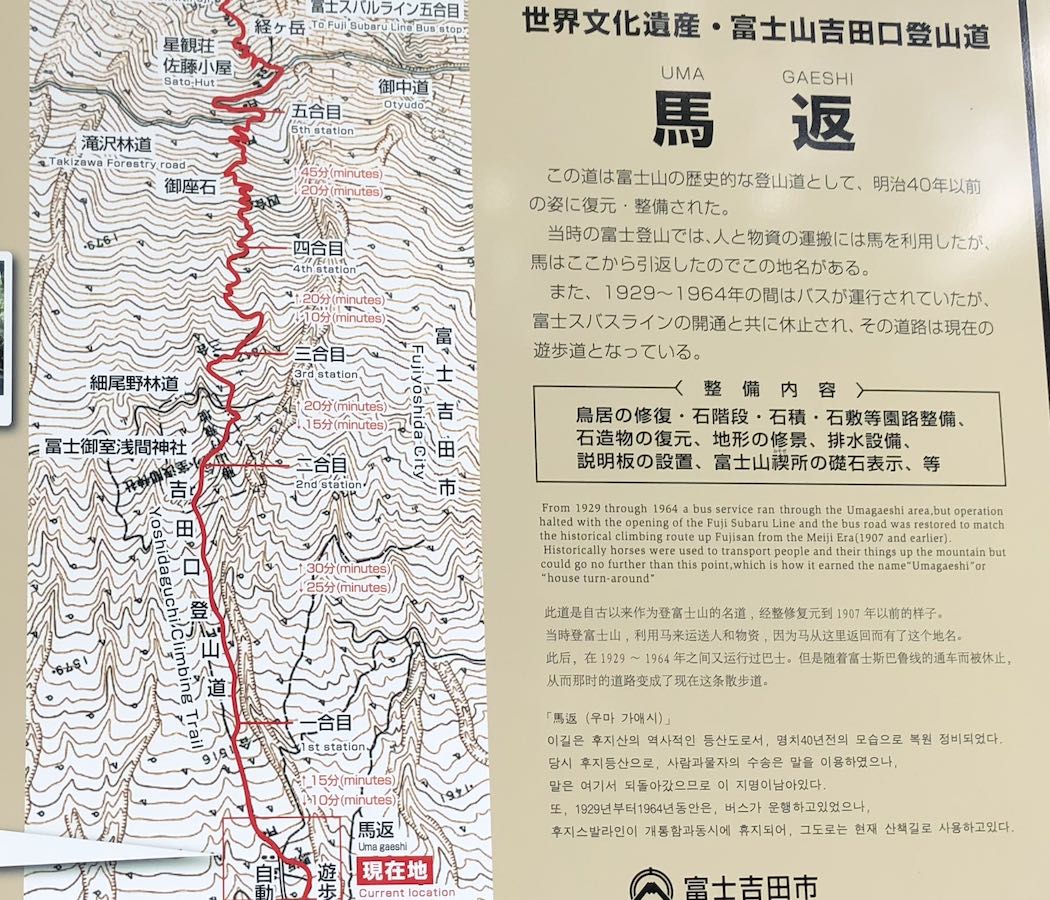
One of the really neat things about the Umagaeshi sign shown above is that you see the next five stations, presented on a contour map. You also see the path to the Fuji Subaru Line 5th Station bus stop going off to the right after the Yoshidaguchi 5th station.
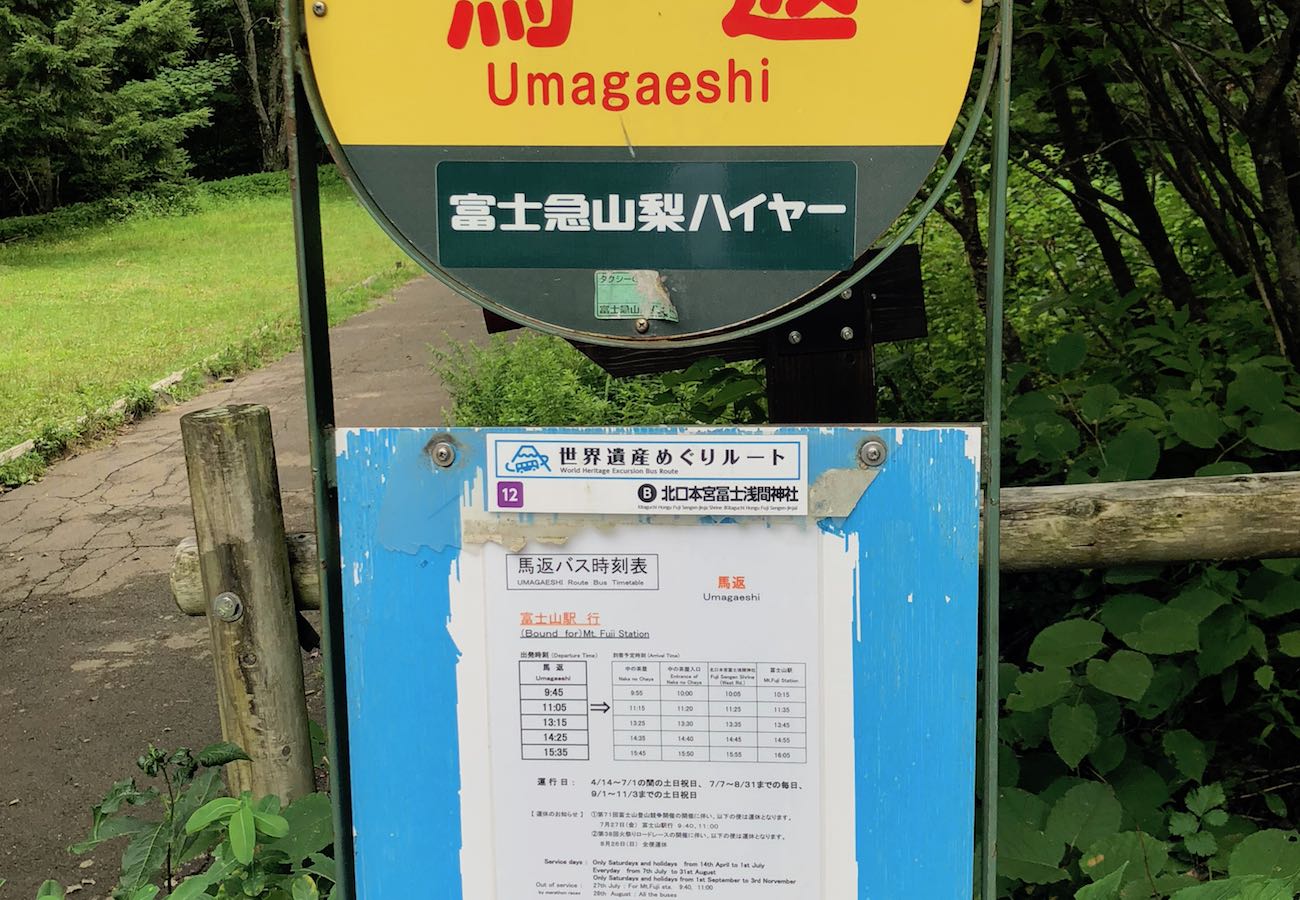
Speaking of bus stops, there is still a bus stop at Umagaeshi, so if you want to give up at this point, you can take the bus from it back to Mount Fuji station. (At the time I looked at the sign, the first bus left Umagaeshi at 9:45 and the last bus left at 15:35, but the times vary with the season.) There’s also a phone number for a taxi on the bus stop sign, in case you have missed the last bus.
By the time I reached Umagaeshi, I had drunk three of my 900ml bottles of Pocari sweat and eaten a couple of my energy jelly packs, which made the load about 5 or 6 pounds lighter. This weight difference mattered.
(Thankfully, there was also a proper portable flush toilet at Umagaeshi, which flushed with a foot pedal. I’ll talk more about toilets later.)
So, after Umagaeshi, I started to feel a bit less like a pack horse and a bit more like a hiker.
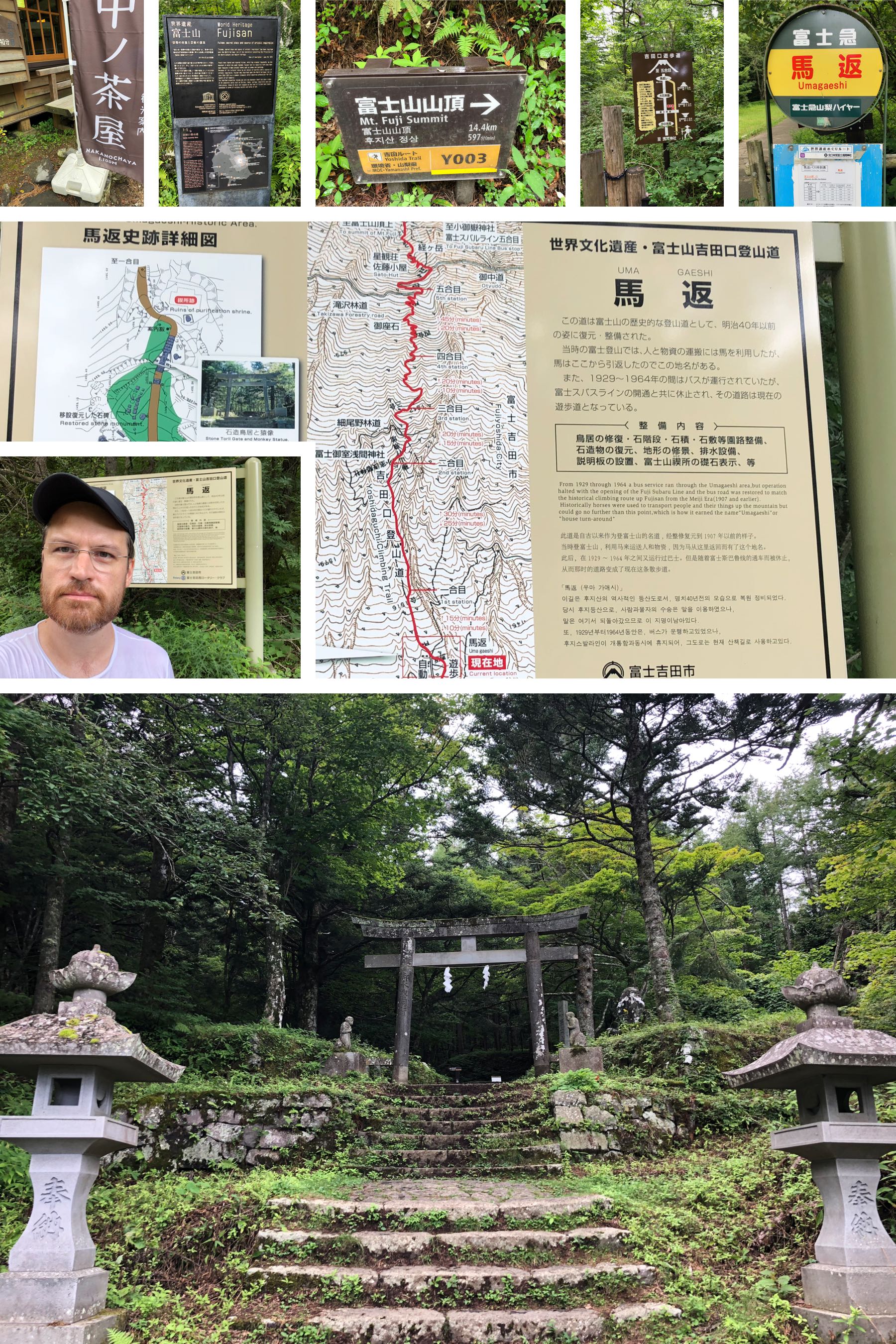
The proper hiking path lay ahead, through a stone Torii gate, framed by two stone lanterns.
From this point, it was 10.6 km to the peak of the Yoshidaguchi trail of Mount Fuji. I had completed the first 8.4 km of the hike, and I had done so carrying way too much pack weight.
However, standing under the stone Torii gate, my pack was now lighter, my hip wasn’t getting any worse, and I was in good spirits.
The Hike to Yoshidaguchi Station 5
Having trotted through the Torii gate, I was thankful my pack was lighter, since the trekking got harder. The elevation gain became steeper.
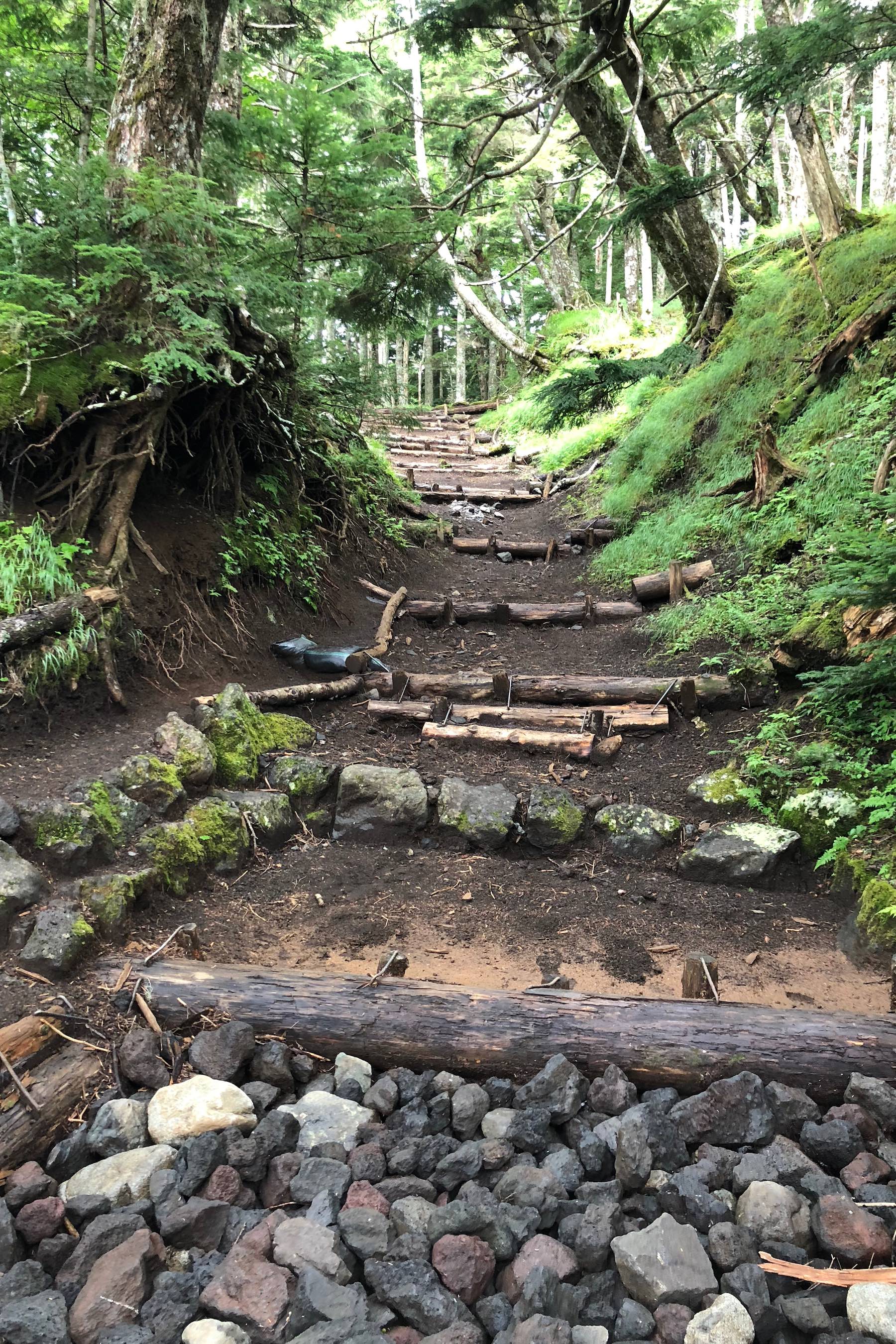
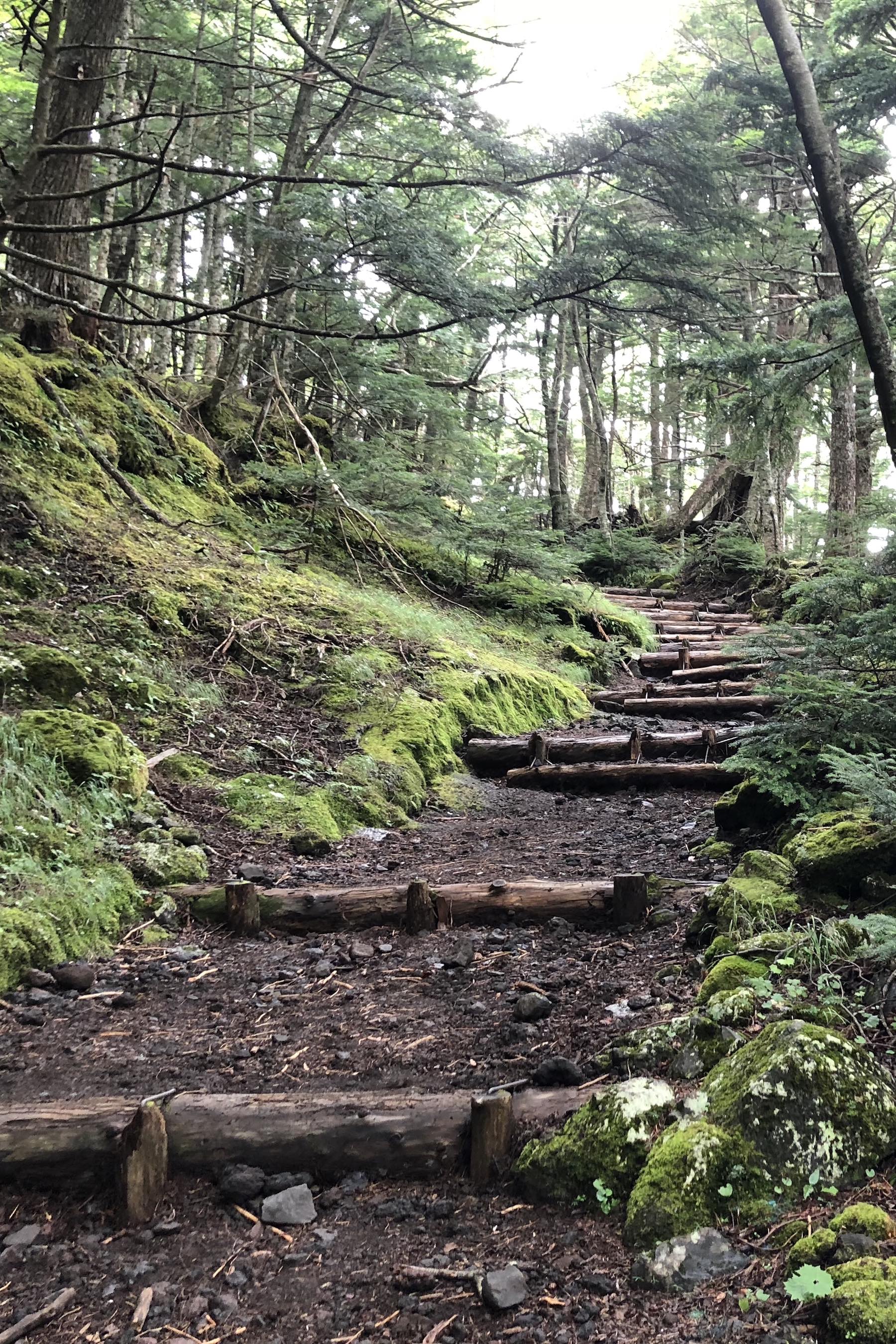
It was still a hike in a forest, but there were parts where the forest floor was broken into stairs. There was also the occasional pit of rocks, to ensure that no one could drive a vehicle or ride a bicycle (or horse!) in the path.
The path continued this way from Umagaeshi to about fourth station. One really cool thing is that the first station came relatively quickly, especially compared to the seemingly forever hike to Umagaeshi. (The fact that my pack was somewhat lighter also helped!)
From first station, the second, third and fourth stations also came by pretty fast. However, the forest path stairs did get a bit tiresome. Thankfully, there were rewards. For example, near third station, you get your first view of Lake Kawaguchiko through the trees.
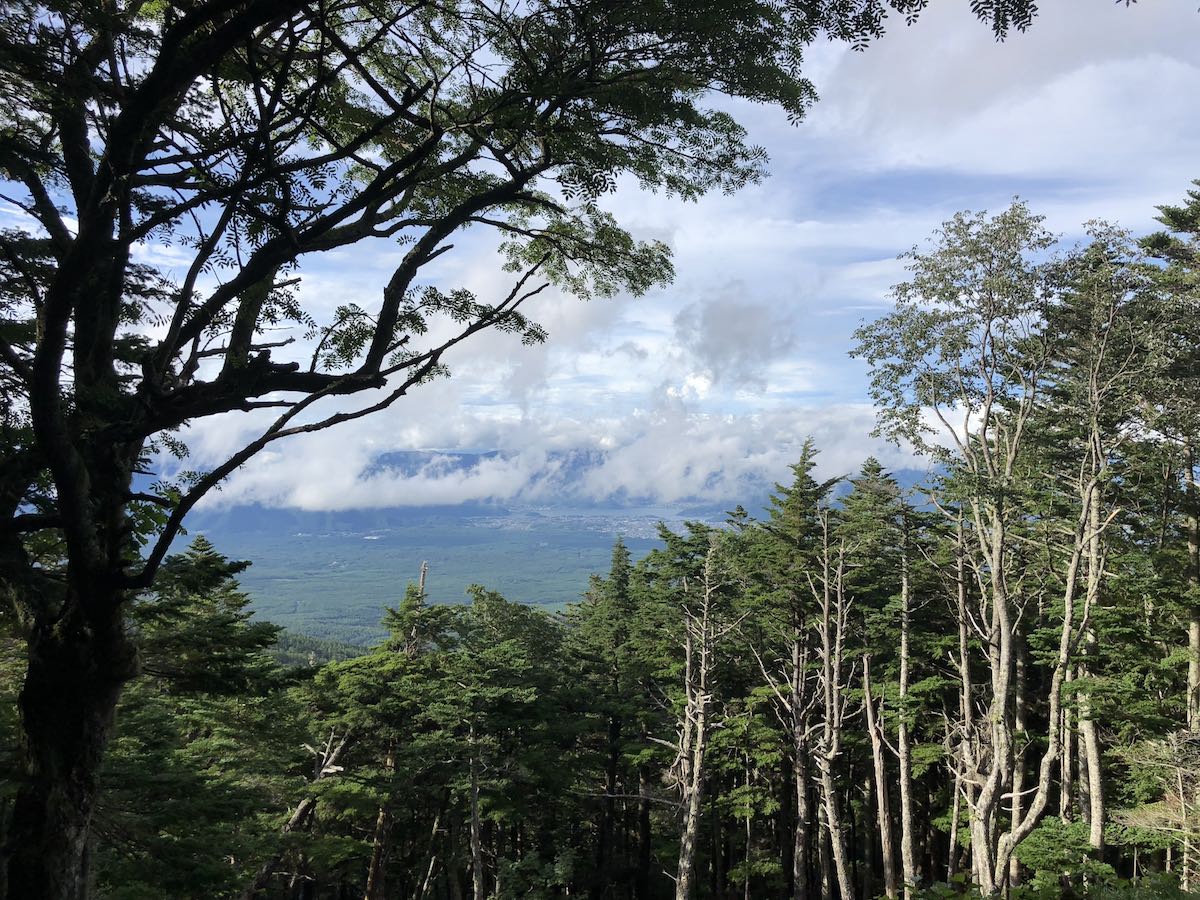
This is when it really starts to hit you how far you’ve walked. Then you keep walking.
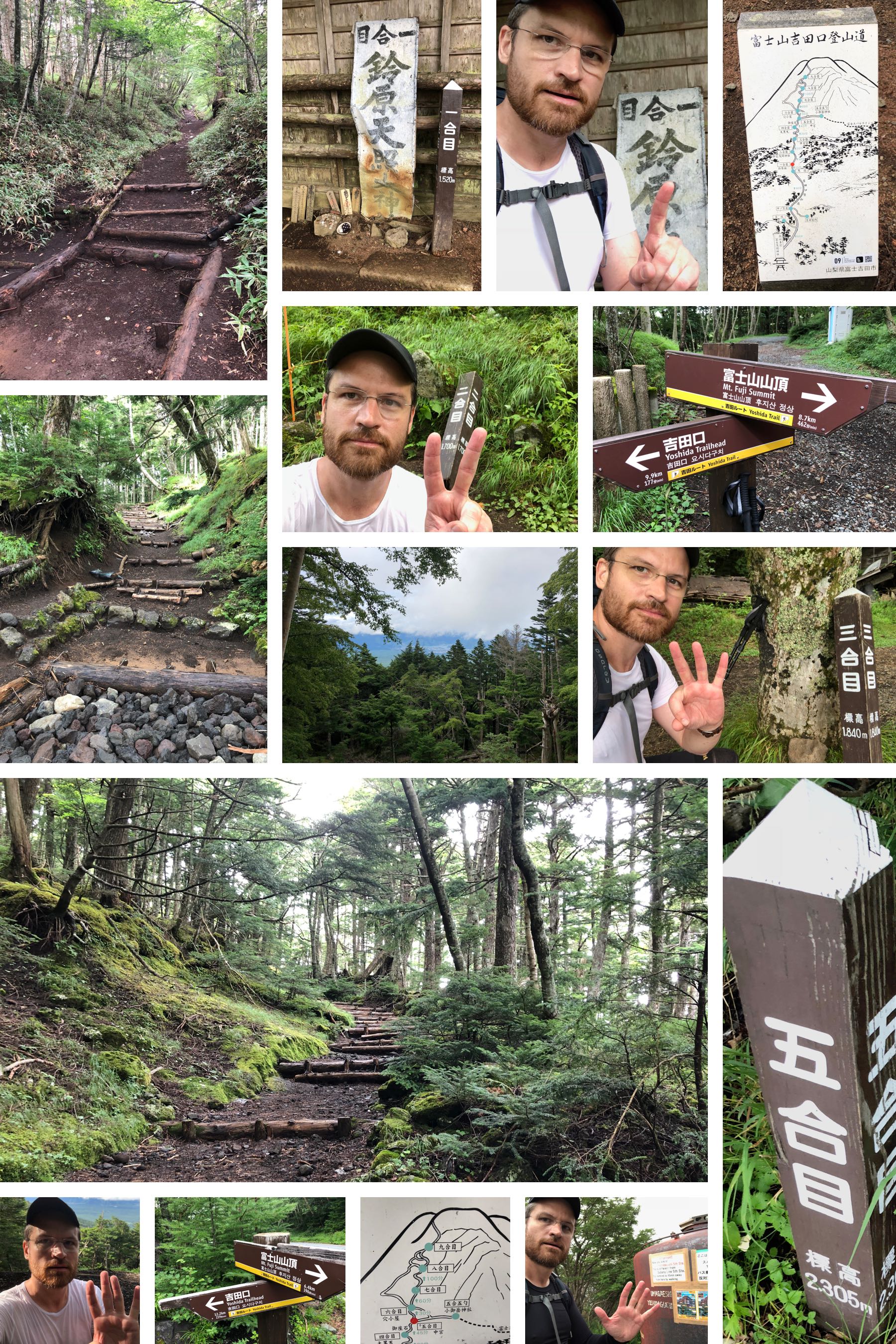
The Yoshidaguchi Fifth Station is at roughly 2300 meters elevation. When I got near there, it was starting to get cooler, so I had thankfully changed out of the second shirt I had sweated through, and into an excellent long sleeve Airism shirt from Uniqlo. Looking at the sign, there were over 12.2 kilometers behind me, and only 6.4 kilometers left to go. However, the distance estimates were another thing: they estimated that the hike had only taken 219 minutes so far, and that there were another 396 minutes to go.
Now, 219 minutes is just over 3.5 hours, and it had taken me about 6 or 7 hours to get to this point. Even if you blame an hour of it on the pack weight, and half an hour on extra rest breaks and stopping to take photos, I was behind the pace. So, 396 minutes is just over 6 and a half hours. If you assume that time is a similar underestimate, I had at least 8 hours to go to the summit, and it was about 5:30 PM.
Dinner and a Decision
So, it was decision time. I walked forward, and stopped at the first mountain hotel I found, to have some dinner, and think things over.
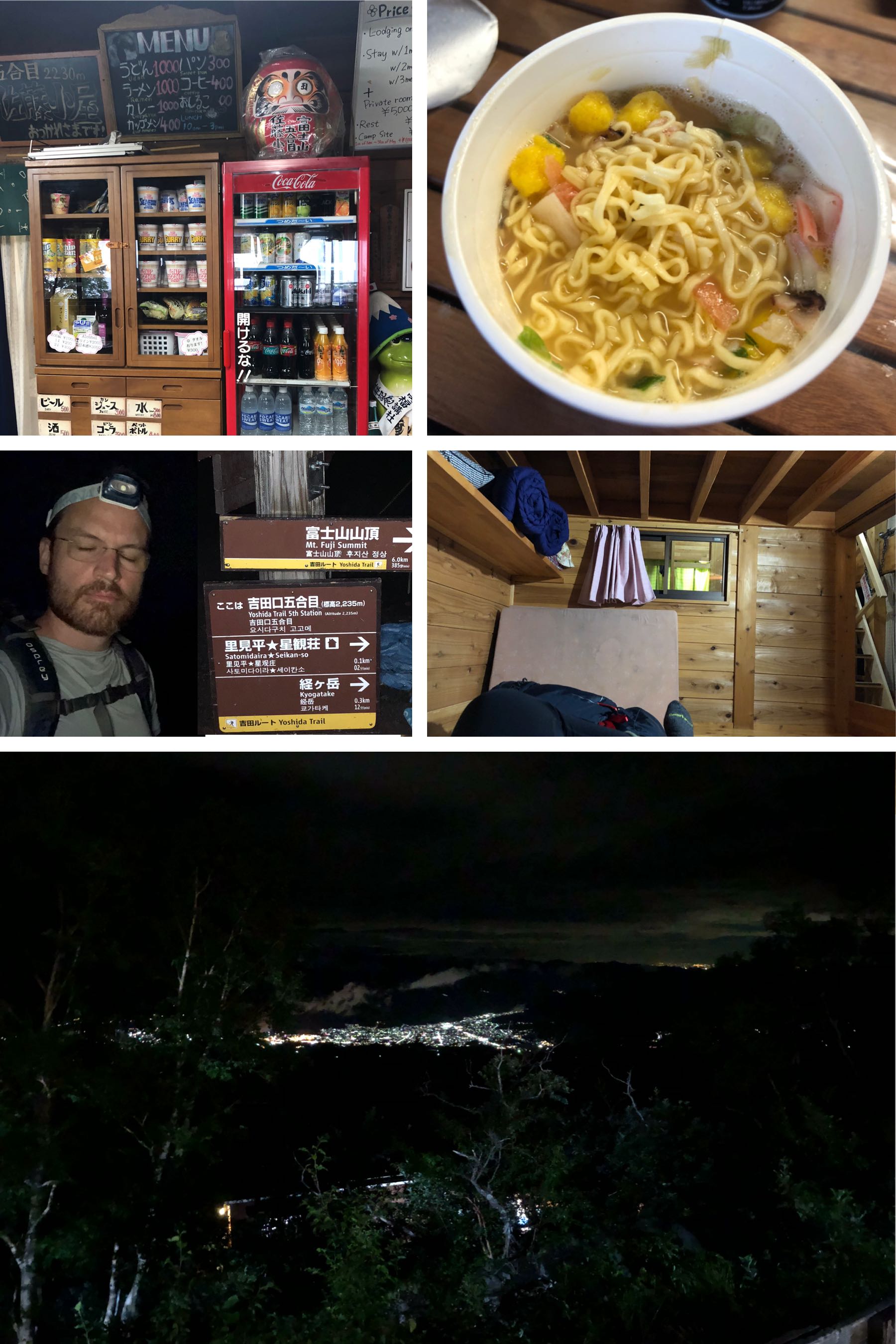
I got to the hotel shortly after 6 PM. The kitchen had just closed, but they let me in and sold me Cup Noodle, iced tea and iced coffee. They also were gracious enough to let me recycle my six empty Pocari Sweat / Pocari Sweat Ion Water 900ml bottles. This meant I had less garbage to carry with me in my pack.
I had dinner, and a good conversation with a hiker from Finland who came in shortly after me. He spoke reasonably good English, and I gathered he had just made his descent from the summit, having done it successfully. He was in a T-shirt and shorts, and he had been very, very cold at the summit. He was also fairly sleep-deprived by this point, having been awake for somewhere between 24 and 30 hours. The combination seemed pretty traumatic.
When I finished my dinner break, it was about 7 PM, and it had gotten completely dark.
Now, I had deliberately not booked any accommodation at any of the mountain hotels. The reason why is that frankly, I wasn’t sure if I would make it to, or past, 5th station, and it’s very rude to book a night at a mountain hotel and not show up. Space is limited, and I didn’t want to cost someone else a place to sleep. Also, you pay with cash at the mountain hotel, so you need to show up in order to pay. Finally, even if I did make it, I had no clue which mountain hotel I would want to stop at—there are a number to choose from, at very different elevations.
So, my plan had been to hike to the Yoshidaguchi 5th station, and then make the decision about whether to continue or whether to bail.
So, when I got there at around 5:30 PM, there were actually 3 options:
- Eat dinner, put my headlamp on and continue hiking up Mount Fuji in the dark. Either hike all night or stop at a mountain hotel for a couple hours to get some rest before continuing to the summit before sunrise.
- Eat dinner, find the first mountain hotel (if any) with a room, sleep through the night, and do the hike to the summit the next day in daylight.
- Skip dinner, hike over to the Fuji Subaru Line 5th Station, and take the bus down the mountain and the train back to Tokyo.
Given that it takes 45 minutes to get from Yoshidaguchi 5th Station to Fuji Subaru Line 5th Station, if I was going to choose option 3, I would have hiked directly there instead of stopping for dinner. The last bus that would get me to a train with enough time to get back to Tokyo comfortably was shortly after 7 PM.
I hadn’t checked out from my cheap Tokyo hotel room; I was in the middle of a prepaid 10-night stay I had booked via Hotwire. Because the weather forecast was so variable and there was the threat of typhoons, this was the simplest and safest thing to do. This way, I could pick the days to go to Mount Fuji based solely on the weather at the time, not when I had booked a gap in hotel stays in advance. Also, it was simpler, as I didn’t have to check out, segment my stuff and find a locker for part of it, etc. Also, it meant I had somewhere to return to late at night if I bailed on the hike.
When I finished dinner, I had energy, and I thought I could probably hike for at least a couple hours more. So, I checked mountain-forecast.com one last time, and made my decision to proceed. I put my headlamp on, took a photo of the sign showing 6 km to Mt. Fuji summit, and kept going. In the distance, I could see the glow of headlamps going up Mount Fuji. Behind me, I could see the lights of Fujiyoshida City, where I had started that morning.
However, I couldn’t see much else.
Seriously, it was really, really dark!
I left the mountain hotel where I had eaten dinner, and hiked about 100 meters and passed another of the mountain hotels (Hotel Seikanso). I kept going for maybe 30 or 50 more meters, and found it really confusing to figure out what was and was not the path. Even if it would get better when I was surrounded by the other hikers farther up the mountain, I decided that night hiking was definitely not for me on this trip.
So, I turned around and went back to Hotel Seikanso. One of the women who was working there let me in, and fortunately they had plenty of rooms available for the night.
The rooms were kind of a wooden combination of a hotel room and a capsule hotel: they were half-height, there was another one above me, and there was a curtain you pulled shut (much like a capsule hotel); but on the flip side, they were about three times as big as a capsule hotel, and you set your futon up in it (much like a hotel room). Whatever it was, it was friendly, quiet, dark, warm and dry.
So, I checked in, set up my futon, and took some pictures of my capsule-style room and the lights of Fujiyoshida City in the distance. Shortly afterward, just before 9 PM, I went to sleep. Thankfully I had my earplugs and my face mask, and I only woke up briefly a couple times in the night.
I had charged my iPhone, and set my iPhone alarm for 6 AM, but told myself to wake up by 5 AM if possible. Given how long the rest of the hike seemed from the signs, and given the wind forecast, I wanted to have as much time as possible to complete it.
Day Two
The Climb to the Peak
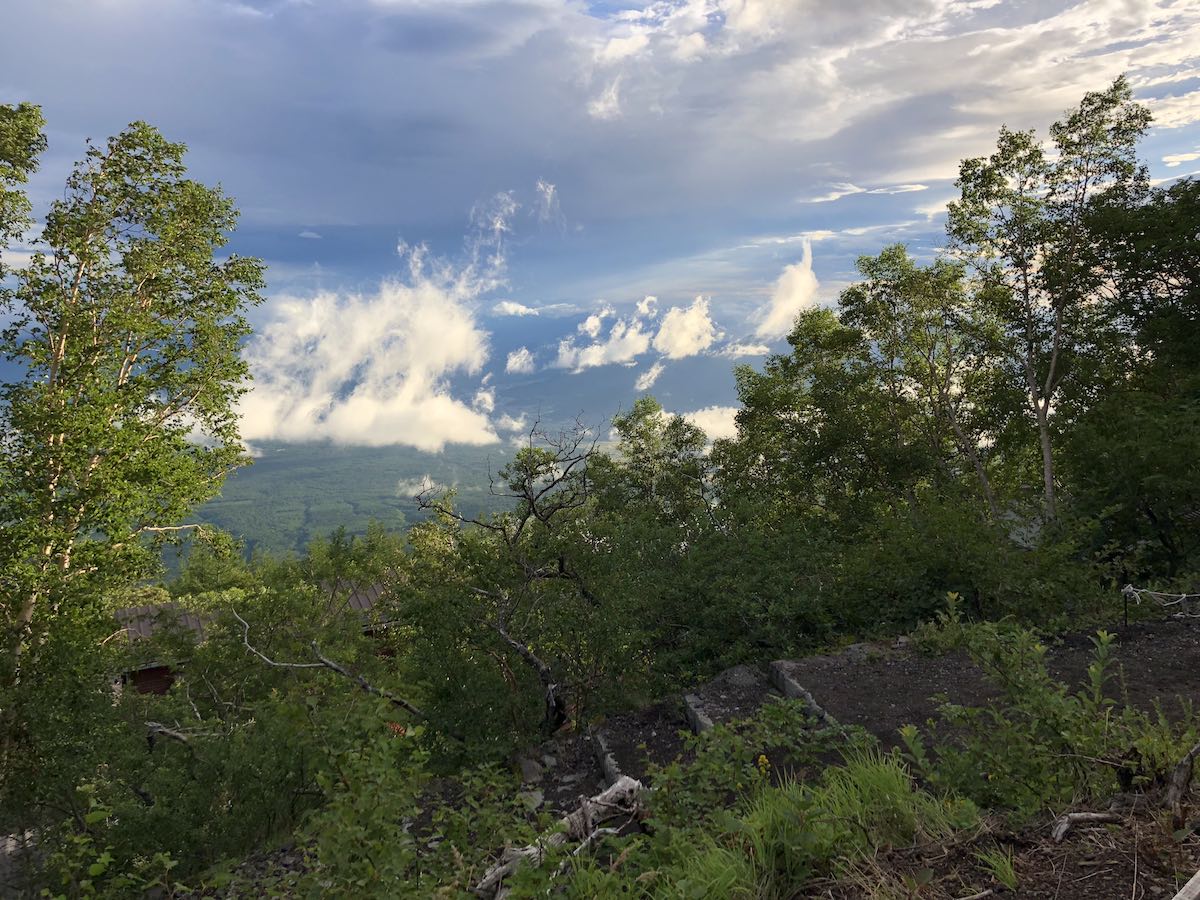
I did wake up naturally with the sunrise, just after 5 AM. I was very well-rested. The kitchen at Hotel Seikanso didn’t open until around 11 AM, so I just checked out and was on my way before 6 AM. What a difference daylight makes: what was a confusing path at night was totally obvious in the daytime. And instead of no view, there was a great view.
After checking out, I continued trekking up Mount Fuji. Fairly shortly after leaving Hotel Seikanso, the Yoshidaguchi trail joins with the trail from Fuji Subaru Line 5th Station. From this point, you are on the same Yoshida trail to the summit as everybody else. (So, I don’t have to go into too much detail in this section, since whenever you read an account of someone’s climb of Mount Fuji, chances are they also did this trail.)
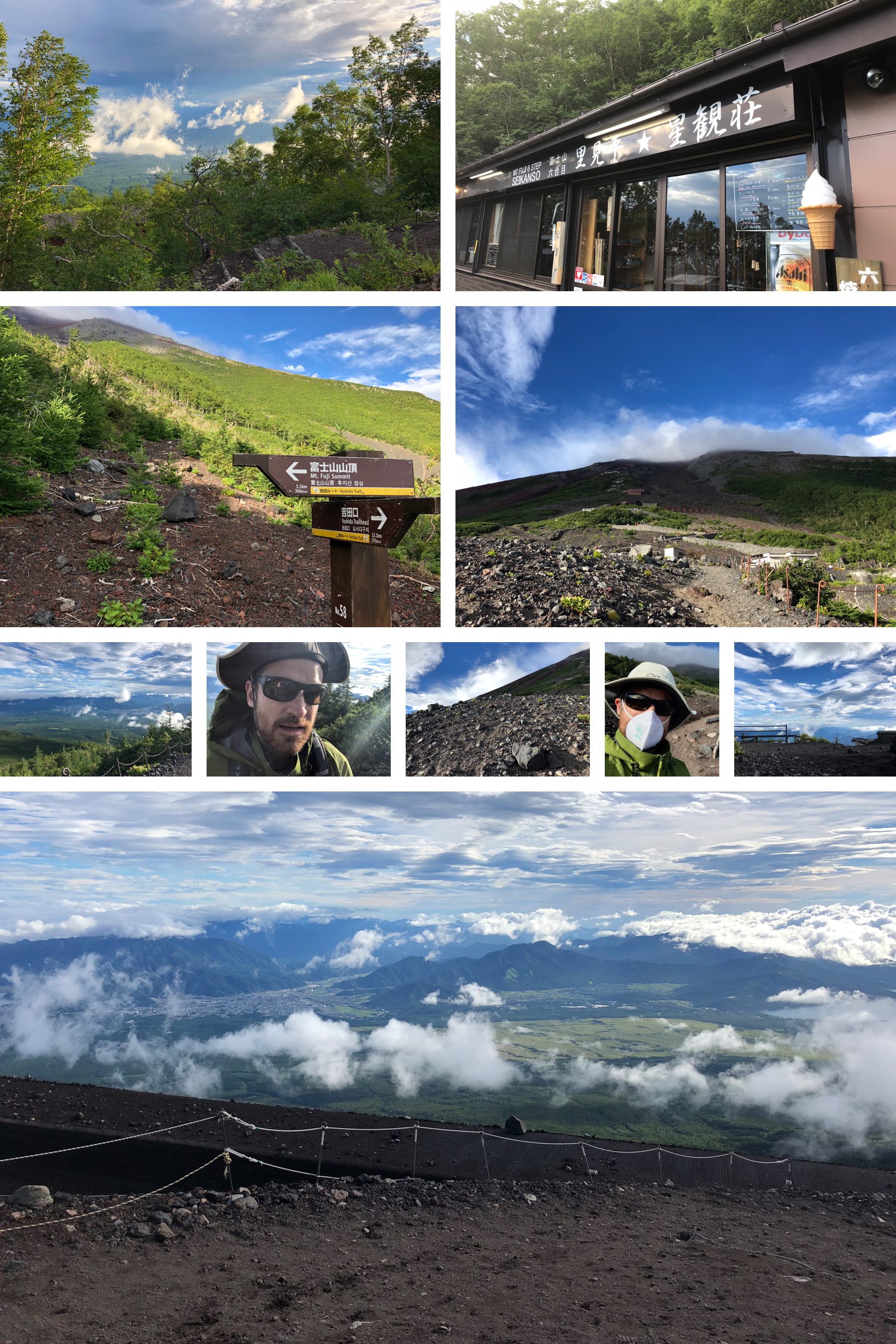
So, instead of solitude, there are other people. And instead of being in a forest, you’re on Mars. Seriously, I get the whole “don’t put all your eggs in one basket” thing, but I have no idea why Elon Musk wants to go to Mars so much. All he would need to do is hike the upper portion of the Yoshida trail of Mount Fuji!
The air is dusty from the wind, and from dirt kicked up by other hikers, so I put on my face mask for a while, before switching to my balaclava, as its neck tube was nicer than the face mask. Also, this is when the wind really picked up. The forecast had been for 65 km/h wind, and it felt like it. There were times when I had to duck down and brace myself with my poles, before continuing up the trail.
Thankfully, since I had gone on a weekday, and a windy one at that, the trail was actually not very crowded at all. There were probably only about 30 people making the ascent at a similar time as I was. Frankly, I was glad they were there. I’m not sure if I would have made it to the peak if it had been completely deserted; the camaraderie was nice.
Also, there was a young French couple a tiny bit ahead of me, wearing shorts, t-shirts and hoodies, and looking woefully unprepared for the rain, wind and cold. I try not to be a petty person, but there was absolutely no way that I would give up before them.
They gave up somewhere between 7th station and 8th station. I was continuing uphill as they I saw them walking downhill, the woman looking pretty pissed and the man looking very sheepish.
There were people from all over. For a little bit, I hiked with a few people from Brazil and Chile, who were very friendly and seasoned hikers. They seemed like they would make it to the summit with no problem.
I also saw one group of three women in their 30s and 40s, wearing track suits and carrying light backpacks, who looked like they were taking it all in stride. The oldest of the three was wearing a parka, and using an umbrella as a walking stick. I had expected them to give up soon after the French couple, but they were continuing on, and doing better than I was. I was genuinely impressed.
I asked “Where are you from?” to the oldest of the three.
Nepal.
At that point, I realized this was just a walk in the park for them, so why not bring an umbrella?
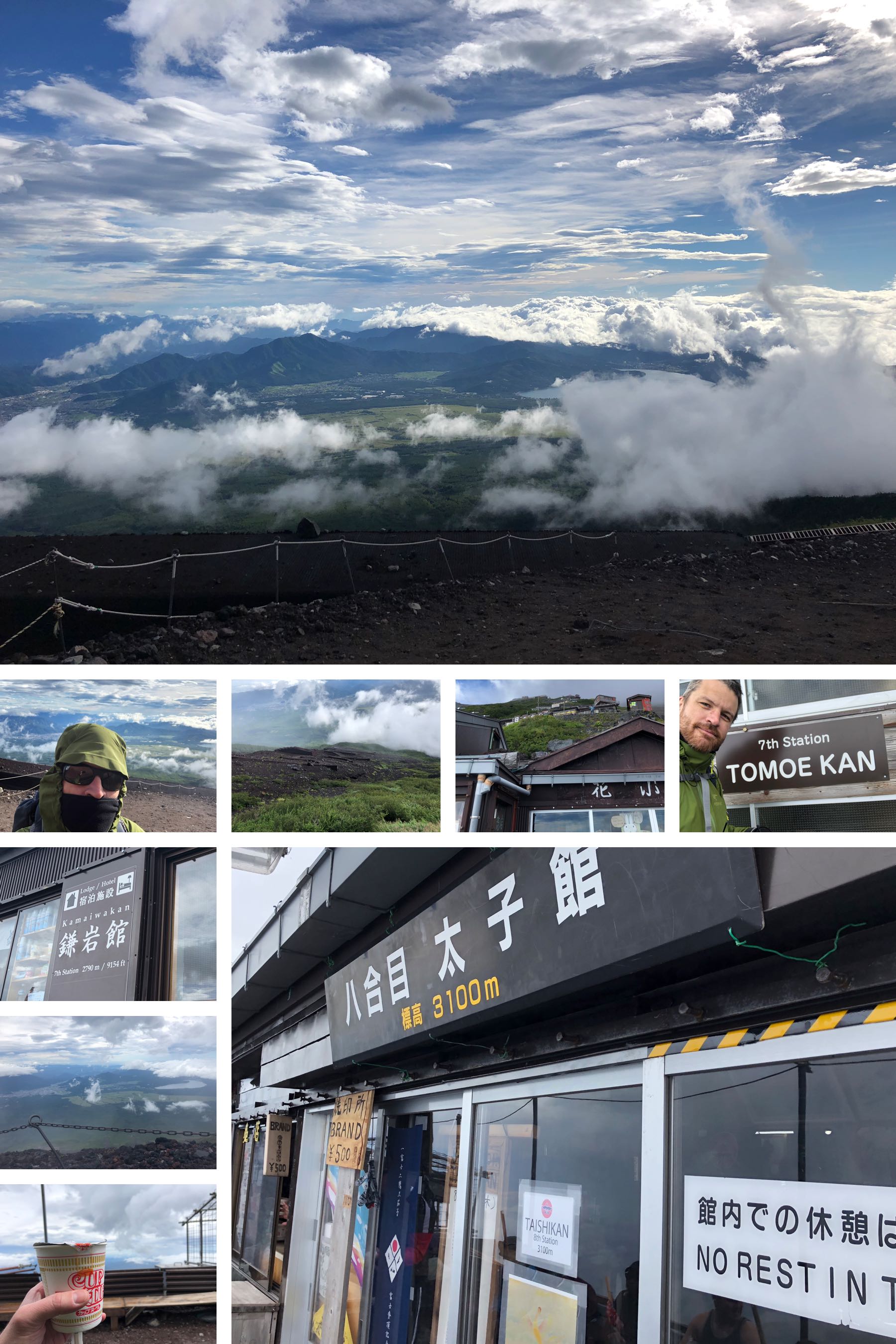
I stopped at all the mountain hotels, either to go to the toilet, buy iced coffee, Snickers bars or Cup Noodle. When you stop at the stations, you typically can’t actually go inside, however. That privilege is for the guests who are spending the night. You will see signs indicating that there is no rest inside the hotels, except for hotel guests.
You will also see various signs at the upper mountain hotels indicating that the penalty for sleeping in the toilets is about 6000 yen, which is the price of a room in the hotel for the night. That would be a truly shitty hotel room.
At around 1:15 PM, I stopped at one of the topmost hotels (I think it was 8.5 station) for lunch. I ordered a big lunch of curry rice, a Snickers bar and coffee, and they let me eat inside in a narrow bench right by the door. I asked if I could eat inside before ordering it.
While I wanted the curry rice, mostly for the novelty of eating actual food, what I was really paying for was a 10-20 minute respite from the wind and rain, before pushing forward to the peak.
The wind was really, really hard at this point, and I still wasn’t sure whether I would continue. I needed a break to get the mental strength as much as anything.
Also, as an added bonus, there was cell phone reception at that hotel, and while I was waiting for my curry rice I even managed to call my wife to say hi.
When I was eating my curry rice, a French man and his teenage son came in, looking thoroughly soaked. I asked if they were coming back from the summit. The man said yes. I asked how the hike was. He emphatically said “Horrible!”, in a delightful accent, explaining how there had been not just rain but hail, and that they hadn’t seen anything. They seemed even happier to be indoors than I was. He asked if I was going to the summit. I said yes. He looked at his watch and said good luck.
I think they also had the curry rice.
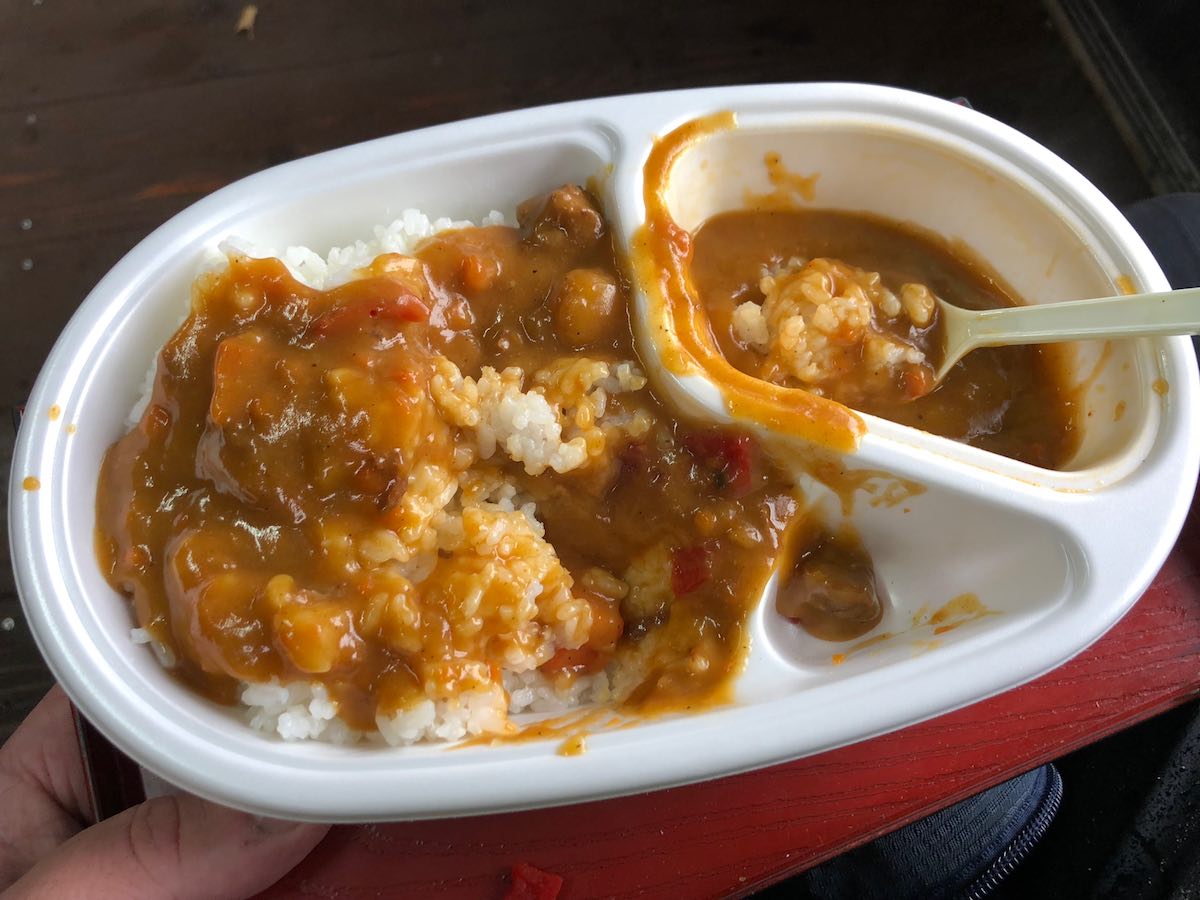
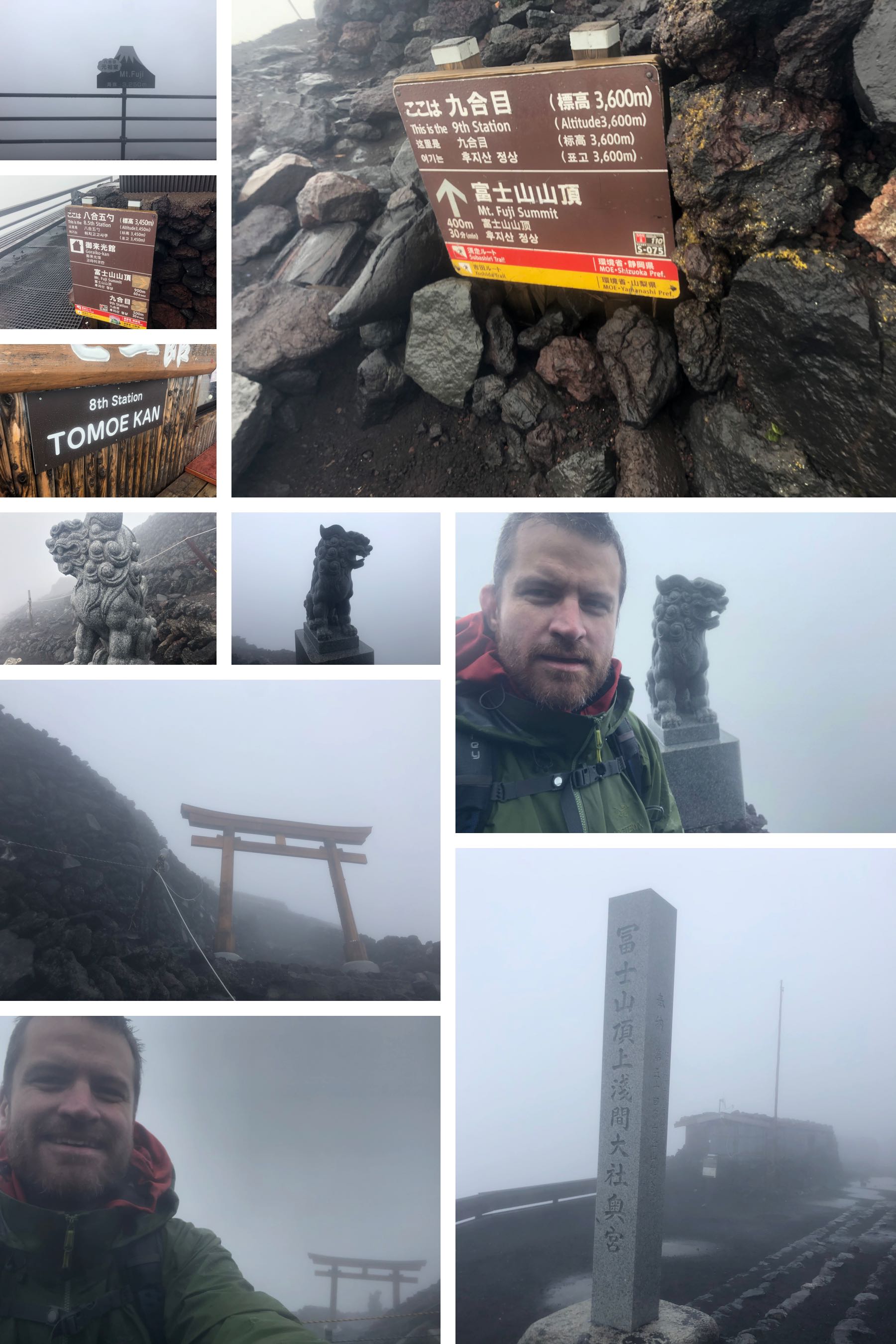
After the curry rice and the Snickers bar, I pushed on, and after a brief stop at 9th station, I made it to the peak of the Yoshidaguchi trail. It was a truly amazing feeling, and worth all the effort to get there.
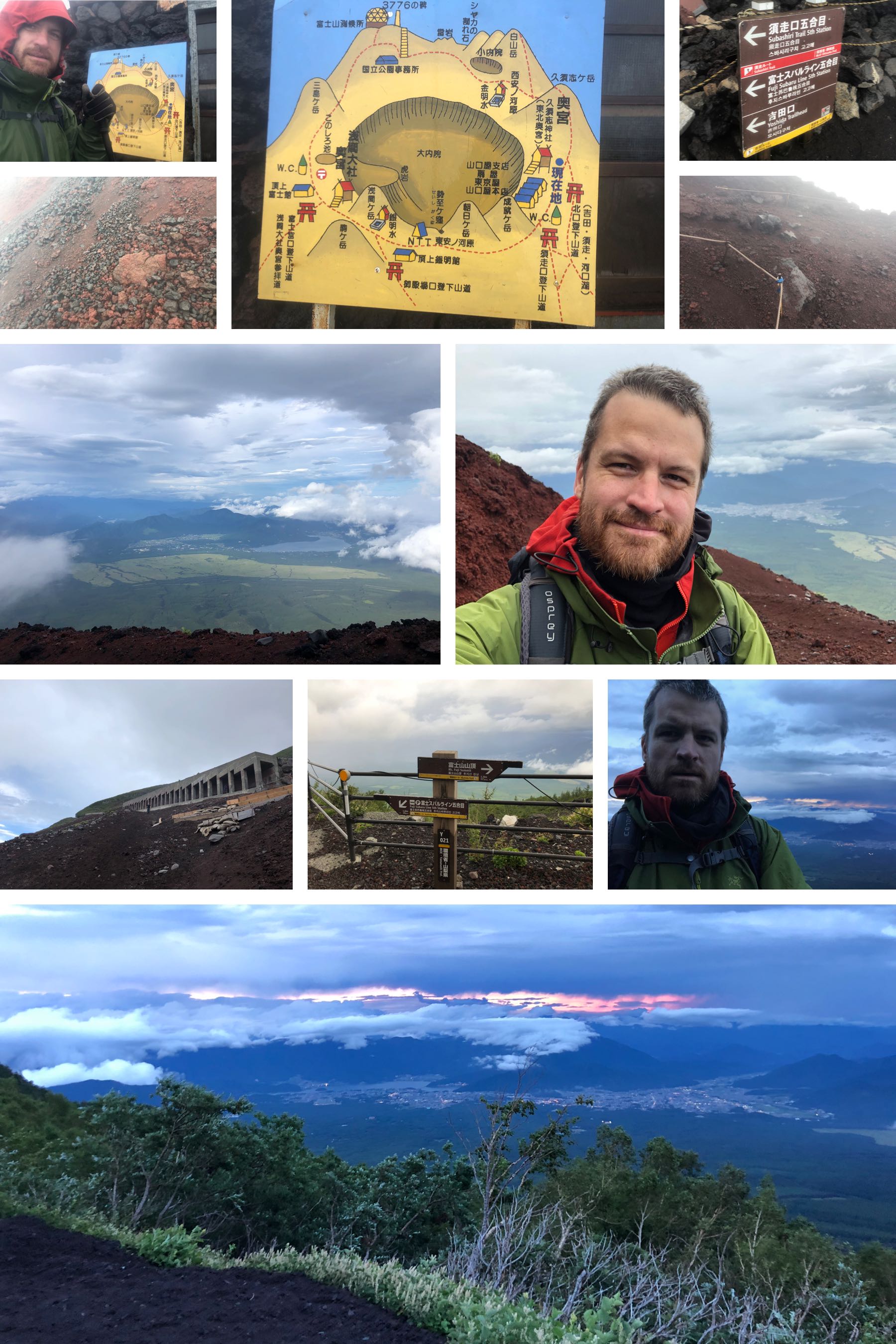
I wandered around for a few minutes, looking around and trying to see inside the crater through the cloud. I looked at the sign showing all the various peaks at the top of Mount Fuji, and looked at the path to the summit trail.
I chatted briefly with a couple of hikers from Hokkaido, who had also just climbed Mount Fuji for their first time.
After about five minutes, I decided not to hike to the summit, for reasons I explain below.
The Descent and Trip Back
I hiked down the descending Yoshida trail to the Fuji Subaru Line 5th Station. Yes, there is a completely separate trail for descending the Yoshida trail. This is presumably because the ascending Yoshida trail can get crowded. These trails are actually reasonably far apart (see the two different yellow lines on the map). You cut over to rejoin the ascending Yoshida trail at 6th station.
Note, however, that on the descending Yoshida trail there are no mountain hotels to sell you drinks, curry rice or Cup Noodle. (So, you need to ensure you have enough liquid for the descent once you leave 9th station to make your ascent to the peak.)
Now, while there were no mountain hotels, there were one or two toilets along the way. There were also two or three concrete tunnel-like structures that you could walk inside, with signs indicating that they were for protection from falling rocks caused by hikers above you. Presumably these are also useful for emergency refuge.
I got to Fuji Subaru Line 5th station shortly before 7 PM, just as the sun was setting. I was on a bus about 20 minutes later, and I got to Lake Kawaguchiko at around 8 PM.
From Lake Kawaguchiko, there was a highway bus directly back to Shinjuku station in Tokyo. However, it was sold out, so I took the Fujikyu train back to Otskui, and a JR train back to Tokyo. After one transfer, I arrived at Asakusabashi station at around 11 PM.
Walking back to my hotel, I stopped in at a small noodle bar about a block from the train station and ordered udon noodles. It was just me and about 10 salarymen, all slurping away. They were actually really good noodles by any standard, but after the previous two days, I couldn’t remember having eaten better.
I then went back to my hotel room, had an amazing hot shower and a long, perfect sleep.
Don’t You Wish You’d Hiked to the Summit?
Of course!
The summit is the highest peak of a mountain. Obviously, if you climb one peak of a mountain, you also want to reach the summit. Anyone who says otherwise is lying to themselves or to you.
In my ideal world, two things would have happened differently during this hike:
- I would have reached the 3776 meter summit of Mount Fuji, not “just” the 3706 meter peak of the Yoshidaguchi trail.
- I would have seen the view from the summit of Mount Fuji.
Now, since the top 700 meters of Mount Fuji were completely covered in cloud, I knew from 8th station that the whole “view from the summit” thing wasn’t happening.
Worse, when I reached the peak of the Yoshidaguchi trail, it was 3 PM. If I did the hike to the summit, it would have been about 5 PM when I got back to the peak of the Yoshidaguchi trail. I would then only have two hours to descend before it got dark. (I had a headlamp, but descending Mount Fuji in 65 km/h wind in the dark was not something I wanted to do.)
Also, if I was going to get a bus back to the train station in time to catch the trains for Tokyo, I would only have about 2 or 3 hours to get to that bus—and the descent to the fifth station was about a 4 hour hike.
So, I had 2 options:
- Hike to the summit on the other side of the crater, and then hike 1-2 hours of the descent (down the ascending trail) before sleeping in one of the mountain hotels (near 8th or 7th station) on Mount Fuji, and complete the descent (either to fifth station and then taking the bus, or all the way down the Yoshidaguchi trail to the base) the following day.
- Skip the summit, hike down the proper descending trail of the Yoshida trail (it’s a different trail, and there are no mountain hotels on the descending trail) and then walk a couple kilometers over to the Fuji Subaru Line 5th Station. From there, I could get one of the last buses down to Lake Kawaguchiko, before taking one of the last trains back to Tokyo.
I chose option two, for the following reasons:
First, since Mount Fuji was completely covered in cloud by that point, there was literally no view to see. I would be making that hike around the crater to the summit, essentially just to say “achievement unlocked”. Standing where I was standing, and having started where I had started, I already had an enormous sense of accomplishment. Going from the peak of the Yoshidaguchi trail to the summit felt like a technicality at that point.
Second, I had no dry clothes left in my backpack. My backpack was pretty wet, as I had deliberately removed the rain cover. (It was so windy near the peak that I was afraid that the rain cover would be caught by a wind gust, and act like a parachute!) So, during the very wet and windy climb from 8th station to the peak, I deliberately stored my rain cover inside my backpack, and just let my backpack get soaked. (Also, I had only brought cold weather clothes for one day, not two.)
When you plan a hike up Mount Fuji, one quote you will encounter a lot of versions of is the Japanese proverb “A wise man climbs Mount Fuji once, only a fool climbs it twice.”
Standing at the peak of the Yoshidaguchi trail, I realized that at heart, I’m a fool.
I decided at that moment that someday I would return and hike Mount Fuji again, both to enjoy the hike and the view from the summit—and I would time the hike in a way that I would see the sunrise from the summit like everyone recommends.
Because of this commitment, I decided there was no need to spend a night sleeping in wet clothes and an extra day hiking down the full trail, just to check something off that I planned to do again.
I would save it for later.
This sounds like a lot of thinking, but it took about 5 minutes.
So, decision made, I hauled ass down the descending trail. My knees have my trekking poles to thank!
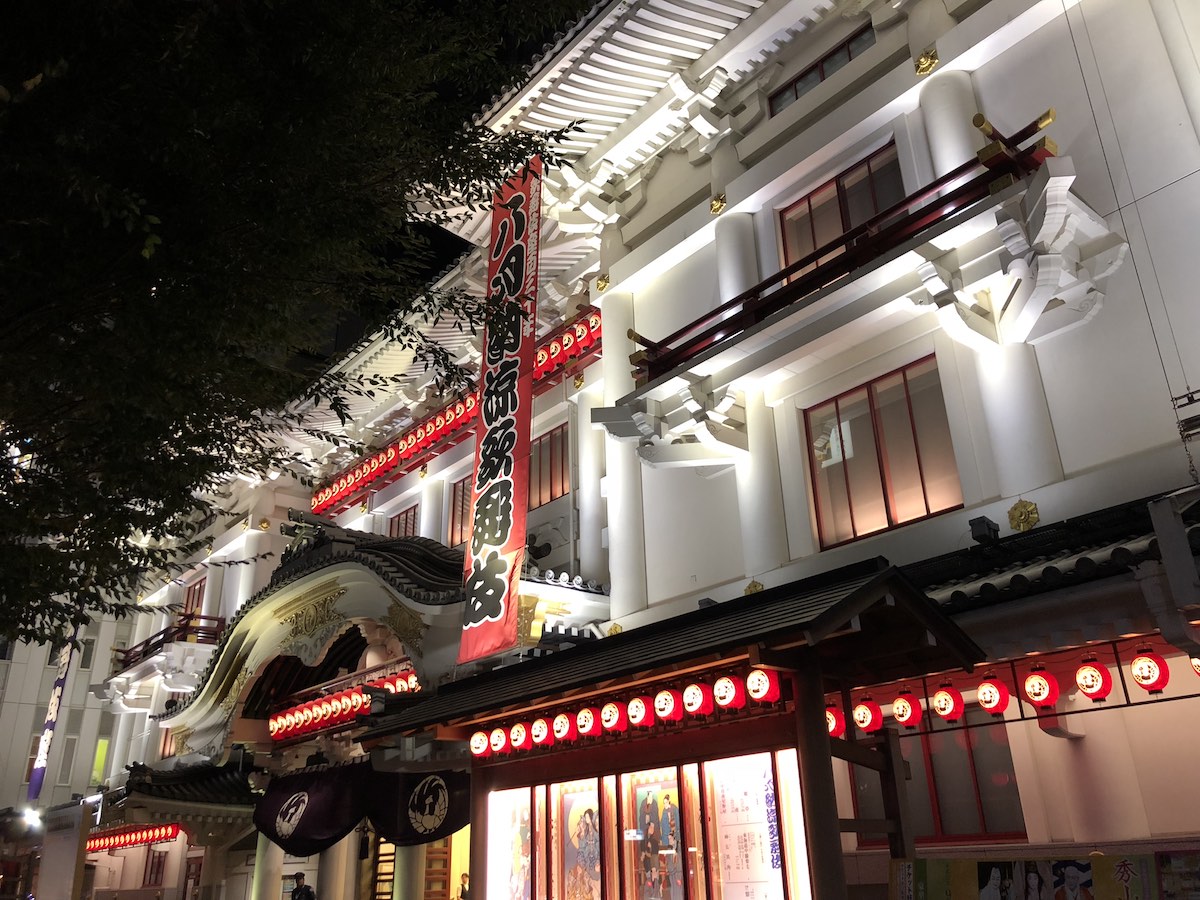
The next day, I woke up in my hotel bed in Tokyo, did some shopping and watched the third act of a kabuki performance.
I flew home to Canada the following evening.