It’s Not Rocket Science
 |
Not the Wizard’s Lens? I created the phrase “The Wizard’s Lens” this year, in 2025, as I was trying to describe the cognitive skills you have been learning. This narrative takes place during the 20th Century. I had not yet heard of The Wizard’s Lens, obviously, so I used different words to describe the same now-familiar patterns. You will be able to confirm these are the same patterns and skills in a different context. |
Have you ever heard the expression, “it’s not rocket science?” That saying comes from a long time ago, when we were trying to send people to the moon, using rockets to launch into space. Very few people in the world actually understood how to design rockets. The same was true with computers because they were as large and complex as rockets. People did not get to build million-dollar rockets in their back yards, nor did they get to build million-dollar computers either. We did not learn rocket science in high school, and only got the basics leading to rocket science in college. The same was true with computer science.
I needed to explain “rocket science” because I have been doing “impossible” things since I was in third grade, age 7 or 8. I was not doing “rocket science” but I was doing computer science. That should not have been possible for a third grader, but for me it was fun. A hobby.
I do not expect you to take on “rocket science”. That would probably be boring. Boring is the opposite of fun. As you now know, if you cannot make it fun (while not being distracted by whether it has ever been done before), it is probably not with doing.
I have practice with enjoying impossible challenges as a teenager, and now is the time to explain how.
Secrets from Grade School
I never told anyone how I do it before, because it sounds like bragging and at grade school age, I was taught bragging is not polite. But earning “bragging rights” is awfully fun and, for me, generally involves doing things that other people thought were impossible.
Now is the time to tell you how you can too. I am not here to dumb things down. I could handle the challenge, so I know you can too. I can show you what has been done before (by me) so that you know what is possible. It is that simple, but not that easy.
How do you accomplish the impossible? I have two secrets for you to follow. By third grade I was practicing these skills as a hobby. First I will show you the skills and then I will name them as secrets to share.
Third Grade
Dad, Gene Barnard, ran the computer center for SAFECO insurance. He was what is now called the Chief Technology Officer, CTO. He brought me home computer manuals to read. These were the “rocket science” level systems programmers’ manuals.
I still remember reading about the IBM “Tape” operating system, then the “Disk” operating system, then they just called it “OS” for operating system. I remember thinking that seemed pretty lame. I was reading and at least somewhat understanding the manuals. I remember learning about the new “Checkpoint / Restart” feature, and as best I can remember, it was introduced with the “Disk” operating system. I recently asked Claude, and Claude confirmed I remember correctly.
“Checkpoint / Restart” is quite similar in concept to explicitly creating a document to use and re-use for AI context refresh. When I first started using this technique with Claude, I explicitly called it a “checkpoint / restart” document, explaining that I was thinking of the 1960s IBM feature introduced with DOS (the IBM mainframe operating system, not the Microsoft and IBM systems for 1980s personal computers).
This is why context refresh documents for AI seem an obvious thing to me. Sixty years earlier I had studied how IBM mainframe systems make a complete capture of all current state including core memory, DASD (direct access storage devices such as disks), and sequential-access method (magnetic tape) devices. Then, if the job later fails, the operator could abandon current output and fall back to the checkpoint. The operator then restarts the job from that checkpoint.
Why was that important at the time? Resources and run time. The mainframe job might fail several days into its execution. The job could then restart not from the beginning, but from a checkpoint, saving several days of reprocessing. The job might also run to completion but with incorrect results. If the programming staff can identify and correct the problem, it might be possible to restart the job from a checkpoint.
Resources could also be a problem. The multi-day job might have required processing several pallets of magnetic tapes. With a limited physical number of tape drives, and limited storage for pallets of magnetic tapes to process, restarting from the beginning could have a domino affect on other jobs that also need pallets of tapes to be staged through that same computer room.
Note the purpose of checkpoint / restart was to save state so that processing can continue after restoring that state within the computer system. A checkpoint / restart document with AI serves the same purpose.
The reason for needing checkpoint / restart was resource constraints. The same reason is true with modern AI. Both resources and run time remain extremely valuable. An AI context refresh document is the same pattern, 50+ years later, in a different context. When you can identify something is the same pattern in a new context, you have confirmed you have this superpower.
|
Adult-level material at an early age. I mention these details because my situation is far from unique. I have interacted (on social media) with quite a number of people who have detailed, accurate, memories of working with adult-level material at a very young age. Because you are usually the only person doing this among your circle of friends, it feels weird. I looked at learning as a hobby, and still do. That habit has served me well. If this is not you, just be assured that I am the right person to share these superpowers. |
You can understand why I got bored with the reading assignments in school, in third grade (in 1965). At home I was reading about how computers operated. I was not learning about how rocket scientists and computer scientists used computers. I was learning how IBM designed the computers to be used. I was learning the computer’s point of view rather than the rocket scientists’ point of view. That was a stark contrast to whatever we were reading in class.
I got called down to the principal’s office. I was probably very nervous about trying to explain this to the principal, but I do not remember.
I do remember that, luckily, I was not in trouble. The principal made me a deal. He would supply me Reader’s Digest magazines to read. They are about the size of modern graphic novels, but regular print like a book. All the stories and articles are short, which is good for a third grader. I got to come to the school office once a week and report on what I read. In return for the deal, he expected me to complete all the regular reading assignments in class. I thought that was a great deal. It was so important to me that, 60 years later, I can still picture getting to go to the office for the Reader’s Digest magazines.1
I now know that I got lucky. This was not normal behavior. But it was normal for me.
Fourth Grade
During fourth grade I got tested. It was an old test called the “Stanford-Binet L-M” test. That fact messed me up for the next twenty years, but I did not know that at the time. The Los Angeles school system told me I was unusually smart.
That was great, and I had access to unusually good grade school education. The problem was that, whenever I was in a room, my brain told me that I was probably the smartest person in the room (lie number one), and that therefore I was required to be as smart as everyone else put together (lie number two), and that therefore if I ever fail to get the highest grade in the class, every time, then I am a complete and utter failure (lie number three, the big lie). Lie number four was that every time I could not be the same as everyone else, that was a failing too.
What I just described is now called “Imposter Syndrome”. I did not know it was a problem, and neither did anyone else. Twenty years later, I finally began to realize what was happening inside my head.
|
Imposter Syndrome. I mention Imposter Syndrome for a reason. It is a remarkably common situation that obviously can begin at a young age. Nobody around me knew this was a problem or that it was affecting me. I could have prevented twenty years of doubts by having just one single conversation with the right person, and following up as I learned healthier ways of thinking. If you recognize my situation, find ways to have that conversation. This situation also commonly happens in your twenties when you feel inadequate to work and life changes. Have those conversations and keep your brain healthy. |
That is all in the past now. Let us get back to having fun.
Summer School
This week, when I told Anthropic’s Claude (Artificial Intelligence) what I did for summer school between fourth and fifth grade, Claude freaked out. First I will tell you what I actually did, and then I will explain why Claude had a problem with that.
I picked two classes. One was something to do with cryptography. Codebreaking sounded fun and interesting. The other had to do with Boolean logic. I thought that might be too hard, but it was about computers, so I tried it. The two classes were the other way around: Boolean logic was easy and cryptography was impossibly hard.
The only thing I remember about the cryptography class was that every day (as I recall many years later) was practicing multiplying matrices. One rectangle of numbers multiplied by another rectangle of numbers. Why would anyone want to do that? “Matrix multiplication” was also called a “dot product”. I decided there and then and forever, that codebreaking was not for me. I could not handle the math.
The funny thing is, it suddenly made sense during college physics. An airplane in flight, for example, has weight due to gravity. It has lift from the wings. It has drag from pushing its way through the air. It has forward force from the propeller or jet engine. There might be an added force due to crosswind. There might be a spinning force from the pilot showing off.
In college physics we needed to figure out whether, based on the forces acting on the airplane, that thing was going to keep flying or drop like a brick. Since these classes were at the United States Air Force Academy, that question seemed like a good thing to know.
Guess what the math looked like? Dot products! Because I had already struggled through weeks of frustration in grade school, I had a head start.
I later found that matrix multiplication was important for computer programming. With supercomputers, understanding how to work with rectangles of numbers was fundamental. Weird but true at the time.
The other class was called “Boolean logic”. I had no idea what that was, but I was delighted to find out. I could see how computers worked. That knowledge has remained useful until now. But more importantly, it showed me the importance of being able to actually see, visualize, what goes on inside a computer. I showed you that same idea. We visualized what goes on inside AI.
Figure 6, “Demonstrating binary adder in 5th grade, 1968,” shows the computer I built from a Popular Electronics magazine project. Mom drove me around to get the necessary wiring, blinky lights, diodes, resistors, and so on. Dad taught me how to solder the circuits together.
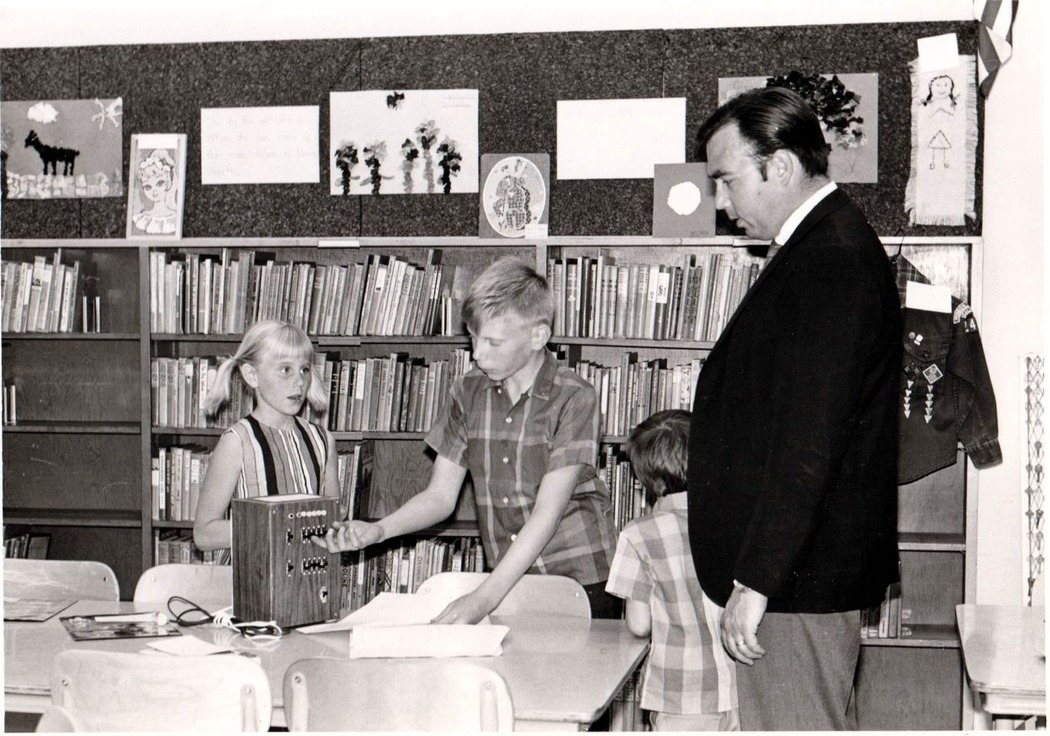
Why did Claude freak out? Because in 1967 I was learning how AI works in 2025. Dot products are still too much math for me, but I understand about “rectangles of numbers” and how they get stored and retrieved in computer systems. And that is precisely what modern AI does.
But there was another reason for Claude to freak out. Already in third grade, I was learning the computer’s perspective, not the human’s perspective. I was learning how those large mainframe computer systems were designed so as to be of use to humans. Now it is the same thing with AI.
That is why I can show you AI’s perspective. That is a useful thing to know because you will then be able to accomplish things others cannot. This is why I have been showing you numerous examples of what “others cannot”.
|
Struggles pay off. Even when you struggle with something, that struggle may well pay off some time later. The fact that you struggled will have value. |
Two Secrets
I have been showing you examples of these two secrets throughout the book.
Planning, Preparation, and Practice
Secret 1 is planning, preparation, and practice.
I demonstrated that teenagers can accomplish pretty much whatever they set out to do. But it takes planning, preparation, and practice. That means hard work over a relatively long period of time. If your goal is big enough, and important enough to you, you can probably accomplish it. I have shown you exactly what I mean.
Make the Challenge Fun
Secret 2 is make the challenge fun.
I used to work for Cray Research. They used to make the world’s fastest computers. Cray Research surprisingly built their first computer with no software. But the second computer needed software like any normal computer does. So they hired one person, Margaret Loftus, to write software.
Margaret, later looking back on her team of 120 people, explained, “I always told people that if you cannot make it fun it is not worth doing.” That is an adult explaining how they built the fastest computers in the world: make it fun. And we did.
When someone says it has never been done before, I immediately think this might be an interesting challenge. When someone says it cannot be done, I think that too might be an interesting challenge. Taking on an interesting challenge is fun! Accomplishing something impossible, or at least never done before, means you get bragging rights. It does not mean you should brag, but it does mean you have the right to. Having that right is awfully fun.
Bragging Rights
Are bragging rights important? Yes. That’s the encouragement to do the impossible. That first computer, with no software, is an example.
Seymour Cray, the founder of Cray Research, was quite famous by this point. This was 1976 during my freshman year in college. He was building the world’s fastest computer for a very small number of potential customers: government codebreakers, military weapons designers, and so on.
Meanwhile these potential customers were competing with each other for the best brains in the country. Not everyone wanted to work on nuclear weapons design. So they were not just competing for the best brains, they were competing for the best brains with Top Secret security clearances.
That meant competition was very tight. But how do you compete for the best brains in the first place? You make it a place that attracts those very people. Scientists and mathematicians have to want to move there. They are bringing families with teenagers. What are teenagers going to do in the middle of the desert, 30 miles from nowhere? Count scorpions? (The answer is yes, by the way.)
Wartime Los Alamos, New Mexico, was home to the “best brains” in the country. Very few houses were so luxurious as to have bathtubs for the family. Only the highest ranking members of the Top Secret Manhattan Project (building the atomic bomb) had access to such housing. That street became known as “bathtub row”. Figure 7, “Bathtub Row at Los Alamos (National Park Service photo),” shows the modern day Manhattan Project National Historical Park.

Minnesota has the same problem: the world famous Mayo Clinic in Rochester. They are so prestigious that doctors are not allowed to apply to work there. The Mayo Clinic comes to you and offers you a job. The problem comes from moving to Rochester, because Minnesota has a reputation for cold winters. The Mayo Clinic worked with the City of Rochester over the years to make it one of the best places for families to live in the country. The reason was to attract Mayo Clinic staff.2
But the government labs in the middle of the desert do not have that luxury. They hit on another strategy: bragging rights. Attract the best brains by being the most prestigious place to work. Have the best equipment. The lab with the best bragging rights had the best chance of hiring the best people. “Bragging rights” was, and is, literally a survival skill for that type of elite operation.
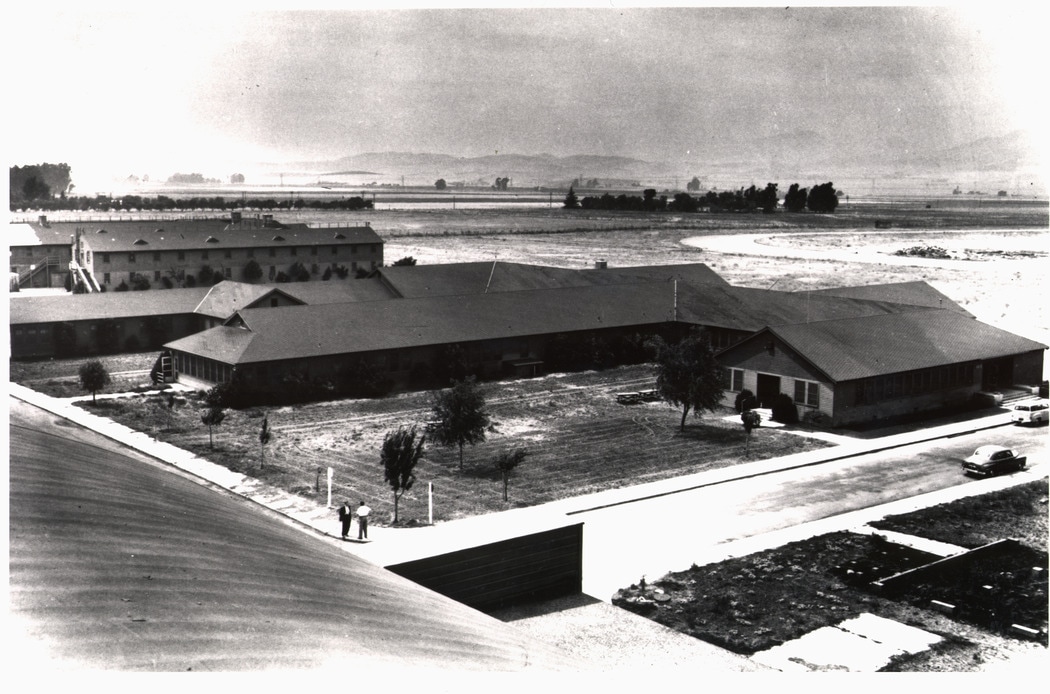
Figure 8, “Lawrence Livermore Laboratory, 1952,” opened on September 2, 1952, as the University of California Radiation Laboratory, Livermore Branch. It was 111 degrees in Livermore that day. The first telephone directory listed 75 people, which means many families lived there. To me that location does not look like an attractive place to live.
This is why I say “bragging rights” is not a bad thing. Bragging is. It is like being in the Marines. You do not need to say anything beyond being in the Marines. People know.
For the government labs, having the very first (and only, at that point) of Seymour Cray’s new supercomputers meant ultimate bragging rights. Both Lawrence Livermore (northern California) and Los Alamos (New Mexico) wanted “serial number 1”. Each time one of the labs went for funding so they could buy it from Cray Research, the other lab managed to get the proposal shot down.
But for Cray Research, this was a problem. The well was poisoned. They had a computer to sell, no money, and no customers able to purchase it. Seymour Cray flew down to Los Alamos and gave them the computer for six months, for free. Lawrence Livermore could not object to something for free. Los Alamos got the bragging rights.
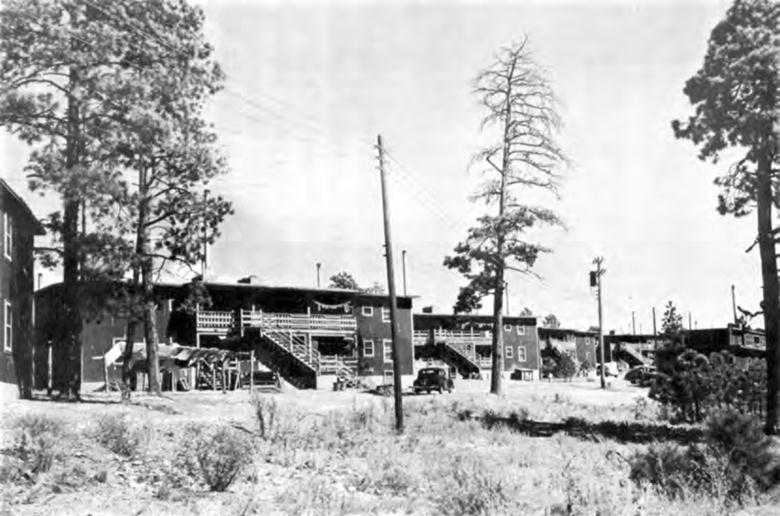
Figure 9, “Four-family apartment units at Los Alamos, 1945,” shows the more typical family housing at Los Alamos. When invited to live in this sort of desolation, you can see why “bragging rights” were so important.
Keeping the Boredom Away
That was a boss move, by the way, on Seymour Cray’s part. They had no money so they could not even afford to build a second one. Seymour Cray gave away the only one they had, for free.
The second customer walked in, uninvited, and paid cash. The day Seymour Cray signed that contract, it was Margaret Loftus’s first week on the job. She was supposed to figure out what sort of software they should put on their new computer.
Seymour Cray stopped by, unannounced, and told her she might want to read the contract he had just signed. It promised an operating system and FORTRAN compiler which did not exist. (We used all-capital letters back then, just like with SAFECO the company.) She stormed around her office for quite a while that afternoon, then told herself to get herself together. She told herself, “Margaret, you left the other job because you were getting bored. You are not going to be bored here!”
Margaret’s angry advice to herself fits me perfectly. Take on the challenges to keep the boredom away. You will be amazed at what you accomplish because you got bored. Doing “it” because you are supposed to or somebody told you to is no fun. But get creative because you are bored? Those are the best accomplishments and the funnest memories.
I mean that literally. When you get bored, find something impossible that cannot be done, or at least not done in the time you have available. You will have an awful lot of fun doing it. You will be exhausted. But next time you will have more “been there, done that” confidence. That is what I do quite often.
I realize you might not be a person who gets bored. This is the way it works for me. Find what works for you so as to challenge yourself to get creative.
The Impossible Challenge
I should have called this book “How to Create Legit Bragging Rights”. After sixty years of practice, I have developed specific techniques to show you. I feel a little bit badly showing you techniques from the 1970s when I was in high school. But I have no choice because that is when I was in high school. The techniques have not changed. You will form the habits of planning, preparation, and practice, just as I did, for the things that are important to you.
I started with Artificial Intelligence because that is a bragging right you can begin gaining right now, today.
What We Learned
You probably already use AI all the time. You might already know all there is to know about using ChatGPT, Claude, or other AI abilities, and you are probably right. You do.
But there are ways to use AI, and understand how AI “thinks”, that even AI professionals do not know. Or if they know, they are not telling. As I write this in November 2025, nobody else seems to know this, and AI searches turn up nothing either. The concepts are simple but mastery comes from deliberate practice and close observation.
Second, I made a career out of creating bragging rights. Some of these were world-class bragging rights, because we really did make the world’s fastest computers. Looking back, I realize that I developed those skills while I was in high school.
I gained the attitude later on, but I shared that part as well. That attitude came from Margaret Loftus and the people around her. If it is not fun, it probably is not worth doing.
When it looks like hard work, and nobody has ever done it before, take joy in the challenge, and make it fun. That is only the first part of the attitude. The second part of that attitude comes because you have already done the impossible (or unheard-of). At that point you know you can take on the next barrier when others would not think it possible. I find that it is the tough ones that keep the boredom away.
In the interest of scrupulous accuracy, I should note that I am tying dates to SAFECO having an RCA Spectra 70, which was an IBM System/360 compatible system, at their Seattle headquarters with Dad the data processing manager. We moved to Los Angeles summer 1966, between third and fourth grades. Thus I plausibly had access to the TOS manual first, and then the DOS manual, since both DOS and the RCA Spectra 70 were apparently introduced late 1965. The Reader’s Digests are Seattle-area memories, thus third grade or possibly second grade.↩︎
Only very recently has Mayo Clinic begun to acknowledge its racist past, including establishing all-white residential neighborhoods such as “Pill Hill” for Mayo Clinic staff.↩︎