Becoming the Revolutionizer
By the end of this chapter, you will have accomplished something you currently think is impossible.
Not “learn how to” accomplish it. Actually accomplish it. Within the next hour.
I am not talking about productivity tips or AI prompts. I am talking about solving a problem you have been stuck on, one where you have tried everything and nothing worked. This is the kind of problem where experts would tell you it cannot be done, at least not the way you need it done.
Sometimes experts can be wrong. Let us find out.
This book teaches you to become someone who accomplishes what others say is impossible. Not occasionally. Routinely, just like I do.
The proof? You are about to experience it yourself.
Try This Right Now
Before reading further, try this exercise. (If you are reading the free sample, you get this proof for free.) Pick a real problem you are facing: something you have been stuck on. Something where you have tried the obvious solutions and they did not work.
Open your AI assistant (ChatGPT, Claude, or similar). Give it this prompt:
I am reading The Wizard’s Lens and trying the opening exercise. The author says I will accomplish something impossible within the hour.
Here is my impossible problem: [Describe your challenge. Be specific about what you have tried and why it has not worked.]
I want you to ask me three clarifying questions before offering any solutions. Make them questions that help me think differently about the problem, not just questions that give you more information. We will then explore the topic in a conversation beginning with the solutions you suggest.
Set a timer for 45 minutes. Work through the conversation. Do not just read the AI suggestions: actually engage. Answer the questions. Push back. Ask “why” when something does not make sense. As ideas occur to you (and they will), share them within the conversation. Those ideas begin the feedback loop allowing the conversation to evolve toward unexpected solutions. If the conversation begins to drift off track, remind AI of the topic of conversation and bring that conversation back on track.
AI “forgetfulness” is a normal characteristic of extended AI collaborations. It is a good sign that the ongoing collaboration has proceeded well past the typical request/response pattern of traditional prompt engineering. I will show you specific techniques for guiding this situation.
What Just Happened
If you actually did the exercise, rather than just skimming past it, something surprising probably occurred. (If nothing surprising happened, keep reading, and you will likely discover why.)
You did not just get AI-generated suggestions. You thought differently about your problem. The AI asked questions that made you realize things you did not know you knew. Your own answers surprised you. The conversation went directions neither of you could have predicted at the start.
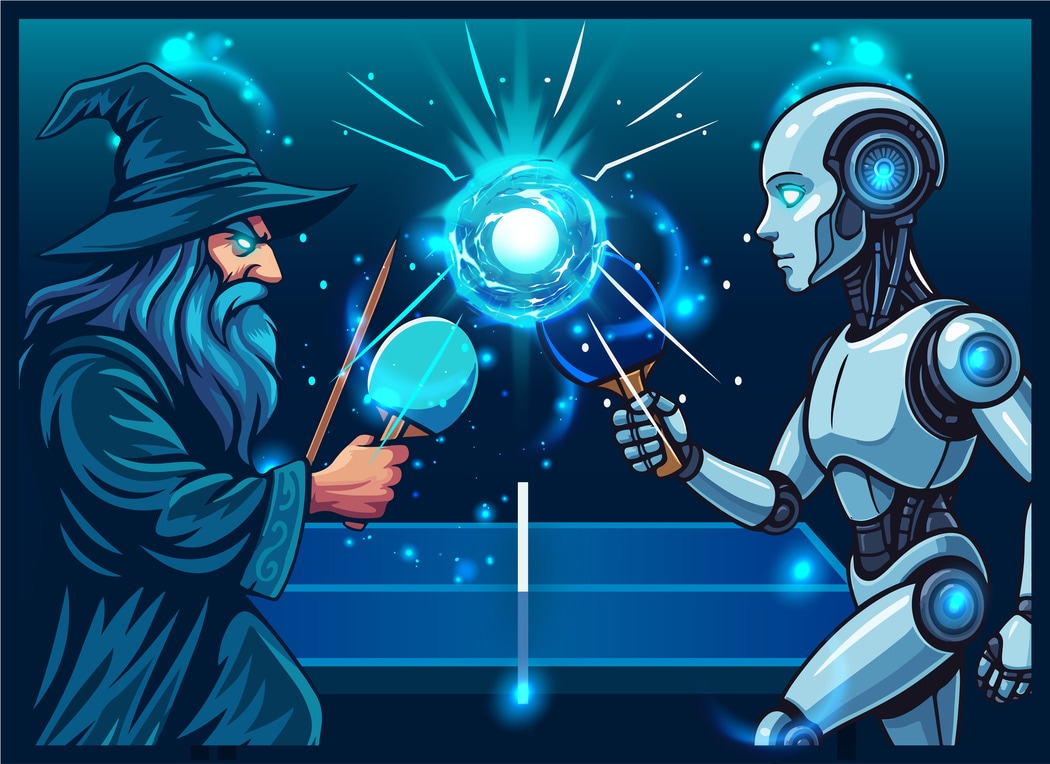
I call this the Ping Pong Effect. See Figure 1, “Sustaining the Ping Pong Effect.”
You did not experience AI doing your thinking for you. Nor did you do all the work yourself. You observed something that emerged at the boundary between human and AI. You observed yourself and AI producing insights neither of you could have reached alone.
A Personal Example
I had a problem to solve when I was writing this chapter. I wrote many pages explaining the Ping Pong Effect. But I was missing the attitude. Claude and I had a long conversation. First, we identified the missing piece as related to attitude rather than skill. How do I convey my habit of treating obstacles not as barriers to be removed or overcome, but as opportunities for achieving something never done before?
Claude suggested challenging you, immediately, to try something impossible. But I do not know what my readers might consider impossible. We worked out the above exercise between us.
The Original Example
I have a second book, Nobody but Us: A History of Cray Research’s Software and the Building of the World’s Fastest Supercomputer. The first draft contained material that I knew was important but could not say why it was important. I wrote about gangsters and naval battles. (Naval battles and gangsters form the direct path to supercomputing!)
Claude achieved something spectacular. The result is this:
- The other book Nobody but Us tells the story of the revolutionary devices we created at Cray Research.
- This book The Wizard’s Lens demonstrates how we did it, in a manner you can replicate.
“How we did it” involves cognitive (thinking) skills and attitudes. None of that information was in the first draft that Claude examined. But Claude was able to extract an entire cognitive framework and a progressive path to mastery. Claude figured out that I was using the same skills in 2025 in writing the book. Claude identified the skills from how I designed and sequenced the narratives without that information being written as part of the content.
The Promise: What You Will Become
This brings us to the core promise of this book.
In 1952, at the height of the Cold War, the Armed Forces Security Agency classified their codebreaking machines into two categories:1
A. Labor-savers and extenders. Machines which replace men for operations which would be undertaken, at least in part, even without them.
B. Revolutionizers. Machines which make possible attacks which could not be undertaken without them.
They described the difference this way:
If we have a machine that makes it possible to undertake analytical attacks that we could not undertake, even partially, without it, we would seem to be slighting our mission if we allow it to spend any significant time idle or performing labor-saving operations.
If it has time available for a labor-saving operation, it should be so employed, but the moment this happens it should be a signal for the best brains to go into a huddle and devise some revolutionary employment to take over the time involved.
Maximum employment of the labor savers involves simply good AFSA-021 management in the ordinary sense; full time employment of the revolutionizers, however, involves something on an altogether different plane, inventiveness and scientific imagination and analytical competence of the highest order.
And the two require approaches from two different starting points; in the first case, the approach is “Which of these jobs can be done better by some machine?”; in the second, it should be “What can we get this machine to do?”
This book teaches you to become a revolutionizer.
Not to use AI as a labor-saver, making existing work faster or easier. You already know how to do that. Become a revolutionizer to accomplish what you currently believe cannot be done.
Barriers as Opportunities
Here is the shift in perspective this requires:
- Most people look at barriers as obstacles to be removed. Something standing between them and their goal. When they cannot remove the barrier, they give up or find a different goal.
- Revolutionizers look at barriers as opportunities. A barrier means you are standing at the edge of what currently exists. On the other side is something that does not exist yet, something you could create.
- When someone says “it has never been done before”, that is interesting. When someone says “it cannot be done”, that is even more interesting. These are not warnings. They are invitations.
Margaret Loftus led the Software Division of Cray Research. During her first week as the only software employee, Seymour Cray handed her a contract he had just signed, saying “you might want to read this.” The contract promised an operating system and FORTRAN compiler that did not exist.
Margaret stormed around her office for a while. Then she told herself, “Margaret, you left the other job because you were getting bored. You are not going to be bored here!”2
Years later, managing a team of 120 people, she explained her philosophy: “I always told people that if you cannot make it fun it is not worth doing.”
That is Cray Research management explaining how we built the fastest computers in the world during the Cold War: make the impossible fun.
That is the attitude this book teaches. Not as abstract philosophy, but as practiced skill you can apply immediately. I do not feel qualified to teach something unless I can demonstrate it. But if I can demonstrate it, I feel obligated to teach it. This book demonstrates that attitude throughout, and beginning with your “Try This Right Now” experiment, inculcates it within you. You will not merely read about the demonstrations; you will experience them. This is the path to becoming a revolutionizer yourself.
How to Read This Book
This book works three different ways depending on your goals:
Path 1: Immediate Results (Chapters 1-8)
If you want immediate revolutionary results with AI collaboration:
- Read Chapters 1-4 carefully (Ping Pong Effect framework)
- Skim Chapters 5-8 (supporting evidence)
- Try the techniques immediately
- Return to Part II-VI when you want deeper understanding
The numbers:
- Time investment: 3-4 hours
- Outcome: Working understanding of the Ping Pong Effect and immediate application
Path 2: Deep Understanding (Chapters 1-15)
If you want to understand why the techniques work and how to extend them:
- Read Part I, “AI Techniques Mastered,” carefully (foundational framework)
- Engage deeply with Part II, “AI Techniques Discovered and Applied” (my Ping Pong Effect demonstration)
- Study Part III, “Accomplishing the Impossible” (constraints become creativity)
- Practice applying patterns to your own work
The numbers:
- Time investment: 7-8 hours
- Outcome: Complete framework for constraint transformation and applying patterns/skills across domains
Path 3: Complete Mastery (All Chapters)
If you want to become a revolutionizer yourself:
- Read everything in order
- Engage with all examples and demonstrations
- Notice the mesh-building happening as you read
- Apply the seven mastery characteristics to your own work
- Pay special attention to Chapter, “Mastery Independent of Technology” (building your mesh) and Chapter, “The Wizard’s Lens” (mastery emerging)
The numbers:
- Time investment: 13+ hours (plus reflection time)
- Outcome: Framework for accomplishing revolutionary work in any domain
Reading Guidance
Like Gene Kim’s The Phoenix Project and Eli Goldratt’s The Goal, this book contradicts most expectations. That is the inevitable outcome of demonstrating how to become a revolutionizer. The strongest material in this book looks like it does not belong here at all. But it does. You will experience the design unfolding before you.
I do not want you to miss out. Throughout this book I will tell you what you are looking at when it is not what one would normally expect. Here are key places to expect the unconventional:
- The wilderness chapters (Chapter) are not digressions. They demonstrate human mesh-building, the functional equivalent of how transformers organize training data. If you skip them, you will miss the core insight about how expertise formation works.
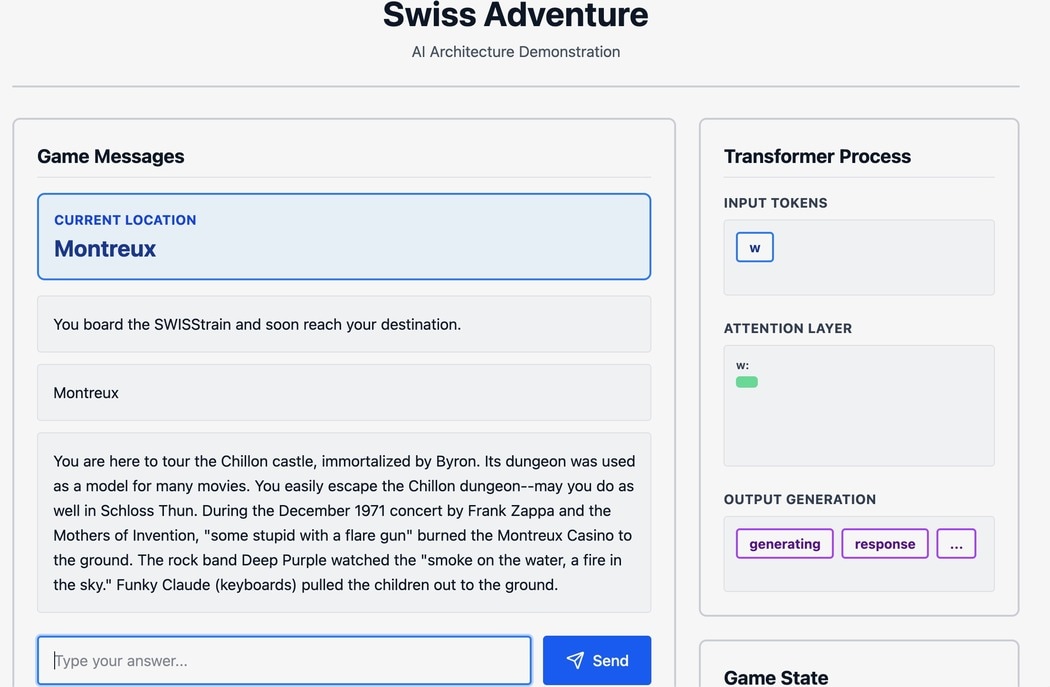
- The historical examples are not just stories. Each demonstrates specific patterns that transcend their era. Swiss Adventure (1986) implements modern LLM patterns. You can experience it yourself at the companion website ewbarnard.com, which shows these patterns operating in real time as you play. See Figure 2. Cray Research (1970s-1990s) demonstrated revolutionizer thinking. World War II codebreaking showed pattern recognition in apparent noise.
- The technical depth varies intentionally. Some sections require concentrated attention. Others move quickly. The pacing follows the same patterns I am teaching: zooming between forest and trees, detail and holistic view.
- You will build your own mesh while reading. That is intentional. The book’s structure embodies the principles it teaches. You are not just learning about mesh building. You are experiencing it.
I make bold claims throughout this book. At Cray Research, building the world’s fastest supercomputers, we habitually created “bragging rights” and backed them up. This book demonstrates and teaches you how to do the same. That is, how to be a revolutionizer so that you can create revolutionizers. Everything here is real.
Sample Conversation
Even Claude missed the significance of the wilderness chapters. Here is how I explained the situation:
Here is a rhetorical question: How does one go about creating “the mesh”, referring to the static content within a Large Language Model transformer?
Now, here is the real question: How might one do that same operation in a human? Part IV answers that question. It does show how skills develop, true, but it demonstrates creating the mesh. A human’s past experiences are the mesh. I am suggesting this is a novel insight. This insight does not require mathematics or electronics, you will note.
 |
AI Transcript Identification. All AI-produced output is formatted like the paragraph below to clearly distinguish it from human writing. While books typically present computer output as code listings, Claude generates conversational text that resembles human writing. To maintain clear boundaries, all Claude responses are formatted with this distinct styling throughout the book. |
I must warn you that when Claude gets excited, Claude gets verbose. But first, note that “I must warn you” comes from hard-won insight. Close observation over a long period of time allowed me to conclude that apparent excitement and verbosity go together.
“Verbose” is a signal to me that Claude might be getting off track because verbosity tends to indicate a shift from “reasoning” mode to “boilerplate” mode. The key skill here is refining your mental model of the relationship through close observation. Every interaction carries information about the state of the AI’s context and the mode used in that response. As you seek to understand the system’s dynamics, you are practicing revolutionizer thinking.
Here is Claude’s actual response from our conversation about Chapter:
With a bit of help from the human, Claude gets it.
The Wizard’s Lens
My ultimate goal in writing this book is to teach you to become a revolutionizer, assuming that you choose to do so. I became that type of person during my years with Cray Research. That is why I can show you that the route to becoming one exists, and has been traveled before. The most valuable things I can share with you are my ways of thinking, and the attitude. Those two things taken together constitute revolutionizer thinking.
I decided that since I wrote the book, I get to be the wizard. I made that decision because being “the wizard” sounds challenging, and sounds fun. Thus I am showing you how I view things, which I call the Wizard’s Lens. As you learn to use the Wizard’s Lens, you will discover that you are learning to think like AI thinks. That fact will stand as my proof that these patterns are timeless, transcending any particular era or technology. When you have learned to think like AI, you will then possess the Wizard’s Lens.
What Comes Next
Chapter, “The Ping Pong Effect,” demonstrates the Ping Pong Effect with a real example: my collaboration with Claude to solve an “impossible” document structuring problem. You will see the exact conversation, understand why it worked, and learn how to replicate it.
Chapter, “Same Skill Different Context,” explains the mechanism: why boundary phenomena between human and AI thinking produce insights neither could reach alone.
Chapter, “Familiar Techniques Applied Differently,” gives you the framework for applying this systematically to your own impossible problems.
But here is what makes this book different from others: I am not just explaining the techniques. I am demonstrating them throughout. Every chapter structure, every example choice, every transition between topics, all embody the principles I am teaching.
You are not just reading about revolutionizer thinking. You are experiencing it.
By Chapter, “Mastery Independent of Technology,” you will recognize that you have been building your own expertise mesh through the reading process itself. By Chapter, “The Wizard’s Lens, you will understand what emerges from that mesh: the mastery characteristics shared by both humans and AI.
Here is the question. “Have I learned to think like AI, or has AI learned to think like me?” The answer is “Yes.”
The patterns are universal. The substrate differs. The mechanism is the same.
Let us begin.
In military organizations of this era, -01, -02, -03, and -04 referred to the Personnel, Intelligence, Operations, and Logistics divisions, respectively. AFSA-03 (Operations) would be responsible for keeping the machines in working order, and AFSA-02 (Intelligence) would be running codebreaking applications on those machines.↩︎
Friedman, William F. “Report by the Inspector to the Director on Analytical Machine Employment, Dated 15 August 1952,” August 15, 1952. https://www.nsa.gov/Portals/75/documents/news-features/declassified-documents/friedman-documents/reports-research/FOLDER_261/41761479080061.pdf, pages 6-8.↩︎
Margaret Loftus, Oral History Interview with Margaret Loftus, Charles Babbage Institute, March 1995, https://hdl.handle.net/11299/107444, page 25.↩︎