3. Communication skills
When two very different people are trying to communicate, they may have different communication styles. One may think a message was sent, but the other may not have received the message, or the receiver may have made assumptions about what was said.
As covered in another chapter, men and women see the world differently and have different ways of communicating. They might have similar goals, but very different ways of getting there. Understanding these differences can help your communication quite a bit.
Here are some communication tips for everyone, whether you are in a relationship or not.
3.1 Speak clearly
Speak loud enough and clear enough for the situation. A car gets pretty noisy with the windows down, going 70mph, so a louder voice that carries is more important in this case.
Also consider that your partner may be hard of hearing. This is not uncommon for military veterans, people who have worked in noisy industries, and older people.
3.2 Include all relevent details
If you are asking someone on a date, in that same conversation you should mention when the date is, where you are picking them up or where you are meeting them, and what place you are going to (movies, restaurant, etc). In the case of a restaurant or movie, make sure to ask if they like the food or movie first.
3.3 Never assume
Never assume something about the message you received. Make sure the message was clear to you and if you are in doubt about any part of the message, ask the sender for clarification.
Example. Two parties are already dating, and are trying to decide where to go out to eat.
He: Hey do you want to go out to eat?
She: Sure!
(They go to a Thai restaurant he picks.)
She: Ugh, I just don’t feel like Thai today.
(Now he is frustrated because 1. she didn’t speak up earlier, and 2. he made an effort which he perceives is wasted. He is now discouraged from making more effort.)
Solution: If she wants to avoid a certain type of restaurant, she should have spoken up before they left the house.
3.4 Don’t blame the person or use “you” phrases
Don’t say phrases like “You make me so angry!” Instead address the root problem and express your feelings using an “I” statement: “I feel so angry when you leave your socks all around the house.” At the same time, ask for a solution: “Do you think you can pick them up every day?” That’s a reasonable request.
3.5 Speak calmly
Don’t yell or raise your voice. If you are too upset to talk, leave the area or the house, cool off, or even talk about it the next day. Most of the time I try to talk about things the same day but that’s not always possible.
3.6 Don’t make personal attacks or call names
“How can you be so stupid? Why can’t you pick up your own darn socks??” That’s a personal attack as She called He the name, “stupid”.
Better way: “I get so frustrated when you don’t pick up your socks. Can you do this at the end of each day?”
3.7 Don’t be passive-aggressive
Passive-aggressive gestures try to make the other person feel guilty by using indirect hostility.3 The DSM V has a Passive-Aggressive Personality Disorder for people who do this too much, where it’s a part of their regular lives. Another term for this is “catty”.
…passive-aggressive behavior is characterized by a habitual pattern of passive resistance to expected work requirements, opposition, sullenness, stubbornness, and negative attitudes in response to requirements for normal performance levels expected of others. Most frequently it occurs in the workplace where resistance is exhibited by such indirect behaviors as procrastination, forgetfulness, and purposeful inefficiency, especially in reaction to demands by authority figures, but it can also occur in interpersonal contexts.
(I don’t know why they said “forgetfulness” instead of “claimed forgetfulness”. PA behavior is constructed or feigned, not the result of other organic medical problems that have these actual symptoms of, say, forgetfulness.)
The WHO ICD-10 also lists passive-aggresive behavior.4
Example:
She: “Ok, I guess we can go to Sheila’s party. I don’t really want to but ok. I’ll compromise. Again. For you. *sigh*”
More examples from Quora.5 Read it for even more examples.
Jane: It’s time to go, we really should get going now.
Passive Aggressive Ann: Oh…okay. I just…well okay, I GUESS we can leave now.
Jane: Ann, do you want to stay? Is that what you’re trying to get at?
Passive Aggressive Ann: Huh? Oh no, we can leave if YOU want. I just didn’t get to do everything I wanted to do yet, but no no, we can go I guess.
Jane: God dammit Ann! Fine, we’ll stay, are you happy?
Passive Aggressive Ann: Oh okay! Yeah! That sounds great too! (Ann got her way without having to openly ask for it)
3.8 Don’t make unreasonable requests
He talking to She: “I get so angry when you don’t do the dishes twice a day every day! You know you agreed to this.” Now the circumstances are both people work full time jobs and they are both tired after work, and don’t have the energy to do the dishes quite every day. And if they have kids the kids will come first and some chores will have to be put off until another day. So this is an unreasonable request, given the circumstances.
The appropriate thing for He to say was: “I noticed you weren’t able to do the dishes every day like you agreed. Is there something wrong? Should we revise our agreement?”
At this point She would be honest and say she’s just too tired. She should also offer a solution, like doing the dishes every 3rd day. And He could just help out also. Bottom line: If He wants to dishes done twice every day, He should do it, not force His personal preferences onto someone else. Even though they agreed to do the dishes twice a day, they soon realized they don’t have the energy to do it. If you want something done your way, do it yourself, don’t fight about it.
And now back to the sock thing.
She gets angry because He leaves his dirty socks all around the house. Picking up after yourself is a basic adult task that any adult can do. He has no reason to not pick up the socks. While she has reason to be frustrated, she should not be yelling about it either. She needs to use good, adult communication.
3.9 Pick your battles, don’t fight about the little things
Pick your battles and what you insist on, carefully. If you fight about too many minor things, the relationship will have problems. If you make small things into big things, you might have issues to deal with yourself.
Example: Some people can deal with dirty dishes in the sink for days, some people can’t. If you don’t like dirty dishes in the sink, don’t fight about it, do them yourself. Take responsibility for your personal preferences. If your SO agreed to do the dirty dishes every other day, and you don’t like them sitting there in the “off” day, do them yourself. If your SO agreed to do the dishes every day and they aren’t getting done for some reason, maybe a new agreement will have to be made. Adjustments have to be made sometimes.
Ask yourself: Is it really worth ending the relationship over this? Because that’s what might happen.
3.10 Be aware of your emotions and theirs
- Make sure you are aware of your emotional state before you start talking. Are you too angry or frustrated to stay calm? Then take a break away from the other person.
- Try to understand the emotional state of the other person too. Did they just get home from a stressful day at work and now they need 30 minutes to decompress? This would not be a good time to talk about certain things you two disagree about. Instead just ask them if they are ready to talk about X. Be specific about the topic, don’t blind side them with something they didn’t expect. Nothing is worth adding stress to the relationship, talk about it later.
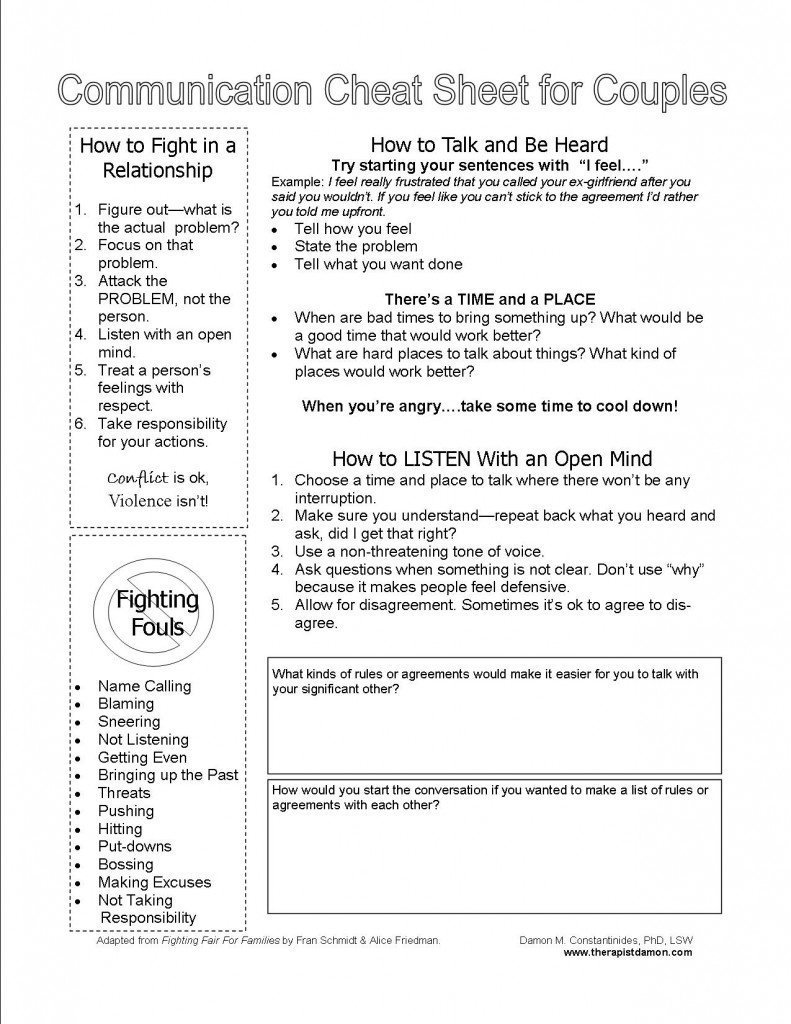
3.11 Communication cheat sheet
Here is a communication cheat sheet to help you remember too communicating tips. Thanks to http://www.therapistdamon.com.