Preface
My one promise to you in this book is to show you the hidden stories, dark data, and actionable tools that will help you manage your imposter experiences. Allow me first to take you on the scenic route through my own reasons for writing this book.
On a map of the world, Italy is the infamous geographical version of a long-legged boot. Just above the knee of the boot, in the north of the country, the city of Bologna represents an architectural haven for lovers of the Middle Ages and the Renaissance. Among the sea of ragu-red rooftops reminiscent of the region’s famous pasta dish (this is where Bolognese sauce comes from), Bologna hosts its most enlightened claim to fame, the Università di Bologna: the oldest university in the Western world. For almost a thousand years, since 1088, the university’s crest has boasted a proud motto reminding the world of what a university should be:
“Alma mater studiorum” or “Nourishing Mother of the Studies”1
If you leave Italy and head northwest on the world map, you eventually reach the University of Cambridge in the UK, home of the 500-year-old Cambridge University Press. On its crest, this publishing house displays an image that conveys another message of the university ideal. The alma mater – or ‘nourishing mother’ – stands tall, proud, angelic. Her maternally curvaceous body is the centre of the Press’s crest. From a wreathed crown on her head rises a castle. Waist-length locks of hair meet a pedestal that the mother stands behind. She holds a chalice in her left hand to represent spiritual fulfilment. Her right hand cradles the sun, shining bright for intellectual enlightenment. And surrounding the crest, the motto:
“Hinc lucem et pocula sacra” meaning “from here, light and sacred draughts.”2
Go still further north to Scotland, and you see the coat of arms for the University of Glasgow. The crest bears a Book of Learning sitting in the highest position as a font of knowledge atop the crest. This book is placed at the peak of a hierarchy of symbols depicting the story of Scotland’s largest city.
Since their beginnings, universities have been designed and perceived to be places where knowledge and progress could move with untainted ease. Regardless of whether you’re in Bologna, Cambridge, Glasgow, or another university town, universities have been modelled as places of discovery for those seeking to understand Nature and all that she possesses. Places free from political strife, free from apathy, free from mundanity, universities were born to be fertile grounds from where knowledge could grow without restriction. But fast-forward to modern universities in the 21st century and there is a parasitic weed growing on the crisp green grounds of utopian university life. There’s a discussion topic that has been somewhat swept aside, out of sight but not out of mind. And it’s no longer taboo.
Rather than universities providing nourishment for the mind, an ever-growing literature is showing that university culture is in serious danger of becoming the insidious centre of a tragic mental health crisis.
That darkening stain on academic life is manifest in higher-than-average reports of poor wellbeing, troublesome work-life balance, and debilitating stress. Sometimes it has even gone so far as to have life-threatening impacts on mental health.3 Students4 and staff5 alike have used suicide as the only means of escape. The utopian perception of the university haven is being recast as a survivalist gauntlet. Moreover, social media is driving new behaviours and university cultures that misguidedly protect students from difficult and debatable ideas that might cause offence.6
There is a worrying string of reports on both student and staff7 mental health problems in the higher education sector. These reports are scattered but nonetheless convergent, and they all crystallised in 2017.8 A mental health review commissioned by the Royal Society and the Wellcome Trust – two of the most respected and trusted bodies in the UK’s scientific community – was released for all to see. Although these specific numbers focus on the situation in the UK, the literature gathered for the 2017 Royal Society and Wellcome Trust review considers a broad data source, including North America, Asia, and Australasia as well as the UK. The review set out to find what (if any) “specific mental health needs” there were among researchers.
It’s worth taking a moment to understand why the 2017 mental health review was commissioned at all. If you look at the statistics for the population of England alone, there are reportedly six million people suffering from a mental health condition at any one time. Six million! That’s enough people to fill a premier league soccer stadium a hundred times over. Six million is about one-tenth of England’s population, and 2% of the total number of Twitter users back in 2017. More people in England suffer a mental health issue than there are people in all of Denmark. Six million is a huge number and it’s horrifying.
In monetary terms, the reported levels of mental health illness are enough to cost £26 billion to the UK, and over £1,000 per employee across the working nation. If you can’t quite wrap your head around how much £26 billion actually is, imagine each pound was a second in time. Twenty-six billion seconds is close to fifty thousand years.
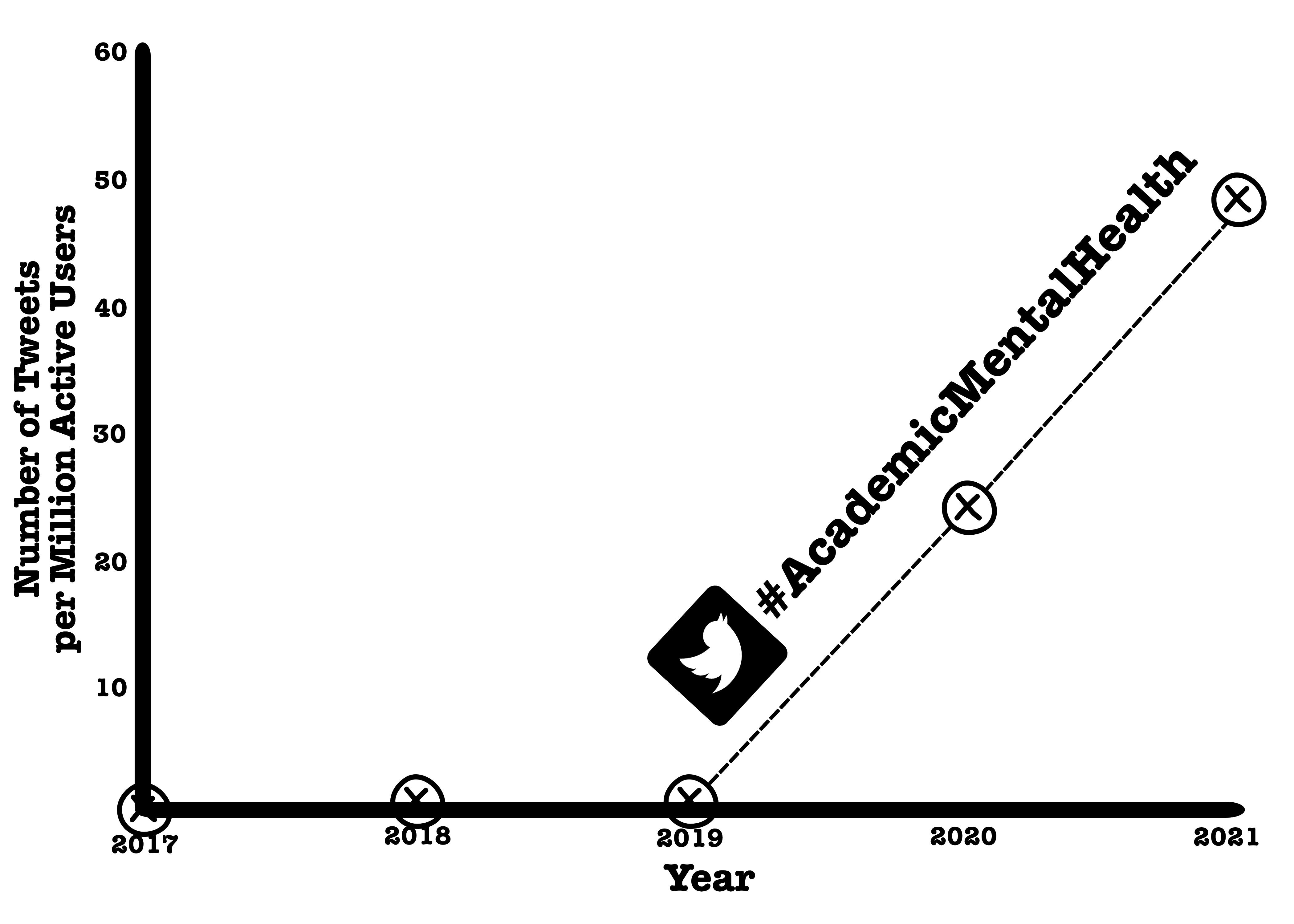
In 2020, a related report from Wellcome painted no prettier picture, sharing the dire statistic that over half of researchers in the UK and globally have sought support for anxiety or depression.9 On Twitter, I personally scraped 15,000 tweets on the subject of academic mental health posted between 2017 and 2021. 99% of those tweets fell within the last two years.
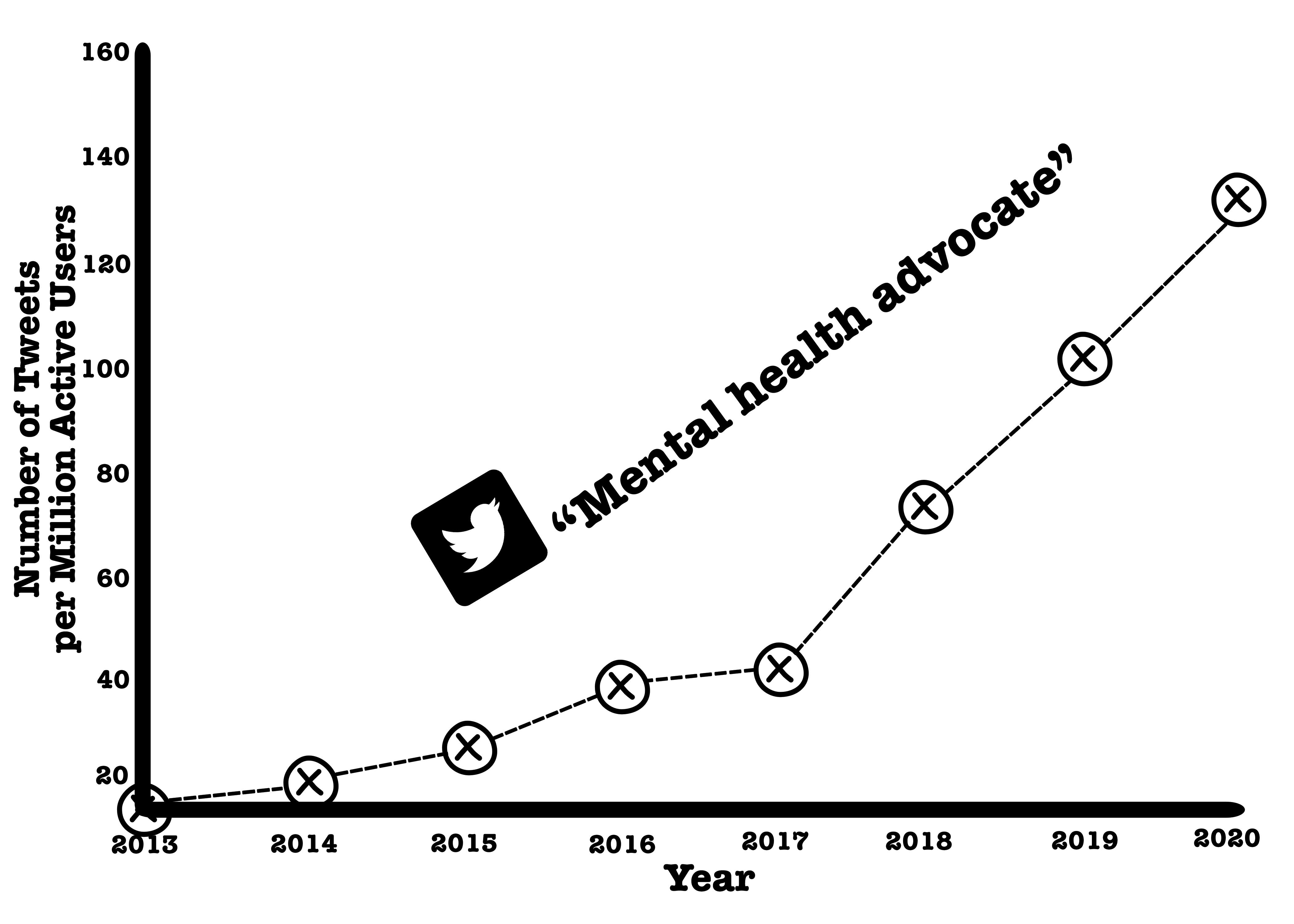
Even when correcting for the growing Twitter user base over time, it is still the case that the use of the term ‘mental health advocate’ has increased more than 700% since 2013.
The academic mental health crisis is extensive.
So, what makes the higher education environment so damn stressful? Why is this sector the seat of such potent concern? Remember, the growing number of reports on mental health problems relates to both students and staff. For students, one reason for the increase is that the number of graduating students – undergraduate and postgraduate – is increasing annually. For instance, the number of PhD graduates has doubled in the last twenty years up to the time of me writing this book.10 Despite there being more graduates, the jobs available in the sector have not increased by the same amount.11
For staff in academia, limited funding sources have plateaued in some research areas and decreased in others, but the competition for grants remains as fierce as it ever was. It’s tougher for young academics starting out now than a generation ago.
Work-life balance, pressure to publish, competition for jobs, short-term contracts, inconsistent managerial support, and increasing competition in the education sector all contribute to a community on the edge. Higher education is approaching a collective mental breakdown.12 The anxiety-inducing hell of uncertain employment has even led to sociologist Vik Loveday coining the term the neurotic academic.13 The social media phenomenon exaggerates the temptation to perpetually compare oneself to others with exhaustingly little context.
At the time of writing, it has been over a decade since I came through the UK higher education system and started my scientific career. So it’s been a while since I first walked through the university doors, hopeful, inspired, and with a lot more hair on my head than I have now. Over those ten plus years in higher education, and for my whole life, I have genuinely loved science. But in the last few years, I started to notice a worrying change in my behaviour that was in no way a reflection of my best self.
The reflections and realisations you will read in this book started at a fork in the road of my academic career. For me, a series of career-progressing shifts revealed to me a particular kind of stress…a stress I never thought possible. So, don’t read my story in isolation. Rather, take it as a nudge to more deeply analyse your own points of professional pressure.
Having trained as a scientist, the fork on the road that gave me cold sweats took the form of a career question:
Industry or academia?
Where should my career go? What jobs should I apply for? What sort of scientist will this choice make of me? Is there a correct decision? Will I love the choice? Will I regret it forever?
And after speaking with many others, I realised I was not alone. Many of us feel this way. Regardless, more and more questions filled my mind with unnecessary worry and dread. It was like a crashing ring of dominos falling one after the other in regimented chaos. On and on, questions would tumble around in my mind, gathering into a shapeless grey mass of anxiety; swirling, darkening, growing, and groaning. These dark thoughts had a hunger that could not be satisfied. Monstrous career stress was taking hold, and it would do so in a very particular way.
Modesty hat off, I have accomplished a lot in my academic life to date. I managed to complete high school with nothing lower than an A grade. I graduated at the top of my university Chemistry class, completed an award-winning PhD, and earned a decorated postdoctoral research post. When I started writing this book, I was beginning my independent academic research career: running my own lab, mentoring my own team, building collaborations, and working with companies.
Along the way, I’ve earned various prizes, awards, scholarships, grants, and honours. I’ve written and published peer-reviewed articles in prestigious journals and lectured in more countries around the world than I’ve got fingers and toes. If you can excuse my cringeworthy big headedness here, understand that I am a classic overachiever.
I probably sound like that one insufferable guy at the party who talks only about himself, but please trust me, there’s a good reason for telling you all of this stuff about my own career.
Towards the later stages of what could safely be classed as a successful career in science so far, I noticed that I was becoming increasingly tired. Shattered, even. My thoughts started telling me a new story, telling me that I was not at all successful. In that decade-plus career progression leading to my first academic job, my mind was slowly but surely turning against me.
As I learned more and more about life in academia, a new monster emerged from the career questions swirling around in my head:
Am I good enough?
Was I ready for this path? Did I really qualify? Did I know enough? Should I even bother? Could I ever be as good as all the other people walking the same path?
I was doubting my abilities and habitually making damned comparisons between myself and my peers. The excitement for creatively carving out my own academic career after a life-long love of science was in danger. My career was being overshadowed by one of the many monsters behind mental health issues in higher education:
The so-called14 Imposter Syndrome: the feeling that you are a fraud, that you are not good enough for your job, and that you are always in danger of being ‘found out’.
As you progress through this book, you will learn about the journaling exercise I used to help me record my own thoughts about feeling like an imposter. Together, we will look at what imposter experiences mean to the 800+ participants from the survey research that grew out of my journaling and now underpins this book. We look closer at the unfounded thoughts and feelings of inferiority that many students and staff in higher education face. Feeling like an imposter almost drowned me. I share the discoveries that stopped me from digging a mental hole from which I might never have recovered.
Feeling like an imposter is not a syndrome.
Journaling and studying the problem has helped me to no end. It still helps me. By treating my neurotic thoughts like any other scientific problem, I felt an incredible ease come over me when I began to understand this so-called Imposter Syndrome in more detail. I have learned from other people who have waded through self-doubt and emerged enlightened out the other side.
In the process, I discovered masterful works of literature that were almost lost in a fireplace. I’ve come to appreciate the power of persistence for writers, actors, researchers, and politicians in enduring what we might call the Imposter Syndrome. Through my story and the stories of others, I wanted to dissect and anatomise the experience of feeling like a fraud in order to make it easier to manage.
I thought very deeply about whether or not to release any of this to anyone other than myself. It began, after all, as an exercise to help me cope with the thoughts that were threatening to crush my career before it began. But there was a moment I knew I had to share it.
When I spoke at a chemistry careers conference for young students and researchers, I took the opportunity to road test some of this book’s emerging content. I spoke about the ubiquitous term ‘Imposter Syndrome’ and found myself quivering close to tears as I shared my experiences for students who might be suffering in similar ways. Rather than being ridiculed, I was embraced. And when one student, timid and curious, approached me after my talk and said, “It really helped”, I was overwhelmed. From that moment on, I took the view that, if my story helps one other person, it’ll all have been worth it.
Before you read on, allow me to be clear. I am not a trained psychologist. Nor, in fact, am I a sociologist, psychiatrist, counsellor, or social scientist. I am simply someone – as a student and mentor – who has felt, and still feels the serrated dagger of imposter experiences! (My draft book was originally titled Pull Out the Dagger before it was finalised.) I have been in the eye of the mental storm and whirled round its violent perimeter. I have studied this particular mental struggle in intimate detail. I know it well. Although I am not a clinician or psychologist, I am a scientist. And, as an academic who has worked in a university, my life has been spent in one of the most notoriously neurotic and competitive environments we know of. It is a breeding ground for all dimensions of the imposter experience and more. I have seen, heard, experienced, and taught students in many scenarios in which the feeling of being a phoney has reared its ugly head.
You Are (Not) a Fraud is all about how I learned to manage my imposter experiences and keep moving on. I wanted to share the low points and the stories and the data that have helped me to recognise imposter experiences and to best understand how to deal with them. Notice, I did not say “to cure” Imposter Syndrome. I did not say “crush”, or “solve”, or “quash” Imposter Syndrome.
It is not something to cure but something for you to recognise and manage.
It sounds easy, doesn’t it? I’ve rhymed off the self-help rattle as if I am some sort of millennial messiah. The truth is that my own struggles to move forever forward in my career have taken a genuine mental toll. This book shares that story, and offers the liberating knowledge I have picked up along the way. You’ll learn about the history of the Imposter Phenomenon, who it affects, and why. You’ll think about real imposters, and what we really mean when we define success as just being ‘lucky’. Going further, you’ll dance with failure, rejections, and social comparisons in new ways. Productive ways! And you, the would-be imposter, will learn a little about what these thoughts in your head really are (and are not).
If you have made it this far, I’m willing to bet that you’re dancing with ambition. You have something you want to achieve and you’re here trying to find at least some of the answers to the hurdles that you’ve raised against yourself. Whether it’s the book, a chapter, or a sentence, I genuinely hope something here makes you look at your own story in a different light.
Alas, for whatever ambition you carry, and the questions you have for yourself, only you can answer the specifics. That’s not the scariest part. There is something more than this self-reliance that is just as important to keep in mind. Whether it is now, soon, or inconceivably far off in your future, you will have someone else in your care other than yourself.
We can all understand what true imposters are.
We can all understand how to be mindful of useless comparisons we make between ourselves and other people.
We can all understand how the Imposter Phenomenon might always be there…but it should never stop you from achieving the goals you set out in your life and career.
Marc Reid (8 June 2022)
Read and Journal
For each of the Your Chapter Challenges closing chapter sections, consider completing the accompanying Your Are Not a Fraud: Journal Resources as you go.
The resource contains ready-made templates for each of the 18 challenges presented to you throughout the book.
Available from wherever you purchased your copy of the book.