Chapter 2: It’s Not a Syndrome
If you know what something is called, it doesn’t mean you know anything about it. I learned that along my way to building a career in academia. Jargon is the easiest mask to hide behind. In this chapter, I want you to lean into the value of knowing something versus knowing the name of it. And let’s frame that through this horrendous experience we so often call Imposter ‘Syndrome’.
Part 1 – Learning to Love the Puzzle
As a kid, I remember being curious about everything. I would annoy my tired and patient parents with endless questions about why things are the way they are. My appetite for answers was never satisfied. First, it was dinosaurs, then planets, then all the cool gadgets that comic book anti-hero Batman had at his disposal. I can only assume that I must have been a harmlessly irritating little shit. Thankfully, my childlike fascination with the world persisted as I grew up, surviving the mild ridicule on the playground.
From the regimented complexity in a grain of sand to the celestial catastrophe of starlight, it is all awesome and all connected. It is, as Richard Dawkins describes it, the Magic of Reality.1 A little corny, yes, but nonetheless true. My wonder for how stuff works slowly but surely became a pursuit of all things Science. Especially chemistry.
One of the things I always loved about chemistry was the creative puzzle of its infinite combinations. Like a box of Lego, discrete blocks come together, through ingenuity and imagination, to give innumerable structures and functions and materials. The creative game of Lego is the science of chemistry. What’s even more alluring is that it’s not always clear how the Lego blocks are actually put together, step-by-step.
You might leave someone with a box of Lego and return to find a magnificent castle has somehow been assembled in your absence. You can have an educated guess on how that castle was built, while the exact order of steps is hidden from view. Only through close examination of the bricks in the walls can the builder’s methods be uncovered. Without that knowledge, the castle’s structure can’t ever be reproduced faithfully. It can’t be miniaturised or expanded without serious threat of collapse. Without knowing specifically how the bricks are each united to form the macroscopic fortitude of the castle, another one can never be built. In the end, knowing that the Lego structure is called a ‘castle’ tells you nothing about where the castle came from or how it was built.
Beyond chemistry and Lego and castles, knowing how something works, how it came to be, puts you in the best position to improve that particular something. I’ve found this to be the case with feelings of being an imposter, too. One significant time in my life was when I was halfway through my postdoctoral position and well on the way to working in academia. That feeling of not belonging among my peers, not being good enough, took a brain-draining toll on me. There was the compulsion to work myself into the ground. But, as with the mysterious mechanisms behind building with chemistry and Lego, I realised that if I was ever going to manage my self-doubt and climb the career ladder, I simply had to recognise what was happening to me. Knowing how to deal with the recurrent feelings of being nothing but a phoney was now vital. I needed to understand the action of the cogs that were turning and crunching uncontrollably in my mind. A Lego brick monument to the feeling of being a fraud stood without a maker. Now, I had to learn how to deconstruct it in order to build something new. Knowing its name wasn’t enough. I had to learn more about this ethereal thing that I kept hearing being called the Imposter Syndrome.
Part 2 – The Rose in my Thorn
When I started researching Imposter Syndrome, I did what everybody in the Internet age does best. I Googled it. I Googled hard. When I opened the web browser to start my search, I typed out the letters of “I-m-p-o-s-t-e-r [space] S-y-n-d-r-o-m-e”, slowly, deliberately, and secretly. The subtle shame of my web browsing made it seem like I was a naughty teenager searching for something altogether more illicit.
After searching for the term ‘Imposter Syndrome’ and reading the obligatory Wikipedia page, dictionary.com, and some other forgettable pages, I scrolled deep into the Google page hits and found an hour-long lecture from the National Institutes of Health (NIH, a major government research funding body in the United States).2 It was the 12th Annual NIH Graduate Symposium, and a crowd of hopeful young graduates were settling into silence as one of their peers took to the stage.
A crisply dressed young man stood up to introduce the keynote speaker for the ceremony. Slightly hunched, he stood behind a varnished wooden podium, leaning into a goose-necked microphone. His nerves shone only through widened eyes as he welcomed the speaker: clinical psychotherapist, Dr Pauline Rose Clance.
With a relieved smile, the student left the stage. As the crowd’s applause rang out, the top of someone’s head could be seen just above the podium but they didn’t stop to take to the same microphone as the announcer. Instead, a petite elderly lady emerged from the left side of the podium as she walked towards a smaller table at the centre of the stage. It was Dr Clance. Clance was small in stature but a giant among the respectfully silent student audience. She wore a pristinely well-ironed suit, shiny and mauve, almost brown against the warm conference hall light. A weightless floral scarf and neatly trimmed hair completed her sophisticated look. From behind gold-rimmed glasses, she looked for a small stack of A4 paper. She wasn’t nervous in holding her speech in physical form, it was more like she had an important message to deliver and didn’t want to miss a beat. Clance greeted the graduates with a smile and began to read them her story; the story of her life investigating the Impostor Phenomenon.
“Wait a minute”, I thought, intrigued with what my Google search had produced.
“Impostor…with an ‘o’?”. My confusion deepened.
“Phenomenon?! What happened to ‘Syndrome’?”, I gasped.
Pauline Rose Clance was one of the first practicing psychologists to formally study the experience of high achieving people feeling like an imposter. Together with her colleague Suzanne Imes, they coined the term “Impostor Phenomenon” in the late 1970s.
As a kid, Clance grew up near the Appalachian Mountains in the US state of Virginia. Having persevered through her poorly resourced grade school, she then made it to high school and thrived. She did so well in her studies that she was competitively elected senior class president, beating the captain of the football team to the post. It’s worth pausing here. Clance, attending school as a woman in the 1950s and 60s, beat a man (the football team captain no less) to class president. And she didn’t just get the job, she was voted in. It was a big deal.
Despite all this promise, Clance’s high school didn’t cover as many grades as other schools. Her teachers, therefore, warned that she might expect to do worse than other students when she eventually went to college. The teachers were wrong. Clance earned a PhD in Clinical Psychology from the University of Kentucky, one of only four in a class of fifteen to do so. During the process, she became routinely anxious before exams but kept the fears internalised to avoid irritating her study group. In the end, she made it, and then started her academic career in Oberlin College in Ohio.
At Oberlin, and later at Georgia State University, Clance started to notice a strange and consistent behaviour among the female students she was speaking to. Young women with high grades were expressing serious doubts about how smart they were. Regardless of the hard, objective data in their shining records, despite praise and support from their professors, these women wholeheartedly believed they were on the verge of being caught out. They felt like they did not deserve their positions in academia. They felt like imposters.
Part 3 – The First Paper on Imposters
As the video of Clance’s speech to NIH graduates rolled on, I was transfixed by the familiarity of the stories she was telling. The experiences she described sounded excruciatingly familiar. It was like staring dead ahead into my hopeless reflection and finally beginning to recognise what I was looking at. Following my Google search and Clance’s keynote speech, I dug deeper to source the original research papers and understand more about what was happening to me. I started reading.
At Georgia State University, Clance’s fellow psychotherapist, Suzanne Imes, was observing oddly repetitive instances of women feeling like they did not belong in academic circles. Imes was one of those women. This was similar to what Clance had first noticed in discussions with female students at Oberlin.
And so, in the late 1970s, Clance and Imes worked together to get to the bottom of what was going on. In 1978, they submitted their work in a manuscript called The Impostor Phenomenon in High Achieving Women.3 The experience of feeling like a fraud had finally been named. It was the beginning of formal studies on high-achieving self-doubters.
Reading Clance and Imes’ seminal paper, my eyes glided over the words as if they were golden coins from long-lost treasure. Everything they wrote triggered memories of my own experience. I read on and on, highlighting passages that read to me like they had been raised from the page:
“…these [people] find innumerable means of negating any external evidence that contradicts their belief that they are, in reality, unintelligent”.
Clance and Imes’ research found that, no matter what hard evidence was available to show the women that their successes were earned, they could always twist that success into a hideous lie. Successes could always be explained away by luck or, if not luck, something equally unfounded.
The original research on the Imposter Phenomenon was specific to the experiences of women because that’s where the phenomenon was most immediately evident at the time. It was reported to show up as a feeling of believing they could not be as good as a man in a similar professional position. Women had their apparent societal roles as second-class citizens ingrained within them, likely from a young age. By going to college, earning advanced degrees, and taking high-powered positions, these conflicted women were, in their minds, breaking the rules. They had it in their heads that they were supposed to be the baby-makers and housewives of the world, not pioneering professionals. Many simply could not accept that their success was earned, despite the fact that their hard work and scholarship had placed them exactly where they deserved to be.
Clance and Imes’ interviews with the women from the 1978 paper contained the increasingly familiar phrases associated with someone – man or woman4 – displaying tell-tale signs of the Imposter Phenomenon:
“I’m not good enough to be on the faculty here…Some mistake was made…”.
“…my abilities have been overestimated”.
“I was convinced that I would be discovered as a phoney”.
How strongly do these phrases resonate with you? It was only in later reading I realised that broader studies of the Imposter Phenomenon showed that the experience was not unique to women.5 Some studies suggest men perceive and report their imposter experiences differently to women.6 Others acknowledge that there is a danger of conflating the fact of more women than men coming forward for such studies with the interpretation that women suffer from imposter experiences more than men.7 It’s not a definitively gendered experience. Even before I realised this, the context of Clance’s original work didn’t seem to matter. The words read as if the study had been written about me.8
Early work on the Imposter Phenomenon also shared theories on the root causes of the experience. Why exactly were these academically brilliant women so authoritatively convinced that they were imposters? Two of the causal ideas presented by Clance focused on a person’s immediate family. Deliberately or not, a family moulds and nurtures their daughter on how to see the world. In one scenario, childhood labels matter. The girl has a sibling or close family member who is labelled ‘the intelligent one’. She, on the other hand, is somehow ‘the sensitive one’. This label, endowed by her parents, is different from what she has actually grown up to be. She works hard and earns a job meant for an ‘intelligent’ person. The family has labelled and treated and talked to her like she is the ‘sensitive’ one, not the ‘intelligent’ one.
The unfortunate effect, as suggested by Clance and Imes, was that the grown-up woman, successful and progressive, feels like her position isn’t deserved because it wasn’t part of her label growing up. She was supposed to be ‘sensitive’, not ‘smart’. What’s more, she thinks that her family is secretly disappointed or angry that she has acted out against the role set for her in her youthful label. The worst part about it is that, whether it’s me writing it or you reading it, we both know it’s a ridiculous notion. She doesn’t need to feel this way. Nonetheless, it’s not ridiculous to those at the centre of such experiences.
In the second scenario proposed as an origin of the Imposter Phenomenon, the family tells their daughter she can do no wrong. She is so able and so intelligent that there is nothing she cannot do. Her intellect carries her on a flying carpet to success with ease and grace. Inadvertently, the family has set a rusty and serrated bear trap in the young woman’s mind. Whilst she walks through life with tremendous parenting and heaps of praise, she is stopped in her path by the sharp snap…the experience of finding out that some things in life are difficult.
Such is the family reinforcement of their daughter’s perfectionism and ability to gather skills without hardship that, when something comes along that the daughter finds difficult, it’s a shock to her. She’s been raised to sprint down the 100-metre running track and win every time. No problem. But when she finds out that she has to run an extra 10-metres and jump hurdles, things change. Now, the daughter comes across something she isn’t able to conquer right away. The thought of revealing this to her parents rains shame upon her. If she fails, she will feel like a lifelong fake. Growing up with the feeling of being indestructible has inadvertently planted a crippling fear of failure in the woman’s mind.
Bringing the imposter origin ideas together, Clance and Imes had suggested that socially acquired expectations could lead to doubt in someone’s position later in life. Think about it. If your success isn’t in keeping with the role set out for you by the environment you grew up in, then you are predisposed to believing that your success is ill-gained. You become more likely to suffer from the symptoms leading to Clance and Imes’ Imposter Phenomenon.
Both origin stories – one of being labelled in a particular way, and the other of believing success would always be easy – made me once again recoil in reflection. As I read the articles, I nodded in recognition and shook my head in disbelief. I let out quiet bursts of “hmm” and “huh”, aghast at just how familiar these imposter theories appeared to me. There was a deep unease in how this research predictively told the story of my own experiences. I was, after all, the first kid in my family to go to university straight from school. Without knowing, and being innocent of any crime, my family labelled me as the ‘smart’ kid, and I was supported as such. Growing up, I made myself a rank overachiever and crafted a mirage of expectations that I pressured myself to meet. My behaviour became characteristic of someone suffering imposter experiences, which brings us to how you can spot your own tell-tale behaviours.
Part 4 – Behaviour and the Imposter Phenomenon
There are (at minimum) three habits that ripen the cocktail of ingredients necessary to experience the Imposter Phenomenon:
(1) The Workaholic Imposter: If you work hard, you work yourself to the bone for fear of being caught out. That hard work creates the second habit.9
(2) The Agreeable Imposter: You wear a veil under which you hide the fullness of your thoughts. You say what you think people want to hear, not what you actually think. In your head, if you were to become disagreeable, you increase your chances of being caught out.
(3) The Charismatic Imposter: And thirdly, you think your charm and charisma have served up sleight of hand, fooling your peers into thinking that you are one of them.
In each of the three cases, there is success. There is also a mechanism to downplay that success. You avoid appearing head and shoulders above the crowd. Through this work and later contributions, the media took the idea to the world, giving Clance the opportunity to define the Imposter Phenomenon for a bigger audience. In one newspaper interview, Clance noted:
“…people from many different professions experienced a haunting fear that they could not continue repeating their successes and that they were not as bright and as capable as they needed or wanted to be, even though there was strong objective evidence that they were truly intelligent.”
As I read on and on, research papers on the imposter experience rang true to my ears with deafening clarity. Gradually, it was slowly becoming easier for me to see that this imposter experience was not a singular entity. It is the chilling and chronic result of several behaviours colluding to convince you that you are a fake. In fact, it originates from one or a combination of several sources and can take one of several forms. This is where the confusion of using the term ‘syndrome’ rather than ‘phenomenon’ originates. Clance herself reserved syndrome for symptoms leading to an “official clinical diagnosis”.
Her coining of Imposter Phenomenon (rather than Imposter Syndrome) reflected a concerted effort to signal that imposter experiences are not technically a syndrome of any sort.10
Let’s take a moment to look a little deeper at this issue of ‘Impostor Syndrome’ versus ‘Impostor Phenomenon’.
It began in 1982. Dr Carol Tavris wrote a piece about the Impostor Phenomenon for Vogue magazine. In her article, Tavris made the first recorded reference to ‘Imposter Syndrome’.11 This unconsciously seeded the term ‘Impostor Syndrome’ to become part of the zeitgeist, and ‘Impostor Phenomenon’ to remain comparatively hidden.
In the academic literature, article titles containing both terms – Phenomenon and Syndrome – have trickled along since the 1980s, increasing more rapidly after 2015. In 2018, the Oxford English Dictionary created draft additions for both terms.12 Yet, in Google search trends, it’s not even close. Impostor Syndrome is far more prominent than Impostor Phenomenon. So, why should we take issue? Why is it worth your time reclaiming such experiences as being a phenomenon rather than a syndrome?
The first alarm bell that rings with the use of the word ‘syndrome’ is its multiple definitions. In the Oxford English Dictionary, the first of three definitions of ‘syndrome’ places it in the realms of a pathology:
“A concurrence of several symptoms in a disease.”
Government, scientific, and other official literature is full of inconsistent uses of words like ’syndrome’ and ‘disease’. In 2003, a team of medical professionals called it out.13 To draw some necessary distinctions, a ’syndrome’ was defined as:
“…a recognisable complex of symptoms and physical findings which indicate a specific condition for which a direct cause is not necessarily understood.”
When the unknown cause becomes more clearly diagnostic and treatable, it becomes a ‘disease’.
All in all, reference to the imposter experience as a ‘syndrome’ is misguided. While the experience does involve a collection of symptoms, they are not the same for everyone, and there are no “physical findings” as such. Marrying the imposter experience to a dictionary term linked to pathology reinforces the notion that feeling like an imposter is a diagnosable illness rather than simply being a pervasive part of our collective human condition.
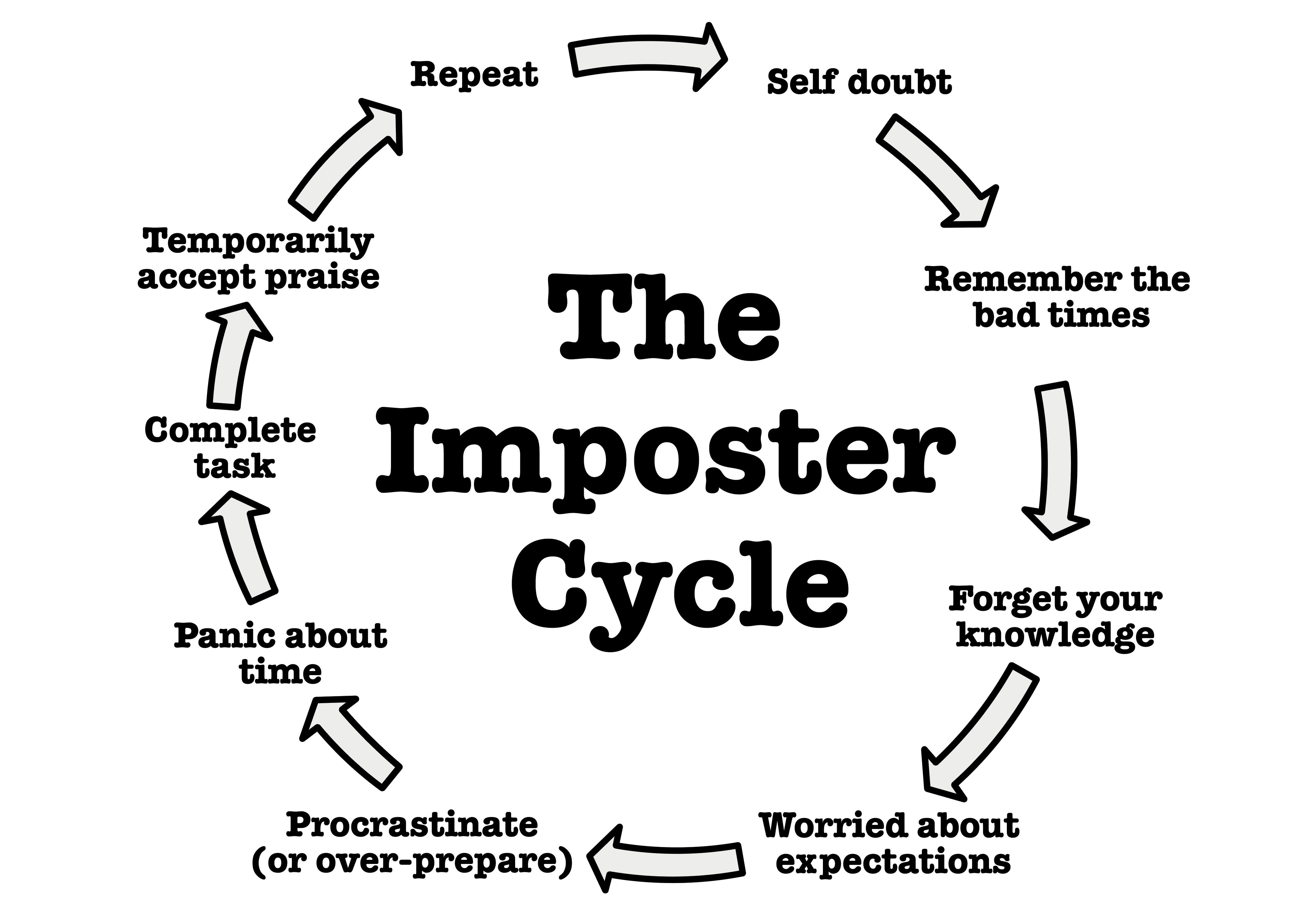
Terminology aside, no matter what variation of the imposter mask you wear, there’s a cycle of rotten behaviour that goes with it. For your current project, for anything you ever try, you’ll doubt yourself, you’ll procrastinate, you’ll overwork, and yeah, you’ll eventually get the job done. But that’s where things get really interesting because you won’t stop long to celebrate. Those suffering imposter experiences never stop. There is always more work to do.
Bringing all this seminal research together, Clance developed an Impostor Test to help people determine whether or not they were predisposed to imposter feelings. The test helped quantify just how often someone falls into feeling like an imposter. All parts of the test are answered on a scale from 1 (not true at all) to 5 (very true), according to how much the participant agrees with a particular statement. The twenty statements included:
(1) I have often succeeded in a test/task when I thought beforehand that I would fail.
(2) I can give the impression that I’m more competent than I really am.
(3) I avoid evaluations where possible and dread being evaluated.
(4) When I receive praise, I’m afraid I won’t live up to future expectations.
(5) I often put success down to right-place-right-time or knowing the right people.
(6) I’m afraid of being found out that I’m not that capable.
(7) I tend to remember my failures more than my successes.
(8) I rarely complete a task as well as I’d like.
(9) I sometimes feel that my success is down to some sort of mistake in the system.
(10) It’s hard for me to accept compliments.
(11) I sometimes feel my success is down to luck.
(12) I’m sometimes disappointed in what I’ve achieved and feel like I could’ve done more.
(13) I’m sometimes afraid others will discover the knowledge I lack.
(14) I’m often afraid I’ll fail when generally I do well.
(15) When I’ve received praise for an accomplishment, I’m afraid I won’t be able to repeat it.
(16) When I receive praise, I tend to discount the importance of what I’ve done.
(17) I often compare my abilities to those around me, and think they might be better than I am.
(18) I often worry about project failure, even when others around me have confidence in me.
(19) If I’m going for a promotion or prize, I don’t tell others until it’s an accomplished fact.
(20) I feel bad or discouraged if I’m not ‘the best’ or ‘very special’.
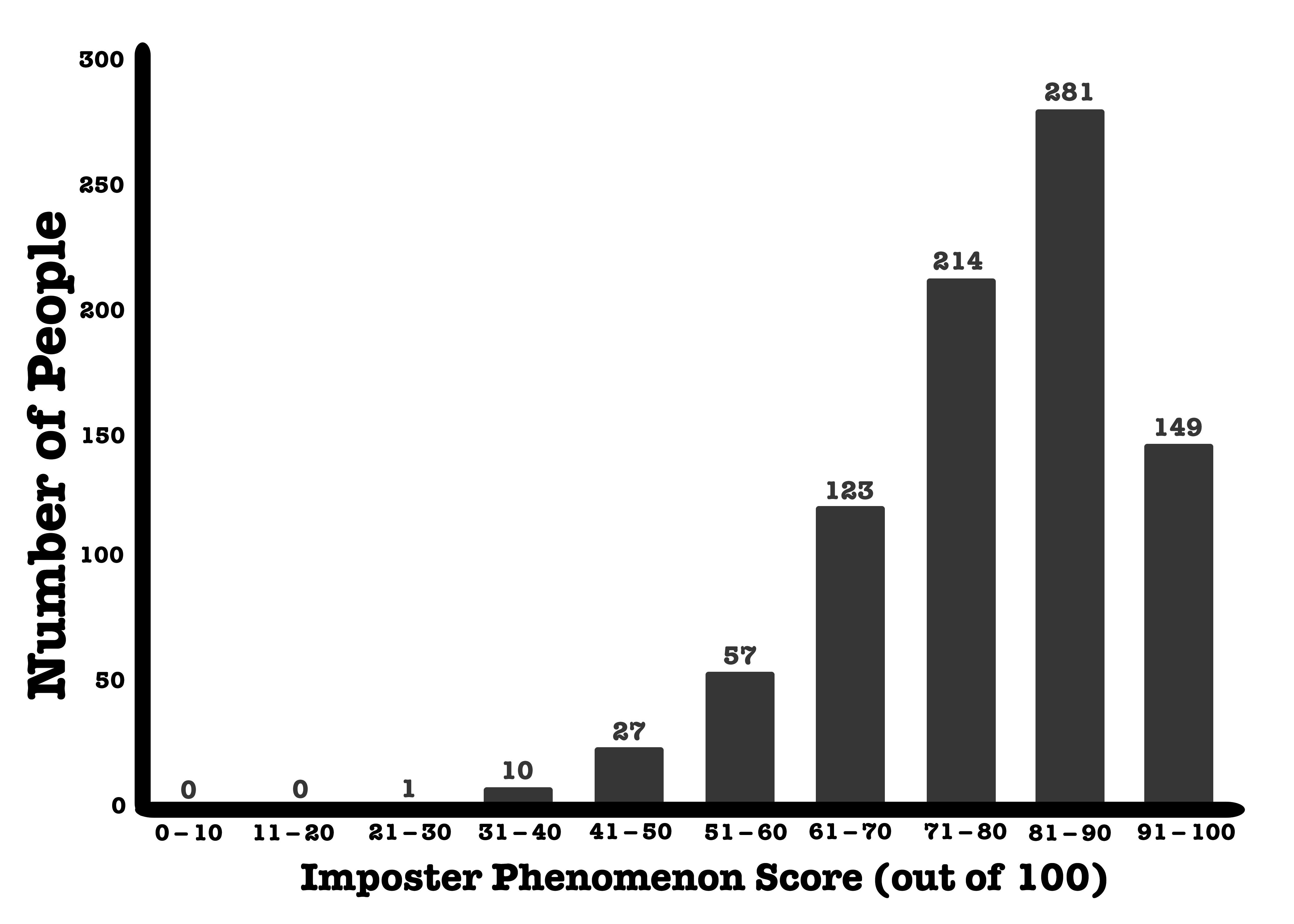
Out of a maximum score of 100, low scores less than 40 indicated someone who rarely feels like an imposter. Higher numbers, 50 or above, indicate increasingly frequent bouts with imposter experiences. I scored 70. For this test, I knew I was beginning to understand the thoughts that were burning me out. I knew, in hard numerical terms, that I thought I was an imposter. And I had such thoughts often.14 This Clance Imposter Phenomenon Scale (CIPS) is what I later used as part of a larger survey of over 800 participants. You can see the overall result in the figure below, and more on that in the next chapter.
As well as recognising imposter experiences in ourselves, it’s equally important to acknowledge and identify those external sources that can exacerbate the situation. Consider starting at the beginning – with family and upbringing. What you hear when you are young tends to stay with you, and more than you’d like to imagine. What you hear provides a kind of frame with which to reference your personality. How a family treats you when you grow up has a big impact on the adjectives you choose to describe yourself.
There are four common elements of the imposter experience originating from family life. In each case below, I have cited an exemplar comment made by participants in my own research who reflected on why they felt like imposters:
(1) Differences in your family’s image of you and the world’s image of you - discrepancies between these two impressions of who you are can lead to confusion.
Participant reflection: “I was always misunderstood by my parents, who were/are not smart, and ignored or brushed off or told I think too much or I don’t know how the world works. That’s probably very much at the heart of why these situations are hard…”
(2) Placing high importance on ‘making something’ of oneself by being ‘smart’ - you might feel like you always want to be seen as the smartest person in the room.
Participant reflection: “My parents have always pushed my brother and I to be the bests in whatever we decide to do, so maybe that generated a pressure difficult to handle when I wasn’t clearly the best.”
(3) Square peg in a round hole - you feel different from other family members and their career paths, particularly if you’re the first in your family to be educated beyond school.
Participant reflection: “I think I just never saw myself as someone who could/would achieve this level of success in my chosen field - I’ve no family/friends in this line of work (my parents didn’t work and my aunts/uncles/cousins worked in factories) and so I never really had anyone to ‘model’ myself on, either from my own circles, or in wider media/society.”
(4) Lack of praise – your parents might tell of their friends about your success and neglect (consciously or not) ever encouraging you.
Participant reflection: “I was always brought up to do my best and my parents are not very forgiving of failure. Hard to get over that feeling of letting people down.”
Some parents expect so much from their kids that they dilute any praise for successes. Others are hypercritical, always questioning, always looking for holes, never sharing any pride. Being among siblings can further trap families into labelling each child with a given characteristic. If you achieved something academically but hadn’t been labelled the ‘smart one’, then praise for your accomplishments might have been downplayed. However, if you were labelled ‘smart’, there began the pressure you now feel to always be the cleverest person in the room.
The parental influences on the Imposter Phenomenon don’t stop there. My own research also showed how many of those participants reflecting on why they felt like imposters made explicit causal links to their family. Despite such why-type questions being dominated by work, jobs, and careers (collectively mentioned over 400 times), parents and family (mentioned 80 times) nonetheless provided a telling signal. Over 30 people (about 4% of all participants) went deep. They cited their attempts to please parents, or the pressure of being the first in their family to go to university as drivers for feeling like a fraud.
You can get the collection of insightful and anonymised quotes from the participant stories as part of the book’s bonus material. For now, let me share with you the one that resonated most with me:
“I feel enormous pressure to do well. I am the person in the family that everyone thinks is ‘super smart’ and that would never fail at anything. Therefore, I feel like failing is not an option, as I don’t want to embarrass myself, or let anyone down. I don’t really have much confidence in myself or my work. I always think that someone is going to repeat my work and prove me wrong; even though I have done everything right…”.
How did that reflection parental influence sit with you? I wonder…
Part 5 – Summary
From my first nervous Google search for “Imposter Syndrome” to finding Dr Clance’s speech to graduates about the Imposter Phenomenon, I had started to scratch the surface of understanding how I was feeling about my own life and career. What was once a private, undefinable experience, singular to me, was now made plain and common.
But following my discovery of how Imposter Phenomenon (not Syndrome) came to be defined and studied, I began to voraciously read the follow-up research. I found stories of artists,15 scientists,16 philosophers,17 librarians,18 prisoners turned scholars,19 and medical students.20 Stories of men and women, people coming from different backgrounds and walks of life, all experiencing the sinking sensation of being a fake. All of them had clear evidence supporting their earned success. It didn’t matter. All of them believed that they were lucky. All of them were sure that if they tried for more success, they would surely fail. All of them believed they were imposters.
Suddenly, I wasn’t alone. I had never been alone. But it would take a rather horrible conference experience to fully come to terms with the fact that I wasn’t as isolated as I originally thought. None of us are…
Your Chapter Challenges
1. Managing your imposter experiences begins with breaking them down. You can categorise your imposter experiences by their origin and how they manifest in you.
Look again at the exemplar imposter ‘types’ listed in Part 4 of this chapter: workaholic, agreeable, and charismatic. If you want to go further, use the available journaling template to write out the reasons you believe you belong to one or more of these categories.
Which of these imposter types most closely aligns with your own imposter experiences? Write it down before moving on to the next challenge.
2. Recognise the trap of the Imposter Cycle as the mechanism that drives your procrastination and overwork.
Use the blank Imposter Cycle template to write out a specific instance of how your bout with the Imposter Phenomenon played out. If applicable, you can do this for more than one instance or story of when you have felt like a fraud.
Don’t hold back. Go diary-level deep on this. And repeat it if you have to. The electronic version of the available journal resource will serve you best for repeating the challenge.
3. Feeling like an imposter is not a syndrome.
Dare to help others by respectfully calling it out when you hear ‘Imposter Syndrome’ being used instead of ‘Imposter Phenomenon’.
Encourage the use of the latter term. Use what you’ve learned from this chapter to explain why ‘Imposter Phenomenon’ (or even ‘Imposter Experience’) is more accurate and more helpful than ‘Imposter Syndrome’.
Don’t worry, you’re right to think this third challenge will be the toughest. You can be a conversation starter without being a callous know-it-all. As a first step, consider using the book’s hashtag (#YouAreNotAFraud) to share the message with your network.
To tag me and spread the word further, use my appropriate social handle (listed in the Contact the Author section). A list is provided on the contact page at the end of the book.
Take a photo of the passage in Part 4 of this chapter that discusses ‘syndrome’ versus ‘phenomenon’ and share it.