Chapter 3: No Longer Alone
Conference travel is a big part of life in academia. It’s a great way to find new collaborators and take bite-sized chunks out of worldwide travel, one meeting at a time. I travelled to many conferences in many countries in the early stages of my career: UK, Germany, Japan, Brazil, the US, and many other places. It’s a true privilege and perk of the job…but it’s a privilege with a dark side. A dark side that exemplifies a crippling loneliness that can accompany your imposter experiences.
Part 1 – The Lonely Conference Road
Long before the university road to academia, during the perpetual awkwardness of my teenage years, I loved the 2001 film Donnie Darko.1 It’s the haunting story of a brilliant but troubled teenage boy struggling to come to terms with a near-death experience. A haunting hallucination of a giant rabbit called Frank leads Donnie out of his bedroom in the middle of the night, moments before a mysteriously traceless jet engine comes crashing through his bedroom. Had Donnie not followed Frank, he would have been crushed under a hunk of metal.
Donnie’s mental health issues compounded the hormonal rollercoaster of teenage life, and he needed professional help. During a session with his therapist, he recounts a chilling message whispered to him by a senile old lady in his neighbourhood:
“Every living creature on Earth dies alone.”
It was as if the old lady’s message was meant to send Donnie deeper into crisis. Disturbed by the message, Donnie remembers watching his old pet dog crawl under the porch of the family home before it died. He realised that his dog went there to be alone. And when his therapist asked if that scared him, Donnie answered through whimpering and broken tones of absolute certainty:
“I don’t wanna be alone.”
Few things in life are scarier or more silently damaging to your health than the feeling of being alone.2 Isolated. Rejected. Outcast. Unnoticed. Loneliness can make us feel like we have been tied to driftwood and left floating on a deadly tide. Adrift without sight of land, loneliness carries an expansive and harrowing sense of utter abandonment. My memories of feeling like an imposter are all, in part, memories of feeling alone. Every single one of them.
On a conference trip, not long after starting my independent academic post, I travelled to London to join fellow early career academics in Chemistry to talk about opportunities for collaboration. Excited and keen, I travelled down from Glasgow on the train the night before the meeting was due to start. From the serenity of the cross-country train line to the organised pandemonium of the London Underground, I eventually made it to my hotel room late in the evening. I performed a quick-change act from jeans into slacks, grabbed a cold drink, and lay on the bed in my hotel room to watch TV.
The noise of people talking to me through the screen did well to simulate a sense of company for a lonely traveller. I lay on the bed and scrolled through my phone. My attention was spread everywhere and concentrated nowhere. I skipped from social platform to social platform and then, as if inevitably, to my emails. Once there, I took the opportunity to remind myself why I was in London. I read over the conference welcome email and downloaded the schedule telling conference attendees all about who was presenting and on what areas of research. As soon as I started scanning over that document, my once calm and periodic breaths became ever shallower. Erratic.
When I put my phone down, I sat up from the bed, swung my feet onto the thin, abrasive carpet, and hunched my palpitating torso over my knees. My hands became a shaky cradle for my heavy head. The quiet company of the TV was drowned out by an isolating ringfence of panicked thoughts:
“What am I doing here?”
“I’m not ready to be here.”
“I’m not a true part of this group.”
“Maybe I should just fake an illness.”
“I should just go home and stop wasting everyone’s time.”
Looking through the conference booklet at my colleagues’ research somehow ignited the dark emotional muscle memory of the imposter experience in my head. My synapses fired off down a well-trodden path, destined to arrive at the same old conclusion. I was a fake among the genuine. An imposter among superstars.
Locked in my hotel room, I couldn’t console myself. A horizontal slumber had become an upright terror. I couldn’t pick up the phone to call my wife. In that moment, I could not make any sense of what I was thinking. I could only see the unchallenged assumption that I was, without any doubt, a phoney. No one could’ve told me otherwise. Collapsing and curling up in the unfamiliar bed, I stared hopelessly at the hotel room ceiling as my internal screams telekinetically muted the TV. I was lost. I was tired. I was scared and alone.
On the other side of loneliness, there is an involuntary sigh of relief that comes with finding out that you are not alone, that you’re not the only person feeling what you feel, or suffering what you suffer.3 So strong is this sensation that the pain of loneliness has been linked to physical pain mechanisms in the body.
It was only later, after the conference in question, that my reading of the Imposter Phenomenon began. And it has only been through my efforts to build self-awareness that I have been able to stop every subsequent conference trip turning into the torturous solitude of my trip to London.
When I started researching the Imposter Phenomenon, I immediately started to feel a small but hopeful sense of belonging. The reading wasn’t just helping me materialise the poisonous thoughts in my mind. Rather, once I recognised the sense of feeling like an imposter, I started seeing it in other people. Reading similar experiences to mine from other people around the world was sort of liberating. Loneliness was becoming community. Confusion was becoming clarity. I had to know more about these other people who suffered as I did.
Part 2 – Who Feels Like an Imposter?
Over time, my frantic internet searches on the Imposter Phenomenon (and ‘Syndrome’) amassed significant presence on my laptop. My amassed notes, links, PDFs, articles, and blog posts4 began to exert their own gravitational pull; a tangible collection of reminders that I was no longer alone in feeling like an imposter.
It soon became clear to me that pretty much anyone from any background could suffer from the unfounded feelings of being a fraud. Although the Imposter Phenomenon was first formalised with studies of high-achieving women, its reach was (and remains) much, much broader.
Indeed, later research has shown that men, too, suffer the imposter experience, and just as often as women, in some cases more so.5 Men typically find the Imposter Phenomenon harder to talk about openly. All in, across sex or gender, colour, culture, creed, or country, it doesn’t seem to matter. Despite exhaustively going through statistical A versus B comparisons in my own research findings, it was all hair-splitting. Men and women, public and private sector workers, those starting out and those seeking retirement.
All the differences recorded between groups, significant or not, all fell in the region of average Imposter Phenomenon scores (introduced in Chapter 2) over 70, and often over 80. In other words, both sides of most demographic splits lay in the realms of frequent and even chronic imposter experiences.
Imposter experiences can hit anyone who is aiming to improve.
That can mean improvement (most commonly) in your career, in your social standing, or with your relationship to your kids. For me, I was primarily concerned with my academic career and its uncertain trajectory.
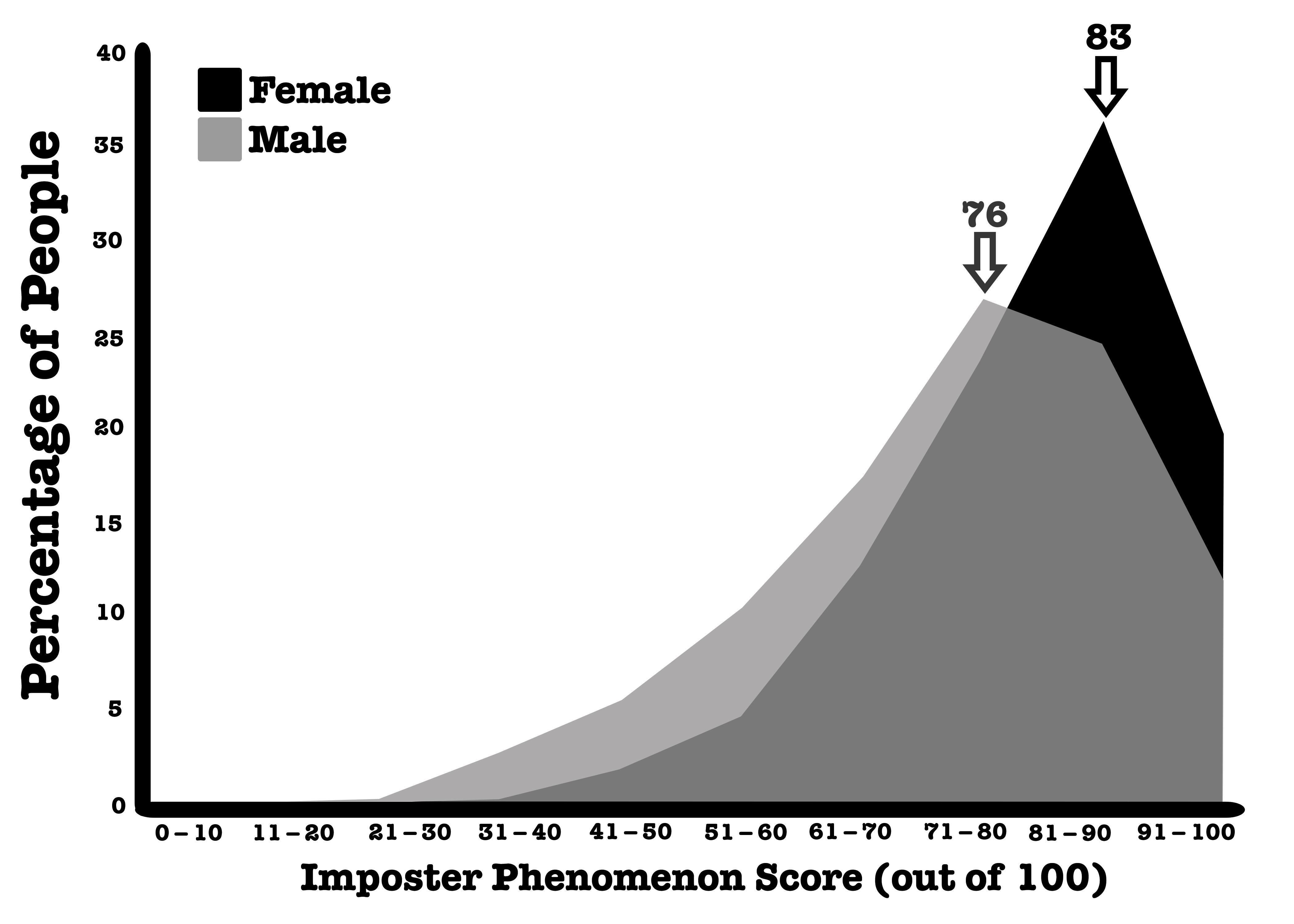
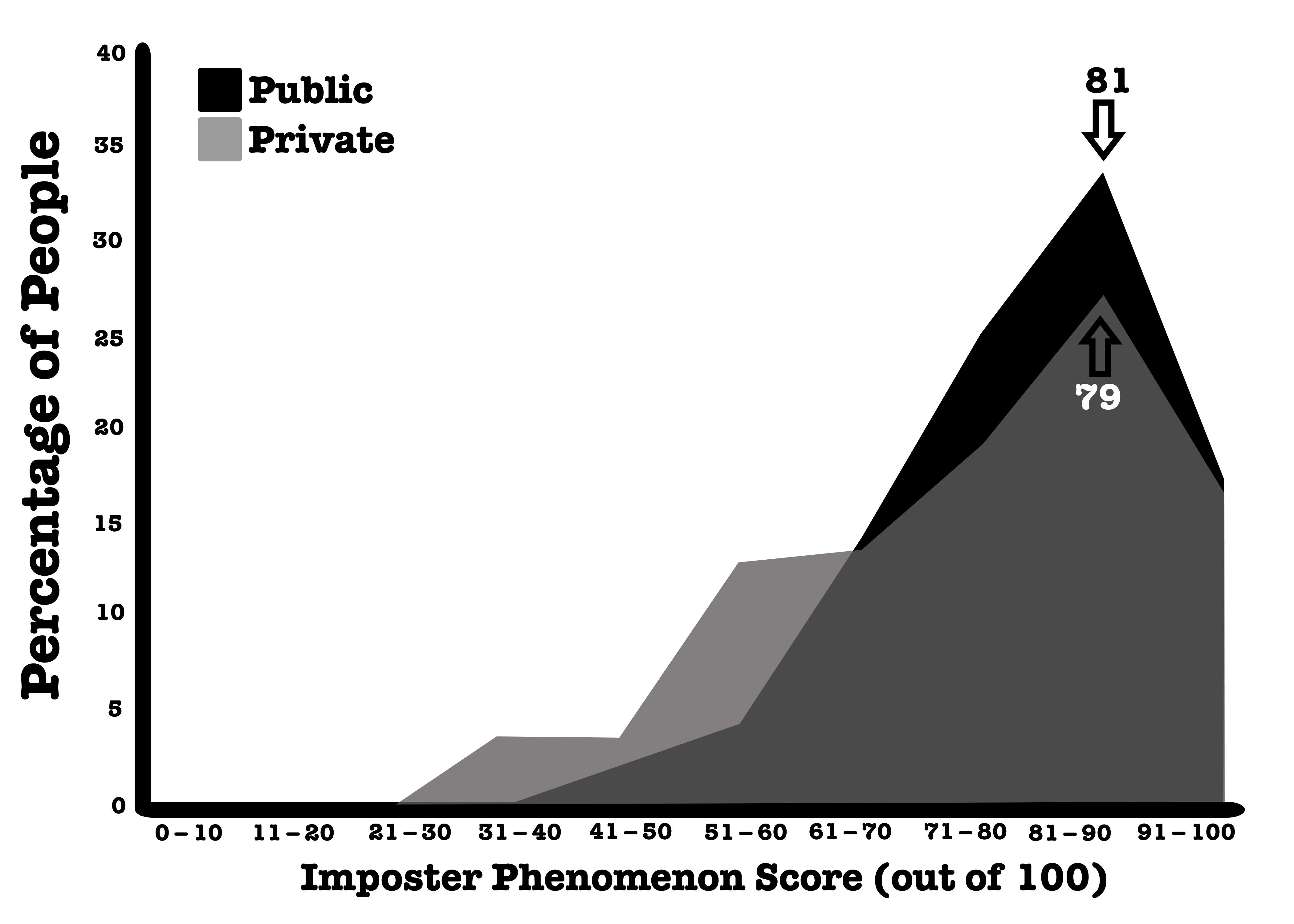
As I discovered more about the community of imposter experience sufferers, some numbers started to emerge from the literature that helped lift me out of my feeling of loneliness. Beyond the pioneering work of Pauline Clance, one particular Imposter Phenomenon statistic kept resurfacing as if to beat my loneliness into submission:
70%.
I have found this magical ‘70%’ to be one of the most quoted statistics about the Imposter Phenomenon. It comes from a study by Dr Gail Matthews (Old Dominion College, San Rafael, CA). From her US study in the 1980s, it was shown that about 70% of professionally successful people suffer from feelings of being an imposter.6
The same study by Dr Matthews also suggested that 40% of everyone in any career feels like an imposter in at least one instance in their life.7 Matthews showed that young and successful people were most likely to accelerate towards the imposter experience and see themselves as frauds. It echoed Clance’s point that students, as aspiring professionals, were among the worst sufferers of the Imposter Phenomenon. They’d cite luck or chance as the key to their success. They’d forget that luck plays side by side with mindful hard work. They’d feel the lonely impending sense of being discovered as a fake. They’d forget the work they’d accomplished. Once again, the words I was reading smoothed out into a reflective surface to show me staring back at myself. I thought:
So just who were all these other people feeling like an imposter?
I had to wonder.
Searching online for all the different variations on ‘Imposter’ versus ‘Impostor’, and ‘Syndrome’ versus ‘Phenomenon’, I found over half a million videos on the topic.8 Similar searches for ‘funny cat video’ returned close to 80 million hits. Nonetheless, finding so many videos about imposter feelings was reassuring to me. And among all the YouTube content I found, one video, in particular, stood out.
From a short series of videos from graduate students at Stanford University, MBA student Chika Okoro described her experience of grad school, having previously been an undergraduate at Harvard. She had also worked at Google and delivered a powerful TEDx talk on racism and colourism.9 I remember, when I first came across her work back in 2016, thinking that she was a seriously impressive individual. And that’s before mentioning that she is also a gifted public speaker with a sharp wit. She was hard-working, driven, informed, and persuasive. Despite all of that, I watched Okoro’s Stanford interview as she timidly admitted the way she saw herself:
“…99% of me knows I deserve to be here, I’m smart, I work hard…but there’s that 1% that’ll be like, ‘You’re not that smart…you just got to be here because you check two boxes (being black and being a female)…you don’t really know anything’.”
I saw then that even someone as accomplished and ascendant as Chika Okoro suffered from imposter feelings. She constantly had to tell herself that she was ‘enough’.
High achievers think they are just the opposite. Lifelong sufferer of imposter experiences, Joyce Roché was the first black and female vice president of cosmetic giant Avon, and CEO of female empowerment charity Girls, Inc. In her book, The Empress Has No Clothes,10 Roché eloquently recounts her struggles to overcome her poor upbringing and ethnicity to get to a place of amazing success:
“In over 25 years of singular achievements in corporate America, I had risen to unprecedented heights for an African American woman…just about every new accomplishment, however, came with the stultifying doubt that I did not deserve the success, and that sooner or later I would be discovered as an imposter.”
Even Hollywood’s own evergreen nice guy Tom Hanks has fought with self-doubt, saying in a 2016 NPR interview:11
“…there comes a point where you think, ‘How did I get here? When are they going to discover that I am, in fact, a fraud and take everything away from me?’”
But enough of the quotes now, here’s the deal.
Anyone, anywhere can feel like an imposter at some time in their life.
And now it’s time for you to see that conclusion dressed in data. The people documenting the loneliness of their imposter experiences can speak to our imposter struggles in numbers. Finding more and more imposter stories in the media urged me to take the chance to put one of my relatively new research skills to work. Around the same time I started to truly suffer from repeated bouts of the Imposter Phenomenon, I was learning how to code. More specifically, I was learning how to scrape data from social media, and describe the beautiful soup of words on imposter experiences in numbers.
In my quest to learn more from the online communities who felt as fraudulent as I did, I used some of my programming skills to gain a sense of how we, as a social collective and group of web-browsing agonizers, felt about the Imposter Phenomenon. Whether it’s a crisp and concise tweet of less than 280 characters on Twitter, or dramatic purple prose in a lengthy blog post on Facebook, a cry for help on a Reddit thread, or a hack for success through LinkedIn, the ability to gain a collective understanding of how people define and respond to the Imposter Phenomenon is at our fingertips. An unimaginable ocean of textually digitised human expressions can be distilled down to its educational essence. It was this data mine that I wanted to tap into.
Part 3 – The Data Show We Are Not Alone
As a data-driven, analytical scientist (a pedantic pain in the ass to some), I wanted to check my new sense that I wasn’t alone in feeling like an imposter; that, in fact, more and more people were talking about their imposter experiences. This went beyond the 800 survey participants. Using a web-scraping computer program written by me and my team, we collected tweeted instances of the terms ‘Imposter Syndrome’, ‘Imposter Phenomenon’ (with both ‘er’ and ‘or’ spellings), and the hashtag versions of each term.
We did this for every year that Twitter has been active, from 2007 to 2021. When I looked at the tweets, year by year, I found that the number of instances of tweets linked with the various ‘imposter’ terms was creeping up. But what really stunned me was that, even when I accounted for the increasing number of Twitter users year on year, the number of people tweeting about ‘Imposter Syndrome’ or ‘Imposter Phenomenon’ maintained an upward trend. It didn’t level off. Compare that result to something like a search for tweets containing “Haiti”. Haiti suffered a devastating earthquake in 2010. Consistent with that awful event, the tweets peaked in 2010 and tailed off thereafter. Those tweets didn’t continue to rise year on year, not like the ‘imposter’ terms.
The number of people talking about their imposter experiences is on the rise.
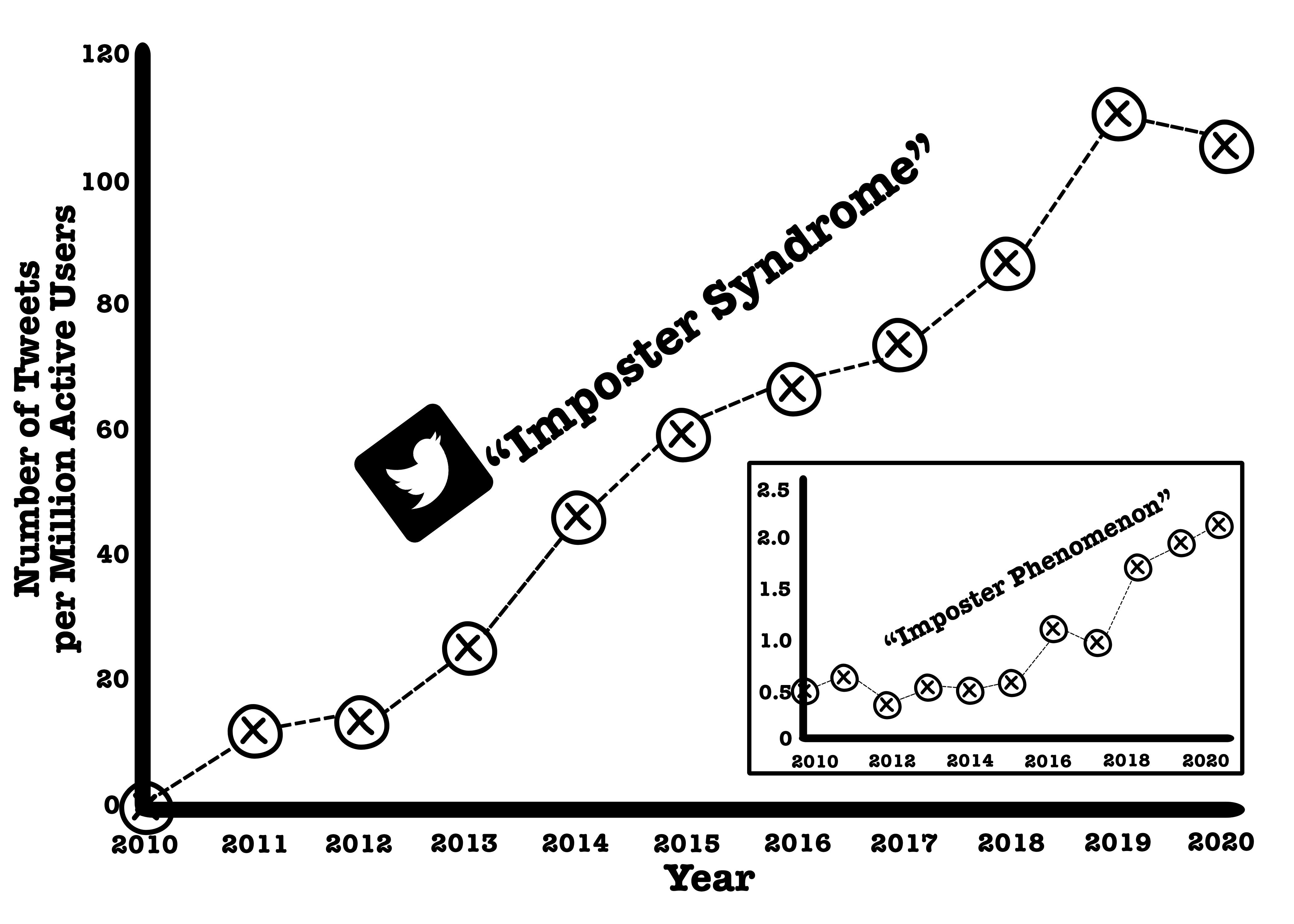
A single tweet is often a window to a world of information behind it. Looking more closely at the scattered tweets I had collected, it became clear that a lot of people were not necessarily sharing direct thoughts on imposter experiences but instead sharing links to blogs and articles on the subject. People were sharing information on how others in their community could identify the imposter experience and become acquainted with it.
In addition to the tweets, I collected and read a lot of articles and blogs, adding more mass to the data I had already gathered. I had a sense of the increase in the number of people talking about the Imposter Phenomenon over time. I now wanted to gain some numerical sense of the tone with which other people were writing about their imposter experiences.
The hidden value of a forest of text strings lies in the specific arrangements and word choices. The specific construction of a sentence provides intriguing clues to how people, en masse, feel about certain discussion topics. How will an election go? How are people responding to the latest hurricane in North America? How do people feel about a celebrity scandal? From the thoughts in our minds to the clicks of our fingers on the keyboard, we electronically leak out the way we feel through the words we type. Text analysis, sentiment analysis, linguistic programming, and even simple word counting (like in the case of the Twitter exercise), allow us to materialise insights from the ether of typed text.
The Linguistic Inquiry and Word Count (LIWC, pronounced ‘Luke’) tool is a text analysis computer program that counts percentages of words in a text to infer different thinking styles and emotions.12 The LIWC is a tool used mainly by psychologists. It takes in a written text and compares each and every word against a store of internal reference words. In this way, it answers simple queries like:
- What’s the word count?
- How many words are there per sentence?
- How many words in the text match the words in the reference list?
- What sort of pronouns are used (‘I’, ‘me’, ‘you’, ‘he’, ‘she’, ‘they’)?
And questions like:
- Does the text contain positive emotion (‘love’, ‘nice’, ‘sweet’, etc.)?
- Does the text contain negative emotion (‘hurt’, ‘ugly’, ‘nasty’, etc.)?
- Does the text contain anxiety (‘worried’, ‘fearful’, etc.)?
- Are there words associated with social processes (‘talk’, ‘friend’, ‘they’,etc.)?
- What words present are associated with cognition (‘know’, ‘think’, ‘because’, ‘maybe’, etc.)?
The program does this for 90 numerical output variables, all reported as percentages. These numbers act like breadcrumbs on a path to the underlying truth. Each number comes together like pieces of the textual puzzle, and together give us a picture of what all the text is conveying, functionally and emotionally.
I put LIWC into action on 50 articles and blogs on the Imposter ‘Syndrome’ (there’s that word again). I combined 115,000 words and utterances on the topic, all from people either sharing their experience, or acting to educate an audience on the basics. In my loneliness, I expected to churn through the numbers and find that the combined texts reflected the negative, woeful way that I was feeling about my own imposter experiences…but that’s not what I found, at all.
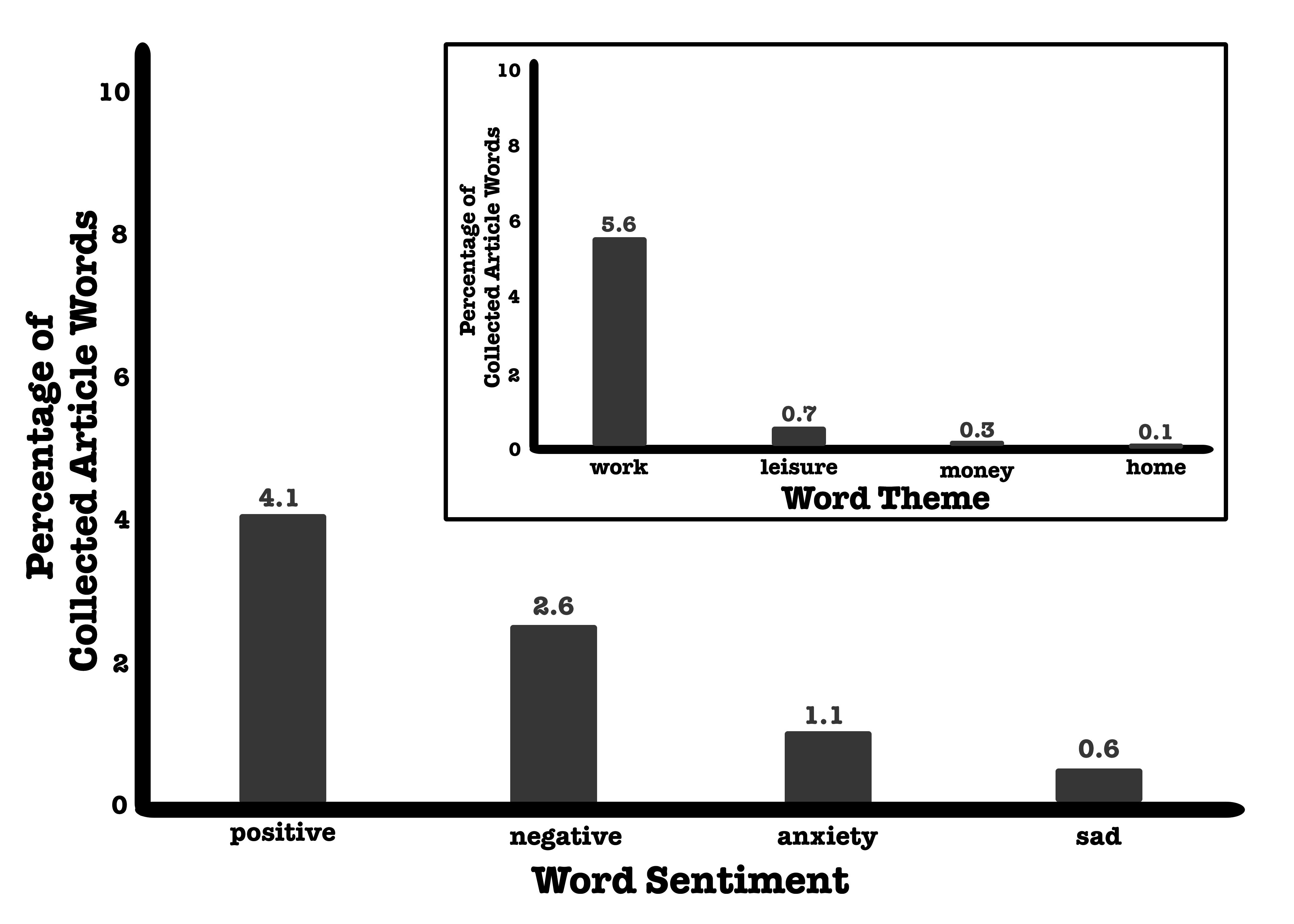
Upfront, and perhaps obviously, my analysis found that words used to describe personal concerns were mostly work-related. This made sense given that most of the articles and blogs I had read mentioned words like ‘career’ or ‘job’. The unexpected result came later.
By looking at all the words associated with psychological affect – words reflecting positive emotion, negative emotion, anxiety, anger, sadness – I found that the highest proportion of such words was not negative, or anxious, or sad. They were positive in tone. There were 4.1% of words linked with positive emotion but only 2.6% were bound to negative feelings. Why? This was a significant and, to me, surprising find. And being forced to think about it more, it started to make sense.
If you Google articles on ‘Imposter Syndrome’, you’ll find that most people writing articles on the subject are giving advice on how to handle the experience. Authors of these articles are trying to be positive. In the comments to these blogs and articles, readers often report their own experiences and elation with having read something that helps them. As obvious as that sounds, the positivity in Imposter Phenomenon articles simply wasn’t apparent to me when I was feeling alone. It wasn’t obvious in that hotel room before the conference in London. But there’s more.
From my research, the survey respondents did more than evaluate their imposter experiences in the hard numerical terms of Clance’s scale. They answered open questions that enabled them to share the fullness of their individual story. By processing over 380,000 words, the top ten distilled utterances of Imposter Phenomenon sufferers emerged.
(1) “I don’t know enough”
(2) “I’m not good enough”
(3) “I’m underqualified”
(4) “I don’t deserve it”
(5) “I don’t belong”
(6) “I’m not smart enough”
(7) “I’m out of place”
(8) “I don’t understand”
(9) “I lack confidence”
(10) “I’m not able”
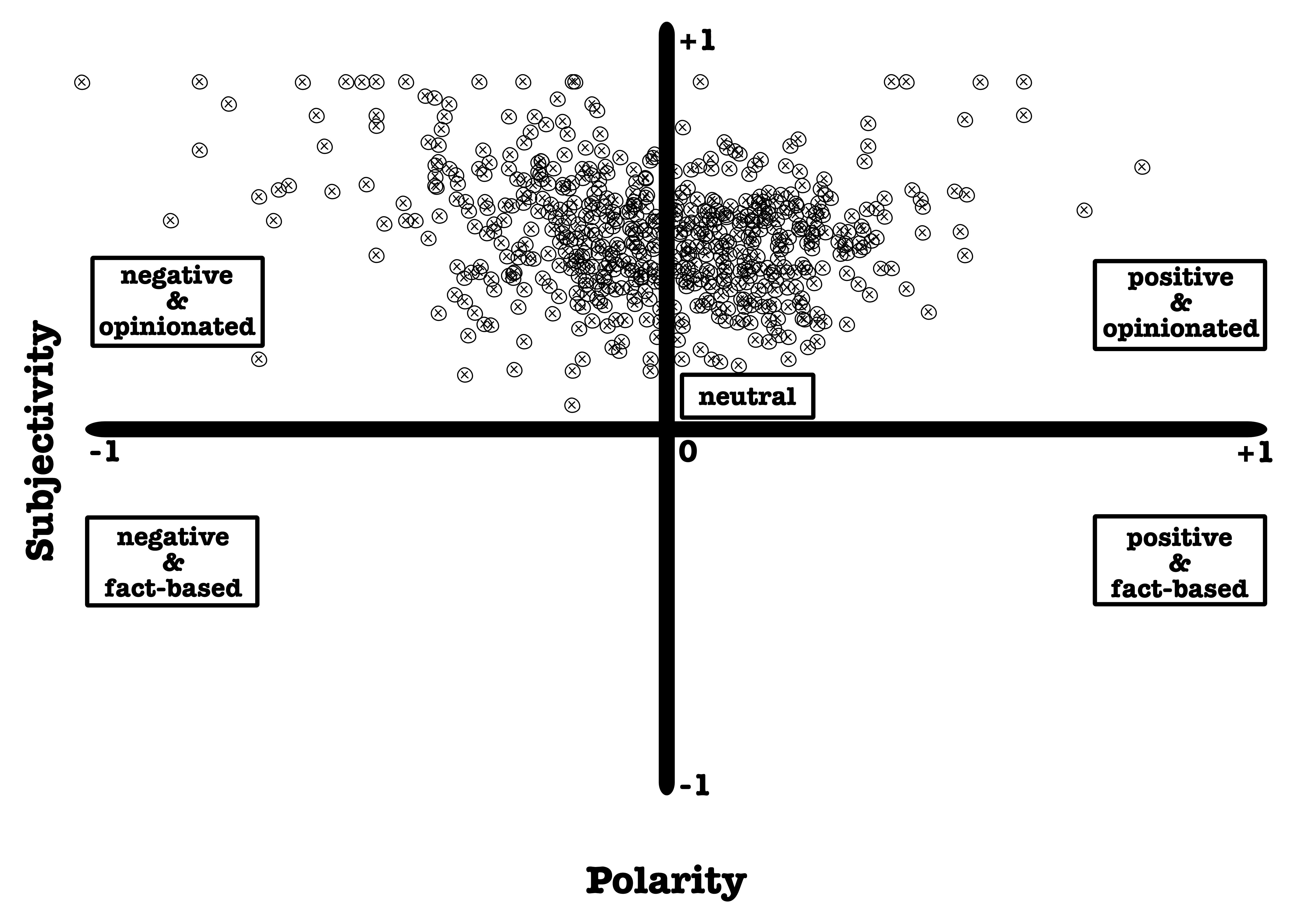
The same text was analysed to see where responses lay on a scale of subjective (personal, opinionated) responses through to objective (cold, fact-based) responses. A text score between 0 and 1 denotes more subjective language. Anything below 0, in the negative region of text scores, suggests something more even-handed. Similarly, the text can be analysed on another scale: polarity. That is whether the text carries a mostly negative sentiment (scores below 0), neutral sentiment (scores around 0), or positive sentiment (scores above 0).
What did we find? While the polarity of responses centred around 0 (neither positive or negative, on average), every single response from over 800 lay in the opinionated rather than the fact-based region (all scores of subjectivity above 0).
The numbers more robustly decorate what you might have suspected. For me, the research brought a warmth, a relief, and a confidence to say what I say to you now, where I would never have dared before.
There is no set unfeeling, unflinching, immovably moulded single experience that is said to be the Imposter Phenomenon.
Some stories might overlap, yes, but all are unique. And so is yours.
Part 4 – Summary
From all the articles quoting the magical 70% figure as the number of people suffering from imposter experiences, to the new research that I’ve shared with you here, there comes the same distilled message for you in your own struggles with the Imposter Phenomenon:
You are not alone.
It was only after looking to the wider world for stories of the Imposter Phenomenon that I felt comfortable enough to do what I should have done from the very beginning of my lonely struggles. I spoke to someone – my wife. From then on, every time I was preparing for those conference trips, I told my wife I was worried about fucking up, worried about being ‘found out’. Verbalising the thoughts crystallised their absurdity, and my wife was quick to point this out on each occasion.
Like the participants in the research, my own imposter experiences were more opinionated than factual. More assumption than assertion. The relief of being able to say how you feel like a fraud is made even more satisfying by the listener showing you that your conclusions are nonsense.13 Perhaps counterintuitively, resilience is also bred from those able to seek help from others and face the anxious awkwardness of the constructive criticism they receive. The height of your ambition, and the depths of your imposter experiences, need not be traversed in loneliness.
In an interview for the New York Times in 1984, Dr Joan Harvey, a psychologist and one of the leading researchers in the Imposter Phenomenon, noted that, by its very nature, feeling like an imposter is a secret.14 Those who suffer such feelings rarely share them. Flashing forward to our time, this simple statement may seem somewhat diluted given the fact that the internet grants a voice to everyone, but it remains true.
People who feel like an imposter might never admit it openly. Yet, speaking about your imposter experience can provide immeasurable relief.
When I asked our research participants who they had told about their own imposter experiences, one in five admitted to never having told anyone at all.
Realising that I wasn’t alone was a leap. Our Imposter Phenomenon experiences are individual but they are not isolated. Rather, yours, for all its specificity and enlightening individuality, is one story in a collection. A contribution to a community. There were many other people needlessly hijacking their careers with radical conclusions about being unworthy of success.
Finding out that I wasn’t alone was more than reassuring. It lit a rocket under my ass and propelled me to go further. This is no longer just about learning what the Imposter Phenomenon is…it’s now about how we challenge these thoughts that live in our heads. To do that, we have to properly define one word that has been hiding in plain sight. I wonder if it’s a word you’ve thought much about.
What do we really mean by the term ‘Imposter’?
Your Chapter Challenges
1. Increasing numbers of people – famous and not – experience imposter feelings. Let everyone know it.
Tap into the vein that is the social media trends shared in this chapter.
Use #YouAreNotAFraud, take a photo of a page in this chapter, and share your own message for those in your network who need to know they do not suffer alone.
2. Be aware of imposter feelings leading to loneliness. Never suffer alone.
Talk to people that will help show you that you are not an imposter. You can use the available template to write out the reasons for thinking you are a fraud, and the hard evidence against you being an imposter.
The latter should be drawn out in conversation.