1. Introduction
It was only 4 years ago, in 2011 when Marc Andreessen, one of the most well known technology entrepreneur and innovator declared that “software is eating the world”. While that statement is more true than ever, in the meantime fundamental changes in the economy also brought about a renaissance of hardware too.
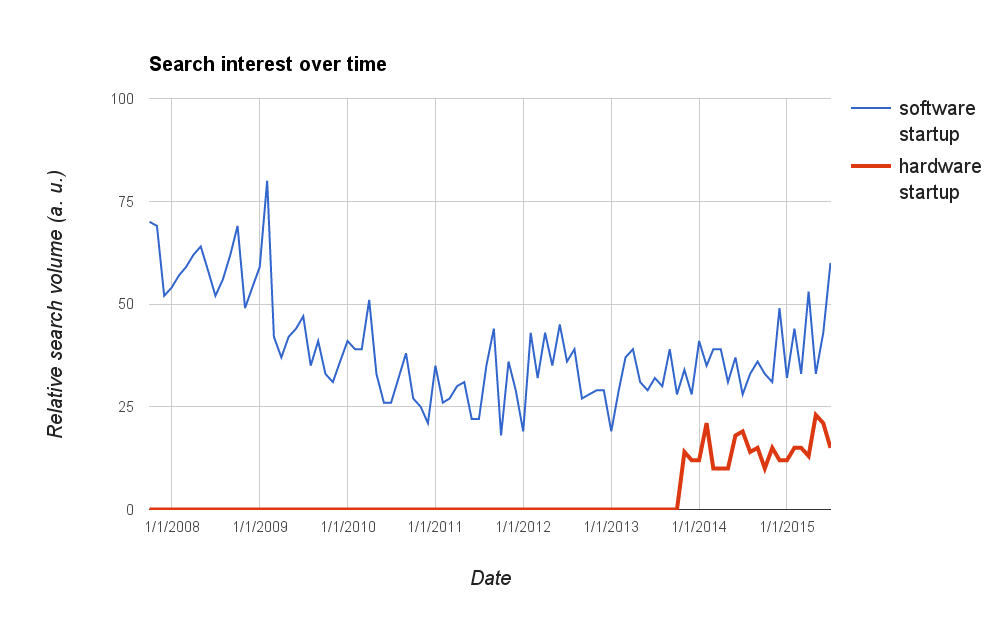
It has never been as easy to create new hardware devices as now, thus more people are creating businesses based on that: hardware startups. The increasing abundance of hardware in turn makes it easier for people to tinker and create, fueling a powerful positive feedback loop. This growing interest is illustrated by online search results, “hardware startup” starting to show up significantly in the recent year1 (see Figure 1 above).
This hardware renaissance seems to be the result of multiple developments coming to fruition just recently, opening up whole new areas for development. Since many of these changes are ongoing, in this report we are aiming to take a critical and comprehensive look at the important factors, as well as their trends. In the end, we hope to help the reader have a deeper understanding of the current status of hardware startups and entrepreneurship, and help them find opportunities in this space.
We have centered our investigation on the Asia-Pacific region, as we believe that large changes are coming to the economies of the region. The large size of the population, the importance of education in the region’s cultures, the unique skills in general manufacturing and trade, and the increasing availability of capital (both from investors and general customers) set Asia-Pacific on a course of large changes in hardware entrepreneurship.
The structure of the report is as follows. In Chapter 2, we introduce the changes in the tools for entrepreneurs that have the largest bearing on what’s possible nowadays compared to before. Chapter 3 surveys the ecosystem specific to hardware startups, and the inherent strengths and challenges of the different players. Chapter 4 highlights a number of product categories that we think are posed to be very significant areas of development in the near future. Chapter 5 takes a look at women in technology as we believe there are very important lessons to learn and great opportunities to have. Chapter 6 presents our conclusions. Finally, we are closing our analysis in Chapter 7 with a number of recommendations for the governments in the Asia-Pacific region in order to take advantages of these ongoing developments.
- Data source: Google Trends↩