TLSv1.3
TLS stands for Transport Layer Security and is the successor to SSL (Secure Sockets Layer). TLS allows client/server applications to communicate over the Internet in a way that is designed to prevent eavesdropping, tampering, and message forgery. This section mostly focus on TLSv 1.3. TLS 1.3 was defined in RFC 8446 in August 2018. It is based on the earlier TLS 1.2 specification.
TLS Histrory and Development
| Protocol | Published |
|---|---|
| SSL 1.0 | Unpublished |
| SSL 2.0 | 1995 |
| SSL 3.0 | 1996 |
| TLS 1.0 | 1999 |
| TLS 1.1 | 2006 |
| TLS 1.2 | 2008 |
| TLS 1.3 | 2018 |
TLS1.3 has been over eight years since the last encryption protocol update, but the final version of TLS 1.3 has now been published as of August 2018 Image Ref

Major Differences from TLS 1.2
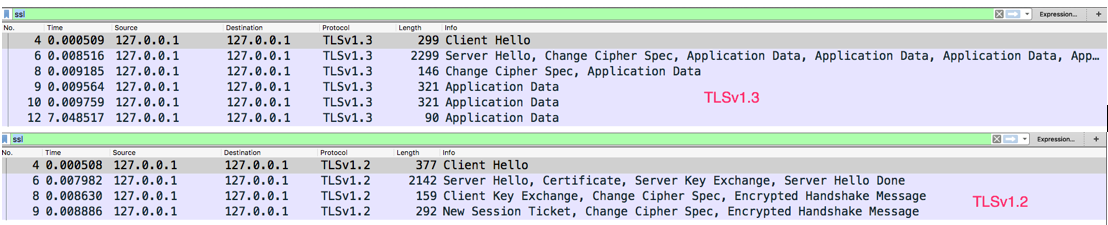
From the Wireshark packet capture, its clearly visible the TLSv.1.3, the number of packets is being reduced this offer better speed in TLS v1.3 , and some of the major changes from TLS1.2 as follows
- The list of supported symmetric encryption algorithms has been pruned of all algorithms that are considered legacy. Those that remain are all Authenticated Encryption with Associated Data (AEAD) algorithms.
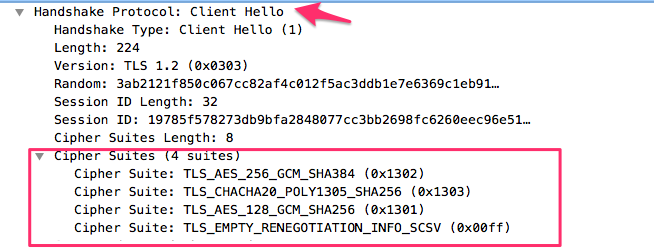
- The cipher suite concept has been changed to separate the authentication and key exchange mechanisms from the record protection algorithm (including secret key length) and a hash to be used with both the key derivation function and handshake message authentication code (MAC).
- A zero round-trip time (0-RTT) mode was added, saving a round trip at connection setup for some application data, at the cost of certain security properties. IMP 0-rtt should be avoided , there are proven replay attack has been found
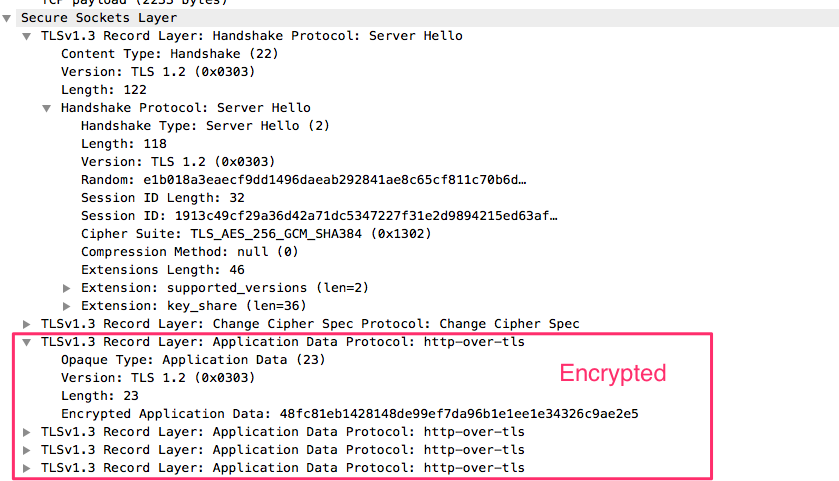
- All handshake messages after the ServerHello are now encrypted. The newly introduced EncryptedExtensions message allows various extensions previously sent in the clear in the ServerHello to also enjoy confidentiality protection.
- Static RSA and Diffie-Hellman cipher suites have been removed; all public-key based key exchange mechanisms now provide forward secrecy.
- The key derivation functions have been redesigned.
- The handshake state machine has been significantly restructured to be more consistent and to remove superfluous messages such as ChangeCipherSpec (except when needed for middlebox compatibility).
- Elliptic curve algorithms are now in the base spec, and new signature algorithms, such as EdDSA, are included. TLS 1.3 removed point format negotiation in favor of a single point format for each curve.
- The TLS 1.2 version negotiation mechanism has been deprecated in favor of a version list in an extension. This increases compatibility with existing servers that incorrectly implemented version negotiation.
- Session resumption with and without server-side state and the PSK-based ciphersuites of earlier versions of TLS have been replaced by a single new PSK exchange
TLS 1.3 Handshake
The handshake can be thought of as having three phases (indicated in the diagram below)
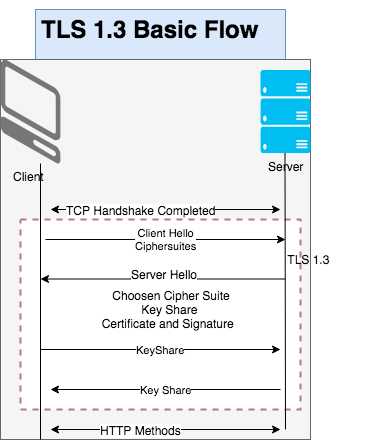
- In the first phase, the client sends the ClientHello message, which contains
- random nonce (ClientHello.random);
- protocol versions;
- symmetric cipher/HKDF hash pairs; either a set of Diffie-Hellman key shares (in the “key_share” extension
- A set of pre- shared key labels (in the “pre_shared_key” extension or both;
- And potentially additional extensions.
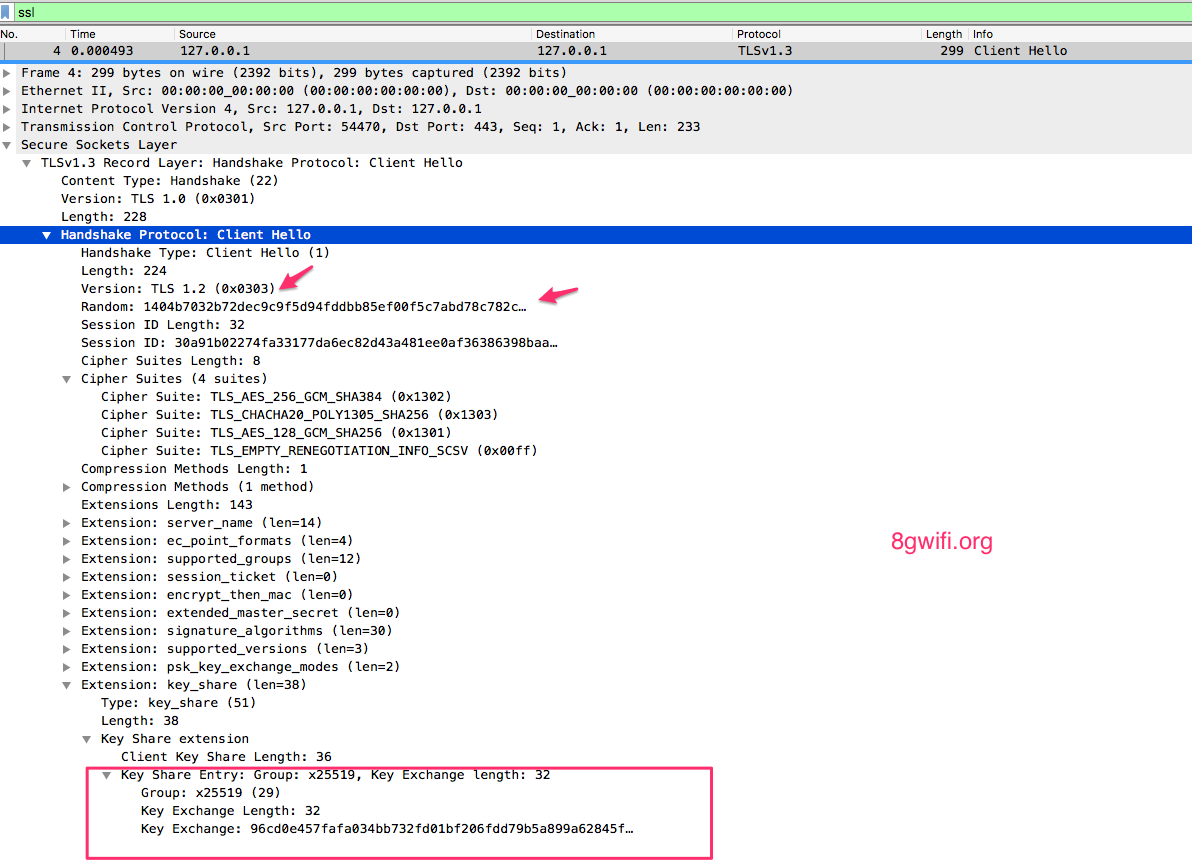
The “key_share” extension contains the endpoint’s cryptographic parameters.In TLSv1.3 the client selects a “groupâ€� that it will use for key exchange.
The PSK: If clients offer “pre_shared_key” without a “psk_key_exchange_modes” extension, servers abort the handshake and used to negotiate the identity of the pre-shared key to be used with a given handshake in association with PSK key establishment
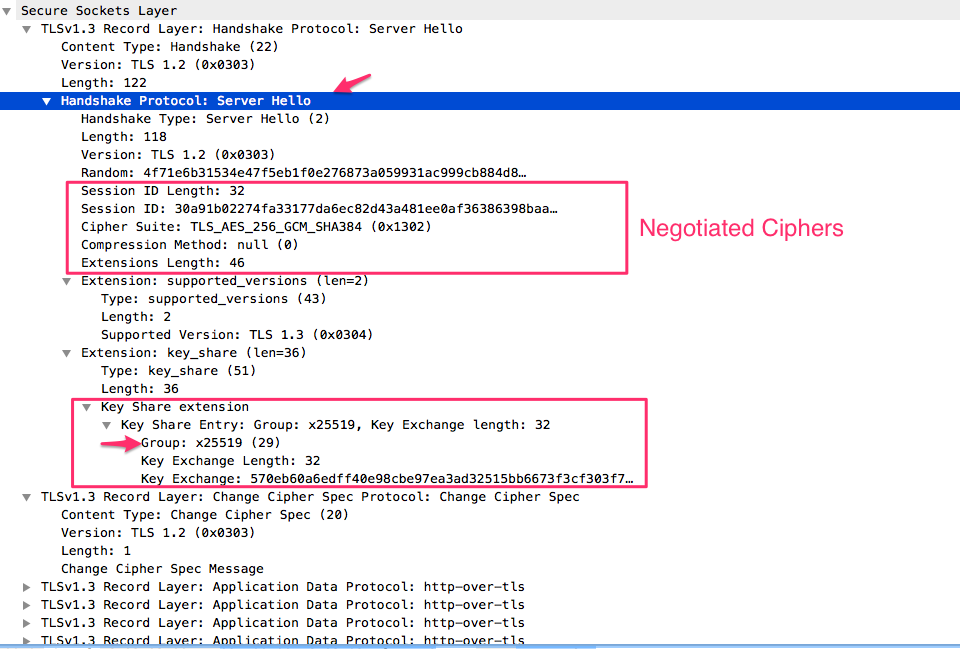
- The server processes the ClientHello and determines the appropriate cryptographic parameters for the connection. It then responds with its own ServerHello which indicates the negotiated connection parameters. The combination of the ClientHello and the ServerHello determines the shared keys
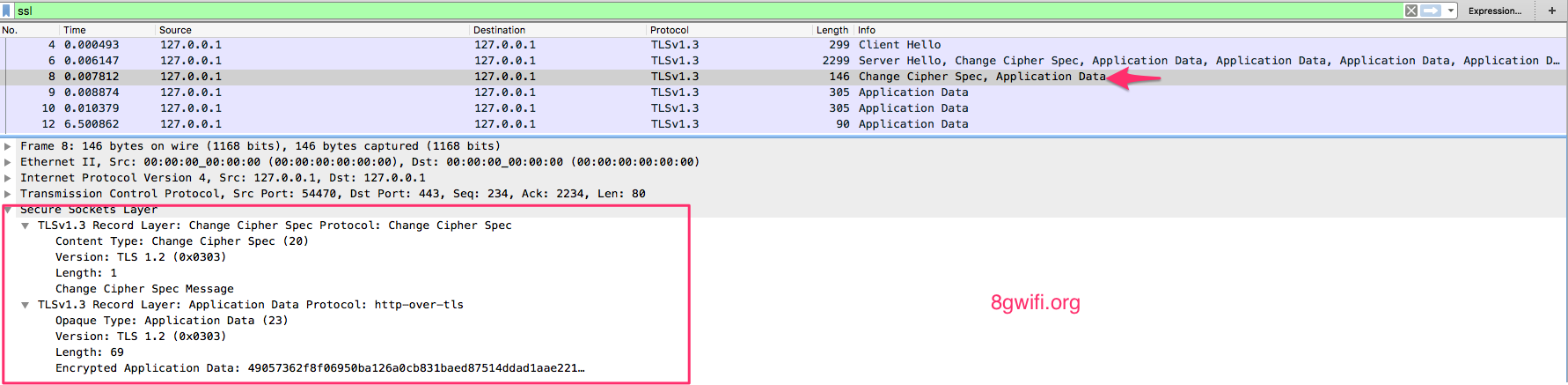
- Upon receiving the server’s messages, the client responds with its Authentication messages, namely Certificate and CertificateVerify (if requested), and Finished.
Ciphersuites
OpenSSL has implemented support for five TLSv1.3 ciphersuites as follows:
- TLS_AES_256_GCM_SHA384
- TLS_CHACHA20_POLY1305_SHA256
- TLS_AES_128_GCM_SHA256
- TLS_AES_128_CCM_8_SHA256
- TLS_AES_128_CCM_SHA256
openssl ciphers  -v | grep TLSv1.3
TLS_AES_256_GCM_SHA384  TLSv1.3 Kx=any  Au=any  Enc=AESGCM(256) Mac=AEAD
TLS_CHACHA20_POLY1305_SHA256 TLSv1.3 Kx=any  Au=any  Enc=CHACHA20/POLY1305(256) Mac=\
AEAD
TLS_AES_128_GCM_SHA256 **TLSv1.3** Kx=any  Au=any  Enc=AESGCM(128) Mac=AEAD
Start the TLS1.3 server in openssl
The forthcoming openssl 1.1.1-pre9 (beta) release has included support for TLSv1.3.
openssl command to start the tls1.3 server
Connect to TLS1.3
The openssl command to connect to tlsv1.3.
Browser Support
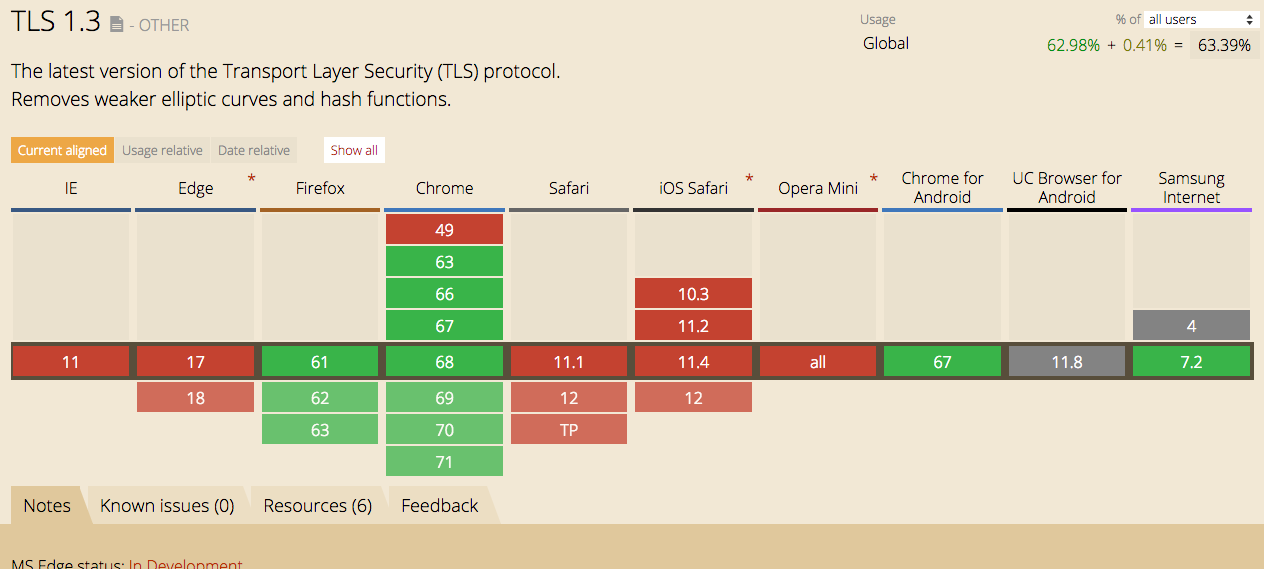
Checkout the browser compatibility for TLS 1.3 here : https://caniuse.com/#feat=tls1-3