Part 1: The Retrospective
source: twitter
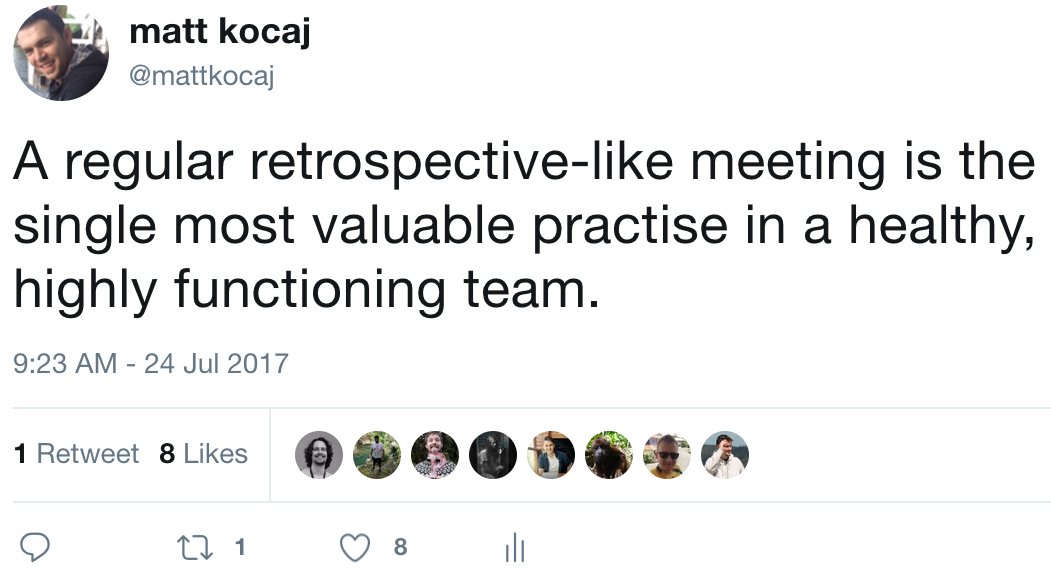
If you only implement one thing from this ebook, make it this: launch a Retro (Retrospective) meeting in your team. The core mission of a Retro is to “inspect and adapt” the agile process over time as a team. This is how you do it:
-
It should be a regular meeting which is given priority by all who attend.
I’m not a fan of meetings, with few exceptions - this is one. This is the single greatest asset your team has, whether using an agile process or not. Everyone should make the time and respect the time of others. You’re not going to magically have this buy-in from all team members. You need to take them on a journey. Over time they will value it and therefore respect the time slot. Shoot for once every two weeks if you can. I’ve found that works best. Weekly is hard for new teams and longer than every 4 weeks can wear away at the trust that we’re trying to create. - Invite everyone from your Dev/Build Team: testers/QA, Project Managers, leads, key users/SMEs, architects, designers, product owners, developers and other stakeholders who you can get along. Provided this list is not 50 people long, you should manage with anywhere from 3 up to 25 in a Retro no problems.
-
Ensure that it’s a safe place and a democratic environment.
Someone will have to facilitate or drive the meeting, and it looks like it’s you again. But over time I suggest you rotate that responsibility around the group. Not everyone will want to do it, but it’s important you try. I’ve seen even the most shy personalities give the Retro facilitation “a shot” after months of meetings.
The key here is to build trust. It’s building trust first in the Retro, and then the things the Retro stands for: flat hierarchy, team decision making, actionable changes, leadership/management buy-in, experimentation, testing with data, and most of all: human-centric collaboration. Until Skynet writes all the line-of-business/enterprise software, it will be humans creating these things so the emphasis should be on fostering an environment where people can work together, and if you’re really lucky, even like each other! -
Ensure that actions are acted upon and a follow up is conducted each meeting.
As you’ll see below in the quick playbook, each Retro should produce zero or more actions. These are usually tasks expressed as Chores (outlined later) on your backlog and generally assigned before the Retro meeting is over. Distribute the responsibility of enacting the Retro’s decisions around the group. Everyone should take part over time in carrying out the decisions of the meeting. The point is not to place blame, but for the team to support each other and find ways to clarify, assist, break up or redefine the priorities as necessary. As you mature you’ll notice sometimes you don’t have any actions: that’s fine, but try to encourage the discovery of actions, even small. Sometimes tasks will “roll over” from meeting to meeting without a resolution - this might mean it’s not really that important, or simply a hurdle the team needs to work around some other way. Remember, your agile process is about finding ways to do things better: inspect and adapt. -
Try an experiment.
When a challenge arises or there is some question of “is there a better way?”, invite ideas and allow members to propose solutions. Experimentation is at the heart of agile so try to identify how an idea can be tested. Can one time-box a Spike (short investigation that uncovers more information) of a new way of doing something and report on the findings next Retro? Or perhaps, can the group alter slightly their process or workflow for a potentially better outcome? Review the experiment at the next meeting. Not everything needs qualitative data to support it. A “gut feel” is often validation enough given a quorum.
A great tool to help with structuring Retros is Retromat. Play around with this tool. It will soon become clear what you’re trying to get from a retro and how you can go about it. You may not need all of the components the tool suggests.
Questions and Actions
- There is only one action and one question for this section. The action is schedule a meeting and have your first Retro. The question is this: did you do it?
It’s time to put this playbook to real work now. You should be able to convince your leaders to allow a “once off” meeting as an experiment into team building and innovation. You’ll get credit for trying and no boss wants to hear how her subordinate manager turned down an opportunity to “innovate”. If you can gain momentum here with a regular Retro, then you’re on your way to building trust which will set the stage for implementing the beginnings of a meaningful agile process.