The End
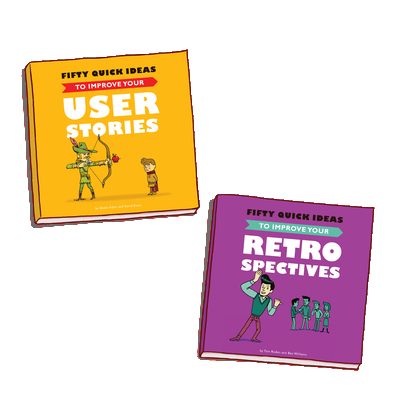
This book is part of a series of books on improving various aspects of iterative delivery. If you like it, check out the other books from the series at 50quickideas.com.
Authors
Gojko Adzic is a strategic software delivery consultant who works with ambitious teams to improve the quality of their software products and processes. Gojko won the 2012 Jolt Award for the best book, was voted by peers as the most influential agile testing professional in 2011, and his blog won the UK Agile Award for the best online publication in 2010. To get in touch, write to gojko@neuri.com or visit gojko.net
David Evans is a consultant, coach and trainer specialising in the field of Agile Quality. David helps organisations with strategic process improvement and coaches teams on effective agile practice. He is regularly in demand as a conference speaker and has had several articles published in international journals. Contact David at david.evans@neuri.com or follow him on Twitter @DavidEvans66
Tom Roden is a delivery coach, consultant and quality enthusiast, helping teams and people make the improvements needed to thrive and adapt to the ever changing demands of their environment. Tom specialises in agile coaching, testing and transformation. Contact Tom at tom.roden@neuri.com or follow him on Twitter @tommroden.
Bibliography and resources
- Fifty Quick Ideas To Improve Your User Stories by Gojko Adzic and David Evans, ISBN 978-0993088100, Neuri Consulting 2014
- Domain-Driven Design: Tackling Complexity in the Heart of Software by Eric Evans, ISBN 978-0321125217, Addison-Wesley Professional 2003
- How Google Tests Software by James A. Whittaker, Jason Arbon and Jeff Carollo, ISBN 978-0321803023, Addison-Wesley Professional 2012
- More Agile Testing: Learning Journeys for the Whole Team by Lisa Crispin and Janet Gregory, ISBN 978-0321967053, 978-0321967053
- Lessons Learned in Software Testing: A Context-Driven Approach by by Cem Kaner, James Bach and Bret Pettichord, ISBN 978-0471081128, Wiley 2001
- Explore It!: Reduce Risk and Increase Confidence with Exploratory Testing by Elisabeth Hendrickson, ISBN 978-1937785024, Pragmatic Bookshelf 2013
- A Practitioner’s Guide to Software Test Design by Lee Copeland, ISBN 978-1580537919, Artech House 2004
- The Checklist Manifesto: How to Get Things Right by Atul Gawande, ISBN 978-0312430009, Picador 2011
- Simple Testing Can Prevent Most Critical Failures: An Analysis of Production Failures in Distributed Data-Intensive Systems by Ding Yuan, Yu Luo, Xin Zhuang, Guilherme Renna Rodrigues, Xu Zhao, Yongle Zhang, Pranay U. Jain, and Michael Stumm, University of Toronto, from 11th USENIX Symposium on Operating Systems Design and Implementation, ISBN 978-1-931971-16-4, USENIX Association 2014
- User Story Mapping: Discover the Whole Story, Build the Right Product by Jeff Patton, ISBN 978-1491904909, O’Reilly Media 2014
Useful web sites
Access these links quickly at http://www.50quickideas.com
- Fifty Quick Ideas discussion group
- QUPER web site
- Chaos Monkey Released Into The Wild, by Ariel Tseitlin 2012
- Improving Testing Practices at Google, a conference report on Mark Striebeck’s presentation at XPDay 2009 by Gojko Adzic
- The Forgotten Layer of the Test Automation Pyramid by Mike Cohn, 2009
Legal Stuff
Title: Fifty Quick Ideas to Improve Your Tests
Print ISBN: 978-0-9930881-1-7
Published On: 15. May 2015.
Copyright (c) Neuri Consulting LLP
Authors: Gojko Adzic, David Evans and Tom Roden
Copy-editor: Marjory Bisset
Design and layout: Nikola Korac
Published by:
Neuri Consulting LLP
25 Southampton Buildings
London WC2A1AL
United Kingdom
Many of the designations used by manufacturers and sellers to distinguish their products are claimed as trademarks. Where these designations appear in this book, and the publisher was aware of a trademark claim, the designations have been printed with initial capital letters or in all capitals. The author has taken care in the preparation of this book, but makes no expressed or implied warranty of any kind and assumes no responsibility for errors or omissions. No liability is assumed for incidental or consequential damages in connection with or arising out of the use of the information or programs contained herein. All rights reserved. This publication is protected by copyright, and permission must be obtained from the publisher prior to any prohibited reproduction, storage in a retrieval system, or transmission in any form or by any means, electronic, mechanical, photocopying, recording, or likewise.