Learning To Feel (and Control) Your Body
These are some basic techniques that can make learning to feel and control your body easier (and more enjoyable).
A sample pose is included to show how these techniques can be applied in an actual yoga pose.
Direct Your Awareness
When doing the poses, or actions, direct your awareness.
Your body provides you with information, and if you look in the right places, think “gas gauge, speedometer, rev counter”, you can access that information.
As an example, when teaching balance poses a starting point can be feeling the point where you body contacts the earth. (You can then use that connection to feel where your center is.)
If lengthening the spine then focus on feeling the ribs and pelvis or head and ribcage.
Use Rhythm to Feel your Body
Most exercises will have a rhythm which can make doing them feel good.
That same repetitive rhythm is a chance for you to learn to feel your body and understand what it is telling you.
A hint that you’ve found the right rhythm is that you stop thinking or think less.
Notice Differences in Sensation
So that the exercises are easy learn and do they are broken down into steps.
Repeat the steps slowly and smoothly.
Each step is clearly defined, but also each step can be felt. So rather than blending them all together, first do each step, one after the other, clearly and distinctly and feel each step.
Feel the difference between each step. Then once you can feel the difference then work at combining those steps.
And that actually is a guide to how many repetitions you should do of each exercise. Practice until you get relatively smooth. Practice to the point where you can feel each step. And practice while it still feels good. Take rests when you need to.
Feel the Number of Repetitions
I rarely count sets or repetitions. I just stop when I’ve had enough or when I’m done. But if you are driven by the desire to count, the count. Do 3, 5 or 10 reps or more if you choose. And recognize when your body is telling you to stop.
Where there is the possibility to go deeper or higher, but you feel stuck on unable, work at gradually going deeper or higher. And rest when you need to.
Sample Pose: Janu Sirsasana
The pose below is called Janu Sirsasana.
It’s a forward bend (and so you could use a pose like Table Top as a counterpose since it is a backwards bending yoga pose.)
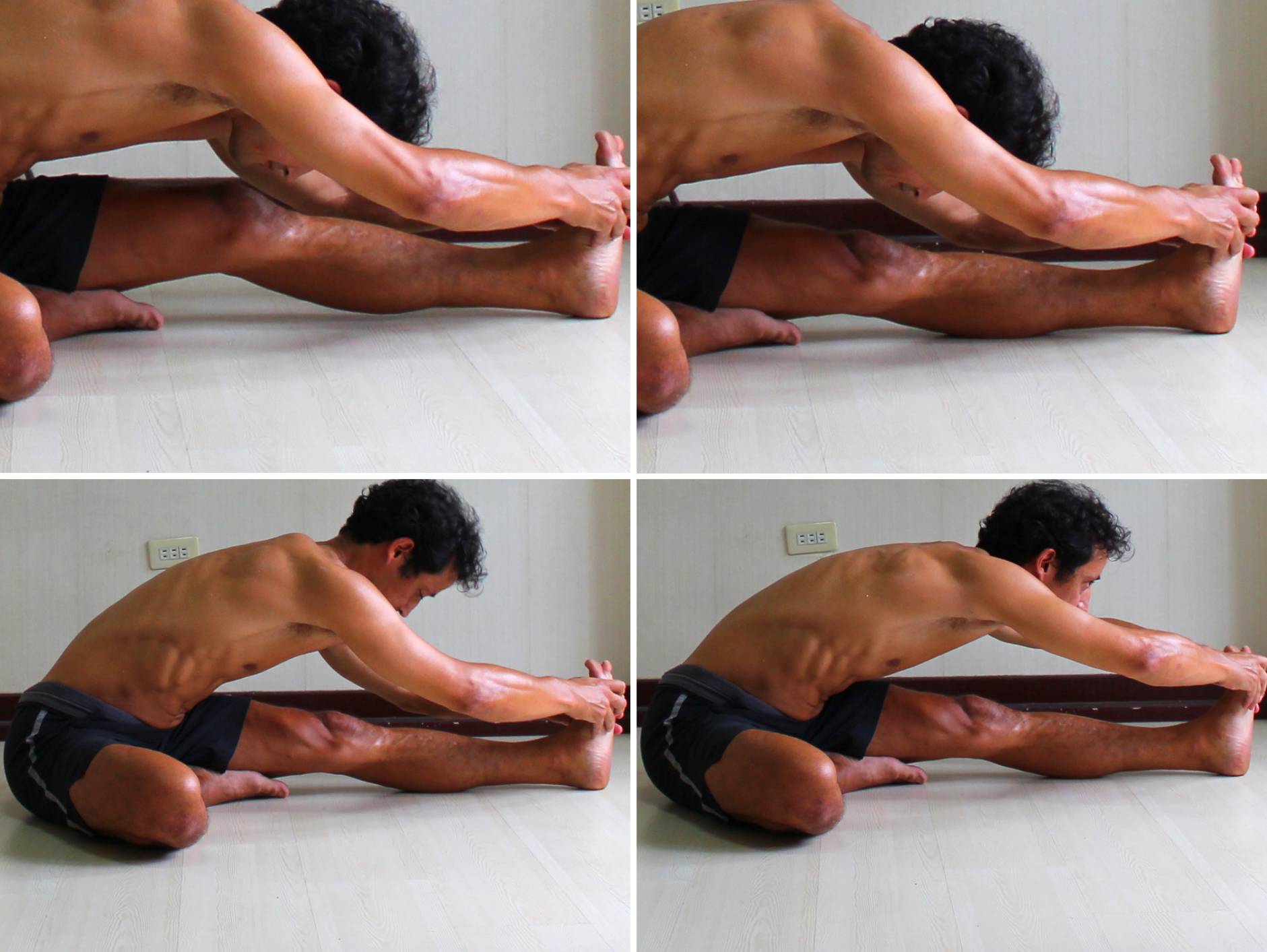
1. Relaxed.
2. Lengthen leg
(notice the smaller gap beneath the left knee.)
3. Lengthen spine.
4. Pull up on the leg with the arms.
The steps I often use to teach this pose, once the body is in the starting position are:
- Press the straight leg down,
- Lengthen the spine,
- Pull up with the arms,
- Relax and repeat.
Pressing the leg down can be done slowly and smoothly. And while doing so you can focus on feeling the leg. You can notice the bottom of the leg pressing into the earth or you can notice the muscle tension that causes the leg to press into the earth.
If you are not sure where that muscle tension comes from then practice pressing your leg down and relaxing it a few more times. Do it slowly. Imagine crushing something beneath your thigh as you press down.
See if the repetition helps you to better notice the changes in sensation.
For myself I feel the tension in the back of the thigh. You may feel it somewhere different. You may also be able to “move” that tension.
For now just notice it as you activate and release.
As for lengthening the spine, well that’s actually one of the first exercises. Rather than going forward, focus on reaching the ribs and head away from the pelvis. That’s one way to make your spine long.
As you move your ribs away from your pelvis, can you feel the sides of your waist lengthen? If not, then practice activating and relaxing and see then if you can feel it lengthening. Likewise with your neck.
Pull your ear holes away from your shoulders to make your neck long. Or pull the back of your head away from your ribcage.
In both cases lengthen slowly and smoothly. Relax slowly and smoothly.
As for pulling up with the arms, grab onto the sides of the foot or the ankle, or use a towel or strap if you can’t reach.
Keep pressing down with the leg, keep the spine long, then use the arms to pull upwards on the foot or ankle.
Then relax and repeat.
While relaxing, let your ribcage slowly sink down with gravity. Relax your arms, relax your leg. Then smoothly repeat, press down with the leg, lengthen the spine, pull up with the arms.
You may notice that as you pull up with your arms your ribcage sinks down. And that’s the idea.
Integrate
Once you can feel each of the individual actions, then integrate them. Or try to vary them.
Going back to the Janu Sirsasana example: try lengthening the spine first, then press down with the leg then pull up with the arms.
What happens if you don’t press the leg down? What happens if you don’t lengthen the spine?
The better you are at feeling or sensing your body the better you can decide for yourself at any given time what is good to do and what isn’t.
It’s a little like driving a car when you know one of your tires is low on air. You drive slowly and carefully until you get to the gas station so that you can fill the tire up. But of course you had to notice the tire was low on air in the first place.
That’s where sensitivity and awareness comes into play.
Once you’ve played around with different ways of sequencing the steps, see if you can blend the steps together so that they turn into one smooth action. Practice this “integration” step, and if you have any problems, then isolate the problem area and practice it in isolation.
Then re-integrate.