Counterpose (For Balance)
Although the exercises can be done all in one go as a “yoga practice session” in the order given, I’ve included information on how you can pair these exercises together so that you can do those exercises in isolation and still finish with your body in a “balanced” state.
Some exercises don’t need a balancing counter pose, they are self balancing. But for those that aren’t I’ve included why two poses are balancing so that as your repertoire of poses increases you can figure out how to balance those poses or actions.
Ideally, with practice you’ll learn to feel your body (that is after all the goal) and you’ll notice how your body feels after each pose and after each workout.
You’ll begin to feel what your body needs without having to specifically think about counter poses.
But for now, do learn to think about and understand what poses balance each other.
In the pictures below, can you see why Downward Dog and Table Top Pose might be complimentary?
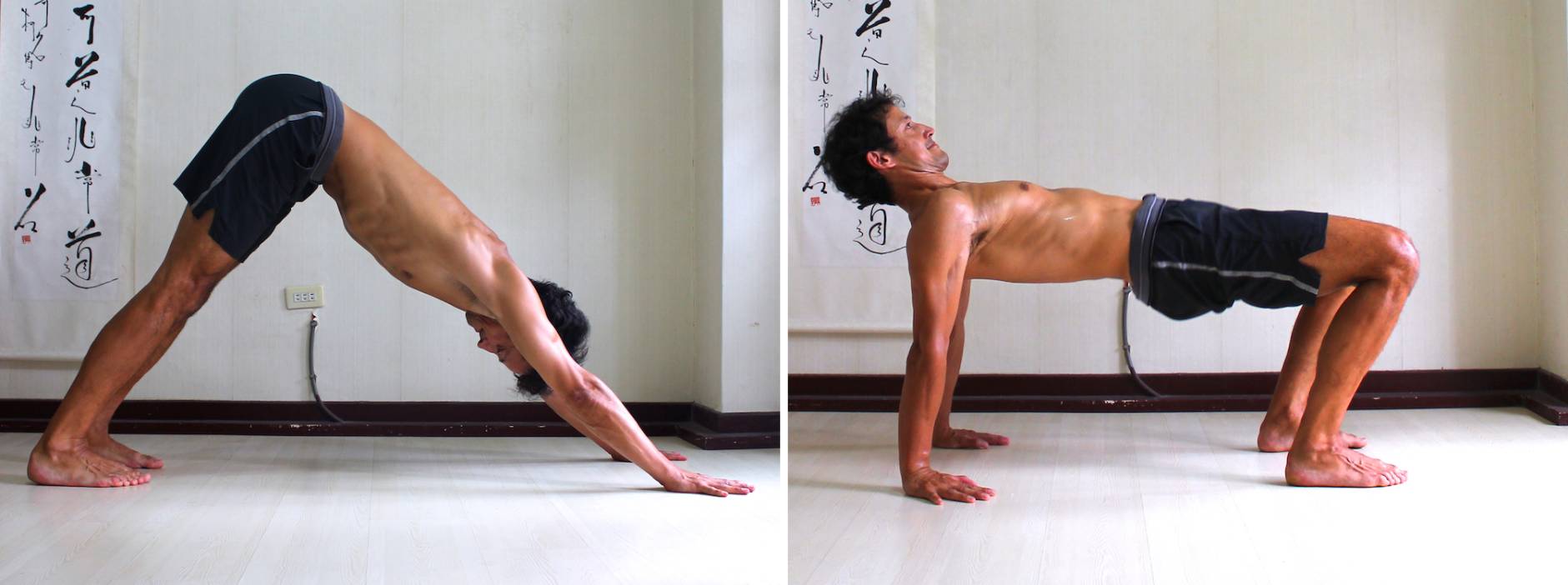
1. Down Dog
(Arms Up and Over the Head).
2. Table Top Pose
(Arms “Behind the Back”)
- One is the position of the arms. In downward dog the arms are “up and back.” In table top they are behind the back.
- Also in downward dog the back of the hips are open. In table top the front of the hips are stretched.
- Also, you could say that one faces upwards while the other faces downwards.