Basic Principles for Driving Your Body
Here are some of the basic principles you can apply when learning to drive your body.
Create Length
If ever you are stuck for what to do in a yoga pose, then one thing you can always fall back on is creating length in your body, least of all in your spine.
More often than not my reference for lengthening the spine is the pelvis. Move the ribs away from the pelvis. then move the head away from the ribs.
If you have trouble with this then practice by repeatedly lengthening and then relaxing.Â
Use Clear References
Use clearly defined references.Â
As an example, if you are trying to lengthen the spine then you can try lifting the ribs and moving the head upwards. However, these instructions work only in an upright situation.
An equivalent instruction set could include “moving the ribs away from the pelvis” and “moving the head away from the ribcage.”
In the first instance the pelvis is the reference. In the second instance the ribcage is the reference.
Clear references can help make movements easier to understand and do since they help you figure out in which direction you are trying to move the parts of your body.
Use The Ground Effectively
Another important part of this set of lessons is learning to use the ground.
The ground resists and that resistance is something we can learn to use to make doing yoga poses easier. It also provides a foundation for muscle actions that we can control and feel.
Covered in this book, the particular yoga poses where we can benefit from learning to feel and use the ground include downward dog, chaturanga dandasana, upward dog and wheel pose.
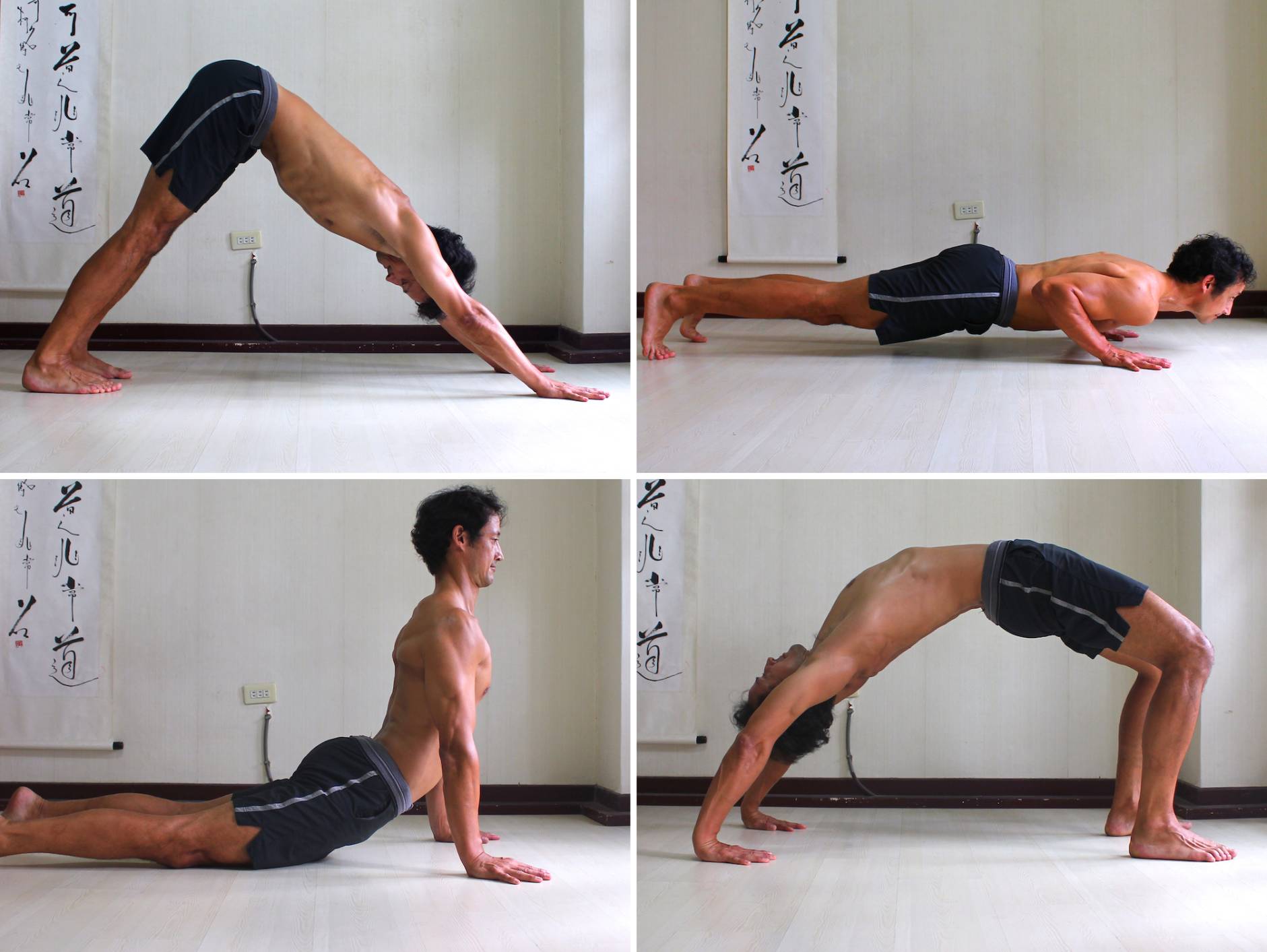
1. Downward Dog.
2. Chaturanga Dandasana.
3. Upward Dog.
4. Wheel Pose