The Queen of Earth
The centuries turn like a great wheel, and Tainn rides it.
She lives in the gold light of the rejuvenation chambers that Mock has had built for her, hidden deep in a cliff, and she is always twenty-five, always beautiful, always calm. Her children grow old and die. Her children’s children grow old and die. She stops counting, and then she stops weeping, and then she stops naming the babies after the people she has lost, because there are too many names and not enough babies.
Her descendants spread out across the land like water from the canals. They go south, to the great cities of the jungle, where they become priests and astronomers and advise kings on the movements of the stars. They go north and east, building great houses of stone in the canyons, aligned to the rising of the sun and moon in ways that will puzzle scholars for a thousand years. In every land they carry the Araxon tongue in secret, and they carry the Three Steps, and they send their reports back, generation after generation, to the woman who never grows old and the Overseer under the red mountain.
The people of the valleys have many names for her. The Woman of the Rain. The White Mother. The Turquoise Lady. In the far south, carved in stone on the side of a temple, there is a picture of a woman in a long robe standing beside a great serpent with many arms. The priests say she is the Queen of Heaven. Tainn has seen the carving. She thinks the serpent looks nothing like Mock. Mock thinks it is an excellent likeness.
She is, without ever claiming the title, the Queen of Earth. Or at least the queen of the half of it that matters to Araxon. Kings kneel to her messengers. Wars start and end with her word. And she is careful, so careful, never to forget that she rules only because Mock allows her to.
Then, in what the far future will call the year 1225, Mock summons her into the red mountain on a night that is not the harvest moon.
“The Council wishes to honor you,” he says. “In person. On Araxon. You will be the first specimen in the history of the Blue World Program to receive the Order of the Fold. It is a very great honor.”
Tainn studies him. In nine hundred years she has learned to read the coiling and uncoiling of his lower segments the way her father read the trail of a deer.
“You are sending me the slow way,” she says.
“The fold engines are reserved for the fleet,” says Mock smoothly. “Honored guests travel on the pilgrim ships. It is tradition. Close to the speed of light. For you, the journey will take only a few years. For this world…” He spreads his many arms. “Somewhat longer.”
“How much longer?”
“Eight hundred years, perhaps.”
So that is it. She has grown too strong. Her descendants are everywhere, and they love her more than they fear the Overseer, and Mock, who has waited fifteen thousand years to be number one, has no intention of becoming number two again. He will not kill her. The Council would ask questions. He will simply send her away, with honor, into the slow river of time, and let the world forget her.
“I accept,” says Tainn. “It is a very great honor.”
Because what else is there to say? She learned on the dark ship, long ago, that a girl alone has nothing to bargain with but herself. She is not a girl anymore. But she is still alone.
The pilgrim ship is slow and quiet and beautiful, with gardens under glass, and for the few years of the voyage Tainn reads everything in its libraries. She reads the histories of the thousand worlds of the Araxon empire. She reads the Three Steps, and the Hundred Laws, and the long, dull, terrible records of a billion years of conquest. And when at last she arrives on Araxon and receives the Order of the Fold before the Council, in a hall so large that clouds form under its ceiling, she asks for only one thing in return: to see the Hall of Failures.
It is a small, dim room. There are three exhibits, three dead worlds. In the center, on a pedestal, behind a field of light, there is a small carved stone with a spiral cut into it.
Tainn stops breathing.
She knows that spiral. She has known it all her life. It is cut into the face of the bluff above her village, beside the hand prints and the horned figure with lightning coming from its fingers and the great bird whose wings stretch across the stone. The bird the first Shaman painted, who flew to the stars and came back.
“It was found on a dead ship at the edge of the galaxy, a hundred million years ago,” says her guide, an old, old Araxon teacher with a kind voice. It is Kiv. “The crew had been killed. Their spines were broken. The ship’s records said only that they had taken specimens from a small blue world, and that one specimen could fly without wings.”
Kiv looks at Tainn.
“I always wondered,” Kiv says softly, “why the Council chose your world, of all the worlds. The records of the old dead ship were lost long ago, all but the stone. No one remembered which small blue world it was. But I think, perhaps, the stars remember. I think, perhaps, your world has done this before.”
Tainn says nothing. But on the long slow voyage home she does not read. She sits in the glass gardens and looks at the stars and thinks about a boy on a bluff, and a knife the color of honey, and a voice saying: Now you must protect them.
Mountains of Central Arizona AD 2046
The pilgrim ship lets her down in the valley at night, quietly, and is gone.
She does not recognize the land. The valley is crossed by a black road on which carriages without horses race by, lit with fierce white eyes. On the horizon, where the red mountain used to stand alone, a city glows orange against the sky, a city larger than all the cities of the jungle put together. The canals her people dug are still there, buried under concrete, still carrying water. On the top of the red mountain there is a great white dome with a slit in it, pointed at the stars.
She has seen enough of the Araxon empire to recognize its handwriting. The Third Step is nearly complete.
It takes her a week to learn how the new world works. It is easier than learning the worm language on the dark ship. It is a world of machines that do almost every task, a world that is slowly growing soft, the way the Kakars grew soft. Its people carry little glowing windows in their hands and look into them all day, and the windows tell them what to want. The great companies that make the windows, and the great companies that make the food, and the great companies that own the land where the canals run, are owned by other companies, which are owned by still other companies, and at the bottom of all of them, like the roots of a tree spread through soil, there are names she knows. Her names. Her children’s names, carried down through forty generations. The Returned are still here. They have simply learned to wear suits.
And beneath the red mountain, under the white dome, in a hall carved deep in the stone, the Overseer is waiting.
She does not go to him. Not yet. First she goes to the bluff.
It is a park now, with a wooden fence and a sign that says PETROGLYPHS: DO NOT TOUCH, and a parking lot, and a small building that sells cold drinks. It is late afternoon and the parking lot is nearly empty. Tainn climbs the trail in her strange new clothes, blue trousers of heavy cloth and soft shoes, and finds that the rock paintings are still there. The spirals. The hand prints. The horned figure. The great bird.
A girl is sitting beside them.
She is twelve or thirteen, thin as a willow switch, with a long face and dark hair tied back, and she is sitting cross-legged on the warm rock where Dyami used to sit. Her eyes are rolled back inside her head. Her body sways gently, as if in a wind only she can feel.
Far above, an eagle circles broadly over the wide and shallow valley.
Tainn stands very still. She knows this face. She has seen it in the mirror for seventeen hundred years, softened and changed, and she has seen it on a bluff in winter with the sun on its cheeks, and she has seen it in a cold blue room with its eyes open. She and Dyami had the same grandmother. The gift was never only his. It was in the blood, sleeping, waiting, carried down through her son Dyami and his children and their children, all the way to here.
The girl’s eyes roll forward and focus. She looks at Tainn without surprise.
“You’re her,” the girl says. “The lady in the stories. The Turquoise Lady. My grandma says we come from you.” She tilts her head. “The eagle told me you were coming. He’s been telling me for a month. He says something else is coming too. Something from under the mountain. He says it’s hungry.”
“Hungry like a bear?” Tainn asks. Her voice does not sound like her own.
“Hungry like winter,” says the girl.
Tainn sits down beside her on the warm stone. For a long time neither of them speaks. The eagle circles. The shadows of the junipers stretch across the valley. On top of the red mountain, the white dome turns slowly, pointing its slit at the sky, and somewhere deep beneath it Tainn knows that a great patient creature is watching his instruments, and has seen, as the old captain once saw on the dark ship, a pattern of activity that should not be there. A mind that does not dream like a stone. A mind that dreams like a storm.
Mock will come for this girl. He will come smiling, with gifts and honors and a place in the gold light, the way he came for Tainn. And if the girl refuses, he will take her anyway. He has waited fifteen thousand years. He will not let a child stop the Third Step. Not again.
“What’s your name?” Tainn asks.
“Kai.”
“Kai. Have you ever heard a voice in your head, Kai? Like a hand on your hair?”
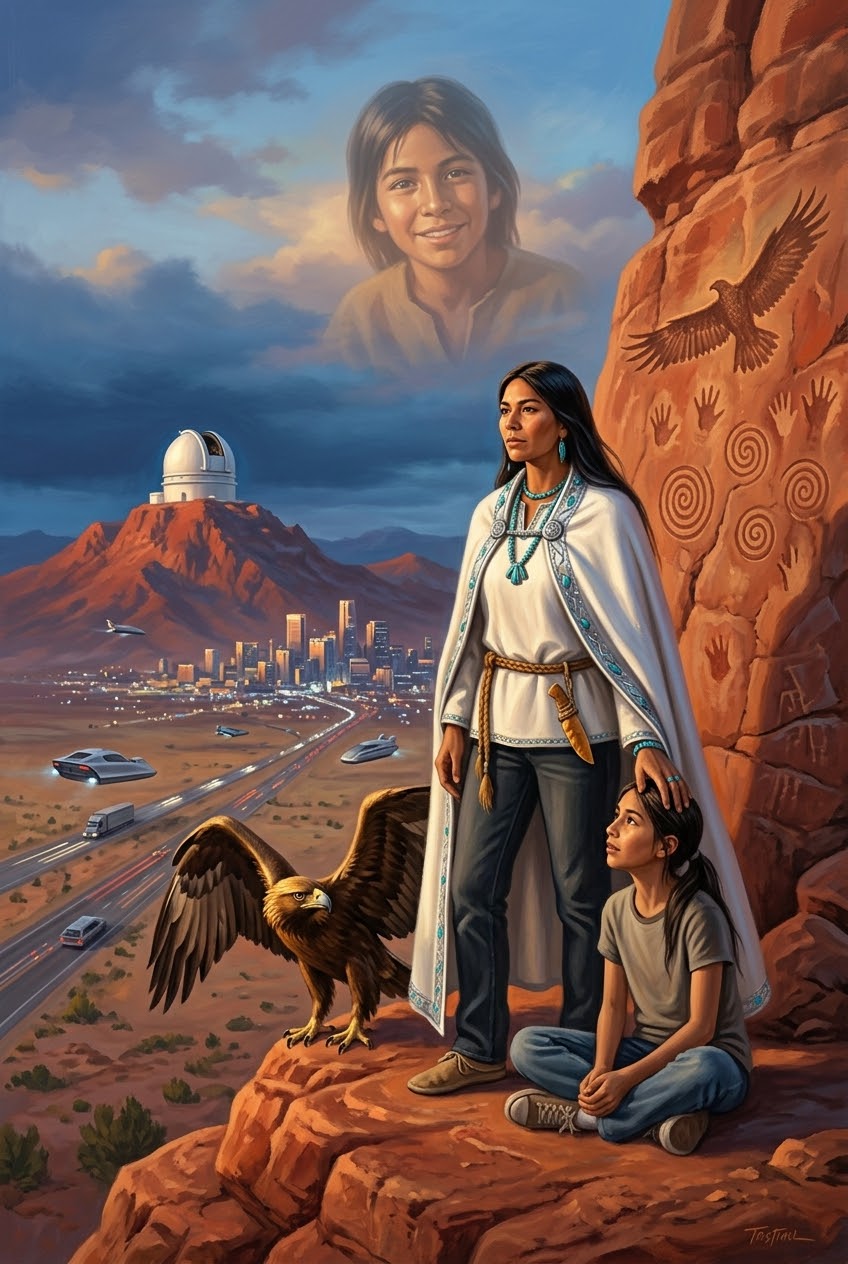
The girl’s eyes widen. “Sometimes. When I fly really far. A boy. He says he’s been waiting for me. He says he’s been waiting a really long time.” She frowns. “He says to tell you something. He says he forgives you. He says he always did. He says it was the right thing, then. But now it’s time for something different.”
Tainn closes her eyes.
For a moment she is sixteen again, kneeling on the cold floor of the conditioning room with a boy’s head in her lap. For a moment she is every age she has ever been, every bargain she has ever made, every year in the gold light, every child she has buried. She did what she had to do to survive. She did what she had to do so that her people would survive. She does not regret it. But she has survived long enough, now, to choose something else.
She knows the Araxon tongue better than any human who has ever lived. She knows the Three Steps and the Hundred Laws. She knows where the rejuvenation chambers are hidden, and how the stillness field works, and how a ship’s mind can be spoken to as if it were alive. She knows that the Overseer is old, and alone, and very far from home. And she knows that a hundred million years ago, on the edge of the galaxy, a ship full of Araxons took a specimen from a small blue world, and the specimen came home, and the ship did not.
Tainn reaches into the crack in the rock beneath the painted eagle’s wing. Her fingers find dust, and stone, and then something smooth and cool. She draws it out. Her grandmother’s flint knife, the color of honey held up to the sun, exactly where she left it more than sixteen hundred years ago.
She brushes it clean and ties it to her belt.
“Kai,” she says, “I am going to teach you everything I know. And you are going to teach me how to fly.”
“Why?” asks the girl.
Tainn, Speaker of the Returned, Woman of the Rain, Turquoise Lady, the oldest human being on Earth, looks out over the valley where she was born, toward the red mountain and the white dome and the hungry thing waiting underneath it. The eagle turns one last lazy circle overhead and settles on the rock beside them, folding its great wings, watching her with golden eyes.
“Because I was a servant of Araxon for a very long time,” she says. “And now I am the Queen of Earth.”
She puts her hand gently on the girl’s hair.
“And I protect my family.”
THE END