Planet Araxon: 100,000,000 BC Earth Time
The children are going on a field trip today, a combined journey to the upper atmosphere for sunlight and a visit to the Conquest Museum and Zoo.
On Araxon, sunlight is a treat. The planet is heavy, three times the pull of most worlds, and its air is thick and hot and wet near the ground, a brown fog that the Araxon people have lived in for a billion sun cycles. Their bodies are built for it: long and segmented, thick-skinned and pitted, rippling with muscle, with a fringe of thin jointed arms running down each side like the legs of a centipede. They can lift ten times their own weight. They can survive a fall that would turn most creatures in the galaxy into paste. And they can live, with the help of the rejuvenation chambers, for a very, very long time.
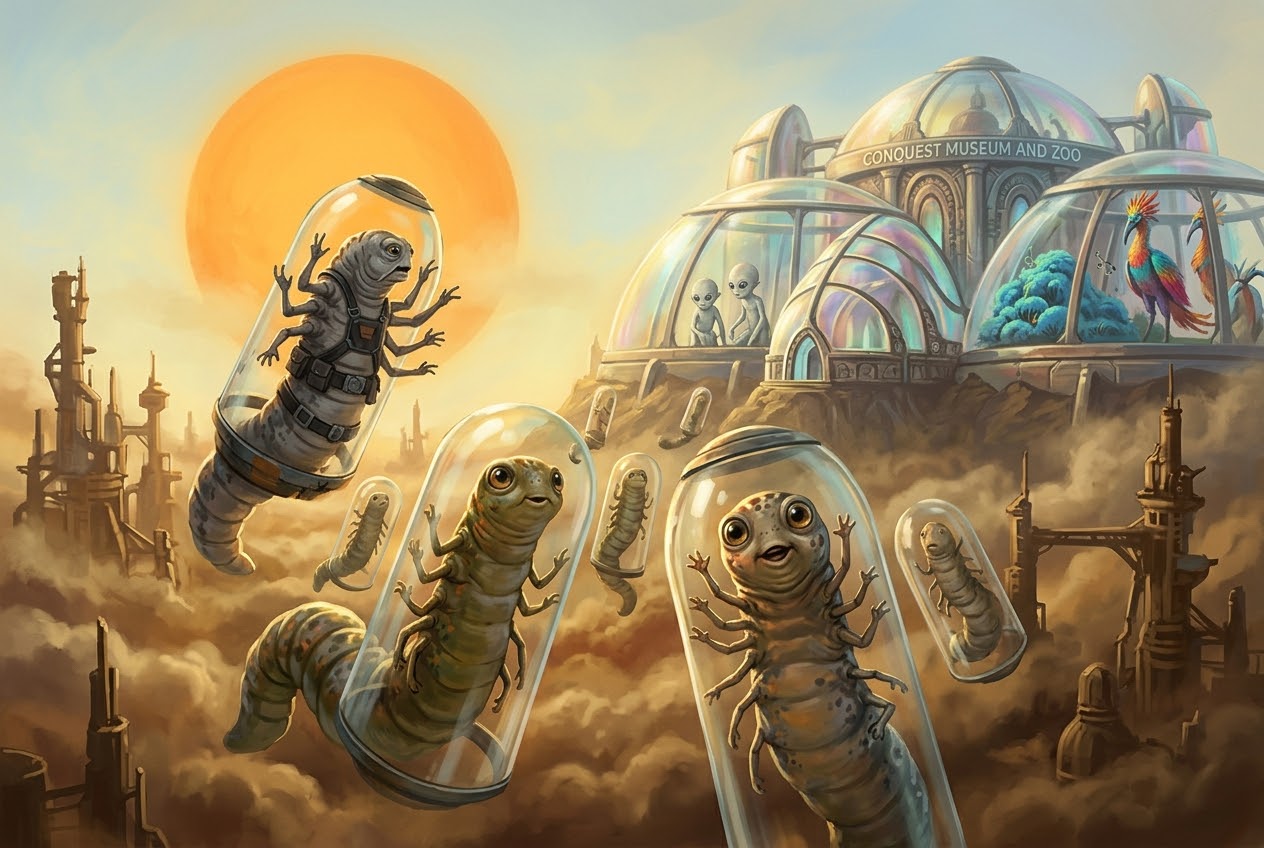
The eager youngsters slither into their clear transport tubes. The tubes hum and rise on columns of pressurized air, carrying them up and up through the brown fog until, all at once, they break into clear sky and the light of the great orange sun falls on them. The children squeal and press against the walls of the tubes, soaking it in. Teacher Vossk, who has made this trip ten thousand times, allows them a few moments of joy before he clacks his mandibles for attention.
“Remember why we come here, little ones,” he says. “Not for the sun. For the lesson.”
The museum and zoo are built on a mountain plateau at high elevation, where the gravity is a little lighter and the air a little thinner, to avoid harm to the live specimens harvested from other worlds. Most specimens are frail. Most specimens break.
The children first go to the zoo. Behind walls of clear hard material they see the soft peoples of the galaxy: the Kakar, slender and pale, with big wet eyes, sitting in a re-creation of a garden; the Tlu, who look like piles of blue moss and who sing when they are afraid; the Ormathi, tall feathered creatures who pace and pace and pace. Each enclosure is a copy of a home world in miniature, with its own air and its own light and its own pull of gravity.
“Who can tell me the Three Steps of Conquest?” asks Vossk.
A small Araxon named Zell waves twelve of her arms at once. “First step: collect a seed of sentient creatures from the planet. Second step: absorb them into Araxon culture for many generations, until they love us. Third step: return the conditioned descendants to their home world, so they can rule it for us.”
“Very good, Zell. And why do we not simply destroy them with our ships?”
“Because a dead planet pays no tribute,” the children chant together.
“And because,” Vossk adds, “a people conquered by force will always rise against you. But a people who are ruled by their own grandchildren will never even know that they are conquered. They will think it was their own idea.”
This process has been refined over a period of more than one billion sun cycles, and the excited children understand the importance of their future contribution. With faster than light travel, the Araxons are the only race in the galaxy to have achieved undisputed dominance. Araxon scientists estimate that they have most sentient species in the galaxy under their control, and they are almost halfway through a 100,000 sun cycle technology upgrade that will allow their people and their control to spread to neighboring galaxies, establishing new home worlds.
At the end of the visit the children enter the Hall of Failures. It is a small, dim room, and most adults do not like it. There are only three exhibits. Each one is a world that resisted. Each one is now a cinder. In the center of the room, on a pedestal, sits a strange object behind a field of light: a carved stone, small enough to fit in a hand, with a spiral cut into it.
“What is that?” asks Zell.
“No one knows,” says Vossk, and for the first time all day he sounds uneasy. “It was found on a dead ship drifting at the edge of the galaxy, a very long time ago. The whole crew had been killed. Their spines were broken. The ship’s records said only that they had taken specimens from a small blue world, and that one specimen could fly without wings.”
The children are quiet. Then Zell laughs, and they all laugh, because it is a silly story, and there are no creatures in the galaxy that the Araxons need to fear.
For each Araxon citizen life is good, and people are happy with their destiny.