My Tribe
Mountains of Central Arizona AD 317
Dyami sits alone on the bluff above his village. Since his parents died he spends too much time off on his own, and the people have stopped calling him back for chores. He is twelve winters old, thin as a willow switch, with a long face and eyes that seem to look at things just behind the things other people see.
He lets his breath slow. In trance state the wind blows hard against his face and he feels the neck feathers of the eagle that circles broadly over the wide and shallow valley. The eagle sees that the people have killed a deer and are preparing to eat it, so Dyami sees it also: the small brown shape on the flat rock by the dwellings, the women bent over it, the thin gray thread of smoke beginning to rise. Turning away, warm winds beneath strong wings, he soars between the ground and the heavens in the intermediary sky, the place his father called the Between, where time and space blend like two rivers meeting.
His father had been the Shaman of the people. Before the coughing sickness took him, he had told Dyami: “The Between is not a place for children. It is easy to fly out. It is hard to fly home. Always remember the way home.” Dyami remembers. He keeps a picture in his heart of the five buildings under the rock overhang, of the smoke stains on the ceiling, of his cousin Tainn’s laugh. That picture is the rope he uses to pull himself back.
Eyes closed, Dyami takes a rattling, old-man breath, too deep for so young a chest. His spirit sinks down into the sweet-smelling dust of the earth. He feels the blue bird nesting in the juniper above him, the off-beat rhythm of a daddy longlegs spider walking near his foot, the slow patience of the stone itself. The cycle of life is harmony, his father taught him, a tug-of-war between the wants of one person and the needs of the tribe. When the rope is pulled too hard by one side, it breaks, and everyone falls.
Down at the dwellings, Nodin has killed a deer. It is a small male deer, a yearling with button horns, but for today everyone will get enough to eat. Nodin stands with his arms folded, letting people praise him. He is the best hunter of the people and he has never let anyone forget it.
Tainn, daughter of Nodin, is a clever girl, sixteen winters old, quick with her hands and quicker with her tongue. She works with her small sharpened flint skinning knife while a cooking fire is started. The knife was her grandmother’s, the flint the color of honey held up to the sun, and she keeps it tied to her belt with a braided cord. She is happy since she has had no meat since the last moon, and her stomach growls loud enough that her aunt Tama laughs at her.
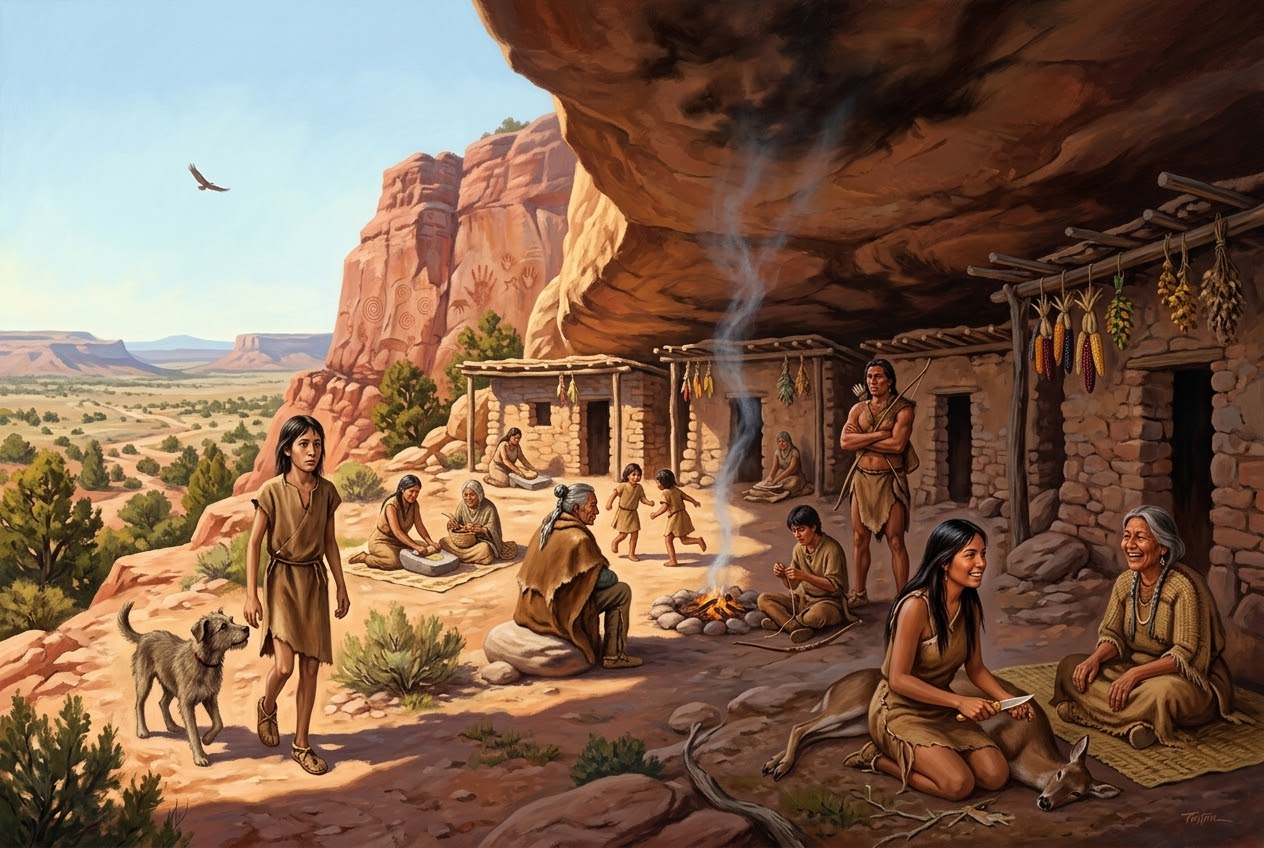
“Your belly sings like a frog in the rain,” Tama says.
“Then my belly should be fed before it sings any louder,” Tainn says, peeling back the hide in one long clean sheet.
She wants to finish quickly and go find her younger cousin Dyami to make sure he gets some food. Dyami is son of the dead Shaman, and she worries that he spends too much time in mind trance for a boy. Last winter he walked out into a snowstorm with his eyes rolled back and Tainn found him sitting cross-legged on a drift, smiling, his lips blue. She carried him home on her back. He had not even been cold, he said afterward. He had been with the wolves.
Up on the bluff, Dyami’s eyes are rolled back inside his head and his body sways as he sits by the rock paintings, trance dreaming, his mind in the transition point between waking and the Shaman’s trance. The paintings are old, older than the grandmothers of the grandmothers: spirals, hand prints, a horned figure with lightning coming from its fingers, and a great bird whose wings stretch across the whole face of the rock. His father told him the bird was painted by the first Shaman, who flew to the stars and came back.
Dyami can see his people building a meat cooking fire, or perhaps he can just smell the wood burning. Rousing himself, he stands on unsteady legs and starts back down to the five buildings under the rock overhang where his people live as a large extended family. The winter sun is low in the sky and shines on the walls, offering up a little warmth to the cool winter air. Corn hangs drying in braids from the roof poles. A dog with one ear trots over to sniff his hand.
At the sharing of meat, Nodin feels his hunter’s power and soaks in his own pride. He carves the meat himself, which is the chief’s right, not the hunter’s. The people notice. They glance at Tyee, who is chief, and then glance away.
Tyee is a gentle man, better at settling arguments over water rights than at leading a hunt. Nodin considers him, with some justification, to be a weak chief. To show this, Nodin gives Tyee’s nephew Dyami a very small share of the cooked meat, a piece of gristle no bigger than a thumb.
“For the boy who sits on rocks while men hunt,” Nodin says loudly.
Some of the young men laugh. Tyee’s face goes still. Yuma, Tyee’s son, begins to rise, his hand drifting toward his knife.
Trouble is, as usual, prevented by Nodin’s daughter. Tainn walks over and sits down beside Dyami and, without a word, tears her own large share in two and drops the bigger half into his bowl.
“A hunter feeds the people,” she says, not looking at her father. “All of the people. That is what makes him a hunter and not a fox.”
Nodin’s jaw works. He could strike her, but every eye is on them, and striking his daughter for generosity at a sharing would cost him more pride than the meat is worth. He grunts and turns away.
Dyami looks at the meat and then at Tainn. Although she is four years older than he is and almost an adult, she feels his power and respects it. She is the only one who does not look at him as if he were a strange bird that had landed among the chickens.
“You were flying again,” she says quietly.
“With the eagle. He saw your deer before your father brought it home.”
“It is not my deer. And you should eat before you blow away like a dry leaf.” She pokes his ribs. “See? Nothing but leaf.”
He smiles, which he does only for her, and eats.
That night, the people sit around the warmth fire and old Grandmother Nita tells the story of the Star People who came long ago, before the mountains were tall, and took the first children up into the sky. Most of the children shiver happily. Dyami does not shiver. He stares into the coals, and for a moment, just a moment, he sees something huge and dark crossing the face of the moon. Then it is gone, and it is only a story.