Preface
One aim of this book is to suggest an understanding of the term Life that may be acceptable and usable in a general way. A second aim is to summarise and recapitulate some general information about the phenomenon Life. You may agree to some of the statements of this book or you may not, but if it makes you thinking about the nature of life, then, writing it was worth its effort. The first five chapters are of a rather abstract nature and contain a number of different definitions as well as general descriptions of life. The last five chapters are of a more concrete nature and discuss a variety of different aspects of live. At the very beginning, however, I would like to address the following two questions.
Firstly, does it basically make sense to define the term Life in a general, objective way? The opinion exists that doing so is not a good idea. I think there are several reasons for this opinion.
a) We associate the term Life with a certain mystery and fascination, as we do for other terms as well, such as Soul or God. I think these associations have the same cause: all these terms are metaphysical and have a very personal meaning. However, different terms are metaphysical to different degrees as shown in the figure below. You may argue about the examples used there and you may find better examples for the gradients explained, but I think you will understand the basic statement: the term Life has two characteristics in medium degree: a metaphysical and a physical. In its physical characteristic it can be studied, analysed and described scientifically. In its metaphysical characteristic it may be better viewed by the means of humanities.
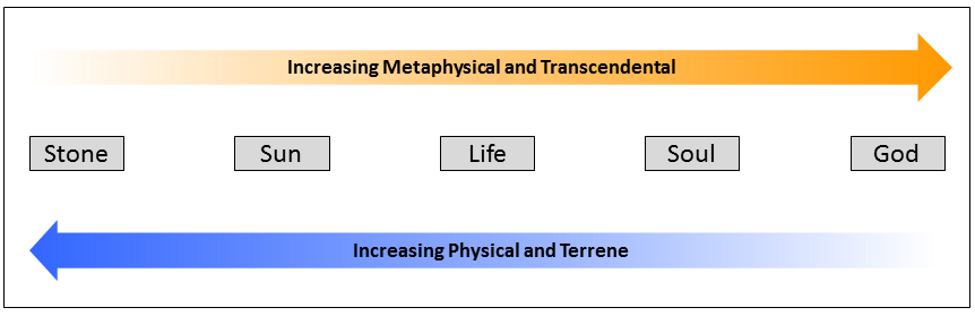
Terrene-Transcendental-Gradient with 5 arbitrary examples of different degrees.
b) Borderline cases are typical for many biological categories, mainly for phylogenetical ones. Such categories, formulated as definition or not, are cupboards in the intellectual world of human beings. There will always be cases that do not fit into existing cupboards: the borderline cases. However, they do not take sense and usefulness from building categories. In contrast, they are helpful reminders, that our categories are only an attempt to reflect reality, and that reality itself is something else, something more complex. The existence of borderline cases must not be a reason to avoid defining terms. A meaningful communication without definitions is hardly imaginable.
c) What would be the benefit of a common understanding and definition of Life? Probably not much. Obviously, teaching and research of life sciences and biology does well without. However, I wonder how such a huge amount of teaching and research in very different disciplines such as e.g. botany, neurobiology, biomechanics, genetics, socio-biology, ecology, medicine… can be hold together by a thin band consisting of no more than a couple of phenomena. For a better interdisciplinary collaboration and mutual understanding between life scientists as well as comprehension for each other, it may be helpful to share solid common ground: a concept of life in which all life scientists find their intellectual root.
d) A definition for a term does only make sense, if you understand the circumstance, the concept, which is named by this term. Currently, scientists of all disciplines do not have something like a theory of life, a general concept or commonly agreed idea what life actually is. This means, that we currently use of the term Life without a concrete or precise perception what we mean by it. Therefore, as soon as someone reckons to see a common concept in the various phenomena of life, then I think, trying to formulate a definition is highly appreciated.
Secondly, is it fundamentally possible to define the term Life in a commonly valid, objective way?
30 years ago when I was studying biology, I was taught that there is no definition of the term Life. The best scientists can do, is to list attributes that can be associated with life1. On the first glance that sounded plausible to me, because life is such a complicated thing. This statement remained logically to me also on the second glance: we know only one kind of life - the one of the biosphere of Earth. In contrast, science does know many different forms of mammals. There are mammals with and without fur, teeth and legs. There are ground bound, sea living and flying mammals. There are even mammals that lay eggs. Because zoologists know so many different kinds of mammals, they can precisely tell which the key attribute is that all mammals feature: they lactate their offspring. Unfortunately, biologists do know only one kind of life and, therefore, it is impossible for them to tell which of the attributes is essential for life. Possibly, scientists will not recognize exotic life if one day they meet lifeforms in a very different form than Earth life. Thus, to describe life, we cannot do better than to simply list attributes that are typical for animated beings, can we?
On the third glance, however, there may be indeed a way to conceive the very nature of Life. I like to put a new view into discussion that may lead to a better understanding of Life. It will not, of course, clear all the questions about life, but it may provide a generally acceptable and useful understanding and definition. Before I explain my idea, I would like at first to define the term definition, because definitions are the spine of this book and I want to make clear, how difficult it is to formulate a good definition especially for such a complicated thing as Life.
(Dear reader, you may imagine that the following chapters are rather theoretical. Right! The first part of this book represents a kind of mind gymnastics. If you don’t care much about definitions and abstract stuff, then, please, go ahead with chapter 6.