1. How to define the term definition ?
The first two of the following three definitions use a metaphor to illustrate the concept of a definition. A definition is a wall of words built to isolate a specific meaning from other meanings and from nonsense. Both definitions have the same shortcoming: they are too narrow because they only catch one of two important aspects. Definition 1.3 may be preferred because it combines the aspects of definition 1.1 and 1.2: a definition represents both a term and the idea behind this term (see also Figure 1.1).
1a An idea is the conception of a circumstance within the human mind.
1b A term is a name for an idea1a, respectively for the circumstance behind this idea.
These definitions are illustrated in the following figure:
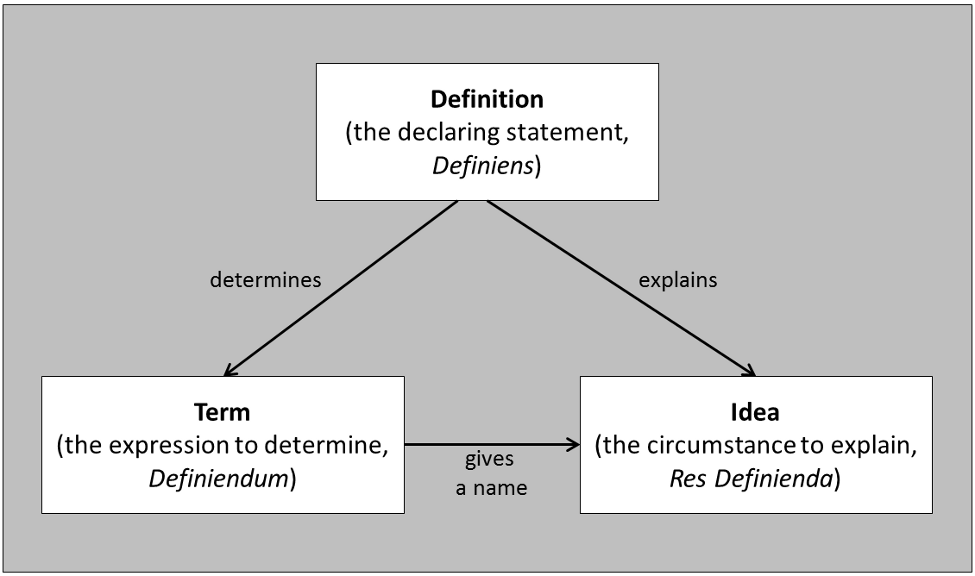
Figure 1.1: Relationship between a circumstance perceived, a term to name this circumstance and a definition to explain both.
When searching for a definition of life, a number of statements can be found on the internet, e.g.
Definition I: Life is “the period between birth and death.”2
This definition uses terms which only have a meaning if you already know what life is. The gain of this definition may be that life is not infinite. However, no ancestor of any living unicellular organism died, because these organisms undergo cell divisions and do not decay. In addition, this definition implies that embryos do not live.
Definition II: Life is an “organismic state characterized by capacity for metabolism, growth, reaction to stimuli and reproduction.”3
Here, the approach is applied to list attributes associated with life. However, life is not a state. To be alive is a state and life is the process that keeps alive.
Definition III: Life is “the condition that distinguishes organisms from inorganic objects and dead organisms…”4
In this definition life is explained by its opposite which is no help if you are searching for the very nature of life. The question remains unanswered what the essential difference between organisms and inorganic objects actually is.
Definition IV: Life is “a characteristic distinguishing objects having signalling and self-sustaining processes from those that do not.”5
This definition is scientifically useful, but it calls life a characteristic of objects. This focuses on individual organisms and misses to consider the aspects such as the biosphere or evolution.
Definition V: Life is “a self-sustaining system capable of Darwinian evolution.”6
This statement is known as the “working definition” of life used by the American space agency NASA. Although it is scientifically meaningful, it has its limitations - therefore called “working definition” by its originators. This definition calls life a system, but these animated systems (the organisms) are only the concrete implementation of life - they are alive - but life itself is a concept that is much larger. Individual organisms are not capable of evolution - they are very tiny parts of it.
These suboptimal examples illustrate how hard it is, to formulate a good definition for such a strange thing as life. The following chapters contain attempts to do better.